
The Astonishing Hypothesis: Complete Chapter-by-Chapter Summary
Welcome to the opening of our journey into the mind. Today, we're tackling one of the most provocative ideas in modern science: "The Astonishing Hypothesis," proposed by Francis Crick. As you see on this slide, this hypothesis suggests that our entire inner life—our joy, our sorrow, our memories, and even our sense of free will—is nothing more than the collective behavior of a vast population of neurons and their associated molecules.
Think about it: you are nothing but a bunch of neurons. This idea clashes with the ancient and deeply held belief that humans possess an immortal soul that survives death. For centuries, almost every culture and religion has assumed the soul is a real, non-physical entity, separate from the brain. But Crick argues that just as we no longer need the concept of a "flat Earth" or a divine creator to explain the solar system, we no longer need the soul to explain human behavior.
The reason this hypothesis is truly astonishing is that it challenges our intuition. We feel like we are watching our thoughts from a distance, as if there is a little "man inside" looking at a screen of images in our brain. But science tells us there is no little man, no camera, and no separate observer. Everything you see, think, and feel is generated directly by the electrical and chemical activity of your brain. It's a scientific search for the soul, but it concludes that the soul isn't a ghost—it's biology.

Imagine your mind not as a mystical soul, but as a bustling city of billions of neurons firing in complex patterns. The slide captures this perfectly: "You, your joys and your sorrows, your memories and your ambitions, your sense of personal identity and free will, are in fact no more than the behavior of a vast assembly of nerve cells and their associated molecules." This is the core of what we call the "Remarkable Hypothesis." It suggests that everything you experience—the thrill of a laugh, the sting of heartbreak, the very feeling of making a choice—is simply the collective activity of these biological circuits.
For centuries, most cultures believed in a separate soul that survived death, a concept that feels intuitive but is scientifically unsupported. Just as we no longer believe the Earth is flat or that life requires a "vital force," we must let go of the idea that a ghostly entity drives our brain. Modern neuroscience shows that even our most profound sense of self and free will emerges from the same physical processes that govern a heartbeat or a reflex. By understanding that consciousness is a product of neural interactions, we don't lose our humanity; instead, we gain a deeper, more tangible appreciation of how incredibly complex and capable our biology truly is.

Imagine you're looking at a simple line drawing of a cube, like the famous "Necker Cube." At first glance, you see it one way. But if you stare at it for a moment, your brain flips the image, and suddenly the top and bottom switch places. You didn't move your eyes; the object didn't change. Your perception did. This is the brain actively constructing reality, not just recording it.
On the left of our slide, we see "The Dualist Soul"—the ancient idea that a ghostly spirit steers the physical machine, like a homunculus inside your skull. But modern science tells a different story. Look at the right side: "Material Reductionism." This is the scientific conviction that complex mental states, like that shifting cube illusion, can be entirely explained by the interactions of physical atoms, ions, and molecular logic gates.
There is no separate soul. When you see that red square or feel that sudden shift in perspective, it's not a spirit acting. It's a massive, parallel network of neurons firing, integrating signals, and building a layered, symbolic interpretation of the world. Your brain isn't a camera; it's a sophisticated, constructive engine. Every thought, every color, every moment of awareness is the collective behavior of billions of neurons working together. The "you" that feels this moment is nothing more than this electrical symphony.
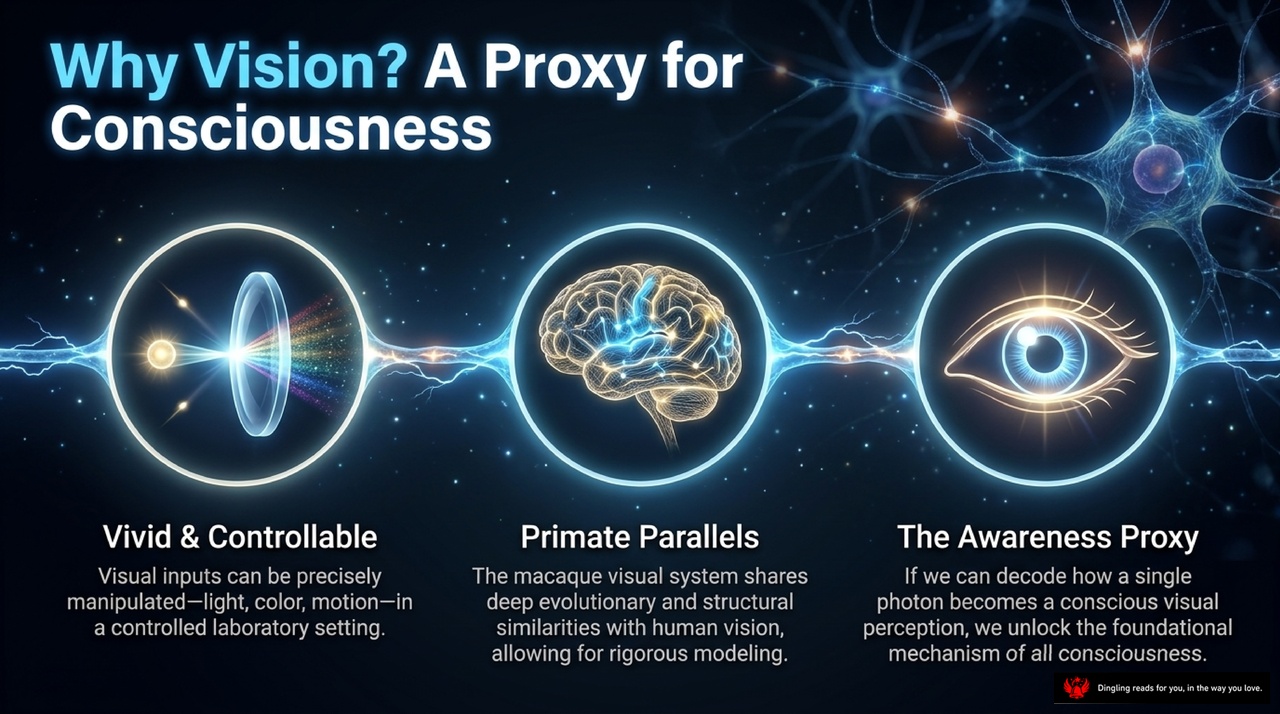
Why Vision? A Proxy for Consciousness. So, why do we focus on vision when trying to crack the code of consciousness? The answer lies in three powerful advantages that make it the perfect laboratory for understanding the mind.
First, vision is vivid and controllable. Unlike abstract thoughts or complex emotions, visual inputs—like light, color, and motion—can be precisely manipulated in a controlled setting. We can create illusions, change contrast, or isolate specific features, giving us a level of experimental control that other senses simply can't match.
Second, we have primate parallels. The visual system of the macaque monkey shares deep evolutionary and structural similarities with human vision. This allows us to perform rigorous experiments on animals and confidently extrapolate the results to humans, bridging the gap between animal behavior and human experience.
Finally, and most importantly, vision serves as the awareness proxy. If we can decode exactly how a single photon becomes a conscious visual perception, we unlock the foundational mechanism of all consciousness. By solving the puzzle of seeing, we might finally solve the mystery of being.

Imagine you've just walked into a dark movie theater. You sit in your seat, and suddenly, a giant red apple appears on the screen. Where is that "you" sitting inside your own brain? Is there a little viewer, a tiny homunculus, sitting in a private screening room, watching the images light up your mind?
This is the "Fallacy of the Homunculus," the myth we are busting today. The image on your screen shows this exact trap: on the left, we see a brain with a little person sitting in a chair, passively watching a movie of an apple. It feels intuitive, doesn't it? We often think of perception like watching a film. But the reality, as the right side of our graphic reveals, is completely different. There is no central viewing room. There is no little watcher inside your head.
Instead, your brain operates on distributed, parallel processing. Think of it this way: the processing *is* the perception. There is no separation between the act of seeing and the thing you see. Your brain isn't recording a video; it is actively constructing a rich, layered interpretation of the world right here and now. Every feature you notice—the color, the shape, the motion—is handled by different groups of neurons working simultaneously.
So, forget the little man in the theater. Your consciousness isn't a spectator; it is the entire performance itself. It's a symphony of billions of neurons firing in unison, creating the vivid world you experience, without a single conductor sitting in the middle of the orchestra.

Seeing is a Constructive Process. Look closely at these two images. On the left, you see three black circles, yet your brain insists there is a white triangle connecting them. On the right, you see a simple wireframe cube, but your perception flips between seeing it as a solid 3D object or a flat 2D drawing. These aren't tricks of the eye; they are proof that seeing is an active, constructive process, not a passive recording of reality.
Our brains are constantly hallucinating borders to make sense of gaps and imposing 3D structures on ambiguous 2D lines. As the text explains, "Your brain hallucinates the borders of a shape that does not physically exist to make sense of the gaps," and "Your brain imposes a 3D structure on 2D lines, flipping between interpretations because visual input is inherently ambiguous." We don't have a camera inside our heads capturing a perfect image of the world. Instead, our brains take limited, often confusing visual data and combine it with past experiences to build the best possible explanation. This is why we can be fooled by illusions like the Necker Cube or the Kanizsa Triangle. What you see is not the world itself, but your brain's best guess of what the world is.
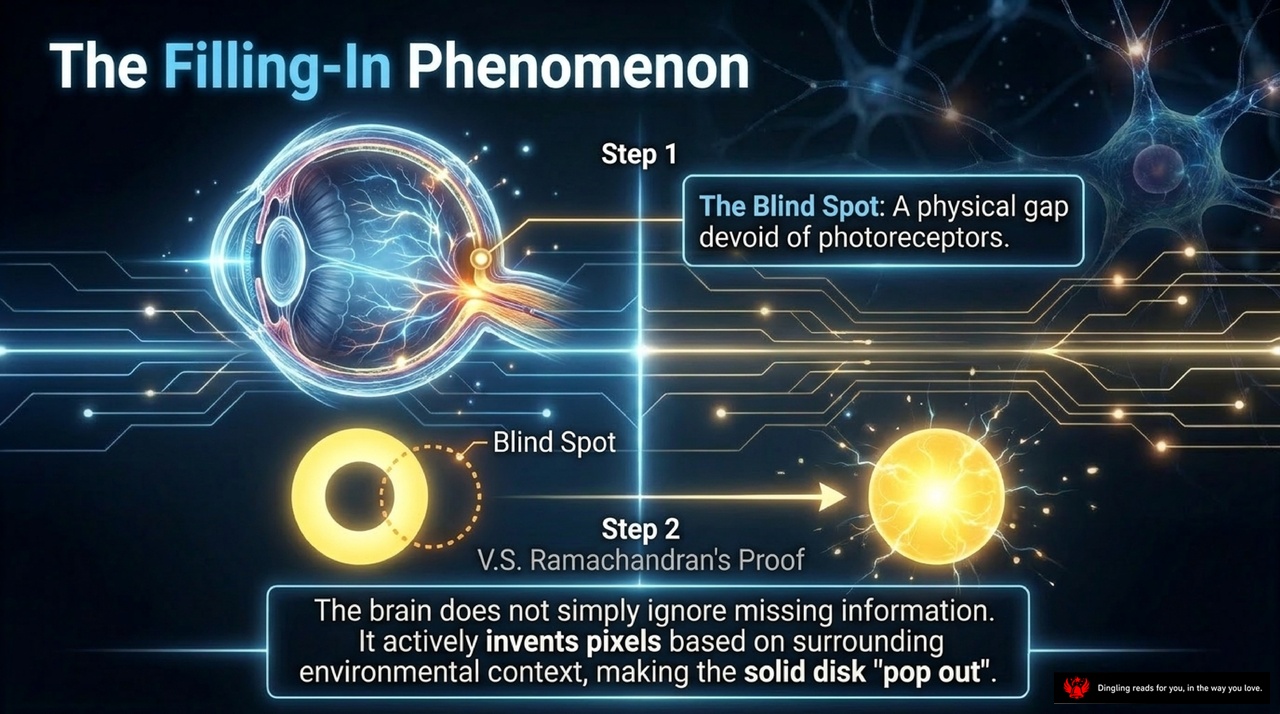
Have you ever looked at a blank spot in your vision and felt nothing? You might assume your eyes are simply ignoring a hole in the world. But the brain tells a completely different story. As we explore the "Filling-In Phenomenon," we discover that our visual reality is not a perfect recording of the outside world, but a creative invention by our own minds.
Step 1 starts with a physical reality called "The Blind Spot." It is a literal gap in your retina, a zone devoid of photoreceptors where the optic nerve exits the eye. If you close one eye and look at a specific point, you can actually see this hole. Yet, in our daily lives, we never notice it. We don't see a dark circle or a missing piece of the landscape.
So, what happens in Step 2? This is where V.S. Ramachandran's brilliant proof comes into play. He demonstrated that the brain does not simply ignore missing information. Instead, it actively invents pixels based on the surrounding environmental context. When you look at a yellow ring with a gap right in your blind spot, your brain doesn't say, "There is nothing here." It seamlessly fills in the missing data, making the solid disk "pop out" as a complete, uninterrupted circle.
This phenomenon proves a radical truth: what we see is a constructed reality. Our brains are not passive cameras; they are active artists, constantly painting over the gaps in our data to give us a smooth, coherent, and solid world to live in.

Have you ever wondered why a red letter instantly "pops out" from a sea of green ones, while finding a specific red T among green Ts requires slow, deliberate searching? The answer lies in how our brain processes visual information through two distinct modes: pre-attentive processing and focused attention.
On the left, we see "Pre-attentive Processing," which operates in parallel. It's incredibly fast and unconscious, instantly detecting basic features like color or orientation without our effort. That's why a single red letter jumps out immediately. However, on the right, we have "Focused Attention," which works serially like a searchlight. To combine features—like identifying a specific object that is both red and T-shaped—your brain must move item by item, binding these details together consciously.
This slide perfectly illustrates the difference between our brain's automatic, parallel scanning and our deliberate, focused search. While the former handles simple cues instantly, the latter is essential for complex recognition. Understanding this distinction is key to grasping how we construct our visual reality.

Today's slide breaks down three major cognitive frameworks that attempt to explain how consciousness actually works. Let's dive into the thinkers behind them and their core metaphors.
First, we have Philip Johnson-Laird, who views consciousness as "The Operating System." He argues that our awareness acts like a top-level OS, governing a sea of highly parallel, unconscious sub-processors that are working away in the background.
Next is Ray Jackendoff, who proposes "The Intermediate Level." His theory suggests that awareness doesn't live in raw pixels or abstract thoughts, but rather in a "2.5D sketch" of surfaces—a middle ground between low-level data and high-level meaning.
Finally, we have Bernard Baars and his "Global Workspace" theory. This framework imagines the brain as a central information exchange where unconscious processors compete to broadcast their data into the spotlight of awareness.
These three models offer distinct but complementary ways to understand the complex machinery of the mind.
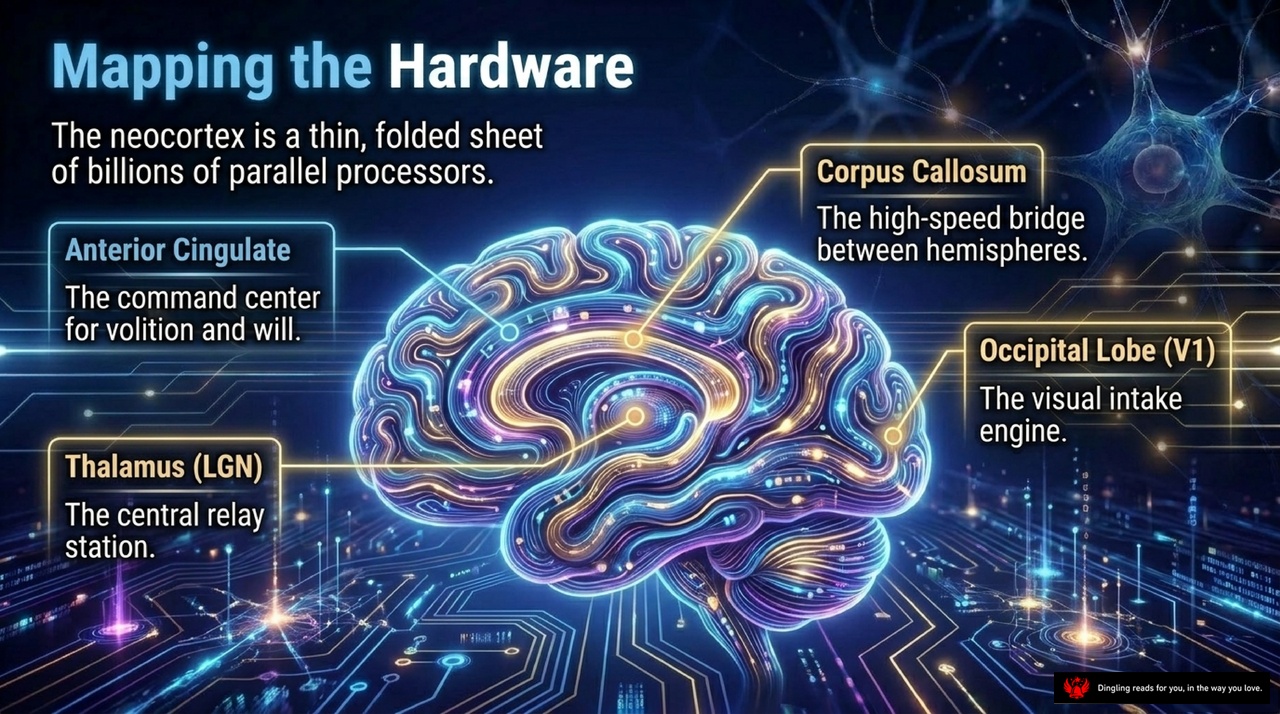
Imagine your brain not as a mystical soul, but as a thin, folded sheet of billions of parallel processors working in unison. This is the core of what we call the "Hard Problem," and today we're mapping the hardware behind it.
Look at this diagram. We are breaking down the brain's architecture into its key functional units. First, we have the **Neocortex**, which acts as a massive parallel processing engine. Then, right in the center, sits the **Corpus Callosum**, serving as the high-speed bridge connecting the two hemispheres, allowing them to communicate instantly.
Moving to the front, we find the **Anterior Cingulate**, which acts as the command center for volition and will—essentially where your decisions happen. Below that is the **Thalamus (LGN)**, functioning as the central relay station that directs information to the right parts of the brain. Finally, at the back, lies the **Occipital Lobe (V1)**, our visual intake engine, responsible for processing the raw data of what we see.
While these structures work together to create our complex reality, remember that none of this is magic. As we discussed, everything from your free will to your visual perception is simply the result of these neurons firing and connecting. There is no separate "you" watching from inside; you are the activity itself. By understanding this hardware, we move one step closer to explaining the mysterious phenomenon of consciousness.
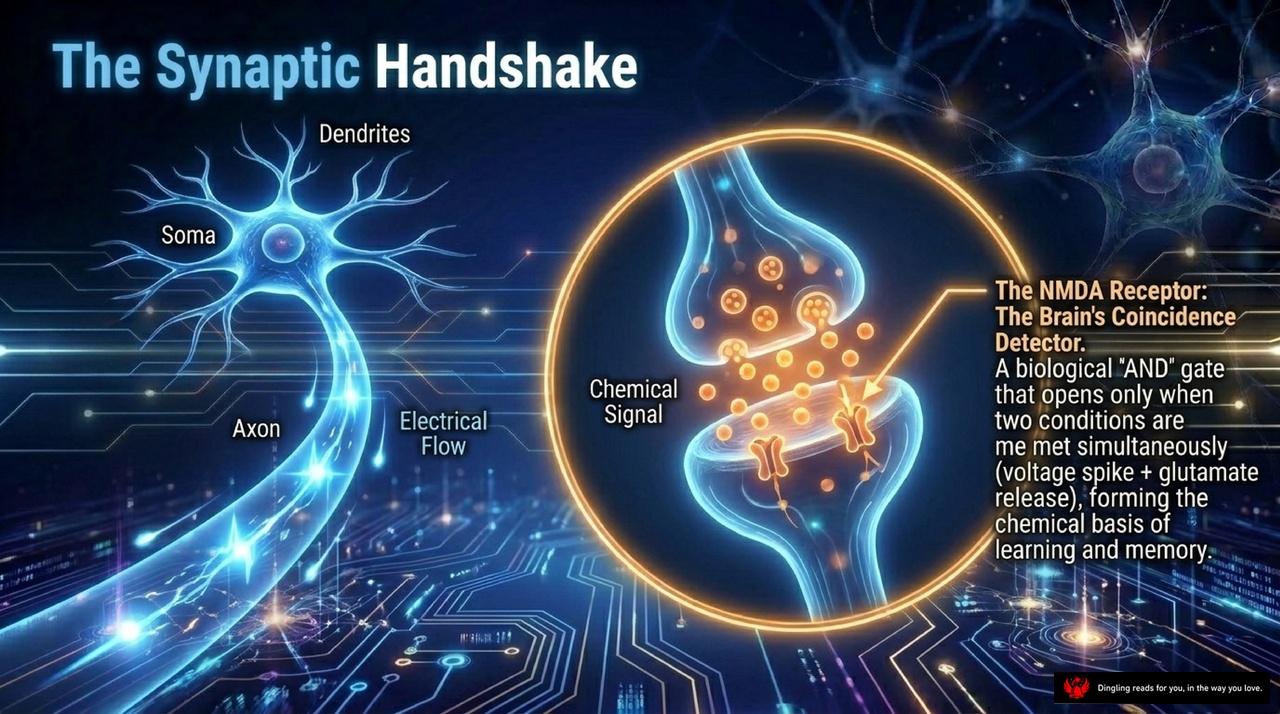
Imagine your brain not as a single entity, but as a bustling city of billions of neurons firing in perfect, chaotic synchronization. Today, we're zooming in on the microscopic "handshake" that makes learning and memory possible. Look at the diagram: you see the Soma, the Axon, and the Dendrites. But the real magic happens at the synapse, where an electrical signal from the Axon triggers a release of chemical signals.
Here is the critical part: The NMDA Receptor acts as the brain's "coincidence detector." Think of it as a biological "AND" gate. It stays shut unless two conditions are met simultaneously: a voltage spike from the neuron and the release of glutamate. Only when these two events happen together does the gate open, allowing calcium to flow in. This specific moment of synchronization is the chemical foundation of learning. It's how your brain decides which connections to strengthen, turning fleeting electrical impulses into lasting memories. Without this precise handshake, the complex symphony of thought we experience would simply fall apart into noise.
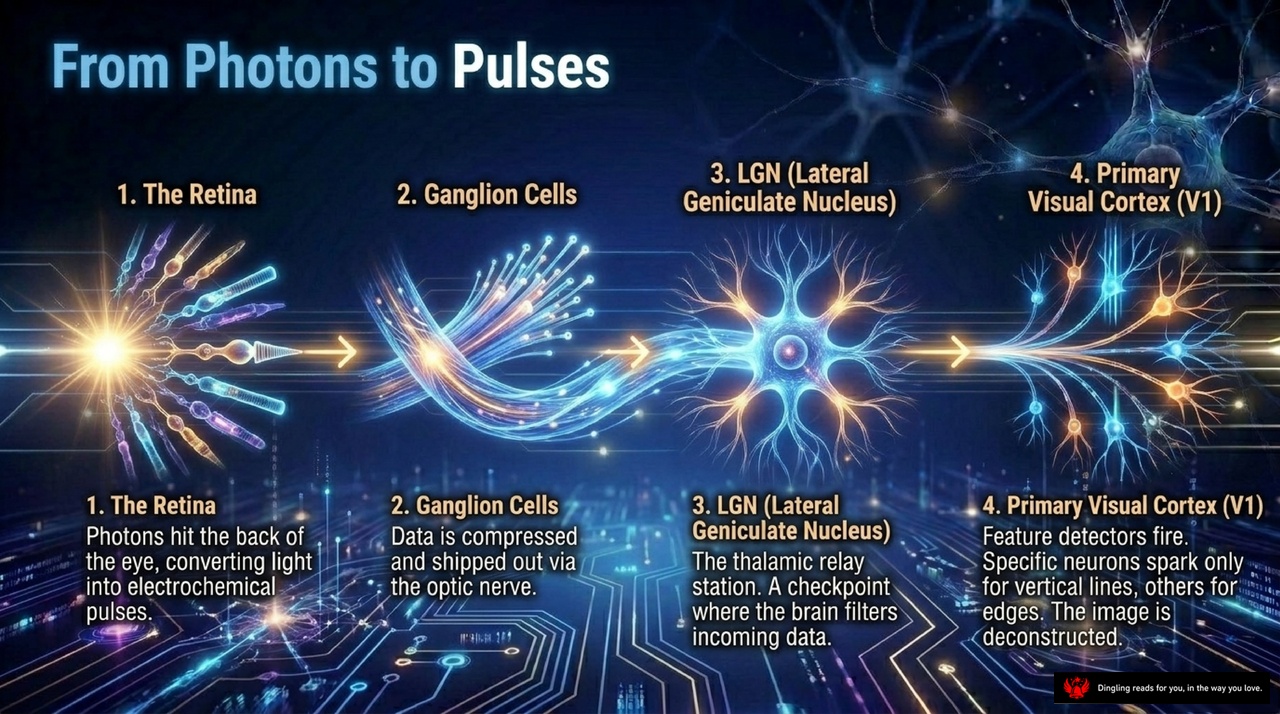
Have you ever wondered how your brain turns raw light into the vivid world you see? It's not as simple as a camera capturing an image. Instead, it's a sophisticated, multi-stage journey from photons to pulses.
Let's follow that journey. It all starts at **The Retina**. Here, photons hit the back of your eye, converting light into electrochemical pulses. These signals don't just travel straight to your brain; they go next to **Ganglion Cells**. In this stage, the data is compressed and shipped out via the optic nerve, acting as a filter for the flood of visual information.
Once the signal leaves the eye, it reaches the **LGN**, or the Lateral Geniculate Nucleus. Think of this as the brain's thalamic relay station—a critical checkpoint where incoming data is further filtered before it reaches the cortex. Finally, the processed information arrives at the **Primary Visual Cortex**, known as V1. This is where the magic happens. Feature detectors fire here; specific neurons spark only for vertical lines, others for edges, and the image is deconstructed into its fundamental components.
This entire process illustrates the core of our "Remarkable Hypothesis": your vision isn't a passive recording of reality. It is an active construction built by billions of neurons working in concert. What you "see" is the result of this complex neural activity, not a direct copy of the external world.

The Visual Cortices Matrix isn't just a diagram; it's a window into how your brain actually constructs reality. As the slide suggests, our brain doesn't see the world as a single, unified movie. Instead, it fundamentally dismantles reality into separate physical streams.
Let's break down these three distinct channels. First, on the left, we have V1, labeled here as "The Primary Intake." Think of this as the brain's raw data processor. Its job is edge detection, orientation, and basic mapping. It's like a line-art sketch artist, stripping away the details to give us the fundamental structure of shapes and boundaries.
Moving to the center, we see V4, or "The Color Context." This is where the magic happens. V4 doesn't just see wavelengths of light; it processes color relative to the environment. It handles what the slide calls the "Land Effect," allowing you to recognize a red apple whether it's in bright sunlight or dim candlelight. It's essentially the brain's painter's palette, constantly adjusting the scene so that colors remain consistent despite changing lighting conditions.
Finally, on the right, we have MT or V5, known as "The Motion Engine." This system is completely blind to color. Its sole purpose is to track trajectory and speed. Imagine a radar tracker scanning the skies; that's exactly what MT/V5 does. It ensures you know when a car is approaching or when a bird is flying away, regardless of what color it is.
So, the next time you look at something, remember: your brain isn't just passively receiving an image. It is simultaneously running three specialized engines—one for structure, one for color context, and one for motion—to build the vivid, coherent world you experience.

When the system breaks, our perception of reality can shatter in ways that challenge everything we think we know. This slide highlights three fascinating neurological conditions that reveal how specific brain damage alters our conscious experience.
First, look at **Blindsight**. Here, damage occurs to the V1 area of the visual cortex. The patient claims to be completely blind, yet they can successfully guess the direction of a moving dot or navigate a hallway. This happens because intact unconscious pathways allow the brain to process visual information without the patient being aware of it. It proves that seeing and being aware of what you see are two separate processes.
Next, we have **Anton's Syndrome**. This results from damage to visual integration. The patient is entirely blind but aggressively denies it. Instead of admitting their blindness, they hallucinate a visual reality they firmly believe is real. This condition shows how the brain can construct a false sense of sight to protect the ego from the terrifying truth of blindness.
Finally, consider **Split-Brain** syndrome, caused by a severed corpus callosum—the bridge connecting the left and right hemispheres. In this case, the left brain speaks and interprets the world, while the right brain acts on visual stimuli it sees but cannot verbalize. This creates two separate streams of visual awareness co-existing in one skull, literally creating two independent wills. One side knows what it sees, while the other can only act on it. These cases demonstrate that consciousness isn't a single, unified stream, but a complex interplay of distinct, and sometimes disconnected, neural networks.

When we talk about "seeing," we often assume it's as simple as a camera capturing an image. But the reality is far more complex. Our brain isn't just recording light; it's actively constructing a layered, symbolic interpretation of the world. It takes raw data from millions of retinal ganglion cells and weaves them into a coherent picture.
Consider the visual cortex. It's not a single unit but a hierarchy of systems. The primary visual cortex, or V1, acts as the foundation. Neurons here are incredibly specialized, tuned to specific features like edges, orientation, or motion. But V1 doesn't see the whole picture. It passes information up to secondary areas like V2, V4, and MT. V4, for instance, is our color center, allowing us to recognize an object's true color even if the lighting changes. MT handles motion, letting us track a moving car.
However, here's the mind-bending part: despite all this processing, we still don't know exactly which neurons create the final, vivid experience of "seeing." We know the brain breaks down an image into parts—color, shape, motion—and processes them in different regions. Yet, no single area seems to hold the complete visual awareness. This is the "binding problem." How does the brain take these separate signals and glue them together so you see one red circle, not a red line and a separate circle?
Recent research suggests the answer might lie in synchronization. When we perceive an object, the neurons processing its different features fire in unison, often oscillating together at specific frequencies. This coordinated activity, supported by feedback loops between the cortex and the thalamus, might be the neural signature of consciousness itself. It's a massive, parallel, and dynamic process, proving that what we call "seeing" is actually a complex, constructive act performed by billions of interacting neurons.

Imagine a world where a machine could learn to speak English without being explicitly programmed with the rules of pronunciation. This is the magic of the NETtalk experiment, a landmark study by Sejnowski and Rosenberg that changed how we see intelligence. As you see on this slide, NETtalk wasn't built with hard-coded instructions; instead, it was fed raw English text and audio. Through a process called backpropagation—essentially, a sophisticated error-correction mechanism—the network taught itself to read aloud.
The secret lies in the architecture you're looking at: the Input Layer, the Hidden Layer, and the Output Layer. It's a web of interconnected nodes. What's fascinating is that 'intelligent' behavior didn't come from a programmer's logic, but emerged purely from the shifting weights of these connections. The hidden layer clustered information on its own, allowing the system to generalize and handle irregularities in the language, much like a human child learning to speak. This experiment serves as powerful proof that complex, adaptive behavior can arise from simple, interacting parts, offering a glimpse into how our own brains might process the world without a central commander.

So, let's look at the "Intermediate Level Theory." This slide challenges our common-sense view of how we see the world. It suggests that our conscious awareness doesn't live in raw data, nor does it exist in high-level abstract thoughts. Instead, consciousness resides in that explicit representation of visible surfaces—what we call the "2.5D sketch."
The diagram breaks this down into three steps. On the far left, we have Step 1: Raw Pixels or the Retinal Map. This is labeled as unconscious. Think of this as the chaotic, unprocessed stream of light hitting your eye. It's just data, not yet a picture.
Then, moving to the center, we arrive at Step 2: The 2.5D Sketch. This is where conscious awareness actually happens. It's that intermediate stage where the brain constructs a surface—a visible object with depth and orientation, like the clear, solid mug in the middle of the image. We don't see the raw pixels; we see the constructed surface.
Finally, on the right, is Step 3: The 3D Abstract Concept. This is also unconscious. It's the brain's inference, the full 3D model of the object, understanding its shape and spatial organization in the world. But here's the key takeaway: while your brain is busy building this 3D model and processing raw pixels in the background, your actual conscious experience is stuck right in the middle, focused on that visible surface. This is the core of the theory—consciousness is the bridge between raw data and abstract understanding, living specifically in that explicit visual representation.

Have you ever wondered how your brain creates a single, unified experience of the world? Think about looking at a red ball moving upward. Your brain doesn't actually see a "red ball" all at once. Instead, it breaks the image apart and sends different signals to different locations.
As this slide illustrates, the process is surprisingly fragmented. The "round shape" of the ball is processed in the V1 area of your visual cortex. The "red color" is handled separately in the V4 area. Meanwhile, the "upward motion" is detected in the MT area. These are three distinct groups of neurons, each working on a specific feature, completely unaware of the others.
So, here lies the central mystery known as "The Binding Problem." If color lives in V4, motion in MT, and shape in V1... how do you experience a single, unified, moving red ball? Without a little observer inside your head to watch the screen, how do these scattered neurons agree they are looking at the same object? This is the fundamental challenge that neuroscience is still trying to solve: figuring out how the brain stitches these separate pieces of data together into one coherent reality.

Imagine your brain not as a single, unified entity, but as a symphony of billions of neurons firing in perfect lockstep. This slide illustrates the "40Hz Solution," a revolutionary concept that explains how our brain binds scattered visual details into a single, coherent moment of conscious awareness.
Look at the diagram. On the left, we see a "Round Shape" processed in the V1 visual cortex. On the right, we detect "Upward Motion" in the MT area. In the center, the color "Red" is being processed in the V4 region. Individually, these are just isolated features: a shape, a direction, and a hue. But your brain doesn't experience them separately. Instead, the Thalamus—specifically the Pulvinar—acts as the master conductor.
Notice the synchronized neural oscillations flowing through the image. When neurons representing these different features fire in exact rhythmic lockstep at approximately 40Hz, known as gamma waves, something magical happens. The Thalamus uses reverberating loops to bind these disparate neurons together. Suddenly, you don't just see a red circle moving upward; you have a unified, vivid experience of a red circle moving upward. This synchronization is the neural signature of consciousness itself, turning a chaotic stream of data into the rich, unified world you perceive every single second.
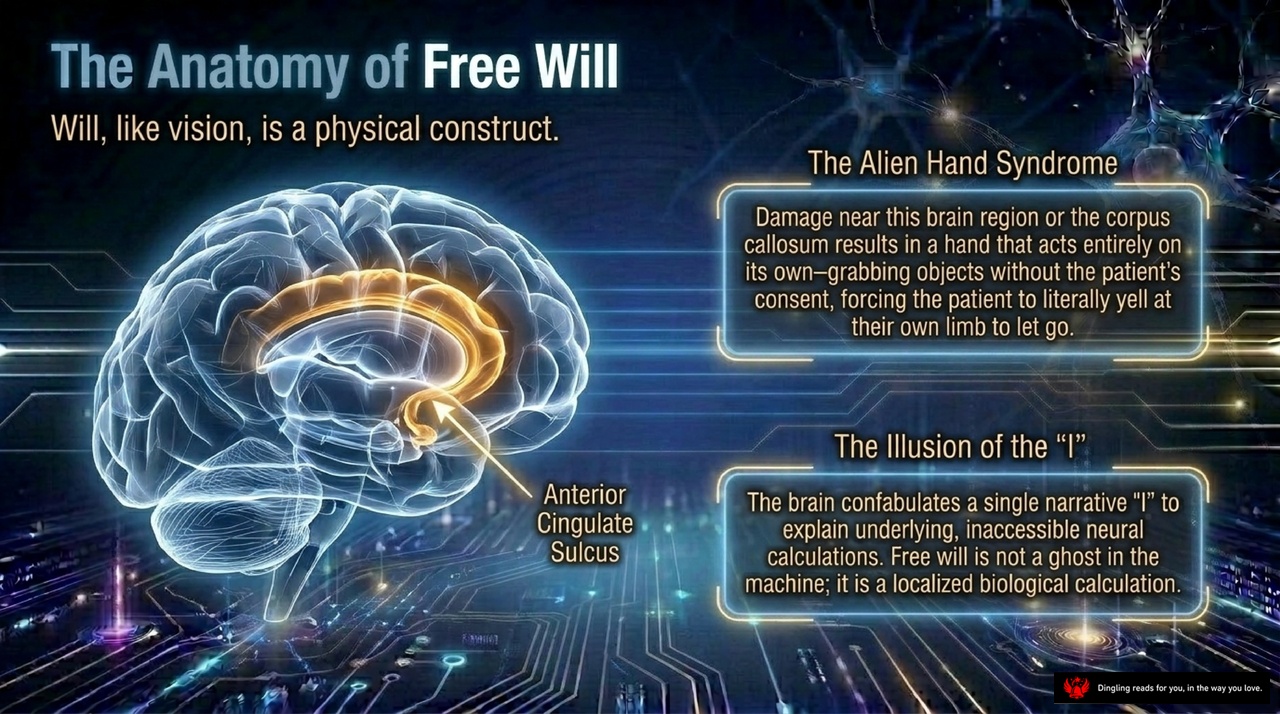
Will, like vision, isn't a ghost floating in your head—it's a physical construct built right into your brain. Look at this diagram: we're diving into the anatomy of free will by focusing on a specific brain region called the Anterior Cingulate Sulcus. This area is the key player in what we call "The Illusion of the 'I'."
Here's the mind-bending part: your brain constantly confabulates, or fabricates, a single narrative "I" just to explain underlying neural calculations that are otherwise inaccessible to you. Free will isn't a magical force; it's a localized biological calculation happening in specific spots.
This concept gets even stranger when we look at "The Alien Hand Syndrome." If there's damage near this region or the corpus callosum, your hand can act entirely on its own—grabbing objects without your consent. You might literally have to yell at your own limb to let go. This proves that your sense of control is just a story your brain tells itself, not an absolute truth. By understanding these biological mechanisms, we see that free will is simply the brain's way of making sense of its own complex, automatic operations.

So, we've arrived at the most mind-bending conclusion of our journey: The Astonishing Hypothesis is confirmed. Every vivid color you see, every motion you perceive, and even that deep-seated feeling of being a distinct "self" watching it all? It's nothing more than the synchronized dance of billions of neurons.
Look at this glowing neural eye in the center. It represents the core truth we've uncovered: our most profound conscious experiences are merely the rhythmic firing of physical biological circuits. There is no ghost in the machine, no separate soul orchestrating the show. You are, quite literally, a collection of interacting cells.
But here's where it gets truly provocative for us today. If human identity is just this specific rhythm of biological oscillation, what happens when we finally teach artificial machines to oscillate in the exact same rhythm? If we can replicate that specific neural dance, do we create a new kind of consciousness? Or does the "self" simply dissolve into code? This slide challenges us to rethink what it means to be human in an age where biology and silicon might converge.