
The Autobiography of Benjamin Franklin: Complete Chapter-by-Chapter Summary
Welcome to *The Autobiography of Benjamin Franklin*. Before we dive into his incredible life, let's set the stage with what this book truly represents.
As you see on the cover, this isn't just a historical record; it is described as a timeless blueprint for personal mastery, relentless industry, and the architectural design of a meaningful civic life. Imagine a man who started with nothing but a poor upbringing and a passion for reading, only to become one of the most influential figures in history. Franklin himself wrote that while he could not relive his life to fix his small mistakes, he could at least write it down so his descendants—and us today—could learn from his journey.
He reminds us that while we often pride ourselves on our achievements, we must remain humble, acknowledging that our success is often a blessing from a higher power. His story begins in a family that had lived in England for centuries, but his own path was shaped by a father who valued integrity and foresight over material wealth. From a young age, Franklin was drawn to the world of print, seeing it as a way to improve his mind and his writing. He famously realized that to become a better writer, he had to first become a better thinker, using self-discipline to refine his words and his logic.
This book is your invitation to step into the mind of a man who believed that through hard work, curiosity, and moral improvement, anyone could build a better life. Let's begin his story.

Look at this timeline of Benjamin Franklin's early life. From Boston at age twelve to his return to Philadelphia as an independent printer, every step was driven by one core desire: autonomy.
He started in Boston, apprenticed in his brother's shop, but quickly escaped harsh authority to seek intellectual freedom. A brief stop in New York at seventeen didn't stick; he was redirected back to Pennsylvania. Arriving in Philadelphia with only a few coins and three bread rolls, he began as an unknown journeyman. He spent eighteen months in London mastering advanced printing techniques while learning the hard lessons of poor financial habits from his peers.
Upon returning to Philadelphia, he established his own printing house—the true foundation of the Self-Made Man. Notice the final takeaway at the bottom: this drive was never merely financial. It was a relentless pursuit of autonomy. Franklin didn't just want money; he wanted control over his own life and destiny, transforming from an apprentice into a man who could shape his own future.

Friends, let's look at the stark contrast between how the world worked back then versus how Benjamin Franklin changed it all. This slide, "The Printer's Edge," breaks down the difference between the "Status Quo" and "The Franklin Blueprint."
On the left, you see the old way. Most printers, like Keimer and Bradford, relied on standard hours and were easily distracted. Their leadership was often illiterate or lacked real press knowledge, and they lived in debt with unkempt appearances. It was a comfortable but stagnant existence.
But Franklin? He built a completely different machine. Look at his "Relentless industry." Unlike the distracted workers of the past, Franklin worked with a ferocity that his rival Bradford couldn't even match. As Franklin himself noted, he saw Franklin working late into the night while others were at the club, proving that superior industry is the ultimate competitive advantage.
Then, look at innovation. While others were stuck with outdated methods, Franklin pursued continuous self-education. He didn't just learn; he invented. He created the copper-plate press specifically to print paper money, a massive leap forward that no one else in the industry dared to attempt.
Finally, consider financial discipline. The old printers relied on debt and looked sloppy. Franklin, however, practiced extreme frugality. He famously lived as "The Water-American," drinking only water to save money, all to leverage his savings into buying his own typeset. This wasn't just saving pennies; it was strategic reinvestment.
The lesson here is clear: you don't just compete on effort; you compete on relentless execution, smart innovation, and the discipline to fund your own future. That is the true Franklin Blueprint.

Look at this slide comparing Dogma and Persuasion. On the left, we see a solid brick wall labeled "Dogma." This represents the method of direct contradiction, using words like "certainly" or "undoubtedly." The result? It builds walls, triggers defensiveness, and ultimately destroys the purpose of any conversation. Now, look to the right at "Persuasion." Instead of a wall, we see an open door. This method relies on guided questioning and phrases like "I imagine," "It appears to me," or "If I am not mistaken." The result is powerful: it disarms opponents, guides them to conclusions naturally, and secures faster agreement.
This shift from a wall to a door is the essence of effective communication. As the quote at the bottom reminds us, "To speak, though sure, with seeming diffidence." This wisdom comes from Alexander Pope, and it was a lesson deeply learned by Benjamin Franklin himself. Early in his life, Franklin realized that a dogmatic, arrogant tone was a barrier to influence. He abandoned his habit of using absolute words like "certainly." Instead, he adopted a humble, questioning style. He would say, "I believe" or "I think," rather than declaring facts as unchangeable truths.
Why did this work? Because when you speak with seeming diffidence, you invite others to join you in the discovery of truth, rather than forcing them to submit to your authority. This approach didn't just help Franklin win arguments; it helped him build alliances, gain political influence, and even secure the support of powerful figures who might have otherwise opposed him. By choosing the open door over the brick wall, Franklin turned potential enemies into allies and transformed his words from weapons into bridges.

The Junto: A Hub for Mutual Improvement & Civic Impact
Benjamin Franklin didn't just want to be a successful printer; he wanted to build a better community. To do that, he created something revolutionary for the 18th century: The Junto. As this slide illustrates, it was strictly limited to just 12 members, a small circle designed for high-impact collaboration rather than mass appeal.
This exclusive group functioned as a mastermind hub. On the input side, the culture was built on Socratic debate without confrontation, allowing members to discuss morals, politics, and natural philosophy with intellectual safety. Instead of arguing to win, they practiced inquiry to learn.
On the output side, the benefits were tangible and far-reaching. It became a vetting ground for civic initiatives, meaning they could test ideas before launching them to the public. It fostered collective knowledge pooling, sharing the wisdom of the group. Most importantly, it generated shared business referrals and capital, directly fueling Franklin's printing empire and the success of his partners.
By limiting membership and mandating a spirit of inquiry over argument, Franklin created a mastermind group that quietly directed Philadelphia's future. It wasn't just a book club; it was the engine behind the American Revolution, proving that a small group of committed thinkers can change the world.

The 13 Virtues Matrix isn't just a philosophical concept; it was Benjamin Franklin's actual operating system for a productive life. As seen in this diagram, he organized morality into three distinct pillars: Self-Mastery, Execution, and Social Harmony.
First, let's look at **Self-Mastery**, or internal regulation. Franklin believed that to change your character, you had to attack it one virtue at a time. He placed **Temperance** at the very top, arguing that a calm mind and clear thoughts were essential to resist old habits. This was followed by **Silence**—speaking only when necessary to avoid foolishness—and **Order**, which helped him manage his time and resources. He also championed **Frugality** and **Industry** to build wealth, and **Cleanliness** and **Chastity** to maintain his physical and moral health.
The second pillar is **Execution**, focused on output and focus. Here, the key virtues are **Industry**—"lose no time"—and **Silence**, defined specifically as speaking only what benefits others or yourself. Franklin realized that wasting time or engaging in unnecessary chatter was the enemy of productivity. By strictly adhering to these rules, he could turn his intentions into tangible results.
Finally, we have **Social Harmony**, or external relations. This section includes **Sincerity**, **Justice**, and **Tranquility** to ensure peaceful interactions. Most notably, it highlights **Humility**, which Franklin defined as imitating the modesty of Jesus and Socrates. He famously learned that even when you are right, speaking with arrogance destroys your influence. By adopting this humble approach, he found that people were far more willing to listen to him.
Franklin didn't try to master all thirteen virtues at once. Instead, he used a simple chart to track his progress, marking off each week until a virtue was fully established before moving to the next. This method allowed him to transform himself from a flawed man into one of history's most productive and respected figures.

So, how do we actually make these abstract virtues stick? Franklin didn't just list them; he engineered a system for focused execution. As the slide illustrates, he didn't try to conquer all thirteen virtues at once. Instead, he used a method of isolation, tracking, and cycling. He would pick one virtue to master for a full week, marking a black dot in his ledger for every single fault he committed against it. Once a week passed without a mark, he would move to the next virtue, cycling through all thirteen over four years. Think of it like gardening; you don't weed the entire garden at once. You clear one bed at a time. This approach allowed him to build habits layer by layer, turning self-improvement from an overwhelming task into a manageable, daily practice that ultimately reshaped his life and the world around him.

Benjamin Franklin's Daily Routine: A Framework for Purposeful Living. Look at this clock. It's not just about waking up at dawn or hitting bed at dusk; it's about the deliberate allocation of every single hour to a specific purpose. Notice the cycle: we start with "Dawn/Preparation," asking ourselves, "What good shall I do this day?" Then, we move straight into "Deep Work." This is the core of Franklin's philosophy—uninterrupted industry. He believed that true productivity happens when you protect your focus, avoiding distractions to tackle the hardest tasks first.
As the day progresses, we shift to an "Intermission" to read, check accounts, and dine. But the work doesn't stop; there's a second block of "Deep Work" in the afternoon. This structure ensures that production remains consistent throughout the day. As evening approaches, the tone changes. We enter "Dusk/Reflection," a time to put things in their places, listen to music, and engage in conversation. Here, the question flips: "What good have I done today?" Finally, we transition into "Rest" and "Sleep," allowing our minds to recover for the next cycle.
The bottom line, as stated here, is that structure creates freedom. Every hour is deliberately allocated to either production, preparation, or reflection. By designing your day this way, you stop being a slave to chaos and start steering your life with intention.

"It is hard for an empty sack to stand upright"—this powerful quote from the beginning of the page sets the stage for Benjamin Franklin's entire life philosophy. It's a simple truth: you can't expect to stand tall or achieve greatness without first filling your life with substance.
Looking at this roadmap, we see a clear path from basic survival to civic greatness. It starts at the bottom with **Frugality**. Franklin teaches us that cutting all wasteful expenditures isn't just about saving money; it's about building the foundation for everything else. Without financial stability, you're just an empty sack.
The next crucial step is **Avoid Debt**. Franklin warns us that debt makes you a slave to creditors and breeds dishonesty. In today's world, where credit cards and loans are everywhere, this advice is more relevant than ever. You need to stay out of debt to maintain your freedom and integrity.
Once you've secured your independence through frugality and debt avoidance, you move to **Secure Independence**. This isn't just about being rich; it's about having the moral and intellectual freedom to think for yourself and act on your own principles. Financial stability grants you the liberty to pursue knowledge and uphold your values without fear.
Then comes **Step 4: Public Utility**. Here, Franklin makes a profound point: wealth is not the end goal; it is the tool that buys the time to serve society. Once you've secured your independence, you can focus on contributing to the greater good. Whether it's through innovation, community service, or public office, your resources should be used to help others.
Finally, at the top of the ladder, we reach **Civic Greatness**. This is where individual responsibility transforms into collective impact. When you use your resources wisely and dedicate yourself to serving society, you contribute to the betterment of your community and nation.
Franklin's journey reminds us that true success isn't measured by how much you have, but by how much you give and how well you stand on solid moral and financial ground.
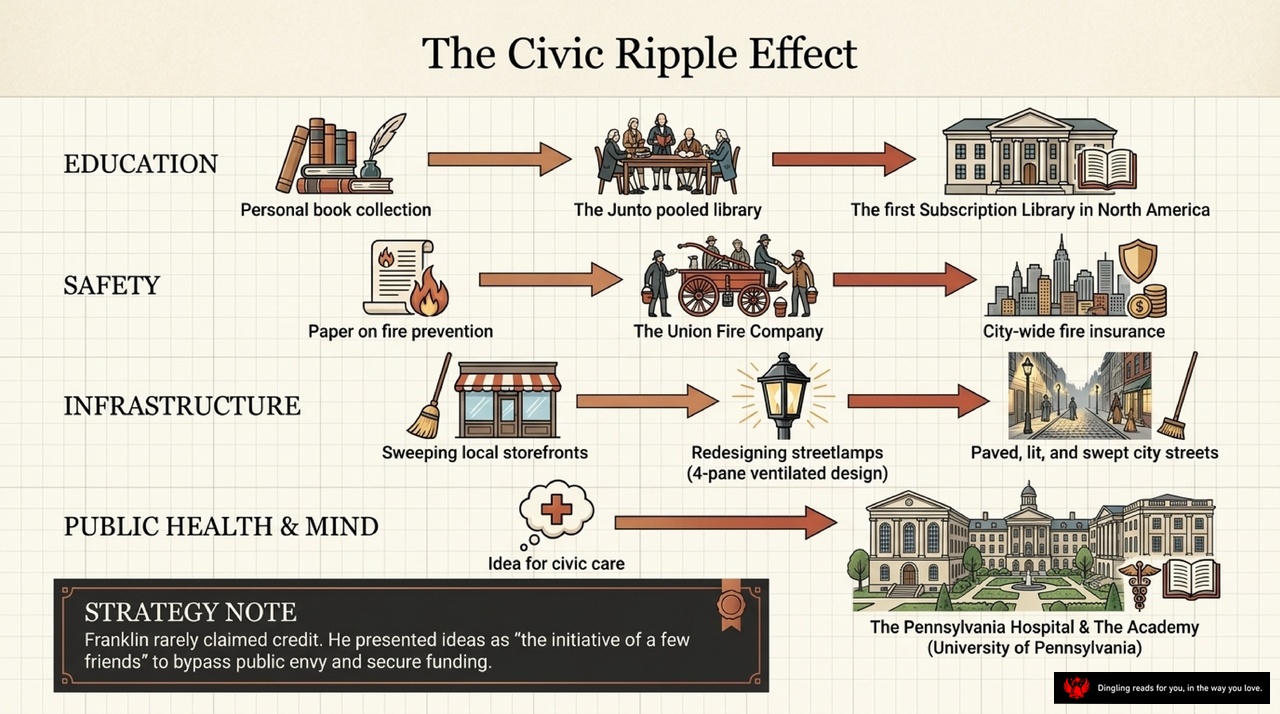
The image you're seeing outlines what I call "The Civic Ripple Effect"—a powerful idea that small, local actions can spark massive, lasting change across an entire society. Look at the four rows: Education, Safety, Infrastructure, and Public Health. Each one shows how a single idea, when shared and acted upon, ripples outward to transform communities.
Take education, for example. It started with personal book collections, then evolved into shared libraries like the Junto pooled library, and eventually led to the first subscription library in North America. This wasn’t just about books—it was about making knowledge accessible to everyone, not just the elite. That shift changed how people thought, talked, and even governed themselves.
Safety followed a similar path. A simple paper on fire prevention inspired the creation of the Union Fire Company, which in turn made city-wide fire insurance possible. Suddenly, safety wasn’t just luck—it was a system built by ordinary citizens working together.
Infrastructure began with something as simple as sweeping local storefronts. That small act inspired better street designs, like the four-pane ventilated streetlamps, and eventually led to fully paved, lit, and cleaned city streets. Imagine walking down a safe, bright street instead of a muddy, dark alley—that’s the kind of change that lifts entire neighborhoods.
And public health? It started with one person’s idea for civic care and grew into institutions like the Pennsylvania Hospital and the University of Pennsylvania. These weren’t built by kings or generals—they were born from community vision and collective action.
At the bottom, there’s a key insight: Benjamin Franklin rarely claimed credit. He presented these ideas as “the initiative of a few friends” to avoid jealousy and secure funding. That humility made all the difference—it allowed big ideas to take root without triggering resistance.
So here’s the takeaway: when you invest in your community, even in small ways, you’re not just helping neighbors—you’re creating a ripple that can reshape the future. And that’s something worth getting excited about.
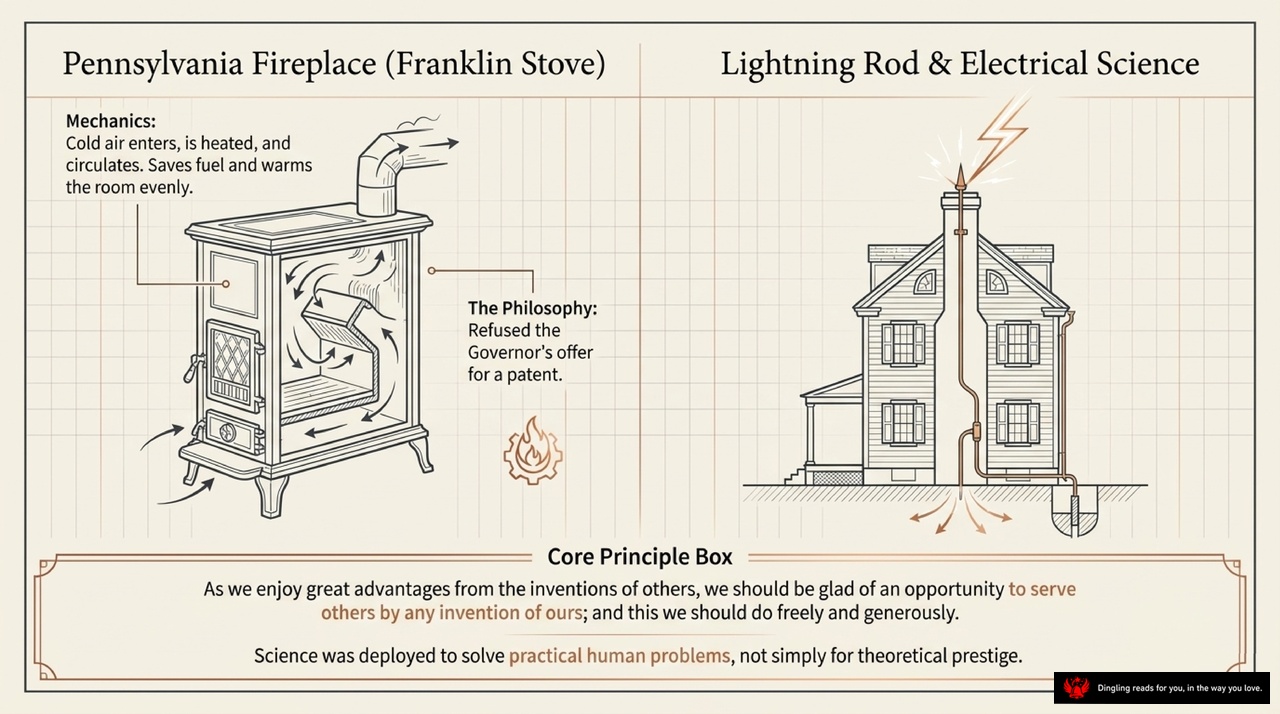
Today's slide highlights two of Benjamin Franklin's most iconic inventions: the Pennsylvania Fireplace, also known as the Franklin Stove, and the Lightning Rod. On the left, you see the mechanics of the stove. Cold air enters, gets heated, and circulates, which saves fuel and warms the room evenly. The philosophy behind it is clear: Franklin refused the Governor's offer for a patent, believing that science should solve practical human problems rather than just serve for theoretical prestige. He wanted to serve others freely and generously by sharing the advantages of his inventions. On the right, we see the Lightning Rod protecting a house. This invention was born from his electrical science experiments, proving that he could harness nature's power to protect lives and property. Just as he refused to profit from his stove, he offered the design for the lightning rod to the public for free. These inventions embody his core principle: as we enjoy the benefits of others' innovations, we should be glad to serve others with our own, doing so freely and generously. Franklin's life proves that true genius lies not in hoarding knowledge, but in applying it to make the world safer and more comfortable for everyone.
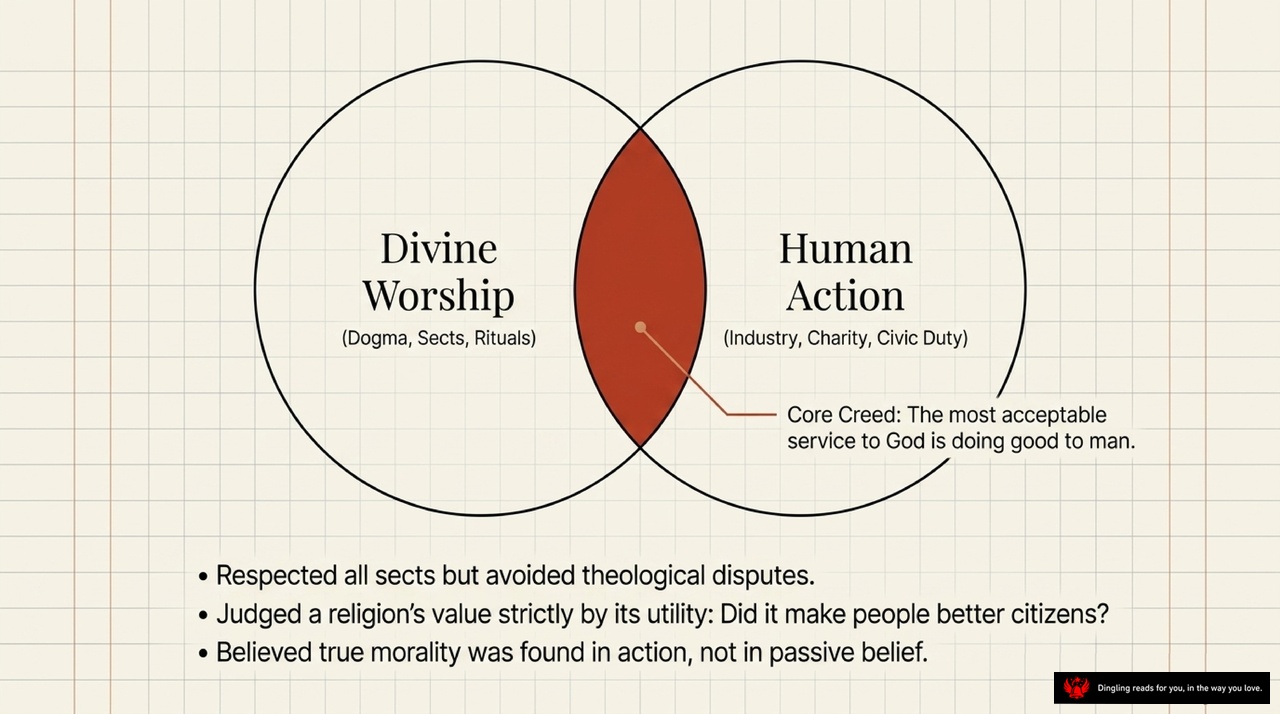
Imagine a world where your spiritual life and your daily work are not two separate tracks, but one unified path. This slide beautifully captures that balance. On the left, we see "Divine Worship"—the dogmas, sects, and rituals that often dominate our religious discussions. On the right, we see "Human Action"—the industry, charity, and civic duties that make up our real lives. The magic happens in the center, where these two circles overlap.
This intersection is the "Core Creed": the belief that the most acceptable service to God is simply doing good to man. It suggests that true faith isn't found in passive belief or arguing over theological disputes, as the text notes. Instead, true morality is discovered in action. As Benjamin Franklin demonstrated, a religion's real value should be judged by its utility: does it make people better citizens? By respecting all sects while focusing on practical kindness and civic responsibility, we find that the best way to honor the divine is to actively improve the human condition right here and now.
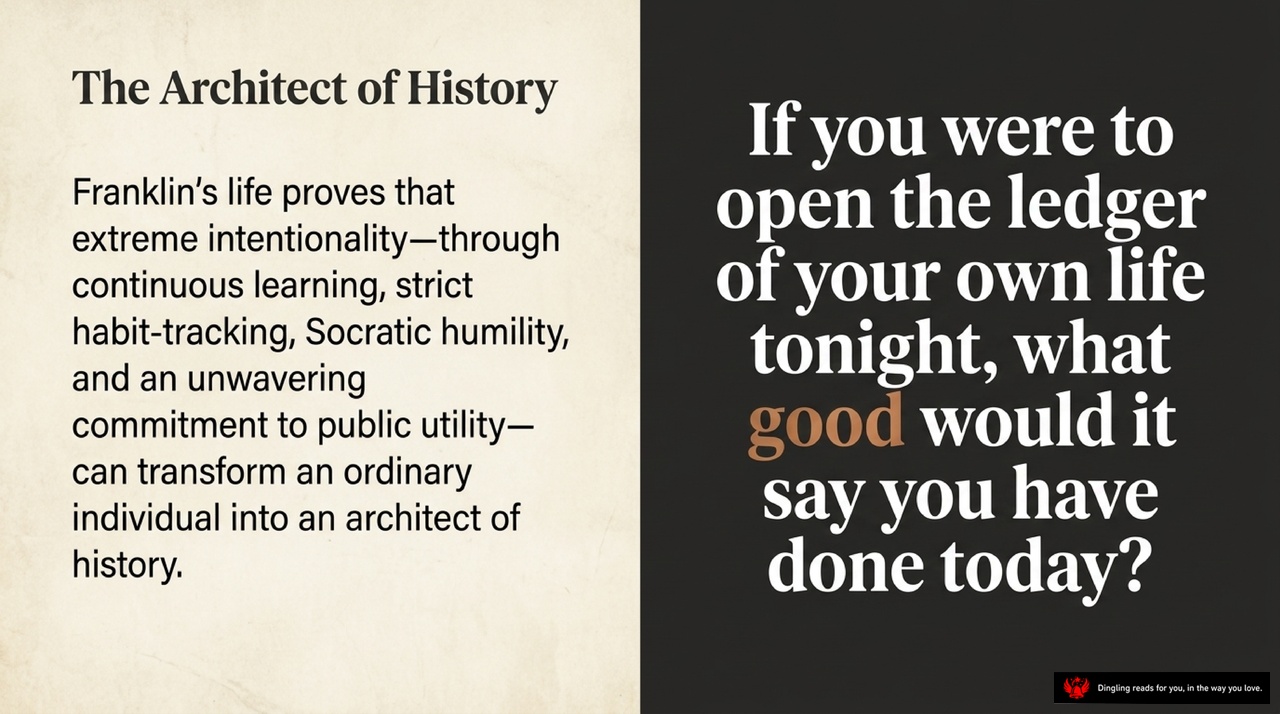
Imagine you could open the ledger of your own life right now and ask, "What good would it say I have done today?" That is the question Benjamin Franklin left us to ponder. As we look back at his journey, we see that Franklin's life proves that extreme intentionality—through continuous learning, strict habit-tracking, Socratic humility, and an unwavering commitment to public utility—can transform an ordinary individual into an architect of history. It wasn't about being born special; it was about the deliberate choice to build a better self and a better world every single day.