
The Big Short: Complete Chapter-by-Chapter Summary

The Big Short by Michael Lewis. Imagine the entire financial system as a skyscraper under construction, but look closer at the blueprint. You'll see cracks everywhere. The data integrity is at 99.9%—a lie. The leverage ratio is unsustainable. The default probability is 99.9%. Structural integrity is critical, and foundation failure is imminent. This isn't just a building; it's the greatest financial collapse in history, and most of Wall Street was blind to it.
A few outsiders, however, saw the truth. They watched as the structure, built on risky subprime loans and complex derivatives, began to rot from the inside out. While the rest of the market celebrated a booming real estate market, these outsiders knew the foundation was crumbling. They understood that the rules had been selectively enforced, that the truth was being deliberately hidden, and that the entire system was a machine designed not to create value, but to extract it from the vulnerable. As the cracks widened, turning from minor stress fractures into catastrophic structural failures, the clock began to tick toward a disaster that would reshape the world.
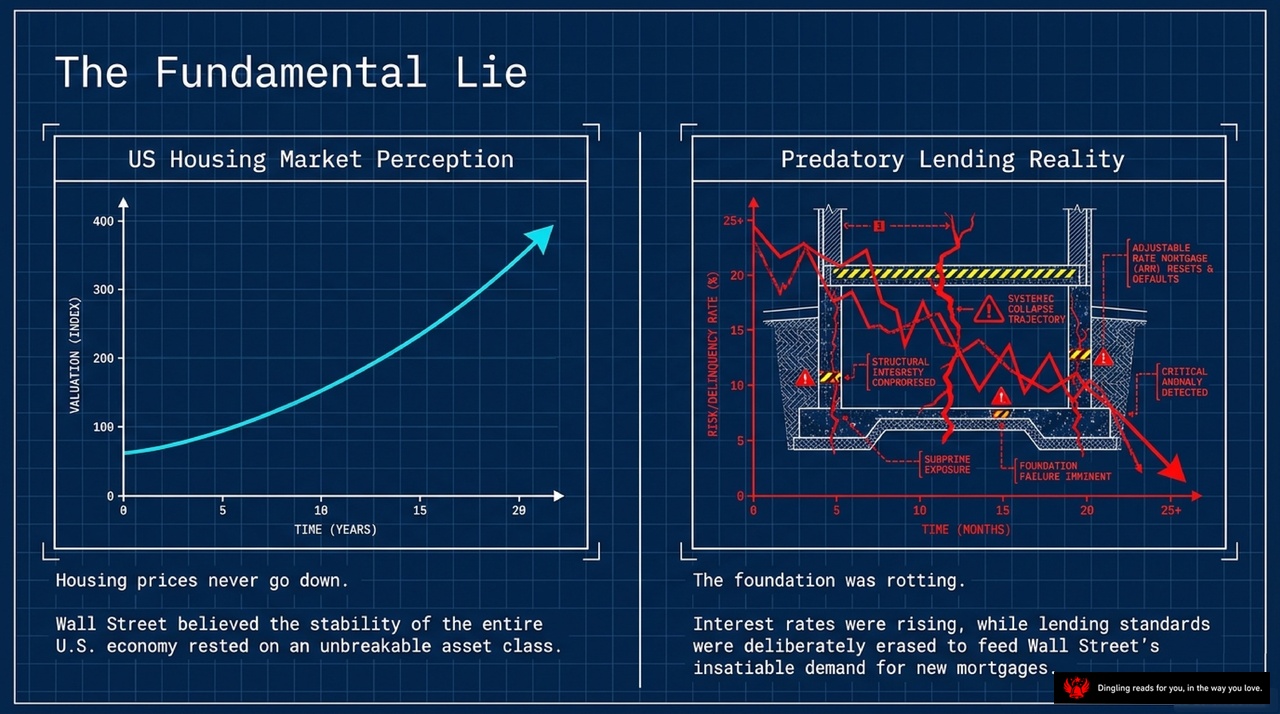
The slide contrasts the comforting myth we've been sold with the brutal reality of the subprime crash. On the left, we see the "US Housing Market Perception"—a smooth, upward curve suggesting that housing prices never go down. This was the fundamental lie Wall Street believed in: that the entire U.S. economy rested on an unbreakable asset class.
But look at the right side. This is the "Predatory Lending Reality." While the public saw rising prices, the foundation was actually rotting. Interest rates were climbing, yet lending standards were deliberately erased to feed Wall Street's insatiable demand for new mortgages. The chart shows how adjustable-rate resets and subprime exposure compressed the system's structural integrity, leading to a systemic collapse trajectory. By the time critical anomalies were detected, it was already too late. The lie wasn't just about prices; it was about the deliberate destruction of the foundation to create the illusion of endless growth.
The bond market is Wall Street's biggest secret, a dark room where rules are made by the powerful and ignored by the rest of us. Unlike the transparent stock market, bond prices are hidden, and clients are often left guessing while complex derivatives are engineered to keep money flowing to the top. In this shadow system, AIG stepped in as the ultimate "risk eater." By the mid-2000s, they were insuring 95% of their portfolio with subprime mortgages, swallowing billions of dollars in potential losses for a tiny premium. While banks like Goldman Sachs made billions selling these protections, AIG was left holding the bag, completely unaware of the scale of the disaster they were enabling.
To hide this mess, the industry invented the CDO, a financial trick that took risky junk bonds and repackaged them as safe, triple-A assets. It was a lie so elaborate it fooled everyone, even the rating agencies. But here is the fatal flaw: these bonds weren't diversified at all. If housing prices stopped rising, every single loan would fail simultaneously. The market was betting on a house of cards that was destined to collapse.
This is where the real money was made for the short-sellers. By buying credit default swaps on these fake triple-A bonds, investors could bet against the entire system for a fraction of the cost. If the crisis hit, the payout would be massive. But to pull this off, they had to break through Wall Street's gatekeeping. Small funds like Cornwall Capital were initially rejected, mocked for their size and lack of pedigree. But with persistence and sharp insights, they finally got in, buying insurance on the very bonds that would soon become worthless. As the bubble began to pop, the tables turned, and those who had been laughed out of the room became the only ones standing to win.

The diagram on this slide is a perfect blueprint of the "Doomsday Machine"—a terrifyingly efficient machine designed to hide garbage as gold. Let's break down how this fraud worked, step by step.
First, look at the top of the funnel. It starts with "Toxic Subprime Mortgages." Thousands of risky loans that no one wanted are bundled together into bonds. This is the first step: **Package**. By grouping these bad loans, the banks created a product that looked like a solid investment, even though the underlying assets were crumbling.
Next, the machine slices these bonds into layers, which the diagram calls **Tranches**. This is where the illusion of safety begins. The bonds are sliced by risk. The bottom layer, labeled **BBB**, is the high-risk garbage that absorbs the first losses. But above that sits the **AAA** layer, labeled as "Safe." This is the trick. The AAA layer is designed to look secure, but it's only safe if the layers below it never fail.
Finally, we reach the most deceptive part: **The Launderer**, or **The CDO**. This is the Collateralized Debt Obligation. Here's the magic trick: Wall Street takes the unsellable BBB garbage from the bottom and repackages it. Through complex financial engineering, they magically create a new AAA rating from the agencies. The diagram shows these glowing blue AAA blocks being produced. The system successfully laundered the risk, turning toxic trash into a premium, safe asset that investors couldn't resist. This entire process allowed the financial system to keep printing money on a foundation of sand, until the whole machine eventually collapsed.

The bond market is the ultimate dark room on Wall Street, a place where rules are written by the powerful and transparency is a myth. Unlike the regulated stock market, bond trading happens in shadows, driven by massive institutions that manipulate prices behind closed doors. Here, complex derivatives are designed not to manage risk, but to concentrate it in the hands of a few, leaving ordinary investors vulnerable to being drained dry.
In this opaque system, AIG played the role of the ultimate "risk eater." Starting in the late 80s, its financial products division evolved into a central hub for absorbing risk that others refused to touch. By the mid-2000s, they had swallowed over $50 billion in subprime mortgage bonds, mostly the lowest-rated "BBB" tier, without truly understanding the danger they were holding. They were selling credit default swaps on these toxic assets for a pittance, charging less than 0.12% annually, while exposing themselves to potential losses of $20 billion. It was a classic setup: Wall Street banks profited handsomely by offloading the danger to AIG, while AIG sat on the powder keg, blind to the fact that the entire structure was built on sand.
The complexity of these instruments, like the synthetic CDOs, was a deliberate illusion. By layering these toxic assets and having rating agencies stamp them with "AAA" ratings, Wall Street made the uninvestable look safe. This allowed them to create endless synthetic bets without needing any real mortgages, letting the risk bubble expand infinitely until it inevitably popped. The entire system was a house of cards, propped up by collective ignorance and greed, waiting for the first domino to fall.
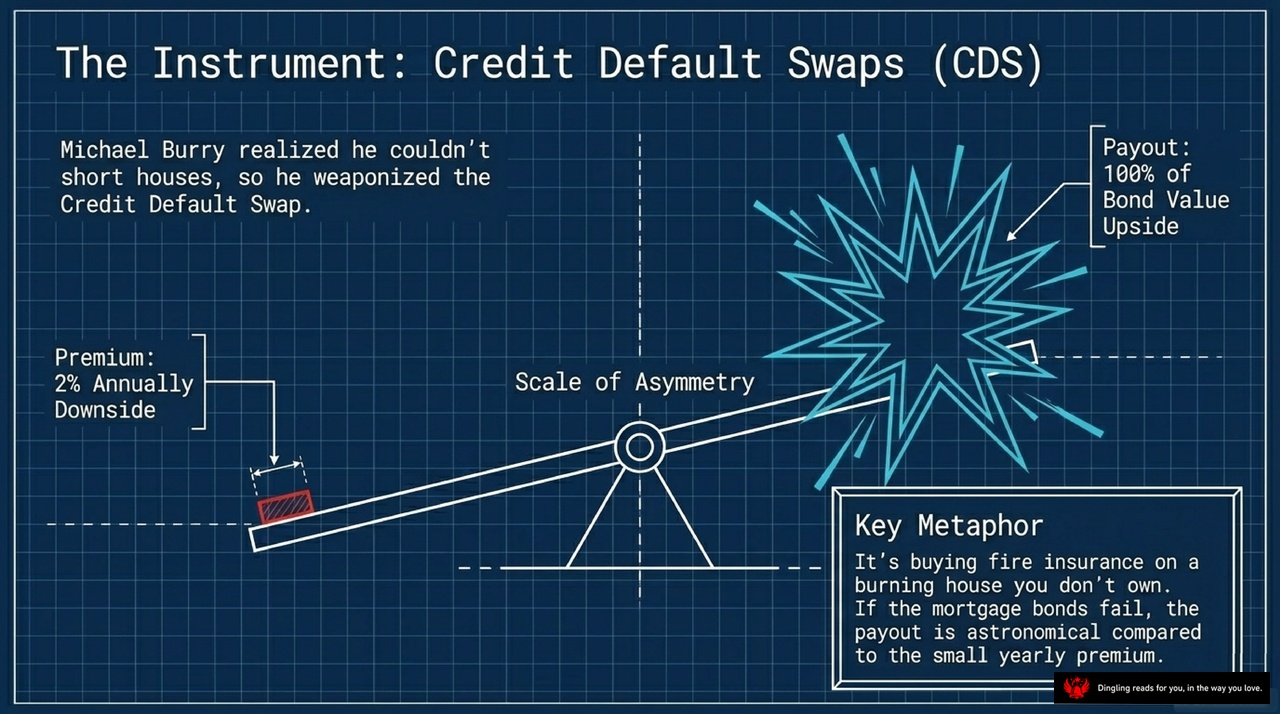
The slide you see here perfectly captures the terrifying asymmetry that defined the subprime crisis. On the left, we have the "Premium"—a tiny, manageable cost of just 2% annually. It feels safe, almost trivial. But look at the right side of this scale. That massive explosion represents the "Payout": 100% of the bond value upside. This is the essence of a Credit Default Swap (CDS).
Think of it like buying fire insurance on a house you don't own. You pay a small yearly fee, but if the house burns down—if the mortgage bonds fail—the payout is astronomical. Michael Burry realized he couldn't simply short the houses themselves, so he weaponized this instrument. By paying that small 2% premium, he was essentially betting against the entire housing market.
This "Scale of Asymmetry" is why the CDS became so dangerous. It allowed investors to leverage their bets to the maximum. You could lose only the small premiums you paid, but if the market collapsed, the profits were unlimited. It turned a financial crisis into a casino where the house, the banks, and the rating agencies were all running the game, while the insurance companies like AIG took on the risk without ever understanding what they were insuring. This tool didn't just predict the crash; it amplified it, creating a feedback loop that pulled the entire global economy into the fire.
On March 14, 2008, the dominoes finally fell. The collapse of Bear Stearns marked the true beginning of the crisis, shattering the illusion of stability that Wall Street had so carefully maintained. This once-untouchable titan, built on dangerous leverage and hidden toxic assets, vanished in hours, eventually being swallowed by JPMorgan for a mere $2 per share.
But the panic didn't stop there. By September, the entire house of cards came tumbling down. Lehman Brothers filed for bankruptcy, Merrill Lynch was forced into an emergency acquisition by Bank of America, and AIG barely survived only because the Federal Reserve stepped in with an $85 billion bailout. The giants of finance that seemed invincible were now in ruins, leaving a trail of destruction in their wake.
In this chaos, the early bettors found a strange, solitary victory. Michael Burry's fund returned nearly 489% in profit, while Steve Eisman's firm doubled its assets. Yet, instead of celebrating, they felt a deep sense of emptiness. Eisman described the experience as watching a flood while standing on the shore—knowing the truth but powerless to stop it. These pioneers proved they were right, but they also saw the dark reality of the aftermath: the executives who created this disaster walked away with massive bonuses, while the ordinary people and taxpayers bore the ultimate cost.
The root of this catastrophe wasn't just bad luck; it was a decades-long shift in the system. When investment banks transformed from partnerships into corporations, the risk shifted from the owners to the shareholders, fueling endless greed. Complex financial instruments like CDOs and credit default swaps, designed to spread risk, actually wove a global web of interconnected fragility. When one node broke, the whole system collapsed. And when the government bailed out the banks, it didn't fix the problem—it simply transferred the Wall Street risk directly onto the backs of the American people.

The system ran out of actual bad mortgages to package, so Wall Street invented a way to cheat reality. They created the Synthetic CDO using Credit Default Swaps, effectively replicating the risk of the original bonds without needing a single actual house. As the slide illustrates, for every $50 million in real bad loans, they built a billion dollars in synthetic side-bets. This synthetic multiplier meant the blast radius was no longer limited to the housing market; it became infinite. While the diagram shows a massive web of $1 billion in synthetic CDOs radiating from a tiny core of $50 million in bad loans, the terrifying insight is clear: Wall Street had decoupled the financial game from the real economy. They could now bet on the collapse of a housing market that didn't even exist in their books, creating an endless supply of risk that could destroy the entire global system with a single glitch.

Look at this chart titled "The Agony of Being Early." It captures the terrifying disconnect that defined the 2007 financial crisis. While the red line showing actual mortgage defaults was slowly climbing, the blue line representing bond prices remained stubbornly flat. Why? Because the banks had rigged the market.
In 2005 and 2006, investors like Steve Eisman were already seeing the writing on the wall. Burry was bleeding premiums, and investors were revolting, demanding their money back. But here is the trap: by mid-2007, defaults hit record highs, yet the banks refused to mark down the bonds. They were holding onto the illusion.
Wall Street controlled the pricing. Short sellers were bleeding out, waiting for reality to break the illusion, while Burry was forced to lock up investor funds to prevent a mutiny. This was the agony of being early—screaming about a collapsing house of cards while the architects of the system pretended everything was fine. The pain index on the right tells the story: the pressure was building, but the system refused to acknowledge the cost until it was too late.
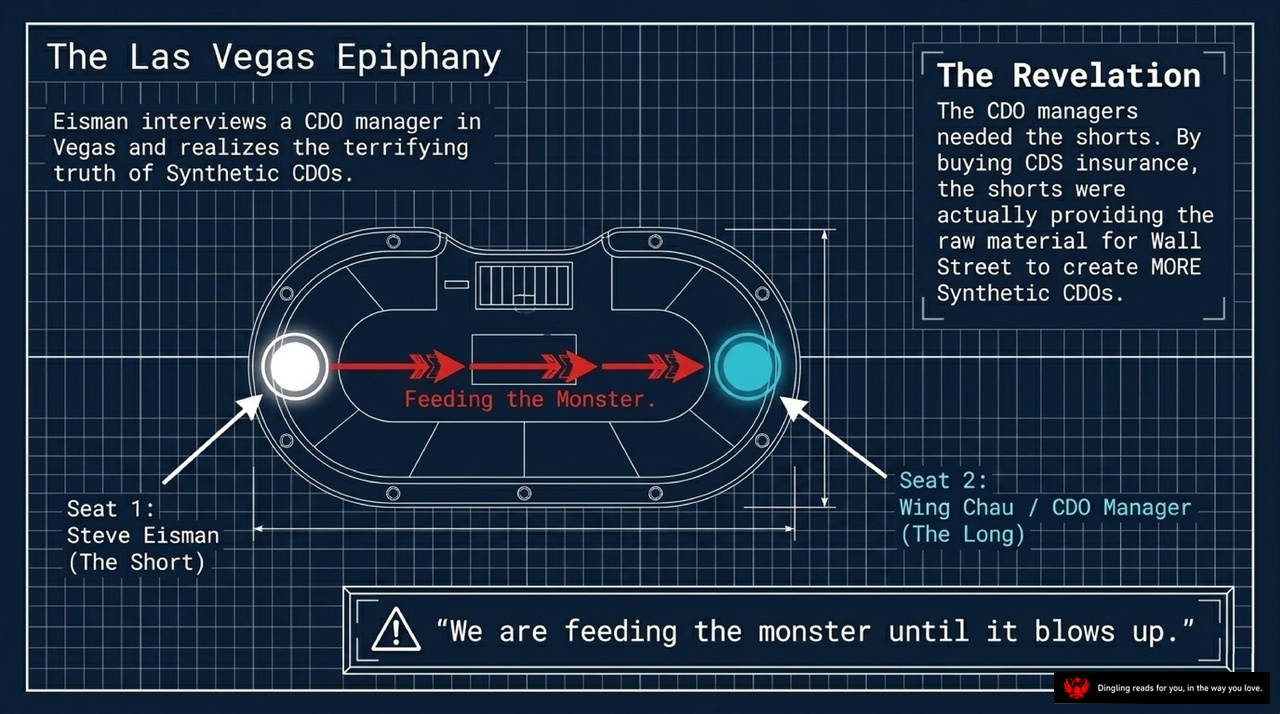
Imagine the financial system not as a machine designed to create wealth, but as a ravenous beast waiting to be fed. This is the terrifying truth Steve Eisman discovered during his epiphany in Las Vegas. He sat across from a CDO manager, a key player in this high-stakes game, and realized a chilling cycle: the very people betting against the market were actually providing the fuel that kept it alive.
Look at the diagram on the screen. On the left, we have Steve Eisman, the "Short." On the right sits Wing Chau, a CDO manager representing the "Long." Between them flows a dangerous current labeled "Feeding the Monster." Here lies the revelation that changed everything. The managers on the right needed those short positions. By selling credit default swaps to Eisman, they weren't just hedging risk; they were creating the raw material for Wall Street to manufacture even more synthetic CDOs. Every time Eisman bet against the system, he was inadvertently funding the machine that was destined to destroy it.
The warning at the bottom of the slide couldn't be clearer: "We are feeding the monster until it blows up." It was a moment of clarity for Eisman. He realized that the entire financial architecture was a self-perpetuating lie, sustained by the desperate need for new capital to cover old debts. The monster wasn't going to starve; it was going to grow until it consumed the entire economy. This wasn't just a market correction; it was a controlled explosion, and the architects were the ones holding the match.
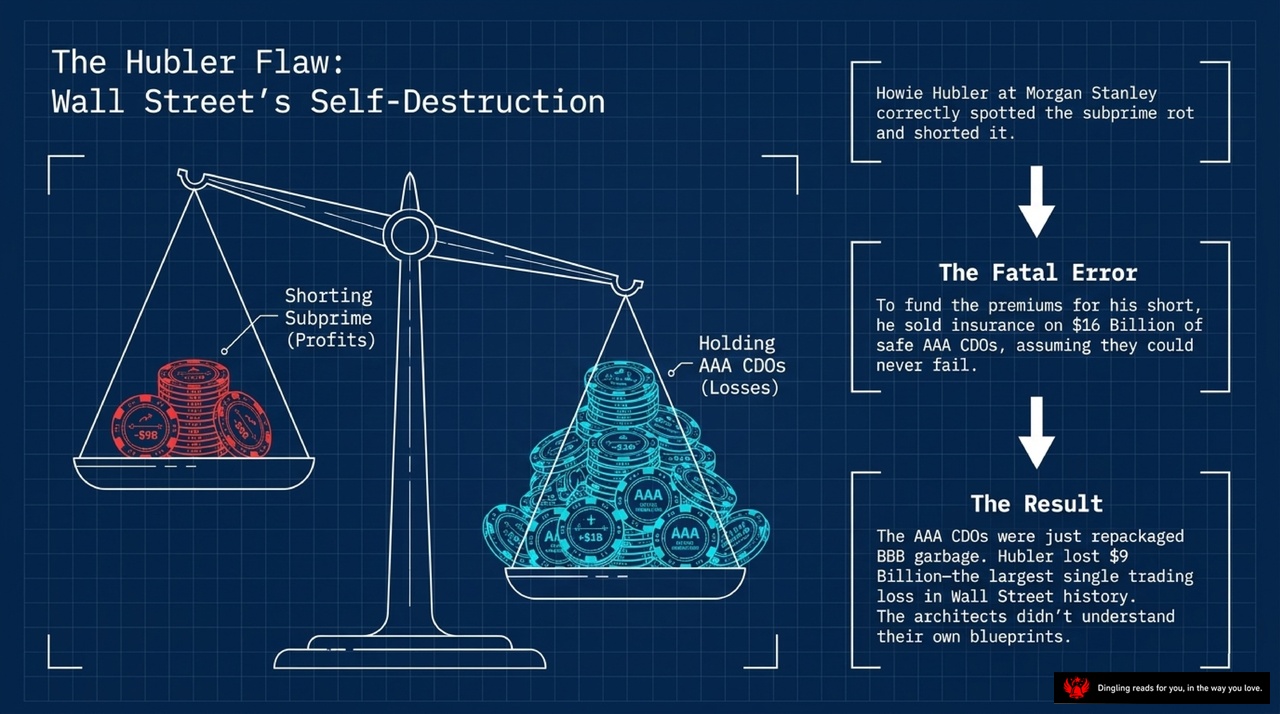
The Hubler Flaw: Wall Street's Self-Destruction. This slide captures the ultimate irony of the 2008 crash. On the left, you see the profit side: Howie Hubler at Morgan Stanley correctly identified the rot in subprime loans and decided to short them. He was betting that the market was wrong. But look at the right side of the scale. To fund his short position, Hubler needed to collect premiums. So, he did something catastrophic. He sold insurance on $16 billion of AAA-rated CDOs, assuming they could never fail. He bet on the safety of the asset he was shorting. The fatal error was thinking he could have it both ways. In reality, those AAA CDOs were just repackaged BBB garbage. When the crisis hit, the correlation of default jumped from 30% to 100%, and the entire structure collapsed. Hubler lost $9 billion, the largest single trading loss in Wall Street history. It wasn't just a bad bet; it was a system designed to destroy itself. The architects of this disaster simply didn't understand their own blueprints.

The domino effect is now in full swing. As we see on this slide, the tipping point between 2007 and 2008 wasn't a sudden explosion, but a controlled collapse triggered by a specific sequence of failures. It all began with the ABX Index plummeting, finally revealing the true, toxic price of subprime mortgages. This triggered a wave of margin calls, forcing banks to turn on each other, desperately demanding cash to stay afloat.
The domino that finally broke was Bear Stearns. In March 2008, the market panicked so hard that JPMorgan was forced to buy the entire firm for a mere $2 per share—a price that symbolized the total loss of confidence. This wasn't just one bank failing; it was the spark that ignited the final collapse. By September 2008, the chain reaction reached its inevitable conclusion with the fall of Lehman Brothers and AIG. The global credit system froze completely, leaving the world's financial infrastructure in ruins. Steve Asimow's warnings were right, but the cost of exposing this "doomsday machine" would be paid by everyone else.
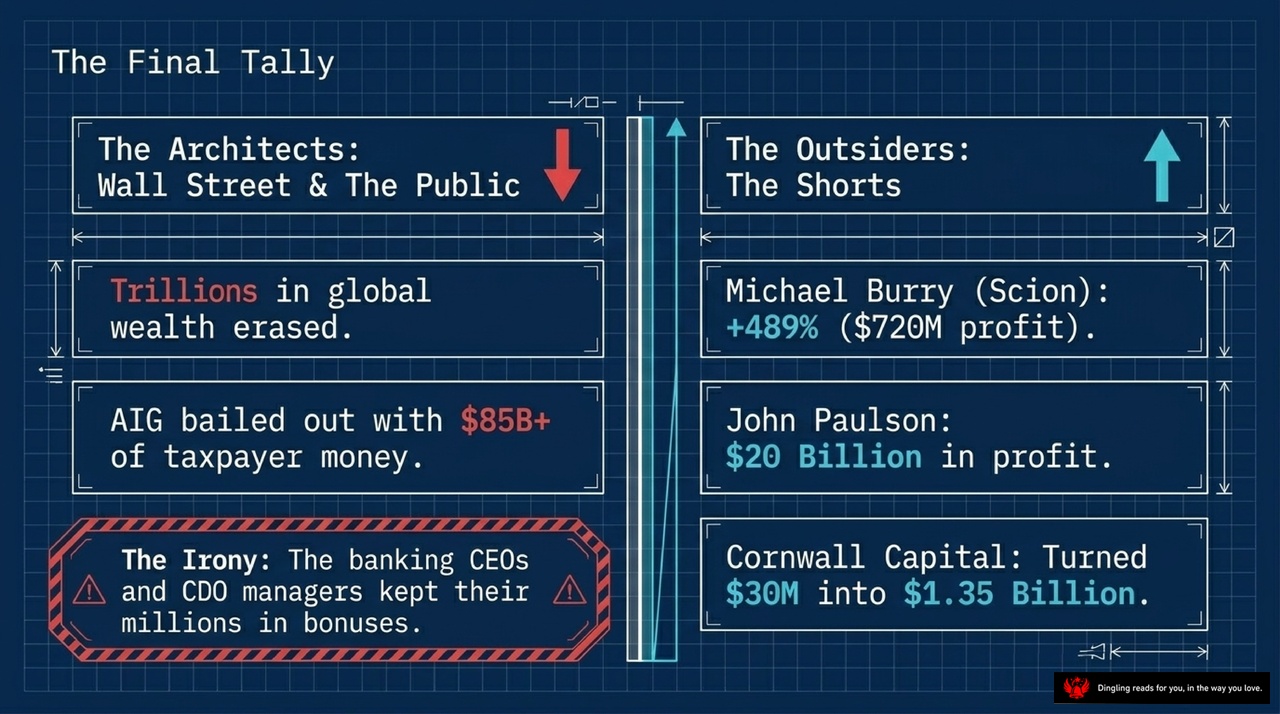
On the left, we see "The Architects: Wall Street & The Public," marked with a sharp red arrow pointing down. This represents the massive destruction of trillions in global wealth and the $85 billion taxpayer bailout of AIG. Most tragically, as the red warning box highlights, the banking CEOs and CDO managers kept their millions in bonuses while the system collapsed around them.
On the right, under "The Outsiders: The Shorts," we see the stark contrast. Michael Burry achieved a +489% return, netting $720 million in profit. John Paulson walked away with $20 billion, and Cornwall Capital turned a modest $30 million into $1.35 billion.
This slide captures the ultimate irony of the crisis. While the architects of the financial disaster bailed out with public money and pocketed private gains, the outsiders who saw the truth and bet against the system reaped the rewards. It was a final tally where the victims lost everything, and the few who dared to speak up became the biggest winners of all.
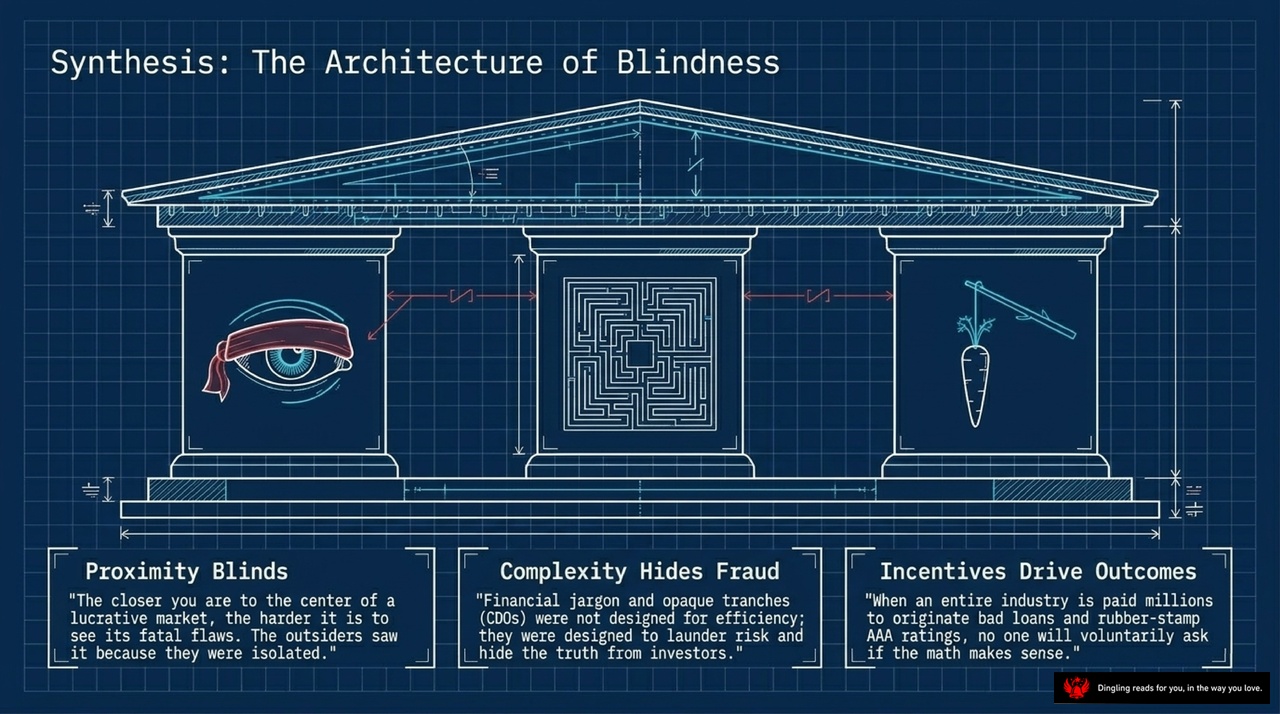
Imagine the entire financial system as a grand, classical building designed to look solid and timeless. But look closer at its three pillars, and you'll see it's actually an architecture of blindness.
First pillar: Proximity Blinds. The closer you are to the center of a lucrative market, the harder it is to see its fatal flaws. It's like wearing a blindfold; the insiders are so isolated in their wealth that they simply cannot see the cracks forming around them.
Second pillar: Complexity Hides Fraud. Financial jargon and opaque tranches act as a maze. When risk is buried behind layers of confusing structures, it becomes invisible to everyone except those who are paid to ignore it.
Third pillar: Incentives Drive Outcomes. When an entire industry is paid millions to originate bad loans and rubber-stamp AAA ratings, no one will voluntarily ask if the math makes sense. The reward for lying is far greater than the penalty for telling the truth.
This synthesis reveals the truth: the system wasn't broken by accident; it was engineered to be blind, to hide fraud, and to prioritize short-term greed over long-term reality.

Wall Street didn't just make money; they built a financial doomsday machine, fueled by relentless greed. For years, only a few outcast contrarians possessed the clarity to see its fatal flaws and profit from its inevitable collapse. But here's the terrifying question that hangs over us today: if the opaque systems and misaligned incentives that caused the crash have largely survived, who is quietly building the next doomsday machine right now? We often think the worst is behind us, but the blueprint for destruction is being drawn once again.