
The Black Swan: Complete Chapter-by-Chapter Summary
Welcome to the world of *The Black Swan* by Nassim Nicholas Taleb. Look at this image: dark, churning waves crashing under a heavy, stormy sky. This isn't just a dramatic backdrop; it's the perfect visual metaphor for the book's core idea. We live in a world driven by highly improbable and unpredictable events—what Taleb calls Black Swans.
Most of us, however, are blind to this reality. Our brains are wired to create smooth, logical stories to make sense of history, treating chaotic jumps as if they were a straight, predictable line. We convince ourselves that the past guarantees the future, ignoring the very disruptions that actually shape our lives. As Taleb illustrates with the collapse of the Levant, history isn't a gentle climb; it's a series of sudden, violent leaps that we often fail to see coming until it's too late.
This book challenges that illusion. It asks us to stop pretending we can predict the unpredictable and instead learn to navigate a world where the extraordinary, not the average, drives everything we know.
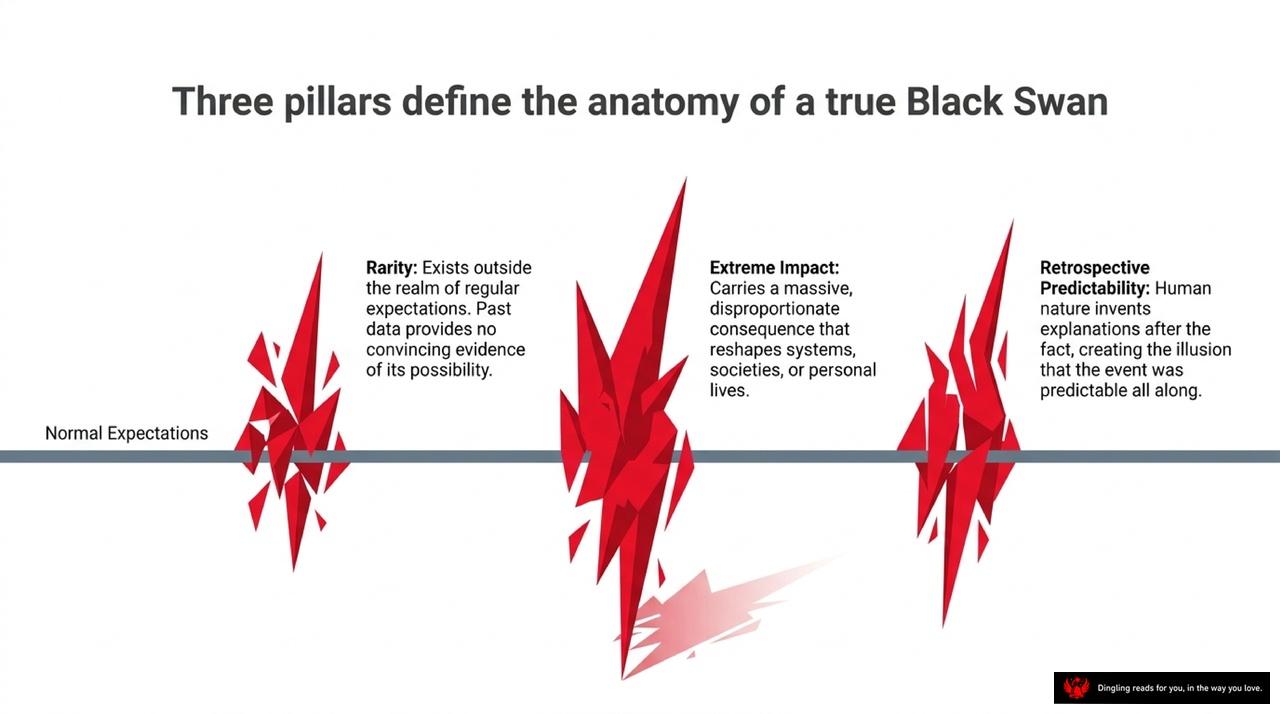
The slide highlights the three pillars that define a true Black Swan: Rarity, Extreme Impact, and Retrospective Predictability. Let's break this down. First, Rarity means the event lies completely outside our normal expectations; past data simply cannot predict it. Think of the 2008 financial crash or the sudden rise of a novel like Eugenia's—it wasn't on anyone's radar before it happened. Second, Extreme Impact is about the sheer scale of the consequence. These events don't just nudge the needle; they reshape societies, economies, or even personal lives entirely. A single event can wipe out a company or launch a new era. Finally, and perhaps most dangerously, is Retrospective Predictability. This is the human tendency to invent explanations after the fact. Once the event occurs, our brains scramble to create a logical story, making it look like it was obvious all along. We pretend the Black Swan was predictable, even though it wasn't. This illusion blinds us to future surprises, trapping us in a cycle of false confidence. To truly understand risk, we must accept that some things are fundamentally unknowable until they happen.

Look at this graph. It shows a terrifying truth: past survival does not predict future safety. You see, confidence in safety actually peaks at the exact moment of maximum risk.
Imagine a turkey being fed by a farmer for 1,000 days straight. Every single day, the turkey gets fed. It uses logic and induction to build a perfect theory: "Humans are friendly, and feeding will continue forever." By day 1,000, the turkey is at its absolute peak of confidence. It feels safer than ever. But then, on day 1,001, it's Thanksgiving. The farmer pulls out the knife.
This is the fatal flaw of human thinking. We love to weave history into a neat, logical story where the past guarantees the future. We assume that because the sun rose 1,000 times, it will rise tomorrow. We assume that because a stock has risen for a decade, it will keep rising. We assume that because we survived a crisis last time, we are safe now.
But in the real world, especially in high-stakes environments, history is not a linear path. It is full of sudden, unpredictable jumps. The turkey's 1,000 days of safety meant absolutely nothing when the black swan event arrived. Historical data actively misleads us when extreme randomness is at play. Just because you survived the past doesn't mean you're safe for the future. In fact, the moment you feel the most secure, is often the precise moment you are most vulnerable.
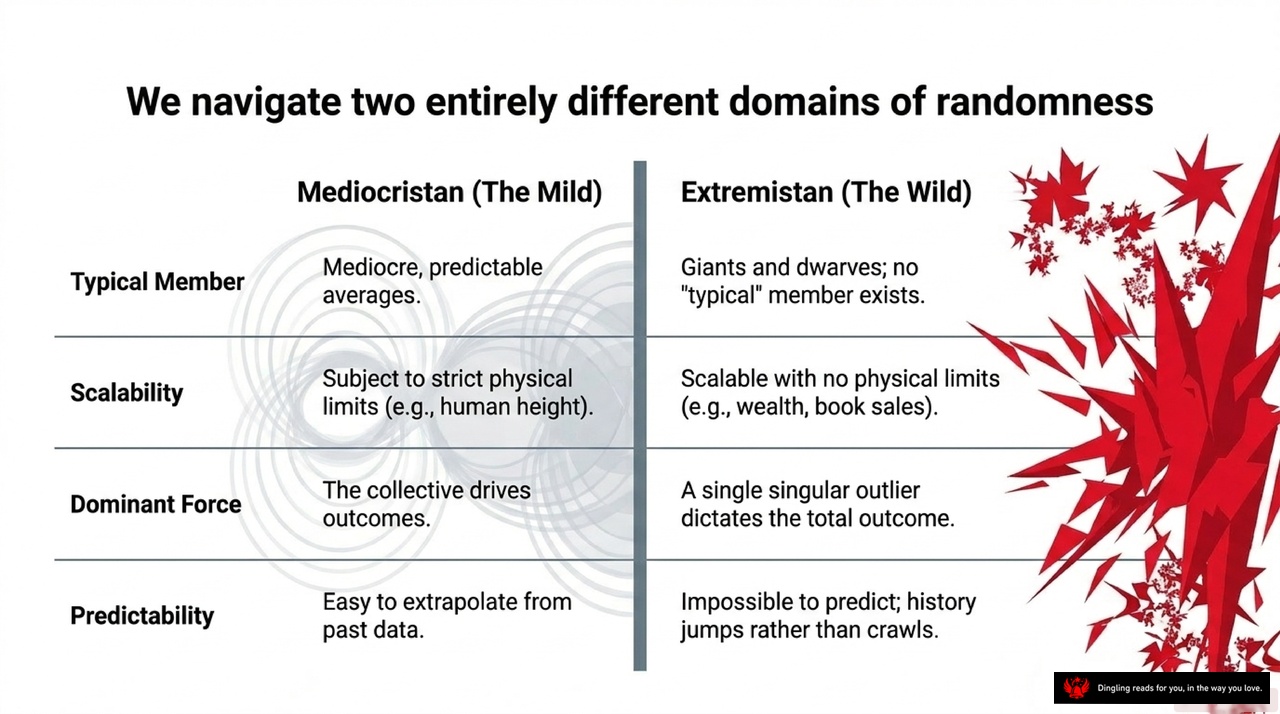
We navigate two entirely different domains of randomness: Mediocristan, the mild world of averages, and Extremistan, the wild world of extremes. Look at the chart. In Mediocristan, the typical member is a mediocre, predictable average, subject to strict physical limits like human height. The collective drives outcomes, making it easy to extrapolate from past data. But step over into Extremistan, and everything changes. Here, there are no typical members—only giants and dwarves. Scalability has no physical limits; think of wealth or book sales. A single singular outlier dictates the total outcome, and history jumps rather than crawls, making prediction impossible. This is the reality of the Black Swan: it doesn't live in the predictable middle; it rules the wild, unpredictable extremes where one event can shatter the entire system.

We often tell ourselves stories to make sense of the chaos, but in doing so, we fall into the "Narrative Fallacy." Our brains are wired to crave a coherent plot, turning random, fragmented events into a logical sequence with a clear beginning, middle, and end. It's like watching a detective movie where every clue fits perfectly, even if in reality, the clues were just a messy coincidence.
This distortion becomes deadly when facing Black Swan events. Take the 2004 Rome conference: a professor initially agreed with my argument against over-explanation, only to immediately invent a new story about the "Mediterranean Orthodox environment" to explain my stance. He wasn't listening to the data; he was listening to the narrative. We do this constantly. When asked about the probability of a California earthquake causing floods, people estimate it as much higher than a flood anywhere in the US. Why? Because the specific, vivid story of "earthquake" triggers fear, making the abstract, more likely event of "a flood somewhere" feel less probable.
Our emotions hijack our logic. We overestimate the risk of specific, dramatic scenarios—like terrorism or plane crashes—while ignoring the silent, high-impact risks that lack a catchy headline. When a Black Swan finally strikes, we rush to create a new story to explain it, convincing ourselves it was inevitable, when it was actually pure randomness.
To avoid this trap, you must actively engage your slow, logical thinking system to override your brain's instinct for a good story. Don't just listen to success stories; look at the raw data, including the failures that were erased. Train yourself to ask: "What information is missing from this story? What other explanations exist?" By resisting the urge to compress reality into a neat narrative, you stop lying to yourself and start seeing the world as it truly is: unpredictable and full of hidden dangers.

The Sydney Opera House stands as a monument to the failure of prediction. What was supposed to be a 700 million Australian dollar project finished in 1963 eventually took a decade and cost over 100 million dollars, with the final structure even smaller than originally planned. This isn't an isolated incident; it's a pattern. Before the 2008 financial crisis, almost no mainstream economist saw it coming. They were trapped in a bubble of overconfidence, believing their complex models could tame the market.
This is the "illusion of prediction." We suffer from a built-in cognitive arrogance. We overestimate what we know and dangerously underestimate the world's true chaos. Even when asked to give a 98% confidence interval for a number, people—including Harvard Business School students—consistently fail, with error rates far exceeding 2%. We draw lines around what we think we know, not realizing those boundaries are terrifyingly narrow.
But there's a deeper trap here: the "Gambler's Fallacy." We mistake the casino for reality. In a casino, the rules are fixed, and probabilities are calculable. But the real world is "wild uncertainty." It has no fixed rules. When a performer gets bitten by a tiger in a casino, causing a loss of nearly 100 million dollars, that's a risk no traditional model ever accounted for. We try to apply simplified game logic to a complex, unpredictable reality, and it always fails.
So, how do we stop pretending we can predict the future? The answer lies in admitting our ignorance. We must shift from trying to be prophets to becoming prepared. Instead of obsessing over the impossible task of pinpointing the exact moment a black swan will strike, we should focus on building resilience. We need to design systems that can survive shocks and even benefit from them. By acknowledging that our knowledge is limited and that the future is inherently chaotic, we stop chasing false certainty and start building a life that can withstand the unexpected.
In the world of extreme volatility, experts often fail because they suffer from cognitive arrogance. We tend to overestimate what we know and drastically underestimate the sheer uncertainty of reality. Even brilliant minds, like those at Harvard Business School, struggle with this. If you ask them to give a range where they are 98% sure the answer lies, they are wrong far more often than they should be. This isn't just about being wrong; it's about the dangerous accumulation of small errors that eventually leads to catastrophic outcomes.
Consider the Long-Term Capital Management fund, founded by Nobel laureates. They relied on complex mathematical models that ignored the possibility of extreme events. When a Black Swan hit, their entire system collapsed, nearly bringing down the global financial system. It's a stark reminder that prediction is often an illusion.
This brings us to a critical error known as the "Gambler's Fallacy." We mistakenly apply the logic of a casino—where rules are fixed and probabilities are calculable—to the real world, which is full of wild, unpredictable uncertainty. In a casino, risks are managed; in life, a single unexpected event can cause losses thousands of times larger than any standard risk model predicts.
The root of this failure is our innate overconfidence. We treat our assumptions as facts. We look at a blurry image and see a fire hydrant too quickly, mistaking random noise for a clear signal. We believe we can control the future with formulas, but the truth is far messier. To survive, we must stop pretending we know everything. We need to question our own confidence, actively seek evidence that disproves our beliefs, and delay our judgments. Only by admitting our ignorance can we truly prepare for the unknown.
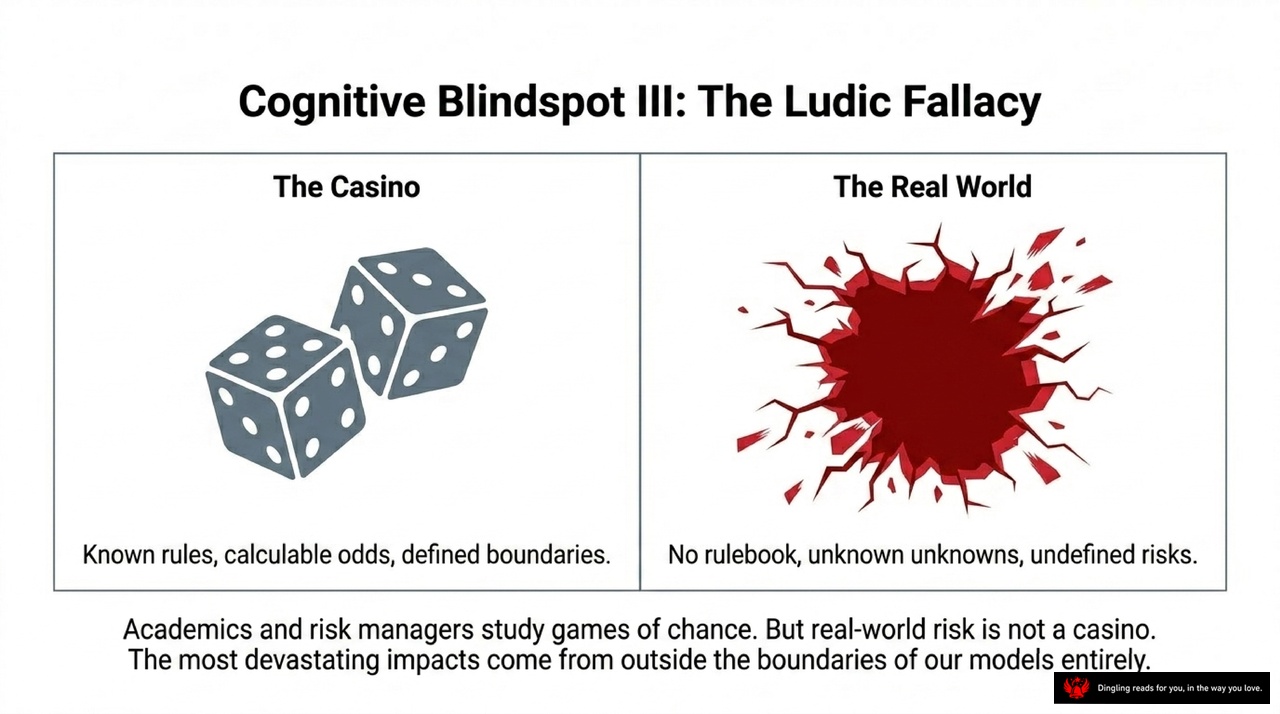
So, we've been talking about how our brains love to turn random chaos into neat, logical stories. That's the Narrative Fallacy in action. But here's the kicker: the real world isn't a casino. It's wild, unpredictable, and full of "unknown unknowns."
Look at that split on the screen. On the left, "The Casino." Think of it like a game of dice. The rules are clear, the odds are calculable, and you know exactly where the boundaries are. It's a controlled environment where everything makes sense.
But look at the right side: "The Real World." This is a massive, red splatter. No rulebook. No defined boundaries. Just "unknown unknowns" and undefined risks.
This is where the Ludic Fallacy hits us hardest. Academics and risk managers often study games of chance, like those dice in the casino, and then try to apply those same rules to real life. They assume the world works like a game with fixed probabilities. But here's the truth: real-world risk is not a casino. The most devastating impacts don't come from within the rules we know; they come from entirely outside the boundaries of our models.
When a black swan event hits, it's not a roll of the dice we can calculate. It's a total system collapse that our "casino logic" simply cannot predict. So, stop treating life like a game with a known scorecard. The biggest dangers are always hiding in the chaos, outside your model.

The slide highlights a critical truth: in the real world, we are not playing a game with fixed rules like in a casino. We are living in a realm of "wild uncertainty" where black swan events are not just possible—they are inevitable. This is where the concept of the "Barbell Strategy" becomes your ultimate survival tool.
Instead of trying to find a safe middle ground, which often leaves you vulnerable to both ruin and missed opportunities, the Barbell Strategy forces you to live at the extremes. Think of it like a literal barbell: on one end, you have an ultra-conservative fortress. This is where you keep 85% to 90% of your resources—safe assets like government bonds or cash reserves. The goal here is simple: ensure you never go bankrupt. No matter what black swan event hits, your survival is guaranteed.
On the other end of the barbell, you allocate the remaining 10% to 15% into high-risk, high-reward ventures. This could be speculative investments, startup equity, or niche art. The logic here is pure asymmetry: you can afford to lose this entire portion without affecting your life, but if you hit a positive black swan event, the returns are unlimited and could cover all your losses many times over.
This approach perfectly adapts to our reality because it acknowledges that the world is not fair or linear. By combining a solid defensive shield with a daring offensive spear, you stop being a victim of chaos. You don't need to predict the future to survive it; you just need to structure your life so that you are protected from the worst-case scenarios while staying open to the life-changing opportunities that only the extreme can offer.

The slide you see right now is a powerful visual metaphor for how we should actually position ourselves in an unpredictable world. Look at this seesaw. On the left, we have "Positive Black Swans." These are opportunities where the downside is limited, but the upside is uncapped. Think of venture capital, scientific discovery, or publishing. You might lose a little, but if you hit that rare, unpredictable moment, the reward is infinite. On the right, we have "Negative Black Swans." Here, the upside is capped, but the downside is ruinous. This is the world of banking, homeland security, or catastrophe insurance. A single unexpected event can wipe you out completely.
The text at the bottom of this slide gives us the golden rule for survival: You cannot predict Black Swans, but you can position yourself based on their asymmetry. The strategy is simple yet profound: Seek environments where a surprise brings infinite reward, and avoid environments where a surprise results in total ruin. Instead of trying to guess when the next crash or breakthrough will happen, focus on building a life where you are safe from the bad surprises while remaining fully exposed to the good ones. It's about embracing the asymmetry of impact rather than fighting the uncertainty of the future.

We've just seen how the "Fourth Quadrant"—where extreme randomness meets complex, interconnected systems—is the absolute danger zone for any statistical model. In this red zone, standard forecasting collapses because it tries to apply the rules of "Mediocrity" to a world defined by "Extremistan."
Think about the tools we rely on. The bell curve, or Gaussian distribution, is the gold standard for the average world—like predicting human height or weight. But it fails completely in the Fourth Quadrant. It assumes that extreme outliers are so rare they can be ignored. In reality, in fields like finance, publishing, or wealth, a single "Black Swan" event can dwarf the combined impact of thousands of normal events. The bell curve doesn't just underestimate the risk; it fundamentally misunderstands the physics of the situation.
This is why experts often fail so spectacularly. They build models based on past data, assuming the future will look like the past. But in the Fourth Quadrant, the past is irrelevant. A tiny, seemingly insignificant event—a rumor, a political shift, a minor technical glitch—can trigger a cascade that shatters the entire system. The 2008 financial crisis or the collapse of Long-Term Capital Management weren't accidents; they were the inevitable result of trying to predict chaos with linear equations.
So, what's the takeaway? Don't try to forecast the Fourth Quadrant. It's a trap. Instead of pretending you can calculate the probability of a catastrophe, you need to build systems that are antifragile. Accept that your models will break, and design your life and business to not just survive the break, but to gain from the disorder. In the danger zone, the only winning move is to stop trying to be right, and start preparing for the unexpected.

Welcome back to our deep dive into *Antifragile*. Today, we're talking about the ultimate antidote to the chaos of the Black Swan: The Barbell Strategy.
Look at this graphic. It's a simple yet powerful visual of a barbell. On one end, you have 85 to 90 percent of your resources locked into hyper-conservative assets like Treasury bills. This is your absolute safety net. It offers extreme downside protection, ensuring that no matter what global catastrophe strikes, your survival is guaranteed. You are completely insulated from ruin on this side.
On the other end, you have just 10 to 15 percent of your capital allocated to hyper-aggressive bets. Think venture capital, speculative options, or niche art. This is where you expose yourself to infinite upside. The goal here isn't steady growth; it's capturing massive positive Black Swans. If you get lucky here, you win big. If you lose it all, it doesn't matter because your other 90 percent keeps you alive.
Notice the long, empty space in the middle? The slide calls it "The Void." This is the most critical part of the strategy. You must avoid "medium risk" entirely. The traditional middle ground—moderate stocks, balanced funds, or steady careers—is actually the most dangerous place to be. Why? Because it caps your upside while still exposing you to significant downside. In a world driven by extreme outcomes, trying to aim for the average is a losing strategy.
The text at the bottom drives this home: Do not attempt to manage risk by aiming for the middle. Instead, cap your downside completely on one end and expose yourself to massive positive Black Swans on the other. This isn't about gambling; it's about building an antifragile system where you thrive on volatility. By embracing the asymmetry of the barbell, you stop fearing the unknown and start leveraging it for your advantage.

Today's slide lays out the four non-negotiable rules for surviving in a world defined by Black Swans. First, favor experimentation over storytelling. Instead of relying on rigid, top-down plans or trying to craft a perfect narrative about how things will go, embrace tinkering and trial-and-error. In an unpredictable environment, the ability to adapt through small, frequent tests outperforms any static blueprint.
Second, build redundancy and actively avoid optimization. We often chase efficiency to the point of fragility, stripping away buffers until we have nothing left to give when a shock hits. The smart move is to keep spare capacity—whether that's extra cash, overlapping skills, or backup systems. This redundancy guarantees survival when the unexpected strikes.
Third, maximize your exposure to serendipity. Don't hide away; go to parties, live in vibrant cities, and put yourself directly in the path of positive Black Swans. Opportunities rarely find you when you're isolated; they appear when you are open to the chaos around you.
Finally, and most critically, beware of the 'Expert' forecast. Do not base your survival on the predictive models of economists or government planners. Their linear thinking simply cannot account for the non-linear reality of our world. Trust your ability to adapt, not their ability to predict.

Look at this single red dot in the vast, dark void. It represents you. The slide declares, "You are a Black Swan." But what does that actually mean? It's not just a catchy metaphor; it's a mathematical reality.
The text below explains that the odds of your specific existence—the exact chain of historical events, biological encounters, and evolutionary survivals required to create you—are infinitesimally small. You are a highly improbable event. Think about it: if you rewound time to the Big Bang and let the universe play out again, the chance that you, specifically, would emerge is virtually zero.
So, why does this matter? Because if your life is a statistical anomaly, then the small stuff—the daily commute, the minor conflicts, the routine worries—doesn't really matter. The slide advises us to "not sweat the small stuff." Not because we should be indifferent, but because realizing how incredibly lucky you are should fundamentally shift your perspective. When you understand that your existence is a one-in-a-billion cosmic accident, the trivial anxieties of life lose their grip. You stop worrying about the predictable and start appreciating the miraculous. You are not a typical data point in a bell curve; you are the outlier that makes the curve possible. Embrace the absurdity of your own existence.

So, here is the final takeaway from our journey into the unknown. We've learned that while we can't predict the extreme events that dictate our world, we absolutely can build systems, minds, and lives that are robust enough to thrive in their wake. Stop fighting uncertainty; instead, structure yourself to benefit from the shock.
Think about it: if the most consequential events of your life were entirely unpredictable, why are you still building your future on the illusion of a forecast? That question challenges everything we thought we knew about control and prediction. The truth is, the world isn't a smooth, predictable line; it's a landscape of sudden jumps and black swans. By admitting our limits and embracing a "barbell strategy"—keeping a solid core while daring on the edges—we stop being victims of chaos and become masters of it. The future isn't something you forecast; it's something you prepare to survive and even thrive in.