
The Blank Slate: Complete Chapter-by-Chapter Summary

Welcome to the book club. Today, we're diving into Steven Pinker's *The Blank Slate*, a book that challenges the very idea of what it means to be human.
Look at that title and the subtitle: "The scientific dismantling of the modern dogmas that deny human nature." This isn't just about biology; it's about the stories we tell ourselves to make sense of the world. For centuries, Western thought has been built on three powerful myths. First, the Blank Slate theory, which suggests our minds are like empty sheets of paper, waiting to be written on by our environment. Second, the Noble Savage idea, which claims we are born peaceful and that all violence is a result of bad society. And third, the Ghost in the Machine, the belief that our souls or minds exist separately from our physical brains.
Pinker argues that these aren't just harmless theories; they are dangerous fictions that have shaped our politics, our wars, and our view of ourselves. He shows us that science has moved far beyond these old ideas, revealing that our brains come pre-wired with instincts, emotions, and cognitive tools that have been shaped by evolution. It's a wake-up call to stop pretending we are infinitely malleable and start understanding the real, complex human nature that we all share.

The diagram on this slide lays out the three dominant myths that have shaped our understanding of human nature for centuries. At the center lies "The Standard Model of Social Science," a framework built on the intersection of three powerful ideas.
First, look at the top circle: "The Blank Slate," championed by John Locke. This theory argues that the human mind is born as a blank sheet of paper, possessing no innate traits. It suggests that all our knowledge, behaviors, and even our personalities are completely inscribed by our experiences and culture. For a long time, this idea was the bedrock of social science, suggesting that human differences are merely the result of different environments.
Contrast that with the bottom-left circle: "The Noble Savage," proposed by Jean-Jacques Rousseau. This view takes the opposite stance, arguing that humans in their natural state are peaceful and selfless. It posits that violence and greed aren't part of our nature but are purely artifacts of corrupt civilization. This perspective has deeply influenced modern thought, often leading us to blame societal institutions for our problems rather than looking at our own biology.
Finally, on the right, we have "The Ghost in the Machine," a concept originating from René Descartes. This theory claims that the mind and body are separate entities. It suggests that human choices are driven by an immaterial soul that operates outside the physical laws of biology. This idea—that we have a non-physical pilot controlling our biological machine—still permeates our daily language and beliefs today.
These three models—the blank slate, the noble savage, and the ghost in the machine—don't exist in isolation. They often overlap and reinforce each other, forming the traditional wisdom that has guided our policies, cultures, and personal behaviors for millennia. However, as we've seen in previous chapters, these ancient intuitions are increasingly being challenged by modern science.
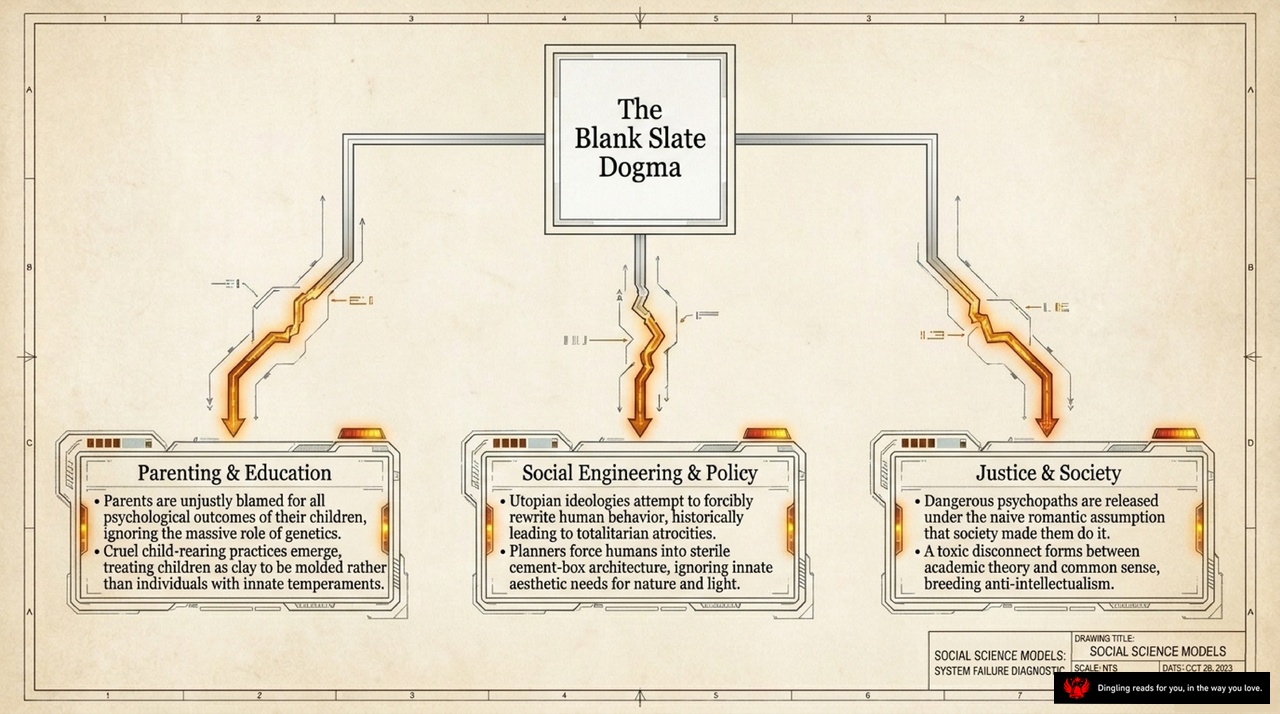
Have you ever wondered why your child acts the way they do, or why two kids from the same home turn out so differently? For decades, the "Blank Slate" dogma told us that parents and educators hold all the power, believing children are like clay waiting to be molded. But modern science has shattered that illusion.
The data is clear: the home environment you create accounts for less than 10% of a child's personality and intelligence. Studies on twins raised apart prove that genetics plays a massive role, while shared family experiences matter far less than we assume. So, where does the rest come from? It's not just nature; it's the "unique environment"—those specific moments that happen only to one child, like a chance encounter with a teacher or a unique life event.
This shift changes everything for parenting. You stop trying to sculpt a perfect child and start enjoying the journey of raising a unique individual. It also means we must stop blaming parents for outcomes that are largely out of their control.
And this logic extends beyond the family room. If we accept that human behavior has deep biological roots, we can stop chasing utopian social engineering that tries to rewrite human nature. We can also stop forcing rigid, sterile designs on our cities and schools, ignoring our innate need for nature and light.
Finally, it challenges how we view justice. We can't simply blame society for every crime, assuming people are blank slates who learned to be bad. We must acknowledge the complex interplay of biology and environment. By embracing this reality, we move from a culture of blame to one of understanding, creating policies and relationships that work with human nature, rather than fighting against it.
We've all felt that deep, unsettling anxiety: "If my actions are just the result of my brain's wiring, am I actually in control? If my personality is just my genes talking, does that mean I'm not responsible for who I am?" This is the core of the "Four Worries about Human Nature" we face today.
First, there's the fear that admitting we have innate differences will become an excuse for discrimination. History shows us that twisted ideologies like Social Darwinism have used biology to justify inequality, claiming the strong deserve their power and the weak deserve their suffering. But this is a fundamental misunderstanding. Evolution explains how we adapt to survive, not how we should be treated morally. True equality isn't about pretending everyone is identical; it's about ensuring everyone has the same rights and opportunities to thrive, regardless of their starting point.
Second, we worry about our inherent imperfections—our natural tendencies toward selfishness, aggression, or greed. Does this mean social reform is pointless? Not at all. Just because a trait is "natural" doesn't make it right. Our moral compass didn't evolve alongside our selfish impulses; it evolved specifically to counteract them. We have the capacity to expand our circle of empathy, to forgive, and to cooperate, proving that our biology isn't a prison, but a toolkit we can learn to use wisely.
Third, the question of free will versus determinism keeps us up at night. If our brains are just complex machines processing inputs, is our choice an illusion? Science suggests a more dynamic picture. Our brains aren't rigid robots; they are adaptable systems that learn from consequences and adjust their behavior. While our choices are influenced by our biology and environment, we still have the power to make different decisions based on our reasoning and values. Responsibility exists not because we are magic, but because we are capable of understanding the impact of our actions.
Finally, there's the fear that if we are just biological machines, life loses its meaning. Is joy just a chemical reaction? Is love just a hormone? While it's true our feelings have a biological basis, that doesn't strip them of value. In fact, understanding our nature allows us to appreciate life more deeply. We don't need a supernatural soul to find purpose. The meaning of our lives is found in our connections with each other, in the love we give and receive, and in the conscious choices we make to create something meaningful in a finite world. By embracing our full humanity—both our flaws and our potential—we can move beyond fear and live with intention.

We often feel that our understanding of the world is a direct, perfect copy of reality, like a mirror reflecting the universe exactly as it is. But the truth is far more fascinating: our brains are actually sophisticated information decoders, constructing our reality through a complex process of reverse engineering rather than simple replication.
Consider optical illusions like Shepard's "turning table" or Adelson's "checker shadow" illusion. In these images, identical shapes or shades of gray appear completely different to our eyes. Does this mean our vision is flawed? Absolutely not. These aren't errors; they are proof that our visual system is working brilliantly. It is actively trying to identify the true properties of objects in a three-dimensional world—like size, shape, and texture. It only gets "tricked" when we deliberately create visual traps that violate the rules of our physical environment.
Our brains never touch reality directly. Instead, we take fragmented signals from our retinas and combine them with past experiences and innate cognitive rules to build a meaningful picture of the world. This construction isn't random; it's entirely focused on our survival. We need to accurately spot cliffs, predators, and the emotions of our peers to stay alive.
When we notice a perception illusion, we don't fall into skepticism; we actively seek to correct it. If a oar looks "broken" in the water, we touch it or change our angle to verify its true shape. This ability to cross-check our perceptions against physical evidence is what anchors us in reality. We aren't passive blank slates waiting to be filled, nor are we mirrors. We are intelligent systems that actively build, verify, and coordinate our understanding of the world, allowing us to find our true coordinates in a complex and ever-changing universe.

We often think of our brains as blank slates, waiting to be filled by experience. But the reality is far more complex. Our perception of the world isn't a direct copy of reality; it's an active construction. Our visual system acts like a sophisticated decoder, using past experiences and innate rules to make sense of fragmented signals. This is why optical illusions happen—they aren't mistakes, but proof that our brain is trying to find the "real" world behind the data.
This same cognitive wiring shapes how we understand society. We rely on core intuitions evolved for the Stone Age, which often clash with modern reality. We instinctively categorize people into groups, leading to stereotypes. While categorization helps us navigate a busy world, it becomes dangerous when we ignore individual differences and apply group traits to specific people. Education, then, isn't about filling a blank mind. It's about helping us override these deep-seated intuitive errors—like our tendency to see life as "all or nothing"—and embrace the nuance of science, logic, and empathy. We must move from relying on gut feelings to understanding the complex, biological roots of our thoughts and choices.
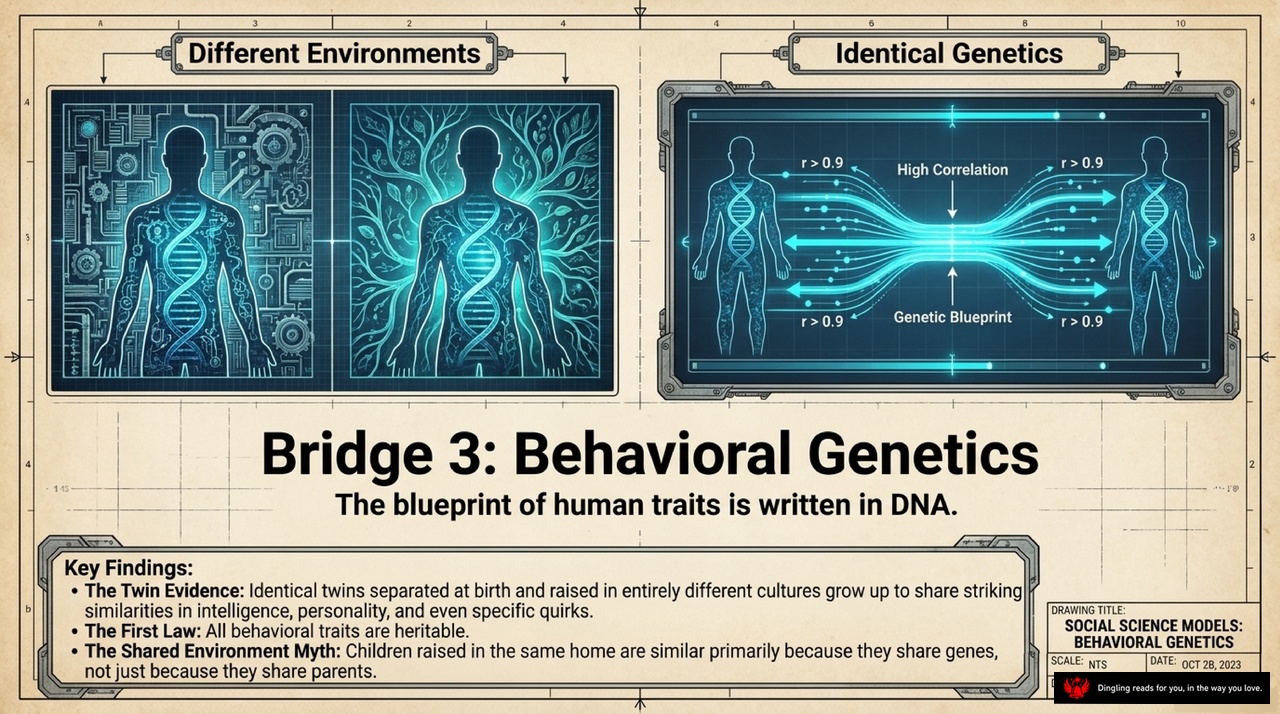
For centuries, parents have been told that their parenting style is the master key to shaping a child's future. We've been sold the idea that if we just talk enough, set the right boundaries, or avoid punishment, we can sculpt our kids into perfect versions of ourselves. But the science of behavioral genetics tells a completely different story.
The research is clear: the shared environment—the home, the parents' teaching style, the family atmosphere—accounts for less than 10% of a child's differences in intelligence and personality. In fact, this influence almost disappears entirely by adulthood. Siblings raised together often turn out no more similar than strangers, while identical twins raised apart remain remarkably alike. This shatters the "blank slate" myth and proves that your home life doesn't determine your child's core traits.
So, where do these differences come from? It's a mix of genetics and unique, individual experiences. While genes load the gun, unique environment pulls the trigger. These are the specific, unpredictable moments in a child's life: a favorite teacher, a unique friendship, a chance failure, or even random events during brain development. It's not about the family you share, but the unique path each child walks.
This doesn't mean parents are useless. Your role isn't to shape their personality, but to nurture their happiness and provide a secure foundation. You are the first relationship in their life, and that bond matters deeply. You guide their values and help them navigate the world, but you cannot—and should not try to—rewrite their genetic blueprint.
By letting go of the illusion that we can control everything, parents can finally stop the anxiety and start enjoying the journey. Your child is not a clay statue waiting to be molded; they are a unique individual with their own trajectory. Embrace their individuality, support their growth, and trust that their potential is far greater than any parenting manual could ever predict.
Welcome to Bridge 7, where we tackle the myths that keep parents up at night. For decades, the parenting industry has sold us a dangerous lie: that your specific actions—talking more, setting stricter limits, or avoiding all physical punishment—can sculpt your child's intelligence and personality. It makes us feel like we're holding a lump of clay, ready to mold our kids into perfection. But the science says otherwise.
Behavioral genetics has shattered this illusion. Research shows that the "shared environment"—the things we think matter most, like your family's socioeconomic status or your parenting style—actually accounts for less than 10% of a child's development. By the time they hit adulthood, the influence of growing up in the same house almost disappears entirely. Siblings raised together are no more similar than strangers. Meanwhile, identical twins raised apart remain far more alike than those raised together. This proves that your home environment isn't the architect of your child's mind.
So, what actually drives individual differences? It comes down to two main forces. First, genes play a massive role, accounting for roughly 40% to 50% of variation in traits like intelligence and personality. This isn't about "genetic determinism," but rather acknowledging that our biological blueprint sets the stage. Second, and perhaps most surprisingly, is the "unique environment." This includes the specific, random events that only one child experiences: a chance encounter with a mentor, a unique failure, or a specific peer group. These unique factors account for the other 50% of variation.
The takeaway is liberating. You are not the primary shaper of your child's intellect or core personality. Your role isn't to sculpt them, but to connect with them. Your job is to provide warmth, safety, and love, which directly impacts their current happiness and future relationships. You choose their friends and model values, but you cannot force their mind. Stop viewing your child as a project to be finished. Instead, embrace the mystery of their unique journey. Break free from the anxiety of being a "perfect parent," and enjoy the privilege of simply being a witness to their life.

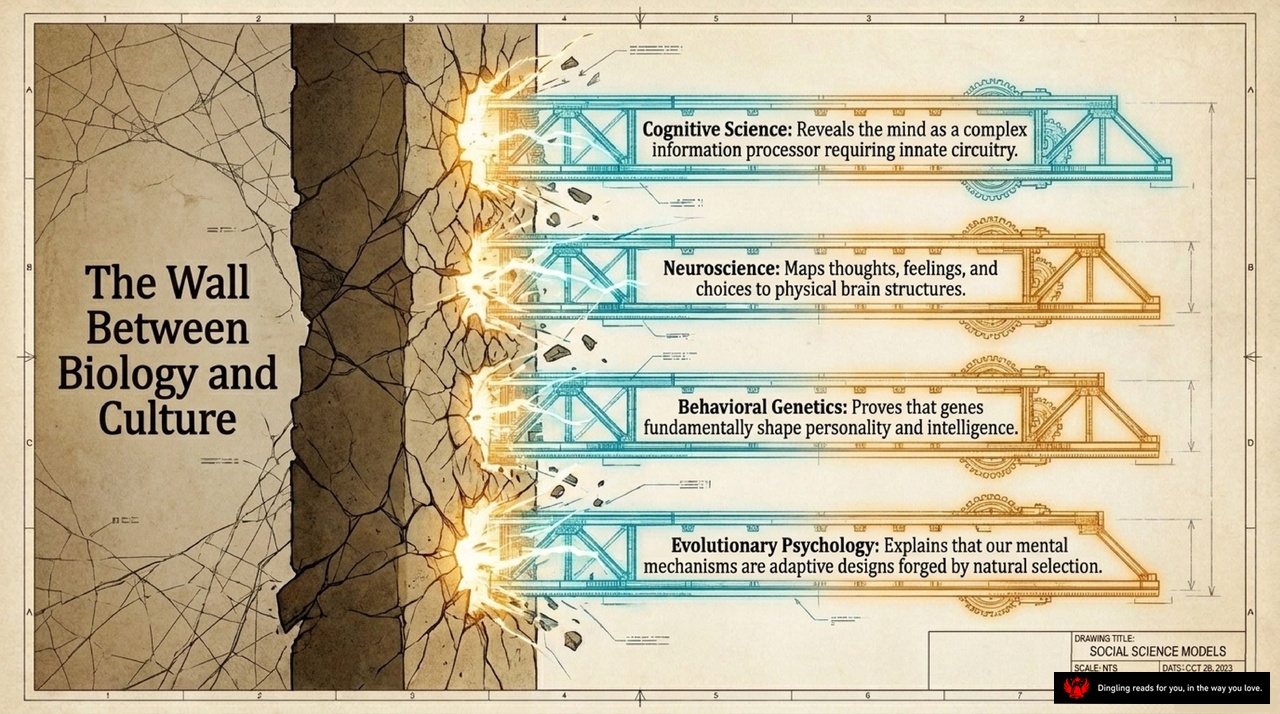
Bridge 5: The Scientific Consensus. The core message here is simple but revolutionary: the mind is a machine, not a mystery. For centuries, we've been taught to believe in "The Old Dogma"—the idea that we are blank slates, shaped entirely by culture, with no innate wiring. But the scientific reality tells a very different story.
Look at the first row: Cognitive Science. We used to think the mind was empty until culture filled it. Today, we know it's a complex processor with innate circuitry specifically designed to learn culture. You don't just absorb information; you have built-in tools to process it.
Move down to Neuroscience. The old view suggested choices were made by an immaterial soul. The reality? Consciousness and morality are physical processes happening right here in your brain. Your decisions are biological events, not spiritual whispers.
Then there's Genetics. We were told differences between people are solely due to upbringing. Science shows that DNA fundamentally shapes your personality, intelligence, and behavior. You aren't a blank canvas; you come with a pre-painted palette.
Finally, Evolution. We were taught human nature is a social construct. The truth is, human nature is a biological adaptation forged by natural selection. We are wired for certain things because it helped our ancestors survive.
This shift from the old dogma to scientific reality changes everything. It means we aren't passive products of our environment; we are active participants, equipped with a sophisticated biological toolkit to navigate the world. We are machines, beautifully engineered, not mysteries waiting to be solved.
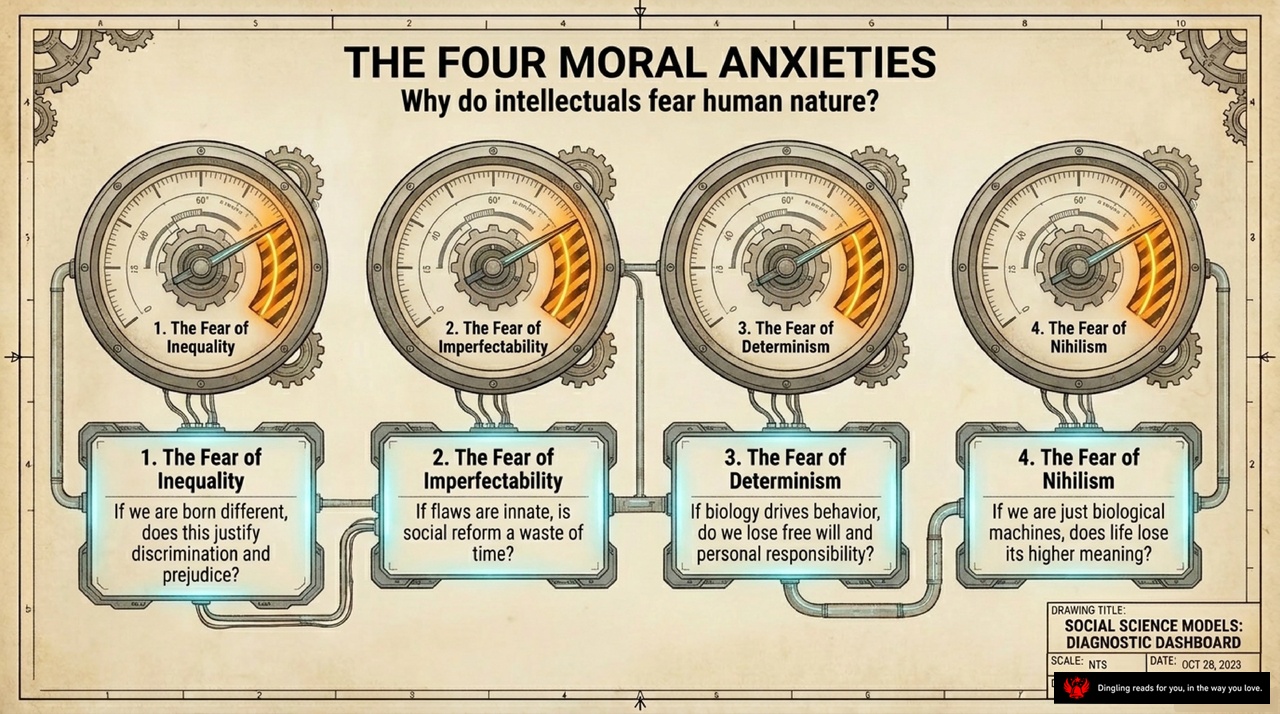
Have you ever stopped to ask why intellectuals often seem so terrified of human nature? We've built a whole society on the idea that we are blank slates, shaped entirely by culture and education. But what happens when we admit the truth: that we are biological machines, driven by ancient instincts for inequality, imperfection, and even determinism?
This slide breaks down the "Four Moral Anxieties"—the deep-seated fears that have haunted our thinking for centuries.
First, there is the Fear of Inequality. If we are born different, does that justify discrimination? We worry that acknowledging biological differences will give a scientific cover to prejudice.
Second, the Fear of Imperfectibility. If flaws like violence or selfishness are hardwired into our DNA, is social reform even a waste of time? We fear that if our nature is broken, we can never truly fix it.
Third, the Fear of Determinism. If our biology drives our behavior, do we lose our free will? This anxiety threatens the very idea of personal responsibility. If our actions are just the result of our genes and brain chemistry, are we truly in control of our lives?
And finally, the Fear of Nihilism. If we are just biological machines, does life lose its higher meaning? We dread the thought that without a soul or a divine purpose, everything we hold dear—love, art, morality—is just a chemical reaction.
These anxieties reveal a uncomfortable truth: we don't fear human nature because it's dangerous. We fear it because it's real. It challenges our comforting narratives and forces us to face the raw, unfiltered reality of who we are.
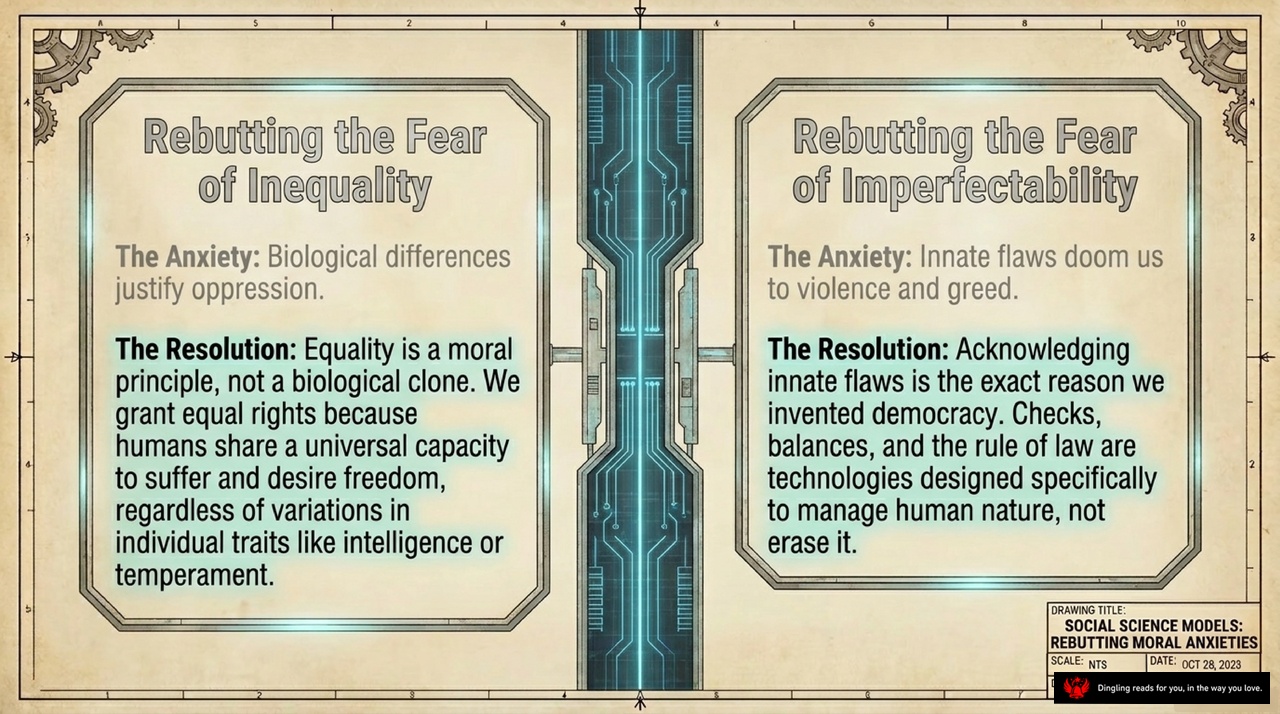
So, we've tackled the hard science of how our brains work and how culture shapes us. Now, let's turn to the emotional side: why do we actually *fear* the truth about human nature? The slide breaks this down into two major anxieties we need to address.
On the left, we see "Rebutting the Fear of Inequality." Many people worry that if we admit biological differences exist—say, in intelligence or temperament—those differences will justify oppression. They fear that equality is impossible because we aren't all clones. But the resolution is clear: Equality is a moral principle, not a biological requirement. We grant equal rights because humans share a universal capacity to suffer and desire freedom, regardless of variations in individual traits. Just because someone is born with different strengths doesn't mean they deserve different rights.
On the right, the slide addresses "Rebutting the Fear of Imperfectability." The anxiety here is that our innate flaws—our tendencies toward violence and greed—doom us to chaos. If we are hardwired to be selfish, how can we ever build a good society? The answer is the opposite of what we fear. Acknowledging these flaws is exactly why we invented democracy. Systems like checks, balances, and the rule of law were designed specifically to manage human nature, not erase it. We don't need to be perfect to live together; we just need the right institutions to channel our imperfect nature toward cooperation.
So, the takeaway is simple: recognizing our differences and our flaws isn't a reason to despair or to oppress. It's the very foundation for building a fair and stable society.
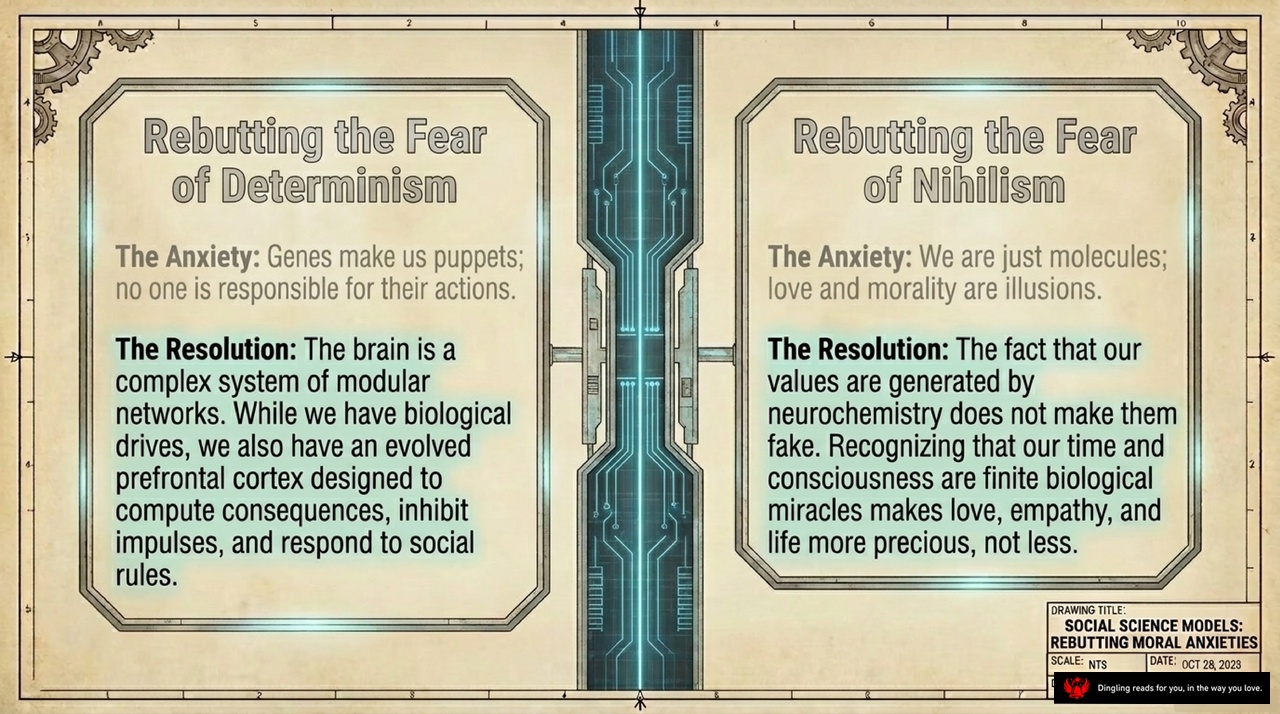
Look at this blueprint for the mind. We often get stuck on two terrifying fears: determinism and nihilism. On the left, we face the fear of determinism—the anxiety that our genes make us mere puppets, stripping us of all responsibility. But the resolution is clear: our brains aren't blank; they are complex systems of modular networks. While biological drives exist, our evolved prefrontal cortex allows us to compute consequences, inhibit impulses, and respond to social rules. We are not just biological machines; we are capable agents.
On the right, we confront the fear of nihilism—the anxiety that if we are just molecules, then love and morality are just illusions. The resolution flips this script entirely. The fact that our values are generated by neurochemistry doesn't make them fake. Recognizing that our time and consciousness are finite biological miracles actually makes love, empathy, and life far more precious, not less. Understanding our biological limits doesn't strip life of meaning; it anchors it in something real and tangible. We don't need a soul to have a purpose; we have the biology to create one.

Look at this triangle. It's the core logic of conflict. The slide argues that violence isn't a learned disease, as utopians might hope, but an evolved strategy that we can't simply unlearn.
At the top, we have **Competition**. This is the drive for resources and reproductive success. In our ancestral past, this meant fighting for food and mates, but today it translates into the relentless chase for wealth and status.
On the bottom left is **Diffidence**. This is the fear of being harmed. Because we can't always trust others, we often strike first to ensure our own safety. It's a preemptive move born out of anxiety.
And on the bottom right is **Glory**. This is the pursuit of status and deterrence. We fight not just to win, but to prove we are stronger than the rival, to command respect, and to prevent future challenges.
These three forces—competition, fear, and the desire for glory—form a self-reinforcing loop. This is the realist's view: conflict is a biological potential wired into our DNA. Unlike the "blank slate" theory which suggests we can be molded into peaceful utopians, reality demands something else. As the takeaway here states, we must continuously counter this biological drive with strong social contracts, laws, and mutually assured consequences. Without these structures, our evolved nature would inevitably lead us back to the chaos Hobbes described.

So, we've just unpacked the hard science behind our minds, and now it's time to talk about the messy, beautiful reality of raising a human being. For decades, parents have been terrified by a specific myth: the idea that they are master sculptors, capable of molding their child's intelligence and personality through the right parenting techniques. But the research from behavioral genetics tells a completely different story. It turns out that the shared environment—the family atmosphere, the parenting style, the socioeconomic status—actually contributes less than 10% to a child's development. Once those kids hit adulthood, that shared influence almost disappears entirely.
Instead of blaming their parents for being too strict or too lenient, we need to look at what actually drives individual differences. It's a mix of genetics, which accounts for about half of the variation, and what we call the "unique environment." This unique environment isn't about the home itself, but the specific, unpredictable experiences that only one child has. Maybe it's a specific teacher who changed their life, a random accident, or the unique dynamic of being the oldest sibling. Interestingly, kids often mimic their peers more than their parents.
This doesn't mean parents don't matter. Their role isn't to shape the child's core traits, but to provide a warm, safe base that boosts immediate happiness and security. They are the first relationship a child experiences, which sets the template for all future connections. So, let's stop treating our kids like clay waiting to be molded. Let's embrace the truth: we can't control their destiny, but we can enjoy the journey of being their guide.
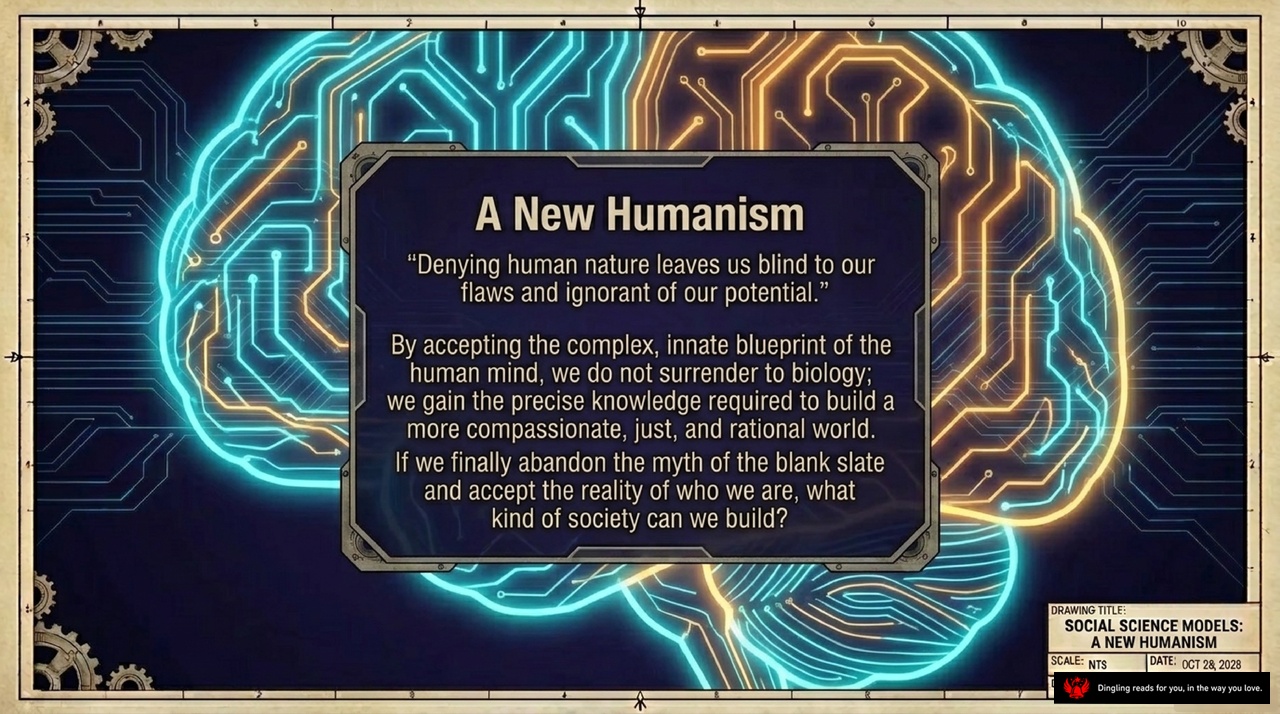
So, we arrive at a crucial turning point: the concept of a "New Humanism."
The slide behind me asks a profound question: "If we finally abandon the myth of the blank slate and accept the reality of who we are, what kind of society can we build?"
For centuries, our understanding of humanity was built on a dangerous illusion. We believed in the "blank slate"—the idea that we are born as empty vessels, shaped entirely by our environment and culture. We thought that by fixing our social systems, we could fix human nature itself. But as we've seen in our journey through biology, psychology, and evolution, this view was fundamentally flawed.
Science has now revealed the truth: we are not blank slates. We come equipped with an innate blueprint. Our brains have pre-wired circuits for language, for detecting intent, for recognizing threats, and for forming social bonds. We have deep-seated evolutionary drives that shape how we love, how we compete, and how we perceive fairness.
As the text on the screen powerfully states, "Denying human nature leaves us blind to our flaws and ignorant of our potential." When we ignore our biological reality, we make policies that fight against the very forces that drive human behavior. We try to engineer away our aggression, or force equality upon systems designed for hierarchy, only to fail because we don't understand the underlying mechanisms.
However, accepting this reality isn't about surrendering to our biology. It is the opposite. By understanding the complex, innate design of the human mind, we gain the precise knowledge required to build a more compassionate, just, and rational world. We can stop trying to rewrite human nature and instead start designing institutions that work *with* it.
Imagine a society where we design schools based on how our brains actually learn, rather than how we wish they would. Imagine economic systems that account for our innate drive for status and competition, channeling it into innovation rather than exploitation. Imagine legal frameworks that recognize our moral intuitions are real and can be cultivated, rather than dismissing them as mere cultural constructs.
This is the promise of a New Humanism. It moves us away from the fantasy that we can create perfect humans in a vacuum, and toward the practical goal of building a perfect society for the humans we actually are. It is the shift from ignoring our nature to harnessing it.
So, the question remains: if we embrace this biological reality, if we stop pretending we are blank slates, what kind of future do we unlock? The answer lies in the intersection of science and wisdom. It lies in building a world that is not just socially constructed, but biologically grounded. That is the path forward.