
The Blind Watchmaker: Complete Chapter-by-Chapter Summary
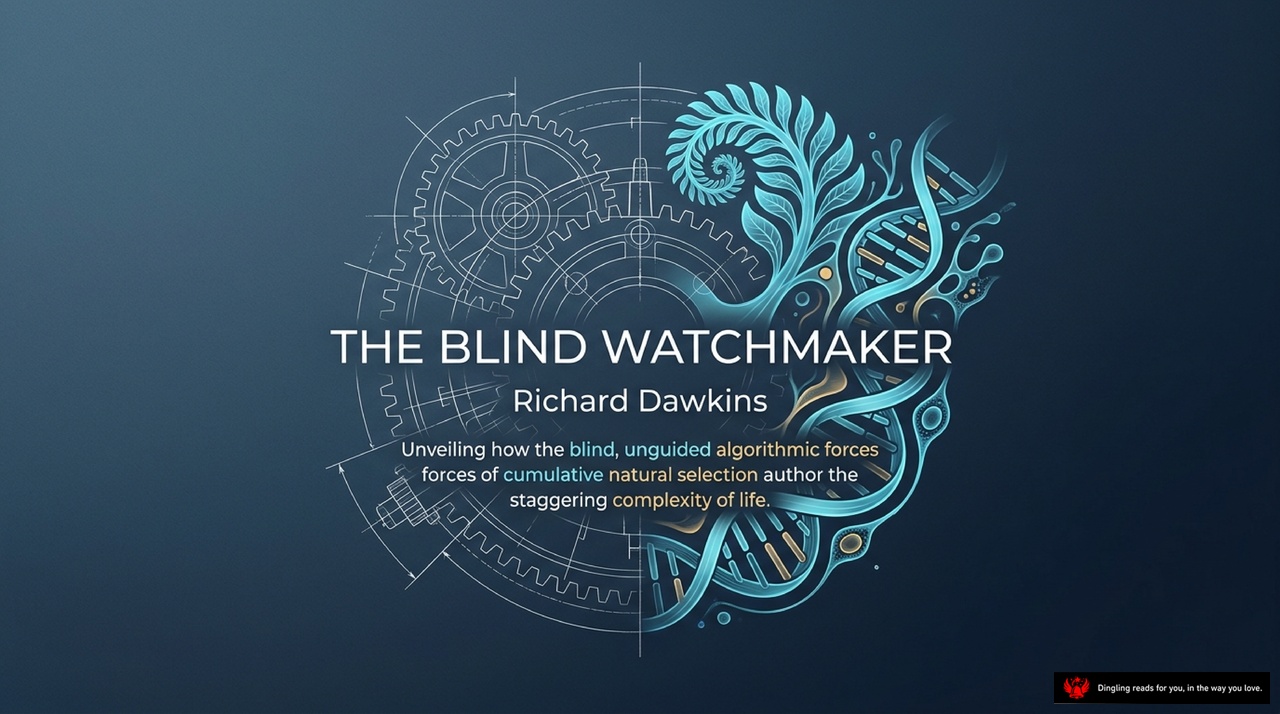
Welcome to the world of *The Blind Watchmaker* by Richard Dawkins. Look at this cover art: gears on one side, representing the mechanical precision of design, and a DNA helix on the other, symbolizing the biological complexity of life. Dawkins uses this image to propose a radical idea: the staggering complexity of life isn't the result of a conscious designer, but rather the product of blind, unguided algorithmic forces.
He argues that nature operates like a cumulative selection process. It doesn't aim for a perfect final product from the start. Instead, it takes small, random steps that offer even a tiny survival advantage—like just 5% better vision or slightly faster running—and keeps them. Over millions of generations, these tiny improvements stack up, transforming simple beginnings into intricate systems like the human eye or the bat's sonar.
The beauty of this concept is that it explains how complexity arises without a master plan. Every step is a solution to an immediate problem, not a step toward a distant goal. Whether it's the evolution of snake venom from ordinary saliva or the development of wings from simple gliding membranes, nature builds the impossible, one small, imperfect brick at a time.

Imagine a world where the rules of physics and biology operate on completely different playing fields. On the left, we see the inanimate world, represented by a rigid, geometric crystal structure. In this realm, physics reigns supreme, governing the simple. A rock doesn't need a special explanation; it simply exists. It resists decay not through effort or design, but through sheer durability. It's a static state of being, perfectly stable and requiring no active intervention.
Now, look to the right at the biological organism. This is where the enigma of organized complexity truly begins. Unlike the passive rock, life actively fights against entropy. Take this bat, for instance. It isn't just a collection of parts; it's a dynamic machine utilizing specialized, interlocking components to achieve a precise proficiency. From the intricate geometry of its wings to the precise angles of its flight path, every detail serves a function. This creates what looks like an "illusion of design," a level of sophistication that demands a profound explanation.
So, how do we bridge the gap between a simple crystal and a complex, flying bat? The answer lies in the power of gradual change. Evolution doesn't demand a perfect, fully formed wing appearing overnight. Instead, it relies on a continuous trajectory of tiny improvements. Think about the bat's flight ability: it didn't start with full wings. It began with tiny skin folds that allowed an ancestor to glide just a few feet. That 5% improvement in gliding distance was enough to survive a predator, and that survival allowed the trait to pass on. Over millions of generations, those small advantages accumulated, refining the glide into a full flight capability.
This process explains why we see "imperfect" designs in nature. Consider the human eye or the fish's skull. These aren't blueprints drawn from scratch by an engineer; they are historical artifacts. Evolution works by tinkering with what already exists, not by redesigning from zero. That's why the bat's wings are connected to its ribs in a specific, sometimes awkward way—they are modified structures from its ancestors, not perfect new inventions. Every complex feature, from the bat's echolocation to its flight, is the result of countless small steps, each one offering a slight survival advantage. It is the accumulation of these tiny, imperfect steps that builds the magnificent complexity we see today.

The slide we're looking at is titled "The Two Watchmakers," and it lays out a classic debate that has shaped our understanding of life for centuries. On the left, we have William Paley, the "Intelligent Designer," who argued that the complexity of nature—like the intricate gears of a watch—must imply a conscious planner with foresight, deliberate assembly, and a pre-determined final goal. He believed in rapid creation, as if a master engineer could build a complex system in an instant.
On the right stands Richard Dawkins, the "Blind Watchmaker." His view is radically different. He argues that there is no conscious planner, no vision for the future, and no ultimate goal. Instead, what we see is the result of automatic, unguided physical forces acting over immense, incremental geological time. The mechanism isn't a deliberate assembly by an agent, but a process of trial and error where only immediate survival and reproduction matter.
The takeaway at the bottom is crucial: the natural world's only watchmaker is natural selection. It has no mind, no mind's eye, and no ability to see tomorrow. It simply selects whatever works right now. This blind process, operating over vast stretches of time, is what built everything from the simplest bacteria to the human brain, all without a single blueprint or a single designer.

The slide highlights a critical misconception about how evolution works: the idea that complex structures like the Boeing 747 could spontaneously assemble from a chaotic mix of random parts in a single step. Critics often argue that evolution is like an unguided tornado swirling through a scrapyard, hoping to accidentally build a fully functional aircraft. Mathematically, the probability of this happening is zero percent. A complex organ arising from a single, random macro-mutation is simply impossible.
However, the reality is quite different. Natural selection does not operate via single-step chance. Instead, it builds complexity through gradual, incremental improvements. Every small change that offers even a slight survival advantage gets preserved and refined over generations. This process allows nature to transform simple, random components into intricate, functional systems without needing to see the final picture all at once. It's not about jumping to perfection; it's about taking one small, viable step at a time, turning the impossible into reality through persistent accumulation.
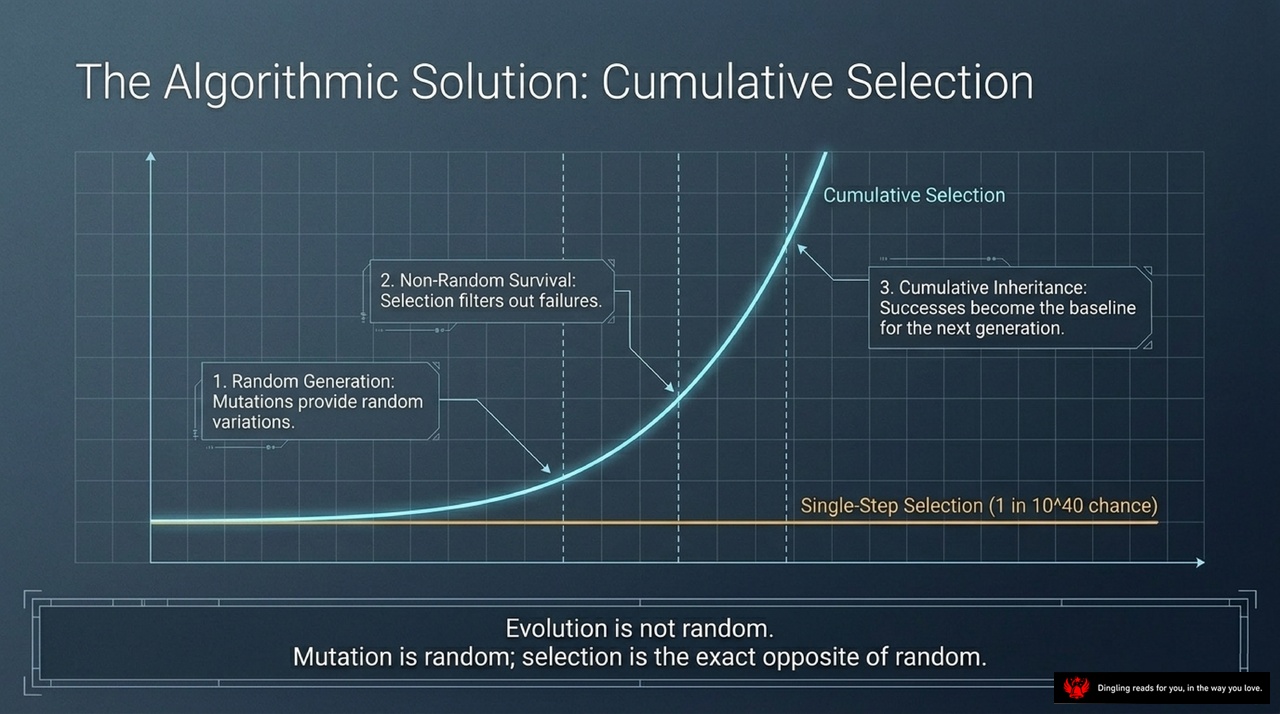
Imagine you're watching a graph where the line doesn't just go up—it rockets upward, defying the odds. This slide illustrates the "Algorithmic Solution" to evolution: Cumulative Selection. It contrasts this powerful engine against the near-impossible chance of single-step selection, which the graph notes has a probability of just 1 in 10 to the power of 40. That is a number so vast it renders instant perfection statistically impossible.
But evolution isn't a lottery; it's an algorithm. The graph breaks down this process into three distinct steps. First, we have Random Generation. Mutations provide random variations, throwing a handful of dice into the air. Second, we see Non-Random Survival. This is the crucial filter where selection steps in to filter out failures, keeping only those variations that offer an immediate survival advantage. Finally, we arrive at Cumulative Inheritance. Successes become the baseline for the next generation, stacking one small win on top of the last.
This iterative loop transforms the improbable into the inevitable. As the text explains, evolution is not random because while mutation is random, selection is the exact opposite—it is a precise, non-random filter. This mechanism allows us to understand how complex structures, like the human eye or even the intricate system of bat echolocation, could arise without needing a designer. Instead, they are the result of countless tiny improvements accumulating over millions of generations. Each step builds on the previous one, turning a chaotic mess of random changes into a highly ordered, functional masterpiece.
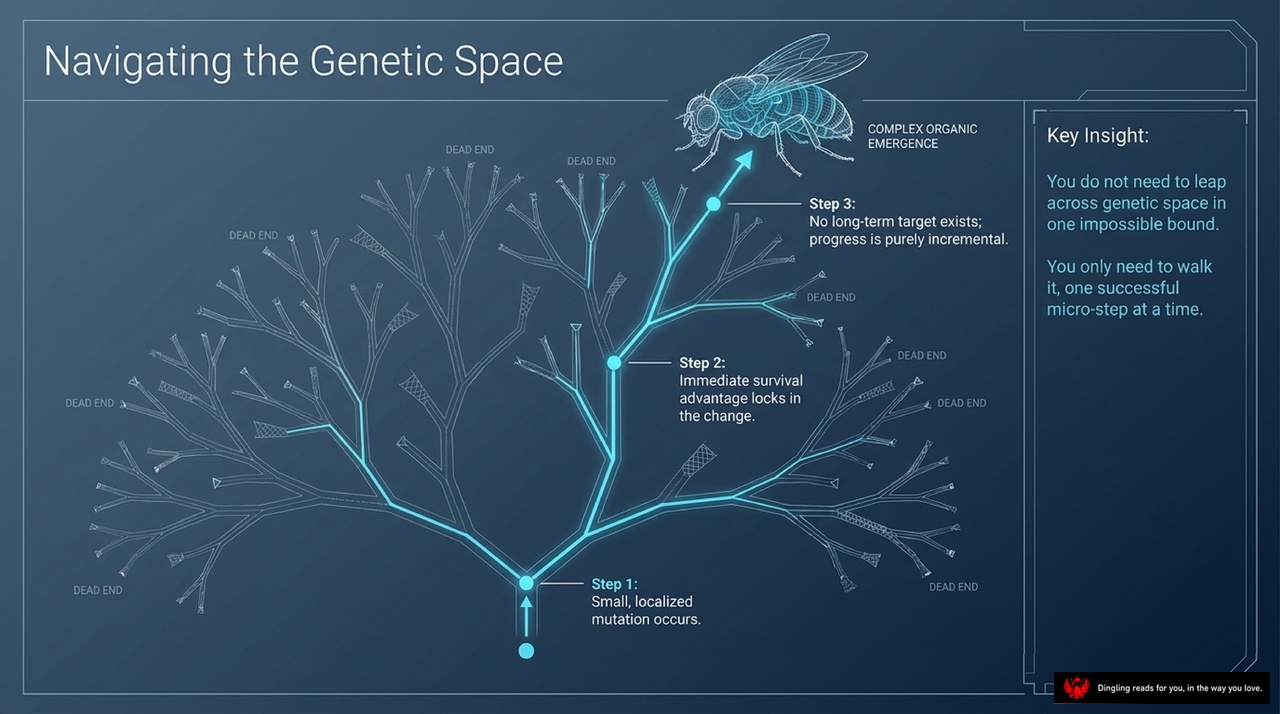
Navigating the Genetic Space isn't about taking a giant leap to reach perfection; it's about taking one successful micro-step at a time. As this diagram illustrates, evolution works through a series of incremental improvements rather than impossible bounds. It starts with a small, localized mutation, like a slight change in a gene. If that change offers an immediate survival advantage—say, slightly better vision or a bit more efficient energy use—natural selection locks it in.
From there, the process continues without a long-term target in mind. There is no blueprint for a perfect eye or a complex wing waiting to be built all at once. Instead, progress is purely additive. Each successful step builds the foundation for the next. Think of it like climbing a tree: you don't jump to the top; you just keep finding the next branch that's slightly higher and safer than the last. Over millions of generations, these tiny, seemingly insignificant upgrades accumulate. What we see as a complex organic emergence, like the intricate flight mechanics of a bat or the sophisticated vision of a human, is actually the result of countless small adjustments, each one providing a 5% advantage that made the difference between life and death for the ancestors. This is the power of the genetic space: you don't need to invent the whole thing at once; you just need to keep walking forward, one successful step at a time.

The Gradient of Advantage isn't just a catchy title; it's the core logic of how life actually works. Look at this diagram. It challenges a common myth: that an organ must be perfect to be useful. But reality tells a different story. Even 5% vision is exponentially better than absolute blindness.
Let's trace this progression from left to right. At just 1%, an organism can detect shadows, which is enough to evade predators. Move to 10%, and it can detect the direction of movement. By 50%, it forms blurred shapes. And only at 100% do we get perfect focal acuity.
This visualizes the "Gradient of Advantage." Every micro-improvement in biological design pays immediate survival dividends. Nature doesn't wait for a final, perfect blueprint before starting to build. Instead, it keeps whatever works right now. Whether it's a frog's webbed toes, a flying squirrel's membrane, or the gradual refinement of snake venom, every step offers a tangible benefit. That 5% advantage might seem small, but in the brutal competition for survival, it's the difference between life and death. It's not about reaching a distant ideal; it's about winning the next round today.

Imagine a world where the physical body is just a temporary vessel, destined to die, while the information it carries lives forever. This slide contrasts three fundamental ways things exist in nature. On the left, we see a dewdrop. It forms easily and is beautiful, but it evaporates quickly; it lacks the durability to last. In the middle is a rock. It is incredibly durable and will outlast us all, but it cannot generate or replicate itself; it lacks generative power. Neither is the ultimate solution for life.
The true secret of life, as shown on the right, is found in the DNA helix. It combines the best of both worlds: it generates easily through replication, and it endures through copies. This is the concept of the "Enduring Replicator." As the text at the bottom explains, bodies are merely vehicles that die, but the digital blueprints—our genes—are the only things that persist across geological time. Natural selection doesn't just favor strong bodies; it specifically favors DNA that can successfully build biological machines capable of ensuring its own replication. This simple equation—easy generation plus eternal durability—is the engine that drives all of evolution, allowing information to survive long after the organisms that carried it have vanished.

Let's dive into the first of our four "Constructive Powers," which is co-adaptation. Look at this image: we see a lion, but its body is actually a complex machine of interlocking gears. This visual perfectly captures the core idea: genes do not evolve in a vacuum. The most crucial environment for any single gene is actually other genes.
Think of it like this: a gene for carnivorous teeth is completely useless without a matching gene for carnivorous digestion. If you had sharp teeth but no digestive enzymes to process meat, those teeth would just be a liability, not an asset. Natural selection doesn't pick winners in isolation; it favors genes that cooperate with their neighbors to build a functional whole.
Over time, these individual selfish replicators forge cooperative alliances. They stop acting alone and start working together, building highly integrated, unified biological vehicles. Just like those gears inside the lion, no single part works in isolation. Every component—from the engine to the wheels—must fit perfectly with the rest to make the machine run. This is the power of co-adaptation: it transforms a chaotic collection of competing parts into a sophisticated, life-sustaining system.

The slide illustrates the "Evolutionary Arms Race," a dynamic where predators and prey are locked in a perpetual cycle of adaptation. As the graphic shows, when a predator evolves faster muscles, it forces the prey to develop sharper reflexes just to survive. This creates a feedback loop: any success for one side immediately degrades the environment for the other, pushing the other to upgrade its own defenses. This relentless inter-species warfare is what drives the exponential increase in biological sophistication, mimicking forward progress even when the relative position of each species stays the same. This concept is famously known as the Red Queen Effect, capturing the idea that you have to run as fast as you can just to stay in the same place.

Let's dive into the third mechanism of constructive power: sexual selection. Think of it as nature's most powerful positive feedback loop. It starts with something incredibly simple—a female's slight preference for a specific trait in a male, like a slightly longer tail or a brighter color.
Here's the magic happens: that preference links directly with the genes for that trait. When a female chooses a male with that trait, she passes on both the gene for the trait and the gene for the preference. Over generations, this creates a runaway explosion. The trait gets more exaggerated, and the preference gets stronger, accelerating in a cycle that has nothing to do with survival.
Look at the graph on your screen. The curve shows survival cost rising as the trait—like tail length—gets more extreme. Nature pushes this until it hits the "Utilitarian Limit," the point where the biological cost becomes so high that the individual can no longer survive. That's the brake. The explosive growth only stops when the cost outweighs the reproductive advantage.
This mechanism explains why we see so many "useless" or even dangerous features in nature, like the peacock's tail. It's not about staying alive; it's about getting mated. This process turns aesthetic complexity into a biological reality, driven entirely by the power of choice and the relentless feedback loop of evolution.

Let's talk about the speed at which evolution actually happens. For decades, scientists debated two main theories: Gradualism and Punctuated Equilibrium. On the left, you see the Gradualism model, which suggests a constant, slow change over time—a smooth, steady line of morphological evolution. On the right, we have Punctuated Equilibrium, showing a pattern of long periods of stasis interrupted by rapid shifts. This isn't a contradiction; it's a synthesis. Punctuated equilibrium isn't a rejection of Darwinism; it's a variation. Even those "rapid" evolutionary bursts in geological terms consist of thousands of cumulative micro-steps. Neither model relies on impossible macro-mutations.
Think about the evidence we see in the real world. From the gradual development of a frog's webbed toes to the independent evolution of eyes in octopuses and humans, nature doesn't jump from simple to complex in a single leap. Instead, it accumulates tiny advantages. A 5% improvement in vision or flight capability might seem small, but in the struggle for survival, it's the difference between life and death. Over millions of generations, these small steps add up. We see this in the "imperfect" designs, like the vertebrate retina with its blind spot, or the flattened skull of the flatfish. These aren't mistakes; they are the fingerprints of history, showing us that evolution works by tweaking what already exists, not by designing perfection from scratch. Whether it's the slow accumulation of traits or sudden bursts of change, the core truth remains the same: evolution is a continuous process of adaptation, driven by the relentless pressure of survival.

We often marvel at the complexity of life, seeing it as a miraculous leap from simple beginnings to intricate designs. But what if that "miracle" is actually just math? This slide introduces a powerful concept called the "Dealion Scale," which reframes how we view evolution.
Our brains are wired to think in seconds, days, and decades. We simply lack the cognitive hardware to intuitively grasp millions of years. This is our cognitive flaw. When we look at a complex organ like an eye or a wing, we assume it must have been designed all at once. But the Dealion Scale teaches us that what we perceive as an impossible miracle is simply a statistical certainty when an algorithmic filter—natural selection—is applied across billions of iterations.
Think of time as the canvas and cumulative selection as the brush. On this timeline, we see the vast stretches of geological time: 100 million years, 500 million, even 3 billion. It is over these immense scales that small, incremental changes accumulate. A 5% improvement in vision or flight capability might seem negligible to us, but over millions of generations, it becomes the difference between extinction and dominance.
So, the next time you see a complex biological structure, don't be fooled by the illusion of perfection. Remember, these aren't instant creations. They are the result of countless tiny steps, refined over geological epochs, turning the improbable into the inevitable.

The Blueprint Revealed. Look at this diagram. It's not just a picture; it's the ultimate answer to the question of how complexity arises without a designer.
At the center is our eye, but notice the forces acting upon it. On the left, we have The Engine: small, localized mutations filtered by non-random survival. Nature doesn't aim for perfection; it just keeps what works right now. On the right is The Accelerator: co-adaptation, sexual selection, and those fierce adversarial arms races we see in nature.
But these forces need a stage. That's where Deep Time comes in, acting as The Canvas. Millions of generations of geological time provide the space for these tiny, incremental changes to accumulate into something staggering.
The result? Purposeful complexity. We see the emergence of intricate systems like our own vision, not because of conscious design or foresight, but because natural selection relentlessly sifts through random variations over eons. It's a process that builds the impossible from the simple, one tiny step at a time.
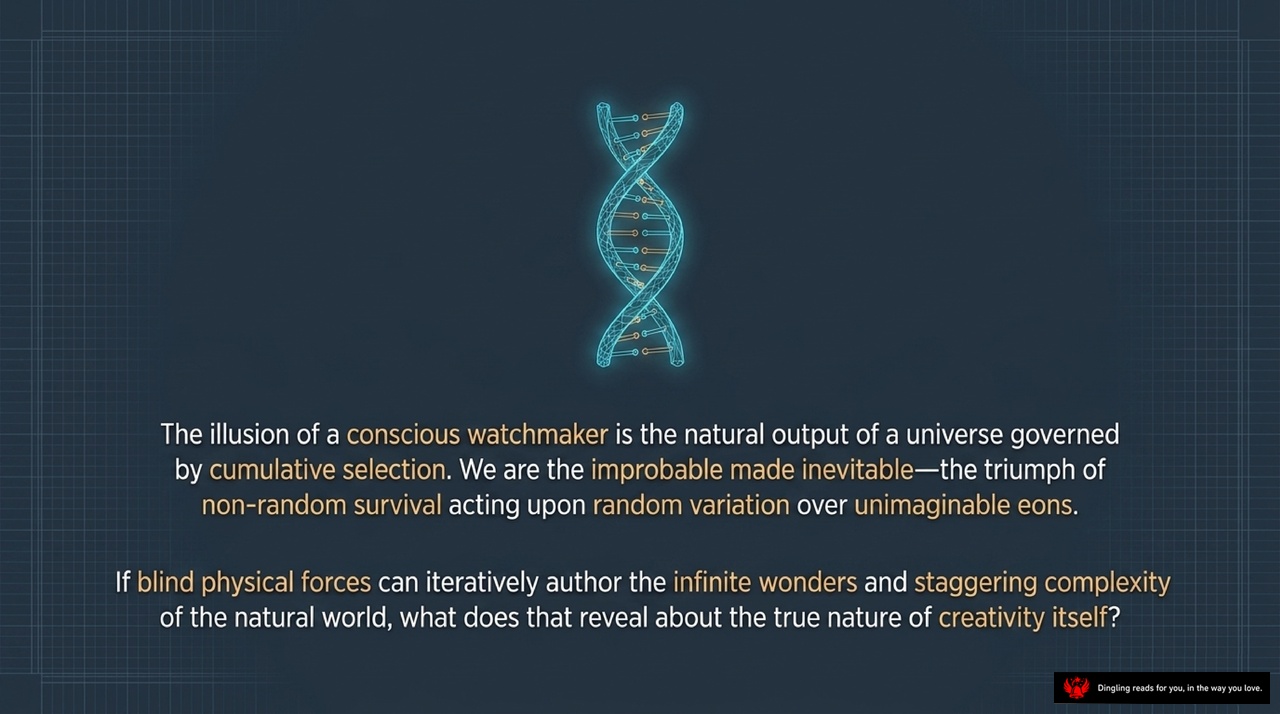
Imagine a glowing DNA helix floating in the void, representing the ultimate illusion of a conscious watchmaker. What we often perceive as deliberate design is actually the natural output of a universe governed by cumulative selection. We are the improbable made inevitable—the triumph of non-random survival acting upon random variation over unimaginable eons.
Consider this: if blind physical forces can iteratively author the infinite wonders and staggering complexity of the natural world, what does that reveal about the true nature of creativity itself? It suggests that complexity isn't the result of a master planner, but rather the accumulation of tiny, successful steps. Just as a 5% improvement in vision or flight capability can mean the difference between life and death, these microscopic advantages stack up over millions of years to create the intricate machinery we see today. The perfection we admire isn't engineered all at once; it's a history of trial, error, and relentless adaptation, proving that nature's greatest masterpiece is built not by a designer, but by the relentless power of survival.