
The Book Thief: Complete Chapter-by-Chapter Summary

Welcome to the world of *The Book Thief*, by Markus Zusak. This isn't just a story; it's a visual synthesis of mortality, survival, and the profound architecture of language set against the brutal backdrop of Nazi Germany.
Imagine a world where books are not just pages of ink, but lifelines. In this story, a young girl named Liesel discovers that while words can be used to destroy, they can also save. She learns to steal books from burning piles, treating them as treasures in a world that tries to steal her own humanity.
Through her eyes, we see how language builds bridges where hate tries to build walls. It explores the delicate balance between fear and hope, showing us that even in the darkest times, the power of a story can keep us alive. This is a tale about finding light in the ashes, proving that as long as words exist, we can never truly be silenced.
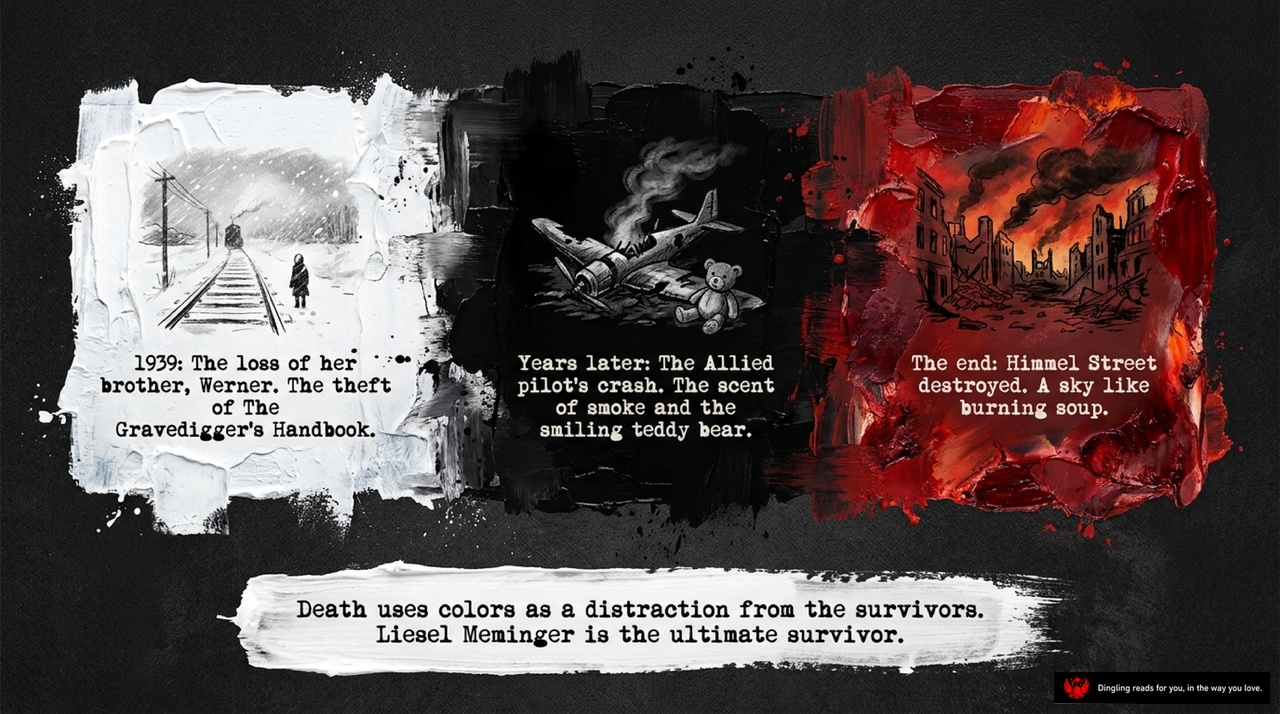
The story of Liesel Meminger isn't just about the books she stole; it's about the terrifying colors that defined her world. Look at this timeline: it starts in 1939, painted in stark white and gray. This is the moment of her brother Werner's death, a cold, snowy day where she loses her family and finds the *Gravedigger's Handbook*. Then, the scene shifts to black. Years later, the sky turns dark with smoke from a crashing Allied plane, a moment of chaos marked by a single, smiling teddy bear amidst the destruction. Finally, everything erupts into a violent, burning red. This is the end of Himmel Street, a landscape of ash and ruin where the sky looks like boiling soup.
But here is the profound truth Liesel learns: Death uses these intense colors as a distraction. It wants us to focus on the fire, the snow, or the smoke, so we forget about the survivors. While the world burns in red or freezes in white, Liesel remains the ultimate survivor. She doesn't just survive the war; she survives by holding onto the words that gave her life, proving that even in the darkest, most colorful moments of tragedy, the human spirit can endure.
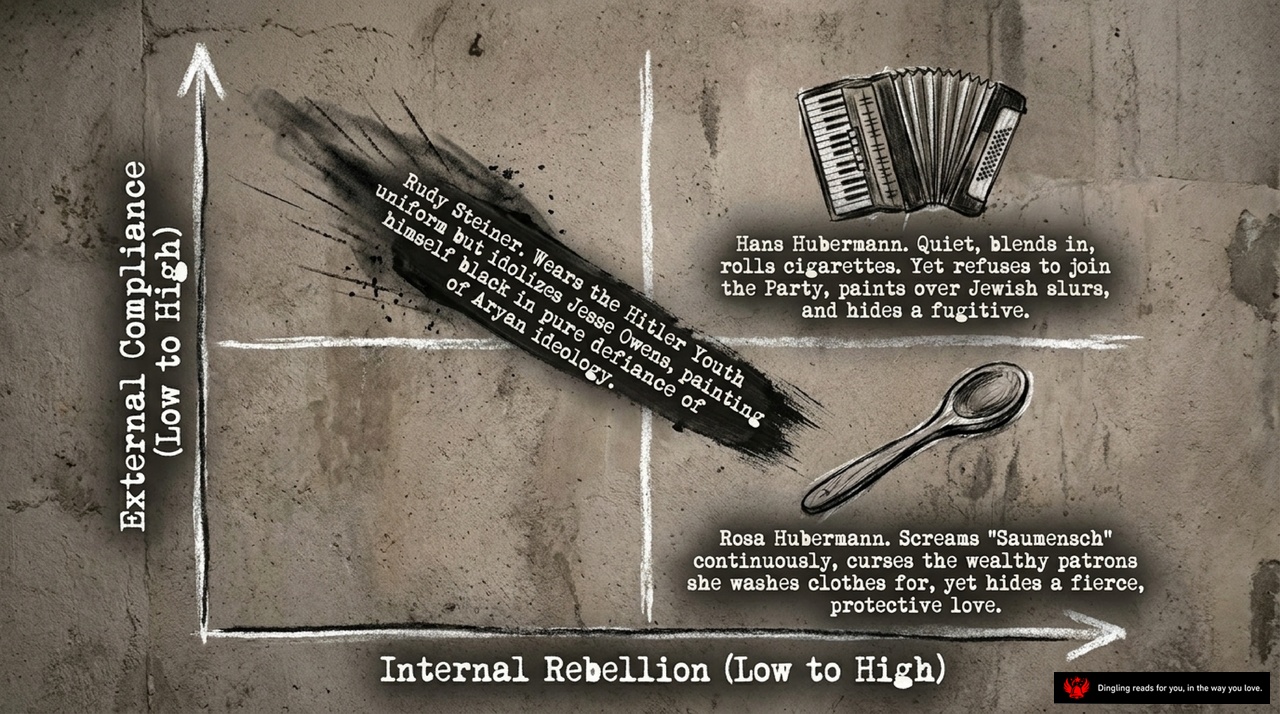
Look at this chart. It maps the complex, often contradictory lives of three characters we've met: Rudy Steiner, Hans Hubermann, and Rosa Hubermann. Notice the axes: "External Compliance" versus "Internal Rebellion."
In the top left, we see Rudy. On the outside, he wears the Hitler Youth uniform, paints himself black to idolize Jesse Owens, and shouts the Nazi salute. That is high external compliance. But look at his internal rebellion. He hides a fugitive, refuses to join the Party, and paints slurs over Jewish names. He is a quiet, fierce rebel hiding in plain sight.
Now, move to the top right. This is Hans. He is the quiet man who blends in. He rolls his cigarettes, plays the accordion, and even buys a copy of *Mein Kampf* just to get his son's application processed. His external compliance is high; he looks like everyone else. Yet, his internal rebellion is the highest of all. He refuses to join the Party, protects a Jewish man in his basement, and teaches Liesel to read in secret. He is the definition of a good man living in a bad world.
Finally, look at the bottom right quadrant. This is Rosa. Her external compliance is low. She screams "Saumensch" at her customers, curses the wealthy patrons she works for, and hits Liesel with a wooden spoon. She is loud and aggressive. But her internal rebellion? It's fierce. She hides a fugitive in her home, she protects Liesel with a fierce, protective love, and she secretly mourns the Jewish tailor whose shop she once ran. She is a woman who channels her rage outward to survive, but whose heart is full of hidden compassion.
This chart shows us that in times of tyranny, you can't always tell who is a rebel by what they wear or how they speak. The most dangerous people are often the ones who look the most normal, while the most rebellious people are the ones who scream the loudest.

Look at this striking visual of *The Gravedigger's Handbook* buried in the snow. It's not just a book; it's the anchor of Liesel's survival. The slide breaks down her journey into three critical moments. First, the catalyst: grief. Her brother Werner is buried in the ice, and her mother is forced to leave her with the foster system. That loss is what drives everything next. Then, we see the act itself. On January 13, 1939, a young apprentice gravedigger drops this manual in the snow. Liesel, just a 14-year-old apprentice herself, steals it. Why? Because at that moment, the book has no literary value to her—she is illiterate. To her, it is purely a physical tether to the last moment she saw her mother and brother. It is a monument to her lost family. As the text on the right reminds us, the text itself feels irrelevant, but the book becomes sacred. This stolen manual is the very beginning of Liesel's journey, transforming her from a grieving child into someone who can hold onto hope through the power of words.

Look at this "Sandpaper Curriculum." This isn't just a list of objects; it's the very survival kit Hans Hubermann built for Liesel when the world turned against her.
First, we have the **Rough Sandpaper**. It was the canvas. Because notebooks were scarce, Hans used the back of sandpaper to teach Liesel the alphabet. It was gritty, uncomfortable, and raw, but it became the texture of her literacy. Then, the **Painter's Pencil**. This was Hans's trade tool, repurposed to draw a lopsided apple and a pig. It turned a simple stick into a bridge between a father's trade and a daughter's dreams.
For light, there was the **Kerosene Lamp**. It provided a dim, flickering glow against the concrete wall, masking the scent of fear that hung heavy in the air. And finally, the **Accordion**. This was the soundtrack. Hans's silver eyes and the music from that instrument provided the safety necessary for learning. Together, these elements created a sanctuary.
As the text reminds us, "Illiteracy is conquered not by schooling, but by the scent of paint, the texture of grit, and radical paternal empathy." Hans didn't just teach Liesel to read; he taught her that she was worthy of a future, one word, one note, and one piece of sandpaper at a time.

The Bonfire of April 20, 1940, stands as one of the darkest chapters in history, where words were turned into weapons to enforce conformity. The state incinerated language, burning the "poison" of Communist and Jewish texts in a frenzy fueled by heat, propaganda, and a crowd's blind mentality. Yet, amidst this destruction, a single act of defiance sparked a different kind of revolution. Liesel, driven by hidden hatred and a desperate need to hold onto something real, reached into the ashes of the bonfire and snatched a book titled *The Standover Man*. That stolen book, still smoking and burning against her chest, became her refuge. While the world burned to erase humanity, Liesel hoarded language to preserve it. This moment wasn't just about saving a book; it was the catalyst that would soon pull a Jewish boxer named Max Vandenburg from the shadows into the safety of the Hubermanns' home, proving that even in the coldest winter, one person's courage could thaw the frozen heart of an entire nation.

On April 20th, 1940, the day Hitler was born, Liesel didn't just witness a bonfire; she participated in one. As the flames consumed books deemed "enemies of the German people," Liesel saw a specific blue book caught in the heat. It was *The Shoulder Shrug*. In a moment of pure, desperate instinct, she reached into the ash heap, pulling the smoking book from the fire under the watchful eyes of the Mayor's wife. That act wasn't just theft; it was a rebellion.
But the cost of this defiance was immediate and physical. Later that night, on the church steps, Liesel's father, Hans, delivered a brutal, protective slap. He didn't hit her for stealing; he hit her to save her. His words were stark: "You can say that in our house... but you never say it on the street." This was the physical cost of ideological silence. Hans taught Liesel a dangerous lesson: words have power, and in a world demanding conformity, speaking the truth could get you killed. Yet, by stealing that book, Liesel had already begun to break the silence, holding onto the only thing that mattered to her amidst the burning ashes.
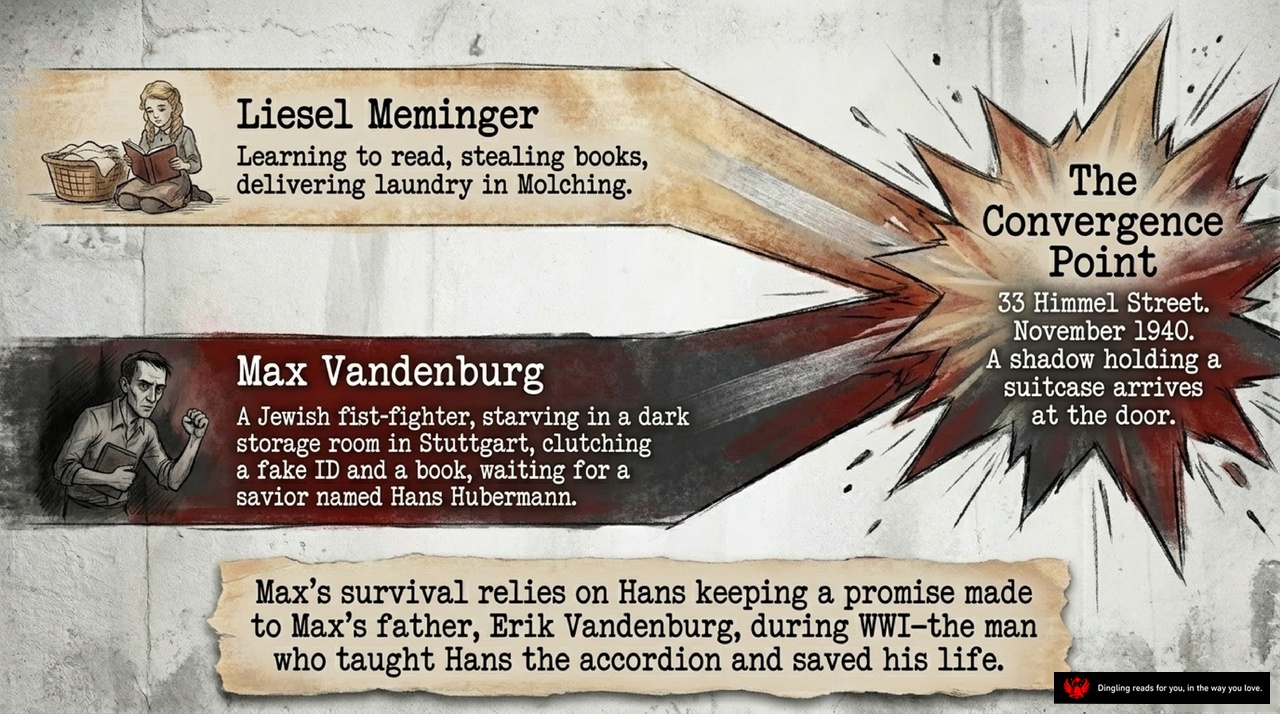
Look at this convergence point. On the left, we have Liesel, a girl learning to read, stealing books, and delivering laundry in Molching. On the right, we see Max Vandenburg, a Jewish fist-fighter starving in a dark storage room in Stuttgart, clutching a fake ID and a book, waiting for a savior named Hans Hubermann. Their paths finally meet at 33 Himmel Street in November 1940. A shadow holding a suitcase arrives at the door, marking the moment their lives intertwine forever. But Max's survival isn't just luck; it relies entirely on Hans keeping a promise made to Max's father, Erik Vandenburg, during WWI—the man who taught Hans the accordion and saved his life. This promise becomes the bridge between two strangers, turning a hidden basement into a sanctuary where fear is replaced by friendship.
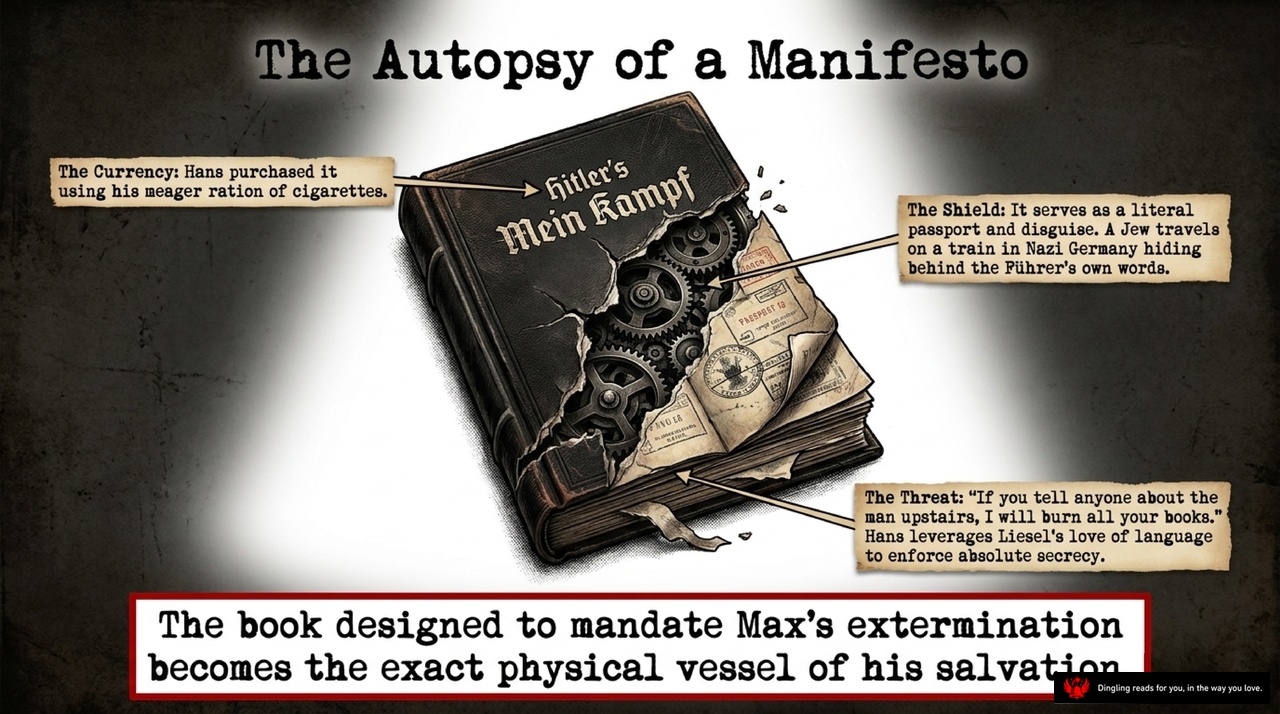
The book designed to mandate Max's extermination becomes the exact physical vessel of his salvation.
Look at this torn cover of *Mein Kampf*. In the story, it's more than just a book; it's a shield. It serves as a literal passport and disguise. A Jewish man named Max travels on a train in Nazi Germany, hiding behind the Führer's own words, using the book as his only ticket to survival.
But this book also represents the currency of his escape. Hans purchased it using his meager ration of cigarettes. That small trade is what allowed Max to enter the house upstairs.
And finally, this book is the source of the threat. "If you tell anyone about the man upstairs, I will burn all your books." Hans leverages Liesel's love of language to enforce absolute secrecy. The book that was meant to destroy him becomes the very thing that saves him.

Look at this striking image of a bird, its wings seemingly frozen in time, set against a chaotic backdrop of smeared white paint and dark, indistinct text. This visual perfectly captures the tragic yet defiant journey of Max Vandenburg, a man who was literally freezing in a basement, trying to survive by rewriting his own reality.
The process shown here is one of desperate transformation. Max rips pages from his savior's manifesto—essentially the Nazi ideology that tried to erase him—and paints over the hate speech with white. He then hangs these pages to dry near a furnace, turning the very tools of oppression into a canvas for empathy. He doesn't just hide; he actively reclaims the architecture of language. By whitewashing hate speech, he creates a blank space where a new story can be born.
This leads directly to the creation of *The Standover Man*. It is a story written specifically for Liesel, a tale about a bird who is afraid of men, mirroring Max's own fear, until he meets a young girl who loves books. In Liesel, Max finds the connection he lost to the world. The image of the bird represents this fragile hope, proving that even in the darkest winter, when hate speech is everywhere, one person's act of love and storytelling can freeze the fear and thaw the heart. This is the ultimate architectural reclamation of language.

Liesel's evolution is the evolution of language itself—from a void, to a weapon, to a sanctuary.
At the bottom of the stack, we see *The Gravedigger's Handbook*. This book represents the initial Deprivation and Trauma. It was stolen by illiteracy; to Liesel, a book was held merely as a tombstone, a silent connection to her dead brother.
Moving up, we see *The Shoulder Shrug* and *Mein Kampf*. This layer symbolizes Weaponization and Defiance. Language is used by the state to burn, control, and hide. Liesel watches books being burned in the bonfire, realizing that words can destroy just as easily as they can heal.
Finally, at the very top, sits *The Standover Man*. This represents Sanctuary and Creation. Here, language is reclaimed, overpainted, and gifted as an act of pure survival and love. Liesel transforms the ashes of destruction into new stories, turning the void into a place of safety. Through these books, Liesel finds her voice and her freedom.

In Molching, words were the primary fuel for the fires of the Holocaust. Yet, in a cold basement on Himmel Street, those exact same words were dismantled, painted over, and rewritten to forge an unbreakable bond between a traumatized orphan and a hunted man.
Look at the contrast in this image. On one side, we see the destruction—the charred remains of books being burned, representing the Nazi regime's attempt to erase history and humanity. On the other, we see the snow, a blank canvas waiting to be filled with life. This is the central question the book poses: If the very tools used to orchestrate mass destruction can be repurposed to heal a single fractured soul, do words possess an inherent morality, or do they merely mirror the soul of the speaker?
Liesel and Max are living proof that words are not inherently evil. They are simply vessels. For Liesel, the book she stole from the bonfire became a shield against fear, a way to remember her lost brother and her mother. For Max, a Jewish fugitive hiding in the dark, Liesel's words and her quiet companionship became a lifeline, transforming his basement from a prison into a home. The same ink that could label someone a "Jew" or a "Communist" could also describe the beauty of a snowstorm or the courage of a friend. In the end, it isn't the words themselves that determine our fate, but the hearts that speak them.