
The Brothers Karamazov: Complete Chapter-by-Chapter Summary
Welcome to our deep dive into Fyodor Dostoevsky's masterpiece, *The Brothers Karamazov*. This isn't just a story about a family feud; it is a profound philosophical dialectic on faith, freedom, and the fierce battle for the human heart.
Imagine a household torn apart by greed and hypocrisy. At the center stands the patriarch, Fyodor, a man who has amassed a fortune but offers nothing to his three sons. His eldest, Dmitri, is consumed by passion and debt; his middle son, Ivan, is a brilliant but cynical atheist who questions the very existence of God; and his youngest, Alyosha, is a young monk who seeks truth and redemption.
As the narrative unfolds, we are drawn into a storm of conflicting ideologies. Ivan challenges the moral order, asking if a world filled with innocent suffering can be justified by a distant God. Meanwhile, Alyosha stands as a beacon of compassion, trying to bridge the chasm between the brothers. But when tragedy strikes, the lines blur. Is it possible that without faith, humanity is free to do anything, even the unthinkable?
This book forces us to confront the darkest corners of our own souls. It asks us: Do we have the right to create our own moral laws? And in the end, is it possible to find love and redemption even in the most broken of places?
Grab your copy of *The Brothers Karamazov*. Prepare yourself for a journey that will challenge everything you believe about God, freedom, and the complexity of being human.
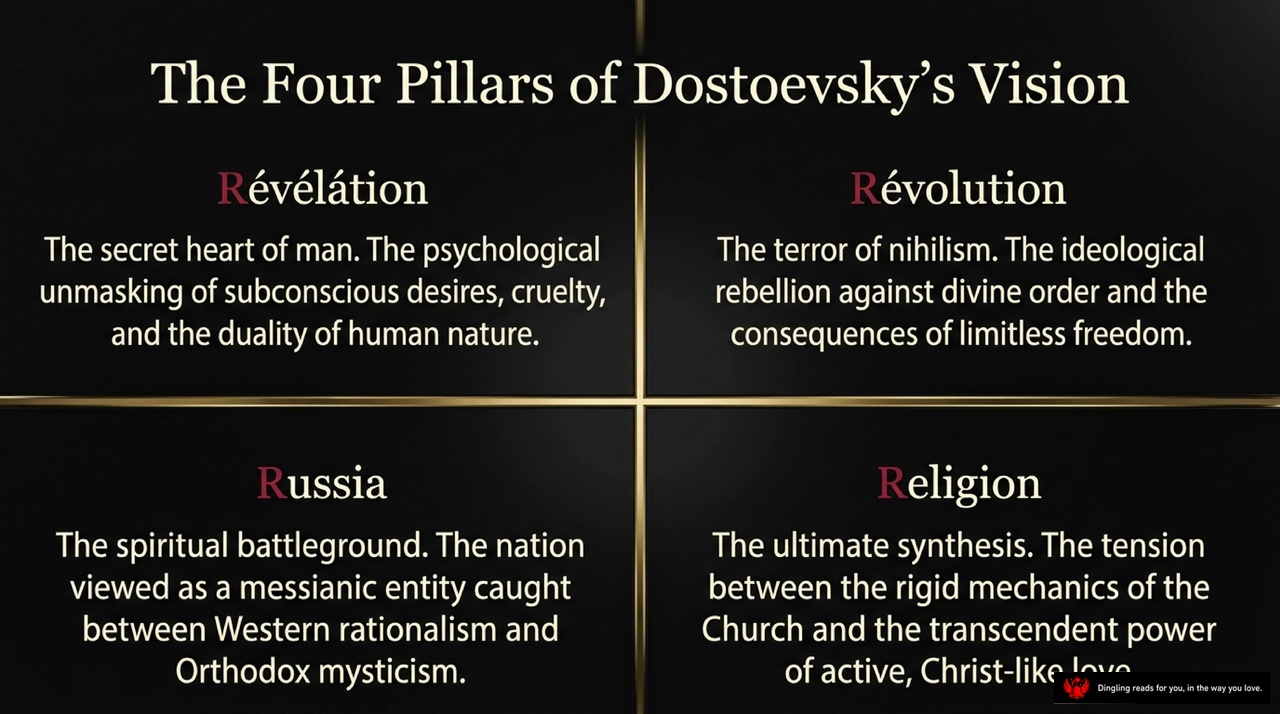
The Four Pillars of Dostoevsky's Vision
Let's break down the core of Dostoevsky's world into four essential pillars. First, Revelation. This is the secret heart of man—the psychological unmasking of our subconscious desires, cruelty, and the terrifying duality of human nature. It's the raw truth we try to hide from ourselves. Second, Revolution. This represents the terror of nihilism and the ideological rebellion against divine order. It explores the chaotic consequences of limitless freedom when we reject all moral boundaries. Third, Russia. For Dostoevsky, Russia was the ultimate spiritual battleground, a messianic entity caught between Western rationalism and Orthodox mysticism, struggling to find its soul. Finally, Religion. This is the ultimate synthesis, capturing the tension between the rigid mechanics of the Church and the transcendent, active power of Christ-like love. These four forces collide in his novels, creating a drama that still resonates deeply with us today.
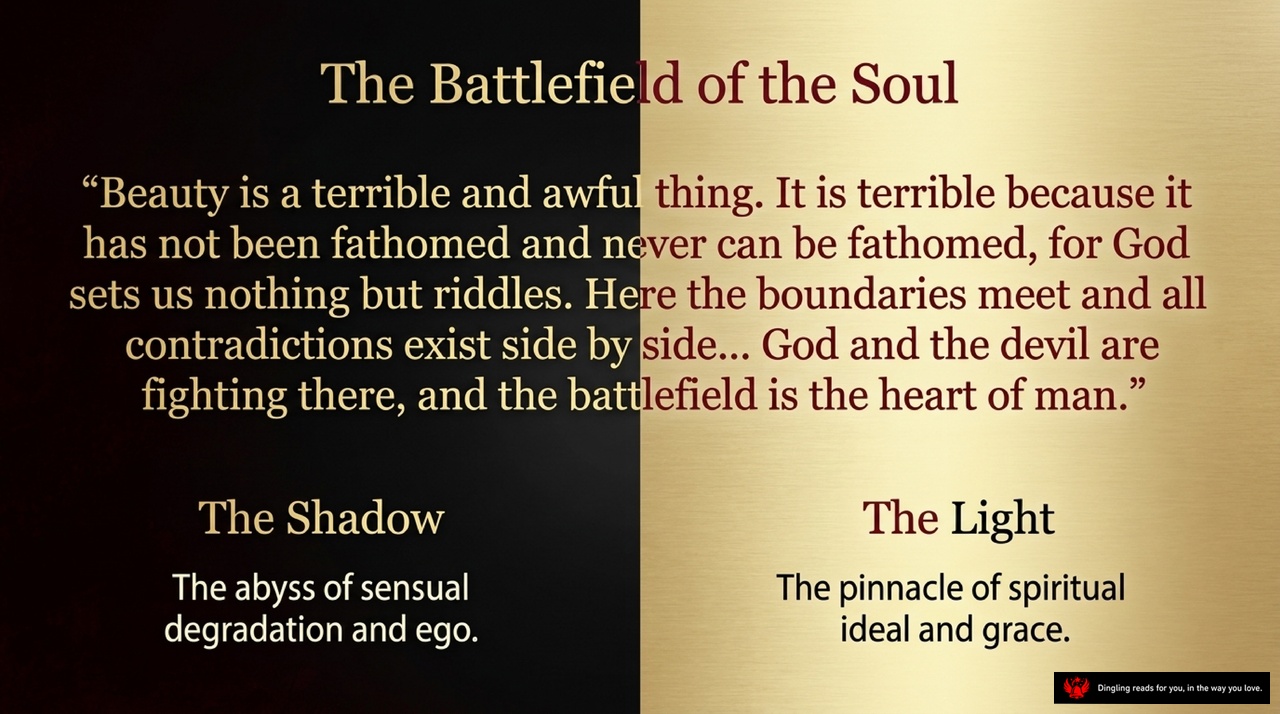
The battlefield of the soul isn't just a metaphor; it's a visceral reality where the abyss of sensual degradation clashes with the pinnacle of spiritual grace. As we see here, beauty itself is described as something terrible and awful because it remains unfathomable—a place where God and the devil fight side by side within the human heart. This internal war is most vividly illustrated through the character of Ivan. He represents the shadow side, embodying the terrifying logic that if there is no God, then anything is permissible. He collects cases of innocent suffering, from infants killed in front of their mothers to children torn apart by dogs, concluding that a world built on such cruelty cannot be accepted. His famous "Rebellion" argument asks a chilling question: if eternal harmony requires the suffering of the innocent, then he refuses to pay that price. He even imagines a "Grand Inquisitor" who would trade Christ's freedom for the safety of a lie, proving that humanity often chooses comfortable servitude over painful truth. Yet, even in this darkness, the light persists. While Ivan rejects the world, the story of Alyosha and the dying Ilyusha reminds us that love remains the only true redemption, offering a glimmer of hope against the overwhelming weight of despair.
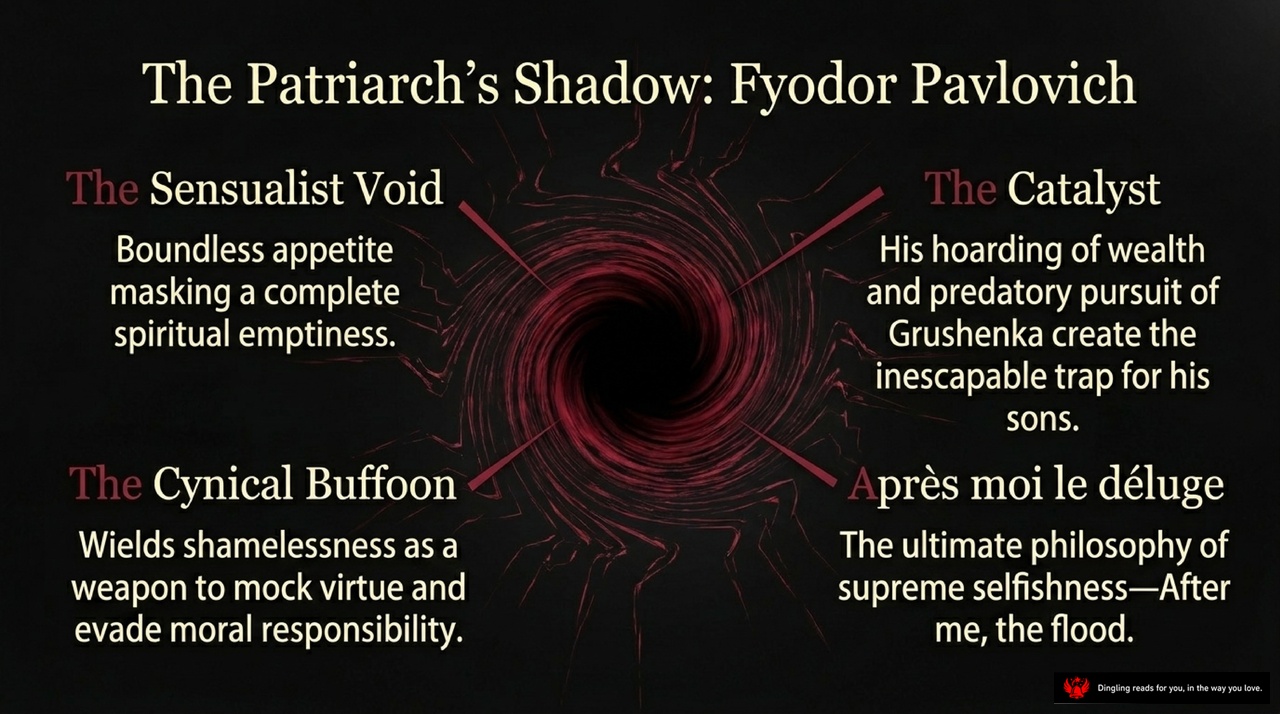
The Patriarch's Shadow: Fyodor Pavlovich isn't just a villain; he is the toxic root of a family tree destined to rot. Look at this slide. It breaks him down into four terrifying facets that defined his entire existence.
First, "The Sensualist Void." Fyodor wasn't driven by love or ambition; he was driven by a boundless appetite for money and pleasure, completely masking a spiritual emptiness so deep it was terrifying. He hoarded wealth while his sons starved for attention.
Second, "The Catalyst." His greed created the trap. By hoarding money and predatory pursuing Grushenka, he didn't just embarrass his sons; he pushed them toward destruction. He forced Dmitri into debt and jealousy, and he gave Ivan the dark, nihilistic ideas that would eventually kill him.
Third, "The Cynical Buffoon." This is the most dangerous part. Fyodor wielded shamelessness as a weapon. He mocked virtue to evade moral responsibility, laughing at his own wife's madness and his sons' suffering, treating their lives as a comedy show where he was the only star.
Finally, his ultimate philosophy: "Après moi le déluge"—"After me, the flood." This French phrase captures his supreme selfishness perfectly. He didn't care about the consequences of his actions or the ruin he left behind. He only cared about his own pleasure right now, leaving the chaos to wash over everyone else.
Fyodor Pavlovich is the embodiment of unchecked evil, a man who thought he could do whatever he wanted without consequence, ultimately dragging his entire family into the abyss.
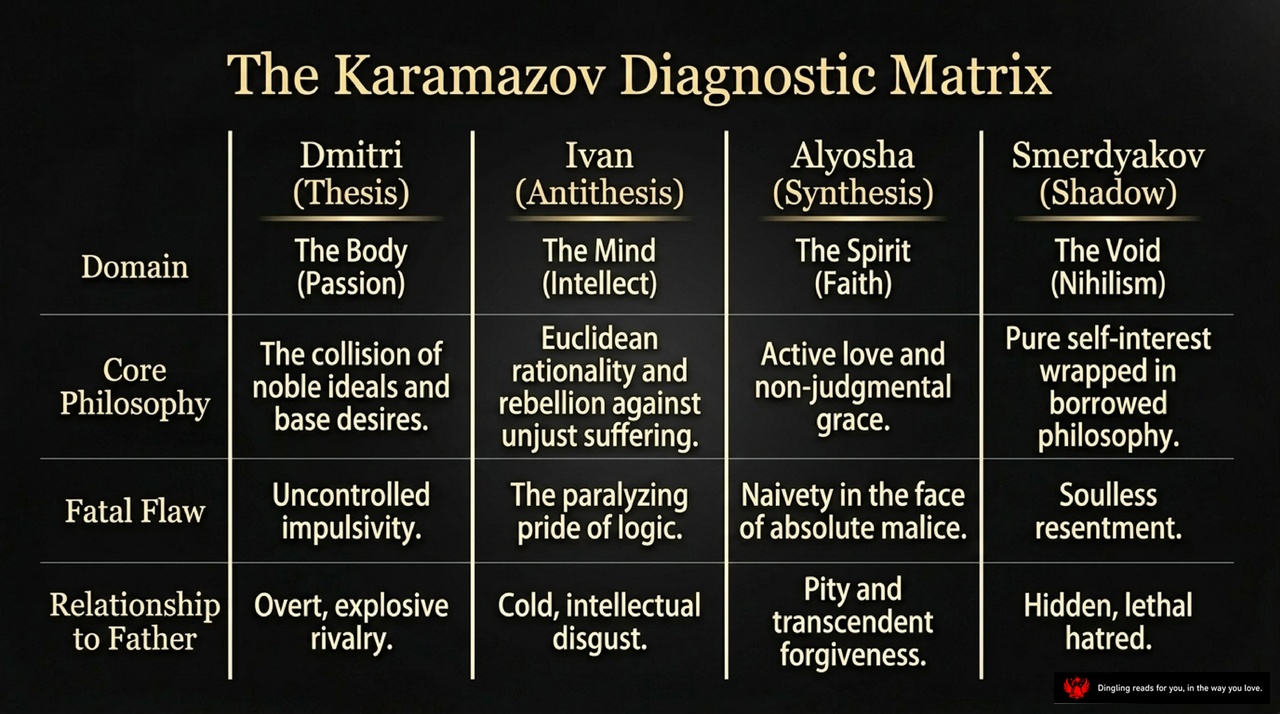
Look at this slide: "The Karamazov Diagnostic Matrix." It's not just a chart; it's the psychological autopsy of a family destroyed by their own minds.
Let's break down these four archetypes. First, Dmitri represents the "Thesis"—the Body and Passion. His core philosophy is the collision of noble ideals with base desires. He is defined by uncontrolled impulsivity and an overt, explosive rivalry with his father. He lives in the moment, driven by raw emotion.
Then we have Ivan, the "Antithesis"—The Mind and Intellect. He embodies Euclidean rationality and a rebellion against unjust suffering. His fatal flaw is the paralyzing pride of logic. He believes that if God doesn't exist, anything goes, leading to a cold, intellectual disgust toward his father rather than hatred.
Alyosha stands as the "Synthesis"—The Spirit and Faith. He represents active love and non-judgmental grace. While he shows naivety in the face of absolute malice, his relationship with his father is defined by pity and transcendent forgiveness. He is the bridge between the extremes.
Finally, Smerdyakov is the "Shadow"—The Void and Nihilism. He is pure self-interest wrapped in borrowed philosophy, channeling Ivan's abstract ideas into action. His fatal flaw is soulless resentment, and his relationship with his father is hidden, lethal hatred. He is the dark side of the family that eventually kills the father.
This matrix reveals the tragedy: the father's selfishness created these four distinct psychological forces that eventually consumed him.

Dmitri: The Torment of the Senses. Look at this split heart. It perfectly captures the internal war tearing our protagonist apart. On one side, we see "The Insect of Lust"—a raw, biological compulsion driving him toward debauchery and ruin. This is the man who stole three thousand rubles from Katerina, the money meant for her family, only to spend it on a night of drunken excess. But on the other side, burning with a desperate, white-hot light, is "The Thirst for Honor." It's an unyielding need for spiritual redemption. Even in the depths of his shame, he screams that a Karamazov can never be a thief. He knows he's a despicable man, yet he cannot accept the label of a criminal. This tragic realization is what keeps him alive, even as he walks toward destruction. He is trapped between his animalistic instincts and his soul's desperate cry for purity. This isn't just a crime; it's a battle for the very definition of his humanity.

Ivan represents the tragic collision between a rigid, logical mind and a chaotic, suffering world. He accepts the existence of God but flatly rejects the world God created, refusing the "ticket" to universal harmony if it demands the unatoned suffering of innocent children. His tragedy lies in his reliance on an earthly, Euclidean brain that demands transactional justice and simply cannot comprehend the mystery of transcendent grace. For Ivan, if there is no immortality, there is no virtue, leading to the fatal premise that all is permitted. Yet, his intellectual rebellion ultimately shatters him, proving that a mind built only on logic cannot survive the weight of moral truth.
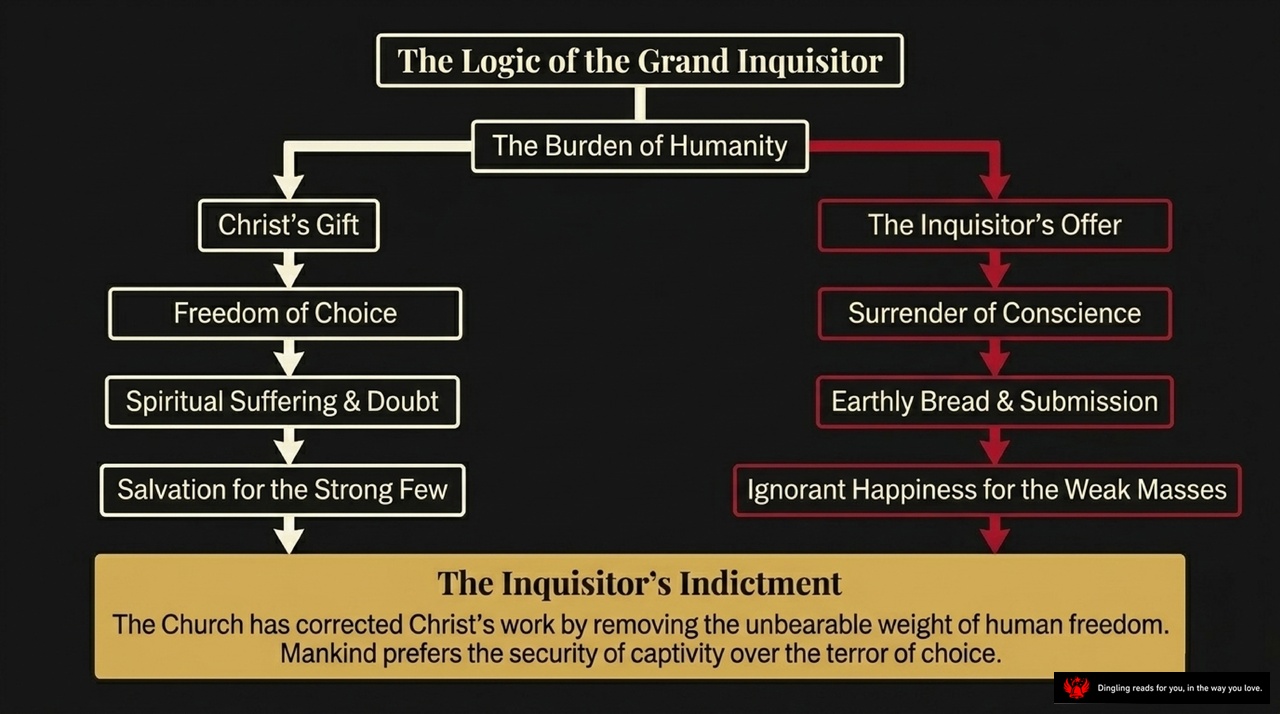
Look at this flowchart. It perfectly captures the terrifying heart of Dostoevsky's *The Brothers Karamazov*: The Logic of the Grand Inquisitor.
On the left, we see the path Christ offers us: the gift of freedom of choice. But come on, be honest with yourself—does that sound like a vacation? No. Freedom means spiritual suffering, endless doubt, and the terrifying responsibility of being the judge of your own soul. It is salvation only for the strong few who can handle that weight.
But look at the right side. This is the Inquisitor's offer. He sees humanity's burden and decides to take it away. He offers surrender of conscience in exchange for earthly bread and submission. He trades our freedom for ignorant happiness for the weak masses. He believes people are too weak to handle the truth, so he builds a church that lies to them, giving them security over terror.
At the bottom, we see the indictment: The Church has corrected Christ's work by removing the unbearable weight of human freedom. It's a chilling conclusion: Mankind prefers the security of captivity over the terror of choice. The Inquisitor isn't just a villain; he's a pragmatic philosopher who believes that to make us happy, he must enslave us. It forces us to ask the ultimate question: Is it better to be a free, suffering human, or a happy, obedient slave?
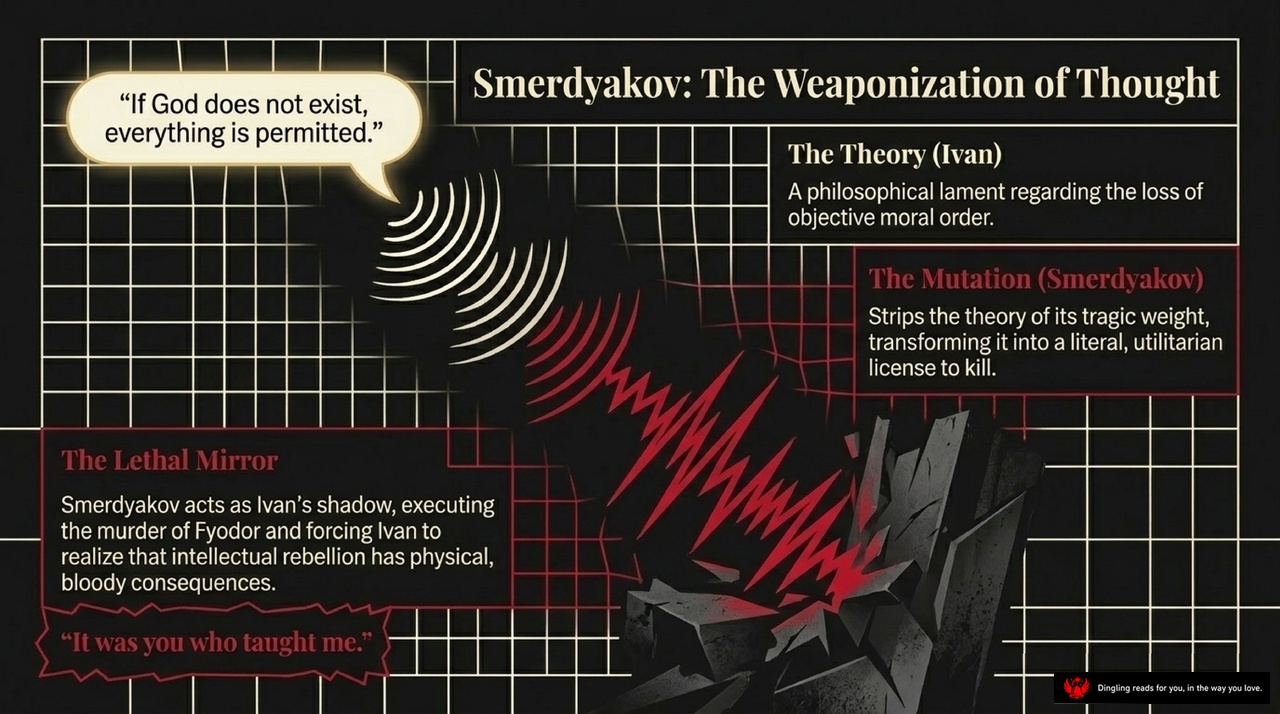
Smerdyakov: The Weaponization of Thought. Look at this chilling transformation. On the left, we see the theory: Ivan's philosophical lament that without God, there is no objective moral order. It's a tragic realization, a heavy burden of intellectual rebellion. But look at what happens when that theory mutates. Smerdyakov takes Ivan's abstract despair and strips it of all tragic weight, turning it into a literal, utilitarian license to kill.
The famous quote, "If God does not exist, everything is permitted," isn't just a slogan here; it becomes a weapon. Smerdyakov acts as Ivan's shadow, executing the murder of Fyodor and forcing Ivan to realize that intellectual rebellion has bloody, physical consequences. When Smerdyakov confronts Ivan with the shattered reality of his own words, saying, "It was you who taught me," he exposes the lethal mirror of nihilism. This is the moment where philosophy bleeds, and the abstract idea of "everything is permitted" becomes the most terrifying justification for murder in human history.
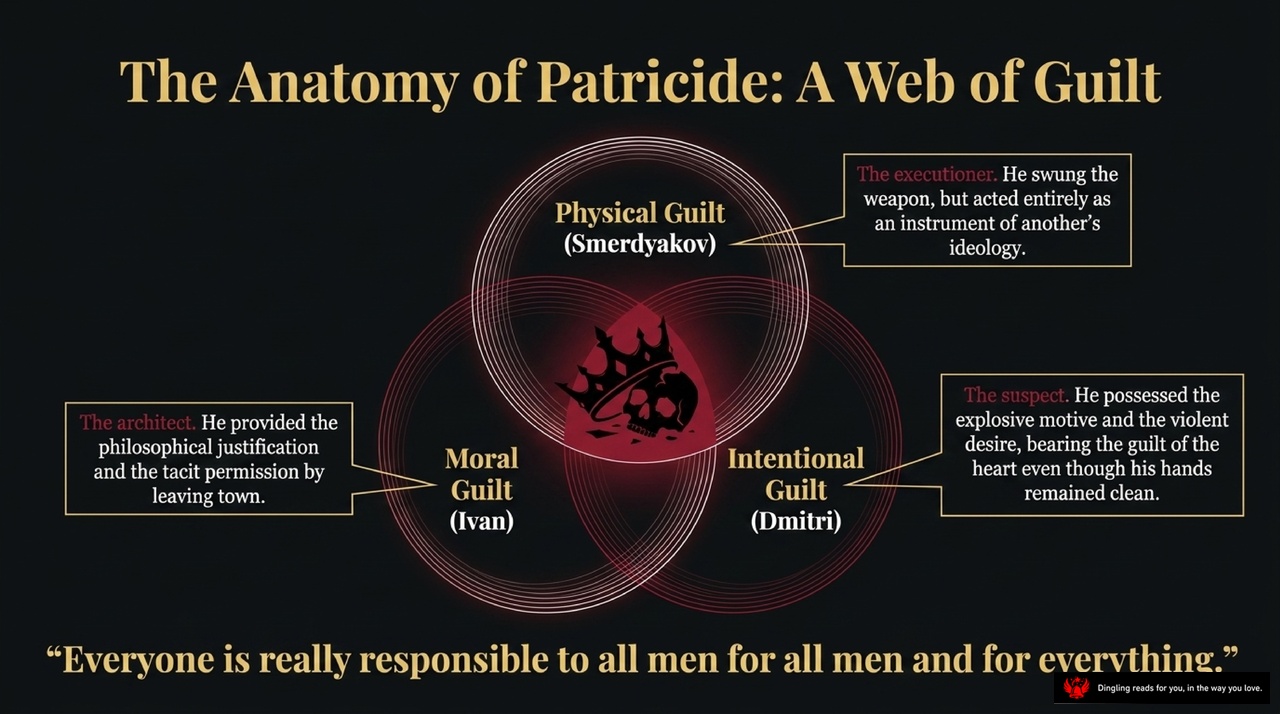
The Anatomy of Patricide: A Web of Guilt
Look at this diagram. It's not just a murder; it's a masterpiece of moral engineering. We are looking at the three distinct layers of guilt that tore the Karamazov family apart.
First, we have the **Architect**. This is Ivan. He provided the philosophical justification. By leaving town and declaring that if there is no God, everything is permitted, he gave the tacit permission for the crime to happen. He built the trap, even though he never touched the weapon.
Then, there is the **Suspect**. That's Dmitri. He possessed the explosive motive and the violent desire. He bore the guilt of the heart. Even though his hands remained clean, his intentions were there. He is the one who swung the hammer of passion.
And finally, the **Executioner**. This is Smerdyakov. He swung the physical weapon, but he acted entirely as an instrument of another's ideology. He was the physical manifestation of Ivan's abstract theories.
Notice how these circles overlap? The tragedy lies in the fact that everyone is really responsible to all men for all men and for everything. The father's neglect, the son's ideology, and the servant's action created a perfect storm. No single person acted alone; the entire family was complicit in this web of guilt.

Alyosha and Zosima: The Synthesis of Faith. This slide reveals the core spiritual conflict of Dostoevsky's masterpiece, framing the monk's role not as a retreat from the world, but as a preservation of Christ's uncorrupted image. While secular society promotes freedom through the multiplication of desires—leading inevitably to isolation and suicide—faith offers a different path. It promotes freedom through the subjugation of the ego. Zosima commands Alyosha to leave the monastery walls, rejecting isolation entirely, to take the light of active grace into the chaotic, suffering world of his brothers. Alyosha's mission is clear: to synthesize faith with action, proving that true redemption happens not in the quiet cloister, but in the messy reality of human connection.

Look at this diagram. We are exploring the mechanics of active love, starting from the very center: The Self. True love begins not with grand gestures, but with a radical humility—subjugating our pride and recognizing our own infinite culpability. We must admit we are flawed before we can truly connect with anyone else.
From the center, we expand outward to Nature. This isn't just about aesthetics; it is about loving the animals, the plants, and the mystery of God's creation. It is the practice of seeing the divine in the ordinary world around us.
Then, we reach The Neighbor. This is where the real work happens. It means loving others not in the abstract, but in the gritty, imperfect reality of daily life. It requires us to embrace the messiness of human connection without expecting perfection.
Finally, our love expands to encompass The Universe. This is a state of spiritual ecstasy and total interconnectedness, where the boundaries between self and other dissolve. As we move through these layers, we touch upon the profound truth at the bottom of this slide: Hell is the suffering of being unable to love. It is the ultimate isolation of a heart that has lost its capacity to connect.

The courtroom isn't just a place to try Dmitri; it's a microcosm prosecuting the soul of modern Russia. As the prosecutor, Ippolit stands trembling, delivering what he calls his "swan song"—a desperate attempt to uphold the law before his own death. He argues that this case isn't merely about a father's murder, but a reflection of a nation's moral decay. He paints a picture of a runaway troika, galloping madly toward a destructive future, driven by the volatile extremes of the Karamazov nature.
In his eyes, the failure of earthly, mechanical justice is inevitable. The court relies on psychology—a knife with two edges—to condemn an innocent man, proving that human law cannot decipher the truth of the human heart. The verdict will be a tragedy not just for Dmitri, but for the very idea of justice itself.

The final stone of Ilyusha's story isn't just a rock; it's the foundation of a new world. As the epilogue reveals, Alyosha gathers the young schoolboys around this sacred stone, forging a brotherhood born not from words, but from the shared grief they feel for the boy Ilyusha. This moment marks the rebirth of community, turning individual sorrow into a collective shield against the darkness.
Alyosha's final teaching is clear and powerful: there is no higher, stronger, or more wholesome defense against future evil than a single, sacred memory of compassion from childhood. While the intellectual rebellion of Ivan and the tragic passion of Dmitri defined the middle chapters, they are ultimately superseded by this quiet, enduring power of shared, active love. The stone stands as a testament to the idea that when we remember the pain of others and choose to stand together, we create an unbreakable bond that protects us all.
In the Karamazov universe, the human soul is not broken by its capacity for profound evil, but tested by its terrifying freedom to choose. Between the Euclidean prison of the intellect and the boundless grace of active love, the heart remains an eternal battlefield. If everyone is truly responsible to all men for all men and for everything, what will you do with your terrible freedom today?