
The Checklist Manifesto: Complete Chapter-by-Chapter Summary
Welcome to *The Checklist Manifesto* by Atul Gawande. Set against the backdrop of a complex cockpit, this book explores how a simple tool transforms human capability. In an age of overwhelming complexity, from the thousands of diseases doctors face to the intricate steps of modern surgery, even the most skilled professionals are prone to error. Whether it's a pilot forgetting to unlock a control or a surgeon missing a critical medication step, human memory and attention simply aren't enough to handle it all alone. But a well-designed checklist doesn't replace human judgment; instead, it acts as a safety net, catching those fatal oversights and ensuring that no single mistake leads to a catastrophe. It's about turning chaos into order, one simple step at a time.
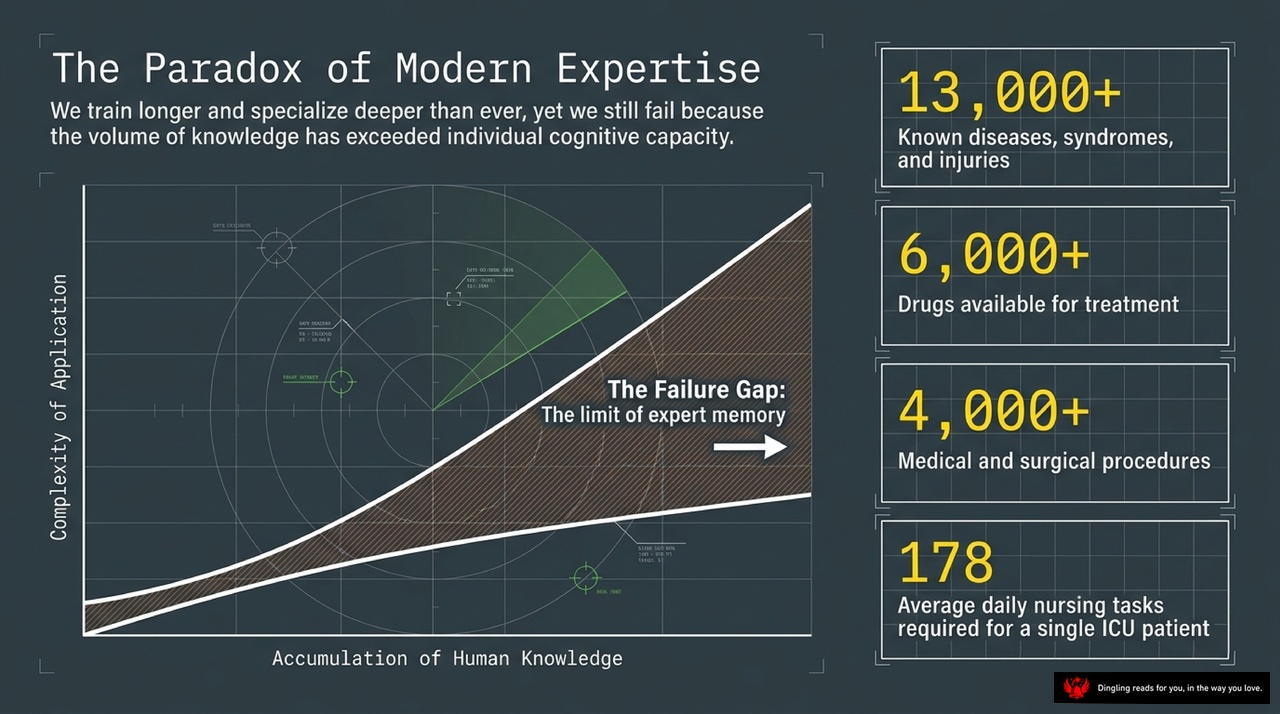
We train longer and specialize deeper than ever, yet we still fail because the volume of knowledge has simply exceeded what any single human brain can hold. Look at the staggering numbers on this slide: there are over 13,000 known diseases, 6,000+ drugs available for treatment, and 4,000+ medical procedures. Just caring for one patient in an ICU requires an average of 178 daily nursing tasks.
The graph you see here illustrates "The Failure Gap." As the accumulation of human knowledge grows exponentially, our individual cognitive capacity—the limit of what an expert can remember—stays flat. This creates a widening gap where complexity outpaces memory. No matter how much we train, we are biologically incapable of holding all the critical details in our heads. That is why, despite our best efforts, mistakes happen. We inevitably miss key steps, ignore risks, and let preventable errors slip through. The complexity of modern medicine has become too vast for any one person to master alone.

Have you ever wondered why some systems fail while others succeed, even when the people involved are equally skilled? The answer often lies in distinguishing between two types of errors: ignorance and ineptitude.
On the left, we see "Errors of Ignorance." This happens when we simply don't know enough. Science hasn't found the answer yet, so we do our best with limited understanding. In the medical world, this is forgivable. Think back to the 1950s, when doctors treated heart attacks with strict bed rest, morphine, and prayer. They didn't have the right tools or knowledge. They failed because they were blind to the truth, not because they were careless.
Now, look at the right side: "Errors of Ineptitude." Here, the cause is different. We possess the knowledge, but we fail to apply it correctly. The result? It's unforgivable. We failed to execute known protocols. A modern example is heartbreaking: today, less than 50% of heart attack patients receive life-saving catheterization within the critical 90-minute window. We know exactly what to do to save them, yet we consistently fail to act.
This distinction is crucial. It tells us that not all failures are equal. Some are born from a lack of information, which we can accept. But many tragedies stem from our own inability to follow the path we already know. In complex systems like healthcare, where we have the answers but often fail to deliver them, the difference between a forgivable mistake and an unforgivable one comes down to one thing: discipline. We must move from ignorance to action, or we will keep repeating the same costly mistakes.
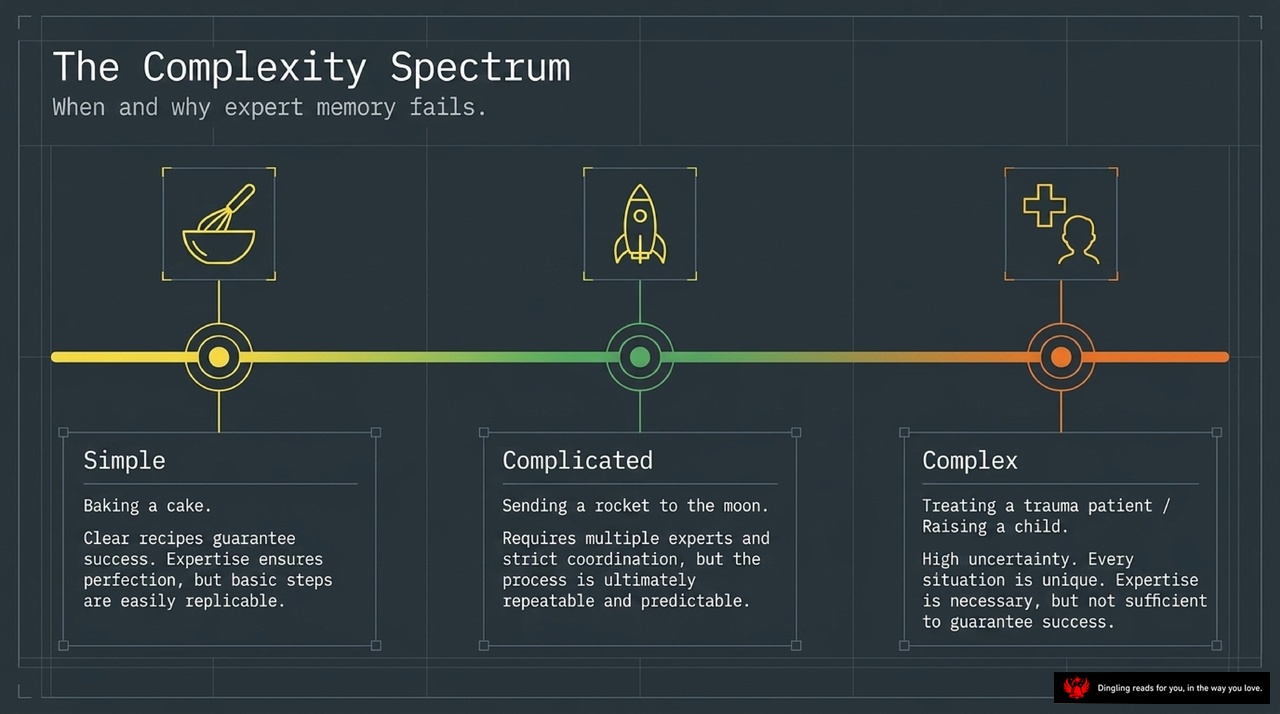
Think about the last time you baked a cake versus the last time you sent a rocket to the moon. The difference isn't just the difficulty; it's the nature of the problem itself. This slide breaks down the "Complexity Spectrum," showing exactly where expert memory starts to fail.
On the far left, we have "Simple" problems. Baking a cake is the perfect example. There are clear recipes, and if you follow the steps, success is guaranteed. Expertise here ensures perfection because the process is easily replicable.
But move to the middle, and things get "Complicated." Think about sending a rocket to the moon. This requires multiple experts and strict coordination. While the process is ultimately repeatable and predictable, the sheer number of variables means human error can still happen if the coordination slips.
Finally, on the far right, we hit "Complex." This is where treating a trauma patient or raising a child falls. Here, high uncertainty rules. Every situation is unique, meaning expertise is necessary, but it is not sufficient to guarantee success. Unlike the predictable steps of a cake or the coordinated mechanics of a rocket, complex problems demand a different kind of thinking—one that relies less on rigid memory and more on adaptive collaboration.
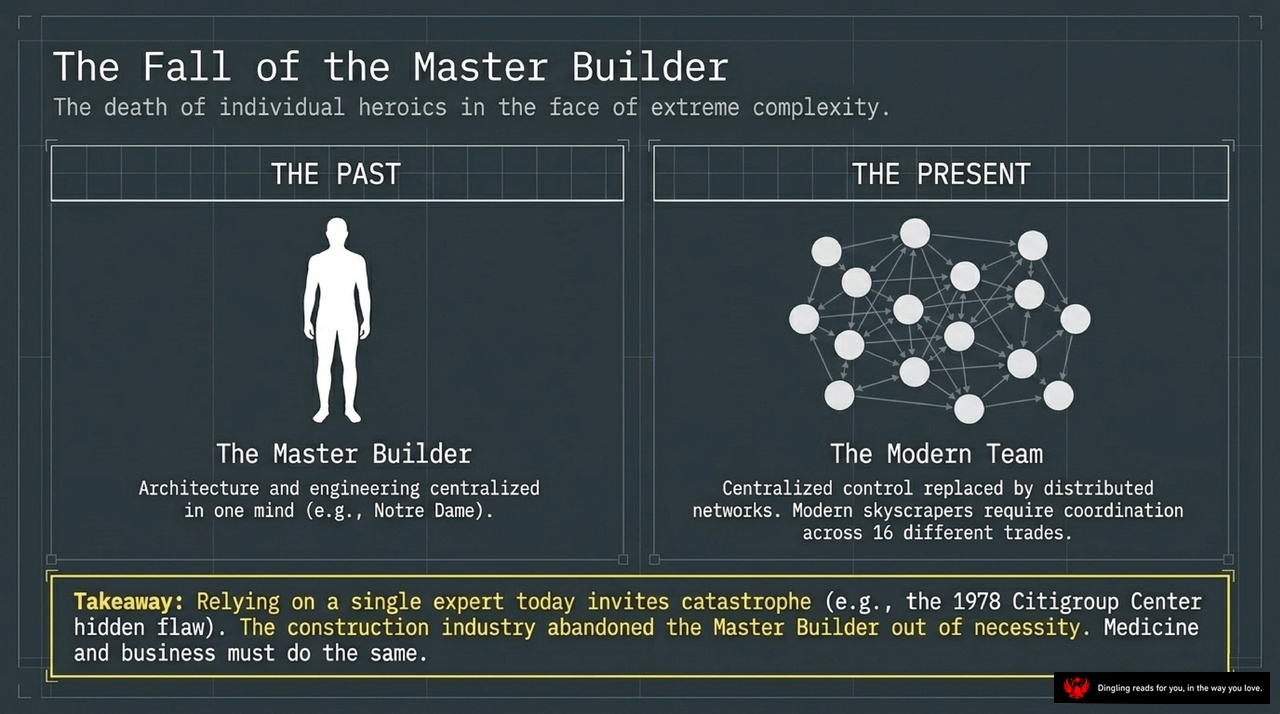
You see, the old way of building things—relying on a single "Master Builder" like the one who designed Notre Dame—just doesn't work anymore. Today's world is too complex for one brilliant mind to control. Look at modern skyscrapers; they require coordination across 16 different trades. No single expert can know it all.
This shift is critical. Relying on a single expert today invites catastrophe, as we tragically saw with the hidden flaw in the 1978 Citigroup Center. The construction industry abandoned the Master Builder model out of necessity, realizing that centralized control replaced by distributed networks is the only way to survive.
We must do the same in medicine and business. Just as a pilot doesn't crash because they have a checklist, but because they use it to catch their own blind spots, our doctors and leaders need to stop trusting individual heroics. Instead, we must build systems where a simple list catches the errors that even the smartest people miss. It's time to trade the lone genius for a reliable team.

What if the difference between life and death wasn't about having better drugs or more expensive machines, but simply about checking a few simple boxes? This slide shows us exactly that, through Peter Pronovost's "ICU Proof of Concept." It's a powerful story of how a simple five-step checklist saved thousands of lives.
On the left, we see the five non-negotiable steps: washing hands, cleaning the skin, using sterile drapes, wearing full protective gear, and covering the insertion site. These aren't just suggestions; they are the guardrails against chaos. On the right, the results are staggering. Before this checklist, the infection rate was a terrifying 11%. After implementing these five steps, it dropped to 0%.
In just 15 months, this simple shift prevented 43 infections and 8 deaths, saving the hospital $2 million. This proves that in a world of extreme complexity, the most powerful tool we have isn't a supercomputer or a new drug. It's a simple list that forces us to do the basics right, every single time.

Imagine a world where a single sheet of paper could save thousands of lives. That isn't science fiction; it's the reality of the surgical safety checklist we're discussing today. By moving beyond simple to-do lists, we've created two powerful systems for handling complexity: Task Checklists for managing the expected, and Communication Checklists for navigating the unexpected.
Think about the difference. On one side, we have Task Checklists. These act as a forcing function for baseline performance, ensuring that critical, predictable steps—like administering antibiotics exactly 60 minutes before an incision—never get skipped due to memory lapses or chaos. It's about preventing stupid errors in a high-stakes environment.
But the real magic happens with Communication Checklists. These are designed to manage the unpredictable. In a complex operating room, things don't always go according to plan. A Communication Checklist forces experts to pause, talk, assess, and collaboratively solve novel problems before surgery even begins. It decentralizes authority, giving the team the power to anticipate issues like blood loss or equipment needs on the fly.
When we combine these two systems, we stop relying on individual heroism and start building a culture of disciplined teamwork. It's the difference between a group of brilliant individuals who might miss the same critical detail, and a unified team that catches each other's blind spots. This shift from simple checklists to a dynamic system of communication is what transforms a risky procedure into a safe one, proving that in the face of extreme complexity, the best tool we have is the power of our collective voice.

Imagine a world where the greatest heroes aren't the lone geniuses making split-second decisions, but teams executing a simple, shared script. Today's slide illustrates exactly how this works by contrasting two responses to the same crisis: Hurricane Katrina. Look at the red arrows pointing inward at FEMA and the government. In that chaotic moment, centralized control failed completely. Information overload paralyzed the decision-makers, creating a bottleneck where no help could reach those who needed it most.
But look at the green arrows flowing outward from Walmart. Instead of waiting for orders from the top, their CEO issued a single directive: "Make the best decision you can with the information you have." This shift to decentralizing power transformed the situation. Frontline managers didn't need permission to distribute water, milk, or use their own resources. They adapted instantly to the reality on the ground. The result? Walmart delivered aid a full day before the government could even move its trucks.
The takeaway here is profound: in extreme complexity, the best checklists don't restrict you; they liberate you. By pushing decision-making power to the periphery, we give frontline workers the freedom to adapt while maintaining core discipline. We stop waiting for a hero to save the day and start building a system where everyone knows how to help.
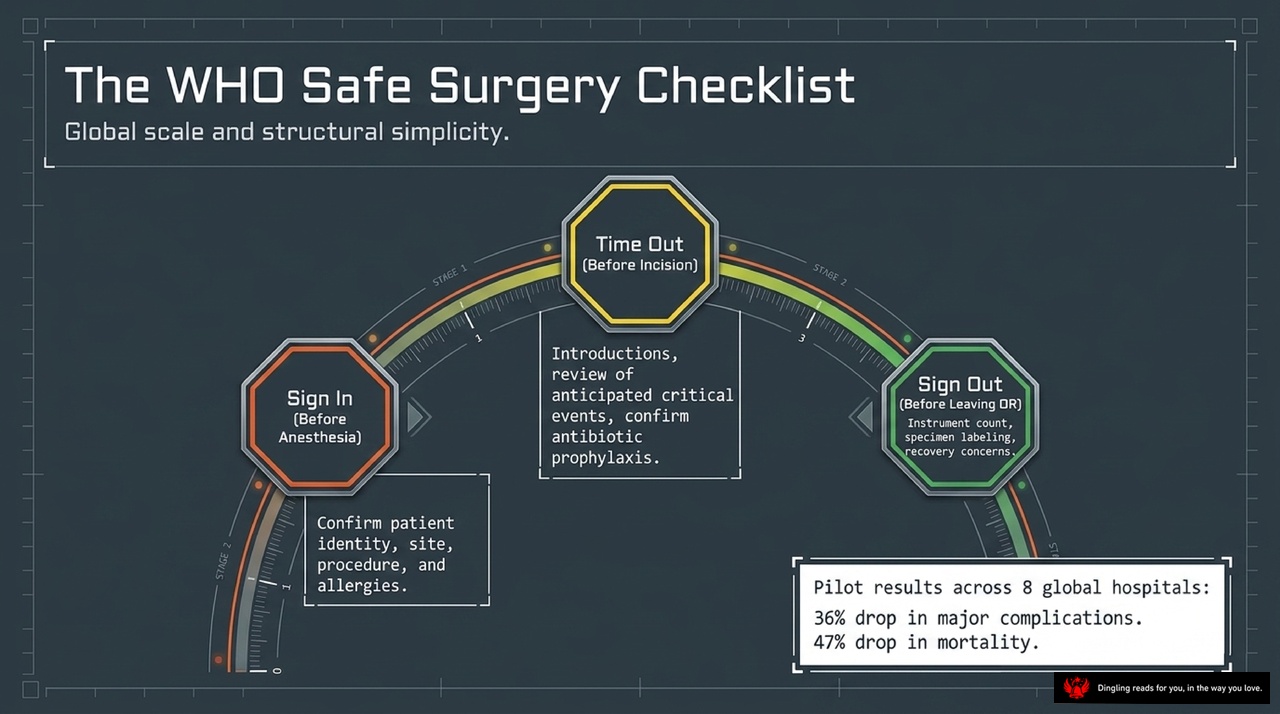
The WHO Safe Surgery Checklist isn't just a piece of paper; it's a global lifeline designed to cut through chaos. As this slide shows, the system relies on three simple, non-negotiable moments: Sign In, Time Out, and Sign Out. Before anesthesia, we verify the patient, the site, and allergies. Just before the first cut, the entire team stops for a "Time Out" to confirm the procedure and anticipate risks. Finally, before leaving the operating room, we count instruments and discuss recovery plans. This structural simplicity works because it forces a pause in a high-pressure environment. The results speak for themselves: in pilot programs across eight global hospitals, this checklist led to a 36% drop in major complications and a staggering 47% reduction in mortality. It proves that in the face of extreme medical complexity, a shared, disciplined routine saves lives better than any individual hero ever could.
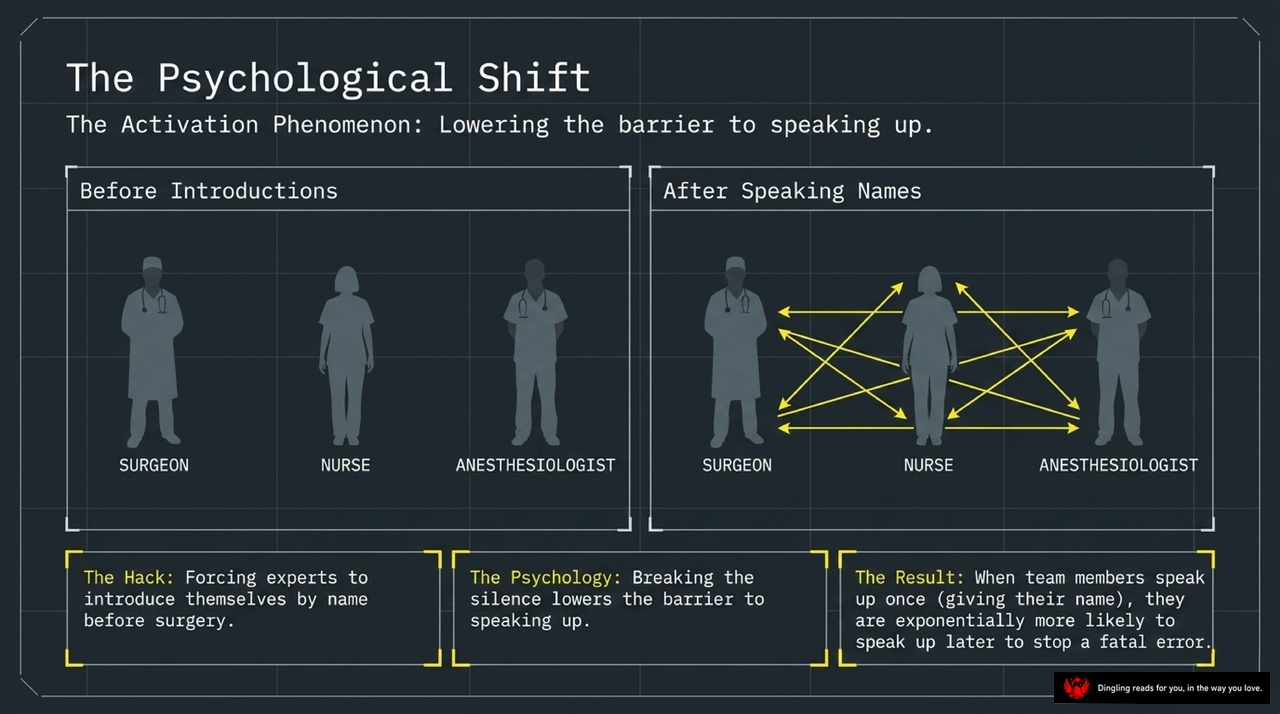
Imagine a world where a simple act of speaking your name transforms an entire team's safety. This slide illustrates that powerful "Psychological Shift" known as the Activation Phenomenon. Before introductions, look at the left side: the Surgeon, Nurse, and Anesthesiologist stand isolated, disconnected and silent. In that silence, barriers rise, and the likelihood of speaking up to stop a fatal error drops to near zero. But now, look at the right side. After speaking names, something changes dramatically. The yellow arrows crisscross between them, representing a sudden explosion of communication and connection.
The hack here is forcing experts to introduce themselves by name before surgery. It might seem like a small social ritual, but the psychology behind it is profound. Breaking that initial silence lowers the psychological barrier to speaking up. Once a team member speaks once, they are exponentially more likely to speak up later if they see a problem. The result is clear: a connected team that can catch errors before they become tragedies. It proves that in complex environments, the first step to safety isn't just better equipment, but simply knowing each other's names.

So, how do we actually stop our brains from hijacking us? The image you see right here maps out the solution perfectly. We are fighting what the book calls the "Cocaine Brain."
On the left, look at those tangled lines labeled "Raw Data Streams." That represents the flood of information we face every day. When that data hits our primitive reward centers, it triggers irrational exuberance or panic. It's like an addiction loop that blinds us to negative data during a boom and paralyzes us during a bust. That is the problem: our emotions are making us ignore the facts.
But the solution, as clearly shown in the middle of this slide, is a systematic filter. The graphic calls it "The Checklist," using examples like a "Day 3 Checklist." This isn't just a to-do list; it's a rational filter. It forces us to review footnotes, cash flows, and management changes before we commit a single dollar.
By moving from that chaotic, emotion-driven left side to this structured, emotionless evaluation on the right, we bypass the "Cocaine Brain." We stop reacting to the noise and start making decisions based on the actual reality of the numbers. That is how you protect your capital from your own impulses.

So, what does a perfect checklist actually look like? We aren't just talking about a random to-do list; we are synthesizing the rigorous design rules used by Boeing to keep thousands of lives safe in the sky.
First, let's talk about the format. You need to choose between "Do-Confirm" or "Read-Do." In Do-Confirm, you perform the task from memory and then pause to check. In Read-Do, you read the instruction first, then execute it. The goal is always to free up your brain for the actual work.
Next, keep it short. A checklist shouldn't be a manual. Focus on five to nine "Killer Items"—those critical steps that are so easy to forget that skipping them could be fatal.
Design matters, too. Use functional typography with clear, sans-serif fonts. No clutter, no fancy fonts, just exact professional language that is instantly readable.
You also need to set a strict pace. The entire checklist must take under 60 to 90 seconds to complete. If it takes longer, users will bypass it entirely, defeating the whole purpose.
Finally, validation is non-negotiable. A checklist is useless if it never sees the real world. It must be tested in actual conditions or high-fidelity simulators and ruthlessly revised based on real-world feedback.
When you get these elements right, you stop relying on fragile human memory and start building a system that catches errors before they become tragedies.

Redefining Professionalism isn't just about being brave or independent; it's about mastering discipline, teamwork, and systems-thinking. For decades, we've been obsessed with "The Old Hero"—the lone wolf who relies on audacity, memory, and risky intuition. We thought greatness came from individual brilliance and the ability to take risks without a net. But the world is getting too complex for that.
Look at the contrast. The New Professional isn't defined by how much they can do alone, but by how well they can collaborate within a system. It's about humility, sticking to protocols, and trusting the team. The Hudson River Miracle proves this point perfectly. When Captain Sullenberger and First Officer Skiles faced the impossible 60 seconds after Flight 1549 hit a flock of geese, they didn't rely on heroic improvisation. They relied on strict adherence to protocol and seamless teamwork. Their checklists freed their minds from rote tasks, allowing them to focus on true problem-solving.
The lesson is clear: a checklist frees expert cognition for true problem-solving. In a world of extreme complexity, the real professional isn't the one who never makes mistakes, but the one who builds a system where the team never has to face the consequences of a single person's error alone.

SYNTHESIS: The Universal System for Complexity. This isn't just a medical or aviation concept; it's a framework uniting medicine, aviation, construction, and finance. At the heart of it all is The Checklist Loop, a cycle of three critical steps. First, we must Acknowledge Fallibility. We have to accept the hard truth that human memory and processing power are fundamentally limited, especially in complex environments. No amount of training can make us infallible. Second, we Systematize the Mundane. By deploying task checklists, we secure the baseline, ensuring that stupid, preventable errors never compromise the foundation of our work. And third, we Democratize the Unexpected. We deploy communication checklists to empower the periphery, forcing teamwork and adaptability when crises strike. This loop transforms individual vulnerability into collective resilience, proving that in a world of extreme complexity, the system must be smarter than the sum of its parts.

We've reached a pivotal moment in our understanding of modern expertise. The reality is stark: we live in an era where human knowledge has exploded far beyond what any single brain can hold. This isn't a call to surrender, but a recognition that relying on solitary heroics is a dangerous strategy. Instead, we must embrace the checklist not as a replacement for skill, but as a cognitive net designed to catch our inevitable flaws. It elevates collective discipline over individual arrogance.
Consider this: if the world's most elite surgeons, pilots, and investors willingly submit to the discipline of a checklist to prevent fatal errors, what arrogance allows the rest of us to rely on memory alone? The truth is, no one is immune to error, especially when complexity overwhelms our capacity. By shifting from a culture of individual brilliance to one of structured teamwork, we don't just prevent mistakes; we unlock a level of safety and reliability that was previously impossible.