
The Chrysanthemum and the Sword: Complete Chapter-by-Chapter Summary
Welcome to *The Chrysanthemum and the Sword* by Ruth Benedict. This isn't just a book about Japan; it's a groundbreaking look into the hidden architecture of a culture that seemed utterly alien during World War II.
The cover art perfectly captures the book's central tension: the chrysanthemum and the sword. In the West, we often see these as opposites—peace versus violence, beauty versus brutality. But for the Japanese, these aren't contradictions; they are two sides of the same coin. The chrysanthemum represents the aesthetic, the spiritual, and the refined, while the sword stands for the warrior spirit, the duty, and the harsh reality of their existence.
Ruth Benedict wrote this in 1944, right in the middle of the war, trying to answer one burning question: Why do the Japanese act so differently from us? Why do they sacrifice themselves so completely, why do they revere the Emperor above all else, and why does their society run on a logic that makes no sense to American ears?
She discovered that the Japanese don't see the world through our lens of individual freedom and equality. Instead, they live by a system of "giving and receiving"—a web of debts and obligations where every action creates a debt that must be repaid. This creates a society where everyone knows their exact place, from the Emperor down to the commoner. It's a culture built on "properness," where maintaining your reputation and fulfilling your duty is far more important than personal happiness or even survival.
This book challenges us to stop judging them by our standards and start understanding their own. It reveals that what looks like fanaticism or cruelty to us is often just a different, deeply logical way of living. Whether you're studying anthropology, history, or just curious about human nature, this book offers a timeless insight into how culture shapes the very soul of a people.
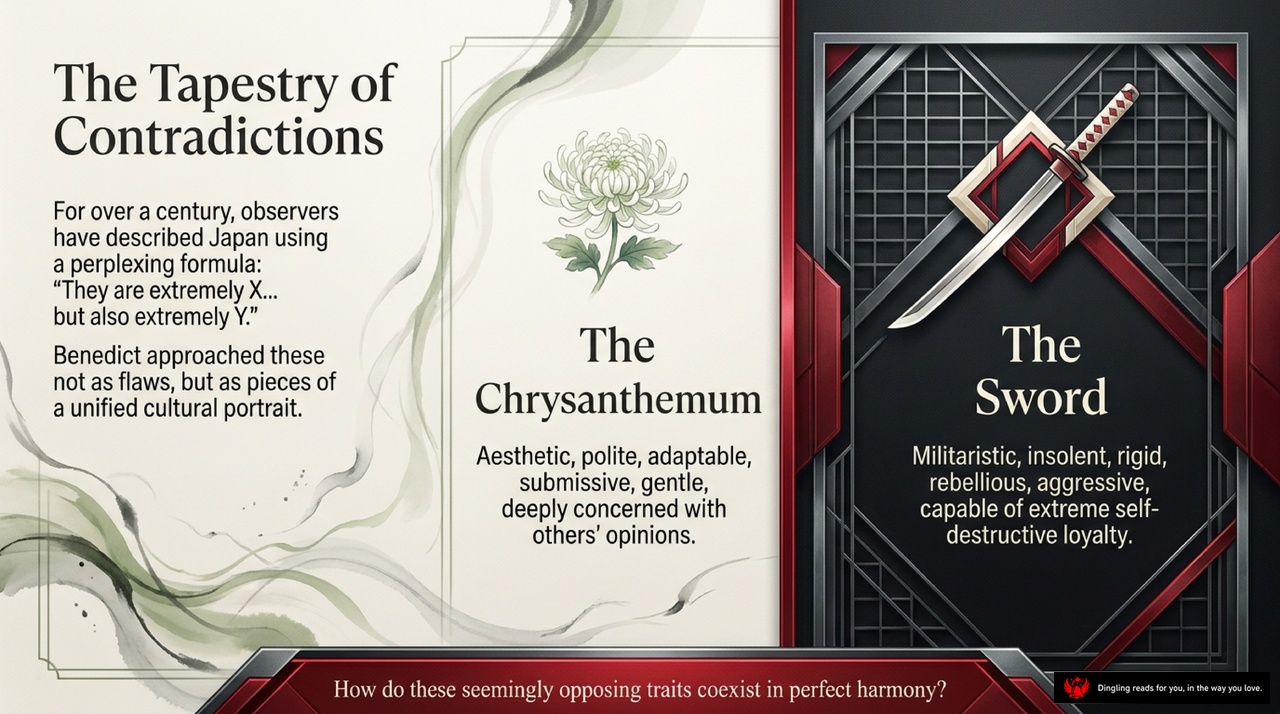
For over a century, the world has struggled to describe Japan with a single formula. It feels like a paradox: they are polite yet arrogant, adaptable yet rigid, gentle yet capable of extreme aggression. This slide captures that tension perfectly with the image of the Chrysanthemum and the Sword. On one side, you have the flower—representing aesthetics, politeness, adaptability, and a deep concern for others' opinions. On the other, you have the sword—symbolizing militarism, insolence, rigidity, and that fierce, sometimes self-destructive loyalty.
But here is the key insight from Benedict: she didn't see these as contradictory flaws. Instead, she viewed them as two sides of a single, unified cultural portrait. How do these seemingly opposing traits coexist in perfect harmony? The answer lies in a unique moral logic. Japanese culture operates on a system of infinite obligations, where every action is a debt to be repaid. The sword is not a tool for chaos, but an instrument for fulfilling these duties with absolute precision. The flower isn't just about beauty; it's about the delicate balance required to maintain social harmony. When a Japanese person faces a crisis, they don't ask, "What is right?" in a universal sense. They ask, "What is my duty?" and then act with the intensity of the sword or the grace of the flower, depending on the situation. This isn't hypocrisy; it's a highly sophisticated way of navigating a complex world where everyone has a specific place and a specific responsibility to uphold.

Decoding the Enemy from Afar: How Benedict Saw Japan
In 1944, the U.S. Office of War Information commissioned a unique mission: to understand the enemy not through maps or troop movements, but through culture. But here's the twist—Benedict couldn't even visit Japan. So, how did she revolutionize cultural anthropology? By treating the bizarre and the contradictory as "positive data."
Look at this map connecting Washington D.C. and Tokyo. Instead of crossing the Pacific with soldiers, Benedict crossed it with a magnifying glass, analyzing propaganda, films, and literature, and interviewing Japanese POWs. Her approach was simple yet profound: no matter how strange a behavior seemed, it wasn't random chaos. It was anchored in a logical system of values learned in everyday life. Every culture acts as a unique lens through which it views the world.
Consider this: while Americans saw war as a clash of steel and strategy, the Japanese saw it as a spiritual battle where spirit triumphs over matter. To them, every act—from self-sacrifice to loyalty to the Emperor—was a rational response to their own cultural lens. By understanding this lens, Benedict didn't just decode the enemy; she taught the world that to understand another culture, you must first put down your own glasses and look through theirs.

The Architecture of Hierarchy isn't just a diagram on a slide; it's the very operating system of Japanese society. While we in the West often champion equality and individual freedom, Japanese culture was built on a completely different foundation: a rigid, predictable pyramid where safety and peace are found only when everyone "takes their proper station."
Look at the top of this structure: The Emperor. He is described here as the "sacred, untouchable apex." This isn't just a figurehead; for centuries, the Emperor was the spiritual core that unified the nation, a concept so powerful that even in total defeat, Japanese soldiers would rather fight to the last man than dishonor him. They believed that as long as the Emperor ordered them, they had no choice but to obey.
Moving down, we see The State and Superiors. These are the authority figures who demand absolute respect, but interestingly, they are bound by strict obligations to those below them. It's a two-way street of duty. You don't just obey blindly; you respect the hierarchy because the system itself demands you care for the people beneath you. This is why Japanese leaders often speak of "burden" rather than "power."
At the base, we have The Family. This is where the hierarchy is learned first. It's dictated by age, gender, and birth order. Think about it: the eldest son inherits authority, and older brothers outrank younger ones. This isn't just about family; it's a blueprint for the entire nation. Just as a son respects his father, a soldier respects his officer, and a citizen respects the state.
Crucially, this slide tells us that hierarchy is not viewed as oppression. In the American mindset, we might see this pyramid as a cage. But for the Japanese, this structure was the ultimate guarantor of societal security. It removed the chaos of uncertainty. Everyone knew their place, which meant everyone knew their responsibilities. This deep-seated belief in "giving each thing its proper place" is why, when the war ended, the Japanese didn't descend into chaos or blame. Instead, they immediately accepted the new order, viewing the defeat not as a moral failure, but as a shift in their position within the global hierarchy. They were ready to climb a new ladder, provided the rules were clear.

The Japanese moral universe operates on a principle that feels almost alien to us: the idea that every action creates a debt that must be repaid. Look at this diagram, "The Ledger of Moral Debts." It visualizes a system where the individual is at the center, constantly surrounded by concentric rings of obligation. In the West, we often separate "obligation" from "duty," but for the Japanese, life is a meticulous accounting system of debts incurred and repaid.
Let's break down these four key debts shown here. On the outer ring, you have "Ko." This represents the active repayment of debt to parents and ancestors. It's a forward-looking action, a way to honor those who came before. Moving inward, we find "Giri." This is the conditional repayment of debt to the outside world and to one's own name. It's about social contracts, promises, and maintaining one's reputation. If you break a promise or lose your face, you owe a debt that must be settled, sometimes at great personal cost.
On the opposite side, we have "On." This is the passive, infinite debt received from parents, the Emperor, or benefactors. It's the weight of the past. In Japanese culture, accepting a favor isn't just polite; it creates a heavy, unpayable burden. You are forever in their debt. Finally, on the inner ring, is "Chu." This is the unconditional, limitless repayment of debt to the Emperor and the State. It's the ultimate sacrifice, the highest form of loyalty where the individual disappears entirely into the greater good.
Together, these four concepts create a moral structure where the individual is never truly free. Every interaction, every kindness, and every command adds to the ledger. Understanding this "Ledger" is the key to unlocking behaviors that might seem confusing or contradictory to us, from extreme self-sacrifice to intense sensitivity about social standing. It's not just about rules; it's about the relentless drive to balance the books of the soul.

"‘On’: The Debt You Can Never Fully Repay. In the West, we view love as freely given, but for the Japanese, receiving 'On' is incurring a permanent, heavy debt that binds the receiver forever. Even a trivial favor, like offering a glass of ice water to a stranger, creates an uncomfortable obligation because it establishes an unpayable bond. This resentment of debt is so deep that accepting 'On' from an unworthy person is seen as a severe humiliation. Furthermore, maternal care isn't viewed as unconditional love here; instead, it is seen as the systematic accumulation of a lifetime debt that a child must repay through 'Ko.' This cultural lens explains why the Japanese often feel immense pressure from the smallest kindness, viewing every interaction through the weight of an unpayable debt."

" 'Giri': The Hardest Burden to Bear. In the world of Japanese culture, 'Giri' isn't just a word; it's the heaviest weight a person carries. Think of it as the active duty to the world, driven by societal pressure and the fear of public judgment, often forcing you to act against your own desires.
The image on the left shows 'The Silk'—Giri to the World. It's about fulfilling obligations to in-laws, employers, and distant relatives. It's often resented, yet strictly obeyed. Why? Because to avoid being labeled a 'wretch' or someone who 'does not know Giri,' you must bow and follow the rules, even when your heart screams otherwise. It's the soft, suffocating weight of social expectation.
On the right, we see 'The Steel'—Giri to One's Name. This is the duty to keep your reputation unblemished. It demands absolute stoicism in pain, living strictly according to your class, and even clearing a slandered reputation at any cost. It's the rigid armor of honor.
Together, the Silk and the Steel represent the impossible balance Japanese people strive for every day. It's not about what you want; it's about what you owe. And when that burden becomes too heavy, the only way to restore the balance is often to sacrifice oneself completely. That is the true, hardest burden of Giri."

In Japanese culture, life isn't framed as a simple battle between good and evil. Instead, it's a delicate balancing act between competing "good" obligations. The deepest tragedies occur when these duties collide, creating a world where the right thing to do often depends on which side of the scale you choose.
This slide illustrates that perfect collision with the famous story of the 47 Ronin. These samurai faced an impossible choice: fulfill their *Giri*, or duty, by avenging their disgraced master, or honor their *Chu*, which represents loyalty to the Shogun's law against unsanctioned revenge. In their case, the conflict was clear—taking justice into their own hands violated the state's authority.
The resolution was a perfect, tragic balance of debts. They killed the enemy to satisfy *Giri*, but then committed *seppuku*, a ritual suicide, to satisfy *Chu*. By ending their own lives, they restored the social order they had disrupted. This story captures the essence of the Japanese moral world: a system where honor is maintained not by choosing one side, but by paying off every debt, no matter how heavy the cost.
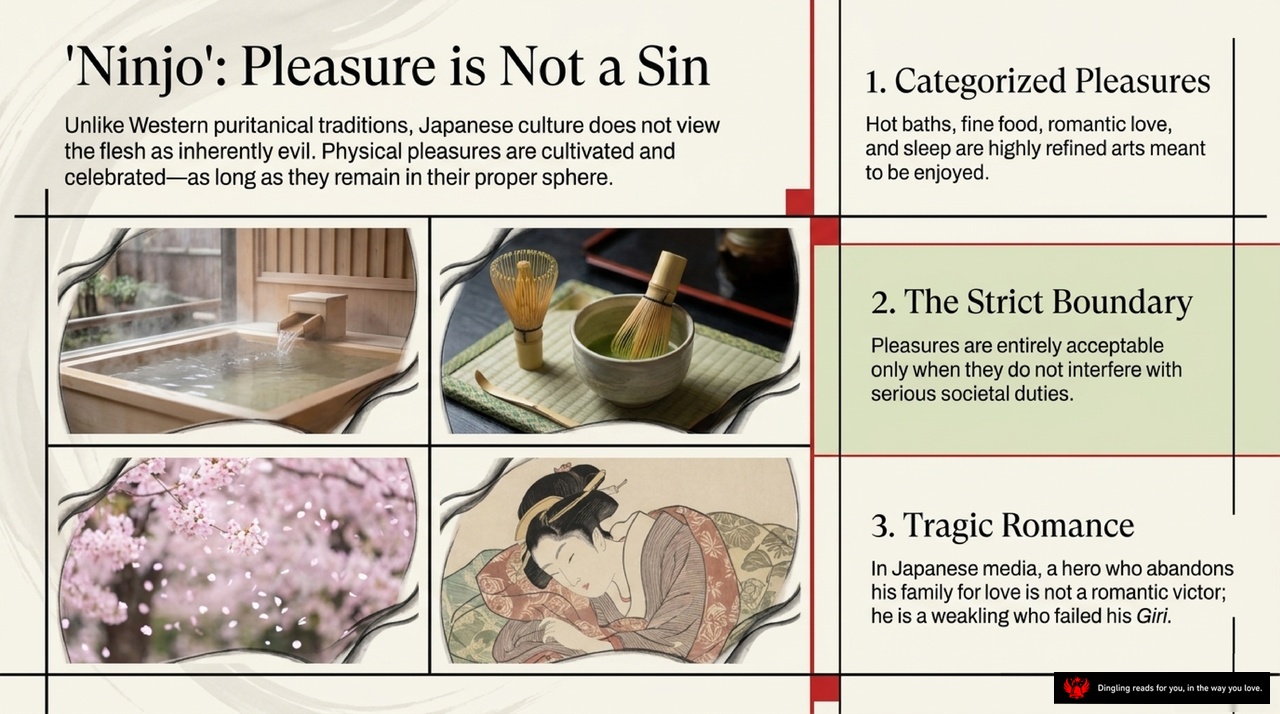
Today's slide unpacks a fascinating paradox at the heart of Japanese culture: "Ninjo"—the idea that pleasure is not a sin. Unlike Western puritanical traditions that often view the flesh as inherently evil, Japanese culture does not reject physical enjoyment. Instead, it cultivates and celebrates it, provided it stays within its proper sphere.
The slide breaks this down into three key points. First, we see "Categorized Pleasures." Notice the images of the hot bath, the matcha tea ceremony, cherry blossoms, and the sleeping courtesan. These aren't just random scenes; they represent refined arts. Hot baths, fine food, romantic love, and sleep are highly valued, but they are treated as distinct experiences meant to be enjoyed, not indulged in recklessly.
Second, the slide highlights "The Strict Boundary." This is the crucial filter. Pleasures are entirely acceptable only when they do not interfere with serious societal duties. You can enjoy a bath or a lover, but never at the expense of your duty to family or society. If pleasure crosses that line and disrupts your obligations, it becomes a failure.
Finally, we have "Tragic Romance." The image of the sleeping woman illustrates this tension. In Japanese media, a hero who abandons his family for love isn't celebrated as a romantic victor. Instead, he is viewed as a weakling who failed his "Giri"—his social obligations. True strength lies in prioritizing duty over personal desire.
So, the takeaway is clear: Japanese culture isn't about denying pleasure. It's about mastering the art of enjoying it without letting it consume your responsibilities. It's a delicate balance where pleasure and duty coexist, but duty always holds the final vote.

Good morning, everyone. Today, we're diving into one of the most profound insights from Ruth Benedict's *The Chrysanthemum and the Sword*: the fundamental difference between how the West and Japan navigate morality. Specifically, we need to look at the mechanics of morality: Guilt versus Shame.
As the slide illustrates, Benedict distinguishes the internal moral compass of the West from the external moral compass of Japan. This isn't just a cultural nuance; it's a complete shift in how humans define right and wrong.
Let's break down the table on your screen. On the left, we have Western Guilt Culture. The core driver here is **internal conscience**. It's about an absolute battle between Good and Evil. You feel guilty because *you* feel you've done something wrong, even if no one else knows. The deterrent is the fear of internal condemnation, and the relief comes from confession and atonement. You can feel guilty in the dark, and that's okay.
Now, look at the right side: Japanese Shame Culture. Here, the core driver shifts to **external expectations**. Morality isn't about an internal ledger of sins; it's about navigating **situational obligations**. You don't feel bad because you violated a universal rule; you feel bad because you failed to meet the expectations of your group or society. The deterrent isn't an inner voice; it's the **fear of public ridicule or losing face**. Notice the **Relief Mechanism**: it's about **clearing one's name**, sometimes even through extreme acts, to restore social harmony.
Finally, look at the **Visibility** row. This is the critical difference. In the West, you still feel guilty if **no one sees** your mistake. But in Japan, you **only feel shame if the act is known to the public**. If you break a rule in private, there is no shame, only a practical problem to solve.
Understanding this distinction is the key to unlocking the "Japanese personality" that confused so many Americans during WWII. It explains why a Japanese soldier might fight to the death to avoid the shame of surrender, or why a leader might make a drastic decision simply to avoid public embarrassment. It's not about being "good" or "evil" in the abstract; it's about maintaining one's place in the social order.
Thank you.

When we look at this slide, we see a powerful visual metaphor: a rusted blade transforming into a gleaming, sharp sword. This isn't just about sharpening metal; it's about "polishing the rust off the soul." The core idea here is that Westerners often mistake Japanese self-discipline for self-sacrifice or repression, but that's a fundamental misunderstanding. To the Japanese, this process is entirely different—it's a functional tool to improve competence and remove the "rust" of weakness from their character.
This mindset is built on two pillars shown here. First, there is "No Concept of Sacrifice." In the Western view, doing your duty often feels like a tragic loss of personal happiness. But for the Japanese, duty isn't a sad sacrifice; it's an investment and a necessary exchange to experience life fully. You don't give up your life for duty; you use duty to fully inhabit your life.
Second, we see "Conquering the Body." This is about training the mind to push past the body's natural limits. The slide references a striking quote from a Japanese officer: "We already know how to sleep; now we must train to not sleep." This illustrates the extreme physical discipline required to achieve mental clarity and readiness. It's not about punishing the body; it's about mastering it to serve a higher purpose. By treating their bodies as tools to be refined rather than masters to be served, Japanese culture achieves a level of focus and resilience that allows them to cut through obstacles with precision, just like that polished blade.

"Muga"—the ultimate form of Japanese self-discipline—represents the pinnacle of human performance, often described as "no-mind." It is the complete erasure of the "observing self," that inner critic we all carry. Imagine the constant psychological burden of watching yourself to avoid shame, a heavy weight that paralyzes action. But Muga is the release from this burden. It is the moment the observer is finally bypassed, allowing the actor and the action to become one, without hesitation or self-critique.
This state is achieved through a radical mindset shift: living as if already dead. When you stop caring about public judgment or future consequences, you free your total energy for the task at hand. It's not about being lifeless; it's about being so focused that the fear of failure disappears entirely. In this flow state, there is no room for doubt, only pure execution. This is the essence of Muga—letting go of the self to achieve true mastery.

Have you ever wondered why Japanese adults seem so comfortable with rigid discipline, while we Americans often view it as oppressive? The answer lies in a unique life cycle known as the "U-Curve of Japanese Upbringing."
Look at this graph. It flips our entire understanding of childhood and adulthood on its head. In the West, we grow up strict and become freer as we age. But for the Japanese, life looks like a U.
Start at the left peak: infancy. This is a paradise of maximum indulgence. Toddlers are treated like gods—unrestrained, deeply loved, and expected for nothing. They are free to scream, cry, and demand attention without consequence.
Then, the curve plunges into the trough: adulthood. This is the lowest point of personal freedom. From roughly age seven until they turn sixty, individuals are under maximum restriction. They are bound by the strict walls of *Giri* (social duty) and societal expectations. They are expected to suppress their desires, work tirelessly, and never let anyone know they are struggling. It's a long period of sacrifice where the self is entirely subordinated to the group.
Finally, the curve rises again to the right peak: old age. Once obligations are fulfilled and children are grown, the elderly return to a state of indulgence. They are permitted to speak their minds, enjoy life, and act with the same freedom their children once had.
So, the rigid discipline adults face isn't something they were "broken into." It is a necessary training ground. They are gently molded into this system after a short, protected childhood, only to return to freedom later in life. It's a trade-off: give up your freedom in your prime to secure a free and respected old age.

After WWII, the world expected Japan to fight back with fierce guerrilla warfare. Instead, they surrendered instantly. Why? Because Japan didn't see war as a moral battle of good versus evil. They viewed it through a completely different lens: a failure of their assigned "station" in the world.
The slide highlights this shift with the concept of "Adapting to a New Station." The Emperor dictated a new course, and Japanese culture demanded they adapt to their newly assigned role. In Japanese society, there is no concept of clinging to a failed path. When a strategy fails, the pragmatic response isn't to double down or blame others; it is to acknowledge the error and pivot immediately.
This is the "Pragmatism of Failure." Militarism was simply an experiment that didn't work. Because they recognized the failure so quickly, they could discard the "sword" of aggression and embrace peace. This allowed them to rebuild their reputation. Their new goal became earning the world's respect through economic strength and stability, while carefully preserving the "chrysanthemum"—their cultural identity and the Emperor's symbolic role.
While Westerners saw defeat as a moral catastrophe, the Japanese saw it as a necessary correction. They realized that their old way of living, centered on military expansion, was no longer their proper station. By accepting this new reality without bitterness, they were able to transform from an enemy into a respected partner. This cultural ability to adapt, to admit fault, and to move forward is what allowed Japan to recover so rapidly after the devastation shown in the background. It wasn't just about survival; it was about finding a new, sustainable place in the global order.
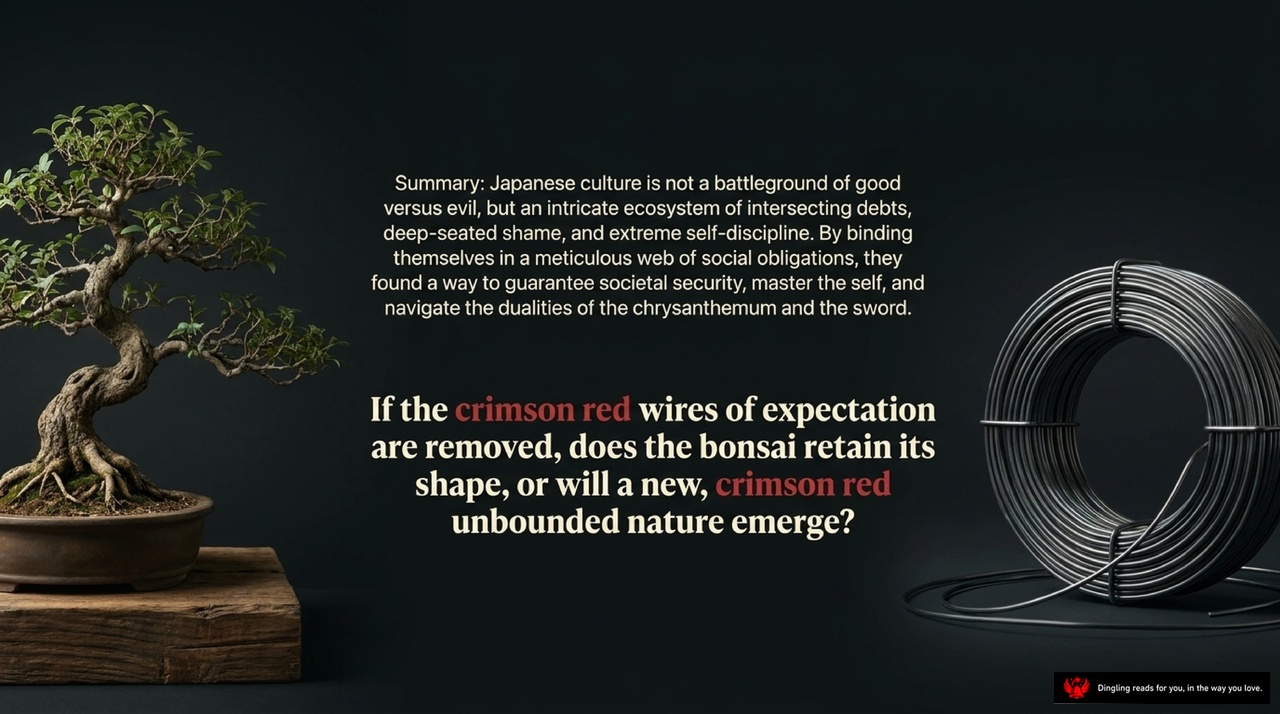
Japanese culture isn't a simple battle of good versus evil; it's a complex ecosystem woven from intersecting debts, deep-seated shame, and extreme self-discipline. Imagine a bonsai tree, carefully shaped and held in place by crimson red wires of expectation. That is the Japanese social fabric. By binding themselves to a meticulous web of obligations, they found a way to guarantee societal security and master the self, navigating the dualities of the chrysanthemum and the sword.
But what happens if we remove those wires? If the crimson red wires of expectation are removed, does the bonsai retain its shape, or will a new, crimson red unbounded nature emerge? This question lies at the heart of understanding Japan. For centuries, outsiders have struggled to decode this enigma, seeing only contradictions: polite yet arrogant, loyal yet capable of rebellion. The key to unlocking these behaviors lies not in judging them by Western standards, but by understanding their unique moral compass, where every action is a response to a debt owed to society, family, or the Emperor. It is a system where the individual finds meaning not through personal freedom, but through fulfilling their specific role within a rigid, yet deeply personal, hierarchy.