
The Compound Effect: Complete Chapter-by-Chapter Summary

Welcome to the book club for *The Compound Effect* by Darren Hardy. Today, we're diving into the very heart of the matter: the power of the Compound Effect.
As you see on this cover, the core idea is simple yet profound: small, smart choices combined with consistency over time engineer the ultimate blueprint for massive success. Think of it as the mathematics of life. It's not about one giant leap; it's about the relentless accumulation of tiny, seemingly insignificant actions that, when given enough time, create an exponential explosion of results.
Most people underestimate this power because the results don't show up immediately. Just like in that classic example where a penny doubles every day for thirty days, you might be tempted to take a million dollars upfront on day twenty-nine. But if you stick with the penny, by day thirty-one, you'll have over ten million. That's the magic of the curve. It stays flat for a long time, testing your patience, before it shoots straight up, rewarding those who refused to quit.
This isn't just about money. It's about your life. Every small choice you make—what you eat, how you spend your time, who you surround yourself with—creates a ripple. Over time, these ripples collide and form massive waves that define your destiny. The Compound Effect is the only force that can help you achieve the extraordinary, but only if you are willing to do the ordinary things consistently, day after day, without expecting instant gratification.
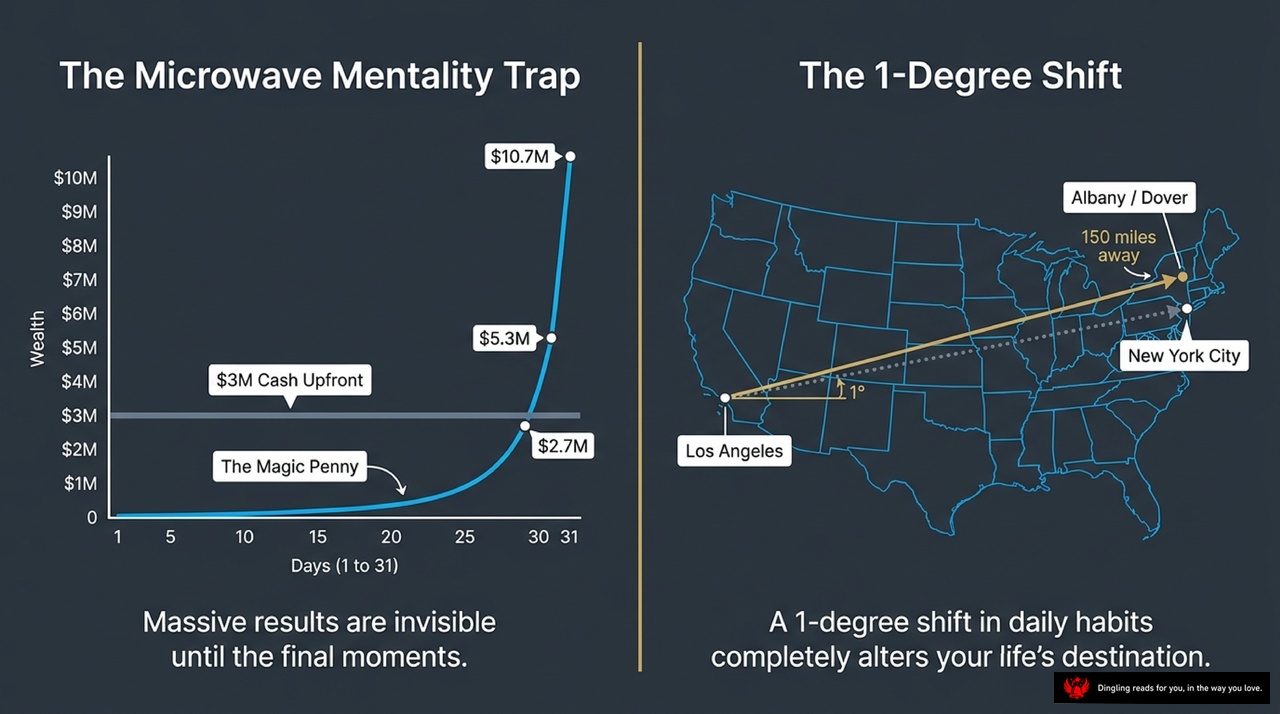
Look at this slide. On the left, we see "The Microwave Mentality Trap." It's a graph showing how wealth grows. You start with just one cent, and for the first 29 days, your money stays incredibly low. In fact, by day 29, you have about $2.7 million. Meanwhile, someone who takes the "instant gratification" route gets $3 million upfront. It looks like the instant winner has already crushed you. Everyone thinks they've lost.
But here is the twist. On day 30, the curve shoots up. You hit $5.3 million. By day 31, you have over $10 million. That is three times the instant cash. The lesson is clear: massive results are invisible until the final moments. The microwave mentality makes us quit too early because we can't see the progress yet.
Now, look at the right side: "The 1-Degree Shift." This map shows a tiny one-degree angle between Los Angeles and New York City. If you flew that exact path, you would land 150 miles away in Albany or Dover instead of New York City. That is a massive difference caused by a microscopic deviation.
This visualizes a powerful truth: a 1-degree shift in your daily habits completely alters your life's destination. Just like that one degree changes your landing spot, small changes in your routine—reading a few pages, saving a few dollars, or avoiding one bad habit—compound over time to create a completely different life. Don't wait for big changes to work; focus on that tiny 1-degree shift today, and watch how time does the heavy lifting for you.
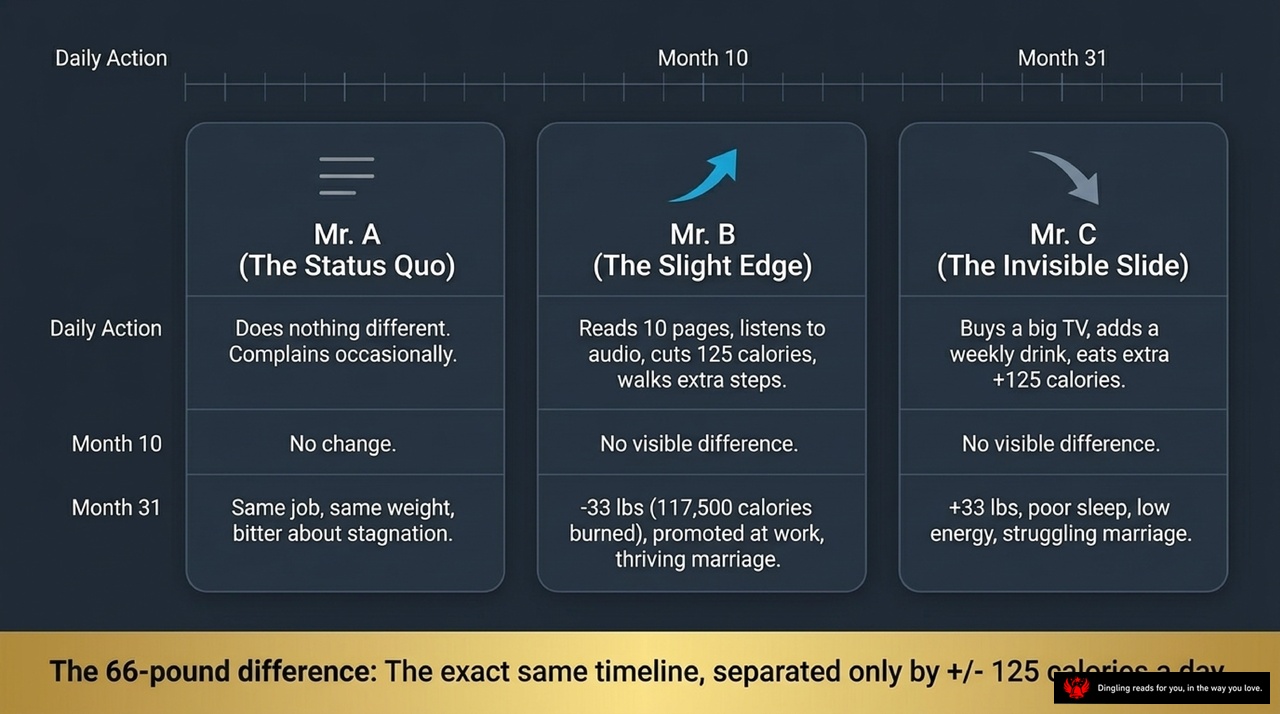
Imagine three people living parallel lives on the exact same timeline, yet ending up in completely different worlds. Mr. A stays in the status quo, doing nothing different and complaining occasionally. By Month 31, he's stuck in the same job, at the same weight, bitter about stagnation. Then there's Mr. B, who chooses the slight edge. He reads ten pages a day, listens to audio, and cuts just 125 calories. At first, nothing seems to change. But by Month 31, that tiny daily habit has led to a 66-pound weight loss, a promotion, and a thriving marriage. On the other side is Mr. C, who chooses the invisible slide. He buys a big TV, adds a weekly drink, and eats extra calories. Like Mr. B, there's no visible difference for the first few months. But by the end, Mr. C has gained 33 pounds, suffers from poor sleep and low energy, and is facing a crumbling marriage. The shocking truth? The only difference between their success and their struggle was a mere 125 calories a day. This is the ripple effect of small choices, proving that your daily actions are quietly shaping your entire future.

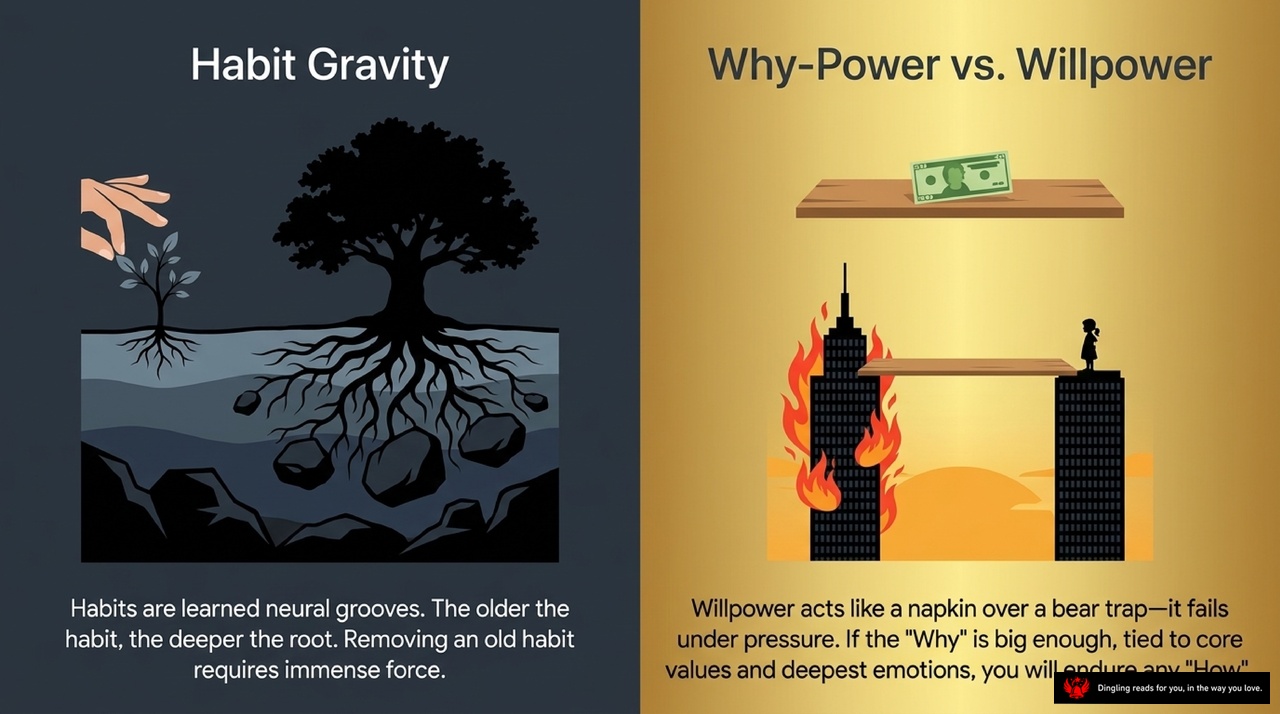
Habits are the invisible architects of our lives, and most of us are riding a horse without holding the reins. Did you know that 95% of our thoughts and actions are driven by habits? The problem is, we often fight them with willpower alone, which is like trying to cover a picnic basket full of temptation with a single napkin—it just doesn't work.
To truly master your life, you need to understand that breaking bad habits isn't about brute force; it's about strategy. First, identify the triggers—ask yourself who, where, and when the urge hits. Then, change your environment. If you want to stop drinking, remove the alcohol from your home. If you want to save money, unsubscribe from retail ads. You have to make the bad choice physically impossible.
But removing the bad isn't enough; you must replace it with something better. Think about addition, not subtraction. Instead of saying "I won't eat junk," say "I will eat a salad." Fill your life with positive actions, and the bad habits will naturally lose their space. Make your new goals public, find an accountability partner, and celebrate every small win. Remember, changing a habit is a marathon, not a sprint. It takes time to rewire your brain, but if you stay consistent, you will eventually become the person you've always wanted to be.

The slide presents a powerful concept: "The Ultimate Diagnostic Tool: Tracking." It uses a simple coffee cup to illustrate a profound financial truth. Just a $4 daily expense might seem trivial, but over 20 years, with an 8% return, it compounds into over $51,000 in lost opportunity. The insight is clear: every dollar spent today costs you five dollars in twenty years.
This isn't just about money; it's about the ripple effect of your choices. As the text explains, unrecorded calories compound into pounds, just as untracked spending compounds into massive financial losses. The strategy is simple but often ignored: track every single action in one target area for 21 days.
Why does this work? Because you cannot manage what you do not measure. Most of us make choices like sleepwalkers, unaware of how small habits—like that extra coffee or skipped workout—drift our lives off course. A small notebook forces these unconscious choices into the light of conscious awareness. By tracking your actions, you break the cycle of invisible drift and take back control of your future. Start tracking today, and let the power of compounding work for you, not against you.
Imagine you are climbing a steep hill on a bicycle. As you push harder, you hit a wall—a point where your lungs burn, your legs feel like lead, and your brain screams, "Stop! Just stop!" This is the "wall" everyone faces, and it's where most people quit. But here's the secret: the magic doesn't happen before the wall; it happens right on the other side.
Think of Lance Armstrong in the Tour de France. When he was exhausted, freezing in the rain, and miles behind the leaders, he didn't just try to keep up. He realized that his competitors were suffering just as much as he was. So, he pushed one more gear. That extra effort, that decision to go beyond the wall, is where the real growth happens. It's the same in business. If you do exactly what everyone else does, you'll get exactly what they get. But if you do five percent more—whether that's driving an extra mile to close a deal or writing a handwritten thank-you note instead of sending a generic email—you create a massive gap over time.
This is the power of "extra effort." It's not about working harder in a stressful way; it's about finding those small, extra steps that compound. Like that penny doubling story we talked about earlier: if you could just add one more day of doubling every week, the result isn't just a little better—it's exponential. Richard Branson didn't just launch a soda; he drove a tank down Fifth Avenue to do it. Oprah didn't just give away cars; she surprised everyone with an extra one. These aren't accidents; they are choices to exceed expectations.
When you consistently choose to go that extra mile, you stop competing with others and start competing with your own potential. You become the person who shows up when others fade, who delivers when others cut corners, and who creates surprises that turn strangers into loyal fans. In a world full of average efforts, being the one who pushes past the wall is the only way to build an unshakeable advantage. Don't stop when you're tired; stop when you've gone too far. That's where the real life-changing results live.

Today's slide lays out the ultimate blueprint for mastering your life, split into two powerful strategies: eradicating bad habits and installing good ones. Let's break down how to take control.
On the left, we tackle the problem of bad habits. The first step is to identify your triggers. You need to map out exactly who, what, where, and when these bad behaviors happen. Once you know the enemy, the next move is to clean house. This means physically removing the triggers from your environment. If you want to stop snacking, don't just try to resist; actually take the snacks out of the house. Then, swap it. Replace the old routine with a benign alternative. Finally, decide whether to ease in or jump in. You can choose to wean off gradually or go for cold turkey, depending on what works best for your psychology.
Now, look at the right side: installing good habits. Start by setting up for success by engineering your physical environment to make the right choice the easy choice. Next, apply the Add-In Principle. Instead of focusing on what you have to sacrifice, focus entirely on what you gain. This shifts your mindset from deprivation to opportunity. Then, embrace public accountability. Broadcast your commitment to the world; let others hold you responsible. Find a success buddy, a peer who can align with you for weekly accountability checks. By combining these six strategies, you stop relying on fleeting willpower and start building a system where good habits thrive naturally.

Protecting the Process: Routine Bookends. Imagine your day as a timeline stretching from 5:00 AM to midnight. In the middle, you're surrounded by unpredictable chaos—fires, emails, and endless meetings. But what if you could build two solid bookends to shield yourself from that noise?
On the left, your Morning Bookend from 5:00 to 7:00 AM. This isn't just about waking up; it's about setting your trajectory. Start with gratitude and love projection, then spend ten minutes on physical stretching to wake up your body. Next, dive into thirty minutes of educational reading to fuel your mind. Crucially, you must identify your three Most Valuable Priorities, or MVPs. Here's the rule: no email until these MVPs are locked in. This ensures you start the day with intention, not distraction.
On the right, your Evening Bookend right before sleep. This is your time to close the loop and recharge. First, do a "Cash Out" session: compare your actual performance against your plan to see where you stand. Then, journal your new ideas and insights to clear your mental clutter. Finally, read ten pages of inspirational material. Why? Because your subconscious processes information while you sleep, and you want to feed it with constructive thoughts, not random noise.
Think of this like a professional athlete's pre-shot routine. Just as a golfer doesn't change their swing on the 18th hole, you need rigid bookends to create predictable outcomes under extreme pressure. By protecting your start and end, you turn a chaotic day into a controlled journey, ensuring that every single day adds up to your long-term success.
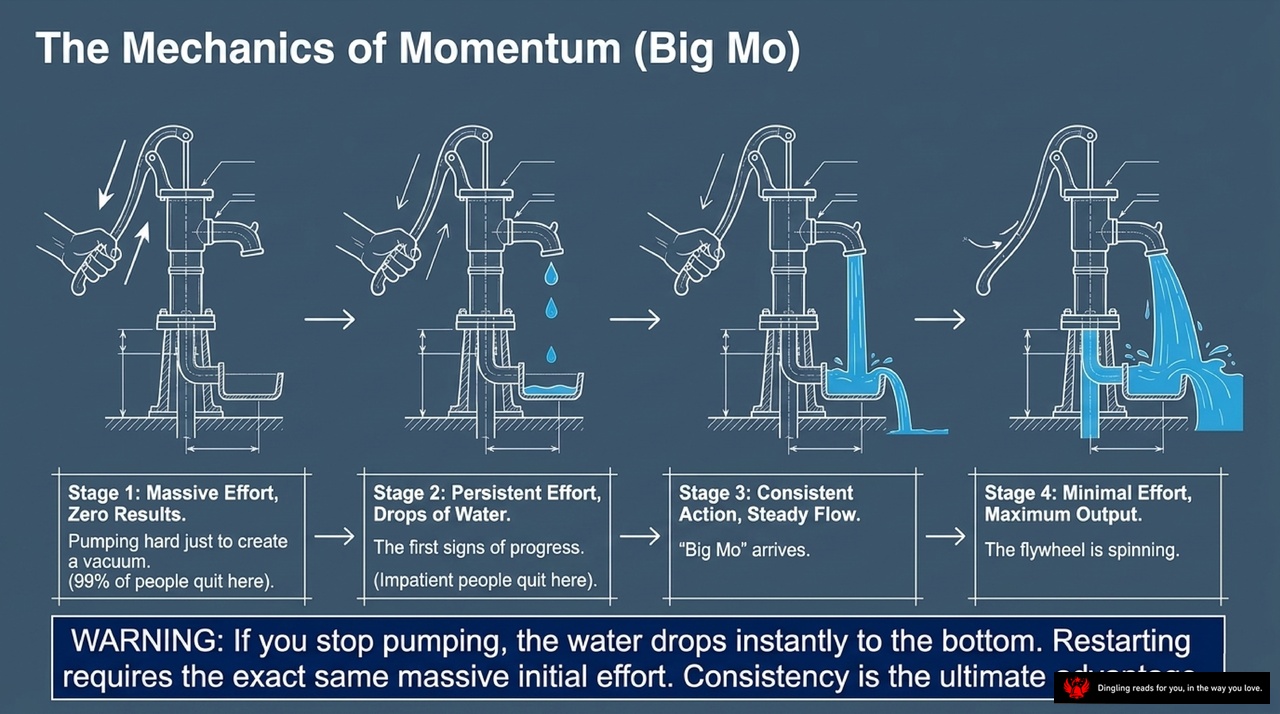
Imagine this: You're pumping water from a deep well using an old-fashioned hand pump. At first, you pull hard and down, but nothing comes out. You keep going, sweating, pushing against the air, creating a vacuum deep underground. For a long time, it feels like your effort is vanishing into thin air. This is Stage 1: Massive Effort, Zero Results. Here's the hard truth: 99% of people quit right here. They don't see the water, so they assume the pump is broken.
But the smart ones keep pulling. Slowly, a single drop falls. Then another. This is Stage 2: Persistent Effort, Drops of Water. It's the first sign of progress, but impatient people walk away, thinking, "Why bother if I don't see a stream yet?"
Then comes the breakthrough. The flow becomes steady and strong. This is Stage 3: Consistent Action, Steady Flow. Suddenly, "Big Mo" arrives. The flywheel is spinning. Now, you don't need to pull as hard to get the same amount of water. You've reached Stage 4: Minimal Effort, Maximum Output. The system is working for you.
However, there is a critical warning at the bottom of this chart: If you stop pumping, the water drops instantly back to the bottom. Restarting requires the exact same massive initial effort you gave up on before. This is the ultimate lesson of momentum. Consistency isn't just about working hard; it's about never stopping until the flow takes over. Don't let the silence of the first few pulls fool you into quitting before the breakthrough.

Look at this "Influence Audit Matrix." It's essentially a diagnostic tool to help you take full ownership of your life by auditing the three biggest drivers of your success: your Inputs, your Associations, and your Environment.
Let's start with the first column: Inputs. The slide reminds us that our brains are wired with a default setting that scans for fear and scarcity. If you feed your mind constant negative news, you're essentially drinking dirty water. The fix here is a strict media diet. Cancel those doom-scrolling feeds and convert your commute into a rolling university. Instead of listening to traffic reports, listen to educational content. As we discussed earlier, what you feed your brain determines the quality of your thoughts. You need to flush out the negativity and replace it with clean, empowering water.
Moving to the second column, labeled Associations, which the slide calls the 95% factor. This is the rule that you are the exact average of the five people you spend the most time with. Your life will match the standards you tolerate. If your circle is full of toxic complainers, you will inevitably become one yourself. The action here is clear: disassociate from those who drag you down. Limit your time with neutral peers to just three minutes, and instead, expand your circle by joining masterminds. Spend your time with people who are already operating at the speed and ambition you desire.
Finally, look at the third column: Environment. This covers both your physical and mental surroundings. The rule here is simple but powerful: your life will match the standards you tolerate. If you allow mental clutter—like incomplete promises and unfinished tasks—to pile up, it drains your energy and lowers your baseline ambition. The action is to clear that mental clutter immediately. Additionally, upgrade your physical view. Change your perspective to expand your baseline ambition. Just like the story of the man who moved to a neighborhood of million-dollar homes, changing your environment changes your dreams.
So, the takeaway is this: you cannot control everything, but you can control what you allow into your inputs, who you associate with, and what standards you tolerate in your environment. Audit these three areas today, make the necessary cuts, and watch how your entire life begins to shift in the direction you truly want to go.

The Turbo Boost: Acceleration. Imagine a runner smashing through a brick wall. In the first 12 reps, you're just getting to the starting line. That's the grind. But the real growth happens only AFTER you hit that wall of failure. When your competitors are in pain, that is your exact moment to accelerate.
This connects directly to the "Multiplier Effect." Doing "enough" keeps you average. It's the trap of mediocrity. But delivering an unexpected WOW multiplies your reputation and results exponentially. Think about Lance Armstrong in the Tour de France. When others were exhausted, struggling in the rain and ice, he didn't stop. He pushed harder. He found strength in their pain. That extra effort, that willingness to go beyond the point of failure, is what allowed him to break away and win.
Richard Branson did the same with Virgin Cola. Instead of a standard press release, he drove a tank down Fifth Avenue. It was aggressive, unexpected, and it created a massive ripple. The lesson is simple: Be aggressively unexpected. Stop settling for the first 12 reps. Smash through your wall. When you do the extra mile, you don't just improve; you multiply your success.

Imagine a complex machine where five distinct gears interlock to drive the engine of success. Today, we're looking at "The Master Synthesis," a formula that multiplies your choices, behaviors, habits, and time by a force called "Big Mo"—or momentum—to equal success.
Let's look at how these gears turn. First, we have Gear 1: Choices, labeled as "The Ignition." This is about taking 100% responsibility and tracking every single action. It's the spark that starts the fire. Next is Gear 2: Habits, or "The Motor." Here, we stop relying on fragile willpower and instead tap into "Why-power," swapping out bad roots for good ones. This is where the real work happens.
Then we have Gear 3: Rhythms, acting as "The Oil." Think of this as protecting your daily bookends to ensure uninterrupted consistency. Without this smooth flow, friction builds up, and the machine stalls. Gear 4 is Influences, or "The Aerodynamics." This gear is about curating your inputs, associations, and environments to remove friction from your path. Finally, Gear 5 is Acceleration, or "The Turbo." This is the moment you push past the wall to multiply your final output.
When all five of these gears align, they create a powerful synergy. It's not just about making good choices; it's about building habits that run on autopilot, maintaining the rhythm so you never stop, surrounding yourself with positive influences, and finally, pushing hard enough to break through your limits. This is how you transform small, daily efforts into a massive, unstoppable force that propels you toward success.

The Compound Effect isn't about some magical secret formula or a quick fix. It's simply an inescapable mathematical reality of your life. Every single action you take, no matter how small, is constantly compounding, working either for you or against you.
Right now, the Compound Effect is actively shaping your future. Are your daily choices building the life you desire, or are you sleepwalking toward a destination you never chose? By taking extreme ownership of your micro-choices, tracking your behavior, curating your influences, and maintaining ruthless consistency, you engineer a system where massive success is the only logical outcome. The magic lies in the fact that while the results might seem invisible in the short term, over time, those seemingly insignificant actions will explode into life-changing results. So, look at your choices today. Are they stacking up to create the future you want, or are they quietly leading you somewhere else entirely?