
The Conquest of Happiness: Complete Chapter-by-Chapter Summary

Welcome to "The Road to Happiness" by Bertrand Russell. Imagine a world where happiness is as simple as being fed and healthy—animals live there. But humans? We are far more complex. Today, even the wealthy and healthy often feel trapped in a cycle of anxiety, self-absorption, and unexplained misery. Russell argues that the path to happiness isn't about escaping the world, but stepping out of our own heads.
He identifies the root of our unhappiness: self-absorption. We get stuck in three traps. First, guilt, where we feel toxic about enjoying life. Second, narcissism, where we crave admiration but can't love others. And third, the need for power, where we seek to be feared rather than loved. Russell warns that chasing these internal states leads to a prison of the self.
So, how do we break free? The answer lies in shifting our focus outward. True happiness comes from cultivating a broad range of interests in the world—whether it's science, nature, or the people around us. When we connect with something bigger than ourselves, our personal troubles shrink. As Russell beautifully puts it, happiness is found not in what we get, but in what we care about. It's about finding joy in the outward horizon, letting the world fill us up, and realizing that by engaging with life, we finally stop fighting against it.

Look at this split screen. On the left, we see a dark, intricate maze labeled "The Prison of the Self," where arrows spiral inward, trapping us in our own fears, faults, and ego. On the right, a warm, flowing light expands outward, representing "Citizenship of the Universe"—a deep, active connection with the people, work, and interests around us.
This visual perfectly captures the book's core thesis: the fundamental cause of modern unhappiness is spatial. The unhappy person's attention is entirely turned inward, trapped in a cycle of self-examination and anxiety. They are stuck in that dark maze, over-absorbed in their personal flaws.
But genuine joy requires a complete shift. We must redirect that attention outward, exchanging the suffocating cell of the ego for the rhythm of the universe. As the author shares, he wasn't born happy; in fact, his childhood anthem was "The world is hateful, and I am full of sins." He spent his youth obsessed with his own defects and failures. But the turning point came when he stopped staring at his internal prison walls and began looking at the world.
He started engaging with global events, diving into complex knowledge, and connecting with the people he loved. While this outward focus still brings pain, that pain doesn't destroy life's core. Instead, it fuels activity that suppresses despair. True happiness isn't about escaping the self entirely, but about expanding beyond it. When we trade our narrow, self-centered worldview for a broader, outward-facing perspective, we stop being prisoners of our own mind and become citizens of a much larger, more vibrant world.

So, we've looked at the external forces draining our happiness—boredom, fatigue, and envy. But there's a deeper culprit hiding right inside our own minds: the "Taxonomy of Self-Absorption." As the slide outlines, unhappiness rarely comes from the cosmos or bad luck; it usually originates from specific psychological distortions that trap us in endless, unfulfilling feedback loops.
Let's break down these three archetypes. First, we have **The Sinner**. Their core drive is a relentless, irrational guilt rooted in childhood programming. These individuals are constantly self-condemning, pursuing a phantom moral purity while secretly believing that all pleasure is inherently wicked. The tragic flaw here is that life gets drained of joy because they subconsciously sabotage their own happiness.
Next is **The Narcissist**. Their engine is a desperate hunger for admiration. They view every relationship and pursuit merely as mirrors to reflect their personal greatness. Once they secure that admiration, they lose all interest, resulting in perpetual boredom. They can't love others because they see everyone only as an audience for their own performance.
Finally, we have **The Megalomaniac**. Unlike the narcissist who wants to be loved, the megalomaniac wants to be feared. Their core drive is the pursuit of power and the desire to bend the world to their will. Their tragic flaw is that boundless ambition eventually hits an immovable obstacle, leading to a complete psychological collapse.
The good news is that once you identify which of these three traps you're in, you can start to untangle the knot. You can stop feeding the ego and start connecting with the real world.

The modern struggle isn't about survival anymore; it's a desperate race to outshine your neighbor. As we see on this slide, society has turned life into a "Competitive Treadmill," where the only finish line is the grave. We are told to risk an unstable 8% return just to feel secure at a mediocre 4%, treating our intellect as nothing more than our income. But this endless grind comes at a terrible cost. By making money the sole metric of human value, we sacrifice our curiosity, our quiet moments of leisure, and the subtle joys of life. We view relaxation as a loss of status, trapping ourselves in a cycle of nervous exhaustion. The real tragedy? We are sprinting on a machine that never stops, convinced that our worth depends on how fast we can run, completely missing the point that a life well-lived isn't about winning the race, but about enjoying the journey.
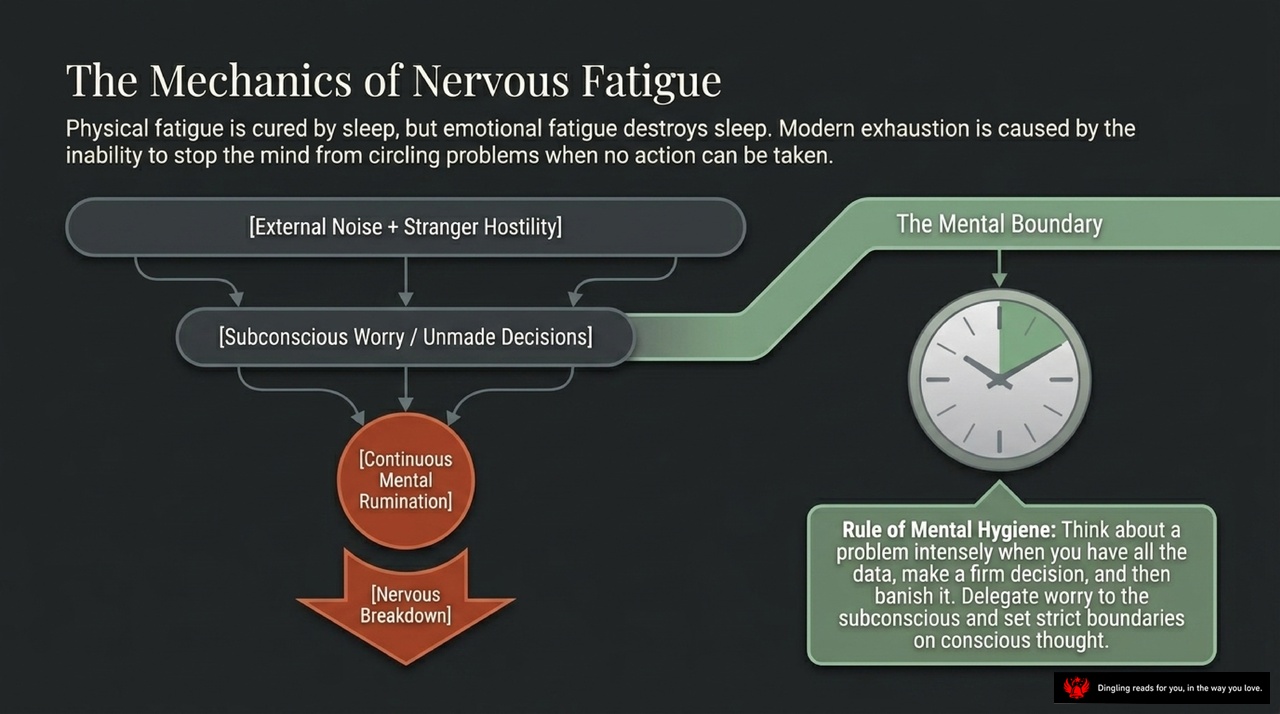
Physical fatigue heals with sleep, but emotional exhaustion steals it away. That's the modern trap: when we can't act, our minds spiral, and that's where the real burnout happens. Look at the diagram on your screen. It starts with external noise and the hostility of strangers, which triggers subconscious worry and unmade decisions. Without a clear path forward, this anxiety turns into continuous mental rumination, eventually leading to a nervous breakdown.
But there is a way out, and it lies in establishing a mental boundary. Think of it like a strict schedule for your thoughts. The rule of mental hygiene is simple yet powerful: only think intensely about a problem when you have all the data to make a firm decision. Once you've decided, banish it from your conscious mind and delegate the worry to your subconscious. By setting these strict boundaries on when we think, we stop the endless circling of problems and reclaim our peace.

The comparative mind destroys joy, and envy is its most destructive engine. As the slide illustrates, envy doesn't just look at things; it looks at relationships. It tells you that spring sunshine is ruined simply because someone else is enjoying it in Sicily. It creates a mental trap where you constantly index your own happiness against an imagined, superior reality that doesn't exist.
On the left, we see the "Envy Engine" in action: the internal monologue of self-destruction. "I must not think my tail is better, but oh, I wish it were! I should pluck his feathers." This is the painful cycle of comparing your reality to someone else's highlight reel. But look at the antidote on the right. The slide reminds us that every peacock actually thinks its own tail is the finest in the world. This isn't arrogance; it's a healthy, self-contained appreciation. When every individual focuses on their own unique beauty without needing to compete, the result is a peaceful species.
The cure is simple but profound: fully inhabit your own present happiness without constantly measuring it against others. True joy comes from stopping the comparison and realizing that your own life, with its own unique "feathers," is already the masterpiece you need to celebrate.

Look at the solitary figure walking in the shadows, dwarfed by two looming giants: "The Imagined Conspirator" and "The Barking Dog." This slide perfectly captures the invisible audience that dictates our joy. We often allow these phantom arbiters to control our lives. We invent persecutors to flatter our vanity, conforming to the crowd out of fear, while society rarely attacks those who treat its eccentricities with cheerful indifference.
Remember this crucial insight: your motives are rarely as altruistic as you think. Others are thinking about you far less than you think about yourself. It's a psychological trick, much like the old saying, "A dog barks more loudly and bites more readily when people are afraid of him." The barking dog of public opinion only seems aggressive because we project our own anxieties onto it.
The solution lies in shifting your focus. Instead of obsessing over these imagined enemies or the fear of judgment, redirect your attention to the external world. Cultivate a genuine interest in the world around you, in science, in people, and in the simple realities of life. When you stop self-obsessing and start engaging with the world, the phantom arbiters lose their power, and you reclaim your own happiness.

Look at this striking image: we are standing on the edge of a dark, imposing structure labeled "The Inward Prison," staring at a glowing, open path called "The Outward Horizon." This visual perfectly captures the core argument of today's discussion: true happiness isn't found by digging deeper into our own minds, but by stepping out into the world.
As we cross this threshold, we must first untie the "tightening knot" of fear, envy, and ego that traps us. Unhappiness often stems from self-obsession—whether it's guilt, narcissism, or the craving for power. We get stuck staring at our own knots, believing that fixing our internal flaws is the only way to be happy. But the text reminds us that the foundation of a joyful life lies in something else entirely: the cultivation of outward interests.
Think of it this way: your mind is like a machine. If it only processes internal data—your own insecurities, regrets, and desires—it eventually grinds to a halt, becoming empty and depressed. But if you feed it material from the outside world—whether it's the complexities of global events, the beauty of nature, or the dynamics of a loving relationship—the machine comes alive. By surrendering the self to the grand, ongoing rhythm of the world, we stop fighting against our own limitations and start participating in something much larger. So, don't stay in the prison. Turn your gaze outward, engage with the world, and let that connection be the source of your freedom and your joy.

Look at this curve. It's called the Activation Curve of Zest, and it perfectly illustrates why some of us feel constantly drained while others seem to thrive with a steady, healthy energy.
On the right side of the graph, you see a jagged orange line labeled B. This represents what the book calls "The Glutton or The Addict." These are people who chase intoxication. They sit at the banquet of life with a greedy appetite, eating out of duty or gorging themselves just to forget their pain. Their emotional state spikes into excitement and then crashes hard into the "Boredom or Exhaustion Zone" at the bottom. It's a cycle of forced excitement that demands ever-increasing doses of artificial stimulation, leaving them running on empty.
Now, look at the green line labeled A. This is "The Healthy Appetite," or what the author calls Zest. Zest is to life what hunger is to food. A person with zest sits at the banquet knowing exactly when to stop. They stay within the "Optimal Engagement Zone," maintaining a connection to the slow, natural rhythms of the earth rather than forcing artificial highs.
The lesson here is clear: true zest isn't about how high you can spike your excitement. It's about finding that sustainable middle ground where you are engaged but never exhausted. As the text reminds us, the unhappy person often tries to escape their pain with constant stimulation, while the happy person enjoys the feast with a healthy appetite. So, the real challenge isn't avoiding boredom at all costs, but learning to trust your natural rhythms and stop the endless cycle of chasing the next big thrill.

The Architecture of Affection isn't just a poetic title; it's the blueprint for a life that actually works. Look at this illustration: on one side, we have the "Safe Harbor," born of fear. Here, affection becomes an escape—a defensive wall built to protect the fragile ego from a harsh world. It's a boat tied tightly to a dock, safe but stagnant. The ego demands protection, absorbing the vitality of its partner just to stay dry.
But on the other side lies "The Open Sea," born of security. This is where the real magic happens. Affection transforms from a shield into an exploration. Rooted in mutual security, it allows both individuals to look outward with renewed interest. Instead of clinging to the walls of the self, you break them down. You integrate into a shared, outward-facing purpose. The love that brings the greatest joy isn't a clinging, defensive posture; it's a robust, reciprocal life-giving force. It doesn't just keep you safe; it propels you forward, turning the terrifying vastness of the world into a playground for your shared curiosity.
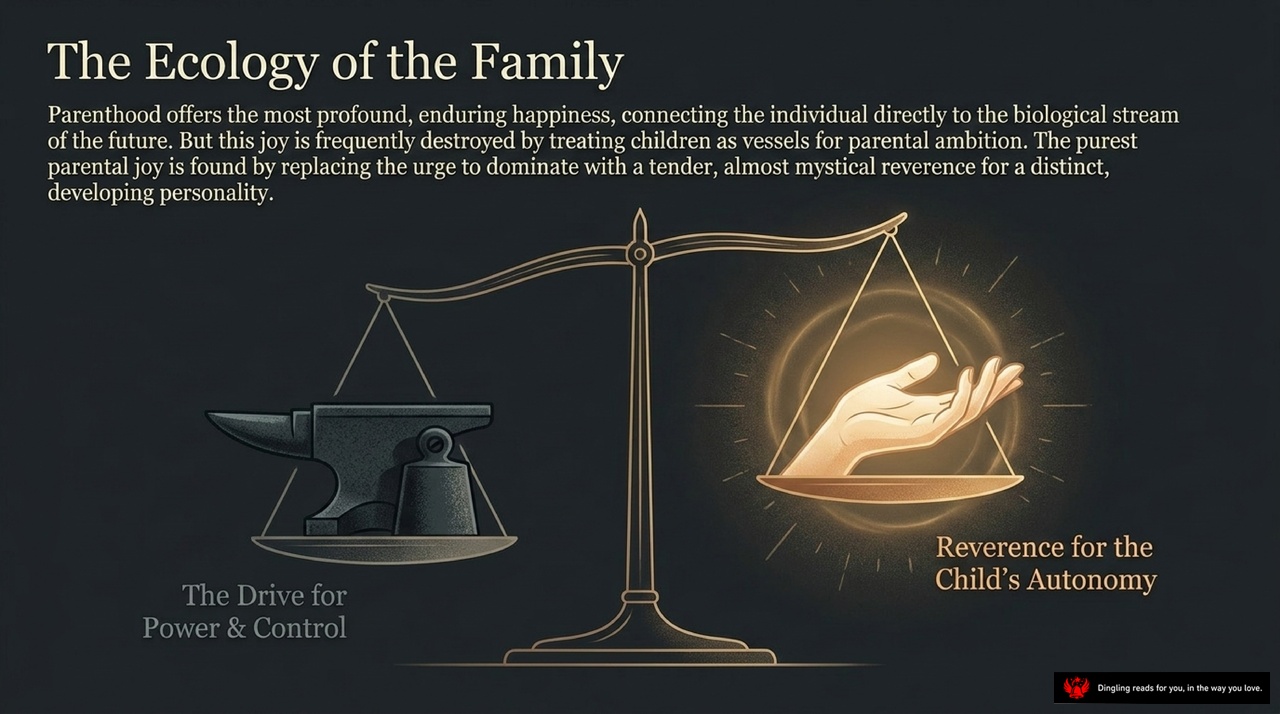
Parenthood is often called the most profound source of happiness, a direct connection to the future that grounds us in the biological stream of life. Yet, as we see in the balance on this slide, that joy is frequently destroyed by the urge to dominate. Too often, parents treat their children not as distinct individuals, but as vessels for their own ambitions and a means to satisfy a drive for power and control.
The image contrasts two opposing forces. On one side, we have the heavy weight of the drive for power and control. This is the mindset where a parent projects their own desires onto the child, seeking to shape them into a specific version of success rather than nurturing who they truly are. It is a struggle where the parent's ego outweighs the child's needs.
On the other side, the scale lifts to reveal the lighter, yet infinitely more valuable, weight: reverence for the child's autonomy. This is the essence of true parental love. It means replacing the urge to control with a tender, almost mystical respect for the child's developing personality. When we shift our focus from dominating our children to honoring their unique path, we unlock the purest form of parental joy. It is in letting go and allowing them to be themselves that we find the most enduring happiness.

Work isn't just about killing time; it's about creating something that lasts. Today, we're looking at a powerful framework called "The Matrix of Constructive Work," which maps out where true joy comes from.
As you can see on the slide, this matrix is built on two axes: the skill required for a task and its level of constructiveness. This simple grid divides us into four distinct types of workers, each with a different relationship to happiness.
In the bottom left, we have "Drudgery." This is repetitive, uninspired labor with no lasting monument. It's the kind of work that fills your day but leaves nothing behind, offering no real joy. Moving up to the top left, we find "The Cynic or The Agitator." These are highly skilled individuals, but their focus is entirely on tearing down existing structures. While they have mastery, their work is destructive, leaving them without that deeper satisfaction of creation.
Then, on the bottom right, is "The Steady Contributor." These people find joy in the quiet, reliable act of cumulative building. They aren't necessarily the most skilled, but their work is purposeful and adds value over time.
But the ultimate goal, highlighted in that green box as "The Architect of Tomorrow," is the perfect alignment of both. This quadrant represents maximal happiness. Here, specialized mastery meets lasting, positive creation. It's the state where your skills are fully utilized to build something that endures. As the text reminds us, this constructive purpose prevents despair and leaves a lasting monument. The best work doesn't just stop the misery of endless time; it provides a deep, enduring joy through the active exercise of skill and the certainty of building something real.

Have you ever felt that your daily annoyances were suddenly the size of the universe? When we are exhausted, minor irritations take on world-ending proportions. A missed bus, a rude comment, or a traffic jam feels like a personal catastrophe. But what if we could shrink those anxieties back to a manageable size?
The secret lies in zooming out to the scale of human history and the cosmos. Imagine looking up at the stars, seeing the vastness of the galaxy, and realizing that your current struggles are incredibly small in the grand scheme of things. This shift in perspective acts like a psychological telescope. By cultivating hobbies, diving into history, or simply gazing at the night sky, you rescue your mind from the prison of immediate, granular stress.
It's about shifting your focus from the narrow, tangled web of your own problems to the infinite, orderly beauty of the cosmos. When you connect with impersonal interests, you stop letting the chaos of your daily grind define your entire existence. Instead, you find peace in the vastness, understanding that while life has its challenges, they are not the whole story. So, next time you feel overwhelmed, take a deep breath and look up. The universe is waiting to remind you that you are part of something much bigger than your temporary worries.

Today's slide captures a profound truth often missed in our frantic modern lives: the delicate balance between effort and resignation. Look at that sailboat cutting through the waves. The green sail represents "Unconquerable Hope & Effort"—that driving force pushing us forward against avoidable suffering. It's the work we must do, the problems we must solve, and the boundaries we must set. But notice the water beneath the hull, labeled "Resignation." This isn't about giving up or surrendering to defeat. Instead, it means yielding gracefully to what we simply cannot control.
This concept, known as "The Middle Way," is an active psychological stance. True happiness demands continuous outward effort to fight off the suffering we can actually change. However, it equally demands resignation regarding the unavoidable chaos of life. We must do the work, but we must not tie our ultimate peace to an outcome beyond our control. Many of us suffer because we try to steer the boat with one hand while desperately trying to calm the ocean with the other. The key to a fulfilling life is learning to row hard enough to make progress, yet trusting the waves enough to let go.

Look at this diagram of "The Integrated Self." It beautifully illustrates the three pillars that dissolve the walls of our internal prisons: Zest, Affection, and Work.
Think of Zest as a healthy appetite for daily life. It's the difference between just surviving and truly experiencing the world. Then, there's Affection—the secure giving and receiving of love. This isn't just about romance; it's the biological glue that connects us to others and breaks down our isolation. Finally, we have Work, defined here as the application of skill to constructive ends. It's not just about making money; it's about creating something that lasts, whether it's raising a child, writing a book, or building a bridge.
When these three elements align, something magical happens. As the text below the image explains, the happy person stops being a "hard, isolated billiard ball" that just bounces off the world. Instead, they become an active, joyous participant in "The Stream of Life." Their internal consciousness finally aligns smoothly with external reality. They stop fighting against life and start flowing with it, dismantling the self-centered barriers that cause so much pain. True happiness, it turns out, isn't about escaping the world, but fully engaging in it through these three integrated channels.
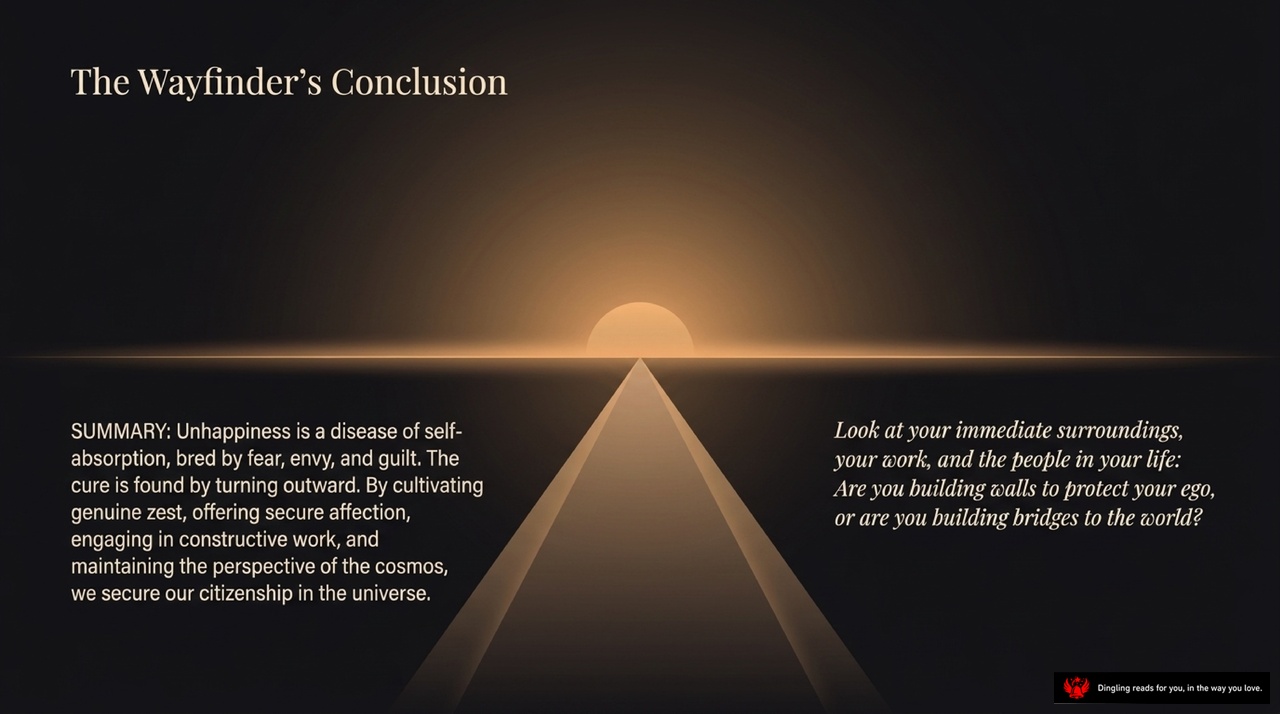
We are at the final horizon of this journey, stepping into what we might call "The Wayfinder's Conclusion." The image before us captures that perfect moment of transition: a path stretching forward, illuminated by a rising sun, symbolizing the shift from the darkness of self-absorption to the light of outward connection.
As we summarize the core message, remember that unhappiness is not a random fate, but a specific disease of self-absorption, bred by fear, envy, and guilt. The cure, as the text clearly states, is found by turning outward. Instead of building walls to protect a fragile ego, we must cultivate genuine zest for life, offer secure affection to others, engage in constructive work, and maintain a perspective that connects us to the vast cosmos. This is how we secure our citizenship in the universe.
So, look at your immediate surroundings right now. Look at your work and the people in your life. Ask yourself the critical question: Are you building walls to protect your ego, or are you building bridges to the world? The choice defines not just your happiness, but your very place in the universe.