
The Constitution of a Great Country: Complete Chapter-by-Chapter Summary

Welcome to the book club session on *The Constitution of a Great Power* by Su Li. Today, we're diving into the very heart of what makes China the enduring civilization it is. This isn't just about ancient history; it's a functionalist exploration of the geographic, institutional, and existential forces that engineered China's lasting stability.
The cover image beautifully captures this essence: vast, terraced landscapes winding around a river, symbolizing how the land itself shapes the state. Su Li argues that China's existence is an incredible miracle. It didn't happen by accident or divine design. Instead, it emerged from the relentless efforts of people living on this complex terrain, gradually coalescing from scattered farming villages into a stable political community.
The book posits that China's constitution was never a static written code. It was a long process of structural integration. The natural environment—the flooding of the Yellow River, the pressure from northern nomads—acted as an invisible hand, deeply influencing early political choices. Su Li introduces a unique framework to understand this: the interplay of "managing the family," "governing the state," and "pacifying the world." These aren't just Confucian ideals; they are the three interconnected domains that define China's governance.
We'll explore how these forces interacted to create a system that could withstand thousands of years of change. From the village level up to the management of diverse ethnic regions, Su Li reveals the core logic that has allowed China to survive and thrive. Join us as we unpack how geography, history, and human ingenuity forged one of the world's great political traditions.

Let's look at this slide, which redefines how we understand China's political system. Instead of searching for a "Social Contract" like we often do in the West, the core message here is clear: we must shift our focus to "Institutional Survival."
The slide contrasts two distinct models side-by-side. On the left, the Western Model is built on deliberate social contracts and legal charters like the Magna Carta or the US Constitution. Its primary goal is limiting government power to protect individual rights, and it relies on components like the separation of powers and judicial review.
On the right, the Chinese Model takes a completely different path. It isn't based on a theoretical contract but on pragmatic institutional responses to real threats—geographic challenges and existential dangers over millennia. The primary goal here isn't just protecting individual rights, but preventing societal collapse and ensuring the survival of a vast, heterogeneous population. To achieve this, the system relies on standardized language, a centralized bureaucracy, unified weights and measures, and a military-administrative zoning system.
This comparison highlights a fundamental difference: while the Western model prioritizes the constraints on power, the Chinese model prioritizes the continuity of the state itself. It's about adapting institutions to ensure survival in a complex environment, rather than designing a perfect abstract framework from scratch.

Look at this map. It illustrates the brutal reality that shaped the Chinese state: it wasn't born from a desire for empire, but from a desperate necessity for survival on a specific piece of land. The slide breaks this down into two vectors driving our agrarian state toward unity.
First, look at the Internal Vector: The Yellow River. The text calls it "The Mother and the Menace." Frequent, catastrophic flooding required something no single village could handle alone. It demanded cross-regional coordination, massive labor mobilization, and centralized planning. This internal pressure forced the formation of a unified political body to manage the water.
Then, look at the External Vector: The Nomadic North and the Climate Cycle. Driven by cyclical climate cooling, northern nomadic tribes posed a highly mobile military threat to our sedentary villages. Survival required deep strategic depth and a unified military front to stop them.
So, existential threats from both inside and outside demanded a massive, unified agrarian state. This redefines our understanding of constitutionalism, shifting it from abstract paper contracts to a matter of institutional survival against nature and history.

Today's slide reveals the intricate blueprint of China's constitutional framework, showing how it operates across three distinct but deeply interconnected spheres. Unlike Western political theories that often focus solely on the state-level apparatus, China's system requires the simultaneous management of the Inner Ring, the Middle Ring, and the Outer Ring.
Let's start with the **Inner Ring: Family**, labeled here as *Qi Jia*. This is the agrarian village, serving as the micro-unit of economic production and social stability. It functions as the foundational elite education system where the basic rules of life are learned and practiced. Moving outward, we see the **Middle Ring: State**, or *Zhi Guo*. This represents the centralized bureaucracy that extracts resources from the agrarian base to manage rivers, defend borders, and prevent regional fragmentation. It acts as the crucial link that transforms the village order into a national political structure. Finally, the **Outer Ring** encompasses the **World**, or *Ping Tian Xia*. This is the periphery, dealing with the geopolitical strategy of managing diverse, non-agrarian adjacent civilizations through military deterrence or localized autonomy.
These three layers are not isolated; they form a nested system where the stability of the family supports the state, and the strength of the state secures the world. This holistic approach allows China to integrate a vast and diverse civilization into a single, enduring political community.

The agrarian family unit formed a self-regulating, zero-cost foundational base, acting as the most efficient economic and social enterprise of the ancient world. Because imperial power did not reach the village, these families operated with remarkable independence, relying on nothing but their own internal logic to survive and thrive.
This system was built on three pillars. First, economic self-sufficiency. The classic male-farming, female-weaving unit provided essential tax revenue and stability without needing external trade or urban centers. Second, internal governance. Regulated by age hierarchy and filial piety, villages maintained strict order through gender distinctions and clear roles, ensuring everyone knew their place. Third, elite incubation. Villages bore the cost of educating their brightest members, creating a continuous, self-funded pipeline of talent that fed the national bureaucracy.
In essence, the village wasn't just a place to live; it was a complete, self-contained ecosystem that generated the resources, order, and leaders necessary to sustain the entire empire.

Look at this split-screen design: on the left, we see the "Centrifugal Risks" pulling a vast landmass apart—mountains, rivers, isolated dialects, and warlords all acting as forces of fragmentation. On the right, we see the "Centripetal Solutions," or constitutional mechanisms, acting as a powerful counter-weight to hold the nation together.
The text at the top explains this perfectly: a landmass the size of Europe with such extreme geographic diversity naturally tends toward fragmentation. Centralization was an engineered counter-measure. The book argues that China's existence itself is an incredible miracle, not because of divine intervention, but because of this deliberate engineering. It was a long-term project where each generation had to build upon the last to create a stable political community out of scattered farming villages.
On the left side, the "Centrifugal Risks" are clear. Geographic barriers like mountains and rivers, local economic isolation, and diverse dialects naturally pull regions apart. You see the icons for a closed gate, a map in various languages, and a warlord with a personal army. These are the forces that would shatter the empire if left unchecked.
But the right side shows how the system fought back. The first solution is "Interlocking Jurisdictions." This was about intentionally designing administrative borders to cross natural geographic boundaries. By doing this, they prevented local warlords from using mountains or rivers as defensive strongholds. No one could easily hide behind geography to become independent.
The second solution is the "Separation of Local Powers." This involved splitting military, administrative, and supervisory powers at the provincial level. The goal was simple but crucial: ensure that no single official could monopolize regional control. By balancing these forces, the central government maintained authority over a vast and diverse territory.
This engineered central design successfully countered the natural centrifugal forces of a vast landmass. It wasn't just about building walls; it was about creating a constitutional framework that forced unity despite the natural tendency toward division.
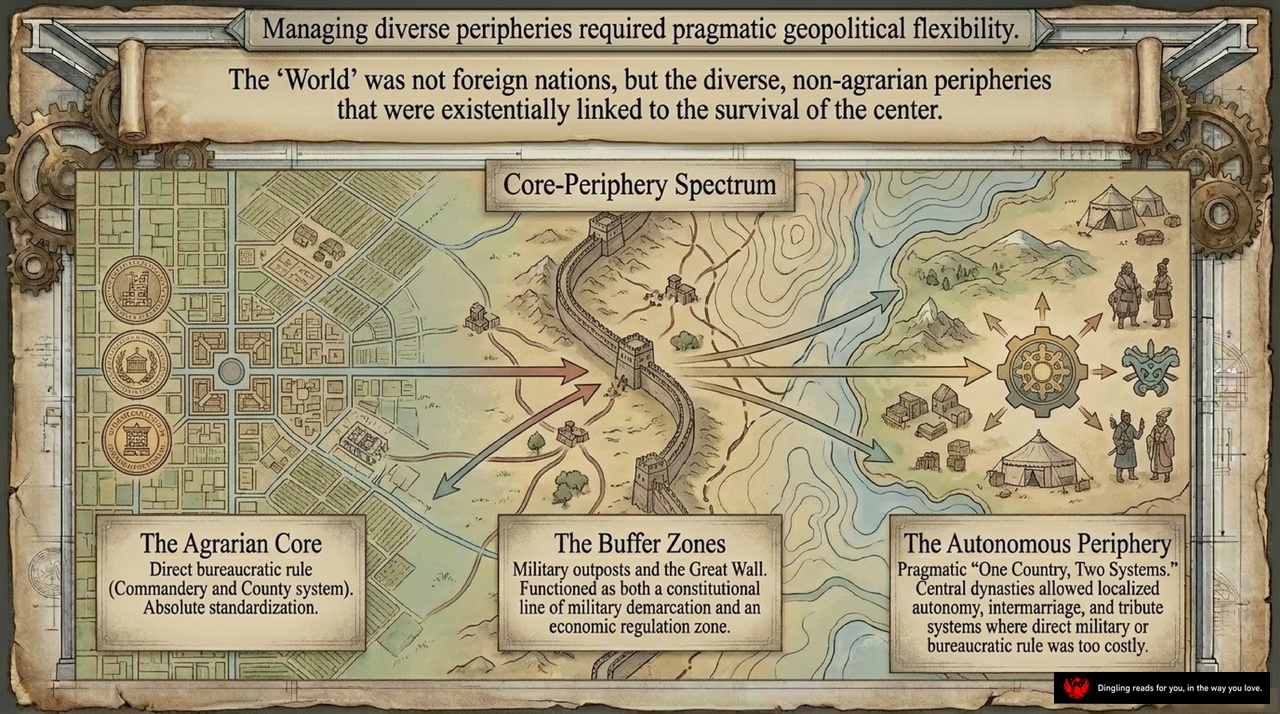
Look at this map of the "Core-Periphery Spectrum." It illustrates how ancient China managed a diverse empire not by treating the outside as "foreign nations," but by viewing these non-agrarian peripheries as existentially linked to the survival of the center. This required a pragmatic geopolitical flexibility, essentially a historic version of "One Country, Two Systems."
On the left, we have **The Agrarian Core**. This was the heartland, governed by direct bureaucratic rule through the Commandery and County system. Here, absolute standardization was the key to stability.
Moving right, we see **The Buffer Zones**. This is where the Great Wall and military outposts sat. They functioned as both a constitutional line of military demarcation and an economic regulation zone, acting as a shield between the core and the periphery.
Finally, on the far right, lies **The Autonomous Periphery**. For the nomadic tribes and distant regions, direct military or bureaucratic rule was simply too costly. Instead, the central dynasties allowed for localized autonomy, intermarriage, and tribute systems. This pragmatic approach allowed the diverse peripheries to remain part of the political whole without needing to be fully assimilated, proving that managing a multi-ethnic empire required a flexible, functional approach rather than rigid uniformity.

Imagine the vast, fragmented agrarian landscape of ancient China. How could a massive empire possibly tax, build grand projects, or deploy armies across millions of square kilometers without a unified system? The answer lies in the central mechanism illustrated here: Unified Weights & Measures.
Look at the flow on the left. We start with billions of isolated, self-sufficient agrarian plots yielding decentralized harvests. This is the "Input." Without a common standard, these scattered resources are invisible to the state. You cannot compare a bushel from the north to a bushel from the south if the units differ.
Then, the gears turn. This is the mechanism. The state arbitrarily enforces unified weights and measures to remove regional trade friction and standardize taxation. By creating a single metric, the government translates raw agricultural output into deployable state power. Suddenly, the state can calculate taxes fairly, distribute salaries to officials, and move resources efficiently.
Finally, look at the output on the right. Because the state can now accurately measure and mobilize resources, it gains the capacity to execute massive public works like the Grand Canal and Yellow River dams. It can maintain standing armies and seamlessly utilize resources across the entire empire.
As the slide reminds us, standardization is the ultimate enabler of state capacity. Without unified metrics, a massive agrarian state simply cannot function. This system turned a collection of villages into a unified political power.

Imagine a massive, industrial funnel labeled "Convergence Funnel Diagram," where chaos is transformed into order. On the left, under "The Inputs," we see a tangled mess of colorful, chaotic threads representing the diverse cultures and languages of a vast continent. The first critical step is "The Filter: Same Script." As these threads enter the funnel, they pass through a mechanism that disconnects written text from spoken pronunciation. This allows a phonetically diverse land to share a single administrative operating system, effectively standardizing communication across vast distances.
Inside the funnel, the gears turn around "The Mechanism: Keju." This is the civil service exam, a powerful engine that shattered regional aristocracies. Instead of inheriting power, elites had to prove their merit. This enforced social mobility and ensured the state was run by an ideologically unified meritocracy, creating a cohesive intellectual class from all walks of life. Finally, look at the "Output." The chaotic inputs are refined into a powerful, golden beam of unity. This output is a class of elites whose loyalty belongs to the "World"—the entire empire—rather than just their local village.
This unified written script and civil service system forged a singular administrative elite. To govern effectively, the state had to construct a class of elites whose loyalty belonged to the 'World,' not just their local village. This convergence funnel explains how China transformed from scattered, isolated villages into a stable, unified political empire, creating a unique model of governance that prioritizes national unity over local fragmentation.
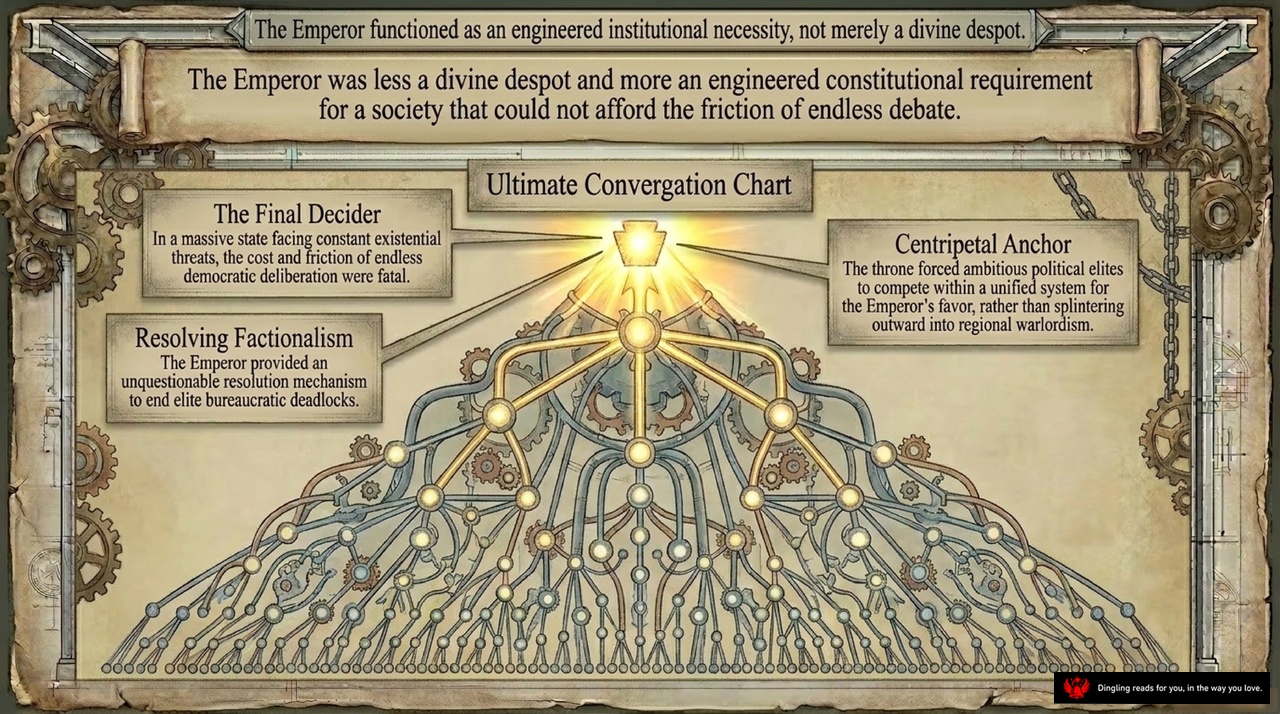
The Emperor wasn't just a divine despot; he was an engineered institutional necessity. Think of the ultimate convergence chart as a massive, intricate machine where every gear must turn in perfect unison. In a state facing constant existential threats, the cost of endless democratic debate was simply fatal. The Emperor served as the Final Decider, providing an unquestionable resolution mechanism to end elite bureaucratic deadlocks before they paralyzed the entire system.
But his role went deeper than just settling arguments. He acted as a Centripetal Anchor. The throne forced ambitious political elites to compete within a unified system for the Emperor's favor, rather than splintering outward into regional warlordism. Without this central point of gravity, the vast machinery of the empire would have fractured. The Emperor functioned as the essential friction that allowed a society too complex to afford chaos to remain stable and unified.

Why 'Citizenship' Never Emerged: The Weight of Survival
Look at this scale. On the left, we see the bustling Western City-States, built on commerce and dense urban populations. On the right, the vast, dispersed Chinese Agrarian State, rooted in stable, blood-tied villages. This image perfectly captures the core argument of today's slide: the absence of the "Citizen" in China was never a constitutional failure, but a reflection of an entirely different survival strategy.
In the West, active citizenship was historically necessary because city-states were crowded with strangers. To resolve daily, high-friction interactions among people who didn't know each other, you needed defined legal "rights" and active political participation. It was a survival mechanism for a society of strangers.
But look at the Chinese side. Here, life was built on highly dispersed, stable villages where everyone knew everyone. The average person required localized distributive justice and peace, not active political participation in a remote capital. The social and economic realities simply rendered the concept of active citizenship unnecessary. In a world where your safety depended on your clan and your village, why would you bother with a distant, abstract state?
The takeaway is profound: the "Citizen" is not a universal default. It is a specific tool designed for a specific environment. China chose a different path, prioritizing the stability of the local community over the individual's political voice in the center. This wasn't a lack of development; it was a sophisticated adaptation to a massive agrarian landscape.

The final slide brings us to a powerful summary that redefines what a constitution actually is. Forget the idea of a document written on parchment; China's historical constitution was forged directly into the earth itself. It was a pragmatic, institutional architecture designed to synthesize a vast agrarian heartland, manage relentless environmental and military threats, and integrate diverse populations into an enduring civilization.
This system prioritized survival, functional integration, and order over abstract political ideals. It wasn't about perfecting a theory; it was about keeping a massive, multi-ethnic civilization alive against all odds. This leads us to a crucial rhetorical question: If a nation's constitutional design is ultimately dictated by its geography, resources, and existential threats, then are the political frameworks we consider "universal" today actually universal? Or are they simply the luxury of those who have forgotten the harsh constraints of survival?