
The Courage to Be Happy: Complete Chapter-by-Chapter Summary
Welcome to our book club session on *The Courage to Be Happy*. Today, we dive into the heart of Adlerian psychology and explore the architecture of true human connection.
This book is distilled from the profound philosophical dialogues between Ichiro Kishimi and Fumitake Koga. It challenges us to rethink how we live, relate, and find happiness—not by looking backward at our past, but by stepping forward with courage into the present.
At its core, this philosophy teaches us that all our troubles stem from our relationships with others, and all our happiness arises from them. We cannot be truly happy in isolation. The real work lies in mastering the three great life tasks: work, friendship, and love.
But here is the most important shift: love is not a passive emotion you wait for. It is an active decision you make every day. It is not about finding a "destined" person, but about choosing a way of life and committing to another human being. True love requires moving from a mindset of "how can I be loved?" to "how can I love?"
This journey demands courage. It asks us to let go of the fear of rejection, the need for approval, and the illusion that we must be perfect to be worthy. Instead, we learn to trust others unconditionally and to contribute to the community around us. When we do this, we stop competing and start collaborating. We stop seeking validation and start finding value in our own humanity.
So, what is the first step? It is simple yet difficult: choose to love. Choose to see others not as obstacles or tools, but as partners in life. Choose to believe that even in an imperfect world, connection is possible.
As we close today, remember this: you are not defined by your past, nor by what others think of you. You are defined by the choices you make right now. Will you choose courage? Will you choose connection? The answer lies entirely in your hands. Let's turn the page and begin our journey together.

Freedom and happiness aren't opposites; they are two sides of the same coin, and the path to each requires a distinct kind of courage. On the left, we see "Freedom," depicted as a key breaking chains. This visual perfectly captures the lesson from *The Courage to be Disliked*: true freedom is found in "Separation of Tasks." It is the brave act of cutting the tethers of others' expectations. Just as the image shows a key liberating shapes from constraints, we must liberate ourselves from the need to meet everyone else's demands. This isn't about isolation; it's about the courage to define your own life without being controlled by what others think.
On the right, we see "Happiness," illustrated by two pentagons woven together. This represents the core message of *The Courage to be Happy*: happiness is not isolation, but the conscious, courageous choice to rebuild interpersonal ties through community feeling and love. While freedom requires separating yourself from external expectations, happiness requires connecting deeply with others. It's the shift from "me" to "we." You cannot achieve genuine happiness by standing alone; you must actively choose to engage, trust, and contribute to the lives of those around you.
So, the journey begins here. First, take the key of freedom to break the chains of other people's expectations. Then, use that liberated self to reach out and weave the bonds of happiness. You must have the courage to be disliked to be free, and the courage to be happy to connect. Only when you embrace both can you truly live.
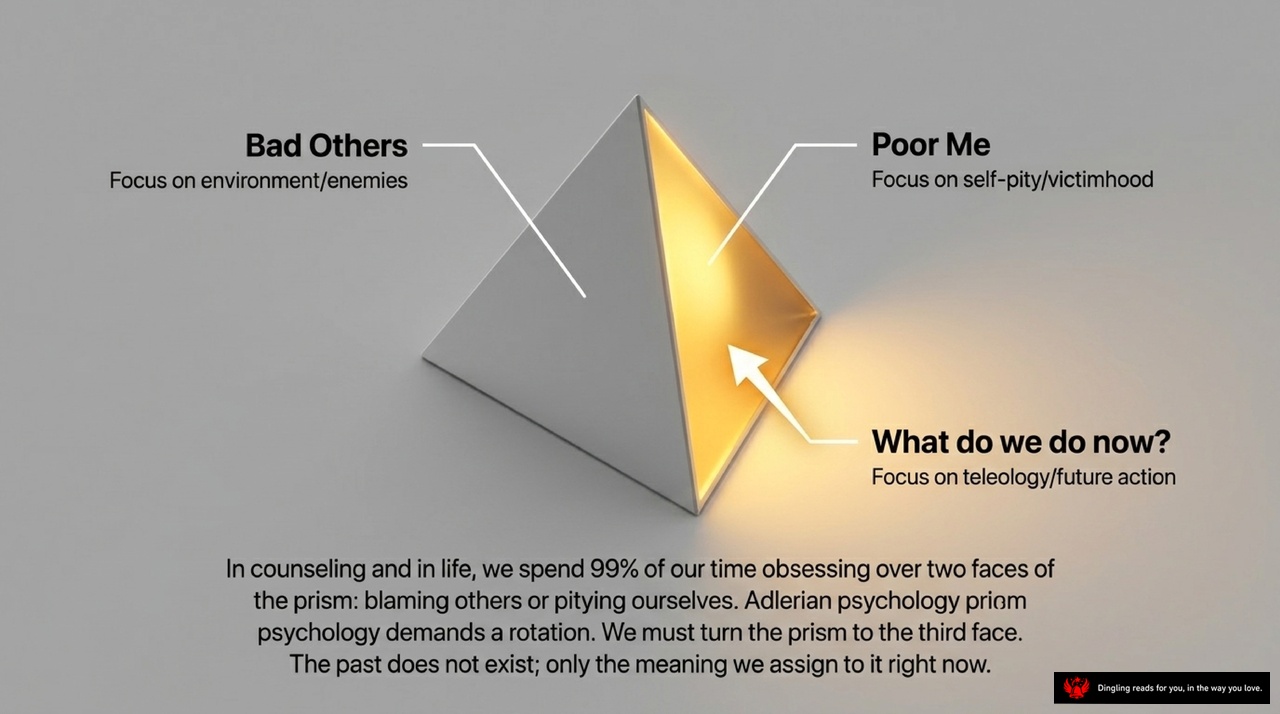
Look at this prism. We spend 99% of our time stuck on just two faces: blaming others for being "bad" or drowning in self-pity as a "poor victim." It's a trap. We obsess over the environment and our enemies, or we wallow in our own suffering, but neither gets us anywhere. Adlerian psychology demands a rotation. We must turn this prism to the third face, the one that's glowing right here: "What do we do now?" This isn't about digging into the past or assigning blame; it's about teleology—focusing entirely on future action. The past doesn't exist in a way that controls us; only the meaning we assign to it right now does. Instead of asking "why did this happen to me?", we ask "what will I do next?" This shift from cause to purpose is the key to breaking free from dependency and taking charge of your own life.

The slide clearly maps out a journey from Dependency through Struggle to Self-Reliance, illustrating that the ultimate goal of education, parenting, and leadership isn't compliance, but total independence. As the image shows, we start by leaning on others, but true growth happens when we break that crutch during the struggle phase.
Adler teaches us that true education is not about intervention or forced molding; it is simply assistance toward total independence. Think of it this way: if you never let go of the support, you never learn to walk on your own. The objective isn't to create followers who obey orders, but to cultivate individuals who can stand alone and contribute to society.
This shift is crucial because it changes the entire dynamic of our relationships. When we aim for self-reliance, we stop trying to control others and start empowering them. It means understanding that the only way to truly help someone is to give them the tools and respect they need to solve their own problems. By embracing this path, we move away from a cycle of dependency and toward a life of genuine freedom and connection.
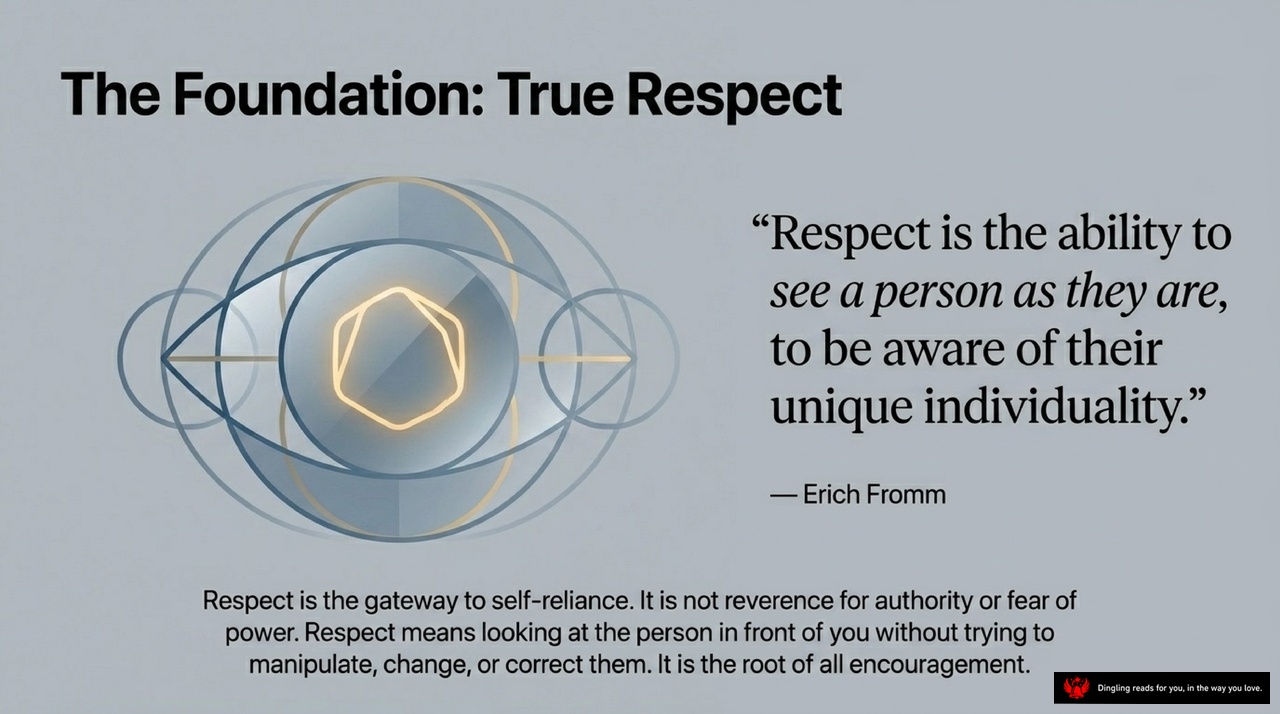
The Foundation: True Respect. Look closely at this image. The central message is clear: respect is the gateway to self-reliance. But what does that actually mean? It's not about bowing down to authority or fearing power. True respect, as Erich Fromm beautifully put it, is the ability to see a person as they are, to be aware of their unique individuality. It means looking at the person in front of you without trying to manipulate, change, or correct them.
Think about this in your daily life. How often do we try to fix people? Parents pushing their children into "useful" paths, or teachers trying to mold students into their ideal vision. But that's not respect; that's control. When you stop trying to change someone and simply accept their reality, you unlock something powerful. You give them the courage to grow on their own.
This is why respect is the root of all encouragement. If you want to help someone stand up, you first have to stop trying to push them down or pull them in a specific direction. You have to trust that they know their own way. This shift from control to connection is the very first step toward a healthy, democratic classroom or any meaningful relationship. It's not about what you can do for them, but about how you see them. And when you truly see someone, you empower them to see themselves.

Let's talk about the hidden ladder of bad behavior. When kids or even adults feel disconnected and disrespected, they don't just stop; they escalate. Think of it as climbing five distinct steps, each driven by a desperate need to secure a place in the community.
At the very bottom, we have the "Demand for Praise." Here, the mindset is, "I will only be good if you applaud me." If you don't cheer, the behavior changes. Next up is "Attention Drawing." If you won't praise me, I'll misbehave so you at least notice me. Being noticed is better than being ignored.
As things get heavier, we hit the "Power Struggle." Now the message shifts to, "I will prove I am stronger than your rules." It's no longer about connection; it's about dominance. If that fails, the next step is "Revenge." The logic here is brutal: "You didn't love me, so I will make you hate me." This is where relationships break down completely.
Finally, at the top of this dark staircase, lies the "Proof of Incompetence." The thought becomes, "Don't expect anything from me; I am worthless." By acting incapable, they protect themselves from the pain of failure.
The core truth behind all five stages is simple: when individuals feel denied of respect and connection, they escalate their misbehavior. The goal is always the same—to secure a place in the community. Understanding these stages isn't about labeling kids as "bad," but seeing the cry for belonging hidden beneath the chaos.

The Trap of Praise and Rebuke isn't just a catchy title; it's a warning about how we often manipulate others to get what we want. Look at this scale: on one side, we have the golden crown representing praise, and on the other, the whip symbolizing rebuke. The pivot point in the middle is manipulation.
When we rely on praise, we create a vertical relationship where action is only taken for a reward. We teach people to be dependent, waiting for the crown to drop before they move. Conversely, rebuke is simply a low-cost, immature, and violent form of communication used when we lack the patience for dialogue. It's the whip raised because we don't know how to talk.
The slide makes it clear: we must abandon the system of rewards, and we must abandon punishments. True connection doesn't come from controlling someone with a carrot or a stick. It comes from respecting them as an equal partner. When we stop trying to manipulate through praise or fear, we finally stop playing games and start building real, honest relationships where people act out of their own values, not because they are being forced or bribed.

Imagine a world where we constantly climb a pyramid, trying to stand above others, versus a world where we hold hands in a circle, supporting one another. Today's slide presents these two paradigms of society: Competition and Cooperation.
On the left, under Competition, we see a rigid structure. It's a hierarchy where the only way up is to crush those below. The motivation here is simple but harsh: praise for winning and punishment for losing. This mindset teaches us to view others as enemies, a constant threat to our own success. The inevitable outcome? A sick, isolated community where everyone is living in fear, trapped in a cycle of sickness and loneliness.
Now, look at the right side: Cooperation. Here, the structure is circular and fluid. The motivation shifts from fear to contribution and empathy. We stop seeing each other as adversaries and start viewing one another as comrades. The result is a thriving community rooted in health and a deep sense of belonging.
The text at the bottom makes it crystal clear: a system based on praise and competition inevitably leads to a diseased community where everyone is viewed as a threat. But when we switch to cooperation, we unlock the potential for true human connection. The choice isn't just theoretical; it's the fundamental difference between a society that breaks us and one that builds us up.
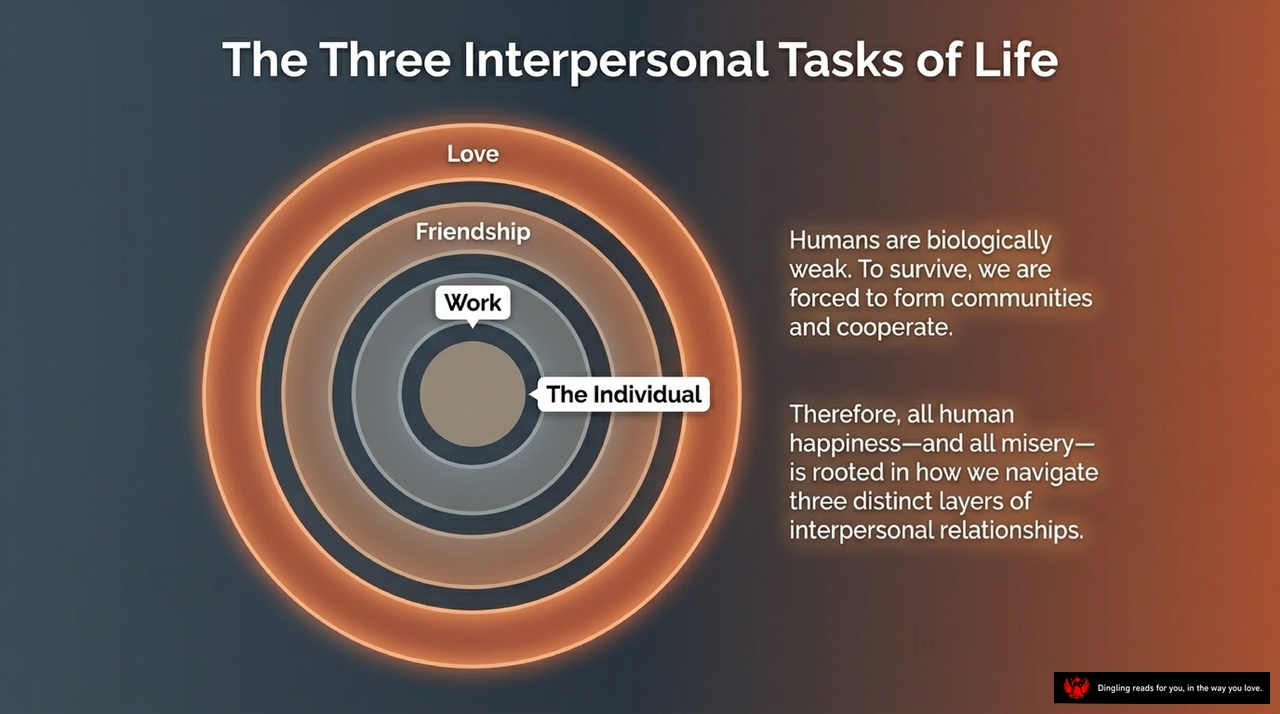
Humans are biologically weak. To survive, we are forced to form communities and cooperate. This fundamental truth shapes everything about our lives. As we look at the three layers of human connection—work, friendship, and love—we see that all human happiness, and all misery, is rooted in how we navigate these distinct layers of interpersonal relationships.
At the core is the individual, but we cannot thrive in isolation. The middle layer, work, represents the trust necessary for our survival. We must rely on others to complete tasks we cannot do alone. Beyond that lies friendship, a realm of unconditional trust where we connect not for utility, but simply because we value the person themselves. And at the outermost ring is love, the most profound commitment we can make. It is not a passive emotion we fall into, but an active choice we cultivate every day.
When we understand that our very existence depends on these connections, we stop viewing others as competitors or obstacles. Instead, we see them as essential partners in our survival. The quality of our relationships determines the quality of our lives. By mastering the art of cooperation, trust, and love across these three layers, we transform our inherent weakness into our greatest strength.
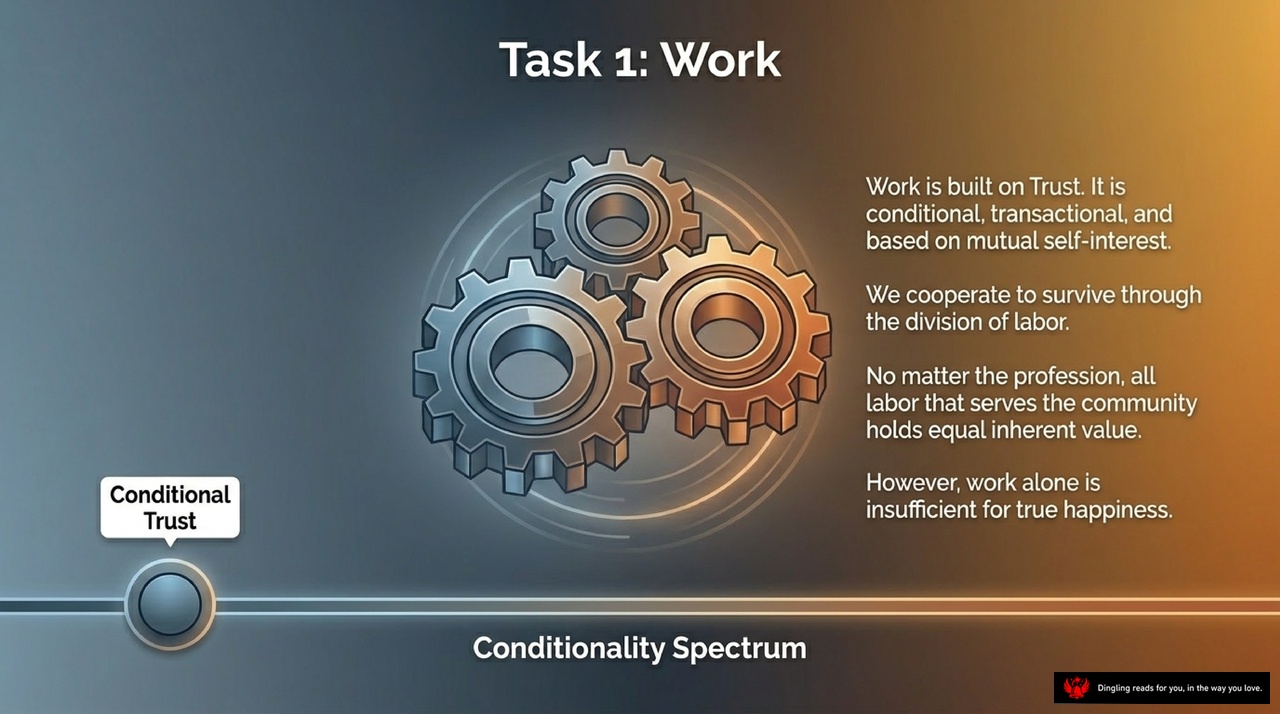
Work is built on trust, but let's be honest: it's conditional, transactional, and driven by mutual self-interest. Think of it like a machine—those interlocking gears in our slide represent how we cooperate to survive through the division of labor. No matter your profession, whether you're a CEO or a teacher, all labor that serves the community holds equal inherent value. There is no hierarchy of worth, only different roles in the same system.
However, here's the hard truth: work alone is insufficient for true happiness. While we rely on this "conditional trust" to keep society running, it doesn't give us the deep sense of belonging we crave. That's why we need to move beyond mere transactions and explore what it means to truly connect with others. The gears turn, but they only go so far. Real fulfillment comes from shifting from this conditional mindset to one of unconditional trust and genuine connection.
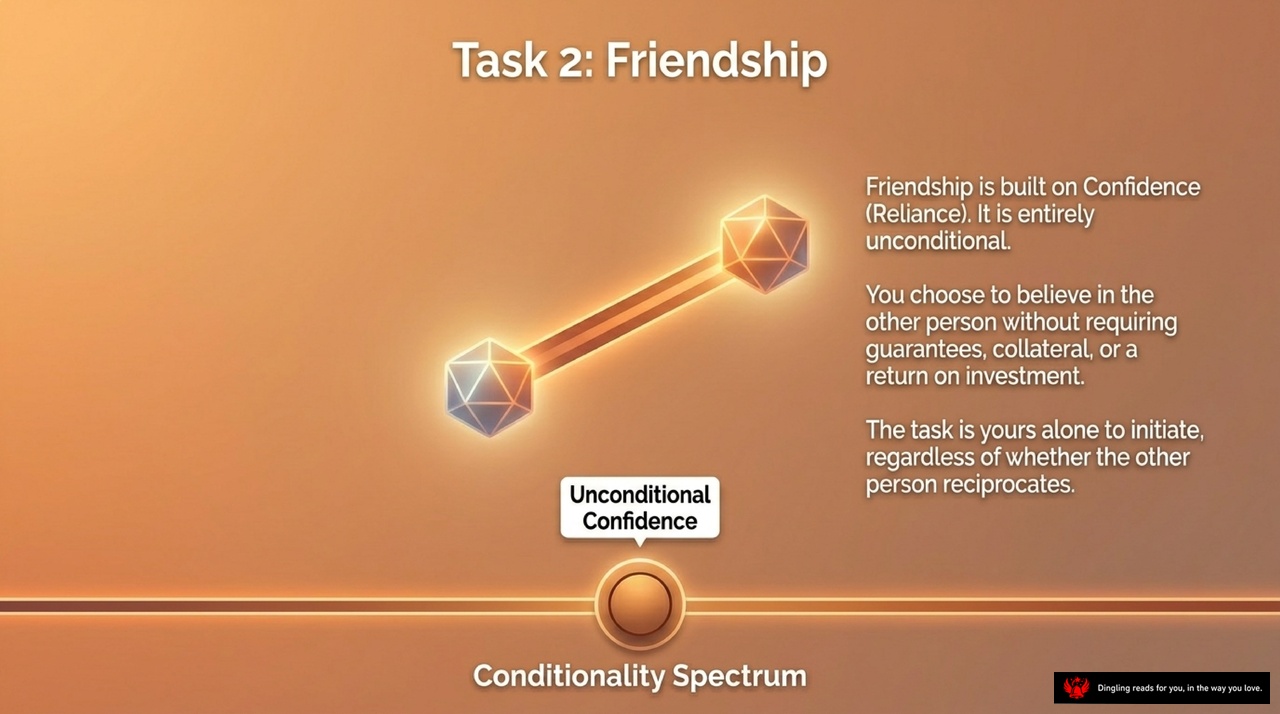
Friends, let's dive into Task 2: Friendship. Look at this spectrum of "Conditionality" stretching across the screen. On the far left, we have "Unconditional Confidence." This is the heartbeat of true friendship. In *The Courage to Be Disliked*, the authors make a radical point: friendship isn't built on guarantees, collateral, or a return on investment. It's built on pure, unconditional reliance.
Think about it: when you choose a friend, you aren't betting on their future success or their ability to pay you back. You are simply choosing to believe in *them*—the person they are right now. As the text says, "You choose to believe in the other person without requiring guarantees." It's a leap of faith, a decision to see their humanity without conditions.
And here is the most challenging part for all of us: the task is yours alone to initiate. The slide reminds us that friendship starts with *you*, regardless of whether the other person reciprocates immediately. You cannot force someone to be your friend, but you can always offer the first step of unconditional trust. In a world where we often wait for others to validate us, the courage to simply believe in someone else first is the ultimate act of freedom. That is the path to genuine connection.
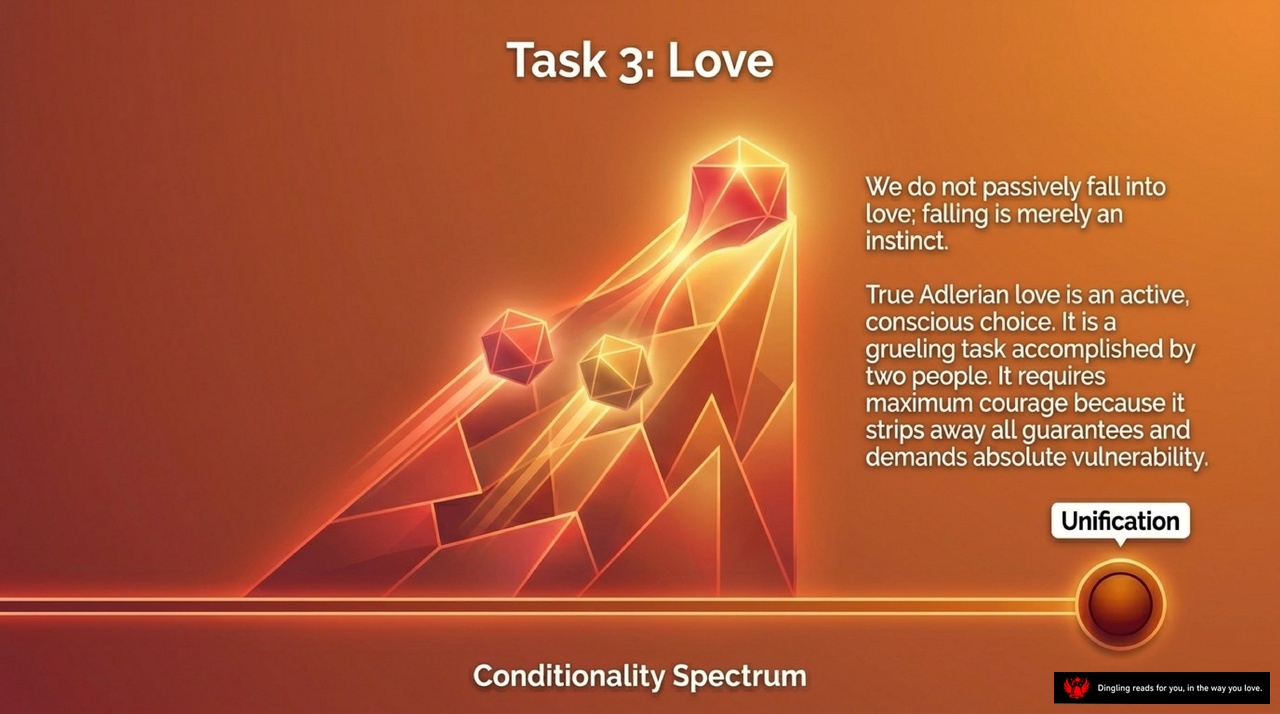
Task 3: Love. Look at this graphic of the "Conditionality Spectrum." It illustrates a profound truth: we do not passively fall into love; falling is merely an instinct. True Adlerian love is an active, conscious choice. It is a grueling task accomplished by two people. It requires maximum courage because it strips away all guarantees and demands absolute vulnerability.
Think about it this way: most of us are still stuck in the "child's strategy," waiting to be loved, trying to be the perfect child or the rebellious outcast just to get a glance of attention. But real love requires a radical shift. You must stop asking "How can I get loved?" and start asking "How can I love?" It's not about finding a "destined person" out there; that's just an excuse to avoid the hard work of building a relationship with someone right in front of you.
Instead, love is a dance. It's a game you play with another person where you both decide to create a new life together. You switch your life's subject from "I" to "We." You commit to the journey, knowing there are no guarantees, and you choose to show up anyway. This isn't about finding the perfect partner; it's about choosing a lifestyle of mutual support and responsibility. So, don't wait for a fairy tale. Take the first step today, trust the person in front of you, and start dancing. That is how you create your own destiny.
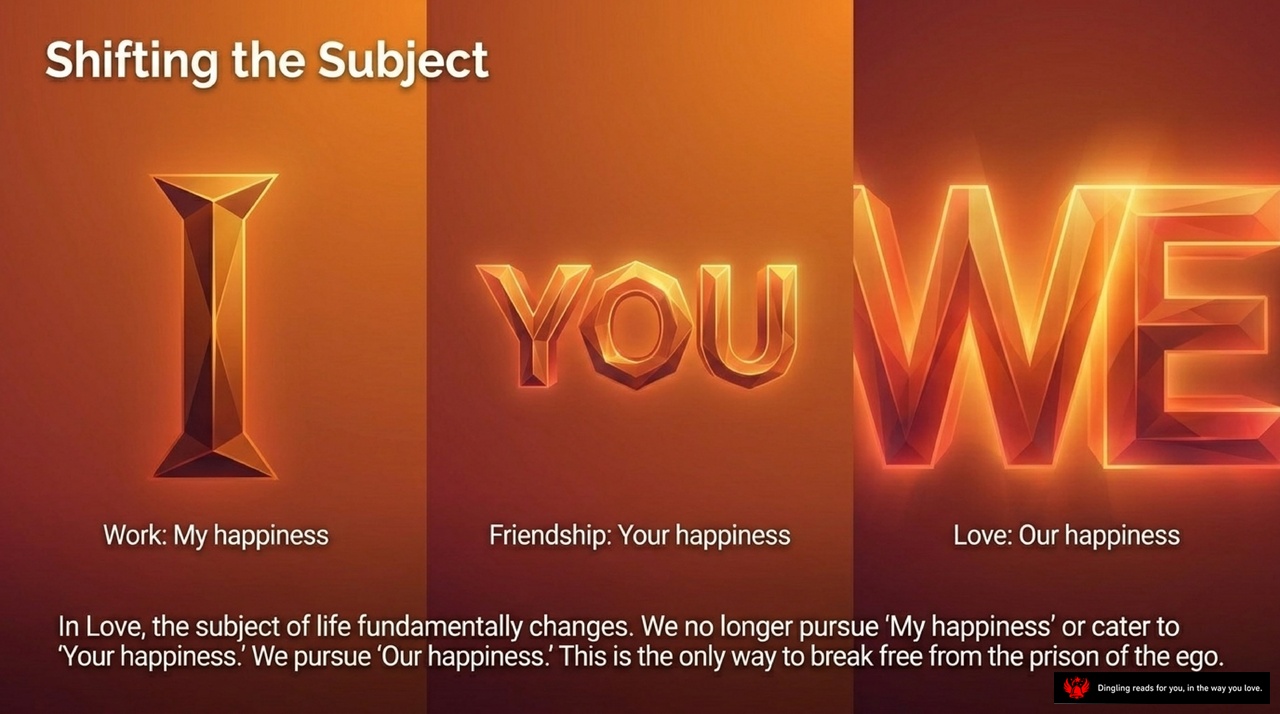
In love, the subject of life fundamentally shifts. Look at this slide: we move from "I," where work is about my happiness, to "You," where friendship focuses on your happiness, and finally to "We," where love is about our shared happiness. This isn't just a change in wording; it's a liberation from the prison of the ego.
In our daily lives, we often chase "my happiness" or try to cater to "your happiness" as a transaction. But true love requires us to pursue "our happiness" as a single, unified goal. When we make this shift, we stop seeing others as competitors or tools for our own satisfaction. Instead, we enter a partnership where our fates are intertwined.
This transformation is the ultimate test of maturity. It means moving from a childish strategy of waiting to be loved to the courageous act of loving others first. As the text reminds us, love is not a passive emotion that happens to us; it is an active choice we make every day. It is a dance where two independent individuals decide to step forward together, creating a rhythm that neither could achieve alone.
So, the next time you face a relationship challenge, ask yourself: Am I still focused on "I," or have I embraced "We"? The moment you choose "We," you break free from isolation and step into the freedom of genuine connection.

Imagine your life as a journey from childhood to adulthood, a path marked by a profound shift in how we see ourselves and the world. In our early years, we are like children under the sun, the "Dictator," where our biological weakness paradoxically makes us feel like the center of the universe. Everyone serves "Me," and the world revolves around our needs. But to truly grow, we must make a conscious choice: the Choice of Love. This is not just a feeling; it is the pivotal moment where we decide to step off the pedestal of self-centeredness.
As we move into adulthood, the goal isn't to become more powerful in the old sense, but to become truly self-reliant. This transformation happens when we realize that love and self-reliance are actually the same thing. By loving others, we learn to no longer be the center of the world. We abandon the childish lifestyle where everyone must serve us, and instead, we embrace a reality where we are all partners. It is a shift from demanding the world to adapt to us, to understanding that our worth comes from connecting with others, not from being worshipped by them.
This choice is the hardest yet most liberating step we can take. It means accepting that we are not special little gods, but ordinary humans who find our strength in community. When we stop trying to control the world and start loving it, we finally find the freedom to be our authentic selves. Love, in this sense, is the ultimate act of courage—it is the bridge that takes us from the fragile ego of childhood to the resilient, interconnected reality of adulthood.
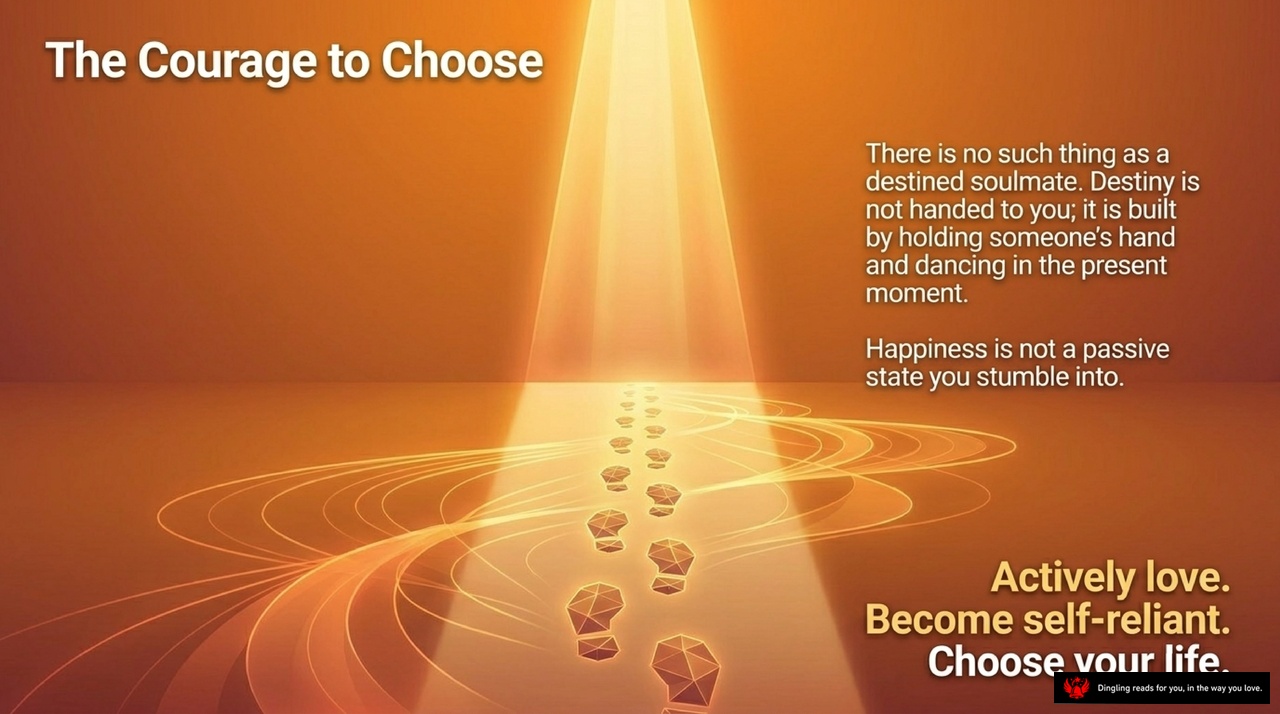
The Courage to Choose. Look at that path of footprints leading into the light. This image captures the very heart of Adler's philosophy: there is no such thing as a destined soulmate, and happiness is never a passive state you stumble into by accident.
In the book, the philosopher tells the young man that destiny isn't handed to you; it is built by holding someone's hand and dancing in the present moment. We often wait for a magical moment or a perfect partner to arrive, but Adler challenges us to stop waiting. Happiness isn't something that happens to you; it is something you actively create.
The slide reminds us to actively love, become self-reliant, and choose your life. This is a call to action. Instead of blaming our past or searching for a mythical "fated" person, we must take responsibility for our relationships right now. We build our destiny through our daily choices and the courage to engage with others.
So, don't wait for the light to find you. Step onto the path, hold hands with those around you, and dance through the present. Your life, your future, and your happiness are all up to you. Choose them today.