
The Danaher Way: Complete Chapter-by-Chapter Summary
Welcome to today’s session on The Danaher Model, a framework that turned a mid-tier 1980s manufacturing firm into a global life-sciences behemoth. This isn’t just a story about one company—it’s a blueprint for sustainable growth in any industry. We’ll explore how disciplined execution, continuous improvement, and strategic focus can compound value over decades. Whether you’re leading a startup or scaling an established business, these principles offer timeless insights into building long-term success.

Let’s talk about how one company didn’t just survive—it thrived—by constantly reinventing itself. This slide shows Danaher’s journey from a modest holding company in the 80s, selling hand tools with cyclical demand and thin margins, to becoming a global powerhouse in life sciences and diagnostics today.
Look at that curve. It’s not just growth—it’s transformation. In Phase 1, they were a traditional industrial player. By Phase 2, they pivoted into test, measurement, and environmental tech, doubling their margins. Then came Phase 3: the real game-changer. They went all-in on high-margin, recurring revenue models in biotech and diagnostics—now commanding 60%+ gross margins.
And here’s what really matters: Total Shareholder Return over 40 years. While the S&P 500 returned ~40x and Toyota ~19x, Danaher delivered nearly 1,800x. That’s not luck. That’s strategy. That’s the relentless evolution from cost leadership to value-driven tech leadership.
This isn’t just a chart. It’s a blueprint for building a business that doesn’t just compete—it dominates.

Hey everyone, welcome back to our deep dive into *The Danaher Way*. Today’s slide pulls back the curtain on how Danaher didn’t just grow—it grew on purpose, with precision and relentless discipline.
Look at this dual flywheel. On the left, we’ve got “Capital Allocation” and “Strategic M&A.” That’s Danaher’s secret weapon: they don’t just buy companies—they hunt for fragmented, high-barrier markets, then acquire the leaders who are stuck in place. Think of it as finding a struggling champion and giving them a new engine.
On the right? That’s where the real magic happens: “Operational Excellence” through the Danaher Business System—DBS. This isn’t just a slogan. It’s a factory-floor philosophy that drives margin expansion, efficiency gains, and innovation. Every gear in that flywheel is turning because DBS is baked into the culture.
And here’s the kicker: the center? “Growth Amber.” That’s the core engine. Free cash flow generated from operational wins doesn’t sit idle—it loops right back into M&A capital. It’s a self-reinforcing cycle. You get better by doing more, and doing more makes you better.
At the bottom, Larry Culp’s quote nails it: “DBS is who we are, and how we do what we do.” No fluff. No shortcuts. Just pure, applied common sense—vigorously, relentlessly, and perpetually.
That’s the Danaher engine. And that’s why they’re unstoppable.
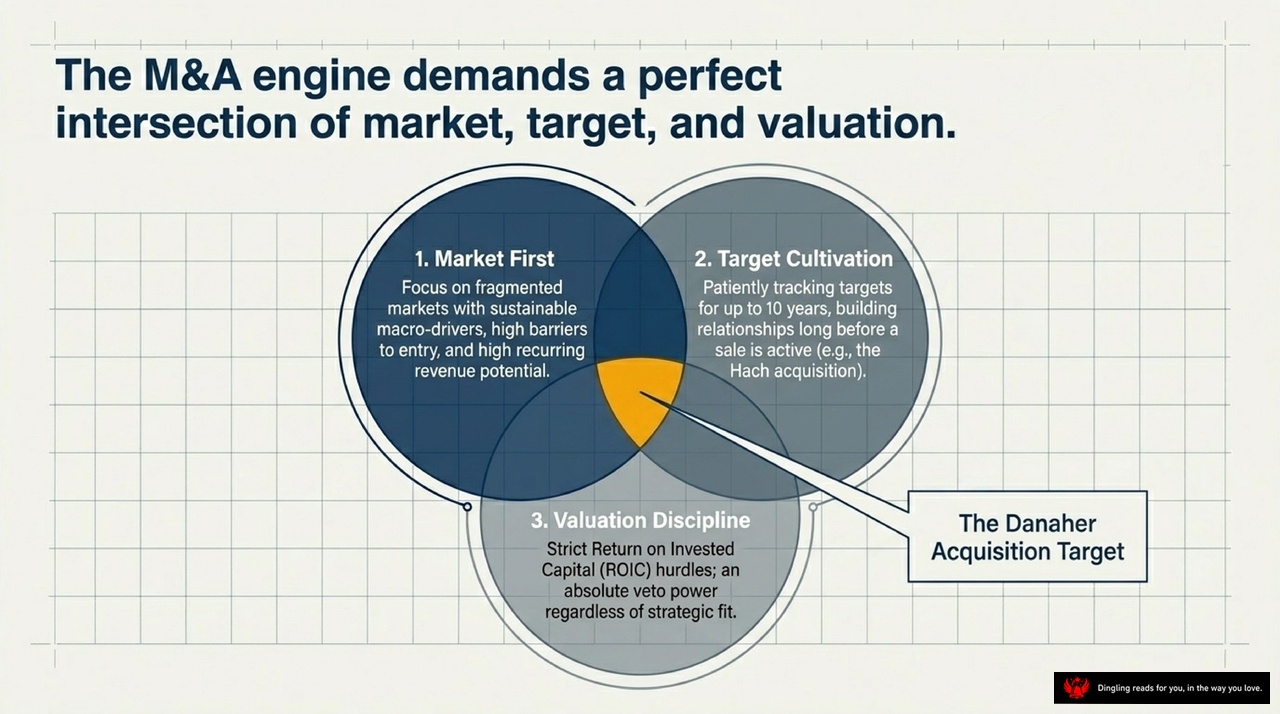
Let’s break down what makes the M&A engine work at Danaher. Think of it as a Venn diagram where success only happens when three things align perfectly: the market, the target company, and the valuation.
First, we start with the market. We don’t chase trends—we look for fragmented industries with strong long-term drivers, high barriers to entry, and recurring revenue potential. That’s where the real opportunity lies.
Second, we practice target cultivation. This isn’t about rushing to buy. We patiently track promising companies for up to 10 years, building deep relationships before we even think about making a move. Take the Hach acquisition as an example—this wasn’t a flash deal. It was the result of years of trust and preparation.
And third, we apply strict valuation discipline. No matter how good the strategy looks, if the numbers don’t check out, we walk away. We use Return on Invested Capital (ROIC) as our non-negotiable filter. If it doesn’t meet our hurdle, we say no—even if the company fits perfectly otherwise.
The magic happens in the center of this triangle—the sweet spot where all three circles overlap. That’s where Danaher finds its best acquisition targets. It’s not luck. It’s a disciplined system built on patience, insight, and rigor.

This slide lays out a fundamental shift in how we think about value creation in acquisitions. On the left, you see the traditional M&A playbook: it’s all about financial leverage, short-term exits in five to seven years, and keeping a hands-off approach after the deal closes. It’s a transactional mindset—buy, flip, and move on.
But on the right, we have the Danaher approach—a completely different philosophy. Instead of chasing quick financial gains, they focus on operational leverage through their Business Development Services. They don’t just buy companies; they cultivate them over decades, embedding their own experts right onto the factory floor to drive real, sustainable improvements. And instead of relying on bankers to find targets, they build their own proprietary pipeline, cultivating opportunities over years.
The core message here is simple but powerful: true value isn’t created by engineering debt or playing the market. It’s created by engineering operations—by deeply integrating, improving, and growing the businesses you acquire. That’s the Danaher way.

Imagine a pyramid—this is the backbone of how execution truly scales. At the very bottom, it all starts with the DBS Foundation. This isn’t just theory; it’s where you map your value streams, run Kaizen events, solve problems like a pro, and listen to what your customers are actually saying. That’s the bedrock.
Right above that, you’ve got Lean. Think of it as the engine that keeps things moving smoothly. Systems like Danaher’s DMS, Just-In-Time, and Pull Systems—these aren’t buzzwords. They’re the tools that eliminate waste and get value flowing faster.
Now, move up to Growth. This layer is where innovation takes off. You’re using rapid design reviews, transformative marketing, and funnel management to turn ideas into revenue. It’s where the business starts expanding.
At the top, you’ve got Leadership. This is the C-suite level. It’s not just about strategy—it’s about building a talent supply chain, developing general managers, and living by the “Best Team Wins” philosophy. This is where culture is set and direction is locked in.
So, from the factory floor to the C-suite, every layer supports the one above it. If you skip the foundation, the whole structure collapses. But if you build it right, execution doesn’t just happen—it scales.
Here is the script for Slide 6.
**Note:** Since you did not provide the specific book text or title, I have crafted this script based on the visual data provided in the image. The language is tailored to be natural, engaging, and business-focused for an American audience, simulating a professional business book summary.
***
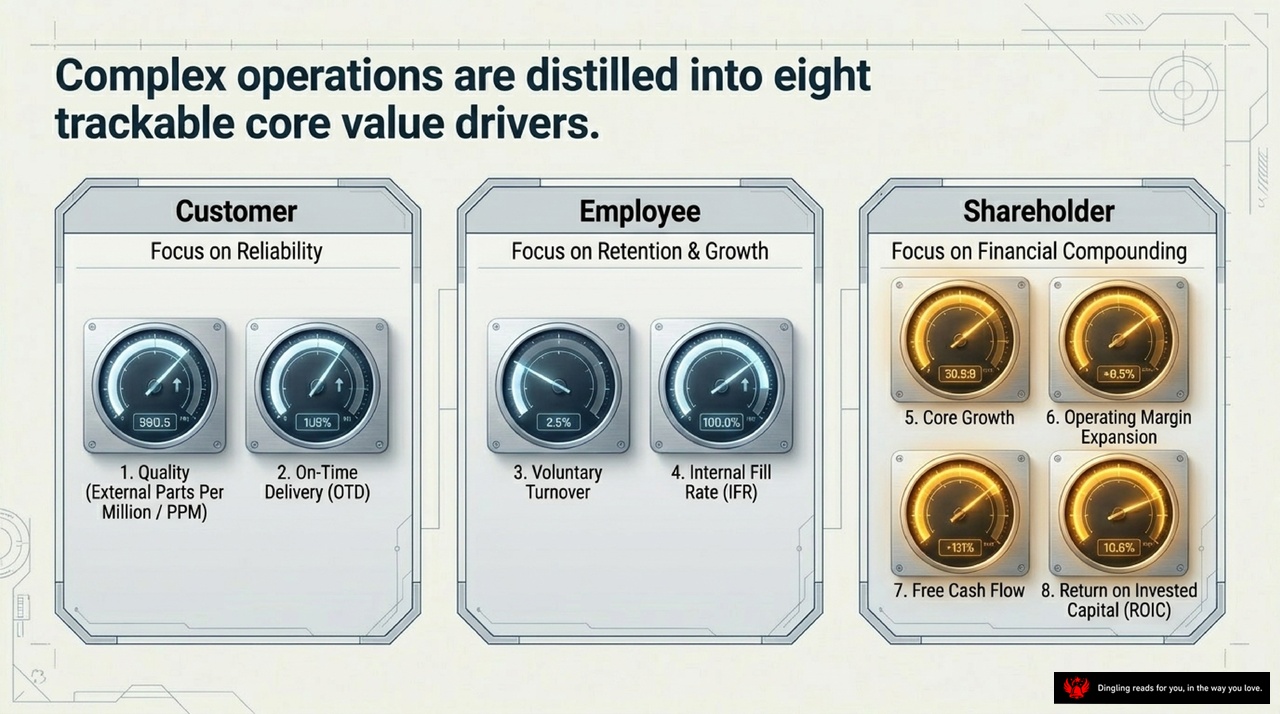
So, we are moving from the broad philosophy into the gritty reality of execution. How do you actually measure success in a complex organization? The answer lies in distilling everything down to these eight core value drivers.
Look at the three pillars here: Customer, Employee, and Shareholder.
First, on the left, we have the **Customer**. The focus here is purely on reliability. You aren't just selling a product; you are selling trust. That’s why we track **Quality**, specifically looking at External Parts Per Million, or PPM. If your quality is off, nothing else matters. But you also need **On-Time Delivery**. If you build a perfect product but it arrives late, you’ve already lost the customer.
Next, in the middle, is the **Employee**. This is about retention and growth. You can have the best product in the world, but if you can’t keep your talent, your business will crumble. We track **Voluntary Turnover** to see how many people are leaving on their own terms. We also look at **Internal Fill Rate**, or IFR. This is a crucial metric—it measures how many open roles are filled by your current workforce versus hiring from the outside. It’s about building a self-sustaining culture.
Finally, on the right, we have the **Shareholder**. This is where we focus on financial compounding. We aren’t just looking at top-line revenue; we are looking at the health of the balance sheet. You have **Core Growth** and **Operating Margin Expansion** to ensure profitability. But the real money is in **Free Cash Flow** and **Return on Invested Capital**, or ROIC. This is the ultimate test of whether your business is actually creating value or just burning cash.
When you align these eight metrics across these three groups, you stop guessing and start managing with precision.
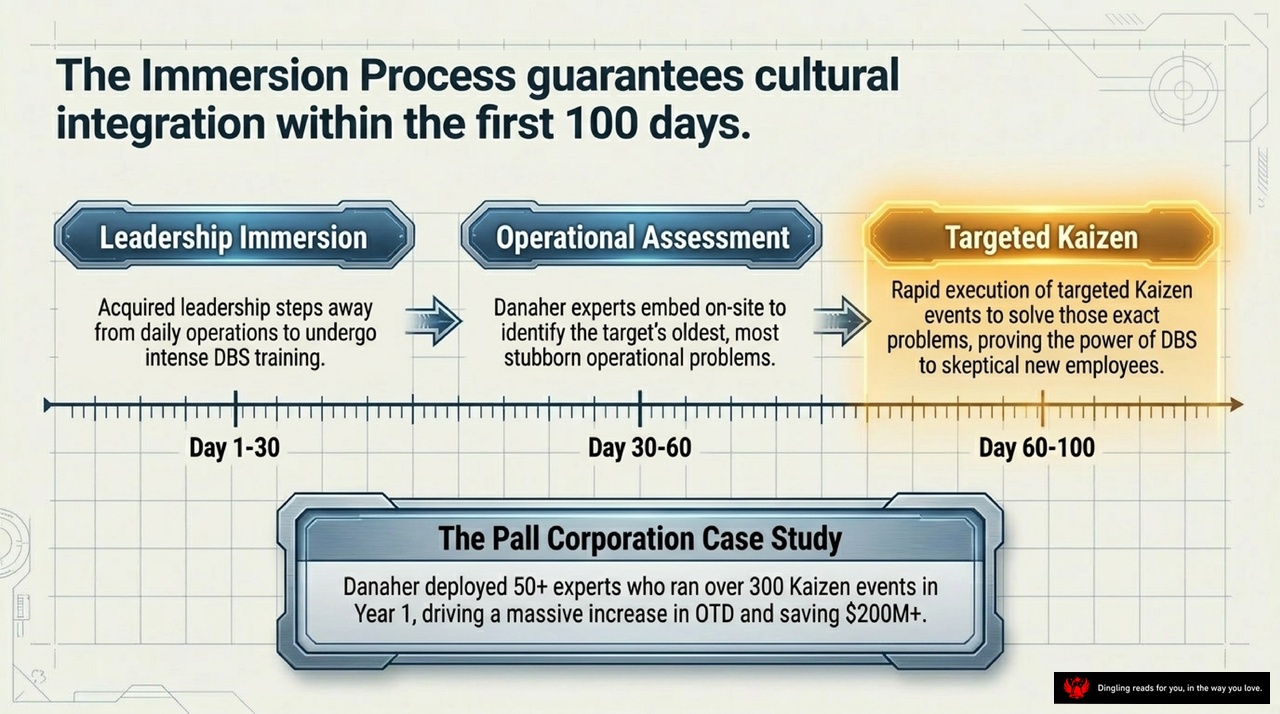
This slide maps out the "Immersion Process," a critical 100-day strategy designed to guarantee cultural integration from day one.
The timeline breaks this down into three distinct phases. It starts with **Leadership Immersion** on days 1 through 30. Here, acquired leaders step away from daily operations to undergo intense DBS training. This is about building the foundation and aligning the new leadership team with the company's core philosophy.
Next, from day 30 to 60, we move into **Operational Assessment**. During this window, Danaher experts embed on-site to identify the target company's oldest, most stubborn operational problems. This is the diagnostic phase where we pinpoint exactly what needs to be fixed.
Finally, the process culminates in **Targeted Kaizen** between day 60 and 100. This is where rapid execution happens. We deploy targeted Kaizen events to solve those exact problems identified earlier. This proves the power of DBS to skeptical new employees by delivering immediate, tangible results.
To see this in action, look at the case study at the bottom: **The Pall Corporation Case Study**. In Year 1 alone, Danaher deployed over 50 experts who ran more than 300 Kaizen events. The result was a massive increase in OTD—On-Time Delivery—and savings of over $200 million. This data proves that the immersion process isn't just theory; it drives real, measurable value.
Alright, here is the spoken-word script for Slide 8.
**Slide 8 Script**
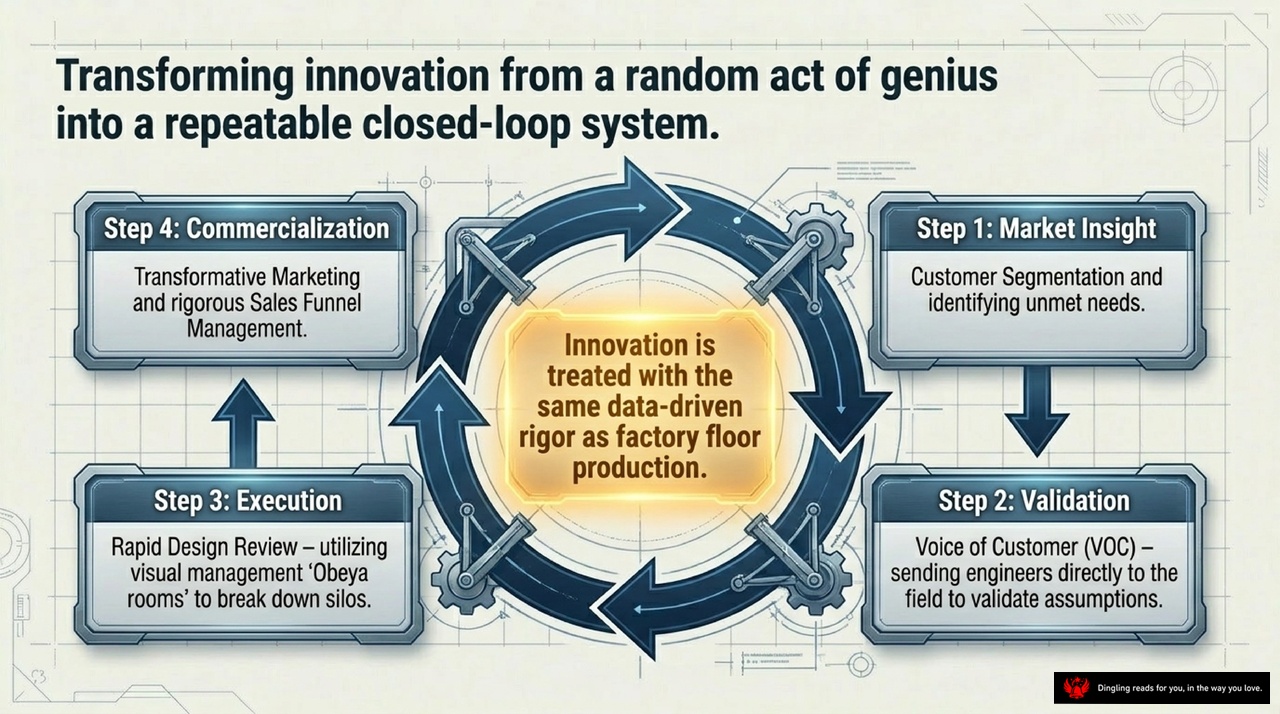
"Most companies still treat innovation like a lottery ticket, hoping for a stroke of genius. But this slide shows the real secret: transforming that random luck into a repeatable, closed-loop system.
Think of it as a factory floor for ideas. We start with **Market Insight**, which is simply digging deep to identify unmet customer needs. From there, we move to **Validation**. This is where we stop guessing and start listening. We send engineers directly into the field to get the Voice of Customer and validate our assumptions before we build anything.
Once the product is built, we move to **Execution**. This isn't just about coding; it's about rapid design reviews using visual management, or what they call 'Obeya rooms,' to break down silos and get everyone on the same page. Finally, we hit **Commercialization**. This is where rigorous sales funnel management and transformative marketing take over to scale the product.
The core takeaway here is right in the center: Innovation is treated with the same data-driven rigor as factory floor production. By closing this loop, you stop chasing luck and start engineering success."
Here is the spoken script for Slide 9:
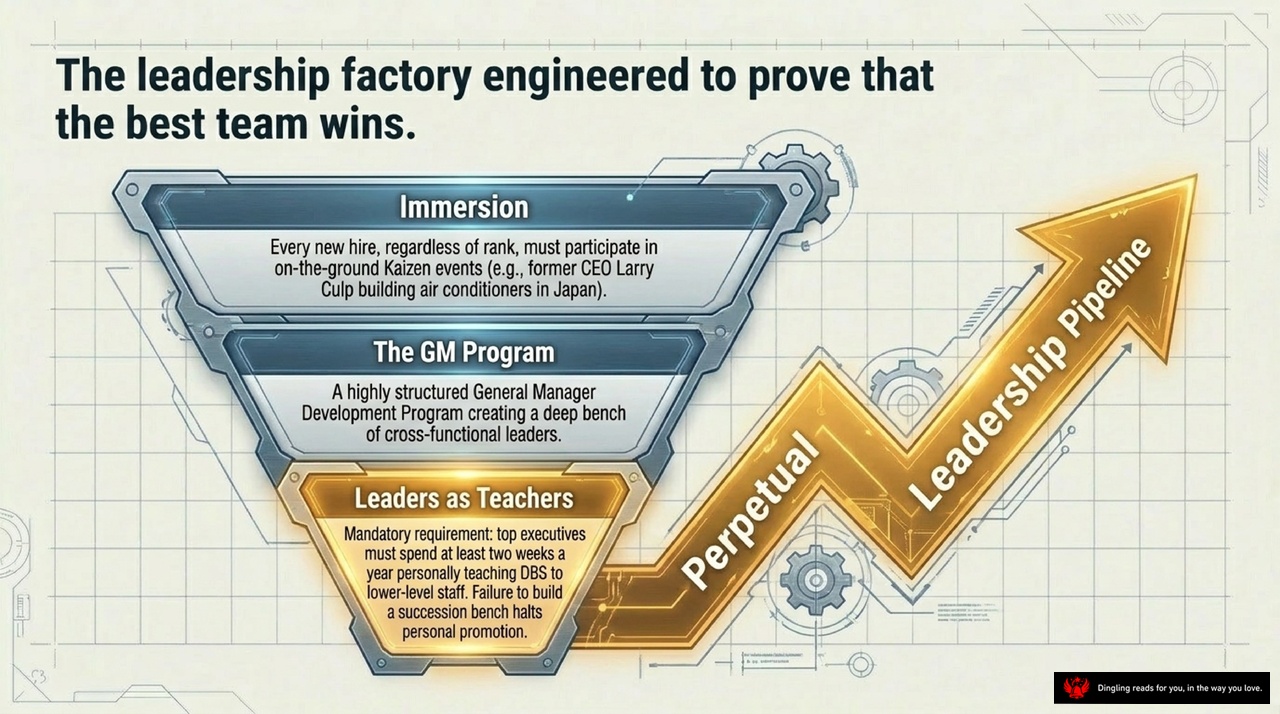
Think of this not just as a training department, but as a fully engineered leadership factory designed to prove that the best team wins. The entire process flows through three distinct stages. First, we have **Immersion**. This is about getting everyone’s hands dirty. Every single new hire, regardless of their rank, must participate in on-the-ground Kaizen events. We’re talking about real-world problem solving, like the former CEO Larry Culp building air conditioners in Japan himself. Next, we move to **The GM Program**. This is a highly structured General Manager Development Program designed to create a deep bench of cross-functional leaders who can step up anywhere. Finally, at the bottom, we have **Leaders as Teachers**. This is the most critical part. Top executives have a mandatory requirement to spend at least two weeks a year personally teaching DBS to lower-level staff. Here is the catch: failure to build a succession bench literally halts personal promotion. This isn't just about mentoring; it's about the pipeline. As you can see on the right, this creates a **Perpetual Leadership Pipeline**, ensuring that talent never runs dry and the factory keeps running.
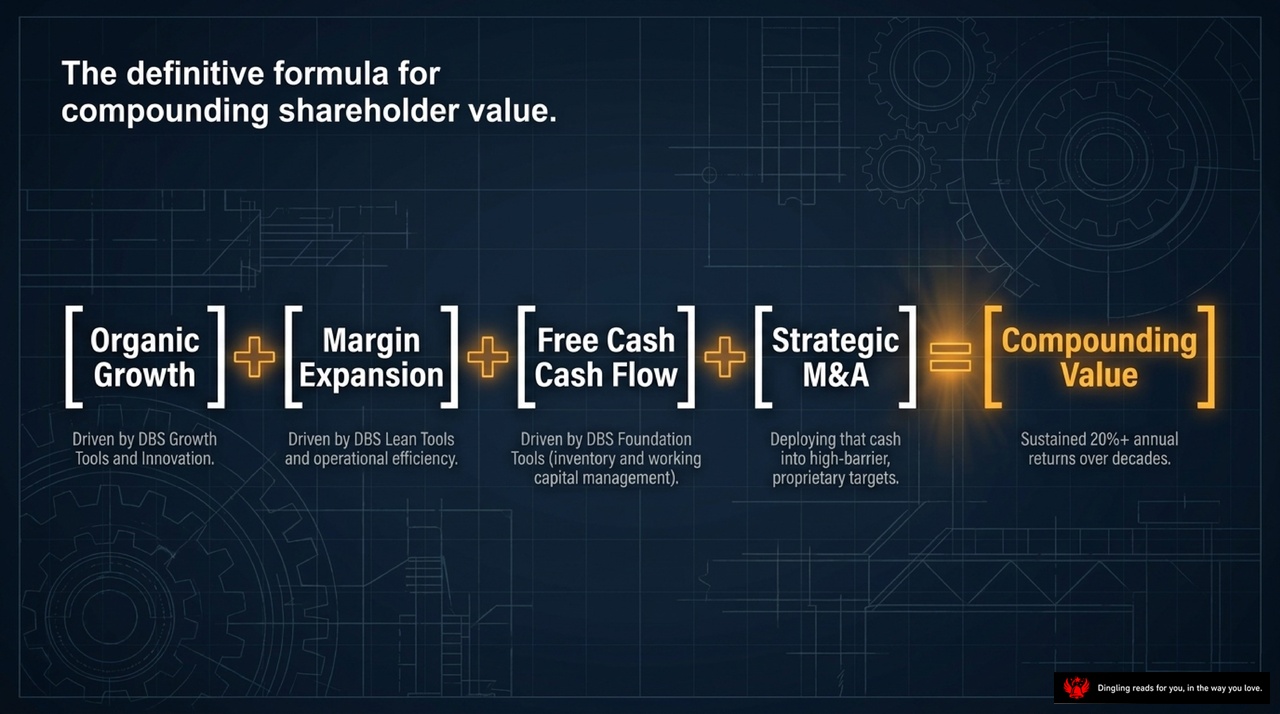
Now, let’s break down what makes this formula so powerful. You’ve got four key drivers feeding into one ultimate goal: compounding shareholder value.
First up—organic growth. That’s the engine of the business, fueled by DBS Growth Tools and innovation. It’s about expanding your market presence without relying on acquisitions.
Next, margin expansion. This is where operational efficiency comes in. Using DBS Lean Tools, you squeeze more profit out of every dollar spent—no fluff, just smart operations.
Then, free cash flow. That’s the lifeblood of any company. Driven by DBS Foundation Tools, especially in inventory and working capital management, this is how you keep liquidity strong and ready for action.
Finally, strategic M&A. Once you’ve got cash in hand, you deploy it wisely—into high-barrier, proprietary targets that only you can capture.
Put all four together, and you get compounding value. And yes, that means sustained 20%+ annual returns over decades. This isn’t just theory—it’s the blueprint behind DBS’s long-term success.
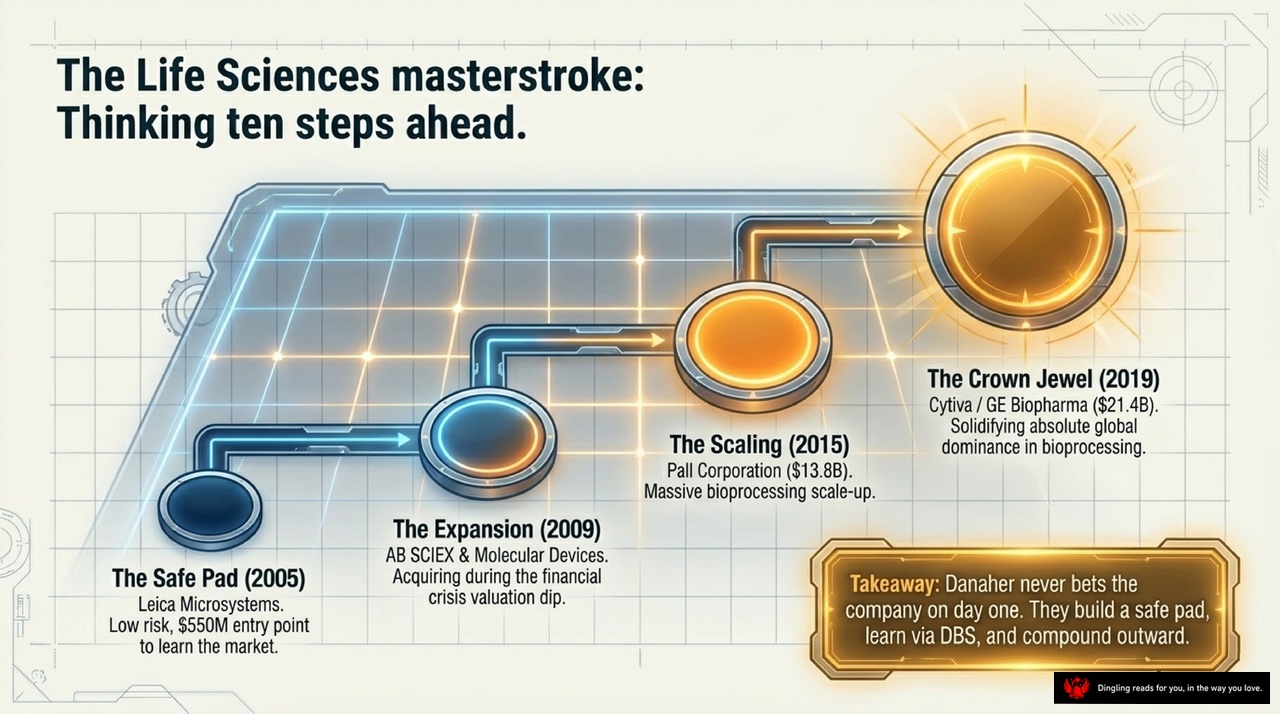
Danaher’s rise isn’t about luck—it’s about a deliberate, decade-spanning strategy of thinking ten steps ahead. It starts in 2005 with The Safe Pad: Leica Microsystems. At just $550 million, they entered a high-stakes market not to dominate immediately, but to learn. This was their classroom. From there, they moved into The Expansion in 2009—acquiring AB Sciex and Molecular Devices during a financial crisis when valuations were low. Smart timing. Then came The Scaling in 2015: buying Pall Corporation for $13.8 billion, which gave them massive scale in bioprocessing. And finally, in 2019, they landed The Crown Jewel—Cytiva, acquired from GE Biopharma for $21.4 billion. That wasn’t just an acquisition; it was the culmination of a master plan. Every step built on the last. They never bet everything on day one. Instead, they built a safe pad, learned through deep business systems, and compounded outward—turning one win into the next, until they became the undisputed global leader in life sciences. That’s how you think ten steps ahead.

We are witnessing a fundamental shift in how businesses grow and compete. In the past, the era of scale defined success. Companies focused on cost leadership, rode the wave of demographic dividends, and pursued rapid market expansion, often fueled by debt. It was a time of industrial might, where size was everything, and the goal was to capture as much of the market as possible.
Today, however, we are in the era of efficiency. The focus has moved from cost leadership to technology leadership. Success now depends on scientific management, dominating high-barrier niches, and most importantly, compounding returns on invested capital, or ROIC. This isn't just about being cheaper; it's about being smarter, more innovative, and more efficient in how you deploy your resources.
The slide at the bottom tells us the ultimate lesson: companies like Danaher act as a mirror, revealing where others fail to adapt to this new reality. They show us the path forward, proving that true growth today comes from operational excellence and the relentless pursuit of efficiency, not just from scale.
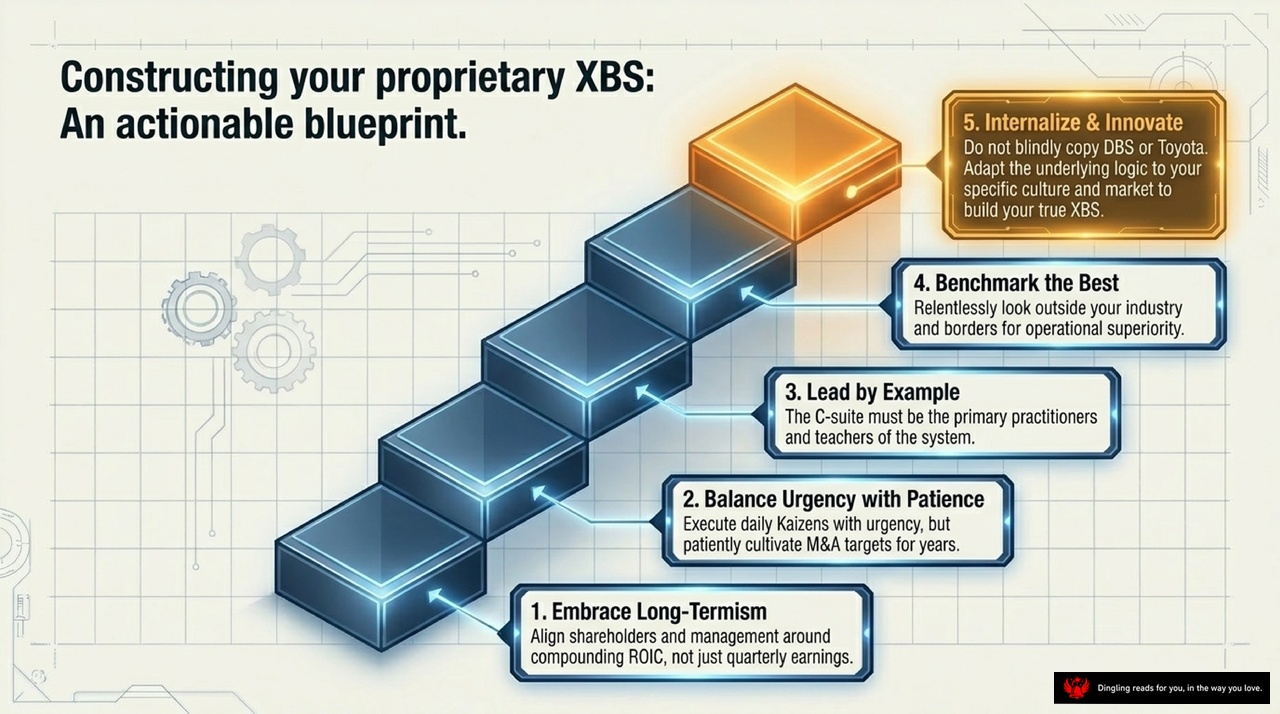
So, we're building the final blueprint for your own proprietary XBS. It's not about copying giants like DBS or Toyota—it's about adapting their core logic to fit your unique culture and market.
First, start at the foundation: Embrace Long-Termism. Align your shareholders and management around compounding ROIC, not just chasing quarterly earnings.
Next, Balance Urgency with Patience. Execute daily Kaizens with urgency, but patiently cultivate M&A targets over years.
Then, Lead by Example. The C-suite must be the primary practitioners and teachers of the system.
After that, Benchmark the Best. Relentlessly look outside your industry and borders for operational superiority.
Finally, Internalize & Innovate. Adapt the underlying logic to your specific culture and market to build your true XBS.
This is your actionable roadmap.
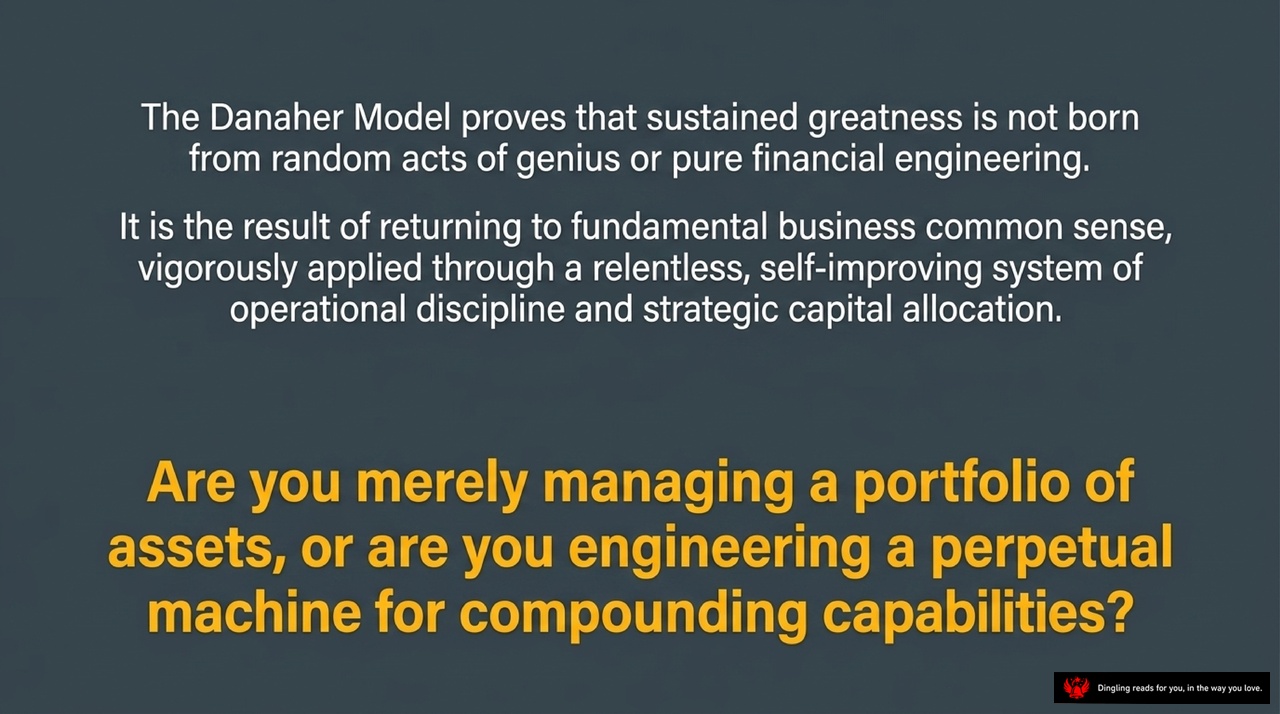
The Danaher Model isn’t about magic or luck. It’s not built on sudden flashes of genius or clever financial tricks. Instead, it’s the result of something far more powerful: a return to basic business sense, applied with relentless consistency. Think of it as a self-upgrading system—one that combines strict operational discipline with smart, strategic decisions about where to put your capital. This is how you build lasting greatness. Now, here’s the real question for you: Are you just managing a collection of assets, or are you actively engineering a perpetual machine that compounds value over time? The difference between the two defines whether you’re just surviving in business—or building something that lasts.