
The Death of Nian Gengyao: Complete Chapter-by-Chapter Summary

Welcome to today's deep dive into one of the most dramatic political tragedies in Chinese history. We are looking at *The Death of Nian Gengyao* by Zheng Xiaoyou. This book doesn't just recount a life; it dissects a fatal flaw in imperial governance: the timeless paradox of the meritorious official.
The cover image you see here, with that blood-splattered gate, perfectly captures the essence of the story. It is an anatomy of a political downfall. Nian Gengyao rose from a humble background to become one of the most powerful generals in the Qing dynasty, only to be executed for crimes he barely committed. The book argues that his tragedy wasn't about personal ambition, but about the inevitable collision between a loyal servant and a suspicious emperor.
In the following pages, we will explore how a man who saved the empire from rebellion found himself accused of plotting against it, illustrating the brutal reality of power in Imperial China.

Look at this cycle of blood and ink. It's a stark map of the "Meritorious Official Paradox"—the cruel trap that doomed a hero like Nian Gengyao.
The journey starts at the top with **Phase 1: Joy & Flattery**. Here, the crisis is averted, and the hero is rewarded. The monarch is delighted, the general is celebrated. But as soon as the danger passes, the dynamic shifts. The celebration quickly turns into **Phase 2: Suspicion**. The ruler's mind whispers a terrifying question: "If he defeated the enemy, could he defeat me?" That initial spark of doubt is the seed of destruction.
Next, this suspicion hardens into **Phase 3: Fear**. Now, the ruler is reviewing the general's overwhelming casualties and territorial metrics, not with gratitude, but with dread. He fears the general's power is too great, that one wrong move could shake the very foundations of the empire. The hero is no longer a protector; he is a potential threat.
Finally, the cycle completes with **Phase 4: Anger & Disgust**. The ruler's patience snaps. He develops an intolerance for the general's inevitable overreach, for his pride, for his success. As the scholar Wang Jingqi from 1725 so poignantly noted: "When the birds are gone, the bow is hidden." Once the threat is neutralized, the savior becomes the greatest danger. The general is viewed not as a friend, but as an enemy who must be eliminated to save the throne. This is the inescapable fate of the loyal subject in a feudal system.

Look at this map. By 1723 and 1724, Nian Gengyao was no longer just a general; he was a king in all but name. At 45 years old, he held titles like Fuyuan General, Taibao, and First-Class Duke, but the real power was his authority: unprecedented absolute command over four provinces—Gansu, Shaanxi, Sichuan, and Yunnan. The red lines on this map aren't just routes; they are the veins of his empire. After crushing the Qinghai rebellion led by Lobzang Danjin, Nian became the undisputed ruler of the Northwest. He operated with complete autonomy, making military, financial, and personnel decisions without waiting for orders from Beijing. This was the climax of power. But as history often teaches us, when a general's power grows this large, the distance between him and the throne shrinks to zero. This absolute control, which seemed like a triumph, was actually the very thing that would eventually seal his fate.

Look at this spectrum, from "The Ecstasy" to "The Warning," and finally landing on "The Verdict." It's not just a timeline; it's the tragic arc of a man who thought his merit was an eternal shield, only to realize it was actually a ticking bomb.
On the left, we see the intoxicating high of "The Ecstasy." Here, the narrative captures that dizzying moment of power where you feel like a god. The text speaks of being a "benefactor" whose name will make future generations "drool with envy." It's the feeling of absolute control, the belief that your contributions have made you untouchable. It's the peak of human ambition, where success feels like a permanent state of being.
But as you move right, the tone shifts violently to "The Warning." This is the moment of reckoning. The text delivers a brutal truth: "Those who rely on merit to create faults turn grace into enmity." It's a stark reminder that in the eyes of absolute power, your greatest achievement is often seen as your greatest threat. The warning is clear: if you do not repent, if you fail to shrink back and acknowledge the source of your power, the pity that follows is indescribable. You have built a tower of pride, and now, you are staring at the ground beneath you.
And finally, we arrive at "The Verdict," splashed in red. This is the inevitable conclusion for those who cross the line. The text is merciless: "If you have even the slightest resentment before killing yourself, you will fall into hell and never erase your sins." There is no middle ground. No chance for a second act. The moment you let your success inflate your ego, or worse, let your resentment simmer against the throne, the door closes forever.
This spectrum teaches us a hard lesson about the nature of power. It's not about how high you climb, but how well you understand the invisible rules of the game. Once you step out of line, once you mistake favor for friendship and merit for immunity, the fall is not just inevitable; it is absolute.

Look at this "Three Titans Matrix." It lays out the brutal mechanics of survival in the imperial court. On the left, we see the three pillars of power: Nian Gengyao commanding the Northwest Army, Longkodo controlling the bureaucracy, and Prince Yi managing the empire's finances. But the right side tells a chilling story. Nian and Longkodo, despite their immense power, were arrogant and overstepped, leading to their execution and purge. In stark contrast, Prince Yi, the Emperor's own brother, chose a path of extreme submission, rejecting honors and deflecting flattery, which allowed him to survive and be revered. The insight at the bottom is the key takeaway: true survival required rejecting the Emperor's dangerous flattery. While Nian believed his own myth and let his ego drive him, Prince Yi understood that deflecting the Emperor's attention was the only way to stay alive.

Look at this cracked pillar. It's not just a broken stone; it's the story of how ambition, when unchecked, destroys everything you built. Today, we're looking at the three fatal fractures that brought the mighty Yan Gengyao down.
First, we have Personnel Usurpation. Yan Gengyao didn't just want power; he wanted to bypass the rules entirely. He ignored the Ministry of Personnel in Beijing, demanding that his own generals—and even his house slaves—be appointed to top regional posts. He was essentially creating a private kingdom within the empire, treating the state's bureaucracy as his personal staff.
Next is Fiscal Defiance. Money is the lifeblood of any government, and Yan Gengyao hijacked it. He allowed his cronies to take over the critical Hedong salt trade, cutting straight into the central government's revenue streams to fund his own machine. Instead of feeding the state, he was feeding himself, starving the very institution he was supposed to protect.
Finally, there's Ritual Transgression. This is where he crossed the line from a general to a tyrant. He adopted the airs of a royal prince, commanding governors to kneel before him, using Imperial yellow guards, and even sitting cross-legged in the direct presence of the Emperor. In a feudal system, these aren't just manners; they are sacred boundaries. By violating them, Yan Gengyao wasn't just being arrogant; he was declaring himself above the law and above the throne.
These three fractures—usurping personnel, stealing the treasury, and defying ritual—shattered the pillar of trust between Emperor and general. And once that pillar breaks, there is no going back.
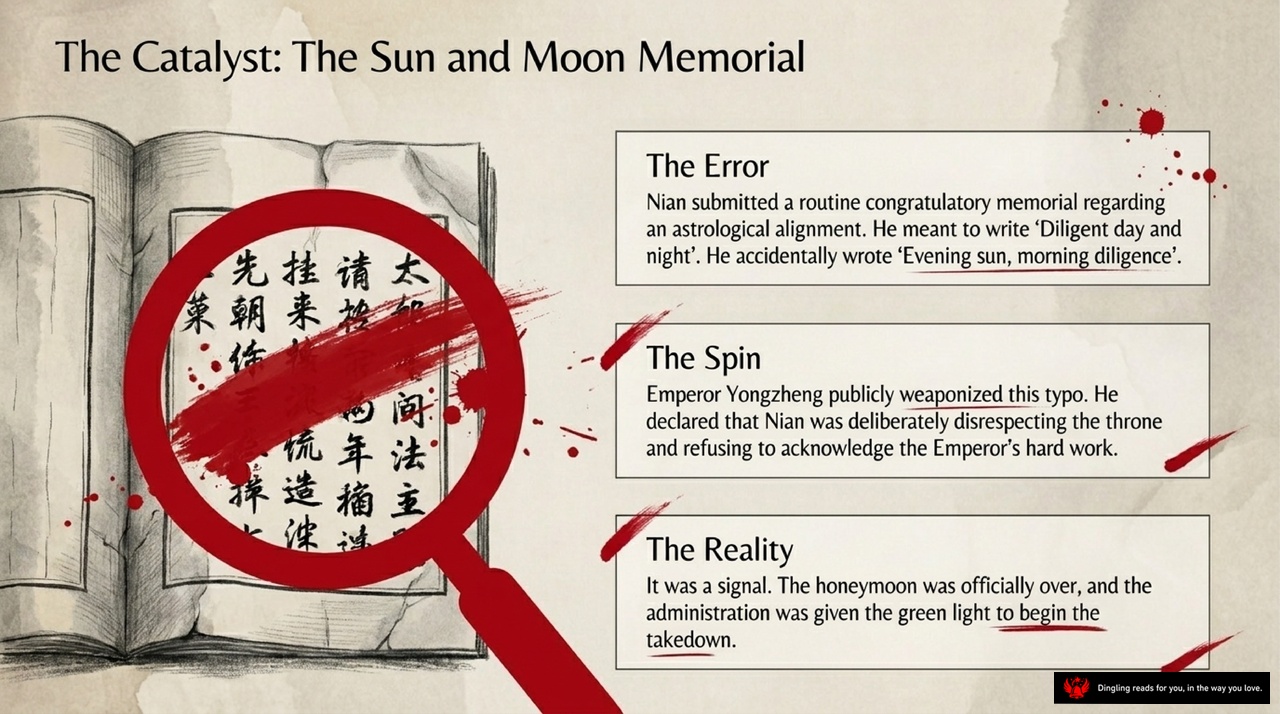
Look at this magnifying glass focusing on a single, fatal typo. It's a powerful metaphor for how one careless mistake can destroy an entire empire.
The slide breaks down the downfall of Nian Gengyao into three critical stages: The Error, The Spin, and The Reality.
First, we have **The Error**. Nian submitted a routine congratulatory memorial regarding an astrological alignment. He meant to write "Diligent day and night." But accidentally, he wrote "Evening sun, morning diligence." It sounds subtle, right? But in the rigid world of court protocol, this wasn't just a typo; it was a glaring insult.
Next is **The Spin**. This is where the tragedy truly accelerates. Emperor Yongzheng publicly weaponized this typo. He declared that Nian was deliberately disrespecting the throne and refusing to acknowledge the Emperor's hard work. Yongzheng didn't see a mistake; he saw treason. He turned a clerical error into a political crime, framing Nian as someone who refused to honor the Emperor's efforts.
Finally, we arrive at **The Reality**. It was never about the typo. It was a signal. The honeymoon was officially over. The administration was given the green light to begin the takedown. Nian Gengyao's greatest achievement—his military brilliance—had become his undoing. That single line of text was the catalyst that triggered the end of a legendary career, proving that in the eyes of absolute power, even a misplaced phrase can be the final straw.

The Emperor's Playbook: Dismantling a Warlord isn't just a title; it's the ruthless strategy Emperor Yongzheng used to neutralize his most powerful general, Nian Gengyao. Think of this not as a military campaign, but as a calculated psychological dismantling, executed in four precise steps.
First, Isolate. Yongzheng didn't rush to fight Nian. Instead, he waged an information war. He secretly messaged regional governors to distance themselves from Nian and appointed spies to surround him. The goal was simple: cut Nian off from his allies so he would be alone in the room.
Second, Transfer. Once isolated, Yongzheng severed Nian's base. He removed him from his military stronghold in Shaanxi and reassigned him to a powerless, yet prestigious post as the Hangzhou General. It was a classic move: give him a title that looked good on paper, but strip him of the real power he needed to survive.
Third, Demote. This was the slow kill. Yongzheng stripped Nian's Duke title step-by-step, effectively killing him with a thousand cuts. He demoted him to an idle banner officer guarding a city gate. Every day, Nian's status dropped lower, his influence evaporated, and his hope faded until he was just a figurehead in a minor role.
Finally, Execute. The Final Strike. With Nian completely powerless and stripped of all authority, Yongzheng sent a specialized envoy in the dead of night to arrest the now-powerless general without a single shot fired. No battle, no bloodshed, just a silent end to a threat that had been carefully, methodically, dismantled piece by piece.

Look at this striking silhouette of a tiger with glowing red eyes. This image captures the chilling climax of a political thriller that unfolded in Beijing in late 1725.
The slide breaks down the "Tiger Incident" into three distinct layers: the event, the spin, and the strategy.
First, **The Event**. In late 1725, Emperor Yongzheng circulated a bizarre rumor: a wild tiger navigated the dense capital, scaled the city walls at midnight, and walked directly into Nian Gengyao's Beijing mansion before being killed.
Second, **The Spin**. Because Nian was rumored to be born under the sign of the White Tiger, Yongzheng framed this unprecedented event as Heaven explicitly demanding Nian's death.
Finally, **The Strategy**. This was a masterclass in psychological warfare. The Emperor masked a cold, calculated political assassination behind the indisputable veil of Heaven's Will.
By transforming a human execution into a divine judgment, Yongzheng turned a personal vendetta into an unassailable act of fate.

The slide in front of us lays bare the terrifying reality of Nian Gengyao's downfall: the fabrication of guilt. Look at this breakdown of the 92 charges stacked against him. It wasn't just about one crime; it was a systematic construction of a monster. The biggest chunk, 18 charges, was corruption and bribery. Then there were 16 for ritual overstepping and 15 for embezzlement. But the most dangerous ones were the political ones: 13 for arrogance, 9 for deception, 5 for treason, and even 4 for cruelty.
The crown jewel of this fabricated guilt was the Heyang Massacre. To paint Nian as a ruthless monster, the court accused him of massacring 805 innocent civilians during a salt-smuggling raid. But here is the chilling truth: historical evidence suggests this number was vastly fabricated to guarantee a death sentence. There was no massacre of 805 people. The number was invented. By inflating the casualty count to a horrific scale, the court created a narrative of unspeakable cruelty that made any mercy impossible. It was a perfect legal trap. With 92 charges and a fabricated massacre, Nian Gengyao's fate was sealed before he even stepped into the courtroom. The emperor didn't need proof; he needed a spectacle, and the numbers provided exactly that.

Look at this stark divide. On the left, "The Condemned": Nian Gengyao was forced to commit suicide, his son Nian Fu was executed immediately, and his other sons were exiled to disease-ridden frontiers. On the right, "The Spared": Nian Xialing and Nian Xiyao were stripped of rank but ultimately pardoned and protected, while Noble Consort Nian, the Emperor's beloved concubine, died of illness just one month before her brother's execution, sparing her the ultimate heartbreak and receiving the highest imperial honors. This isn't just about family loyalty; it's the Emperor's selective mercy. The Emperor decided who lived, who died, and who merely suffered a loss of status. It's a brutal reminder that in this system, your life doesn't belong to you; it belongs to the whims of the ruler.

Nian Gengyao's execution was not merely the punishment of an arrogant warlord, but a structural necessity of autocratic power. Emperor Yongzheng elevated him to an impossible height to secure the throne, only to meticulously dismantle him when his utility transitioned into a systemic threat. The survival of the empire required the death of its greatest savior.
In a system where absolute capability is inherently viewed as absolute treason, can a truly exceptional leader ever safely navigate the corridors of power?
Look at the final verdict: 92 counts of crimes. From political treason to ceremonial arrogance, from abusing the selection of officials to the fabricated "Heyang Massacre" where hundreds of civilians were said to die. These weren't just legal findings; they were a narrative constructed to justify the end. Yongzheng needed to prove that Nian's power was a threat, not an asset. He needed to show the court that even the most loyal general, no matter how brilliant, could become a poison to the state if he grew too big.
This is the cruel logic of the absolute monarchy. When you give someone the keys to the kingdom, you are also giving them the tools to destroy it. Nian Gengyao tried to be a partner, a co-ruler in all but name. But in Yongzheng's eyes, that was the definition of rebellion. The empire didn't need a savior who might one day think he is the master. It needed a servant who knew exactly where his place was.
So, the question remains: in such a system, is there any room for a truly exceptional leader? Or is the moment you become indispensable, also the moment you become expendable? The history of Nian Gengyao suggests that in the corridors of absolute power, there is no safety, only a countdown.