
The Death of Woman Wang: Complete Chapter-by-Chapter Summary

Welcome to a journey into the shadows of 17th-century China. Today, we explore a microhistory of survival, violence, and the erased lives at the margins of a broken world. Our focus is on *The Death of Woman Wang* by Jonathan Spence.
Imagine a vast, desolate landscape of cracked earth and snow, where a lone figure walks away from us, leaving a trail of footprints that eventually turns into blood. This image sets the tone for a story not about heroes, but about ordinary people caught in a cycle of relentless disaster.
From 1622 to the 1670s, the land of Tancheng was a graveyard of hope. Rebellions, famine, bandits, and plague tore through the region. By the time the great earthquake struck in 1668, killing nearly 9,000 people, the population had already been decimated. It wasn't just the earth that broke; it was the social fabric. Families were torn apart, and trust evaporated.
In this crucible of suffering, women like Woman Wang faced impossible choices. The official records of the time were obsessed with "chastity" and "martyrdom," celebrating women who starved themselves or killed themselves to avoid remarriage. But the reality was far darker. For many, like Wang, there was no glory in death, only a desperate struggle for survival in a world that offered them nothing but silence and violence.
This book peels back the layers of history to show us the true cost of empire, revealing the lives that were written out of the official narrative. It is a haunting reminder of how quickly life can be extinguished when the world turns against you.

Look at this funnel. It tells the tragic story of Tancheng County, a place that existed right at the nexus of ruin. The top layer, labeled "Macro & Nature," shows the first blow: the 1668 earthquake that killed nearly 9,000 people, plus earlier locust plagues and relentless floods from the Li and Shu rivers. These weren't isolated events; they were a relentless squeeze on the land.
Below that, the "State Demands" layer reveals the human-made pressure. The government imposed crushing taxation and forced corvée labor, sending people to Beijing and the Grand Canal. They took everything the county had left. The bottom section, "Local Violence," adds the final layer of destruction: the 1643 Manchu slaughter and constant bandit raids from the surrounding mountains.
Under this relentless pressure, the marginalized had no safety net. Natural and political disasters simply squeezed the county dry. The result is starkly shown in the final data point: the peasantry. Tancheng's population plummeted from over 200,000 to just 60,000. In a single century, the county was hollowed out, leaving behind a landscape of ruins and a people with no future.

Reconstructing Voiceless Lives Requires Multiple Lenses. To truly understand the undocumented life of a woman like Wang, we cannot rely on a single perspective. We must look through three distinct lenses: the Local Historian, the Magistrate, and the Writer.
First, consider the Local Historian, Feng K'o-ts'an. His work, *The Gazetteer*, offers a top-down view. It focuses on elite bias, macro-facts, and chronologies of disasters. It meticulously lists "chaste" women, framing their suffering within a narrative of moral triumph rather than human tragedy. It tells us what the state remembers, but it often silences the individual voice behind the statistic.
Next, we shift to the Magistrate, Huang Liu-hung. His legal memoirs provide a different angle, grounded in bureaucratic reality. Here, we see the focus on taxation struggles, legal constraints, and the maintenance of order. The magistrate sees the chaos through the lens of law and revenue. He is concerned with the mechanics of governance—how to collect taxes, how to suppress bandits, and how to enforce the laws that often crush the very people they are meant to protect.
Finally, we turn to the Writer, P'u Sung-ling. His fantastical tales offer a glimpse into the mythic truths and interior lives that official records ignore. This lens reveals the unfulfilled desires and the psychology of the oppressed. It captures the fear, the desperation, and the hidden resilience that never made it into the court records or the gazetteers.
By looking at the negative space between these official records, legal constraints, and folklore, the undocumented life of Woman Wang emerges. Only by weaving these three narratives together can we begin to see the full, complex reality of her existence.

Look at this diagram: "The Inescapable Weight of the Land." It shows a vicious cycle crushing the farmers of Tancheng. It starts with "Unyielding Quotas"—the government demanded taxes eighteen times a year. Because the land was already ruined, officials couldn't get enough money, so they forced the few remaining farmers to pay even more. That's the "Concentrated Burden."
This pressure pushed farmers into "Flight and Abandonment." Many fled their land or starved. But this didn't stop the cycle. It fueled "Systemic Corruption." Silver-melters cheated farmers on their payments, and rich landlords hid their land to shift the tax burden onto the poor. The system was designed for an ideal empire, not a devastated county. The burden always rolled downhill, crushing the poorest first.
This isn't just about bad luck. It's a trap. When you are trapped in a system designed to extract everything you have, even trying to survive makes you pay more. That is the inescapable weight of the land.

Look at this flowchart. It exposes a brutal legal trap that destroyed women's lives in Qing China. When a husband died, a widow faced a terrifying choice: remarry or stay faithful. If she chose to remarry, the Qing Penal Code stripped her of everything—her property and dowry vanished, transferred entirely to her husband's clan. But if she chose to stay faithful, like Widow Peng, she didn't find safety. Instead, she became prey. Her male relatives, like the Chen brothers, would use the law to seize her estate. And in the most extreme cases, as the red box shows, they would resort to violence. To secure inheritance, nephews murdered widows' young sons right in front of them, even in broad daylight at a local temple. The law, designed to promote chastity, actually incentivized exploitation, abuse, and murder. It systematically denied women any physical or financial agency, turning their survival into a fight against their own family.

Look at this slide. It tells a chilling story about how, in a place like Tancheng, the law wasn't a shield for the weak—it was just a weapon for the strong.
The story starts with a tiny, almost insignificant dispute: The Li family's pigs wandered into the Wang family's fields. A minor agrarian dispute. But in this vacuum of state power, that small provocation triggered a brutal retaliation. The warlord Wang San and his son executed a midnight raid, slaughtering four members of the Li family in their courtyard.
Then, look at the bottom. This is the Impotence of the State. Wang San walks into the court to "guarantee" a false suspect, completely untouched by the law. It was only because Magistrate Huang orchestrated a secret, extra-jurisdictional military ambush that Wang San was ever brought to justice.
In Tancheng, survival relied on clan strength. The law was merely a weapon for the strong and a trap for the weak. Without a powerful official like Magistrate Huang stepping in, the cycle of violence would have continued unchecked, leaving the vulnerable with no hope of justice.

When reality becomes unbearable, the marginalized don't just suffer—they turn to myth. This slide captures a profound truth: folklore was never just entertainment for the powerless; it was a shadow-world where they could finally exert control. On the left, we see "The Reality"—a crushing wall of famine, rigid social hierarchies, inescapable poverty, and brutal gender roles that defined life in 17th-century China. There was no escape in the physical world. But look at the right side: "The Escape." Here, P'u Sung-ling's tales provided a vital psychological agency. In these stories, women weren't victims; they were active agents. They exacted revenge through magic, outsmarted corrupt officials, and found love outside the suffocating bounds of arranged marriages. The image of the fox leaping through the crack perfectly symbolizes this transition. Folklore became the mechanism for the powerless to finally exert control, offering a sanctuary where the impossible became possible.

Look at this map. It shows the impossible geography Woman Wang faced when she tried to run away. On the right, she had one option: flee as a fugitive, which meant 100 blows of bamboo or death. On the left, her only other choice was adultery, punishable by 100 blows or death. There was no safe path.
As the text explains, she lacked money, was bound by foot-binding, and was completely shut out from the labor market. With no clan protection or independent wealth, her rebellion was doomed from the start. When she had no money left, she was forced to take refuge in a local temple, only to eventually return to her husband's mud hut. Running away wasn't just a moral failing; it was a capital offense. In this landscape of strict law and poverty, every choice led to the same tragic end.

Imagine a world split in two. On one side, you see a palace floating in the clouds, adorned with lotus flowers and ghostly ships drifting on soft silk. It is a place of gentle lovers and impossible beauty. But on the other side, the reality is brutally stark: a freezing mud hut, a woven grass mat, and a husband named Jen strangling her as his knee crushes her abdomen.
This is the final dream of a woman crushed by the physical world. As the earthquake and the years of famine, war, and banditry tore apart her life, her mind retreated into this sensory-rich escape. It wasn't just a fantasy; it was a necessary survival mechanism. When the real world offered only death and despair, her consciousness built a sanctuary of light and peace. This haunting contrast—the terrible reality of her death versus the serene beauty of her last dream—captures the ultimate tragedy of her existence. In the end, the only place she could truly be free was in a dream she could never wake from.
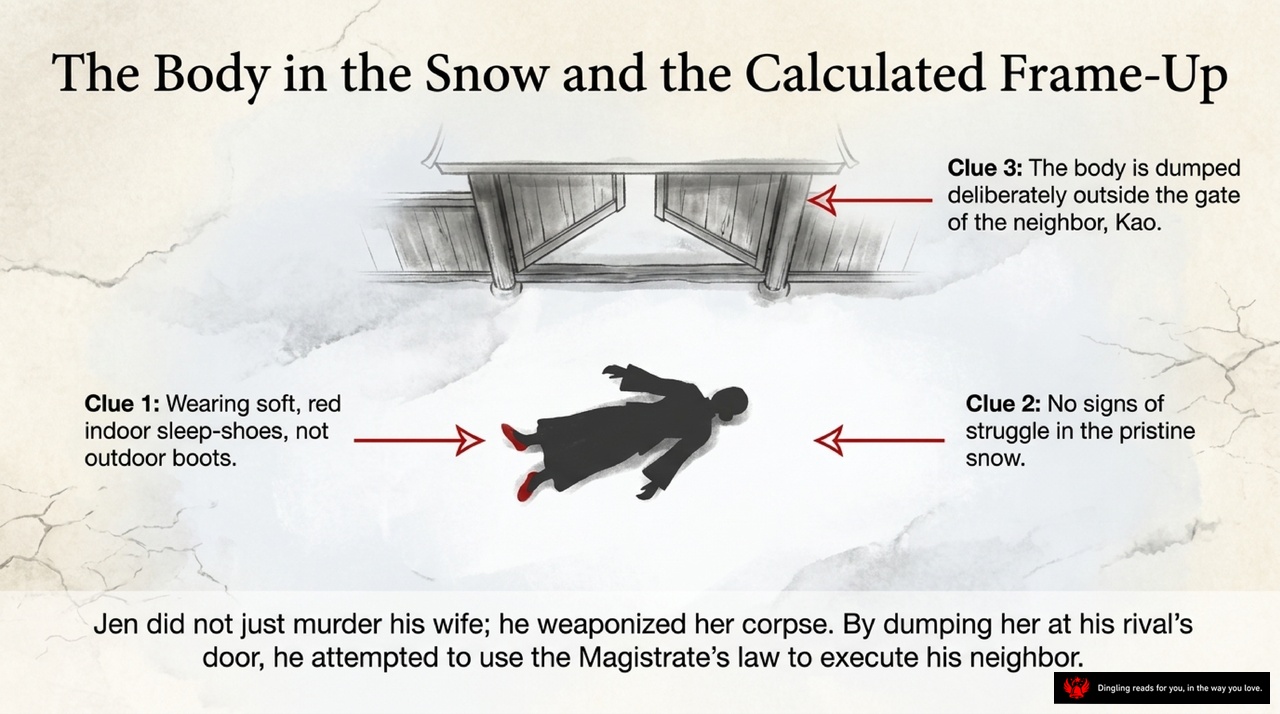
Picture this: a body lying motionless in the snow, dressed in soft red indoor slippers, not the sturdy boots one would wear outside. No signs of a struggle mar the pristine white ground. The scene is staged, calculated, and chillingly deliberate.
This isn't just a murder; it's a weaponized crime. Jen didn't just kill his wife; he used her corpse to frame his neighbor, Kao. By dumping the body right outside Kao's gate, Jen was playing a deadly game with the law. He knew that under the Magistrate's rules, a woman found dead in another man's yard could be presumed to have committed adultery and been killed by her husband.
In this twisted logic, Jen could use his wife's death to execute Kao. He turned the snow into a trap and the law into his weapon. It's a masterclass in manipulation, where the body itself becomes the evidence needed to destroy an innocent man.
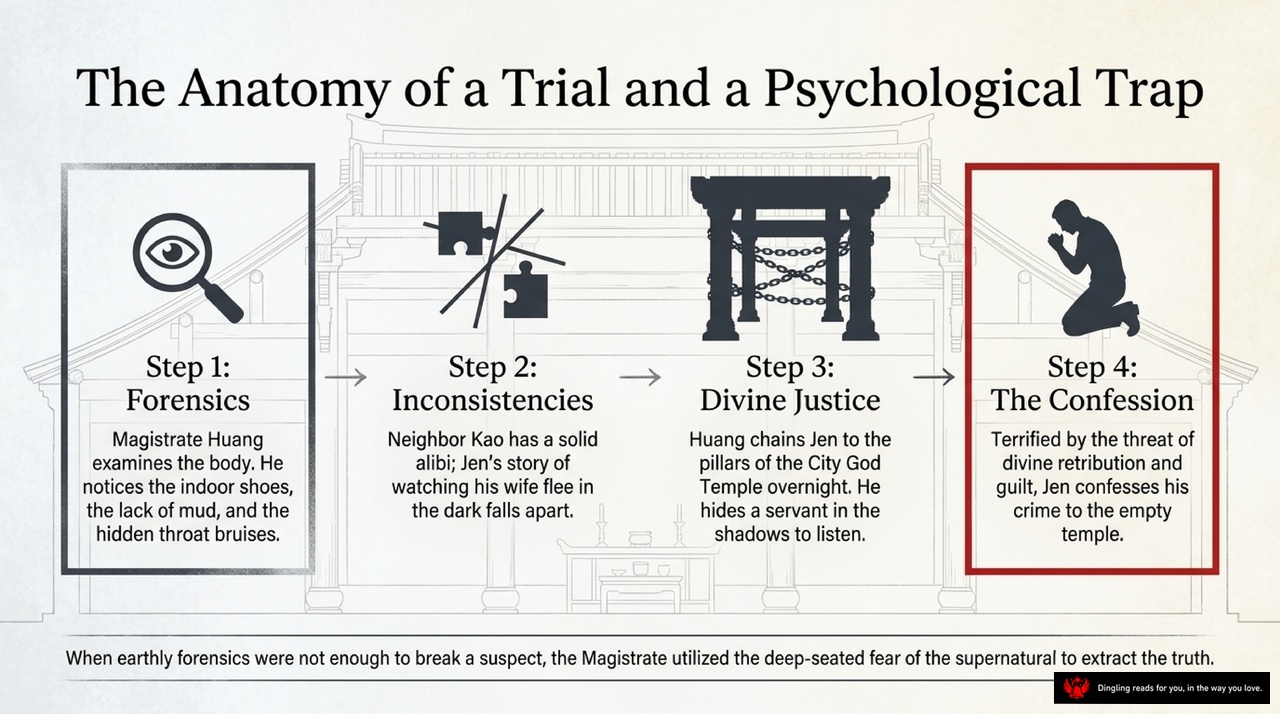
Look at this slide: "The Anatomy of a Trial and a Psychological Trap." It maps out exactly how Magistrate Huang cracked a case that earthy evidence alone couldn't solve.
The process starts with Step 1: Forensics. Huang doesn't just guess; he investigates. He notices indoor shoes where there should be mud, finds no mud on the floor, and spots hidden throat bruises. These physical clues tell a story that contradicts the suspect's version of events.
But when the physical evidence hits a wall, Huang moves to Step 2: Inconsistencies. He finds that Neighbor Kao has a solid alibi, which shatters Jen's story of watching his wife flee in the dark. The puzzle pieces simply don't fit together anymore.
Since logic failed, Huang shifts to Step 3: Divine Justice. He chains Jen to the pillars of the City God Temple and hides a servant in the shadows to listen. He isn't just punishing him; he is using the deep-seated fear of the supernatural to break his spirit.
Finally, we reach Step 4: The Confession. Terrified by the threat of divine retribution and crushed by guilt, Jen confesses his crime to an empty temple. This slide illustrates a powerful truth: when earthly forensics aren't enough, the Magistrate utilized the fear of the unknown to extract the truth.
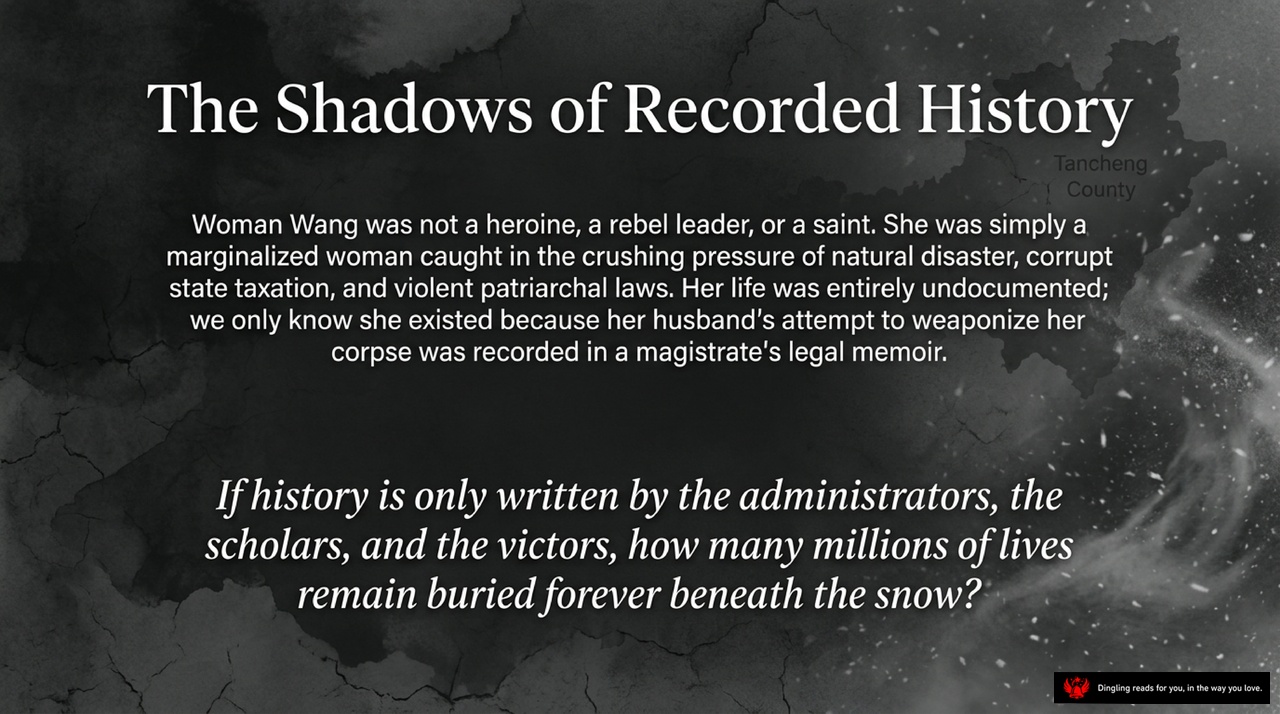
Look at the map behind us, pointing to Tancheng County. This slide asks a haunting question: "If history is only written by the administrators, the scholars, and the victors, how many millions of lives remain buried forever beneath the snow?"
This isn't just a rhetorical device; it's the tragic reality of Wang's story. As the text reminds us, she was not a heroine, a rebel leader, or a saint. She was simply a marginalized woman crushed by natural disaster, corrupt taxation, and violent patriarchal laws. Her entire life was undocumented. We only know she existed because her husband's attempt to weaponize her corpse was recorded in a magistrate's legal memoir.
In a society where official history is controlled by the state, ordinary women like Wang vanish into silence. Their struggles, their deaths, and their humanity are erased unless someone with power chooses to record them. When we look at the archives, we often see only the actions of the rulers, not the suffering of the ruled. This slide challenges us to consider the vast, invisible millions whose stories were lost because they were never deemed worthy of being written down. History, as traditionally recorded, is a selective memory that often forgets the most vulnerable among us.