
The Demon-Haunted World: Complete Chapter-by-Chapter Summary
Welcome to *The Demon-Haunted World* by Carl Sagan, a timeless masterclass on critical thinking. In a world where pseudoscience and superstition are constantly encroaching on our lives, this book stands as a powerful defense of scientific truth. Sagan argues that we must fiercely protect the light of reason against the darkness of unproven claims.
He begins by highlighting a startling reality: a vast majority of people lack basic scientific literacy, often mistaking fantasy for fact. From ancient myths about moon faces to modern conspiracy theories about alien abductions, our brains are wired to see patterns where none exist. This book equips us with the tools to see through these illusions, teaching us that true knowledge comes from evidence, rigorous testing, and a healthy dose of skepticism.
Ultimately, Sagan reminds us that science isn't just a collection of facts; it's a way of thinking. It is the most reliable tool we have to understand our universe, defend our freedom, and navigate a complex world. Whether you're a scientist or just curious about how things work, this is an essential guide to keeping your mind clear and your judgment sharp.

For most of history, we have feared the dark. We are naturally predisposed to accept any explanation that reduces our terror of the unknown. This slide breaks down exactly why that fear persists.
First, look at the top: **The Gathering Darkness**. Historically, humanity feared the dark and the unpredictable forces of nature. That primal fear is still with us.
But why do we see patterns where there are none? That's our **Pattern-Seeking Brains**. Evolution hardwired us to find meaning, leading to pareidolia—seeing faces in random noise. Whether it's a moon crater or a cloud formation, our brain insists there's a face there. We are tricked by our own biology.
And then there is **Cosmic Significance**. We have a deep emotional desire to be at the center of the universe. This need for meaning makes us vulnerable to stories that place us in a special role, even when the evidence doesn't support it.
The scary truth at the bottom is this: we are so afraid of the unknown that we will happily embrace any explanation that makes us feel safe, even if it's a lie. We prefer a comforting myth over a terrifying mystery. Understanding these three drivers—fear, pattern-seeking, and the need for significance—is the first step to seeing through the illusions that hold us back.
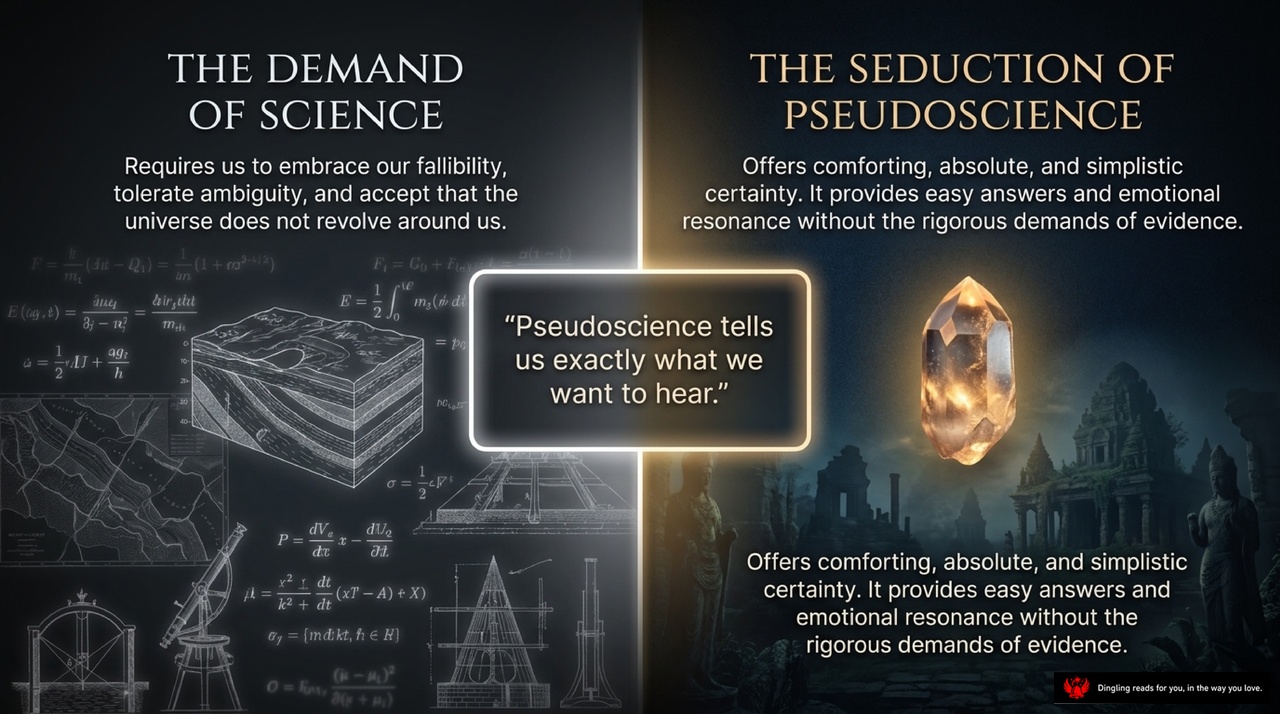
Imagine a world where the Moon isn't a cratered rock, but a giant face staring down at us, or where the red planet is crisscrossed with canals built by an ancient, dying civilization. For centuries, these weren't just stories; they were "facts" that shaped how we saw the universe. But here's the twist: these weren't discoveries. They were optical illusions born from our own brains.
Our minds are wired to find patterns, especially faces, even in clouds or craters. That's why we saw a man's face on the Moon or a giant potato that looked like Nixon on a mountain in New Hampshire. But when we look closer with real data, the truth is far stranger and far more mundane. The "canals" on Mars? They were just trick of the light through the atmosphere. The "face" on Mars that supposedly proved an alien civilization? It was just a rock, and when the signal failed, the shadow created a nose that wasn't there.
And then there's the story of the "face" on Mars that everyone thought was a temple. It was a hill, and when the photo quality dropped, a dark spot looked like a nostril. Suddenly, a mountain became a monster. These aren't signs of extraterrestrial life; they are signs of human imagination running wild.
Even our most famous "aliens" are products of our own pop culture. The couple in New Hampshire who claimed they were abducted by little grey men? Their description of the aliens looked exactly like the monsters from the TV shows they were watching at the time. Their "abduction" was a shared fantasy, a modern echo of ancient hallucinations where people saw demons or spirits. We aren't being visited by beings from other worlds; we are being visited by our own desires and fears, projected onto the dark sky.
The lesson is clear: just because something looks real to us doesn't mean it is. We need to trust evidence over our eyes, and skepticism over our stories.
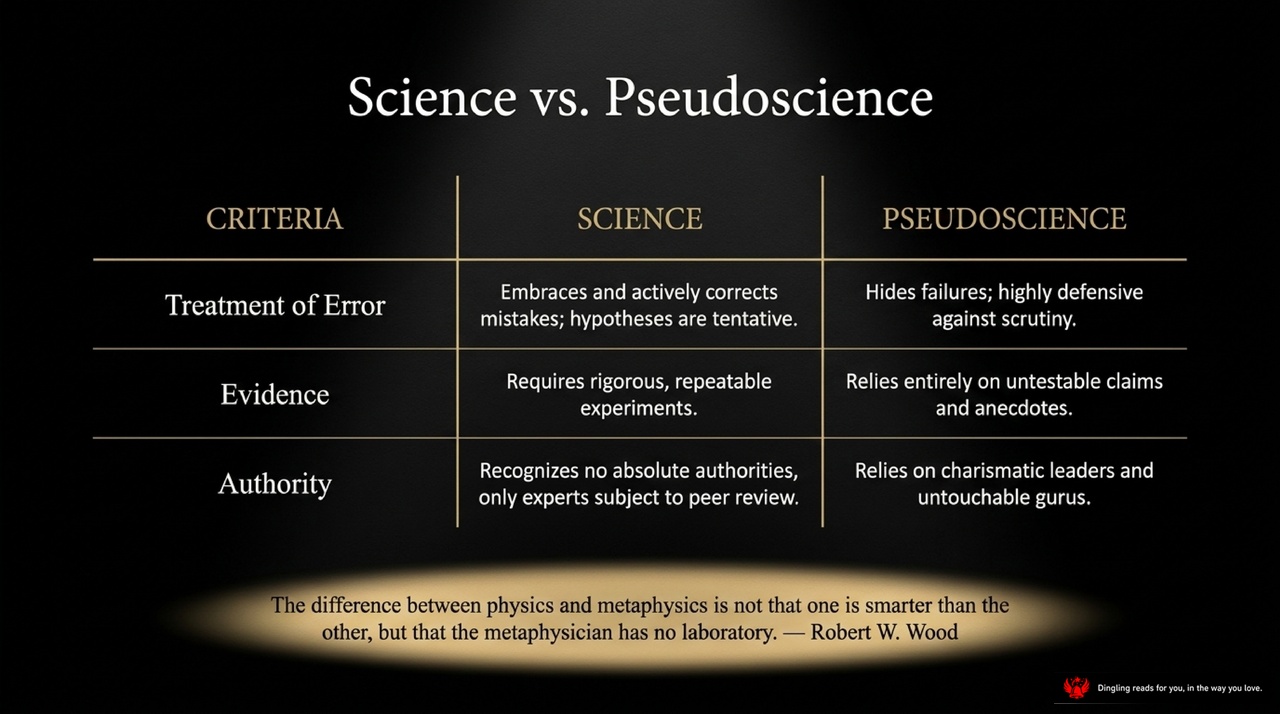
So, how do we actually tell the difference between real science and the stuff that just pretends to be it? The slide breaks it down into three simple but powerful tests.
First, look at how they handle mistakes. Real science embraces them. It treats errors as stepping stones, actively correcting them and keeping its ideas tentative. Pseudoscience? It hides failures and gets incredibly defensive whenever you try to ask questions.
Second, check the evidence. Science demands rigorous, repeatable experiments. If you can't replicate it, it's not science. Pseudscience, on the other hand, relies entirely on untestable claims and personal anecdotes. It's all about "feeling" right rather than proving it right.
Finally, look at who they trust. Science recognizes no absolute authorities. It only respects experts who are willing to be checked by their peers. Pseudoscience relies on charismatic leaders and untouchable gurus who say, "Just believe me."
As Robert W. Wood famously said, the difference between physics and metaphysics isn't that one is smarter than the other; it's that the metaphysician has no laboratory. Without a place to test their ideas, they can't prove them. So, the next time you hear a bold claim, ask yourself: Are they in a lab, or just in a story?

The Anatomy of a Myth isn't just a catchy title; it's a roadmap of how reality gets hijacked. We start with an Innocent Anomaly—something as mundane as a shadow in a Martian crater or a strange pattern in an English wheat field. But here's where the trap springs shut: our brains are wired for Pattern Recognition. We have pareidolia, a biological glitch that forces us to see faces and messages in random noise. That's how a random shadow becomes an alien face, and a crop circle becomes a coded message.
Once that image sticks, Media Escalation takes over. Tabloids and uncritical news outlets exploit the anomaly for profit, aggressively suppressing mundane explanations while feeding the public's hunger for the extraordinary. Finally, we reach Cult Solidification. At this stage, believers invest emotionally in their new worldview. They reject confessions of hoaxes and attack skeptics, not out of logic, but to protect their newfound identity. This four-step process transforms a simple optical illusion into an unshakeable belief system, proving that the most dangerous myths aren't the ones we invent, but the ones we choose to ignore.

The magic of science lies in one simple, yet powerful rule: the ability to be proven wrong. Think about it this way. If I told you there was a invisible, floating, fire-breathing dragon in my garage, and you asked me to sprinkle flour to catch the dust, or use an infrared scanner to find the heat, or paint it so we could see it, and I simply replied, "No, the dragon is invisible, it floats without support, and the fire it breathes has no temperature," then you would immediately realize something crucial: that dragon and the one that doesn't exist are exactly the same. You cannot test it, therefore it has no value.
This is the exact trap that believers in alien abduction stories fall into. They claim millions of Americans have been hijacked by aliens, yet they cannot produce any hard evidence. There are no clear video recordings, no medical reports showing missing fetuses, and so-called implants are often just common earthly substances like cotton fibers or secretions. Even when people point to scars or indentations as proof, they lack independent medical verification, and some have later admitted the whole event was fabricated.
Consider the case of a nuclear physicist named Aaron who claimed he could time travel in a spaceship. His therapist, Linna, initially tried to guide him back to reality but eventually got lost in the man's fantasy until Aaron himself admitted the story was made up. This highlights a critical distinction: scientific exploration, like searching for extraterrestrial intelligence through radio waves, relies on rigorous, repeatable logic. We must exhaust all natural explanations before attributing signals to aliens. In contrast, abduction narratives are often products of illusion, fantasy, or deliberate deception. Until we have undeniable scientific proof, we must remain rational and refuse to confuse our wildest fantasies with reality.

Imagine a claim so absurd it borders on the impossible: "There is a fire-breathing dragon in my garage." Now, here's the twist. I tell you it's invisible, so no camera can see it. Its fire is heatless, so thermal sensors will read nothing. And it's incorporeal, meaning you can't touch it or paint it. If you try to prove it exists, I simply invent a new excuse to explain away every failed test.
This is the essence of the "Dragon in the Garage." It is the perfect metaphor for pseudoscience. When a claim is constructed so that every physical test proposed to prove its existence is rejected by a special excuse, what is the difference between that invisible, untestable dragon and no dragon at all? The answer is none.
This brings us to a core principle of real science: a claim that cannot be tested or falsified is practically worthless. True science demands that we can observe, measure, and verify. It rewards those who challenge existing ideas and punishes those who cling to dogma. Pseudoscience does the opposite; it protects its illusions by making them immune to criticism. Whether it's ancient myths of witches or modern tales of alien abductions, if a story cannot be proven or disproven through evidence, it remains a fantasy, not a fact. We must learn to spot these untestable dragons before they swallow our rationality whole.

The Baloney Detection Kit isn't just a fancy title; it's your personal shield against misinformation. Think of it as a five-tool set for separating fact from fiction, designed to help you navigate a world flooded with claims that sound too good to be true.
First up is Independent Confirmation. This is the golden rule: if a fact can't be verified by an independent, third-party observer, it's likely just a story. Don't take someone's word for it; let the data speak for itself.
Next, embrace Multiple Hypotheses. We all have a natural tendency to fall in love with our first idea, but that's where bias creeps in. Always ask yourself, "What else could explain this?" Explore every possible explanation before settling on one.
Then, we have Quantification. Vague concepts like "a little bit" or "maybe" are the breeding ground for self-deception. If you can't measure it, you can't really know it. Turn qualitative guesses into quantitative data to cut through the noise.
When you have two competing explanations that fit the data equally well, apply Occam's Razor. Go with the simpler one. The universe doesn't need extra complexity to make things work; the most straightforward explanation is usually the right one.
Finally, never forget Falsifiability. This is the ultimate litmus test for science. If a claim cannot be proven wrong, it cannot be proven right either. Real science welcomes the possibility of being disproven; if a theory is immune to criticism, it's not science—it's just belief.
By using these five tools, you stop being a passive consumer of information and start being an active investigator of reality.
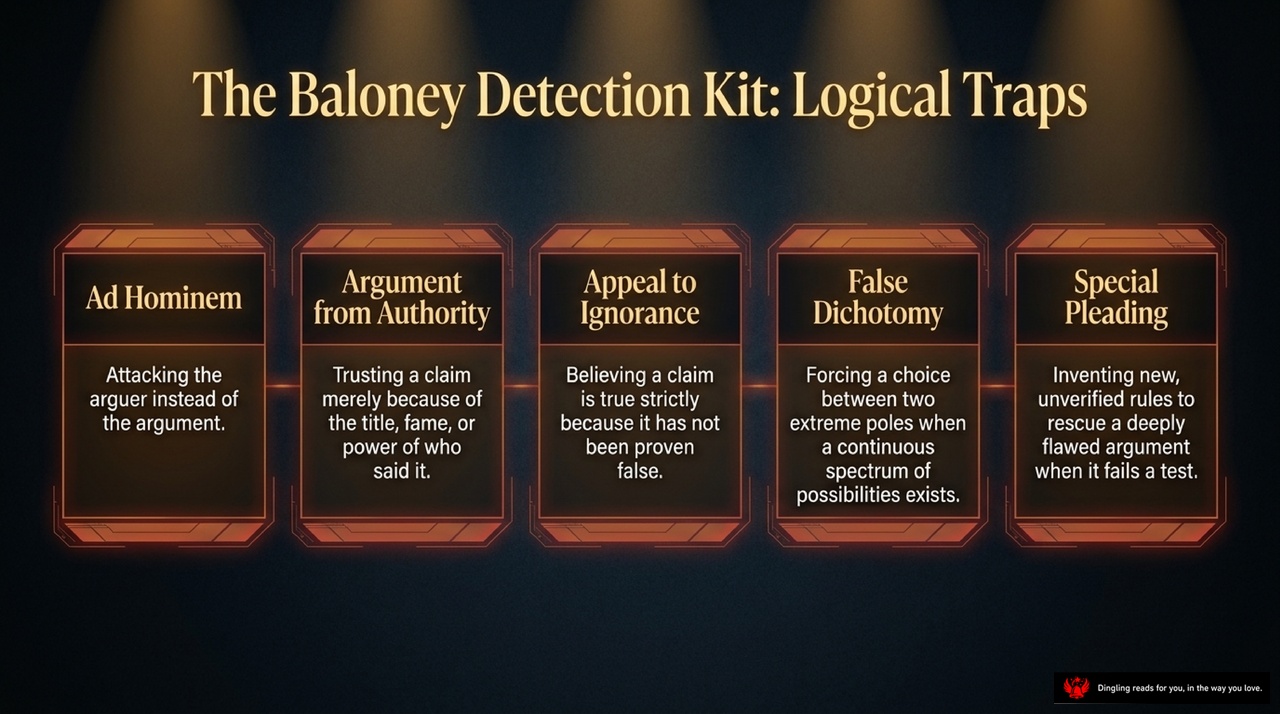
Welcome back to our deep dive into *The Demon-Haunted World*. Today, we're pulling out the tools from our very own "Baloney Detection Kit" to spot the logical traps that keep us trapped in pseudoscience.
Look at these five boxes on the screen. These are the most common ways our brains trick ourselves into believing nonsense.
First, let's talk about **Ad Hominem**. This is when we attack the person making the argument instead of the argument itself. It's a classic move: "You can't be right because you're not an expert," or "I hate him, so his ideas must be wrong." But in science, the truth doesn't care who you are. We need to evaluate the evidence, not the ego.
Next, we have the **Argument from Authority**. Just because someone is famous, wealthy, or holds a high title doesn't make them right. History is full of experts who were wrong. If a claim lacks solid proof, trusting it just because a celebrity said it is a dangerous shortcut.
Then there's **Appeal to Ignorance**. This is the logic that says, "It must be true because we haven't proven it false yet." But absence of evidence is not evidence of absence. Just because we can't disprove the existence of a unicorn or an alien abduction doesn't mean it exists. We need positive proof, not just a lack of disproof.
The fourth trap is **False Dichotomy**. This forces us into a corner by presenting only two extreme options when reality is actually a spectrum. It's like saying, "You're either with us, or you're the enemy." In science, there are rarely black-and-white answers. There are shades of gray, and acknowledging complexity is crucial.
Finally, we have **Special Pleading**. This happens when someone invents new, unverified rules just to save a flawed argument from being disproven. If their theory fails a test, instead of admitting they are wrong, they create a new exception to protect their ego.
Mastering these five traps is the first step to thinking clearly. It's about resisting the urge to believe what feels good and instead demanding what is true.
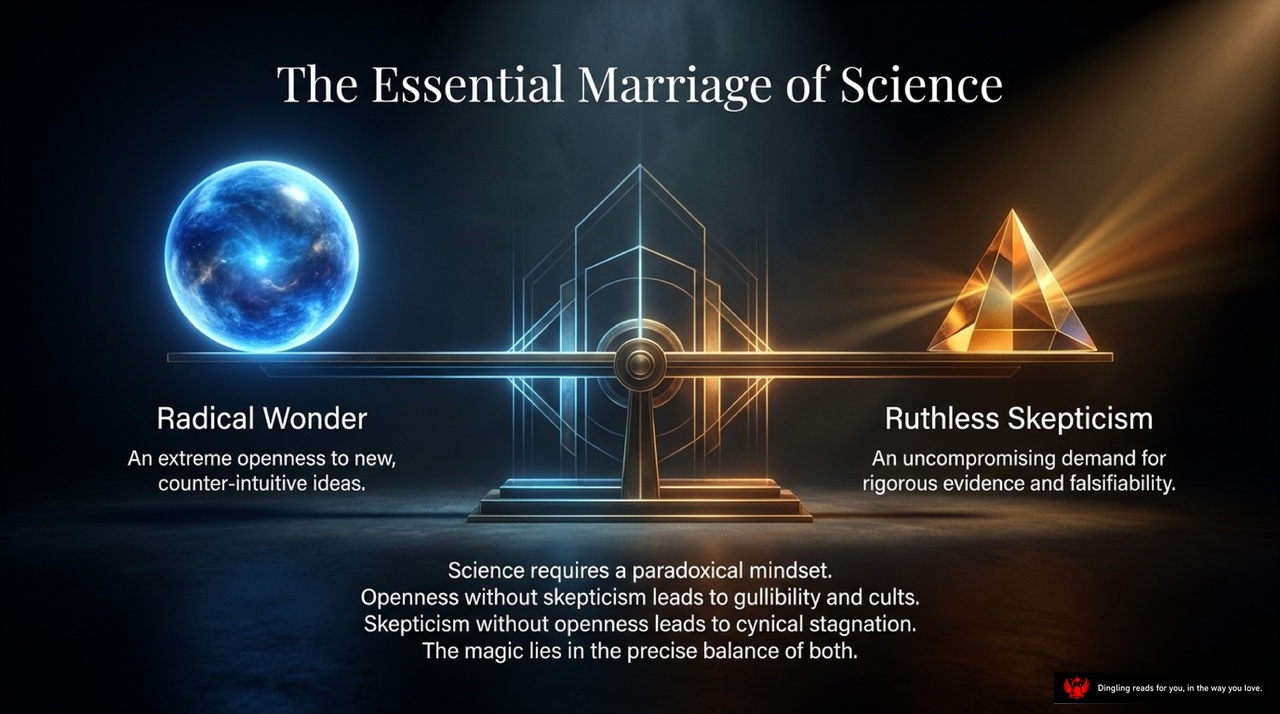
Imagine a seesaw balancing two opposing forces: on one side, a glowing blue sphere representing Radical Wonder—an extreme openness to new, counter-intuitive ideas. On the other, a sharp golden pyramid symbolizing Ruthless Skepticism, demanding rigorous evidence and falsifiability. This isn't just a metaphor; it's the essential marriage of science.
As the slide explains, science requires a paradoxical mindset. If you have openness without skepticism, you fall into gullibility and cults. But if you have skepticism without openness, you end up in cynical stagnation. The magic lies in the precise balance of both.
Think about it this way: Radical Wonder is what allows us to entertain the impossible, to look at the stars and wonder if we are alone. But Ruthless Skepticism is the brake that stops us from jumping into that chasm without a parachute. It forces us to ask, "What is the evidence?" and "Can this be proven wrong?"
Without this delicate equilibrium, we lose our way. We either become blind followers of every new fad or hardened cynics who refuse to believe anything, even when the truth is right in front of us. True scientific thinking isn't about choosing one over the other; it's about holding both in tension. It's about being brave enough to imagine the extraordinary, yet disciplined enough to demand the extraordinary proof. This is the only way we navigate a world full of uncertainty without getting lost in fiction.

Imagine a classroom that is dimly lit, where the only source of illumination is a single spotlight cutting through the darkness. In this scene, two starkly different lines tell a terrifying story about our modern world. One line, glowing with a brilliant, aggressive gold, shoots upward into the sky. It represents our "Technological Dependence"—society's exquisite reliance on complex science and technology. We have built a civilization that runs entirely on these forces, from the apps in our pockets to the power grids keeping our cities alive.
Yet, look at the second line. It is a flat, gray, horizontal line stretching across the room. This represents our "Scientific Literacy." The text beside it delivers a sobering statistic: 95% of Americans lack basic scientific literacy. This isn't just a gap; it's a chasm. We are climbing a ladder of technological complexity while standing on a floor of ignorance.
The quote at the bottom of the screen captures the gravity of this disconnect perfectly: "We live in a society exquisitely dependent on science and technology, in which hardly anyone knows anything about science and technology. This is a prescription for disaster."
Think about what that means for your daily life. You use GPS to navigate, you trust vaccines to keep your family safe, and you rely on weather forecasts to plan your week. But if you don't understand the basic principles of how these things work, how do you know when to trust them? How do you spot when they are being manipulated or when they are being misused?
This is the core of the educational crisis we face today. We have handed the keys to a nuclear reactor to someone who has never learned physics. We have placed the steering wheel of our economy in the hands of those who don't understand statistics. When we separate our daily lives from the understanding of the forces that drive them, we don't just risk making mistakes; we risk catastrophe. The graph shows us the danger clearly: as our dependence grows, our ability to understand what we depend on shrinks to zero. To survive in this world, we can't just be users of technology; we must become students of the science behind it.

Literacy as the Path to Freedom. Look at the image on the screen: Frederick Douglass illuminated by a beam of light, standing over a tablet glowing with scientific data. This visual perfectly captures the central thesis of our discussion today—the bridge between historical liberation and modern intellectual freedom.
On the left, we see "The Historical Truth." Frederick Douglass realized that literacy was the literal pathway from slavery to freedom. He understood that to keep people enslaved, masters had to keep them ignorant. Without the ability to read and think critically, the mind remains trapped.
Now, look to the right at "The Modern Imperative." The lesson hasn't changed, only the tools have. Today, scientific literacy is our modern intellectual freedom. Without the ability to think critically and demand evidence, citizens are easily enslaved by charlatans, corporate greed, and tyrannical politicians. Just as masters used illiteracy to control the past, today's misinformation campaigns use a lack of scientific understanding to control the present.
The image shows Douglass looking out with a determined gaze, while the tablet beneath him represents the new frontier of knowledge. We are no longer fighting for the right to read; we are fighting for the right to understand reality. In an age where fake science and conspiracy theories thrive, the only way to break free is to master the scientific method. We must demand evidence, question authority, and refuse to accept claims that cannot be verified. Because just as Douglass found his freedom in the written word, we find our freedom in the power of critical thinking and scientific truth.

Let's talk about the difference between a collection of facts and a way of thinking. As this slide reminds us, science isn't just a static body of facts; it is a vital defense mechanism against superstition, manipulation, and tyranny. It is the essential tool we need to protect the flame of reason as we face a complex future.
But why do we struggle to use this tool? The text reveals that our brains are wired to see patterns where none exist. We are prone to cognitive illusions, like seeing a face on the moon or interpreting random geological formations on Mars as evidence of alien civilization. These aren't just silly mistakes; they are the very traps that pseudoscience sets. When we ignore the rigorous, self-correcting nature of science—the idea that a claim must be testable and falsifiable—we open the door to deception.
Consider the "abduction" stories. Many are not encounters with extraterrestrials, but rather shared hallucinations or false memories implanted by suggestion. Just as a hypnotized person can recall a fake childhood trauma with absolute conviction, people can be convinced of alien invasions without any physical evidence. The text points out that these narratives often mirror ancient fears of demons and witchcraft, simply updated for a modern age.
The real danger isn't just believing in ghosts; it's losing the ability to distinguish truth from fantasy. When we surrender to the "darkness" of unverified claims, we lose our power to navigate reality. We must arm ourselves with skepticism. We need to demand evidence, question authority, and understand that the most powerful tool we have is not a spaceship, but a clear, rational mind. Only by mastering the scientific method can we ensure that when the "demons" return, we are ready to protect ourselves with the light of reason.