
The Dictator's Handbook: Complete Chapter-by-Chapter Summary

Welcome to the world of *The Dictator's Handbook*. Forget everything you've been told about democracy versus dictatorship. The truth is far more unsettling: bad behavior is almost always good politics.
Look at the graphic on the right. That central black diamond represents the leader. The red dots surrounding it are the "winning coalition"—the tiny group of people whose support is absolutely essential for the leader to stay in power. Everything else, the gray dots, are everyone else.
The core argument of this book is simple yet radical: a leader's primary goal isn't to make you happy or to run a successful country. Their only goal is to survive. To do that, they must keep their winning coalition small and loyal. If that group gets too big, the cost of bribing them becomes too high, and the leader falls.
This logic explains why dictators often act so cruelly. They don't care about the suffering of the masses; they only care about feeding their inner circle. If the leader starts acting "bad"—by looting resources, suppressing protests, or ignoring public needs—it's actually a rational strategy to maintain power. In fact, doing the "right thing" for the public often threatens the leader's position, because it might empower the very people they need to keep in check.
So, why do bad leaders stay in power so long? And why do good leaders often fail? The answer lies in this hidden logic of political survival. We aren't just looking at who is in charge; we are looking at the mathematical incentives that force leaders to make the choices they make. This isn't about morality; it's about the cold, hard rules of power that govern every organization, from nations to corporations.
In the pages that follow, we will uncover these rules, show you how they apply to the real world, and explain why the world often looks the way it does. We'll see that what we call "democracy" and "dictatorship" are often just different ways of managing the same fundamental problem: how to keep the few in charge happy enough to not kick the leader out.
This book will change how you see the news, the history you learned in school, and the leaders you follow. It's time to stop asking what leaders *should* do, and start understanding why they *actually* do what they do. Welcome to the hidden logic of political survival.
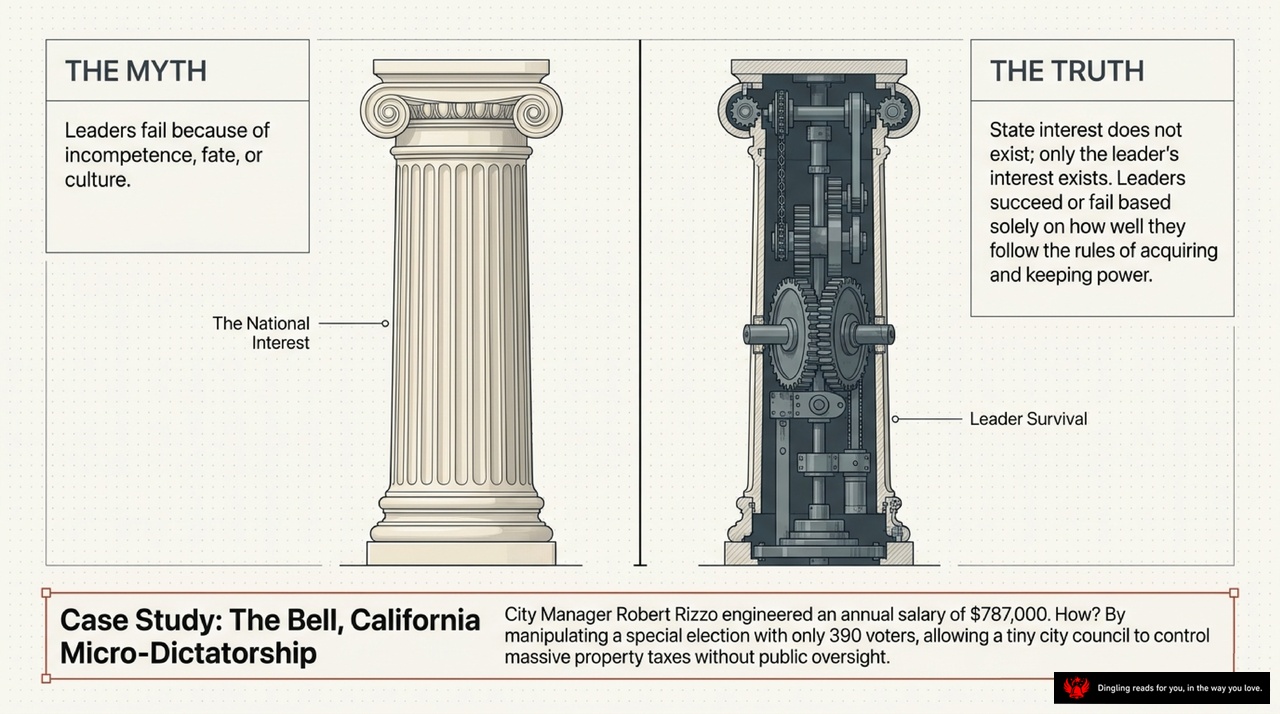
Look at this slide. On the left, we see "The Myth": the idea that leaders fail simply because they are incompetent, unlucky, or stuck with a bad culture. It paints a picture of a noble pillar representing "The National Interest," suggesting leaders serve the public good. But on the right, under "The Truth," the column is cut open to reveal a complex machine of gears and cogs. This represents the reality: state interest doesn't exist. Only the leader's interest matters. Success or failure comes down to one thing—how well they follow the rules of acquiring and keeping power.
Let's look at the case study at the bottom: The Bell, California Micro-Dictatorship. City Manager Robert Rizzo engineered an annual salary of $787,000. How? By manipulating a special election with only 390 voters. He allowed a tiny city council to control massive property taxes without any real public oversight. This is the perfect example of "Leader Survival" overriding everything else.
The slide challenges a fundamental assumption we all hold: that government is built to serve us. The truth is, as the gears show, it is built to serve the person at the top. Whether it's a massive nation or a small city like Bell, the logic is identical. Leaders aren't there to solve problems for you; they are there to secure their own position. They will do whatever it takes—manipulate elections, inflate salaries, or raise taxes—to keep their coalition loyal and their power intact. Don't fall for the myth of the public servant. The only thing that truly drives the machine is the leader's need to stay in charge.

Look at this diagram. It's a mechanical blueprint for how power actually works, stripping away the romantic labels we use for governments. We often think politics is about "democracy" versus "dictatorship," but the truth is far more mechanical. Every single ruler, from the most democratic president to the most brutal warlord, operates using the same three gears.
First, you have the outer ring: **The Nominal Selectorate**. These are the "Interchangeables"—everyone with a legal say, like registered voters or shareholders. They are theoretically important, but they are easily replaceable.
Moving inward, we hit the middle ring: **The Real Selectorate**, or the "Influentials." These are the people who actually choose the leader—think of the Electoral College, major party donors, or institutional investors. They hold the real power to pick the next boss.
And at the very center, in that red gear, is **The Winning Coalition**, the "Essentials." This is the absolute minimum number of people whose support is required just to survive. These are the military junta, the corporate board, or the key generals. Without them, the leader falls immediately.
The historical anchor at the bottom perfectly illustrates this dynamic. When King Louis XIV faced bankruptcy, he didn't try to save the common people. Instead, he replaced his unreliable "Essentials"—the old aristocracy—with a new, dependent nobility. He altered the size and composition of his inner circle to maintain control.
This diagram reveals the core logic of the book: all politics is about managing these three dimensions. Whether you're running a country or a company, the difference between a free society and a tyranny often comes down to the size of these groups. If your inner circle is small and the outer ring is huge, you have a democracy. If your inner circle is tiny and controls everything, you have a dictatorship. Understanding this machine is the first step to understanding why leaders act the way they do.
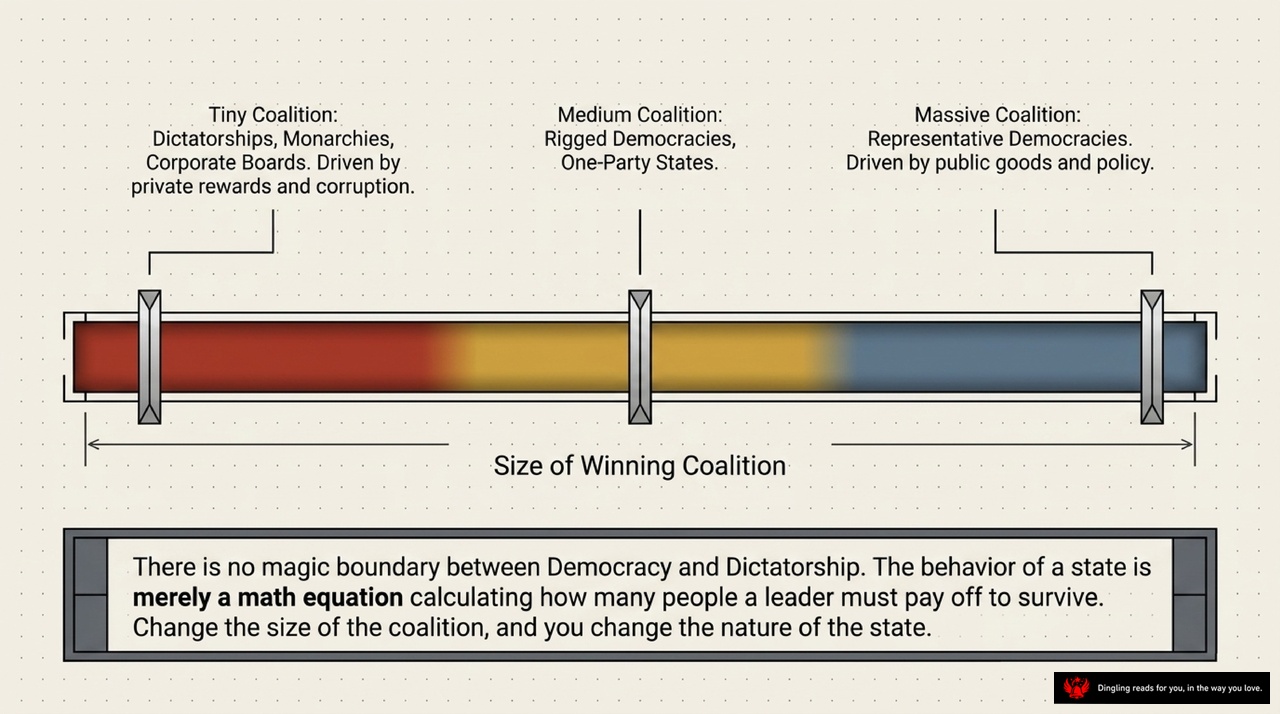
Look at this spectrum. It reveals the uncomfortable truth that there is no magic boundary between democracy and dictatorship. The behavior of a state is merely a math equation calculating how many people a leader must pay off to survive.
This chart breaks down the "Size of the Winning Coalition." On the far left, we have the Tiny Coalition. This includes dictatorships, monarchies, and corporate boards. Because the circle of support is so small, these systems are driven by private rewards and corruption. Leaders only need to buy the loyalty of a few elites, so they focus on enriching their inner circle while ignoring the rest of the population.
Moving to the middle, we see the Medium Coalition. This covers rigged democracies and one-party states. Here, the leader still relies on a specific group to stay in power, often using a mix of private favors and some public goods, but the system remains skewed toward the elite.
Finally, on the far right, is the Massive Coalition. This represents representative democracies. Because the leader must buy off a huge portion of the population, the logic shifts entirely. You can no longer afford to just give money to a few friends. Instead, you are driven by public goods and policy. You must build schools, roads, and hospitals because that is the only way to keep millions of people on your side.
The key takeaway is simple: change the size of the coalition, and you change the nature of the state. Whether it's a nation or a corporation, the logic is the same. If you shrink your winning coalition to a handful of insiders, you get corruption. If you expand it to the masses, you get public policy. Understanding this dynamic helps us see why some systems fail while others thrive, not because of ideology, but because of the math of power.

Welcome to the playbook of power. Today, we're breaking down the five non-negotiable rules every ruler—from a CEO to a dictator—must follow to survive.
Rule number one: Keep your winning coalition small. A smaller group of supporters means lower costs for you and tighter control over them.
Rule number two: Keep the nominal selectorate huge. This is your pool of potential replacements. The bigger this group, the easier it is to swap out disloyal allies without losing power.
Rule number three: Control the revenue flow. You must decide exactly where the money goes and who gets to eat. If you lose control of the cash, you lose control of the loyalty.
Rule number four: Pay your supporters just enough. Give them enough to stay loyal, but not so much that they become greedy or demand too much. Keep them dependent on you.
Rule number five: Never use your coalition's wealth to help the masses. Helping the general public at the expense of your inner circle is the fastest way to get overthrown. Your allies always come first.
These five rules explain why power works the way it does, regardless of whether you're running a democracy or a dictatorship.

Imagine a graph where a leader's grip on power stays steady for years, only to plummet into a dangerous valley. This is the "Window of Vulnerability," a critical moment where a regime can either survive or collapse. As the chart shows, this crisis is often triggered by specific shock points: the leader's illness, death, bankruptcy, or an external shock.
Think of it like a game of chicken. While a leader is healthy and wealthy, they have a massive advantage. They have a proven track record of paying off their core supporters—whether that's the military, a party elite, or wealthy donors. Challengers can only offer promises, but incumbents offer immediate cash. However, the fatal flaw appears the moment the leader goes bankrupt or dies. Suddenly, they can't buy loyalty anymore. The supporters realize the game is over, and the window snaps shut.
History is full of these moments. In Liberia, Samuel Doe simply grabbed the guns when the previous leader failed to pay the army. In Iran, the Shah's terminal cancer signaled that future payouts were impossible. In these scenarios, speed is everything. The first person to seize the treasury and the army wins. The incumbent's entire strategy relies on the illusion of future stability, but once that illusion cracks, the only path to survival is moving faster than anyone else can react.

Staying in Power: The Purge & The Imbalance. This slide reveals the brutal calculus of dictatorial survival. Look at the transition from Phase 1 to Phase 2. Initially, a ruler relies on four "Capable Allies"—competent advisors who can actually govern. But once in power, the ruler realizes that competence is a threat. These capable allies have the skills and networks to challenge him. So, Phase 2 begins: The Purge. The ruler systematically eliminates the capable allies, replacing them with "Dependent Loyalists"—incompetent sycophants whose only skill is ruthless loyalty. As the diagram shows, the connections to the capable allies are severed, leaving the ruler surrounded by yes-men.
This isn't just theory; it's a historical pattern. The text notes that good governance requires capable advisors, but dictatorial survival requires incompetent but loyal ones. When competence becomes a direct threat, the purge begins. A perfect example is Saddam Hussein in 1979. He purged 68 capable party leaders, including professors and officers, replacing them with sycophants like "Chemical Ali," a man with little formal education whose primary skill was just being loyal. This is the rigged election paradox: fake elections aren't designed to fool the public, but to signal to the inner circle that they are easily replaceable. If you are too smart, you get replaced. The ruler maintains power not by building a strong team, but by ensuring everyone around him is too weak to ever replace him.
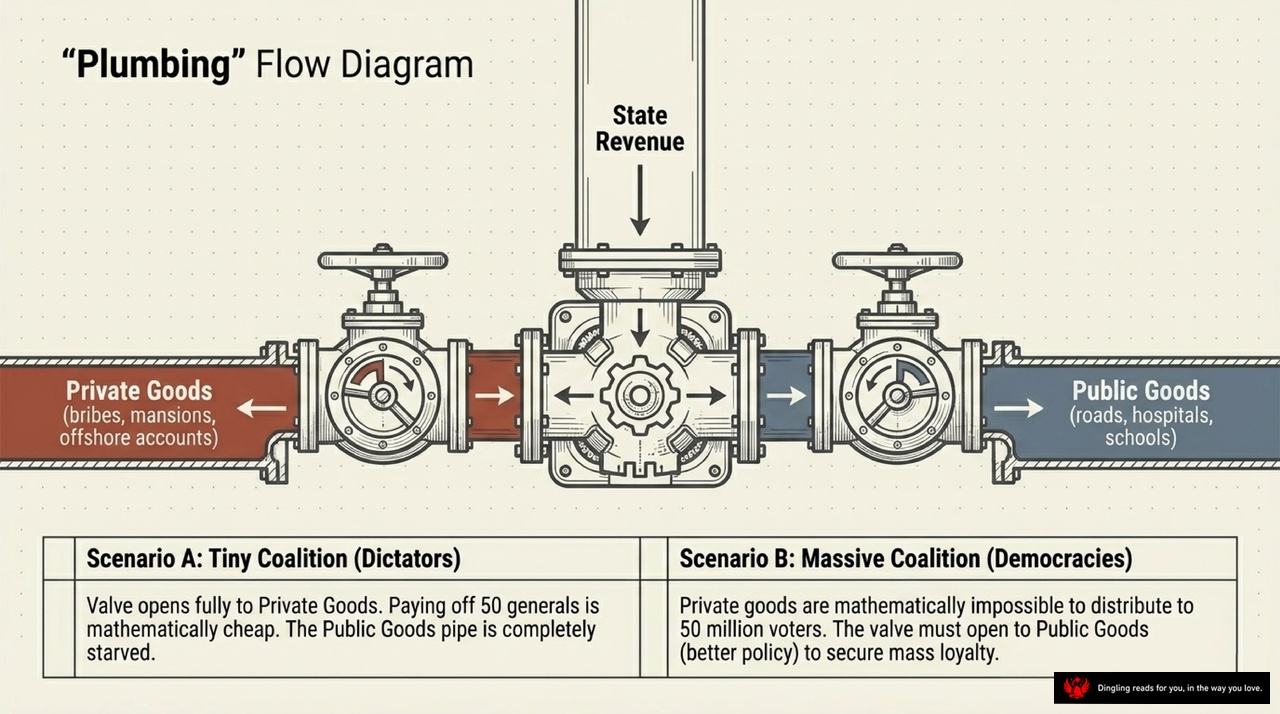
Imagine the state budget not as a public ledger, but as a massive water main. At the top, State Revenue flows in like water from a reservoir. Downstream, there are two distinct pipes: one leading to Private Goods—think bribes, mansions, and offshore accounts—and the other to Public Goods like roads, hospitals, and schools. The flow is controlled by two valves.
Look at Scenario A: The Tiny Coalition, or Dictators. Here, the valve for Private Goods is turned all the way open. Why? Because mathematically, it's cheap. A dictator only needs to buy the loyalty of a handful of generals or elites. Paying off 50 generals costs a fraction of the total budget. The result? The Public Goods pipe is completely starved. Roads crumble, schools fail, and the public pays the price for the elite's luxury.
Now, look at Scenario B: The Massive Coalition, or Democracies. Here, the math changes entirely. It is mathematically impossible to distribute private goods to 50 million voters. You simply don't have enough money to buy everyone a mansion. So, the valve for Private Goods must stay closed. Instead, the valve for Public Goods has to open wide. This forces leaders to invest in better policy, infrastructure, and public services to secure the loyalty of the masses.
This flow diagram reveals the brutal truth: whether you call it democracy or dictatorship, the system is always optimizing for the survival of the leader. The only difference is the size of the group they need to buy. In a small coalition, you bribe a few. In a massive coalition, you must build public value for everyone.

Taxation isn't just about funding the state; for dictators, it's a high-stakes game of theft from the poor. Look at that curve on the left. It illustrates a brutal economic reality: as tax rates rise, revenue initially climbs, but eventually, it crashes. Why? Because if you squeeze too hard, you kill the very economic activity that generates the money. This peak, labeled "The Dictator's Peak," represents the maximum extraction a ruler can get before the economy collapses or the public revolts.
Now, let's look at the real-world case studies on the right. In Russia, oligarch Mikhail Khodorkovsky built Yukos into a massive oil empire. When he dared to defy the government, the state didn't just tax him; they taxed him to ruin and threw him in prison. In autocracies, your wealth is conditional on your loyalty. Similarly, in Zimbabwe, former leader Philip Chiyangwa famously said, "I am rich because I belong to ZANU-PF." Heavy taxation silently siphons wealth from the masses outside the ruling coalition and funnels it directly to the elites inside.
The lesson here is clear: when the state acts as a predator rather than a protector, it steals from the many to enrich the few. This isn't just bad economics; it's a recipe for instability. Dictators walk a tightrope, taxing at the limit of what the economy can bear without triggering a revolt. But unlike a free market, there's no safety net. Once they cross that peak, the consequences are catastrophic.

The Resource Curse Explained: Why oil and minerals are a dictator's dream and a citizen's nightmare.
Look at this graph. It shows the exact mechanism behind this trap. On one side, as reliance on natural resources skyrockets, the need for public goods and citizen taxation plummets. Why? Because when a leader relies on oil, they only need a few foreign rigs and guards. They don't need a healthy, educated workforce or schools. The people become entirely obsolete to the state's revenue.
As you can see, this severs the accountability loop. When a leader relies on taxes, they need a productive workforce to pay them. But when they rely on resources, the people have no leverage.
Consider the data point at the bottom. Between 1970 and 2000, Nigeria generated $350 billion in oil revenue. Yet, in that same period, the percentage of Nigerians living on less than $1 a day skyrocketed from 36% to 70%. Massive wealth for the state, but absolute poverty for the people. This is the resource curse in action: abundance for the elite, and a nightmare for the citizenry.

The Debt & Bailout Trap isn't just a chart; it's a deadly cycle that traps entire nations. Look at this loop: a dictator borrows heavy debt, siphoning that money to buy loyalty for their coalition. When the economy tanks and citizens suffer, the only way out seems to be an international bailout or debt forgiveness. But here's the harsh truth: this relief rarely helps the people. Instead, it simply resets the cycle. Leaders like those in Ethiopia or Mozambique in the 1990s used these fresh funds not to build schools or hospitals, but to buy political loyalty again. By removing the pressure of a financial crisis, bailouts actually take away the one thing that might force a dictator to democratize. Without that threat, the trap remains closed, and the citizens stay trapped.

Look at this comparison matrix. It lays out the brutal truth behind "The Policy of Regimes," revealing why democracies and dictatorships actually function so differently.
On the left, you see Small Coalition Regimes, or dictatorships. Their entire goal is extraction. They maximize taxes just to enrich the elites at the top. Education is limited to basic literacy, with only the chosen few sent abroad. Healthcare is a bare minimum, kept just enough to keep adult laborers alive while ignoring infants and the elderly. Infrastructure? Roads are built straight to airports and mines, designed solely for extraction and escape. As the note highlights, Zaire's Mobutu Sese Seko famously refused to build road networks to prevent rebel forces from reaching the capital. It's all about control and getting out.
Now, look at the right side: Large Coalition Regimes, or democracies. Here, the logic flips. Taxes are kept moderate to appease the voters. Education becomes comprehensive, with university access for everyone. Healthcare shifts to a comprehensive model with a high focus on longevity. And infrastructure transforms into widespread public transit networks that connect the entire population.
The core difference isn't just ideology; it's the size of the group the leader needs to buy off. Dictators pay a tiny group with private benefits, while democracies must provide public goods to a massive group. This single structural difference explains everything from how schools are run to how roads are built.
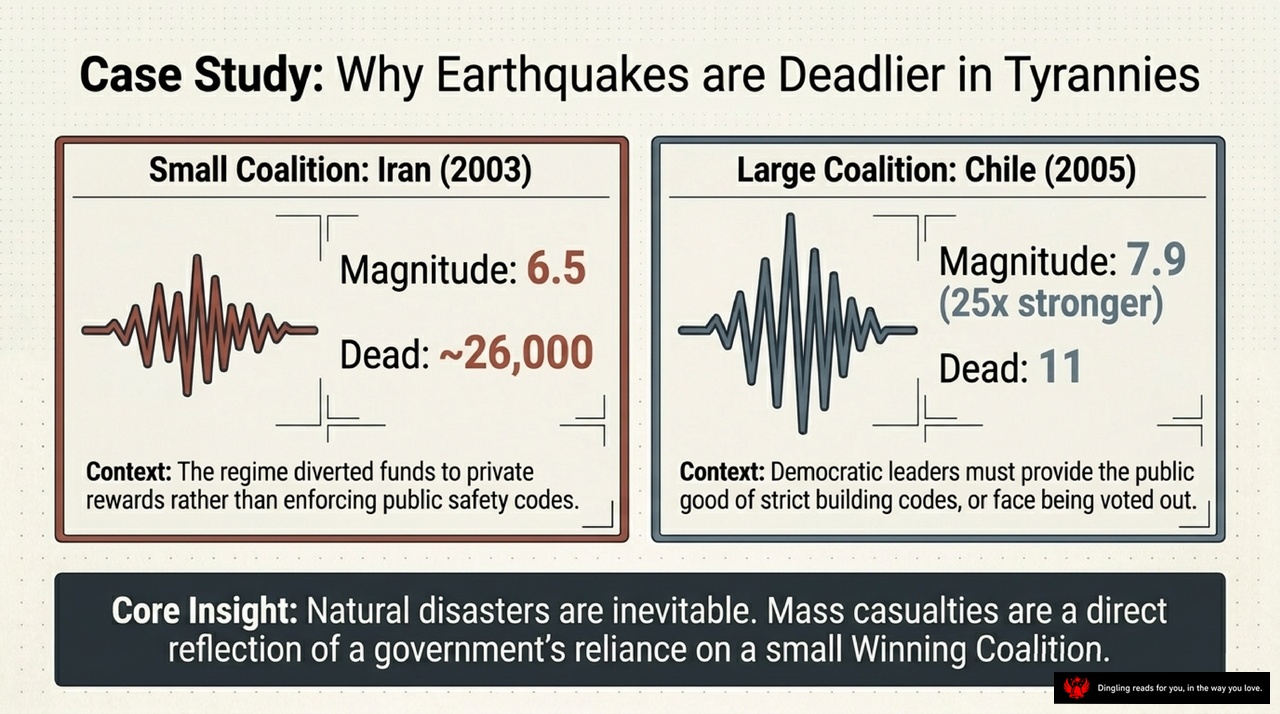
Case Study: Why Earthquakes are Deadlier in Tyrannies
Look at this striking comparison between Iran in 2003 and Chile in 2005. It reveals a terrifying truth about how power actually works. In Iran, a 6.5 magnitude earthquake killed nearly 26,000 people. In Chile, a 7.9 magnitude quake—25 times stronger—killed only 11 people. How can such a massive difference in physical force lead to such a dramatic difference in human loss?
The answer lies in the size of the government's "winning coalition." In Iran, the regime was a small coalition. The leaders diverted funds to private rewards for their tiny inner circle rather than enforcing public safety codes. They had no incentive to protect the general population because the cost of disaster didn't threaten their power. In contrast, Chile's democratic leaders faced a large coalition. They needed to provide public goods like strict building codes to keep the broad public happy, or risk being voted out.
This proves our core insight: natural disasters are inevitable, but mass casualties are a direct reflection of a government's reliance on a small winning coalition. When leaders only need to buy off a few, they ignore the many. When they need the support of everyone, they build safety nets. The earthquake didn't kill more people in Iran because the ground shook harder; it did because the government was built on a foundation that cared nothing for the public's survival.
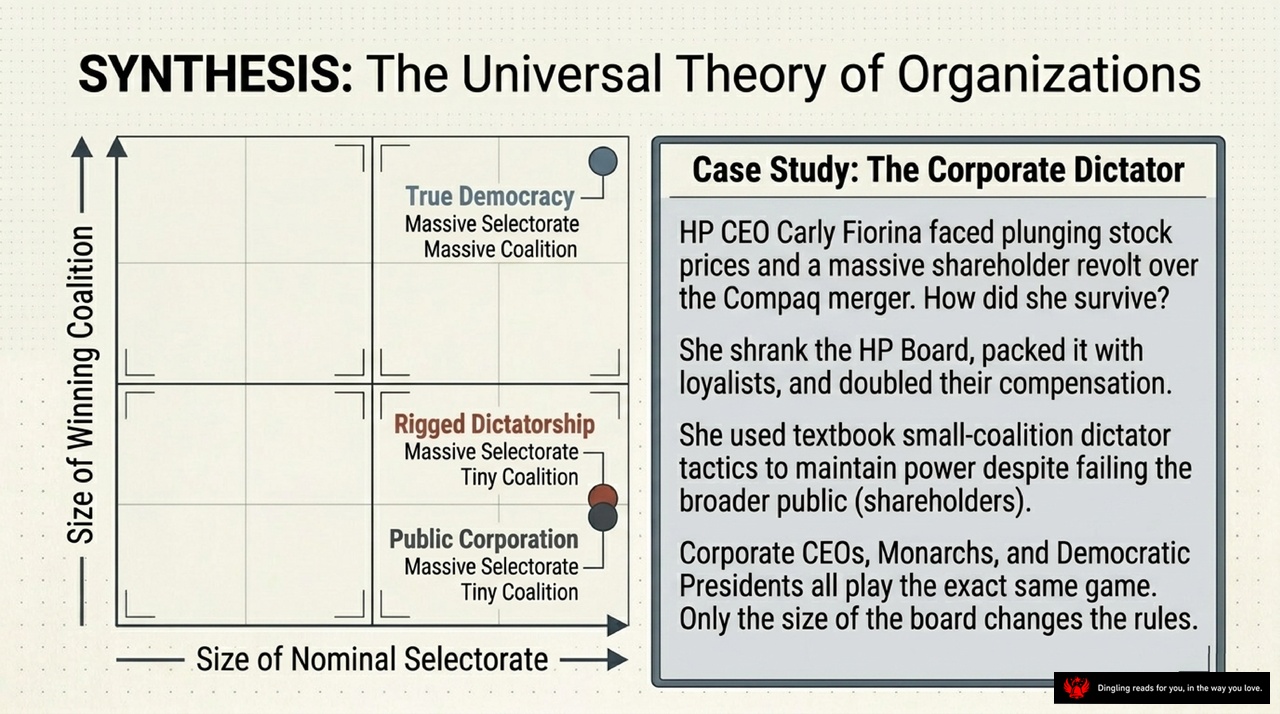
SYNTHESIS: The Universal Theory of Organizations
Look at this quadrant. It's not just a chart; it's the DNA of every organization on Earth, from a Fortune 500 giant to a struggling startup, and even a nation-state. We've stripped away the labels of "democracy" or "dictatorship" to reveal the single underlying logic that drives them all: the size of your winning coalition versus the size of your nominal selectorate.
In the top-right corner, you have "True Democracy." Here, the winning coalition is massive. Leaders must buy off almost everyone. The only way to survive is to provide public goods—education, infrastructure, safety—because you can't afford to give private favors to a specific few. This is the logic of a public corporation where every shareholder matters.
Now, look at the bottom-right. This is the "Public Corporation" model, but rigged. The selectorate is huge—everyone has a vote on paper—but the winning coalition is tiny. Think of a company where a board of 10 directors controls a massive shareholder base. They don't need to please the millions of small investors; they just need to keep the 10 directors happy.
And then, there's the red zone: "Rigged Dictatorship." Here, the selectorate is large, but the winning coalition is minuscule. This is where we see the corporate dictator in action. Take Carly Fiorina at HP. When she faced a shareholder revolt over the Compaq merger, she didn't try to win over the public. Instead, she shrank the board, packed it with loyalists, and doubled their compensation. She used textbook small-coalition tactics to maintain power despite failing the broader public.
The takeaway is stark: Corporate CEOs, monarchs, and democratic presidents all play the exact same game. The only thing that changes is the size of the board. Whether it's a city council or a boardroom, the leader's survival depends on keeping the winning coalition small and loyal, while letting the rest of the selectorate believe they have a say. It's a universal theory of power, and once you see it, you realize the rules are rigged for the few, not the many.

To change the world, we must change the rules of the game. As this slide illustrates, the path to peace and prosperity isn't about waiting for leaders to be benevolent or simply swapping out the person at the top. The diagram shows a central circle of power radiating outward, but the key lies in expanding that circle.
The text reminds us that broken systems cannot be fixed by changing faces. The only mathematical path to survival is to force leaders to rely on a massive Winning Coalition. By expanding the circle of power—ensuring that the group of people who can actually decide the leader's fate is as large as possible—good governance becomes the only logical choice. When the cost of bad governance is borne by the entire population rather than a small, protected elite, the system naturally evolves toward fairness and stability. We stop relying on the whims of a few and start building a structure where everyone's survival depends on everyone else's success.