
The Economic Naturalist: Complete Chapter-by-Chapter Summary

Welcome to the world of *The Economic Naturalist* by Robert H. Frank. Imagine a busy city intersection, like the one you see here, where thousands of people cross paths every day. It's a chaotic scene, but there's a hidden order to it all. This book is about discovering that economic logic isn't just for Wall Street or complex textbooks; it's actually the invisible force shaping the bizarre, the mundane, and the everyday moments we all experience.
Think about it: why do we see Braille on ATM keyboards even though almost no one using them is blind? Or why do brides spend thousands on a one-time dress while grooms rent cheap suits? It's all about cost-benefit analysis. Manufacturers don't make two types of machines; they make one, saving money for everyone. Similarly, renting suits is cheaper for groomsmen because rental companies can reuse them, whereas a bride wants something unique that she owns forever.
This book teaches you to see the world through an economist's eyes. It's not about memorizing formulas; it's about understanding the trade-offs behind every decision, from why your fridge light turns on when you open the door but the freezer light doesn't, to why milk comes in square boxes and soda in round ones. It's about realizing that even the strangest things, like why cars have gas tanks on different sides or why women's buttons are on the left while men's are on the right, are all solutions to specific problems involving cost, convenience, and human behavior.
So, get ready to look at your daily life differently. From the free peanuts at a bar to the pricing of airline tickets, from the design of your clothes to the rules of the road, there's an economic story behind everything. This is your invitation to become an economic naturalist and start seeing the hidden logic that runs through the fabric of our lives.
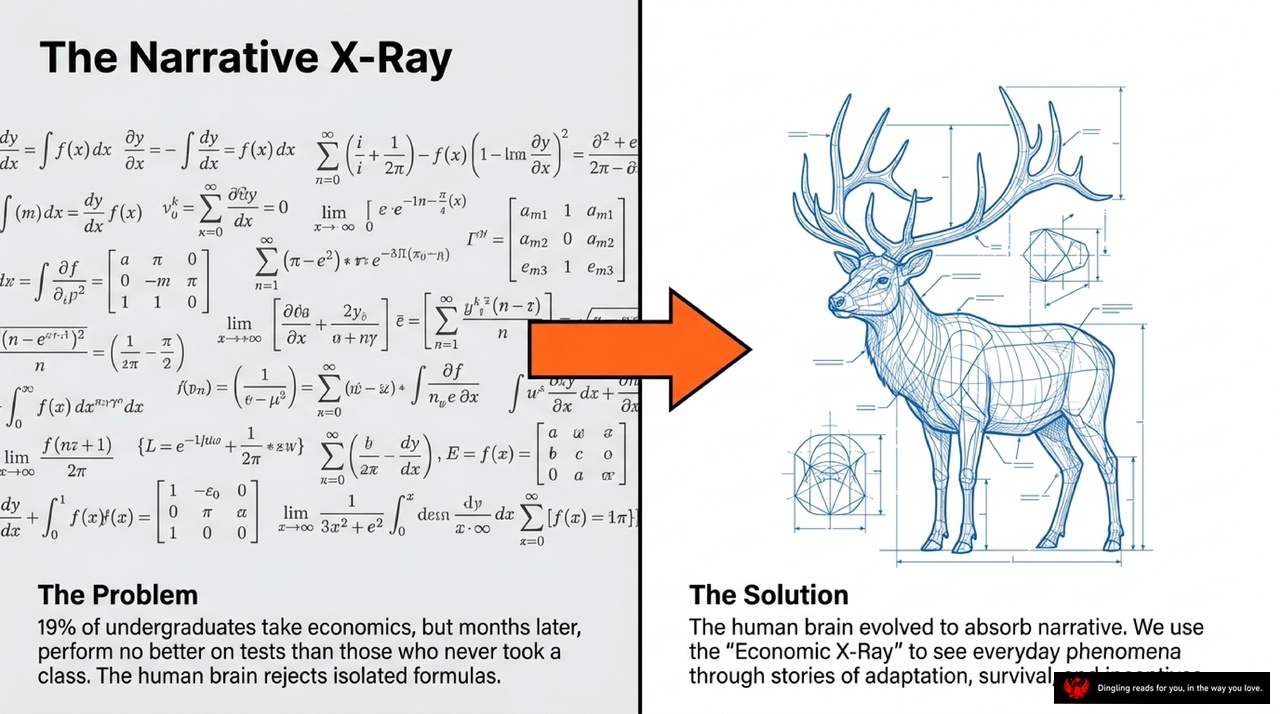
Look at this split screen. On the left, we have a chaotic wall of complex formulas—math so dense it looks like gibberish. On the right, there's a clean, elegant wireframe of a deer. The orange arrow between them tells us the story: we need to translate the noise into clarity. This is the "Narrative X-Ray."
Here's the problem: 19% of undergraduates take economics, yet months later, they perform no better on tests than students who never took the class at all. Why? Because the human brain simply rejects isolated formulas. We are wired for stories, not abstract equations.
The solution is to use an "Economic X-Ray" to see everyday phenomena through stories of adaptation and survival. Instead of memorizing the math on the left, we look for the logic behind the design on the right. Think about why a deer has antlers, or why a laptop works in different countries while your fridge doesn't. It's all about balancing function with cost. By shifting from the confusing formulas to the narrative of how things actually work in the real world, we unlock the true power of economics.
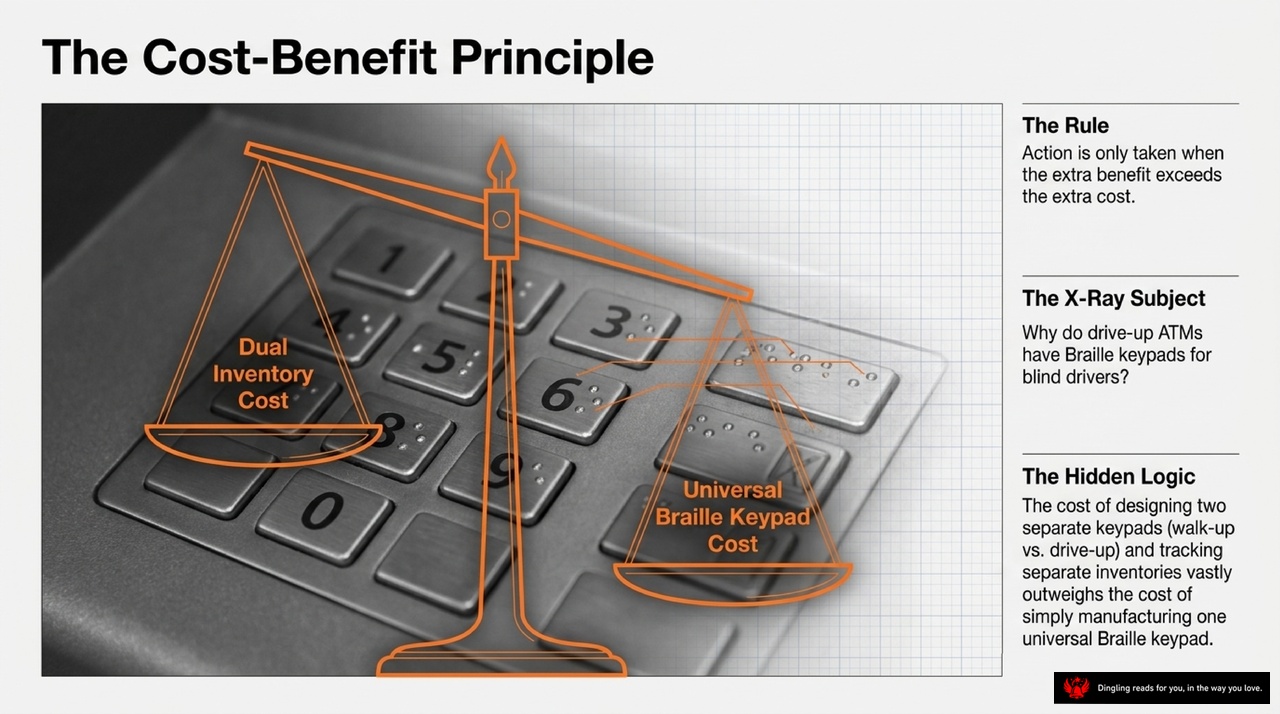
So, let's talk about why drive-up ATMs have Braille keypads, even though almost no blind people drive. At first glance, it looks like a waste of money. But if we look at it through the lens of the Cost-Benefit Principle, the logic becomes perfectly clear.
The rule is simple: you only take an action when the extra benefit exceeds the extra cost. Imagine if manufacturers made two separate machines—one with Braille for drive-ups and one without for indoor kiosks. The cost of designing two distinct models, plus the massive expense of tracking and managing two separate inventories, would be astronomical. Now, consider the alternative: just making one universal Braille keypad for every single machine. The manufacturing cost is virtually the same, and the inventory is much simpler to manage.
Here is the hidden logic: the tiny cost of adding Braille to every keypad is far outweighed by the huge savings of avoiding a complex dual-system setup. Plus, having Braille on the keypads doesn't bother sighted users at all. So, the manufacturer chooses the path of least resistance. They absorb the minimal cost of universal Braille to save a fortune on production complexity. It's a classic example of how smart design isn't about what every individual needs, but about finding the most efficient solution for the whole system.

Have you ever felt like you're getting something for nothing, only to realize you've actually paid a hidden price? That's the illusion of free, and it all comes down to opportunity cost.
Look at this slide. We're comparing two concert tickets. On the left, Eric Clapton is listed as $0—completely free. On the right, Bob Dylan costs $40, but you personally value that experience at $50.
Here's the trap most people fall into: they think the cost of seeing Clapton is zero. But that's wrong. The true cost isn't just what you pay at the box office; it's what you give up to get it.
If you choose the free Clapton ticket, you are surrendering the chance to see Dylan. Since Dylan is worth $50 to you and only costs $40 to attend, you are leaving $10 of value on the table. That $10 difference is your real opportunity cost.
This concept is so counterintuitive that it stumps even economics students. In fact, only 7.4% of them get this right. It's a powerful reminder that whenever you make a choice, the cost is always the best alternative you didn't pick. Don't let "free" fool you; always calculate what you're leaving behind.
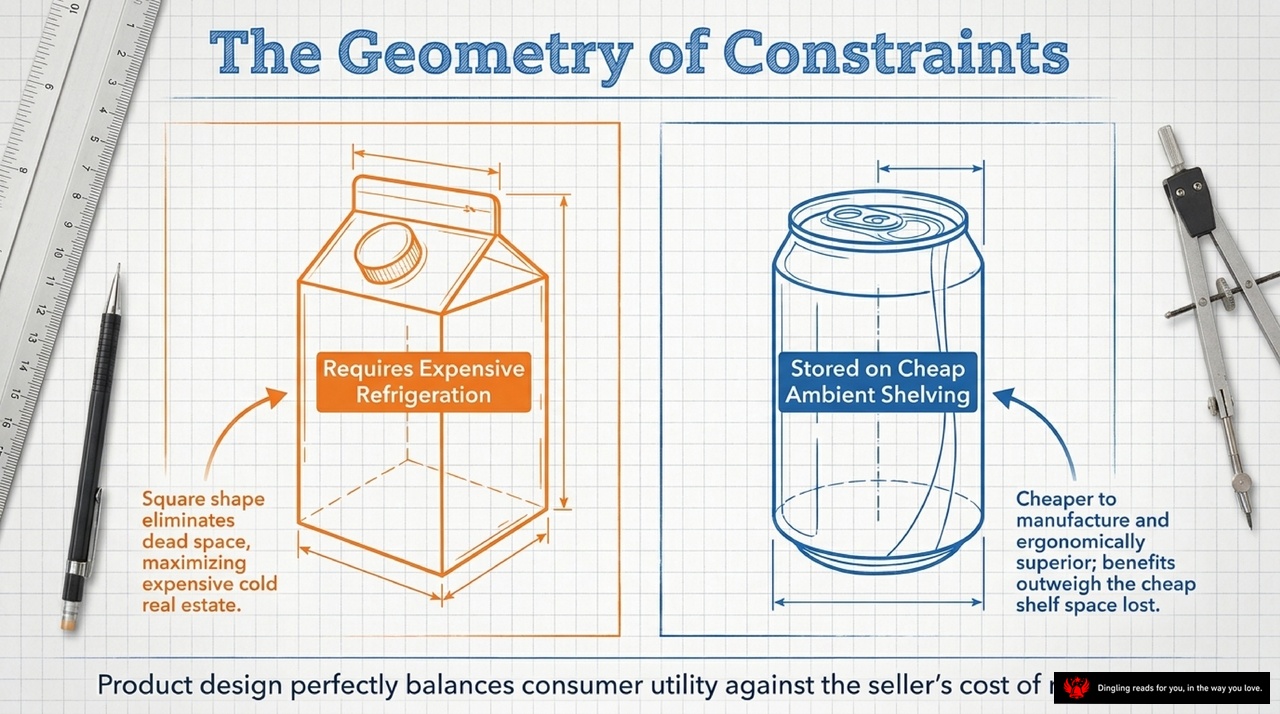
Product design is essentially a game of balancing consumer utility against the seller's costs. Every shape, feature, and material choice we see is the result of a careful calculation to maximize value while minimizing expense.
Look at the milk carton versus the soda can. The milk carton is a square, which eliminates dead space and maximizes the use of expensive refrigerated real estate in the store. The soda can is a cylinder, which is cheaper to manufacture and ergonomically superior for holding, even though it wastes some shelf space. The square wins where space is costly; the cylinder wins where manufacturing and handling are key.
Consider the laptop versus the fridge. Laptops adapt to global voltage standards because business travelers need them to work anywhere, and the cost of a built-in transformer is worth the convenience. But a fridge doesn't need this flexibility; adding a transformer would just raise the price for a product that sits in one place.
Even the placement of gas pump nozzles follows this logic. By putting nozzles on both the driver and passenger sides, automakers split the traffic between left and right pumps. This prevents long lines on one side and idle time on the other, saving drivers time overall.
These details aren't random accidents. They are the invisible hand of economics at work, perfectly balancing what we need with what it costs to provide.
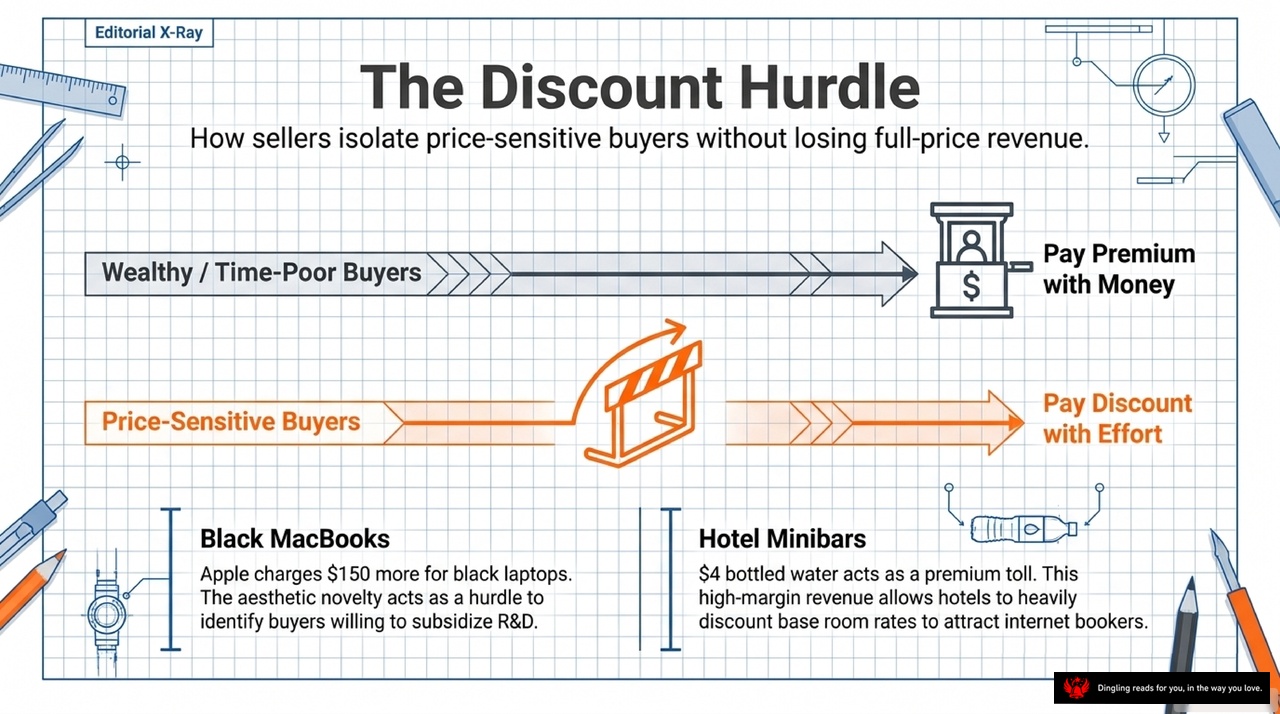
The Discount Hurdle isn't just a marketing trick; it's a brilliant economic strategy for separating the willing from the unwilling. Look at this diagram: sellers are essentially building a gate—a hurdle—specifically designed to stop price-sensitive buyers from accessing the cheapest options, without ever lowering the price for everyone else.
The core idea is simple but powerful. Wealthy or time-poor customers, who value their time and comfort above all, will simply pay the premium to skip the line. They pay with money. But for the budget-conscious buyer, the hurdle becomes a filter. They are willing to work for a deal, so they pay with effort.
Think about the examples here. Apple charges an extra $150 for a black MacBook. That color isn't just an aesthetic choice; it's a toll booth. The "effort" required to buy the cheaper white model is just the time spent researching or waiting for a sale. If you're not willing to put in that mental or temporal effort, you pay the extra $150 for the convenience of the standard price.
Similarly, hotel minibars use a $4 bottle of water as a strategic barrier. It's a high-margin item designed to make you think twice. For the guest who wants to save money, the effort of asking for a glass of water from the front desk is a small price to pay to avoid that $4 charge. This allows the hotel to offer a rock-bottom base room rate to attract internet bookers, while extracting maximum revenue from those who are too lazy or unwilling to go to the front desk.
In both cases, the seller isolates the price-sensitive buyers by making the discount conditional on effort. They don't have to lower their prices for everyone; they just make the cheap option slightly harder to reach. It's a way to capture value from every segment of the market without confusing the price tag.
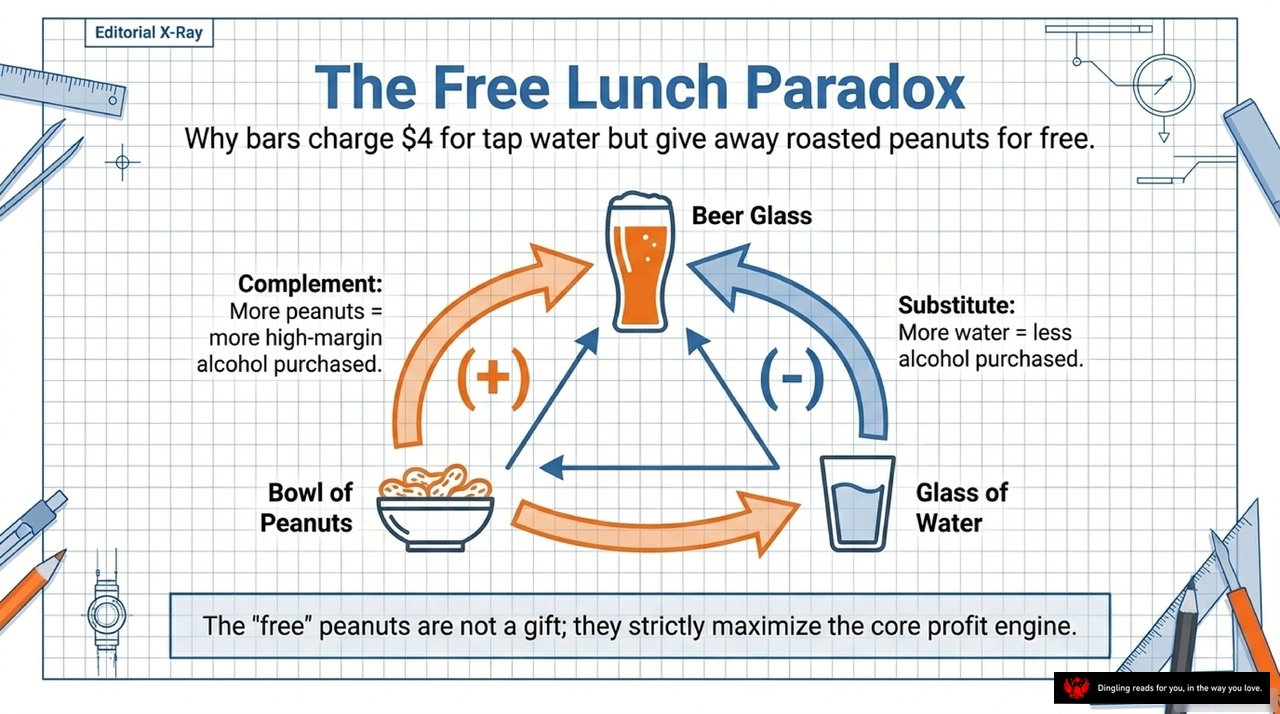
The "Free Lunch Paradox" is a classic example of why businesses don't actually give things away for free. Look at this diagram: bars charge you $4 for tap water but hand out roasted peanuts for nothing. It seems contradictory, right? But it's all about the relationship between these items.
On the left, we see peanuts as a "complement." Think about it: peanuts are dry and crunchy. Once you eat a handful, you naturally feel thirsty and reach for that beer or soda. So, free peanuts actually drive you to buy more high-margin alcohol, which is where the real profit lies. The orange arrow shows this positive feedback loop—more peanuts mean more drinks sold.
On the right, water acts as a "substitute." If water were free, you'd likely drink it instead of your expensive cocktail, right? That would kill the bar's sales. By charging for water, they discourage you from diluting your alcohol, protecting their core revenue stream. The blue arrow shows this negative relationship—more water means less alcohol purchased.
So, the peanuts aren't a gift at all. They are a strategic tool designed to maximize the bar's profit engine by boosting alcohol sales while suppressing water consumption. It's a perfect lesson in how complementary and substitute goods work together to drive business success.

Have you ever wondered why the best-paid people in the world aren't necessarily the ones who work the hardest? Look at this "Compensation Matrix." It reveals a simple but powerful truth: your income isn't just about your skill; it's about the size of the market you serve.
Notice the top left quadrant: Female Models earning millions. Why? Because the women's fashion market is massive. Brands are willing to pay huge sums to attract the attention of millions of potential buyers. Their value is driven by an exponential market multiplier.
Now look at the bottom right: Assistant Chefs. They require intense skill and years of training, yet they earn low wages. This isn't a lack of talent; it's a stepping stone. The restaurant industry simply can't afford to pay top dollar to entry-level chefs because the immediate market for their services isn't large enough.
Contrast that with the High-End Waiter in the bottom left. They might not have the same years of training as a chef, but they earn high tips. Why? Because their role acts as a terminal position requiring immediate premium compensation to retain talent. The market for exceptional service is ready to pay out.
The lesson here is clear: To maximize your economic output, you need to align your skills with the largest possible market. If you can't change the market size, you must find ways to scale your value within it.
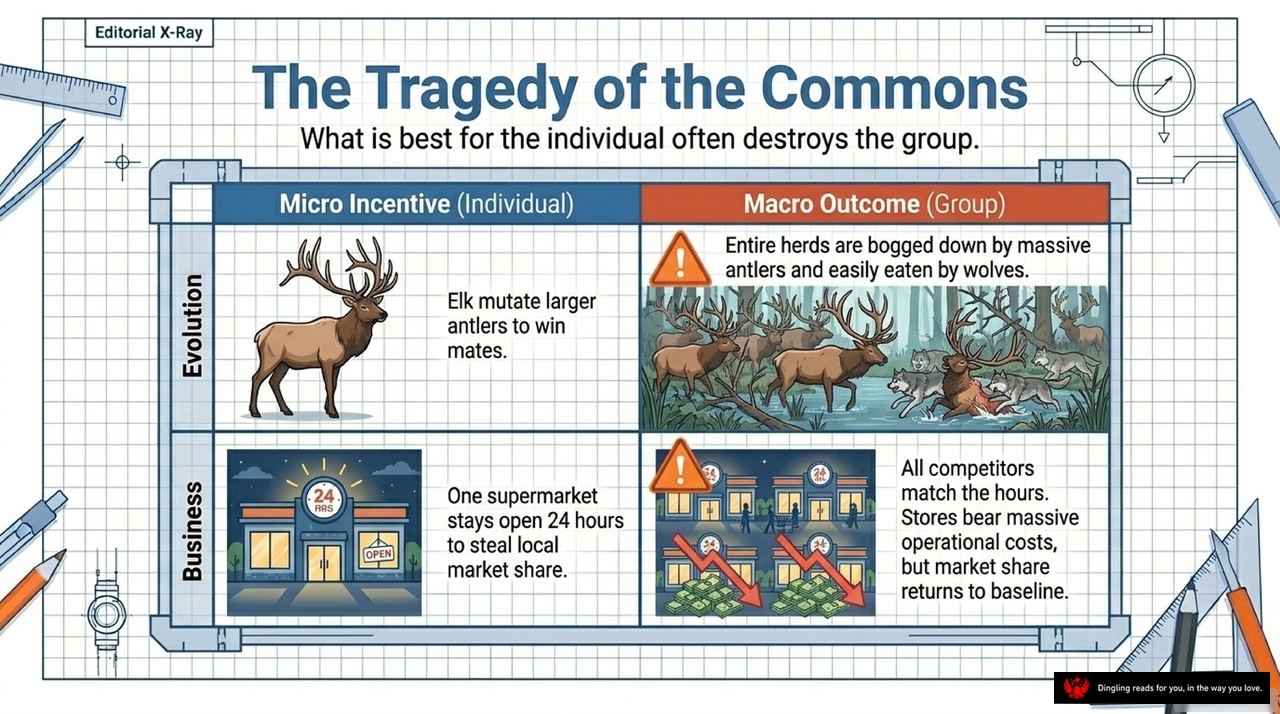
Look at this slide titled "The Tragedy of the Commons." It's a powerful visual that explains why individual rationality often leads to collective disaster. The core message is simple: what is best for the individual often destroys the group.
The graphic breaks this down into two distinct scenarios. On the left, we have "Micro Incentive," or the individual perspective. On the right, we see the "Macro Outcome," or the group result.
Let's start with the top section labeled "Evolution." Here, the individual incentive is clear: an elk mutates to grow larger antlers to win mates. That makes perfect sense for one deer. But look at the macro outcome on the right. Because every elk is trying to outdo the other, entire herds end up with massive, heavy antlers. These huge antlers make them slow and easy targets for wolves. So, the very trait that helped the individual survive actually doomed the whole group.
Now, let's look at the bottom section labeled "Business." The logic is identical. The micro incentive for a single supermarket is to stay open 24 hours to steal market share from its neighbors. It's a smart move for that specific store. But when *all* competitors match those hours, the macro outcome is disastrous. As the slide shows, every store bears massive operational costs for night shifts, yet the market share simply returns to the baseline. No one wins, and everyone loses money.
This concept is central to understanding why we need rules, whether it's laws against overfishing or regulations on workplace hours. Without a system to manage these shared resources, the drive for individual gain will inevitably crash the system for everyone.
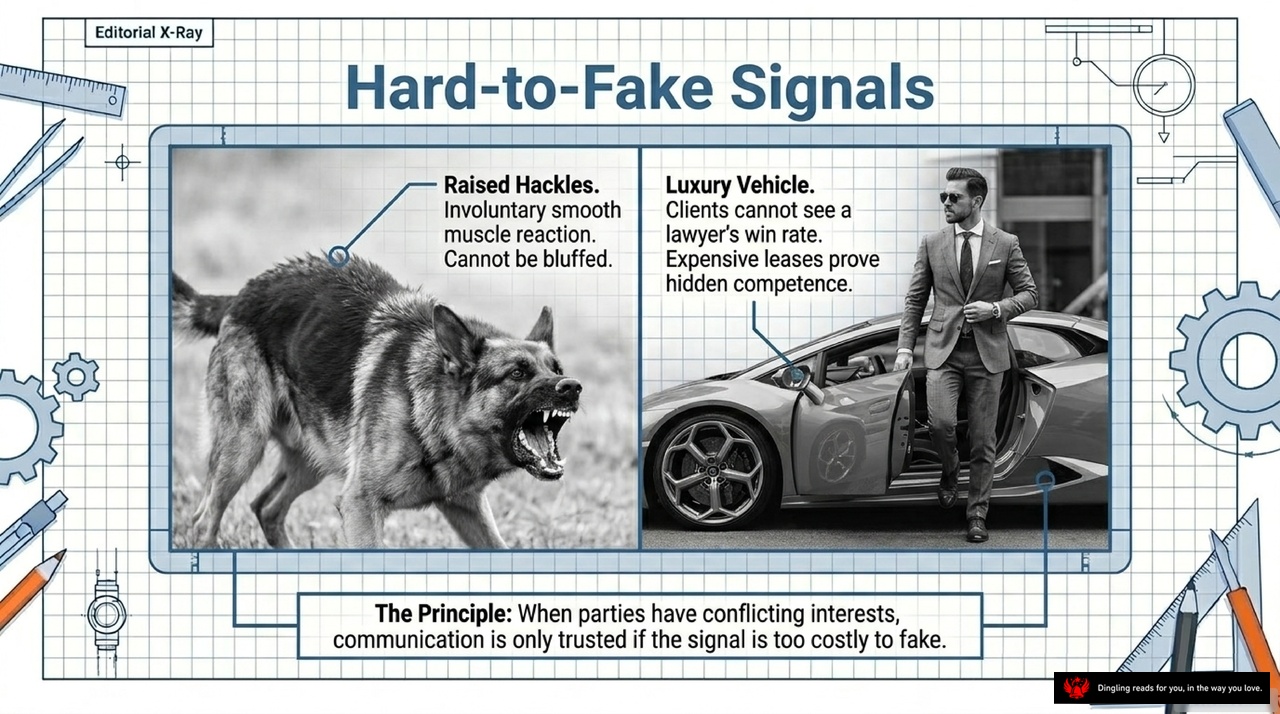
Imagine you're trying to spot a wolf in the wild. You don't need to ask it if it's lying; you just look at its hackles. When a dog raises the hair on its neck, that's an involuntary muscle reaction—it's physically impossible to fake. That's what economists call a "hard-to-fake signal."
Now, think about the real world. Why do top lawyers drive luxury sports cars? It's not just about showing off. It's because clients can't see a lawyer's win rate or track record. So, they look for expensive leases. That car is a costly signal; it proves the lawyer has hidden competence and can afford high expenses.
The core principle here is simple: when people have conflicting interests, you only trust their words if the signal is too costly to fake. A cheap lie is easy to tell, but a real, expensive proof is hard to counterfeit. Whether it's a dog's natural reaction or a CEO's yacht, the most honest signals are often the ones that hurt the liar the most to produce.
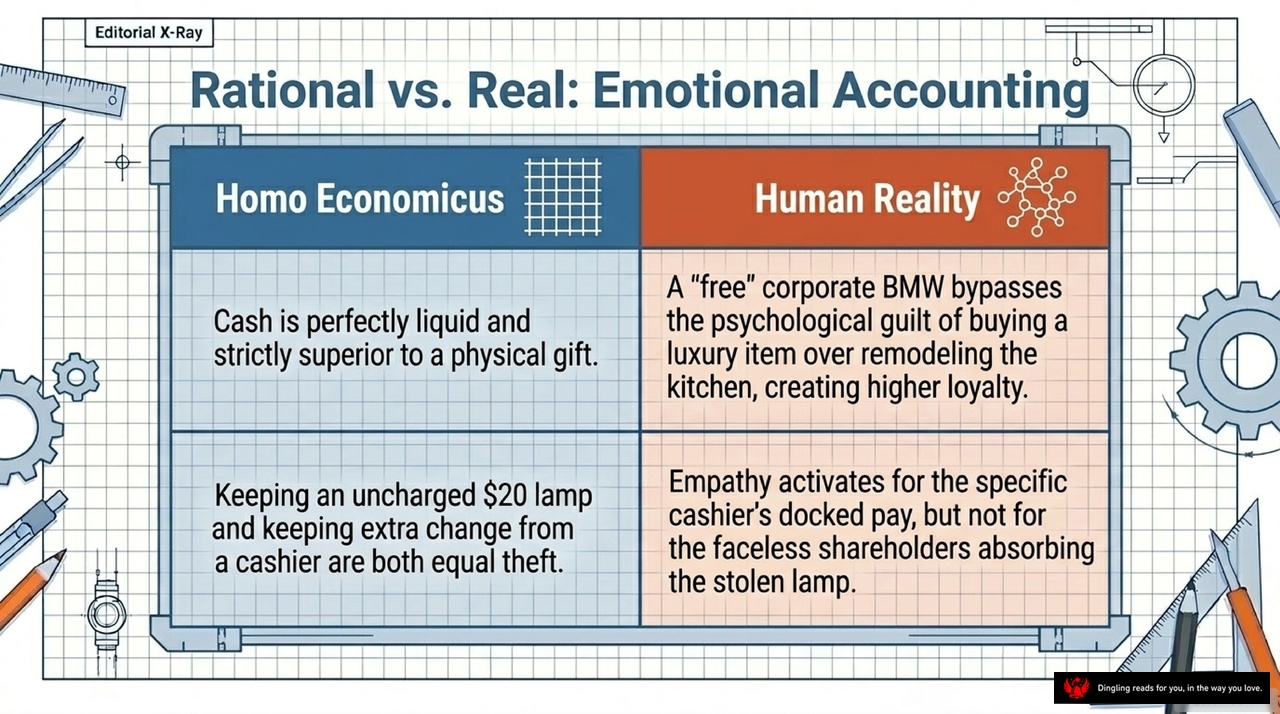
Look at this slide comparing "Homo Economicus" and "Human Reality." It highlights a fascinating gap between how we think we should act and how we actually feel.
On the left, under "Homo Economicus," we see the cold logic of pure rationality. It assumes cash is always superior to a physical gift and that stealing a free $20 lamp is morally identical to stealing $20 from a cashier's register. In this model, everything is just liquid numbers; emotions and specific relationships don't exist.
But look at the right side, labeled "Human Reality." This is where the real world lives. Here, a "free" corporate BMW creates higher loyalty because it bypasses the psychological guilt of spending your own hard-earned money on a luxury item. It feels like a gift, not a purchase. Conversely, when a cashier accidentally gives you extra change, you feel a pang of guilt and return it because you feel you've hurt that specific person. However, if a lamp is left uncharged, you might keep it without a second thought because the loss is absorbed by faceless shareholders, not a specific individual you care about.
The core lesson here is that our moral compass isn't built for abstract math; it's built for empathy. We care deeply about hurting a specific person, but we often rationalize harming a system or a corporation. Understanding this distinction is crucial for grasping why businesses design incentives the way they do—to tap into our emotional accounting rather than just our rational wallets.
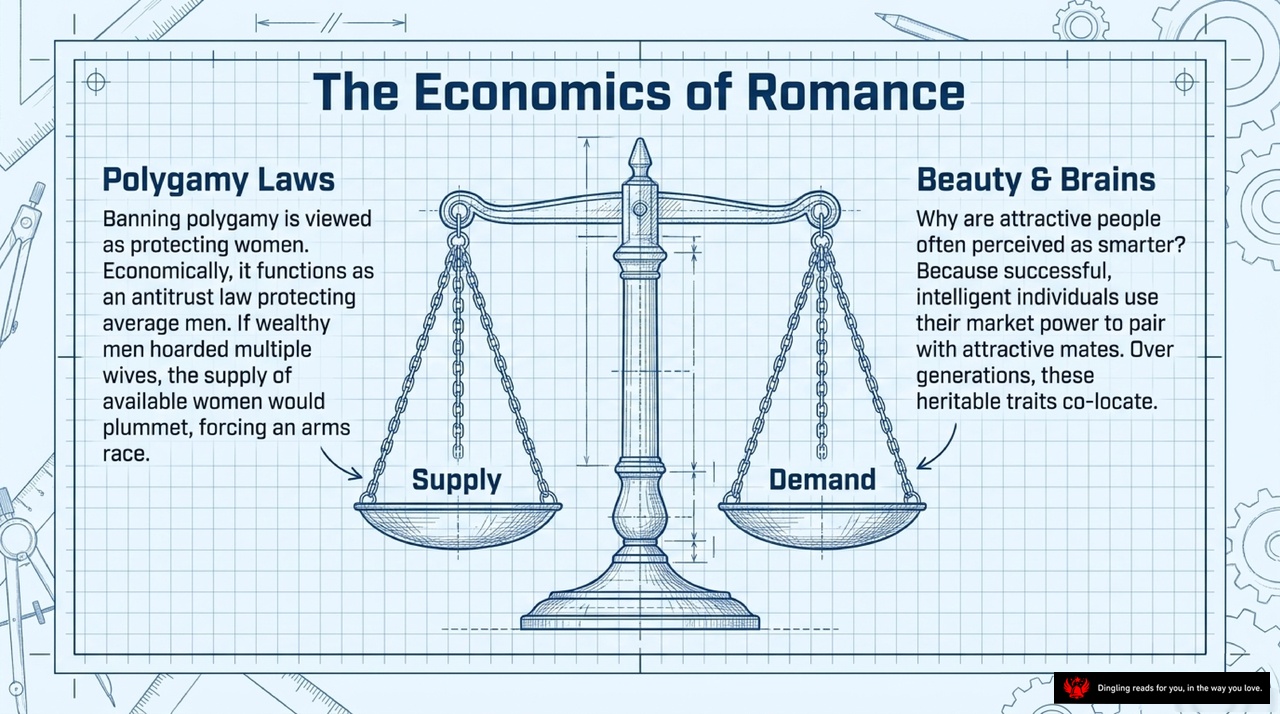
Welcome back to the Economics of Romance. Today, we're diving into a fascinating concept that explains why some people are perceived as smarter or more attractive: it's all about market power and genetics.
Think of romance as a marketplace. Successful, intelligent individuals naturally possess significant market power. Because they are so desirable, they can use that power to pair up with the most attractive partners available. This isn't just about luck; it's a strategic advantage. Over generations, these traits—intelligence and attractiveness—tend to co-locate. When smart people consistently marry attractive partners, their children inherit both traits.
This creates a powerful feedback loop. That's why attractive people are often perceived as smarter; it's a result of this evolutionary matching process. Now, let's look at how these dynamics interact with other market forces, like the laws governing polygamy, which we'll explore next as we balance supply and demand in the dating world.

Why do workers vote for overtime laws, and why do hockey players mandate helmets? At first glance, it seems like everyone is trying to bind their own hands. But this is actually a fascinating paradox of human behavior.
Imagine a game where everyone wants to work longer or remove safety gear to gain an edge. If you don't, you lose out. But if everyone does it, no one gains a relative advantage, and everyone just loses their weekends or gets injured. This is what we call "Competitive Pressure." It's a race where the only way to stop the chaos is to agree on the rules.
That's exactly what happens when we vote to limit ourselves. By agreeing on overtime caps or helmet rules, we create a ceasefire in a wasteful arms race. It might feel like we are giving up our freedom, but without these rules, the competition would destroy us all. So, by voting to bind our own hands, we are actually protecting our collective well-being and ensuring that absolute performance matters less than our relative positioning in a fair game.

Imagine you're an "Economic Naturalist," peering at the world not as it looks, but as it functions. You see that every mundane detail is actually the perfect equilibrium of competing incentives, hidden costs, and relentless human drive. Take that square milk carton versus the round Coke bottle, for instance. It's not about shape preference; it's pure cost-benefit analysis. Milk sits in expensive, tight iceboxes, so the square box maximizes shelf space and slashes storage costs. Coke, however, sits on open shelves where space isn't the premium, so the round bottle wins because it fits perfectly in your hand.
Now, look deeper at the layers of this diagram. At the surface, you see anomalies like free peanuts in a bar. But the real story lies in the micro-incentives driving individual action. The bar doesn't give away peanuts out of kindness; they are a calculated loss-leader. By giving away dry, unsatisfying peanuts, they actually increase your thirst, driving you to buy more expensive, high-margin drinks. The peanuts are a tool to boost the real profit driver: the alcohol sales.
Finally, pull back to the macro equilibrium. You're seeing how these individual choices aggregate into broader patterns, from arms races to market signals. The Economic Naturalist doesn't accept the world at face value. Instead, they recognize that even the smallest design choice, from a milk carton to a free snack, is the result of a complex negotiation between cost, benefit, and what we give up to get it.

Look at this complex highway interchange behind us. It looks chaotic, right? But as the slide suggests, this isn't just random chaos. The world isn't shaped by accident; it's built on a hidden architecture of costs, benefits, and relentless human incentives.
Think about the invisible forces at play here. Why do we have so many lanes weaving in and out? It's not just about capacity. It's about efficiency. Every ramp, every curve, is a calculated decision to minimize travel time and fuel costs for millions of drivers. If we built this differently, with fewer exits or sharper turns, the "cost" to every driver would skyrocket.
Now that you know how to look past the surface, ask yourself: what invisible forces are shaping your own life right now? Why do we pay for things we don't use? Why do some products look the way they do? The answer is always the same: it's about balancing the cost of creation against the benefit of consumption.
From the free peanuts in a bar to the price of a concert ticket, from the design of a soda can to the rules of a workplace, every choice is a trade-off. We are constantly navigating this hidden architecture, trying to get the most value for the least cost. The next time you see a crowd, a price tag, or a complex system, remember: there's an economic logic driving it all. What invisible force will you discover hiding in plain sight tomorrow?