
The Economic Way of Thinking: Complete Chapter-by-Chapter Summary
Welcome to our deep dive into "The Economic Way of Thinking." Today, we're not just looking at charts or graphs; we're exploring the blueprint behind how our world actually works. As the title suggests, this is about understanding how individual choices build complex, coordinated social systems.
Think about the rush hour traffic you face every day. It looks chaotic, right? Thousands of drivers, each with different goals and driving styles, yet somehow, no one crashes, and everyone gets where they need to go. There is no central conductor telling everyone when to turn. This order isn't designed; it emerges naturally from millions of independent decisions interacting together. That is the core of economic thinking.
We are going to move beyond the idea that economics is just about money or selfishness. Instead, we'll see it as a powerful lens for analyzing any social phenomenon. It starts with a simple but profound assumption: every social outcome stems from individual behavior. People act based on what they value, weighing the costs and benefits of their choices. Whether you are a billionaire deciding between a vacation or a business trip, or a student choosing between studying and hanging out, you are making an economic calculation. You are trading off one thing for another because resources, like your time, are scarce.
From this foundation, we can understand the magic of the market. Long before modern computers, Adam Smith realized that society functions like a giant machine where everyone relies on exchange. You don't know the farmer who grew your coffee or the truck driver who delivered it, but through a system of clear rules—especially private property rights—they coordinate perfectly to bring you your morning brew. Private property gives people the security and incentive to produce and trade, creating wealth without anyone needing to micromanage everything.
So, when we look at this visual blueprint, remember that the economy isn't a puzzle to be solved by a central planner. It's a dynamic process of coordination driven by individuals. By understanding how choices, scarcity, and interaction weave together, we can see the invisible hand at work in everything from global trade to the price of your morning cup of coffee.

Have you ever stopped to marvel at how a massive highway interchange functions without a single conductor? Look at this diagram of the "Architecture of Unintended Order." It illustrates a profound truth: complex social order doesn't require a master planner; it emerges spontaneously from individual choices.
Think about it. Every driver on this highway is acting alone. They aren't coordinating with the car next to them. Each driver is simply trying to maximize their own speed, choosing the lane they think is fastest. They are optimizing for themselves. Yet, without a central dispatcher telling them where to go, their constant lane-shifting creates a perfectly coordinated flow where all lanes equalize in speed. This is market clearing in action.
This is the core premise of economics: all social phenomena emerge from the actions and interactions of individuals who are choosing in response to expected benefits and costs. We often mistakenly believe that order requires a top-down design—a myth. But the reality, as shown here, is that when individuals act in their own self-interest, following simple rules of optimization, they inadvertently create a system that is efficient and stable for everyone. Just like these drivers navigating the complex turns, the invisible hand of the market coordinates millions of transactions, turning individual greed into collective prosperity without anyone needing to manage it all.
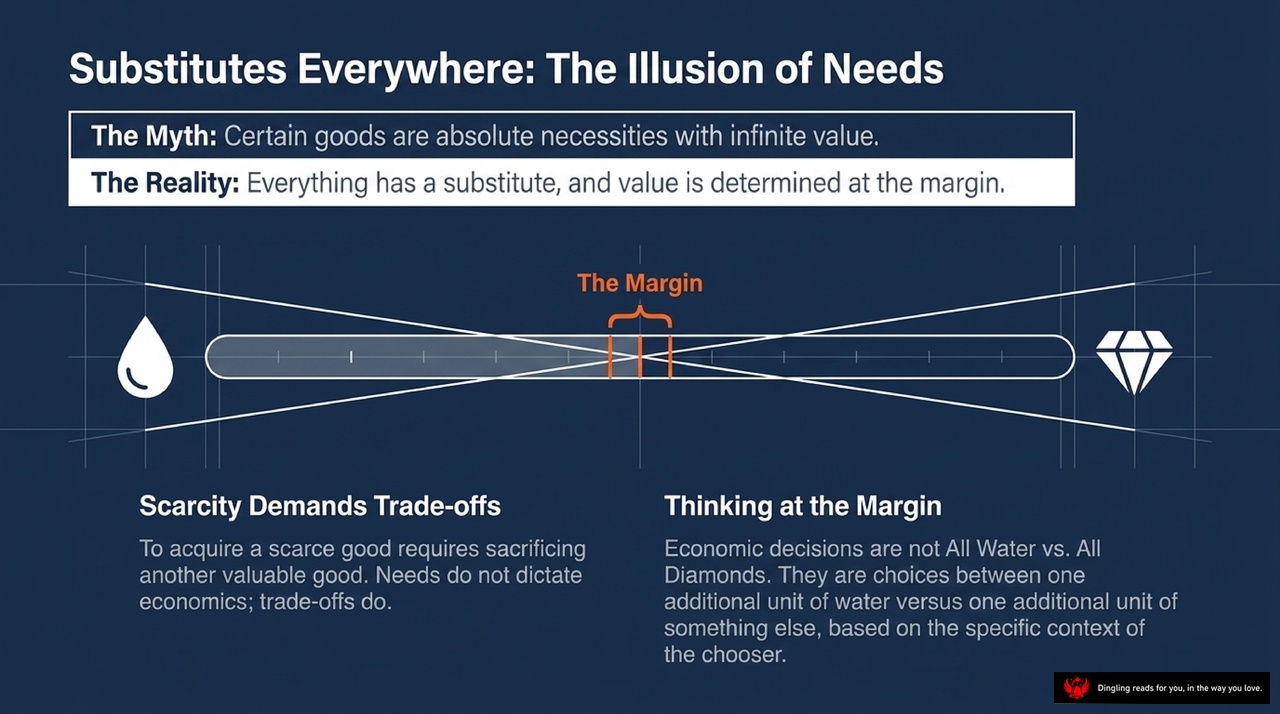
Imagine you're standing in a crowded market. You see a drop of water on the left and a brilliant diamond on the right. Most people assume the water is infinitely valuable because it's a "necessity," and the diamond is just a luxury. But economics tells us this is a dangerous illusion. The reality is far more interesting: everything has a substitute, and true value is determined only at the margin.
Look at the graph on your screen. It illustrates a critical shift in thinking. On the left, under "Scarcity Demands Trade-offs," we see that acquiring a scarce good always requires sacrificing another valuable one. Needs do not dictate economics; trade-offs do. You can't have everything.
But on the right, under "Thinking at the Margin," we see the real engine of decision-making. Economic decisions aren't about choosing between all water versus all diamonds. Instead, it's about choices between one additional unit of water versus one additional unit of something else, based on your specific context. If water becomes incredibly expensive, you might use a broom to sweep the sidewalk instead of watering the lawn. Your value for that specific drop of water changes because you now have a substitute.
This concept destroys the myth that certain goods have infinite value. It reveals that even necessities have substitutes. By understanding that value is determined at the margin, you stop looking at the whole picture and start making smarter, more flexible choices in a world of endless trade-offs.

Imagine a simple 2B pencil. You might assume someone made it from start to finish, but the reality is far more fascinating. Thousands of strangers, speaking different languages and pursuing different goals, coordinate across the globe to produce that single pencil. A logger cuts the wood, a steelworker makes the saw, and a factory worker paints the casing, yet no two people ever meet. This seamless coordination isn't magic; it's the market in action.
The market is essentially a dynamic process that aligns the plans of buyers and sellers. It relies on the interaction of supply and demand. Take the market for acoustic guitars as an example. If the price is set at $500, the number of people wanting to buy matches the number of guitars sellers want to sell. This is market clearing. But if the price jumps to $700, sellers rush to produce more for higher profits while buyers pull back due to the cost. Suddenly, there's a surplus of guitars, forcing sellers to lower prices. Conversely, if the price drops to $300, demand outstrips supply, creating a shortage that pushes prices back up until equilibrium is restored.
Crucially, this competition isn't a battle between buyers and sellers against each other. It's a competition among sellers to attract buyers and among buyers to secure the best deals. This invisible hand guides resources to where they are most valued. However, we must distinguish between "scarce" and "rare." Rarity is just about quantity; a signed baseball might be rare but worthless if no one wants it. Scarcity, on the other hand, is about demand. A signed baseball by a superstar is scarce because everyone wants it, regardless of the absolute number available.
Prices are the signals that communicate this scarcity. When prices rise, they tell us that resources are needed elsewhere. This is why command economies often fail. Without market prices to coordinate supply and demand, planners cannot know what people actually need. We saw this in the Soviet Union, where grain rotted in fields while city shelves remained empty, simply because there was no price mechanism to move the food efficiently.
In a free market, money plays a vital role by drastically reducing transaction costs, allowing us to trade easily without bartering. Even interest rates fit into this logic; they aren't just the price of money, but the price of credit, reflecting our preference for present resources over future ones. While people often try to intervene with administrative controls during crises—like capping gas prices after a hurricane—such actions often backfire. Price ceilings create shortages, leading to long lines and higher actual costs, while price floors, like minimum wage laws or agricultural subsidies, can distort the labor market or lead to surpluses that burden taxpayers. The market's true genius lies in its ability to coordinate these complex interactions without a central conductor, turning individual self-interest into a collective benefit.

Why do companies set prices the way they do? You've probably heard the old school story that businesses just add a percentage to their costs—like, "cost is $10, so I'll sell it for $15." But here's the hard truth: that logic is completely backwards. In the real world, price isn't determined by what it costs to make a product; it's determined by what customers are willing to pay.
Let's look at a real example from the book. Imagine a student named Ed who runs a Friday night movie screening. He has fixed costs of $2,200, and his theater can hold 700 people. If he charges $3, he sells out all 700 tickets, but his total revenue is only $2,100. He's actually losing $100. If he raises the price to $6, he only sells 400 tickets, but now his revenue is $2,400, leaving him with a healthy profit of $200. But the sweet spot is actually at $5. At that price, he sells 500 tickets, generating $2,500 in revenue and a maximum net profit of $300.
So why stop at 500 tickets instead of selling out the whole 700 seats? This is where the concept of marginal revenue gets tricky. If Ed tries to sell more than 500 tickets, he has to lower the price for everyone to attract the extra crowd. That means he loses money on the original 500 customers to gain a little bit on the new ones. Eventually, the money he loses on the old tickets outweighs the money he gains from the new ones, making the marginal revenue negative. The smart move for any price-setter is to find that exact point where the extra money from selling one more item equals the extra cost of providing it.
This logic also explains why you see different prices for different people. Think about college scholarships or airline tickets. If a university charged everyone the same high price, only the wealthy students could afford it. But by offering scholarships to those with lower ability to pay, the school can admit more students and actually double its total revenue. Similarly, if Ed tries to sell a "discount ticket" for $3 to everyone, everyone will buy it, and he ends up back in the red. The solution is to segment the market—sell student tickets at $3.50 and faculty tickets at $6.50. By doing this, he still sells 500 tickets total, but his revenue jumps to $2,725, boosting his profit to $525.
So, forget the idea that costs dictate prices. Whether it's a pizza shop, a university, or an airline, the goal is always the same: maximize the gap between what you earn and what you spend by understanding exactly how your customers react to price changes.

Have you ever wondered how a simple pencil gets made without a single person building it from start to finish? A logger cuts the wood, but doesn't know how to make the steel blade; a steelworker smelts the metal, but has no idea it will end up in a pencil. Yet, thousands of strangers speaking different languages coordinate perfectly to produce it. This is the magic of the market: it's not just a place for trading, but a dynamic system that coordinates the plans of buyers and sellers.
The engine behind this coordination is the interaction of supply and demand. Take the market for acoustic guitars. If the price is set at $500, the number of buyers matches sellers exactly—that's market clearing. But if prices jump to $700, sellers want to produce more while buyers pull back, creating a surplus. To clear that inventory, sellers must lower prices. Conversely, if the price drops to $300, buyers rush in while sellers can't keep up, creating a shortage. This bidding war pushes the price back up until balance is restored.
Crucially, this competition isn't a battle between buyers and sellers; it's competition among sellers and among buyers. This process automatically aligns resources with what people value most. It also teaches us a vital lesson about scarcity: it's not about how few items exist, but how much people want them. A signed baseball might be rare in quantity, but if no one wants it, it's not scarce. A famous athlete's signed ball, however, becomes scarce because demand is high.
Market prices act as the information network that signals this scarcity. They tell us where to invest our resources. Without this pricing mechanism, as seen in failed central planning systems, resources get misallocated—grain rots in the fields while city shelves stay empty. The market, guided by clear property rights and the price system, efficiently lowers transaction costs and directs effort where it's needed most.

Imagine a world where your paycheck isn't a handout, but the direct result of your own value creation. This is the reality of income distribution, and it's far more dynamic than the static pie charts we often see. The truth is, no central "allocator" decides how much you earn; instead, your income is the natural price tag on the specific services you provide to the market. Whether you are a doctor, a teacher, or a tech worker, your earnings reflect the demand for your unique skills and knowledge—what economists call human capital.
But here's the twist: your current income isn't just about today's paycheck; it's a reflection of your long-term choices. By investing in education or training, you are essentially building an asset that pays dividends over your entire life. Consider a medical student; they might be in debt and earn less than a semi-skilled worker in their final year of school, but their future earning potential is vastly higher because they have invested in a high-value skill set.
It's also crucial to distinguish between poverty and inequality. Poverty is an absolute lack of resources, which the U.S. has significantly reduced through growth. Inequality, however, is about the gap between the rich and the poor, which has widened as the economy rewards high-skilled workers more than low-skilled ones. Don't let static data fool you into thinking the poor stay poor forever; income mobility is real. Many families who start at the bottom eventually climb up, while those at the top can fall.
Finally, let's talk about the government's role in this. While redistribution policies like taxes and welfare aim to narrow the gap, they often have unintended consequences. High marginal tax rates can discourage work, and frequent changes to rules can undermine the trust needed for a stable economy. The most powerful driver of wealth creation isn't government handouts, but the protection of private property rights. When people know they can keep the fruits of their labor and investments, they are motivated to innovate, work harder, and create the economic "cake" that everyone can eventually share.
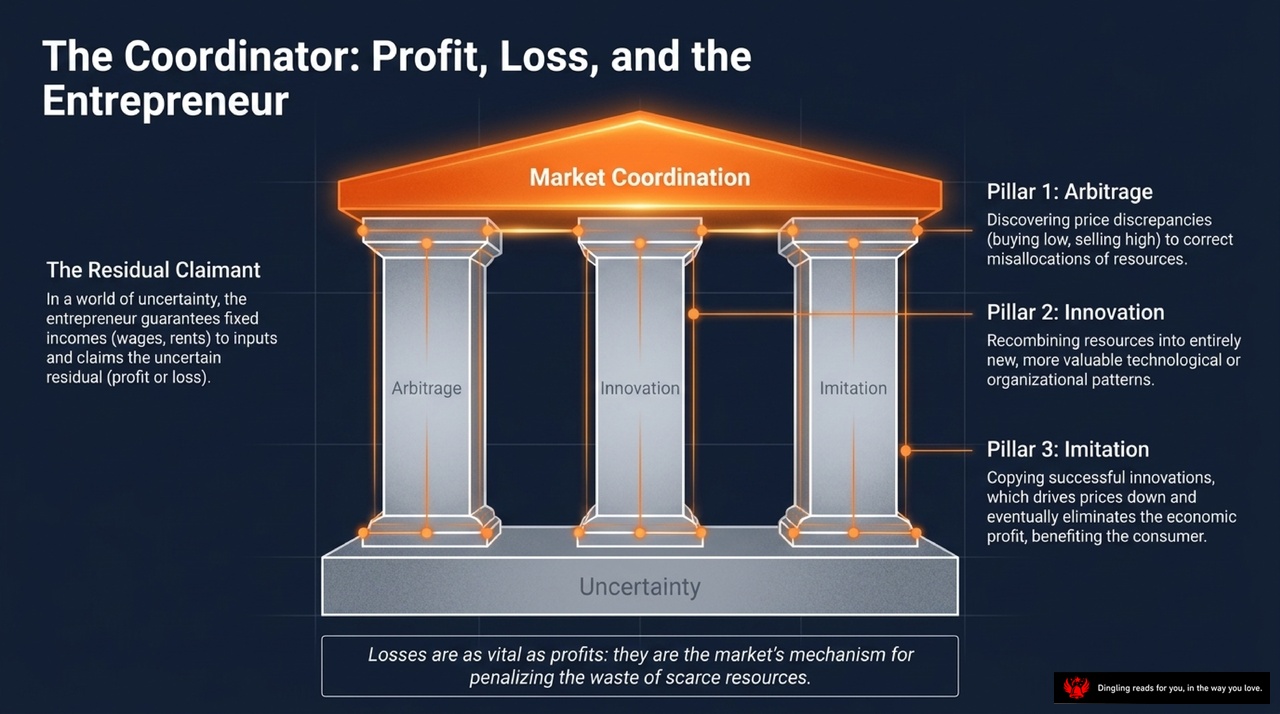
The market isn't just a place to buy and sell; it's a dynamic coordination engine that solves the world's most complex problem: how to align the plans of millions of strangers who have never met. Think about a pencil. No single person knows how to make the wood, the graphite, the metal ferrule, or the painted box. Yet, through the invisible hand of price signals, these disparate resources converge perfectly to create the final product. This is market coordination in action.
But what holds this massive structure together? The answer lies in the entrepreneur, who acts as the market's coordinator. As the slide illustrates, the entrepreneur is the "residual claimant." While wages, rents, and interest are fixed by contracts, the entrepreneur takes on the burden of uncertainty. They guarantee fixed incomes to workers and suppliers but claim whatever is left over—the profit or the loss. This risk is the price of coordination.
This coordination happens through three specific pillars. First is arbitrage. Entrepreneurs spot price discrepancies, buying low in one place and selling high in another, which naturally corrects resource misallocations and equalizes prices across the globe. Second is innovation. This is where true value is created. Entrepreneurs recombine resources into entirely new patterns—think of Henry Ford's assembly line or a new tech startup—making the world richer and more valuable.
However, the system relies on a third pillar: imitation. When others copy successful innovations, competition drives prices down, eliminating economic profits and benefiting the consumer. This cycle of arbitrage, innovation, and imitation ensures resources flow to their most valuable uses. And here is a crucial insight often missed: losses are just as vital as profits. When an entrepreneur fails, they are penalized for wasting scarce resources, sending a clear signal to the market that this path wasn't efficient. Without this mechanism, we would have no way to coordinate our lives effectively.
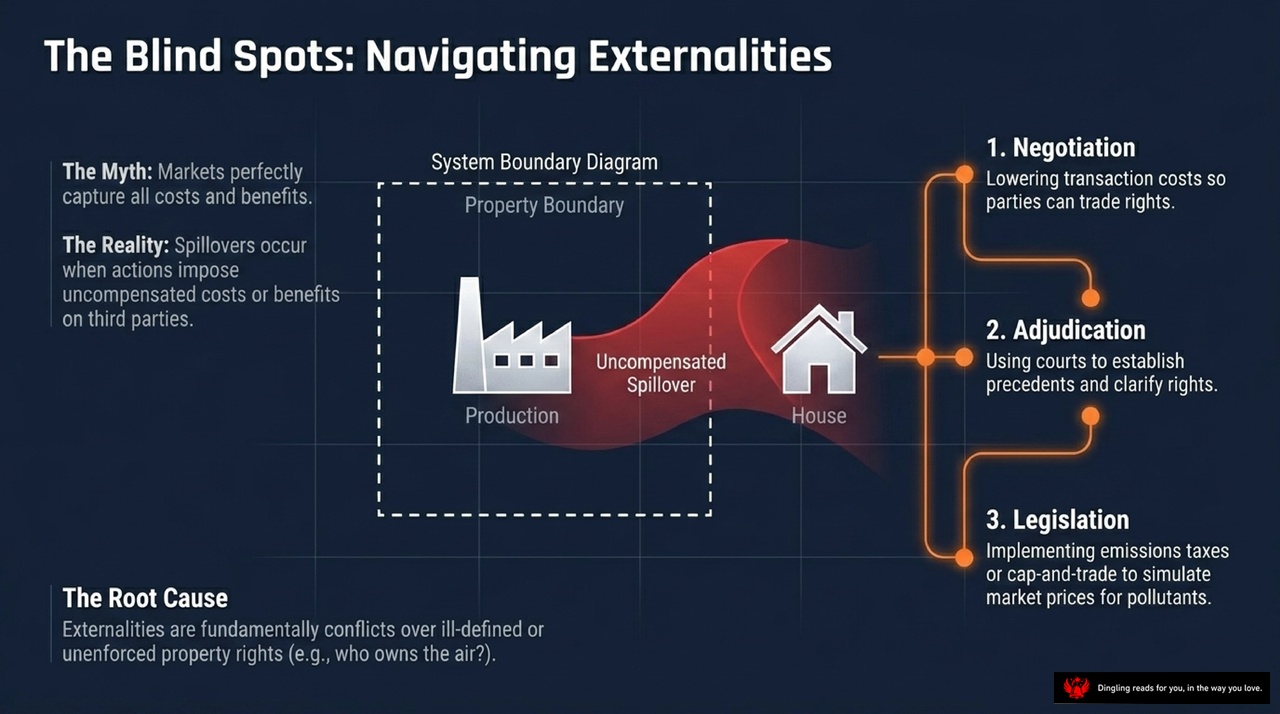
The Blind Spots: Navigating Externalities
So, let's talk about a major economic blind spot that trips up a lot of people: externalities. The slide on the left breaks this down simply. There's a common myth that markets are perfect magic machines that automatically capture every cost and benefit. But the reality? Spillovers happen constantly. This happens when one person's actions impose uncompensated costs or benefits on third parties who didn't agree to them.
Look at that diagram in the center. We have a factory labeled "Production" inside a property boundary, and a "House" right next door. That red wave flowing from the factory to the house is the "Uncompensated Spillover." It's the pollution, the noise, or the traffic congestion that the homeowner suffers from, even though they paid nothing for it. The root cause here is often ill-defined property rights. If no one clearly owns the air or the quiet, there's no one to hold accountable.
So, how do we fix this? The slide on the right outlines three main solutions. First is Negotiation. This is about lowering transaction costs so the parties can trade rights. If it's cheap to talk and agree, the factory owner might pay the neighbor to let them pollute, or the neighbor pays the factory to stop. Second is Adjudication. When negotiation fails, we use courts to establish precedents and clarify who actually owns what rights. Finally, we have Legislation. This is where the government steps in to implement things like emissions taxes or cap-and-trade systems. These policies simulate market prices for pollutants, forcing companies to internalize the cost of their pollution.
Ultimately, these externalities are just conflicts over boundaries. Whether it's air, water, or public roads, we need clear rules to ensure that the costs of our actions don't get unfairly dumped on strangers.
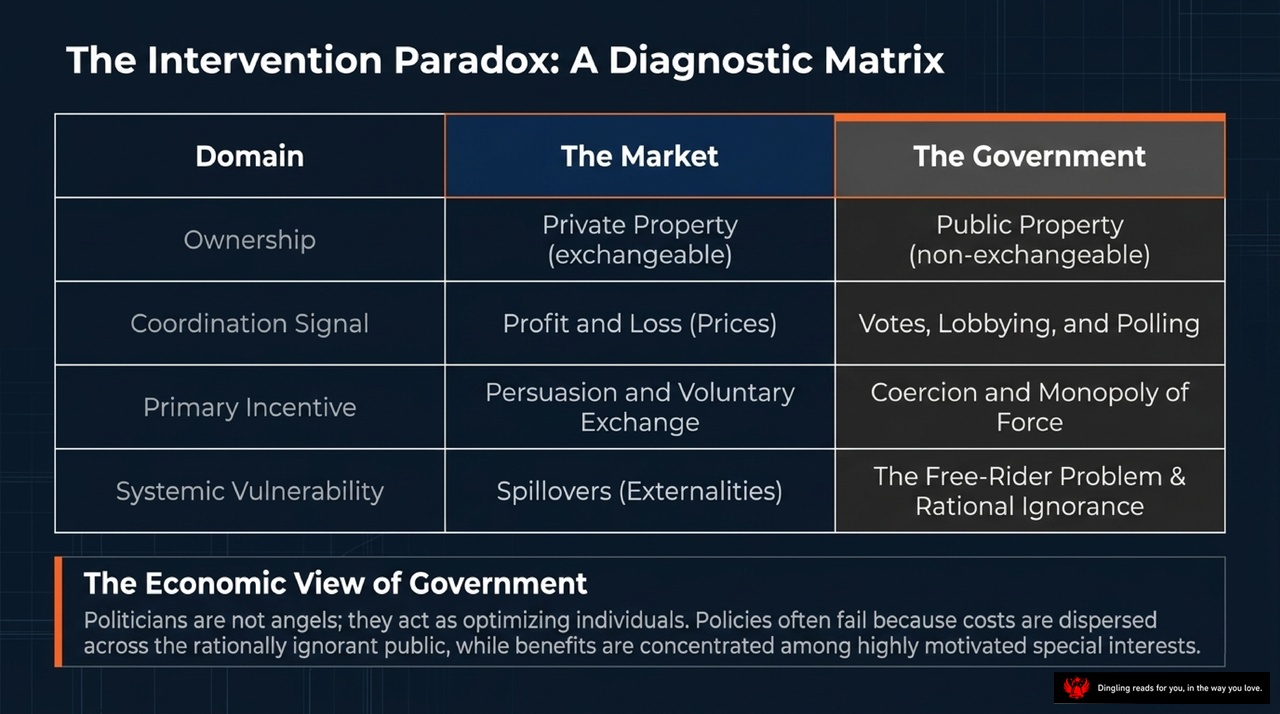
The Intervention Paradox: A Diagnostic Matrix. Let's break down why government and the market often seem to pull in opposite directions. This slide isn't just a chart; it's a blueprint for understanding where each system excels and where they stumble.
On the left, we have the Market. Its foundation is private property—assets you can actually exchange. When you trade, the signal guiding you is simple: profit or loss. Prices tell you exactly what the world values. The market relies on persuasion and voluntary exchange. You aren't forced to buy; you choose. Its main weakness? Spillovers. Things like pollution or noise that affect people who aren't part of the transaction, creating externalities the market ignores.
Now, look at the Government column. Here, property is public and non-exchangeable. You can't buy a vote or sell a law. Instead of prices, the coordination signals are votes, lobbying, and polling. The primary incentive shifts from persuasion to coercion and the monopoly of force. This is the government's superpower, but it's also its vulnerability. It suffers from the free-rider problem—people enjoying public goods without paying—and rational ignorance, where voters don't bother learning the details because one vote doesn't change the outcome.
The bottom section hits home the reality of political decision-making. Politicians aren't angels; they are optimizing individuals. Policies often fail because the benefits are concentrated among highly motivated special interests who lobby hard, while the costs are dispersed across a rationally ignorant public who barely notice. This mismatch is the core of the intervention paradox. Understanding this matrix helps you see that neither system is perfect, and knowing their specific vulnerabilities is the first step to better solutions.
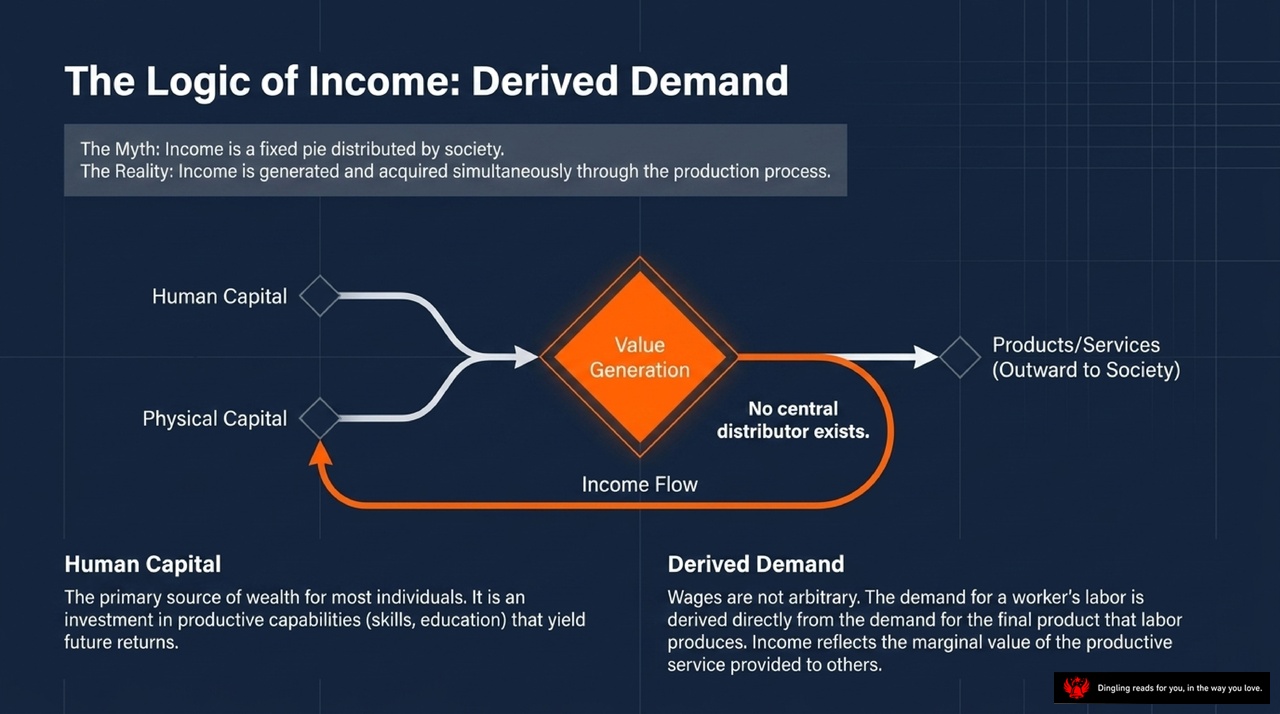
The logic of income isn't about a fixed pie that society hands out; it's about a dynamic engine that generates wealth as we work. As the slide illustrates, there is no central distributor allocating our paychecks. Instead, our income is a direct result of the value we create by combining our human capital—our skills and education—with physical capital to produce goods and services that society actually wants.
Think of it this way: your wages aren't arbitrary numbers decided by a boss or a government. They are simply the market's way of paying you for the specific value of your labor. If you are a skilled carpenter, your income reflects the high demand for your craftsmanship. If the market for your specific product shrinks, your income naturally falls because the demand for your labor has decreased. This is the concept of derived demand: the demand for your work is entirely derived from the demand for the final product you help create.
This framework shifts the conversation from "how should we divide the wealth?" to "how do we create more value?" When we invest in our own human capital through education or training, we increase our productive capabilities, which allows us to generate more value and, consequently, earn higher income. It's a self-reinforcing cycle where our skills drive production, production creates income, and that income funds further investment in our capabilities. Understanding this simple but powerful loop helps us see that our economic well-being isn't about fighting over a static resource, but about continuously improving the tools and skills we use to build the future.

Imagine the economy not as a simple machine, but as a massive, invisible network of individual choices. Today's slide, "Measuring the System: The Macro Illusion," captures a critical insight: our standard tools for understanding the economy are often misleading.
Look at the top of the iceberg. This is "Aggregate Macro-Data"—things like GDP and inflation. GDP measures the market value of final goods and services, giving us a useful pulse of economic activity. It's the tip of the iceberg, easy to see and report. But here lies the trap.
Beneath the surface, we have "The Blind Spots." GDP systematically ignores non-market production, like the hours a parent spends raising a child, or the underground economy. It also fails to account for the qualitative destruction of resources, like pollution or a stressed ecosystem. These are the underwater parts that matter just as much as what's above.
The real danger, however, is in "The Danger of Aggregates." By looking only at the totals, we create an illusion that the economy operates mechanically, like a clockwork device. This is the macro illusion. In reality, the system is built on "Micro-Foundations." It's driven by individual choices, non-market production, and human heterogeneity. True economic understanding requires looking beneath the aggregates to see the countless individual decisions coordinating the system.
So, when we talk about the economy, we must remember that the complex order we see isn't a pre-written script. It's the emergent result of millions of people making their own choices. Ignoring the micro-foundations to focus only on the macro numbers leaves us blind to the real forces driving our world.

The macro disruptions we face today aren't just random bad luck; they are the inevitable result of a specific cycle known as the boom and bust. Look at this graph: it starts with a hidden trap called credit distortion. When central banks artificially suppress interest rates, they send false signals to the market, making it look like money is cheaper than it really is. This trickery triggers an unsustainable boom, where entrepreneurs get overly excited and pour money into long-term projects, convinced that resources are abundant when they aren't.
But every bubble has to pop. As we see in the chart, this leads to a cluster of errors and widespread malinvestment. Eventually, the illusion shatters because true resource scarcity bites back. The sharp drop you see here is the inevitable liquidation. It's not a failure of the free market, as many myths suggest; it's actually a necessary correction. The recession forces us to liquidate these bad investments and realign production with reality. Without this painful but essential process, our economy would just keep building on sand, leading to even bigger crashes later.
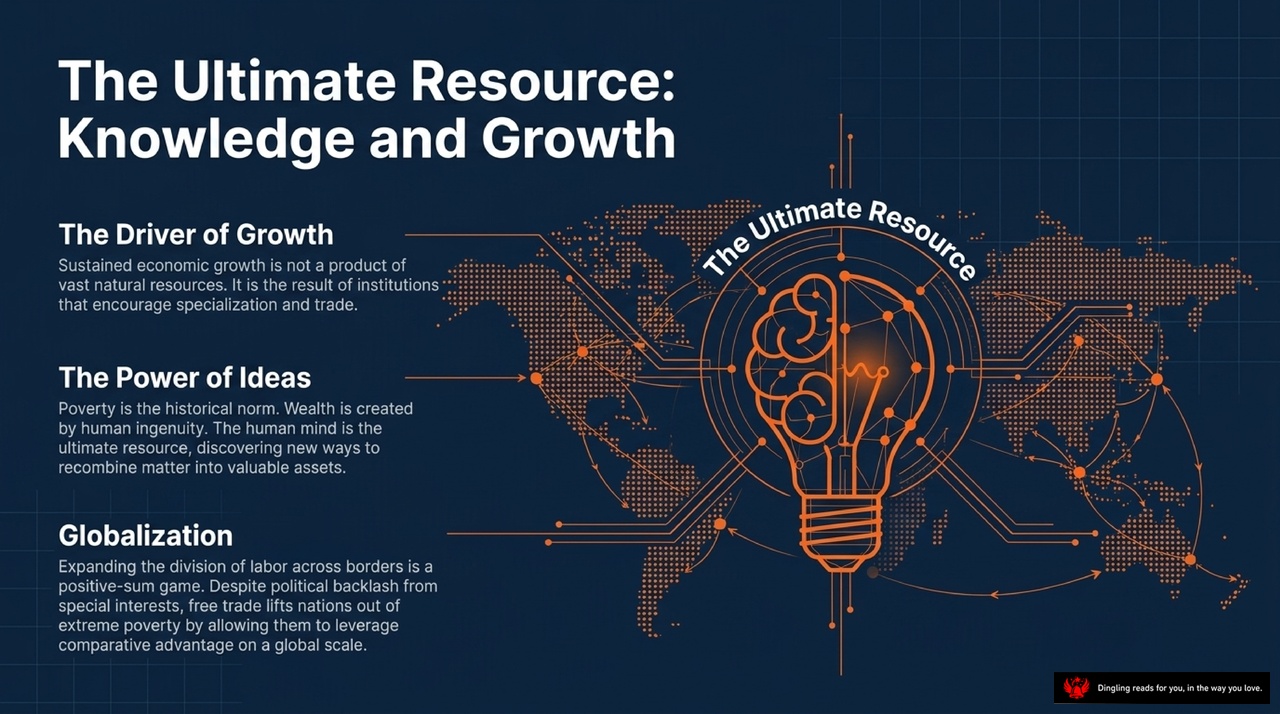
The slide in front of us boldly declares that knowledge and growth are the ultimate resources. It challenges a common misconception: that economic prosperity relies on vast natural endowments. Instead, the text argues that sustained growth is driven by institutions that foster specialization and trade. Look at the graphic of the brain inside a lightbulb connected to a global map—it perfectly illustrates the core idea that human ingenuity, not just raw materials, is what creates wealth.
As the presentation notes, poverty has historically been the norm, while wealth is a product of the human mind discovering new ways to recombine matter into valuable assets. This connects directly to the concept of comparative advantage. When nations expand the division of labor across borders, they engage in a positive-sum game. Even though political backlash often arises from special interests, free trade allows countries to leverage their unique strengths on a global scale, lifting populations out of extreme poverty.
Ultimately, this slide reminds us that the real engine of our economy isn't the land we own or the resources we extract, but the ideas we generate and the systems we build to share them. Globalization, when done right, turns the world into a massive, collaborative laboratory for growth.

The image presents a powerful visual metaphor: concentric circles expanding from "The Market" at the center, out through "Institutions," and finally to "Global Society." This diagram illustrates a crucial point made on the slide—economic thinking is a lens, not a dogma. It reveals that the awe-inspiring architecture of human civilization isn't the product of some grand central design, but rather the spontaneous result of millions of individuals optimizing their choices within the rules of the game.
Think about it. We often look for top-down control to explain how society works, but the economic lens shows us something different. True wealth depends not on government mandates, but on the freedom of individuals to discover and trade their unique advantages. When we shift our perspective from good intentions to systemic incentives, opportunity costs, and unintended consequences, we see how the market coordinates these interactions.
So, the question the slide poses is vital: Are the policies we champion today building the foundation for human flourishing, or are we dismantling the very machinery that makes social cooperation possible? By understanding the market as a lens, we can better judge whether our institutions are empowering individuals or stifling the spontaneous order that drives progress.