
The Education of Children: Complete Chapter-by-Chapter Summary
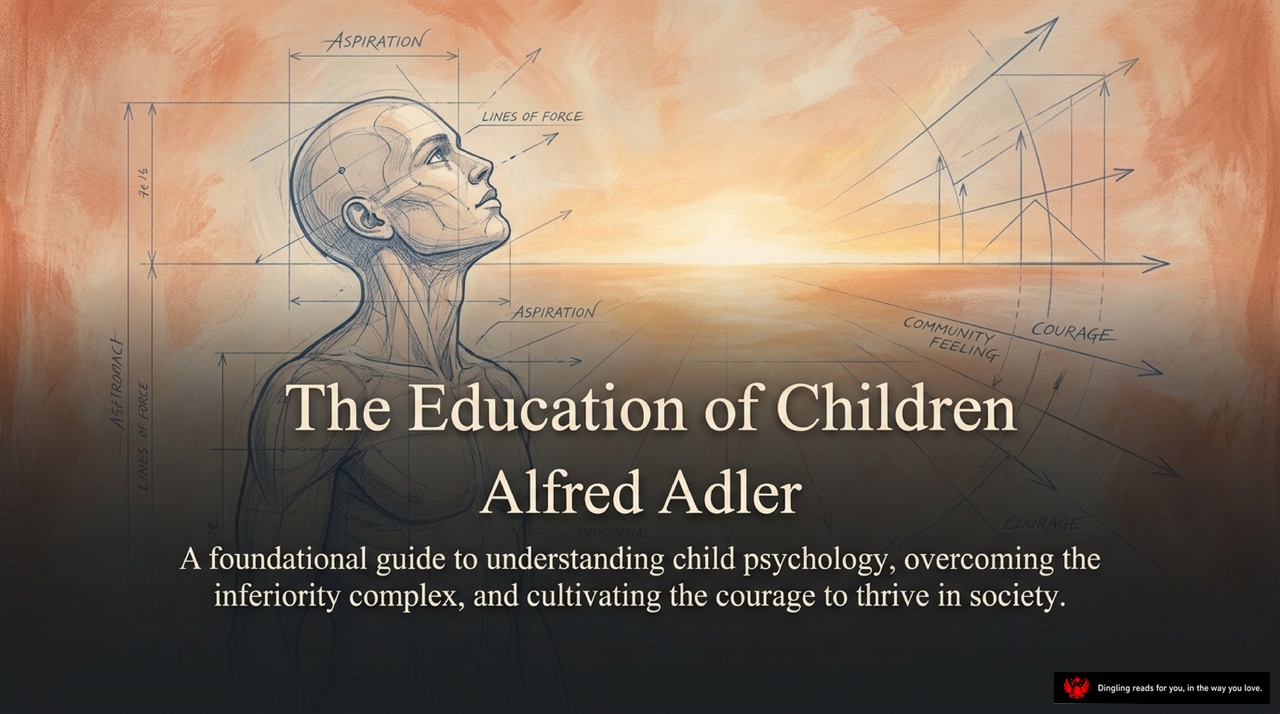
Welcome to our deep dive into Alfred Adler's timeless masterpiece, *The Education of Children*. This book isn't just about school; it's a foundational guide to understanding the very heart of child psychology. As you see in the image, we are looking at the delicate balance between aspiration and the lines of force that shape a life. Adler teaches us that education is the art of helping children overcome the inferiority complex and cultivate the courage to thrive in society.
At its core, this book argues that every child is the creator of their own life story. However, their perception of the world—especially during those formative early years—can create a distorted map that they follow for a lifetime. If a child feels small or overlooked, they might build a life dedicated to proving they are not. Conversely, if they feel secure and connected, they develop the social interest and courage needed to contribute meaningfully to the world.
Adler challenges us to look beyond simple behavior correction. He reminds us that a child's actions are not isolated incidents but part of a unified personality striving for significance. Whether it's overcoming shyness, managing sibling rivalry, or navigating the complexities of adolescence, the key lies in fostering a sense of belonging and competence. By understanding these psychological dynamics, parents and educators can move from being disciplinarians to becoming true guides, empowering the next generation to face life's challenges with confidence and purpose.

The Author and The Canvas. As the slide reminds us, "Everyone is a painting, and also the author of this painting." This powerful metaphor suggests that we are not just passive subjects in our own lives; we are the creators, constantly drawing our own story.
Look at the central figure here. This isn't just a baby; it represents every one of us at the start of our journey. At the heart of this child sits the "Unified Life Goal." This is the most critical concept in understanding human behavior. We often look at a child's actions in isolation—maybe they're throwing a tantrum or refusing to do homework. But here, we see that no single behavior exists in a vacuum. Every action, mistake, or gesture is a coordinated expression of their unified personality, all pointing toward that central life goal.
The "Key Insight" on the left explains this perfectly. A child's actions cannot be judged as isolated incidents. If we try to understand a child by looking at just one behavior, we miss the whole picture. To truly understand the behavior, as our "Takeaway Box" suggests on the right, we must first uncover the hidden psychological backdrop. We need to stop extracting single notes from the symphony and instead listen to the whole composition.
Think about it like this: just as a musician plays every note to create a specific melody, a child acts in a specific way to achieve a specific purpose. If a child seems lazy or rebellious, it's not because they are "bad." It's because their current strategy is the only path they can see to reach their internal goal. By understanding that their entire life is a connected system driven by this unified goal, we can stop punishing symptoms and start helping them rewrite their story, moving from a life of struggle to one of genuine growth and success.

Have you ever wondered why some children struggle to connect with the world around them? The answer often lies in a powerful, invisible force that shapes their entire life: social interest.
Look at this slide. It highlights a critical concept: **Social Interest**. This isn't just about being nice; it's the fundamental psychological drive to cooperate with others and contribute to society. Think of it as the bridge between the individual and the community.
Interestingly, this human need for connection isn't unique to us. Darwin observed that animals without natural weapons, like apes or cattle, rely on group living for survival. They develop their own social laws to protect the herd. Humans are the same. Because we aren't physically strong like predators, we depend on our group for protection and growth. This is why social interest is the bedrock of our logic, language, and even our sense of safety.
But here is where things often go wrong for children. When a child is isolated, over-indulged, or constantly criticized, their ability to develop this social interest stalls. Without it, they struggle to understand logic or feel secure. A child who never learns to communicate or cooperate will eventually find themselves disconnected from reality and from other people.
We also see how a child's position in the family impacts this development. Consider the youngest child. Born into a position of weakness, they often feel a desperate need to prove themselves. If they succeed, they feel secure. But if they feel their efforts are futile, they can become paralyzed by fear. Conversely, the eldest child, once the "only" child and the center of attention, may struggle with jealousy or feel threatened when siblings arrive, leading them to cling to rules or withdraw socially.
Ultimately, every child's behavior is a reflection of how they perceive their place in the social world. If they feel they don't belong or don't understand the rules of cooperation, they will act out. Education, therefore, isn't just about teaching facts; it's about nurturing this social interest. We must help children understand that their true strength comes from connecting with others, not from standing alone. When we build this foundation, we give them the courage to face the future and the wisdom to live as part of a whole.

When we look at the slide titled "The Origins of the Inferiority Complex," we are seeing the blueprint of how childhood shapes our entire adult personality. Adler identifies three specific archetypes that struggle with feelings of inadequacy, and understanding them is key to unlocking a child's potential.
First, we have "The Organically Inferior." These are children born with physical deficits or who suffer from prolonged illness. Because they are physically weaker than their peers, they develop a worldview that sees the world as hostile and demanding. Their survival instinct teaches them that they must constantly fight to be noticed, often leading them to seek immense encouragement just to build a shred of confidence.
Next is "The Pampered Child." These children have never learned independence because their parents remove all obstacles for them. They grow up expecting the world to cater to their every need. When they inevitably face a lack of attention or a minor setback, they don't see it as a normal part of life; instead, they view it as a profound injustice. Their worldview is one of entitlement, and they struggle immensely when reality doesn't match their expectations.
Finally, we have "The Neglected Child." This is perhaps the most tragic category. These children have never experienced love, warmth, or cooperation. To them, the world isn't just difficult; it is an enemy to be fought, manipulated, or avoided. Because they have never felt safe or connected, they develop a cynical worldview where trust is impossible, and they often become cold or defensive to protect themselves from further rejection.
The core message here is that these aren't just labels for "bad kids." They are protective mechanisms. Whether it's the physical weakness of the first group, the entitlement of the second, or the isolation of the third, all three stem from a fundamental lack of security and a distorted perception of their place in the world. Recognizing which category a child fits into allows parents and educators to stop blaming the child and start understanding the root cause of their behavior, paving the way for genuine healing and growth.

Social Feeling is the ultimate metric for a child's future success. As the slide illustrates, mental health and our ability to thrive in life hinge entirely on this one core capability: the ability to cooperate and connect with others. Without it, a child will inevitably struggle to master life's three fundamental tasks: navigating society, finding a meaningful occupation, and building a healthy love life.
Think of society not just as a place, but as the "I-You relationship"—the art of friendship and communal life. Then look at occupation, which is about contributing value to the world and understanding our relationship with the Earth. Finally, there is love, which involves navigating gender, partnership, and intimacy. All three circles intersect at the center: Social Feeling.
If we look at the text, we see that social feeling is the true barometer of a child's development. It's the difference between a child who can build a life and one who gets lost. When children lack this social interest, they often fail because they haven't learned that their worth comes from being useful to others. Instead of connecting, they might isolate themselves or become overly selfish.
The slide also highlights a critical warning: parents and educators must never let a child form a bond with only one person. Relying on a single relationship creates a fragile foundation. True growth happens when children learn to navigate complex social dynamics, turning their natural desire for superiority into something constructive that benefits the group. It's about shifting from a mindset of "me against the world" to "me as part of the world."

When we look at how birth order shapes our psychology, we see three very distinct archetypes that define a child's entire world. First, there is **The Firstborn**. The image shows a throne, and the text explains their dynamic: they were once the absolute center of attention, but suddenly get dethroned by the second child. This shift creates a deep psychological need. They come to revere power, rules, and authority above all else. Because they feel they've lost their special place, they are often prone to feeling wronged and will fight relentlessly just to regain that lost "throne."
Next, we have **The Youngest**. The graphic here looks like a rising bar chart, symbolizing growth and competition. Their dynamic is that of the "perpetual baby," always surrounded by older siblings who act as pacesetters. Their psychology is driven by intense competition; they want to outpace everyone. This can make them highly ambitious, but it also carries a risk. If they feel the gap between them and their older siblings is unbridgeable, they can completely give up, letting their potential fade away.
Finally, there is **The Only Child**. The visual shows a mix of large and small circles, representing a world without peers. Their dynamic is unique because they live exclusively in a world of adults. Their psychology is highly dependent on maternal or parental attention. Because they never had to compete with a sibling, they often struggle significantly when forced into egalitarian environments where everyone is expected to share the spotlight. Understanding these three positions helps us see that a child's behavior isn't random; it's a direct response to their specific psychological positioning in the family.

The Anatomy of Pampering reveals a vicious cycle that starts with over-protection and ends in learned helplessness. When parents remove all obstacles and solve every problem for their child, the child never develops the skills to handle life's challenges. This leads to learned helplessness, where the child fails to build independence, resilience, or courage.
But what happens when these children finally enter the real world, like school? They face an environmental shock. Suddenly, they are no longer the center of the universe. Without the skills to cope, they react with problem behavior—crying, laziness, or disruption—to force adults back into their service.
This isn't just about bad behavior; it's a cry for help from a child who has never learned how to stand on their own. The cycle continues, trapping them in a pattern of dependency. Breaking this cycle requires us to stop shielding children from every difficulty and instead teach them the courage to face it. True growth happens not when we clear the path for them, but when we give them the tools to walk it themselves.

School is often just about grades, but it's actually the ultimate preparation test for a child's life. As we see in this diagram, school acts as the critical bridge between the safety of the family and the complex demands of society. On the left, we have the family, where a child's private life goal is often centered on being the absolute focus of attention. On the right lies society, which operates on a different rule: cooperation and following shared standards. The challenge arises right in the middle, where the child's desire to be the center of the world violently clashes with the school's requirement to work as part of a team. This is the core conflict.
Many parents mistakenly believe that school creates "problem children," but the reality is far more revealing. School doesn't create these issues; it simply exposes the flaws in early family preparation. If a child hasn't learned how to share or cooperate at home, entering a classroom becomes an overwhelming failure. They feel isolated and misunderstood, often labeled as difficult, which only reinforces their behavior. This is a cycle of failure in psychological preparation, not academic failure. The real test isn't whether a child can solve a math problem, but whether they have the courage and social emotional skills to navigate a world where they are no longer the only person in the room. By understanding this clash, we can shift our focus from punishing behavior to building the social confidence children desperately need to succeed.

Decoding the Language of Misbehavior isn't just about seeing what kids do; it's about understanding what they are trying to say when words fail. Think of misbehavior as a secret code where the symptom is just the opening line, and the real message is hidden underneath.
Look at the first row: Laziness and Apathy. On the surface, it looks like a child just doesn't care, but the hidden goal here is protecting the ego. The psychological root is a clever defense mechanism: "If I don't try, you can't say I'm stupid—only that I'm lazy." It's a shield against failure.
Next, consider Stuttering or Bed-wetting. These aren't just physical glitches; they are a child forcing special attention and care. Psychologically, they are regressing to infancy to secure parental service and evade the heavy expectations of adulthood. It's a way to say, "I need you to take care of me."
Finally, look at Playing the Clown or Disrupting. This behavior aims at achieving cheap significance. When positive superiority feels out of reach, negative superiority becomes the easiest shortcut to being noticed. Instead of trying to be the best, they choose to be the loudest or the most chaotic just to ensure they aren't ignored.
The key takeaway? Every misbehavior is a cry for help wrapped in a specific strategy. By understanding these roots, we stop reacting to the symptom and start healing the child behind the behavior.

Arrogance is often just a mask hiding deep-seated cowardice. Think of it like an iceberg: what we see on the surface—defiance, rebellion, and a brash attitude—is only the tiny tip. Beneath the water lies the real bulk: a profound lack of courage and deep discouragement.
This happens because of a psychological trap called the "All or Nothing Fallacy." Many discouraged children view the world in extremes. If they can't be the absolute best, they prefer to be the absolute worst. Instead of facing the risk of failure in real challenges, they take the "short-cut to superiority." They choose cheap victories like bullying or truancy to maintain a false sense of power. It's a self-fulfilling prophecy: by avoiding the hard work required for genuine growth, they convince themselves they are powerful, while actually protecting a fragile, fearful core.
The defining trait of this behavior isn't badness; it's a fear of being ordinary or failing. True strength comes from the courage to face challenges, not from pretending you don't need them.

Adolescence: The Amplifier. Think of this phase not as a total reinvention, but as a powerful magnifying glass. It doesn't rewrite a child's core personality; it simply amplifies everything they have already built—or failed to build—during their childhood. As we see on this timeline, the journey moves from Childhood, through the intense turbulence of Adolescence, straight into Adulthood.
This is the critical "Danger Zone." If parenting was too strict or controlling back home, that rigidity explodes here. Teenagers feel a biological, urgent need to prove they are no longer children. When authority feels like a cage, rebellion becomes the only way to breathe. That's why the old model of authoritative control fails catastrophically.
The solution lies in the other box: shifting from control to trust. Parents and educators must step out of the role of commanders and become partners. We need to move toward an egalitarian friendship. By offering trust instead of demands, we allow the teenager's natural drive for independence to flourish constructively. When we treat them as equals, we stop fighting the current and start helping them navigate the waves toward a healthy adulthood.

Stop right there and look at this slide. Today, we're talking about the "Anti-Toolkit"—the four specific traps that parents and teachers accidentally set, which only end up reinforcing a child's failure.
First, let's look at **Harsh Punishment**. When you punish a child severely, you aren't just correcting behavior; you are confirming their deep-seated belief that the world is hostile. This doesn't fix the problem; it invites rebellion and revenge.
Next is **Humiliation & Pessimism**. Have you ever heard someone say, "You will never amount to anything"? That phrase strips a child of their last ounce of hope. It doesn't motivate them; it guarantees failure by destroying their self-worth.
Then we have **Excessive Pressure**. Forcing immense ambition on a child breaks their confidence. When they inevitably face normal, everyday difficulties—which every child faces—they crumble because they weren't taught resilience, only perfection.
Finally, **Treating Symptoms**. This is perhaps the most common mistake. Imagine punishing a child for forgetting their books, without ever addressing the root cause, which might be a deep dependency on a parent. Punishing the symptom is entirely useless.
The core message here is simple: if you focus on these four things, you are building a toolkit that ensures failure. True growth comes from understanding the whole person, not just fixing the visible cracks.

The Path to Psychological Rehabilitation isn't just a metaphor; it's a concrete roadmap for transforming a child's life. As we climb these steps together, remember that we aren't fixing broken parts—we are guiding a whole person toward a new way of being.
It all starts at the bottom with decoding the goal. Before you can help a child, you must understand their hidden logic. Don't just react to their provocation; look deeper to find the insecurity driving them. Once you see the real issue, you can build a bridge of trust. This is where empathy wins over authority. You cannot influence a child who views you as an enemy, so win them over by connecting with their feelings, not by demanding obedience.
Once that bridge is built, the next step is to encourage, encourage, encourage. Shift the focus from innate talent to effort and time. Prove to the child that difficulties can be overcome. When they realize that success comes from persistence rather than magic, their confidence grows. Finally, we reach the top step: cultivate social feeling. Guide their striving for superiority away from dominating others and toward contributing to the group. When a child feels they belong and can make a difference, the cycle of insecurity breaks, and true psychological rehabilitation begins.

Think of the healthy adult not as a finished statue, but as a fully built temple, standing strong on the foundation of character. As we've seen, education is far more than just transferring facts from a textbook; it is the very engineering of character. This blueprint rests on three essential pillars that support the roof of a balanced mind.
First, we have Courage. This is the willingness to face inevitable difficulties head-on, without looking for easy shortcuts or misbehaving to avoid the hard work. It's about standing firm when life gets tough.
Next is Independence. This means breaking free from the trap of being pampered. It is the freedom to solve your own problems and face reality without relying on others to fix things for you.
Finally, there is Social Interest. This is perhaps the most crucial pillar. It is the deep understanding that true superiority isn't found in ruling over others or making them feel small. Instead, real greatness comes from being useful to others and contributing to the community.
When these three elements—Courage, Independence, and Social Interest—are aligned, they create a stable structure for a healthy mind. Without this foundation, a person might crumble under pressure or turn inward, seeking power over others rather than connection with them. By building this character, we don't just prepare children for school; we prepare them for a meaningful life.

A child's misbehavior is never a permanent defect, but a misguided plea for significance born from a lack of courage and social connection. This is the core truth we must grasp as parents and educators. Instead of seeing our children's actions as simple bad behavior, we need to ask ourselves a deeper question: Are we merely punishing their symptoms, or are we brave enough to understand their hidden goals and teach them how to truly belong?
When a child acts out, it is often a cry for help, a desperate attempt to feel significant in a world where they feel small or disconnected. They aren't trying to be difficult on purpose; they are trying to find a place in the social fabric. If we respond only with punishment, we are treating the symptom while ignoring the root cause. We need to shift our perspective from judging the behavior to understanding the child's inner struggle. By helping them build genuine social connections and giving them the courage to face challenges, we can guide them away from these misguided paths and toward a life of true belonging and success.