
The Elegant Universe: Complete Chapter-by-Chapter Summary

Welcome to *The Elegant Universe* by Brian Greene, where we explore the quest for the ultimate theory of everything. This presentation is framed by the elegant mathematics of physics, from the iconic $E=mc^2$ to the complex equations of quantum mechanics and general relativity that define our modern understanding of reality. At the heart of this journey lies the search for a unified framework that can reconcile the vast, curved fabric of the cosmos with the chaotic, probabilistic world of the very small. We are looking at hidden dimensions, superstrings, and the profound challenge of finding a single, beautiful equation that explains the entire universe.
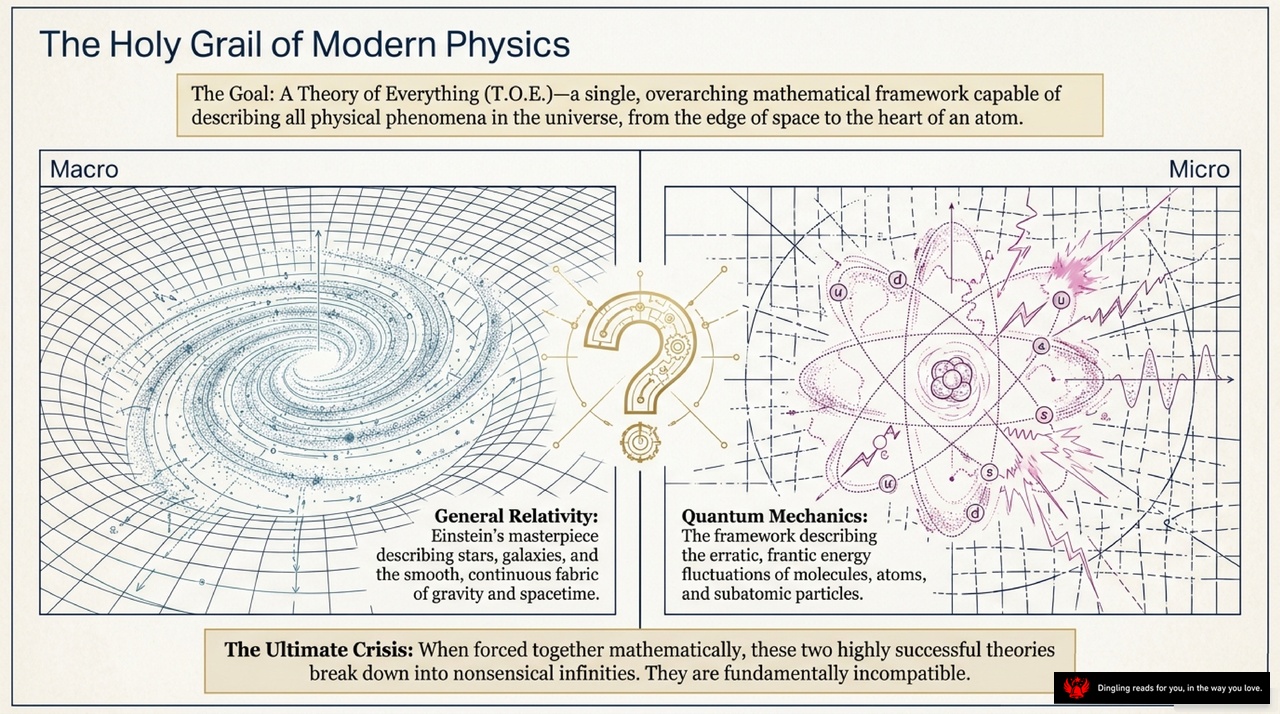
The Holy Grail of Modern Physics is the search for a Theory of Everything—a single, overarching mathematical framework capable of describing all physical phenomena in the universe, from the vast edge of space to the tiny heart of an atom. But here lies the ultimate crisis: when we try to force our two most successful theories together, they break down into nonsensical infinities. On the left, we have the Macro world, governed by Einstein's General Relativity. It beautifully describes stars, galaxies, and the smooth, continuous fabric of gravity and spacetime. On the right, we have the Micro world, where Quantum Mechanics rules. This framework describes the erratic, frantic energy fluctuations of molecules, atoms, and subatomic particles. For decades, these two pillars of physics worked perfectly in their own domains, but they are fundamentally incompatible. When forced together mathematically, they clash. This is why physicists are so desperate for a unified theory that can finally bridge the gap between the smooth cosmos and the chaotic quantum foam.

The Engine of Progress: Three Grand Conflicts
Imagine the history of physics not as a straight line, but as a staircase, where each step is built by solving a massive contradiction from the one below it. Today's slide outlines exactly that: the three great conflicts that drove our understanding of the universe forward.
Let's start at the bottom with Step 1: the late 19th century. Here, we had a clash between Newton's laws of motion and Maxwell's discovery that the speed of light is constant. Newton thought you could outrun light, but Maxwell said no. The resolution? Einstein's Special Relativity. He showed that space and time are relative, while light speed remains absolute, effectively rewriting the rules of reality.
Moving up to Step 2 in the early 20th century, a new conflict emerged. Special Relativity set a universal speed limit, but Newton's theory of gravity assumed gravity acted instantly across the universe. Einstein resolved this with General Relativity, revealing that gravity isn't a force pulling from afar, but the curvature of spacetime itself. This unified the speed limit with gravity.
Finally, we reach Step 3: the late 20th century, where we stand today. The conflict is between the smooth, curved geometry of General Relativity and the frantic, jittery nature of Quantum Mechanics. These two giants refuse to get along at the smallest scales. The proposed resolution is String Theory, aiming to be the ultimate reconciliation by unifying all forces and matter into a single framework. This journey from Newton to Strings is the true engine of our progress.

Welcome back to our deep dive into the core crisis of modern physics. Today's slide tackles the most stubborn problem in all of science: the "Quantum Jitters."
Look at the diagram on the left. It illustrates a fundamental clash between two giants of physics. At the "Normal Scale," where we live, Einstein's General Relativity demands a perfectly smooth, continuous fabric for spacetime to function. It's like a calm ocean surface. However, as we zoom down to the "Atomic Scale" and finally to the "Planck Scale"—that tiny $10^{-33}$ cm threshold—Quantum Mechanics takes over. Operating on the Uncertainty Principle, energy and momentum start to fluctuate frantically. Instead of a smooth ocean, spacetime violently undulates, becoming a turbulent, boiling "quantum foam."
This instability leads directly to the "Point Particle Problem" highlighted in the bottom right. Standard physics treats fundamental particles as zero-dimensional dots. This creates a mathematical disaster. When these point-like particles interact at a single, infinitely concentrated spot, the equations explode into infinities. It's as if trying to calculate the pressure of a gas by squishing all the molecules into a single point; the math breaks down completely, destroying the smooth fabric of spacetime that General Relativity relies on.
The image perfectly captures why we need a new theory. We can't have a smooth geometric universe on top of a jittery, foamy foundation if the building blocks are mathematical points. This is the crisis that String Theory was born to solve.

What if the universe's fundamental building blocks aren't dots, but threads? Imagine zooming in on reality with a microscope millions of times more powerful than anything we have today. Instead of finding zero-dimensional points, we'd discover one-dimensional, vibrating loops. This is the core idea of String Theory, the elegant resolution to physics' greatest conflict.
The image on your screen illustrates this journey from the macroscopic to the microscopic. We start with a familiar object, like an apple, and zoom in. We see molecules, then atoms, then protons, and finally quarks. In standard physics, we hit a wall at the quark level, treating them as point-like particles. But String Theory suggests that at the deepest level—Stage 6—these particles are actually tiny, vibrating strings. Different vibration patterns correspond to different particles and forces, creating a unified symphony of the cosmos.
This shift from points to strings solves a critical problem. When physicists try to combine General Relativity and Quantum Mechanics using point particles, the math breaks down into infinite chaos at the smallest scales. But because strings have physical length, they "smear out" these violent quantum fluctuations. This smoothing effect eliminates the infinities, allowing gravity and quantum mechanics to finally harmonize. It's a profound realization: the universe might be far smoother and more orderly than our current models suggest, woven together by these invisible, vibrating threads.

Today's slide highlights a fundamental paradigm shift in physics: moving from the Standard Model's "point particles" to String Theory's "1D Strings." Let's break down what this really means for our understanding of the universe.
First, look at the "Fundamental Unit." In the Standard Model, we've been treating particles like quarks and electrons as zero-dimensional dots—mathematical points with no size. But String Theory flips this script. It proposes that the basic building blocks of reality are actually one-dimensional vibrating loops. Think of it as upgrading from a pixelated image to a smooth, continuous curve.
This change solves a massive problem regarding the "Origin of Properties." In the Standard Model, properties like mass and charge are just arbitrary numbers we measure; we don't know why they are what they are. String Theory, however, says these properties are determined purely by the resonant vibration pattern of the string. It's like a violin string: the same string can produce different notes simply by changing how it vibrates. Similarly, different vibration modes create different particles, meaning there is "Only one type of stuff" at the core of the universe. Everything we see is just a different note on the same cosmic instrument.
This unification also brings gravity into the picture. The Standard Model excludes gravity because it can't be quantized, creating a huge gap in our physics. String Theory inherently includes gravity; one specific vibration mode perfectly matches the Graviton, the particle responsible for gravity. Finally, this shift comes with a cost in dimensions. While our everyday experience fits into 3 spatial dimensions plus 1 time dimension, String Theory requires a higher-dimensional universe—specifically, 9 spatial and 1 time dimension (10 Total). The extra dimensions are likely curled up so tightly that we can't see them, but they are essential for the math to work.
So, the shift from a dot to a string isn't just a geometric change; it's a unification of matter, forces, and gravity into a single, elegant framework.
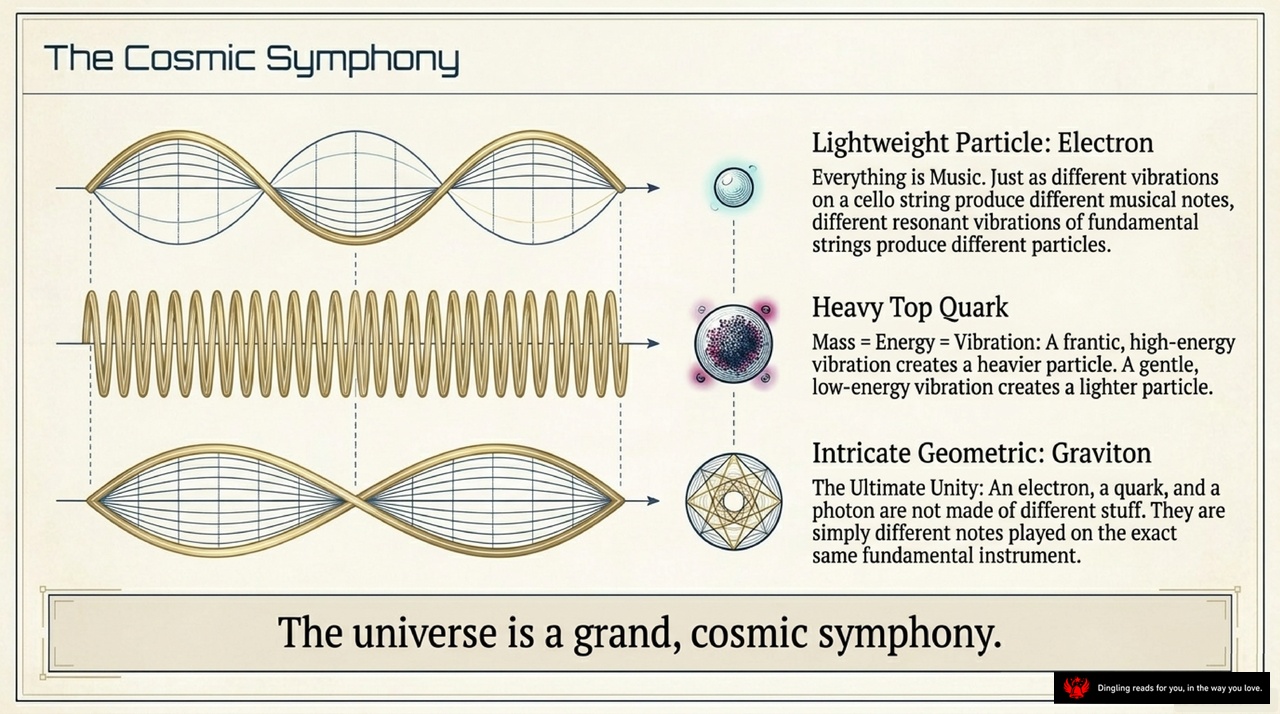
The universe isn't just a chaotic explosion of matter; it is a grand, cosmic symphony. As we've explored, the fundamental building blocks of reality—electrons, quarks, even the elusive graviton—are not distinct, separate objects made of different stuff. Instead, they are simply different notes played on the exact same fundamental instrument: the vibrating string.
Think of it like a cello. Just as different vibrations on a single string produce distinct musical notes, different resonant vibrations of these fundamental strings produce the diverse particles we observe. A lightweight electron results from a gentle, low-energy vibration, while a heavy top quark is created by a frantic, high-energy vibration. Even the intricate geometry of a graviton emerges from the same source.
This unification solves the century-old conflict between gravity and quantum mechanics. Because all forces and particles are just different modes of the same vibrating entity, the universe operates on a single, elegant set of rules. We are not looking at a fragmented reality, but listening to one continuous, magnificent song.
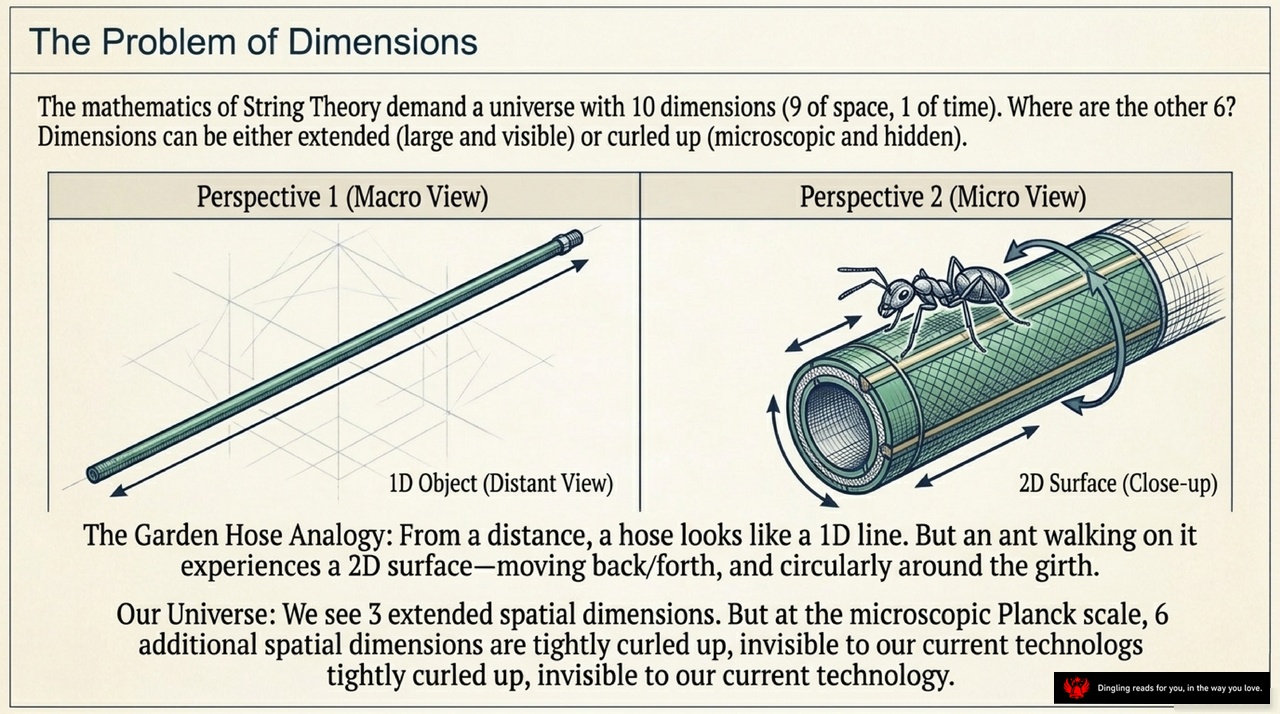
Imagine looking at a garden hose from across the yard. To your eye, it's just a simple one-dimensional line stretching into the distance. But if you were an ant crawling on that hose, the experience would be completely different. You wouldn't just move forward and backward along the line; you could also walk in a circle around the hose's circumference. To the ant, the hose is a two-dimensional surface.
This "garden hose analogy" perfectly illustrates one of the most mind-bending concepts in modern physics: the problem of extra dimensions. String theory suggests our universe actually has ten dimensions—nine of space and one of time. Yet, we only perceive three spatial dimensions. Where did the other six go?
The answer lies in scale. While three dimensions are extended and visible to us, the remaining six might be curled up into microscopic loops, hidden from our view. At the vast scale we inhabit, these extra dimensions are invisible, just like the hose's circumference is invisible from far away. However, if we zoom in to the incredibly tiny Planck scale, those hidden dimensions would become apparent, fundamentally changing how we understand the fabric of reality.
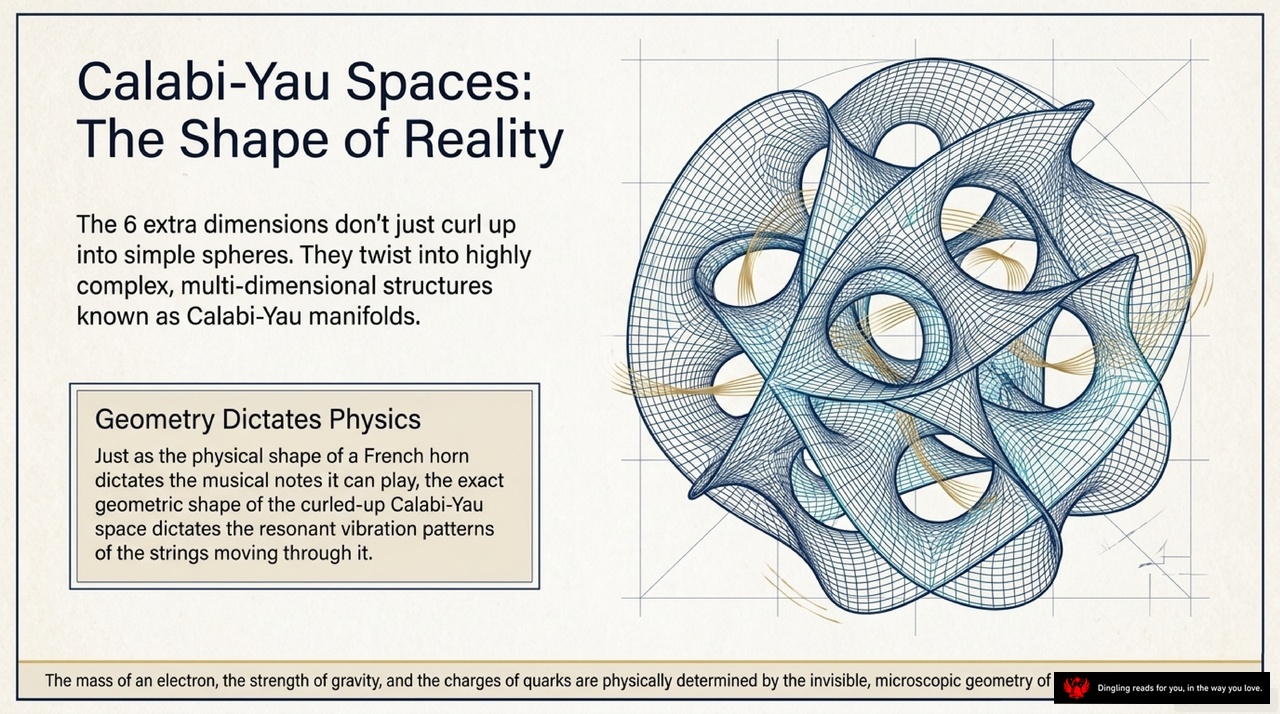
Have you ever wondered why the universe has exactly three large dimensions and why we can't see the other six? The answer lies in a shape so complex, it feels like science fiction. Look at this intricate, twisting structure on the right. This is a Calabi-Yau manifold.
In the 1980s, physicists realized that the six extra dimensions required by string theory don't just curl up into simple spheres. Instead, they twist into these highly complex, multi-dimensional shapes. The specific geometry of these invisible structures is actually the master key to our physical reality.
Think of it like a French horn. The physical shape of the instrument dictates exactly which musical notes it can play. Similarly, the exact geometric shape of this curled-up Calabi-Yau space dictates the resonant vibration patterns of the strings moving through it. It is geometry dictating physics.
This isn't just abstract math; it determines the mass of an electron, the strength of gravity, and even the charges of quarks. Every fundamental property of the universe we observe is physically determined by this invisible, microscopic geometry hidden within the fabric of space itself.
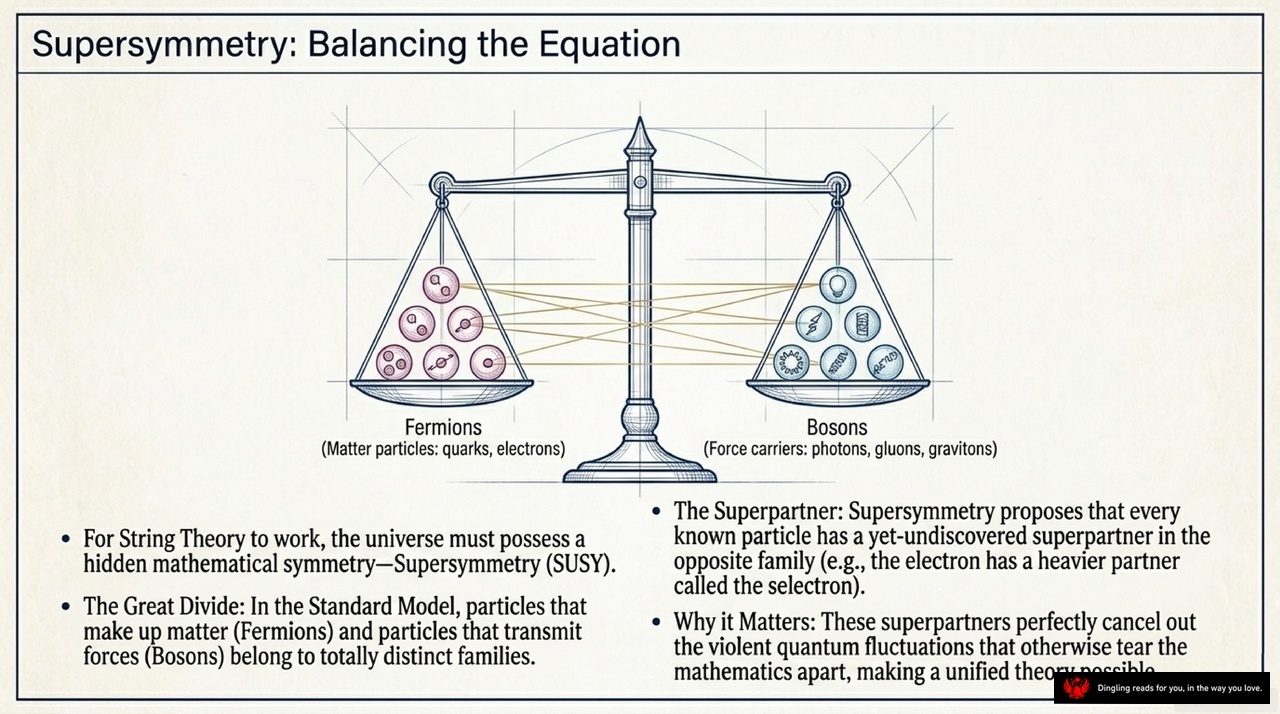
Supersymmetry: Balancing the Equation
Imagine the universe as a giant, perfectly balanced scale. On one side sit Fermions—the matter particles like quarks and electrons that make up everything you see. On the other side are Bosons—the force carriers like photons and gluons that hold it all together. In our current Standard Model, these two families are completely separate, like oil and water. But for String Theory to work, this separation breaks down. We need a hidden mathematical symmetry called Supersymmetry, or SUSY, to balance the equation.
SUSY proposes something radical: every known particle has a yet-undiscovered "superpartner" in the opposite family. Think of it as a cosmic twin swap. The electron, a matter particle, gets a heavier partner called the selectron. Photons get bosonic partners too. Why does this matter? It's the key to unification. These superpartners perfectly cancel out violent quantum fluctuations that would otherwise tear the mathematics of a unified theory apart. Without this balance, the math falls apart; with it, we finally have a path to a single framework that explains both matter and forces. It's a beautiful symmetry that suggests the universe is far more interconnected than we ever imagined.
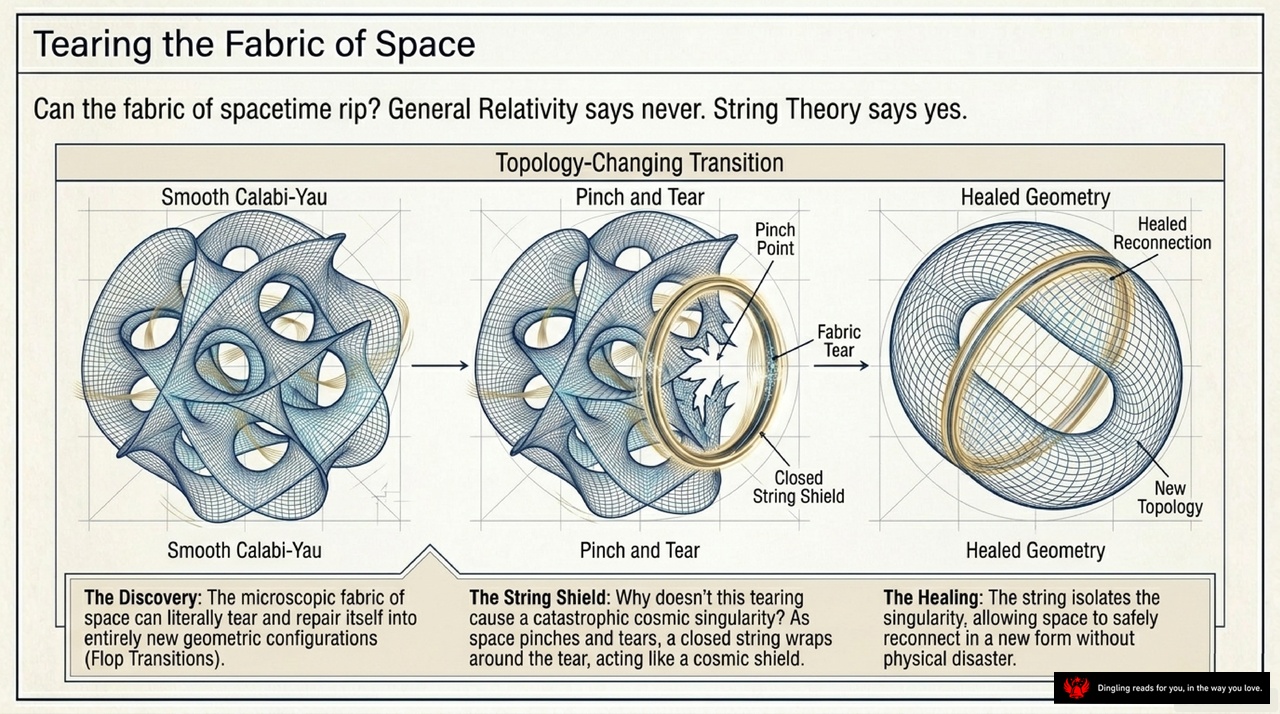
Have you ever wondered if the very fabric of space-time could rip? For decades, Einstein's General Relativity insisted that space is smooth and continuous, making the idea of a cosmic tear impossible. But string theory tells a completely different story: yes, space can tear, and it can even heal itself.
Look at this diagram illustrating a "Topology-Changing Transition." We start with a smooth Calabi-Yau shape, representing the extra dimensions curled up in our universe. Suddenly, a "Pinch and Tear" occurs. As the space contracts, it reaches a critical point where the fabric splits. In classical physics, this would create a catastrophic singularity—a point of infinite density that destroys everything.
But here is where string theory changes the game. Notice the "Closed String Shield" wrapping around the tear. Because strings have a finite size, they cannot shrink down to a single point like mathematical particles. Instead, they wrap around the rupture, acting like a cosmic shield that isolates the singularity. This prevents the tear from becoming a disaster.
Finally, we reach the "Healed Geometry." The string allows the space to safely reconnect in a new form, creating a "New Topology." This process, known as a Flop Transition, proves that the microscopic fabric of space isn't rigid; it can literally tear and repair itself into entirely new geometric configurations. It's a breathtaking discovery that suggests the universe is far more flexible and resilient than we ever imagined.
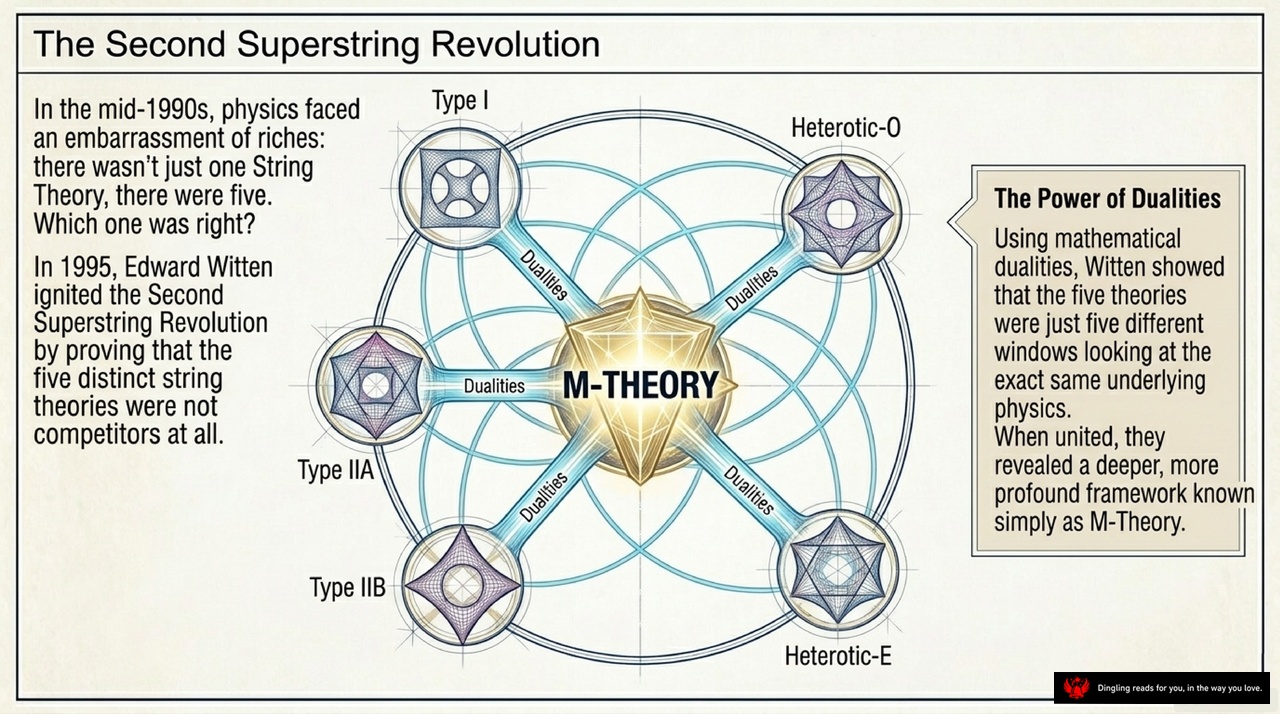
In the mid-1990s, physicists found themselves in a peculiar situation: an embarrassment of riches. Instead of one unified theory, there were five distinct and seemingly incompatible string theories floating around. Type I, Type IIA, Type IIB, Heterotic-O, and Heterotic-E all made sense individually, yet none could claim to be the ultimate truth. The question on everyone's mind was simple but terrifying: which one was right? Was the search for a single "Theory of Everything" doomed to fail because we had five competing candidates?
Then, in 1995, Edward Witten stepped onto the stage at a conference in Santa Monica and changed everything. He ignited what we now call the Second Superstring Revolution. Witten didn't try to pick a winner; instead, he used the mathematical concept of dualities to show something mind-blowing: these five theories weren't competitors at all. They were just five different windows looking at the exact same underlying physics.
Think of it like this: if you look at a complex sculpture from the front, it looks like one shape. From the side, it looks like another. From above, yet another. But the object itself hasn't changed. Witten proved that Type I, IIA, IIB, and the two Heterotic theories were all just different perspectives of a single, deeper framework. When united, they revealed a more profound structure known simply as M-Theory. This discovery unified the landscape of string theory, showing that the diversity we saw was actually a sign of a single, elegant truth hiding beneath the surface.

Enter M-Theory: Beyond the String. So, what does the "M" actually stand for? Is it Magic, Mystery, Membrane, or Matrix? The truth is, even physicists haven't settled on a single definition yet. But regardless of the name, the shift is massive. M-Theory demands we elevate our understanding of the universe from 10 dimensions all the way to 11. This extra dimension changes everything. It means strings are no longer the only fundamental building blocks of reality.
Look at the progression on the right. We start at Level 1 with the familiar 1D strings we've been discussing. But as we move up to Level 2, we enter the realm of 2-branes—essentially two-dimensional membranes. Level 3 introduces 3-branes, which are three-dimensional blobs. And the theory goes even higher, encompassing objects of various dimensions collectively known as p-branes. This is a radical departure from the idea that only one-dimensional strings exist.
The mind-bending implication here is profound: we might actually be living on a gigantic, invisible 3-dimensional brane floating freely in a higher-dimensional space. It suggests that our entire 3D world could just be a surface embedded within a much larger, unseen reality. This framework not only unifies the five different string theories but also provides a natural home for gravity and the other fundamental forces, offering a glimpse into the ultimate theory of everything.

Solving the Black Hole Mystery isn't just about looking at a dark sphere; it's about understanding the fundamental building blocks of reality. On the left, we see the classical view: a massive object crushed into a singularity, where our current laws of physics break down. But on the right, string theory offers a revolutionary perspective. Instead of a point of infinite density, a black hole is actually a complex, microscopic tangle of vibrating strings and branes. This "string/brane configuration" provides the microscopic parts that were missing from the classical picture. Stephen Hawking proved that black holes possess entropy, meaning they hold a vast amount of internal information, but classical physics couldn't explain where this information lived. String theory solved this puzzle perfectly. By modeling specific black holes as tightly wrapped configurations of strings, physicists found that the number of these microscopic string states exactly matches Hawking's theoretical prediction for entropy. This isn't just a coincidence; it proves that string theory can successfully explain the most extreme objects in the cosmos, turning the ultimate crash-test of physics into a triumph of our understanding.

Imagine a universe that refuses to end in a catastrophic crash. While the traditional Big Bang theory predicts a terrifying singularity—a zero-dimensional point where math simply breaks down and density becomes infinite—String Cosmology offers a revolutionary escape. Look at the diagram on your screen; it depicts "The Bounce." This concept suggests that the universe didn't originate from nothing, but rather rebounded from a tightly compressed, Planck-sized nugget of strings.
The key lies in "A Minimum Size." Because strings possess a physical length known as the Planck length, they cannot be crushed into a dimensionless point. When the universe contracts to this limit, the strings simply bounce back, replacing the catastrophic singularity with a quantum-safe rebound. This elegant mechanism transforms our understanding of time itself, suggesting a history that extends far before the explosive moment we traditionally call the beginning.
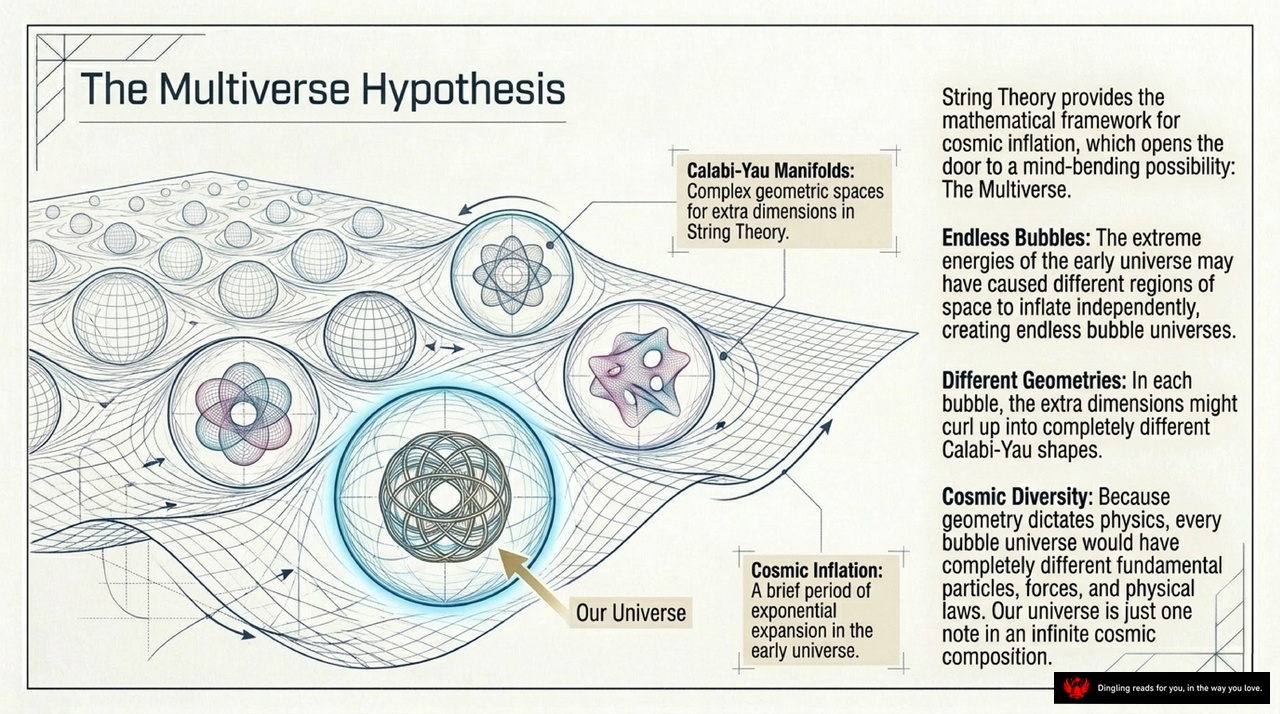
The Multiverse Hypothesis isn't just a sci-fi concept; it's a serious mathematical possibility emerging from the frontiers of physics. Imagine the early universe as a frothing sea of energy, where String Theory provides the framework for a brief, explosive moment called Cosmic Inflation. This rapid expansion didn't just blow up our universe; it may have created endless bubbles, each inflating independently like soap bubbles in a cosmic foam.
Look at the diagram here. These are the "Endless Bubbles." Within each bubble, the extra dimensions required by String Theory might curl up into completely different shapes known as Calabi-Yau Manifolds. Because geometry dictates the laws of physics, every bubble universe would have its own unique set of fundamental particles, forces, and physical laws. To us, our universe is just one note in an infinite cosmic composition. In other bubbles, the rules of nature could be entirely different, perhaps even allowing for life forms we can't imagine. So, while our universe might seem unique, we are actually just one tiny island in a vast, diverse multiverse.

The Frontier: Testing the Untestable. Since strings are predicted to be a mere 10 to the minus 33 centimeters long, we can't see them directly with any current instrument. So, how do we prove they exist? We have to hunt for their fingerprints instead.
First, we look for superpartners. Particle accelerators are currently scanning for these heavy particles predicted by supersymmetry, the twin partners of the matter we know. Next, we search for fractional charges. String theory allows for exotic particles with bizarre electrical charges, like one-fifth or one-eleventh of the standard unit, which are impossible in traditional point-particle physics.
Then, we watch for missing energy. If strings vibrate into hidden extra dimensions during a collision, energy that seems to vanish from our 3D world might actually be leaking out into those curled-up dimensions. Finally, we look at cosmological signatures. By studying the Cosmic Microwave Background radiation, we hope to find echoes of giant, stretched-out strings from the Big Bang itself. These indirect clues are our best hope to finally test the untestable.
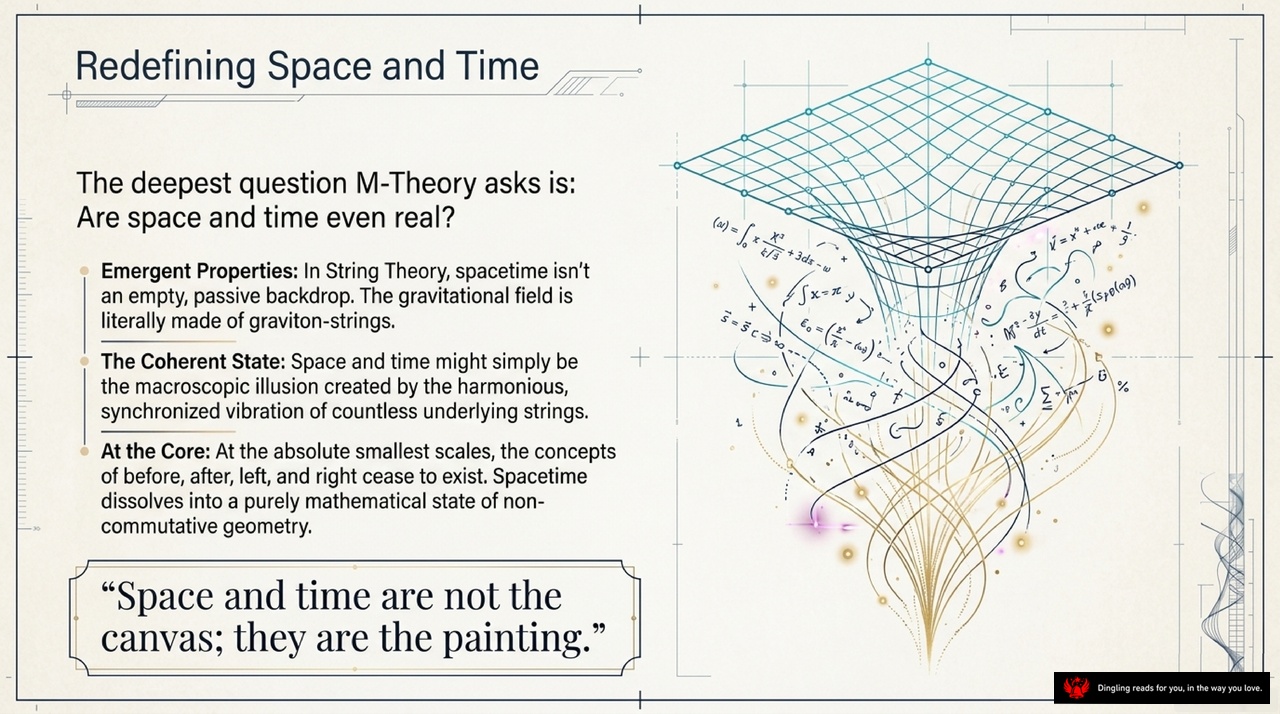
Imagine space and time not as a fixed stage where the universe plays out its drama, but as something far more dynamic—literally the painting itself, not the canvas. This radical shift is at the heart of M-Theory, challenging the very foundation of our reality. The deepest question this theory asks is simple yet profound: Are space and time even real?
In the traditional view, spacetime was often seen as an empty, passive backdrop against which events unfold. But string theory flips this script entirely. It reveals that the gravitational field isn't just something sitting in space; it is literally made of graviton-strings. In this new framework, space and time might simply be a macroscopic illusion created by the harmonious, synchronized vibration of countless underlying strings. Think of it like a complex symphony where the individual notes create the melody we perceive as reality.
As we zoom in to the absolute smallest scales, the familiar concepts of before, after, left, and right cease to exist. At the Planck scale, spacetime dissolves into a purely mathematical state of non-commutative geometry. This means the smooth, continuous fabric we experience every day breaks down into something fundamentally different. The quote on the slide captures this beautifully: "Space and time are not the canvas; they are the painting." We are not observers standing outside the universe watching it happen; we are part of the intricate, vibrating pattern that constitutes the universe itself.

The Promise of the 21st Century is here, and it starts with a single, revolutionary idea: M-Theory. Think of this slide not just as a diagram, but as the architectural blueprint for our understanding of reality. For the first time since Einstein and Quantum Mechanics, we have a framework that unifies the chaotic subatomic world with the vast, majestic cosmos under one set of exact physical principles.
Look at the structure on the right. At the very top sits M-Theory, acting as the ultimate foundation. From there, everything flows down into three distinct pillars that support our universe. On the left, you see The Macro—our familiar world of planets and galaxies, governed by the smooth curves of General Relativity. In the center, we have The Micro—the realm of quarks and electrons, where the wild rules of Quantum Mechanics reign. But the third pillar, The Unseen, is where the magic happens. This represents the hidden dimensions and vibrating filaments of energy that string theory introduces.
This isn't just abstract math; it's a profound shift in how we see existence. It proves that the same vibrating filaments create both the massive stars we see and the tiny particles we can't touch. We are actively charting the final, blank spaces on the map of physical reality, pushing science to its absolute limits. We are no longer just observing the universe; we are finally understanding the hidden geometry that holds it all together.
Imagine the entire cosmos not as a chaotic collection of separate forces and particles, but as a single, unified symphony played on the cosmic strings of a multiverse. This is the profound promise of String Theory, the framework that finally transcends the century-long conflict between General Relativity and Quantum Mechanics. By replacing the abstract point particles of the past with vibrating strings of energy, we unlock a universe filled with hidden dimensions, elegant symmetries, and a set of unified physical laws that govern everything from the smallest subatomic interactions to the grandest cosmic structures.
Think of it this way: if our universe is just one specific melody played on these cosmic strings, what other songs are currently echoing in the dark? String Theory suggests that the same fundamental laws apply to every possible variation of reality, creating a vast landscape of potential universes, each with its own unique physical properties. While we may only perceive one of these melodies right now, the theory opens the door to the possibility that many others exist, vibrating in the depths of a multiverse we are only beginning to understand. This shift from isolated points to interconnected, vibrating strings doesn't just solve mathematical inconsistencies; it offers a breathtakingly beautiful vision of a cosmos where everything is deeply, fundamentally connected.