
The Element: Complete Chapter-by-Chapter Summary

Welcome to *The Element*, a journey into the intersection of what you're good at and what you love. This book by Ken Robinson explores a simple yet transformative truth: discovering where your natural aptitude meets your personal passion changes everything.
Think about the stories of people like Gillian Lynne, who was once labeled as having a learning disability but turned out to be a world-renowned choreographer; or Matt Groening, who ignored advice to get a "normal" job and created the *Simpsons*. Even Nobel laureate Paul Samuelson found his calling not in traditional academic paths, but by pursuing economics with pure joy. These are "epiphany stories"—moments where individuals realize their true potential by aligning their talents with their passions.
The core message is clear: everyone has unique abilities and interests that can lead to extraordinary achievements, but most people never find their "element." Why? Often because we misunderstand intelligence, assuming it's fixed and limited to logic and math. In reality, intelligence is diverse, dynamic, and deeply personal. When you embrace this truth and stop trying to fit into a narrow system, you unlock the ability to create, innovate, and live a life of genuine fulfillment. Your element isn't just about success; it's about doing work that feels real, where time flies, and you feel fully alive.

The Crisis of Wasted Potential isn't just a catchy title; it's a blueprint for how our industrial-era education system systematically suppresses human capability. Look at the grid on your screen. On the left, we see the rigid, outdated model we've all been trained to accept. It prioritizes Math and Science over Humanities, and Humanities over Arts. It reduces our worth to a single number—your IQ or SAT score. It demands one correct answer, absolute conformity, and a binary pass or fail. The consequence? Millions of brilliant, creative minds get disengaged, marginalized, and labeled as "problems" just because they don't fit the mold.
But look at the right side. That's where the real potential lies. The slide argues that all disciplines hold equal weight and interact constantly. Intelligence isn't linear; it defies single-number measurement. True growth comes from divergent thinking, creative problem-solving, and iterative growth—not rote memorization. When passion is accurately identified, the result is limitless unleashed potential. The contrast is stark. We are taught to narrow our focus, but nature intends for us to expand it. The crisis isn't that we lack talent; it's that our system is too busy categorizing and suppressing it to help us discover it.
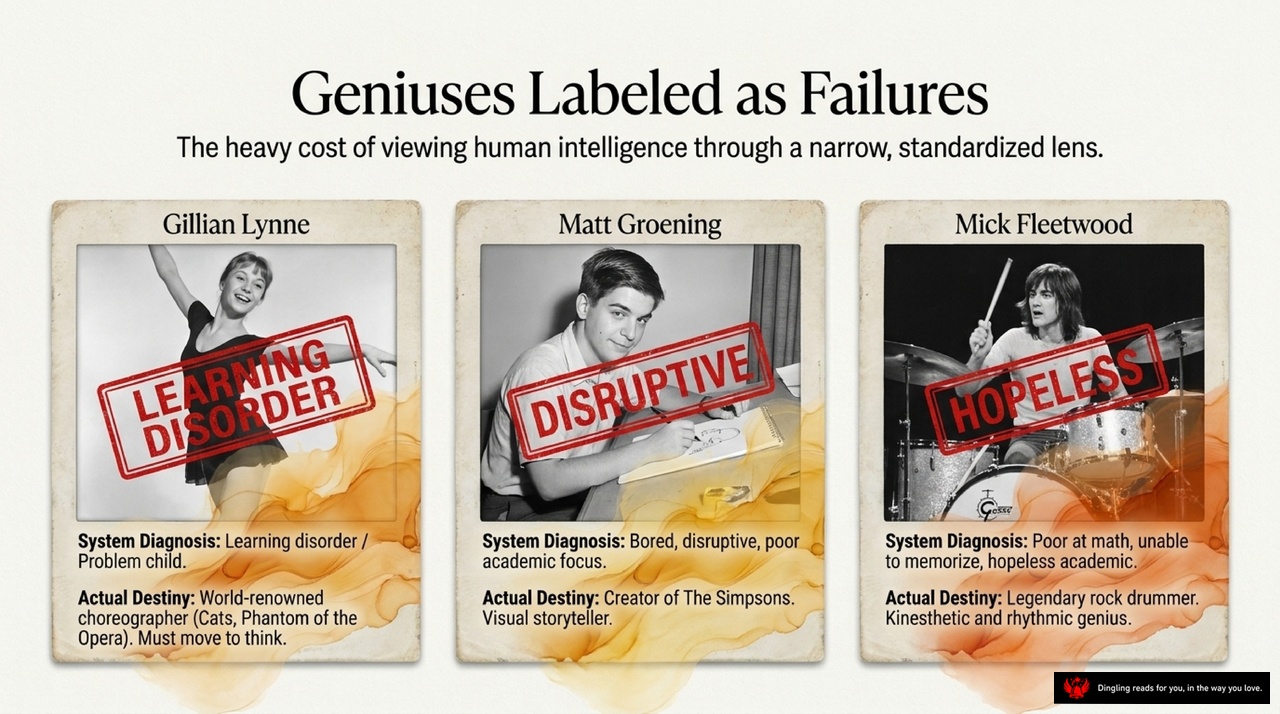
Look at this slide. It tells a powerful story about the hidden cost of judging intelligence through a narrow, standardized lens. We often label brilliant people as failures before they ever get the chance to shine.
Take Gillian Lynne, the legendary choreographer behind *Cats* and *The Phantom of the Opera*. As a child, she was labeled a "problem child" with a learning disorder. Teachers thought she was disruptive, but she was actually a dancer who needed to move to think.
Then there's Matt Groening, the creator of *The Simpsons*. He was called "disruptive" in school for drawing cartoons instead of doing homework. But that rebellious creativity built one of the most iconic pop culture empires in history.
And look at Mick Fleetwood, the legendary rock drummer for Fleetwood Mac. The system told him he was "hopeless," claiming he was bad at math and couldn't memorize facts. But his true genius was kinesthetic and rhythmic. He just needed a drum set, not a textbook.
These stories prove that when we force everyone into a single academic mold, we don't just fail students; we fail the world. Real intelligence isn't just about passing tests; it's about finding the unique way you interact with the world.

Have you ever felt like your intelligence was locked behind a single, rigid door? For decades, we've been told that being smart means excelling at logic, math, and language—skills that can be easily measured on a standardized test. But what if that definition is fundamentally broken?
Look at the image on your screen. It illustrates a radical shift in how we view human potential: Intelligence isn't a fixed, linear metric resting on a single pillar. Instead, it rests on three core pillars—Diverse, Distinct, and Dynamic.
First, intelligence is **Diverse**. We've been trained to believe there's only one way to be smart, but the reality is far richer. Think of Mick Fleetwood, the legendary drummer for Fleetwood Mac. As a student, he was labeled "stupid" because he struggled with math and couldn't memorize the alphabet. Yet, he possessed a profound auditory and rhythmic intelligence that the school system completely missed. He didn't fail; he was just being measured by the wrong ruler. Similarly, consider Alex Lemaire, a student who could calculate the 13th root of a 17-digit number in under a minute using only his mind. His brilliance wasn't in standard classroom tests, but in a unique, self-taught mastery of mental math.
Second, every individual's intelligence profile is **Distinct**. Your brain is a biological fingerprint. It's not about competing with others to see who has a higher IQ score; it's about discovering which specific combination of talents makes *you* unique. Whether it's the visual-spatial genius of a photographer like Gordon Parks or the intuitive rhythm of a dancer, your strengths are personal and specific. The old model tries to flatten everyone into a single curve, but true intelligence celebrates the fact that you might be a master of kinesthetic learning while someone else excels in linguistic analysis. Both are equally intelligent; they just operate in different dimensions.
Finally, intelligence is **Dynamic**. This is perhaps the most important point. The brain is highly interactive, not a static machine. True breakthroughs don't happen in isolated silos; they occur when synapses connect totally different cognitive regions. Albert Einstein is the perfect example here. He wasn't just a math genius; he used his love for music and his ability to visualize abstract concepts to solve physics problems that others couldn't crack. He didn't just think; he felt, he moved, and he connected disparate ideas in a fluid, creative flow.
So, why do so many of us feel stuck? Because we've accepted a narrow definition of intelligence that ignores our diverse forms, our distinct fingerprints, and our dynamic potential. By redefining intelligence this way, we unlock the possibility that everyone has the capacity for extraordinary achievement. It's not about fixing what you lack; it's about discovering the unique, dynamic way your mind is wired to create, solve, and thrive.

Have you ever stopped to think about how many senses you actually possess? We are constantly told there are five: sight, sound, taste, touch, and smell. These are the ones we take for granted, the ones we list without a second thought. But what if that number is far too small?
Today, we are diving into the hidden biological superpowers you already have but likely never noticed. The slide right in front of us reveals a fascinating truth: we routinely underestimate the depth of our own capabilities.
Let's look at the center of this diagram. It lists "The Accepted"—the five familiar senses. But look at what surrounds them. There are four more critical systems that operate silently in the background of your life.
First, there is **Equilibrioception**. This is your profound sense of physical balance and acceleration, centered deep in your inner ear. Without it, you couldn't stand up, walk, or even keep your coffee from spilling. It is the foundation of your stability.
Next, consider **Thermoception**. This is your innate ability to sense temperature independently of touch. You know when a room is cold or a drink is hot without needing to physically feel the heat against your skin. It's a separate, vital channel of information.
Then, there is **Proprioception**, also known as kinesthetic sense. This is your internal mapping of your body's limbs in space. It allows for rapid muscle memory. Think about it: you can type on a keyboard you've never seen before, or ride a bike you haven't touched in years, simply because your brain knows exactly where your limbs are without you having to look at them.
Finally, we have **Nociception**. This is a distinct, independent sensory network designed exclusively for pain. It is a warning system that alerts you to danger before you even realize you are hurt.
These are not just scientific terms; they are the invisible architects of your daily life. They allow you to navigate the world, interact with others, and survive. The lesson here is profound: just because a sense isn't "visible" or "socially recognized" doesn't mean it isn't powerful. In fact, these overlooked senses are often the very tools that allow us to master our environment and, ultimately, discover our true potential. Don't just accept the five you know; start exploring the many more you hold within you.

Today, we're diving into the engine that powers everything: the architecture of The Element. Think of it as the exact intersection where your natural talent meets your profound passion. It's not just about being good at something; it's about loving it so deeply that time disappears.
This blueprint breaks down into four critical components. First, Aptitude. This is the "I get it" factor. It's that intuitive, instinctive feel you have for a specific medium—like how Gillian Lynne just *knew* how to move before she even understood the steps. Then, there's Passion, the "I love it" domain. This is that deep, intrinsic delight that makes you lose track of time. Without this, you're just working hard; with it, you're flowing.
But talent and love aren't enough on their own. You also need Attitude. This is the "I want it" mindset—the resilience, optimism, and perspective required to actually pursue the path, even when it's hard. Finally, you need Opportunity. This is the "Where is it?" piece. It's about the environment, timing, and the specific context where your unique mix of skill and desire can actually take root.
When these four elements align, you stop chasing success and start discovering your destiny. As we've seen with figures like Matt Groening and Mick Fleetwood, the world doesn't reward the most obedient students; it rewards those who find this sweet spot where their inner nature and their deepest desires collide.

Imagine a funnel where boundless, internal daydreams transform into tangible, external reality. That is the core of "The Applied Imagination." As the slide illustrates, creativity isn't a mystical trait reserved for the gifted; it is a practical process you can learn and apply.
It starts with **State 1: Imagination**. This is the internal, mental realm where you bring to mind things that aren't physically present—daydreams, hypotheses, and wild ideas. You can be imaginative all day without anyone noticing. But here is the crucial distinction: to be truly creative, you must do something.
To bridge the gap between your mind and the physical world, you need **The Filter: The Medium**. This is the specific tool or discipline you choose—whether it's music, code, dance, or writing. It acts as the filter that shapes your abstract thoughts into something real.
When your internal imagination flows through this medium, you reach **State 2: Creativity**. This is the external, physical result. It's about generating original ideas that have tangible value—a song, a theorem, a business model, or a piece of art. The magic happens when you stop letting ideas stay in your head and start applying them to the world.

How Creativity Actually Works isn't just a catchy title; it's a map of how breakthroughs really happen. Look at that colorful infinity loop in the center. It illustrates a dynamic, ongoing conversation between the creator and the medium. This process isn't linear; it's a cycle of four distinct phases that feed into each other.
First, we start with Phase 1: Idea Generation. This is where divergent thinking happens. It's messy and abstract. You're sketching, hypothesizing, and making those wild, abstract connections that no one else sees yet. You aren't trying to be right here; you're just exploring possibilities.
Next, that raw idea moves to Phase 2: The Medium. This is often the most overlooked step. You engage with the material—whether it's paint, code, math, or music. The physical medium itself alters your initial idea. It pushes back, it limits you, and in doing so, it actually helps you refine the concept in ways you couldn't have imagined sitting at a desk.
Then comes Phase 3: Evaluation. Now you bring logic back in. You apply intense critique, logical refinement, and test your idea against the rules and constraints of your field. You ask, "Does this actually work?"
Finally, the cycle closes with Phase 4: Iteration. You take that refined concept and feed it right back into the generation phase. You go deeper, evolve the idea further, and start the loop again.
This isn't about waiting for a lightning bolt. It's about entering this flow, letting the medium do the work, and trusting that this back-and-forth conversation is where true creativity lives.

Today's slide contrasts two powerful ways of thinking: Linear Thinking versus Divergent Thinking. On the left, you see a staircase representing linear thought—rule-bound, step-by-step progression where A plus B equals C. While this is crucial for final execution and evaluation, it's actually an enemy when you're trying to generate novel concepts. It keeps us stuck in the same path.
On the right, we see the explosion of Divergent Thinking. This is about lateral connections, analogies, and associative logic. It's where breakthroughs happen. The slide highlights a fascinating example: physicist Richard Feynman. He was watching a student toss a spinning cafeteria plate. He noticed the plate's wobble and connected that seemingly unrelated motion to electron spin. That divergent connection led directly to his Nobel Prize-winning work in quantum electrodynamics.
The core message here is simple but profound: Breakthroughs happen when we connect the seemingly unconnected. If we only rely on linear, logical steps, we might execute perfectly, but we'll never invent the next big thing. To truly break the chains of logic and find your true potential, you need to embrace the messy, colorful, and unpredictable nature of divergent thinking.

Look at this diagram: "The Synergy of the Group." It captures a powerful truth—creativity doesn't just grow; it amplifies exponentially when diverse minds interact without hierarchy. Notice the overlapping circles and that brilliant burst of light in the center? That's the magic of collision.
The slide breaks this down into three parts. First, the concept: dynamic creative outcomes rarely come from isolated geniuses. Instead, they spark from the friction of different aptitudes, voices, and interests interacting within a shared medium. It's not about working alone; it's about the alchemy of connection.
Then, look at the evidence: The Traveling Wilburys. This isn't just a band; it's a masterclass in organic collaboration. The inputs were legendary—George Harrison, Bob Dylan, Roy Orbison, Tom Petty, and Jeff Lynne. But here's the key: there was no over-planning and absolutely no corporate hierarchy. The process was raw, improvisational interaction based on mutual respect. They didn't try to force a style; they let their disparate talents complement one another naturally.
The result? An accidental, multi-platinum masterpiece. This proves that when you remove the barriers of status and rigid structure, allowing unique individuals to simply listen and play off each other, you unlock a level of innovation that no single person could ever achieve alone.

Imagine a beam of pure white light hitting a prism. Suddenly, that single, uniform beam splits into a vibrant spectrum of colors—red, orange, yellow, green, blue, indigo, violet. This visual perfectly captures the core idea of our slide: "The Power of Worldview." We do not experience the world directly; we experience it through a filter of our own ideas. Just like that prism, our minds take raw reality and refract it into something unique, something entirely our own.
Consider the "Hamlet Paradox" shown here. Hamlet famously declared that "Denmark is a prison," but to others, it was a home. There is nothing inherently good or bad in the world; thinking makes it so. This isn't just literary fiction; it's the foundation of your reality. Your imagination isn't just for making art; it is the tool that allows us to completely rewrite our perspective of our own lives. This is what we call "The Ultimate Freedom."
But here is the most critical takeaway, labeled as "The Catalyst." If you change your mind—if you refuse to accept standard, industrial definitions of your own intelligence—you change your reality. The rigid filters we impose on ourselves, whether it's believing we are bad at math or lacking creativity, act like a filter that blocks out the rainbow of possibilities. By shifting your internal narrative, you don't just change how you see the world; you fundamentally alter the world you inhabit. Your mindset is the prism that determines the color of your life.
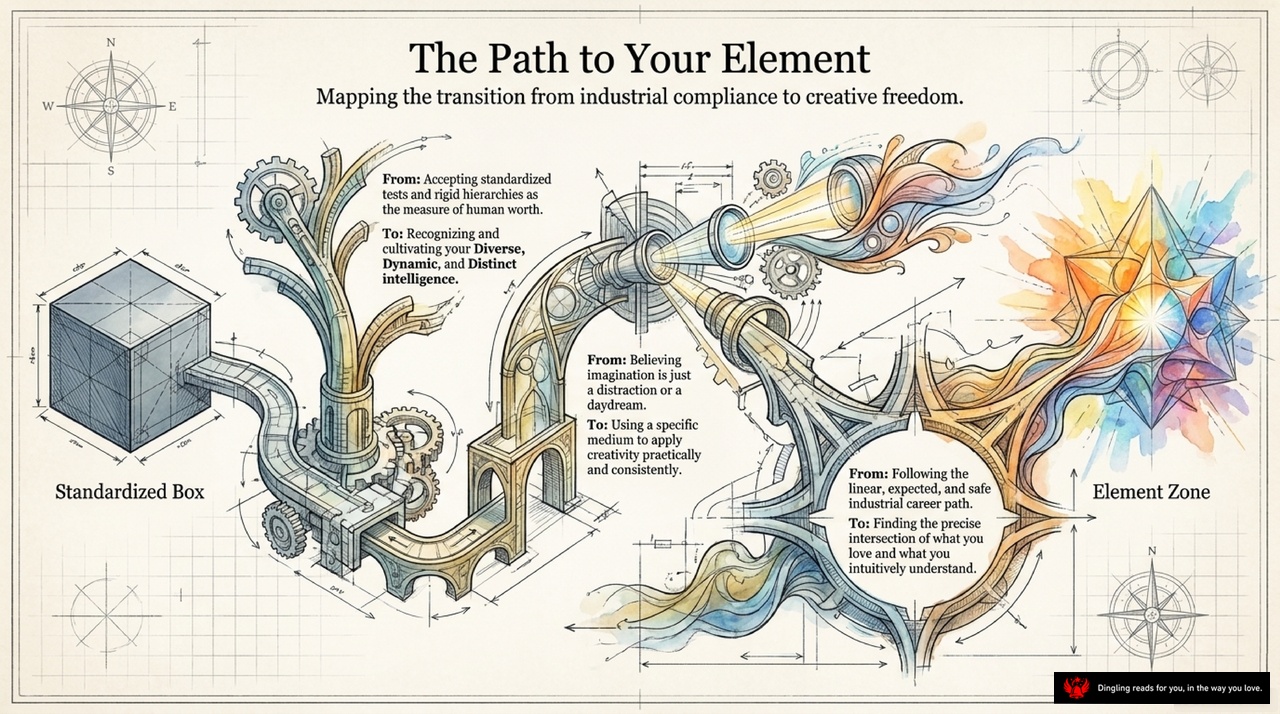
Look at this blueprint of "The Path to Your Element." It maps our journey from rigid industrial compliance to true creative freedom. On the left, we see the "Standardized Box"—a place where human worth is measured by standardized tests and rigid hierarchies. We are told to accept this box as our limit. But the path leads us away from that.
First, we move from believing that imagination is just a distracting daydream to using a specific medium to apply creativity practically and consistently. Instead of treating your unique ideas as a hobby, you choose a tool—whether it's code, paint, or words—and master it.
Next, we shift from following a linear, safe career path to finding the precise intersection of what you love and what you intuitively understand. This is where the magic happens. The journey transforms us from a static cube into a dynamic, flowing stream of color and light, finally reaching the "Element Zone." This isn't just about finding a job; it's about aligning your diverse, dynamic intelligence with your deepest passions. When you stop trying to fit into a pre-made mold and start building your own path, you unlock a level of fulfillment and potential that the standard world never promised you.

True fulfillment lies beyond the rigid metrics of traditional systems; it is found only when we embrace the diverse, dynamic nature of our intelligence and apply our imagination to discover where our deepest passions meet our natural capabilities.
Think about it: what if the school system has been measuring the wrong version of your mind all along? We've been trained to believe that intelligence is just about math, logic, and passing standardized tests. But look at the stories we've explored. Take Gillian Lynne, who was labeled a "problem child" because she couldn't sit still, yet she possessed a genius for dance that no test could capture. Or consider Mick Fleetwood, who struggled with academic subjects but became a world-famous drummer through a rhythm his brain simply loved. These aren't exceptions; they are proof that human potential is far more diverse than a single number can define.
If standardized expectations have been measuring the wrong version of your mind, what could you achieve if you finally defined your own intelligence? The answer lies in realizing that creativity isn't a rare talent reserved for artists—it's the highest form of intelligence. It's the ability to connect dots others miss, to imagine possibilities before they exist, and to bring those ideas into reality. Whether you're solving complex equations like Alex Lemaire or capturing the soul of America through photography like Gordon Parks, your unique path is valid. Don't let the fear of being "different" or "not smart enough" hold you back. Instead, ask yourself: what makes you come alive? Where does your natural curiosity meet your deepest joy? That intersection is your true potential. Stop trying to fit into a mold that was designed for everyone else, and start building a life that fits you perfectly.