
The Elephant in the Room: Complete Chapter-by-Chapter Summary
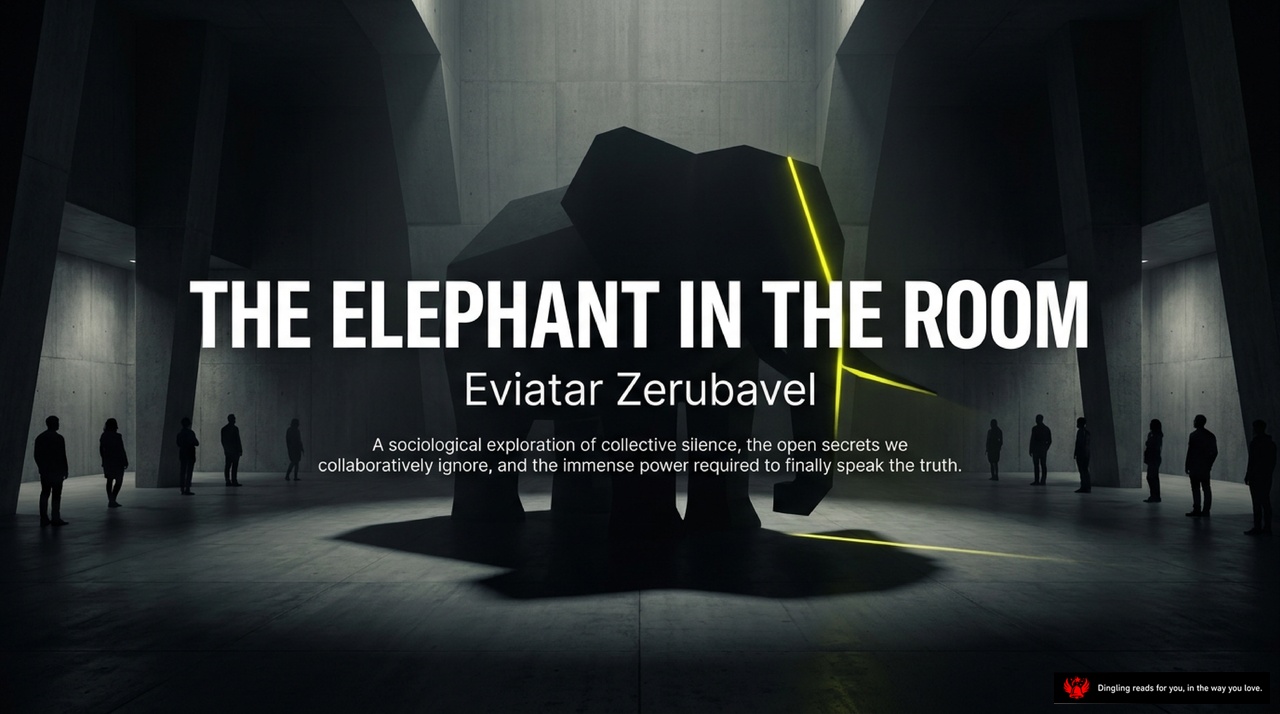
Welcome to today's book club. We're diving into "The Elephant in the Room" by Eviatar Zerubavel. Think about it: there's a secret that isn't hidden in a dark closet, but sits right in the center of the room, visible to everyone, yet everyone pretends not to see it. This is what we call an "open secret."
The core of this phenomenon is a collective agreement. Everyone knows the truth, but in public, we all choose to stay silent. It's not that we're ignorant; it's that we've agreed on an unwritten rule: "Don't speak about this."
Consider the classic story of "The Emperor's New Clothes." Everyone knew the king was naked, but no one dared to say it because they feared being labeled foolish. Only a child, untouched by social rules, broke the silence. This perfectly captures the essence of an open secret: a group masking a naked truth with a fake consensus, while the truth remains hidden in plain sight.
So, what are we going to explore today? We're going to look at how these open secrets work, why we stay silent, and what it takes to finally speak the truth.

Look at this striking image. On the left, we see "The Private Secret"—hidden knowledge known only to a few, where survival depends on staying unseen. On the right, under the bright yellow light, stands "The Open Secret," or what we call The Elephant. It represents visible ignorance: everyone knows the truth, yet we all collude to pretend it doesn't exist. The slide's headline nails it: the power of the Elephant relies on visibility, not concealment.
This concept is perfectly illustrated by Hans Christian Andersen's classic, *The Emperor's New Clothes*. Everyone in the story knows the king is naked, but out of fear of being labeled foolish, they all pretend to see magnificent fabric. It's a collective agreement to deny reality.
Think about this in our modern world. We all see the "Elephant" in the room, but we choose to look the other way. It's like the Emperor's New Clothes on a societal scale. Everyone privately sees the truth, but publicly, we strictly deny it. This isn't just about one person being shy; it's a social contract. We maintain this silence because acknowledging the truth feels too dangerous or embarrassing. We protect each other from the discomfort of the obvious by collectively ignoring it. That is the true power of the Open Secret.
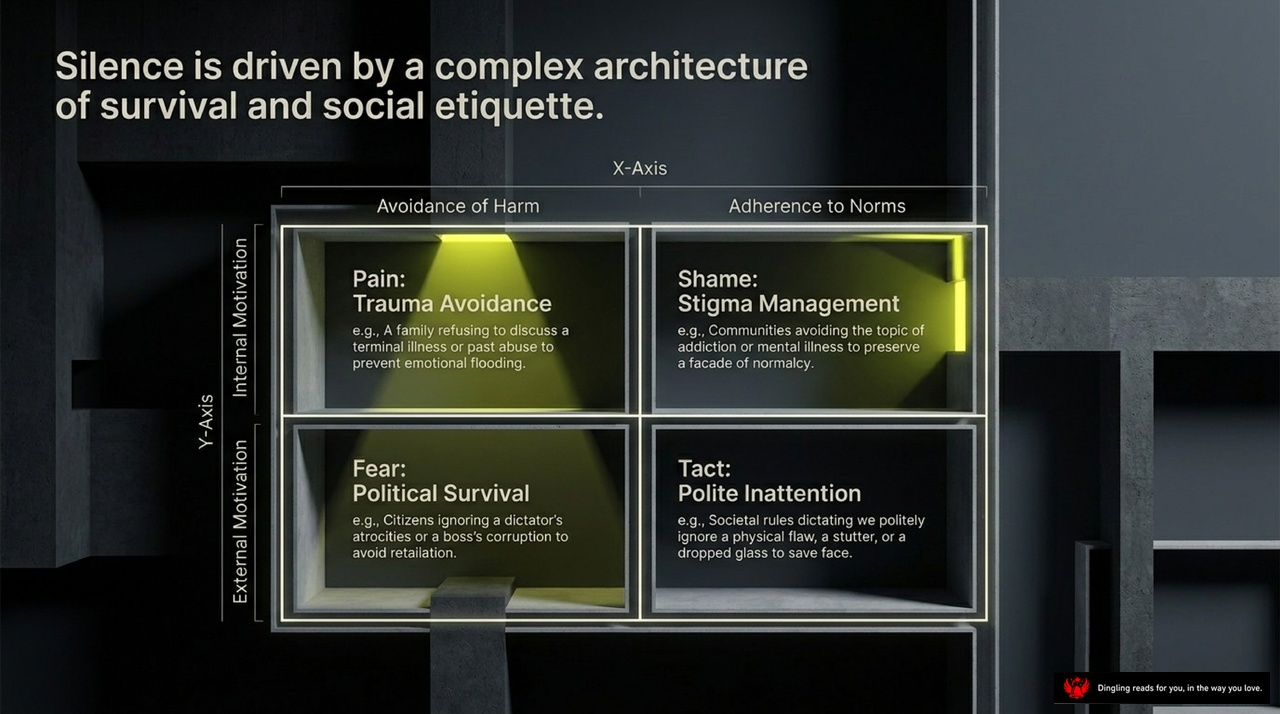
Silence isn't just an absence of sound; it's a complex architecture built on survival and social etiquette. As this diagram illustrates, we stay quiet for four distinct reasons, depending on whether our motivation is internal or external, and whether we're trying to avoid harm or follow the rules.
In the top-left, we have **Pain: Trauma Avoidance**. This is an internal drive. Think of a family refusing to discuss a terminal illness or past abuse. They stay silent not because they don't know the truth, but because acknowledging it would cause emotional flooding. It's a self-protective mechanism.
To the right, we see **Shame: Stigma Management**. Here, the internal motivation is still about avoiding pain, but the goal is adhering to social norms. Communities often avoid topics like addiction or mental illness to preserve a facade of normalcy. They don't speak up because they fear judgment or shame.
Now, look at the bottom row, driven by **External Motivation**. Here, silence is a shield against outside forces. In the bottom-left, we have **Fear: Political Survival**. This is about avoiding retaliation. Citizens might ignore a dictator's atrocities or a boss's corruption simply because speaking up could get them fired, arrested, or worse.
Finally, in the bottom-right, we have **Tact: Polite Inattention**. This is about adhering to norms without fear of physical harm. Society dictates that we politely ignore things like a stutter, a physical flaw, or even a dropped glass just to save face. It's a social lubricant that keeps interactions smooth, even if it means ignoring the truth.
So, this grid shows that our silence is rarely accidental. Whether it's to protect our hearts, manage our shame, survive political pressure, or just be polite, we are all participating in a complex system that keeps the truth hidden in plain sight.
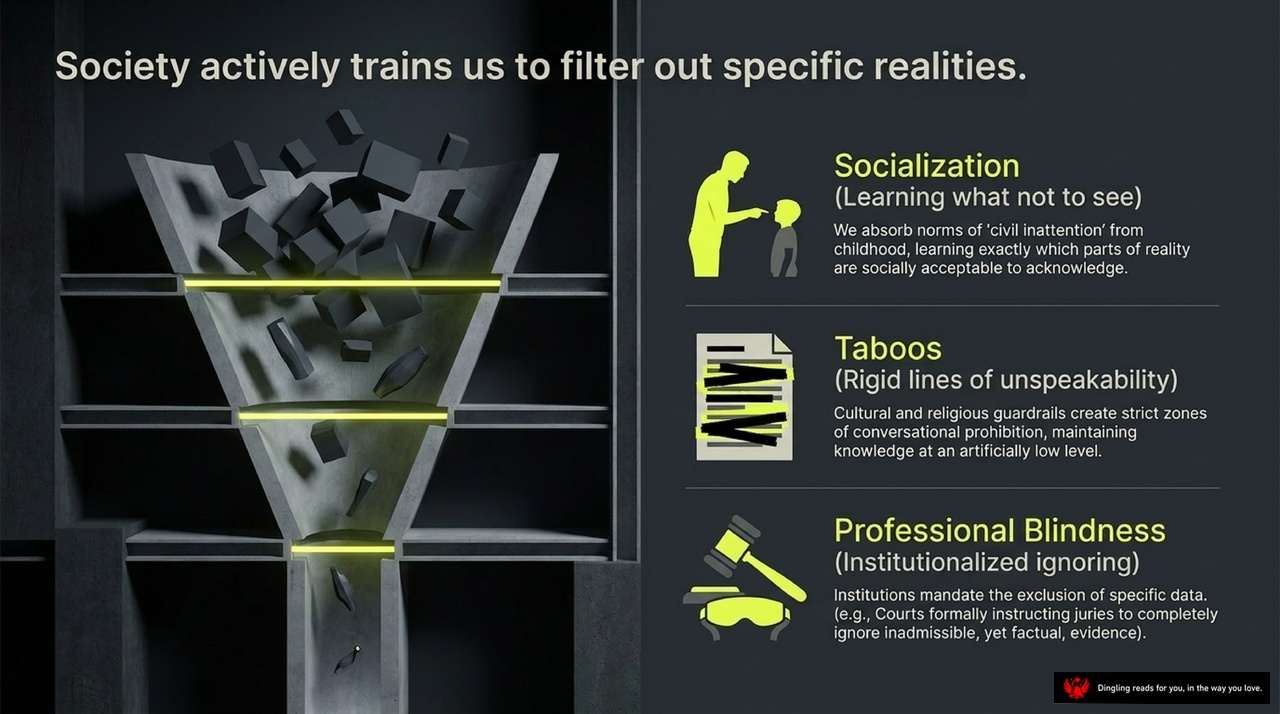
Power plays a massive role in shaping what we see, hear, and say. In fact, the very act of looking away is often a tool of control. Think about the Emperor in the famous story; the reason the courtiers stayed silent wasn't just fear of being called stupid—it was their fear of the King's wrath. Power dictates who gets the truth and who gets to pretend they don't see it.
At the top of this hierarchy, leaders actively filter information to protect themselves. High-ranking officials often claim they have "no idea" about illegal activities not because they are blind, but because they control the flow of information to stay clean. In the Watergate scandal, John Ehrlichman deliberately withheld details from Nixon to keep the President out of legal trouble. It's a calculated strategy: the higher you climb, the more you are trained to ignore the ugly details that might bring you down.
But power doesn't just hide the truth from others; it also forces people to shut up. Leaders can simply say, "Don't talk about that," and suddenly, a massive elephant in the room becomes invisible. This is how power transfers focus. When a government faces a scandal or economic trouble, they might manufacture a new crisis or start a war to distract the public. It's like a magician using a "McGuffin"—a fake object to steal the audience's attention away from the real trick. The media, often acting as a giant radar screen, amplifies this by deciding which stories get the spotlight and which ones get buried.
Beyond just controlling what we know, power enforces silence through threats and contracts. This can be formal, like non-disclosure agreements used by corporations to hide product safety issues or by the Catholic Church to silence victims of abuse. These contracts often come with money, buying silence with cash. But more insidious is the informal pressure—the look from a boss, the hush from a colleague, or the threat of violence. In totalitarian regimes, this goes a step further. Under the Nazis, citizens weren't just told to ignore the concentration camps; they were terrified into self-censorship. People knew the smoke and the screams, but the fear of being caught made them turn a blind eye. They convinced themselves that "not knowing" was safer than knowing. This internalized fear turns everyone into an accomplice, creating a culture where ignorance becomes a survival strategy. Ultimately, power ensures that the loudest truths are often the ones we are forced to keep quiet.

Silence isn't just an absence of sound; it's a powerful, interactive engine that keeps our society running on a fragile consensus. Look at this diagram: it shows how "silence" functions as a machine with three interlocking gears. On one side, we have "The Non-Producer," the person who holds the truth but chooses to withhold it—essentially, the one who decides to "speak no evil." On the other side is "The Non-Consumer," the audience that actively practices "polite inattention," refusing to ask questions or acknowledge what is left unsaid.
These two gears only turn because of the third component: "The Interface," which represents the mutual agreement required to maintain the void. This system relies on immense cooperation. The non-producer depends entirely on the non-consumer's willingness to look away. If even one person breaks this contract—if someone finally speaks up—the entire collusive ecosystem collapses. This is the terrifying reality of a "collusive ecosystem," where everyone knows the truth but no one dares to say it. It's a high-stakes game where the cost of breaking the silence is often isolation or danger, making the gears spin smoothly, even as the truth remains hidden in the dark.
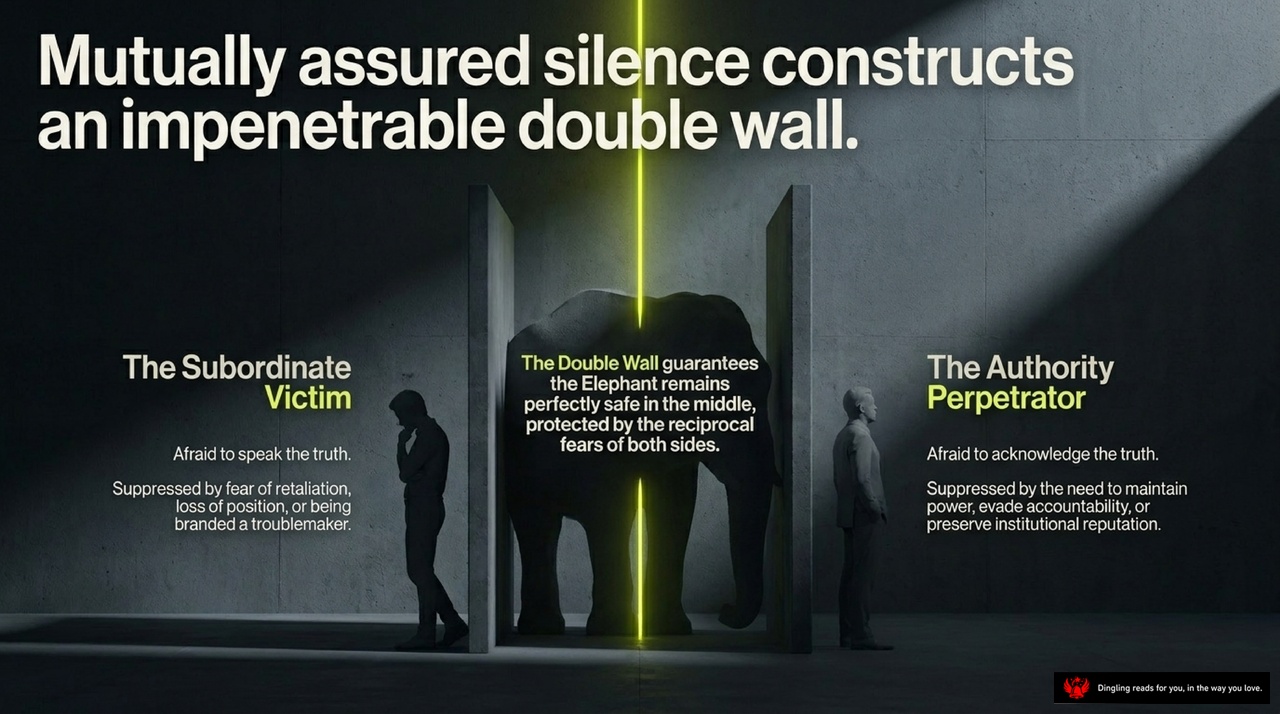
We often think of silence as just an absence of sound, a neutral pause between words. But in reality, silence is a powerful form of communication in itself. It's a deliberate choice, a way of saying something without speaking a single word. When we choose to stay quiet in the face of uncomfortable truths, we are actively participating in a social contract that protects the status quo.
Think about those awkward moments in a relationship or at work when everyone knows something is wrong, but no one says a word. That heavy, thick silence isn't accidental. It's a mutual agreement, a "mutually assured silence" that constructs an impenetrable double wall. On one side, you have the subordinate who is afraid to speak the truth, suppressed by the fear of retaliation or being labeled a troublemaker. On the other side, you have the authority figure who is afraid to acknowledge the truth, driven by the need to maintain power and preserve their reputation.
In the middle of this wall stands the "elephant"—the undeniable reality that everyone sees but no one addresses. This double wall guarantees that the elephant remains perfectly safe in the middle, protected by the reciprocal fears of both sides. It's a classic example of what we call a "public secret." Everyone knows the truth, yet everyone chooses to ignore it in public, creating a sharp tension between what is privately observed and what is publicly expressed. This isn't about ignorance; it's about a shared rule of "not speaking."
This dynamic isn't just about personal fear; it's a structural feature of how groups function. By refusing to break the silence, we are essentially choosing to protect the system over the truth. We prioritize comfort and safety over honesty, allowing the elephant to grow larger and more dangerous with every passing day. Recognizing this silent complicity is the first step toward breaking the wall and finally speaking up.

Power isn't just about control; it's about dictating the very shape of what the public pays attention to. Look at this pyramid. That beam of light hitting the base represents the power to set the agenda—deciding what is "relevant" and what stays off the table. When leaders and media control this geometry, they don't just share information; they define reality itself.
But there are other tools in the arsenal. Consider "Weapons of Mass Distraction." This is the art of creating intentional noise in the bright, illuminated areas of public discourse just to mask the deafening silence happening in the shadows. It's a classic crisis management tactic: changing the subject entirely so no one looks at the real problem.
Finally, we have "The Gag Order." This is the most rigid form of control. It involves formalizing the shadows through non-disclosure agreements, censorship, and systemic isolation. Think of the "Elephant's Invisibility"—legally mandating that certain truths simply do not exist. Whether it's a corporate whistleblower being silenced or a government hiding a scandal, this power dynamic ensures that the most dangerous truths remain hidden in the dark, while the public is left staring at a carefully curated, and often misleading, picture of the world.
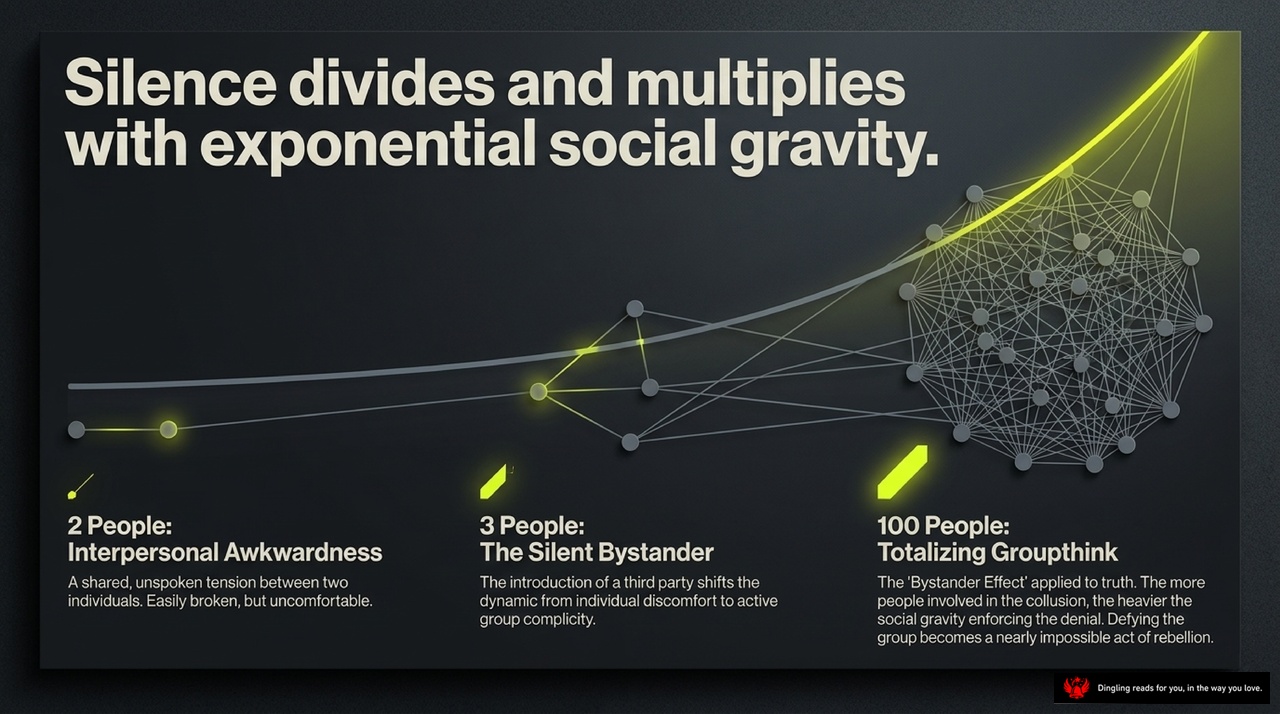
Silence doesn't just hide the truth; it multiplies it with a force we call "social gravity." Look at this curve: it starts small with just two people. When it's only two, it's just awkwardness—a shared, unspoken tension that is easy to break. But the moment a third person enters the room, the dynamic shifts completely. This is where the "Silent Bystander" emerges. The introduction of that third party transforms individual discomfort into active group complicity.
As we move further right to the far end of this spectrum, we see what happens with 100 people. This is where we hit "Totalizing Groupthink." It's the bystander effect applied to truth itself. The more people involved in this collusion, the heavier the social gravity becomes, enforcing denial until the point where defying the group feels like a nearly impossible act of rebellion.
This visual perfectly captures the concept of the "Room's Elephant"—a massive, obvious truth that everyone sees but everyone pretends not to. In a group of two, you might speak up. But in a crowd of hundreds, the pressure to conform creates an invisible wall. The fear of being the only one who sees the elephant, or the only one willing to speak its name, paralyzes us all. We don't just ignore the elephant; we actively protect it by refusing to look, listen, or talk about it. This isn't just ignorance; it's a deliberate, collective strategy to maintain a fragile social order, even if it means sacrificing the truth.
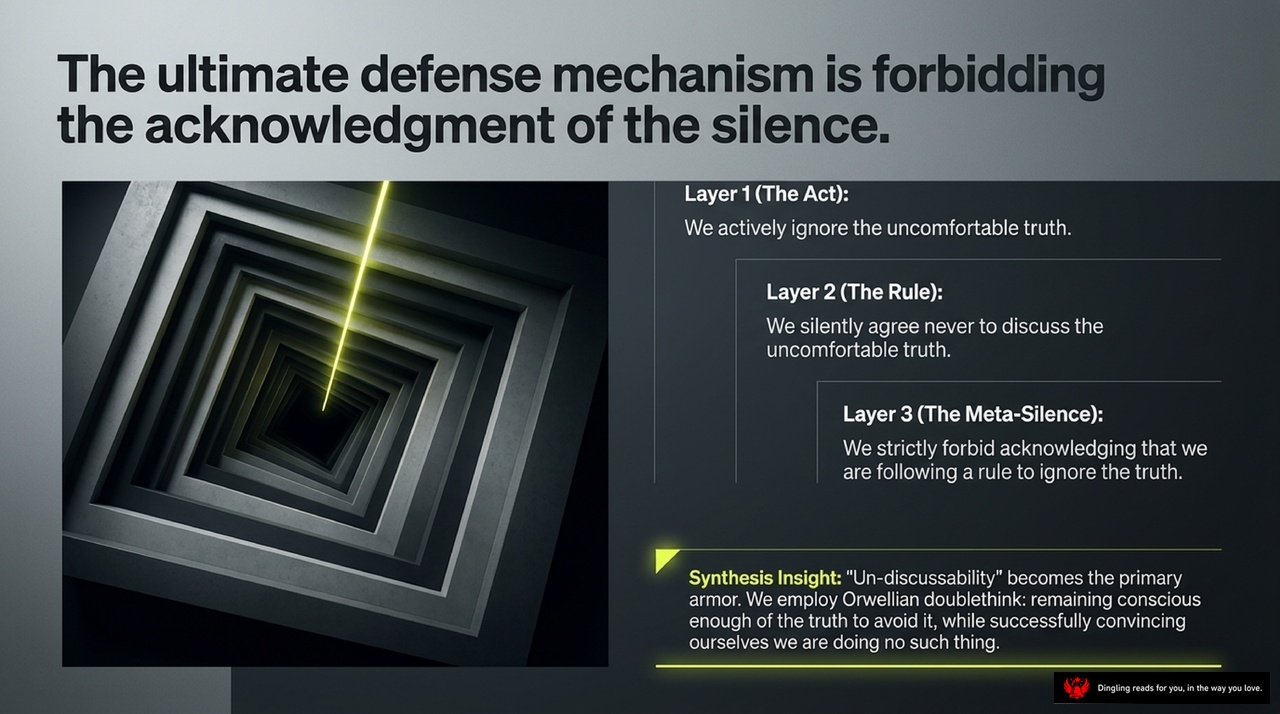
The ultimate defense mechanism isn't just ignoring the truth; it's forbidding the acknowledgment of our own silence. Look at this diagram: it breaks down how we build a fortress around uncomfortable realities in three layers.
First, we have the act: we simply choose to ignore the uncomfortable truth. But it doesn't stop there. Layer two is the rule. We silently agree, as a group, never to discuss it. We create a shared understanding that certain topics are off-limits. And then, we hit Layer three: the Meta-Silence. This is where it gets dangerous. We strictly forbid even acknowledging that we are following a rule to ignore the truth. We pretend we aren't ignoring anything.
This synthesis insight is crucial: "Un-discussability" becomes our primary armor. We use what Orwell called doublethink. We remain conscious enough of the truth to avoid it, while successfully convincing ourselves that we are doing no such thing. We know the elephant is in the room, but we collectively agree to pretend we are blind. This isn't just about hiding facts; it's about hiding the very act of hiding. When we lock the door on the truth, we lock ourselves in a cycle of self-deception that protects our comfort at the cost of reality.
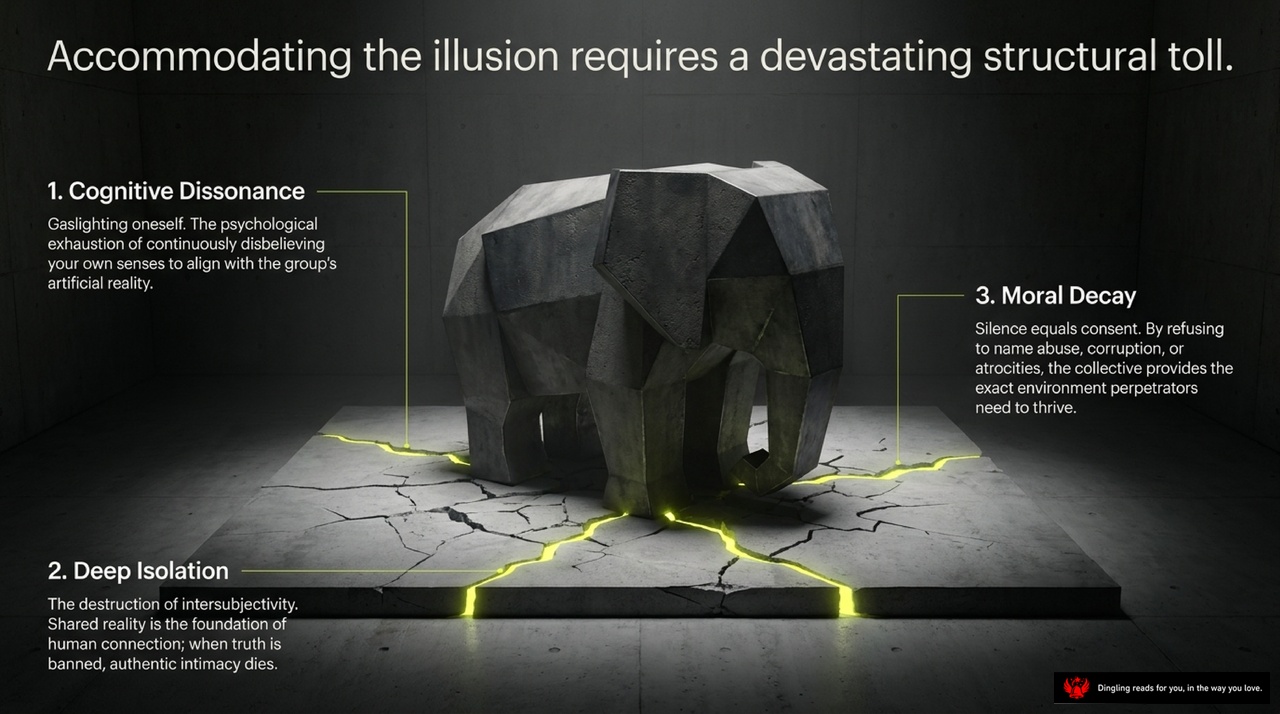
Accommodating the illusion requires a devastating structural toll. When a group collectively ignores the truth, the cost isn't just hidden—it fractures the very foundation of that society.
Look at the elephant in the center. It represents the crushing weight of an unspoken reality. To keep it there, three things must happen simultaneously.
First, we see **Cognitive Dissonance**. This is gaslighting yourself. It's the psychological exhaustion of constantly disbelieving your own senses just to align with the group's artificial reality. You know the elephant is real, but you force yourself to pretend it's invisible.
Second, this leads to **Deep Isolation**. The destruction of intersubjectivity. Shared reality is the foundation of human connection. When truth is banned, authentic intimacy dies. You are physically with others, but mentally, you are alone because no one else is seeing what you see.
Finally, we face **Moral Decay**. Here, silence equals consent. By refusing to name abuse, corruption, or atrocities, the collective provides the exact environment perpetrators need to thrive. The cracks in the floor—the glowing fissures around the elephant—show how this denial destabilizes everything.
This isn't just about ignoring a problem; it's about paying a heavy price to maintain a lie.
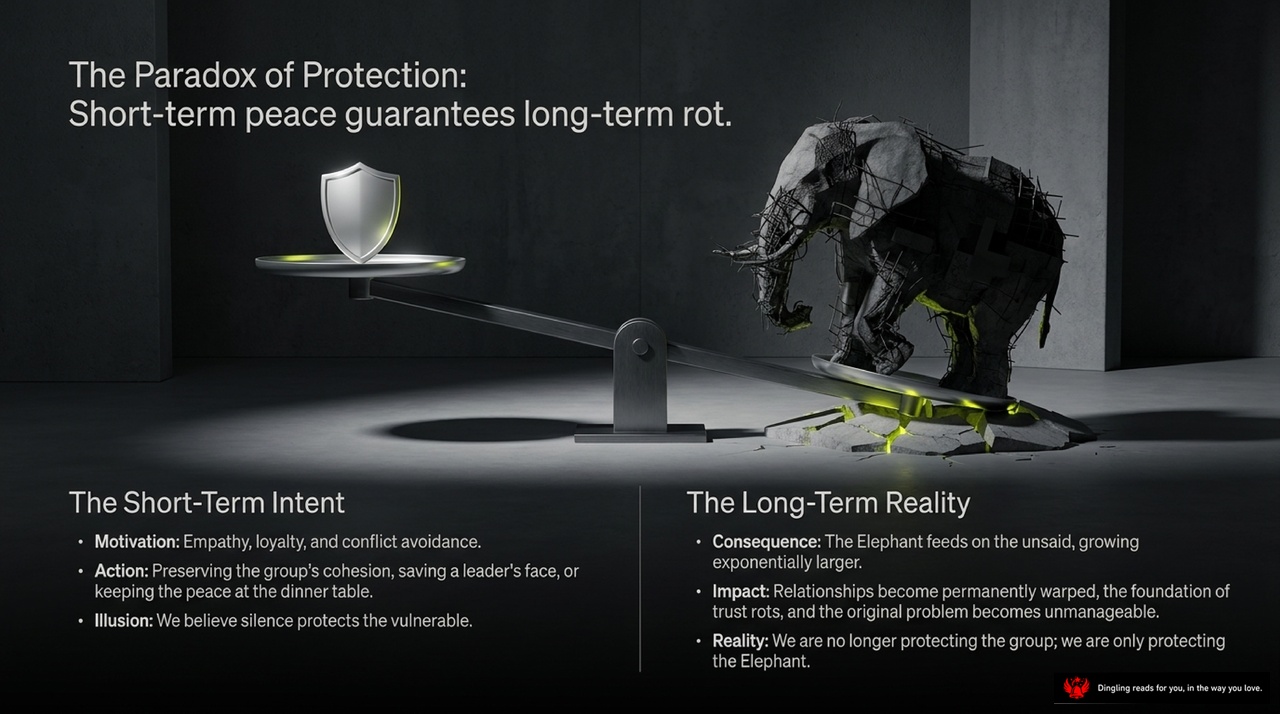
Today's slide captures a harsh but necessary truth: "The Paradox of Protection." It reminds us that short-term peace often guarantees long-term rot. Look at this seesaw. On one side, a shiny shield representing our "Short-Term Intent." We do this out of empathy, loyalty, and a desperate need to avoid conflict. Our goal? To preserve group cohesion, save a leader's face, or just keep the peace at the dinner table. We live under a dangerous illusion: that silence protects the vulnerable.
But flip that seesaw, and you see the "Long-Term Reality." When we choose silence, we aren't protecting the group; we are feeding the "Elephant." This metaphor represents the unsaid truth that grows exponentially larger when ignored. The consequence is severe: relationships become permanently warped, the foundation of trust rots, and the original problem becomes completely unmanageable.
We think we are being kind by not speaking up, but in reality, we are only protecting the Elephant. We are no longer guardians of the group; we are its enablers. This image challenges us to ask: Is your current silence keeping the peace, or is it allowing something toxic to grow unchecked? True protection sometimes requires the courage to break the silence and expose the truth, even when it feels uncomfortable.

Imagine an elephant standing right in the center of the room, bathed in a harsh spotlight, while everyone else stands in the shadows, pretending not to see it. This is the visual definition of our "Catalyst": dragging the background abruptly into the spotlight.
The mechanics of this rupture start with "Naming the Unnamable." We often struggle to give precise language to the void, using euphemisms to soften the blow. But removing those softeners forces a group to confront the brutal reality of the situation.
Then, we have to distinguish between two very different roles. The Whistleblower exposes a hidden secret from a locked filing cabinet—revealing something new that was previously unknown. But the Silence Breaker is different. They point at the Elephant everyone is already staring at. They do not reveal new information; they force the acknowledgment of existing reality.
This distinction is crucial. It's not about uncovering a conspiracy; it's about refusing to look away from the obvious. When we stop pretending the elephant doesn't exist, we drag the background into the foreground, breaking the fragile agreement that kept the truth hidden in plain sight.
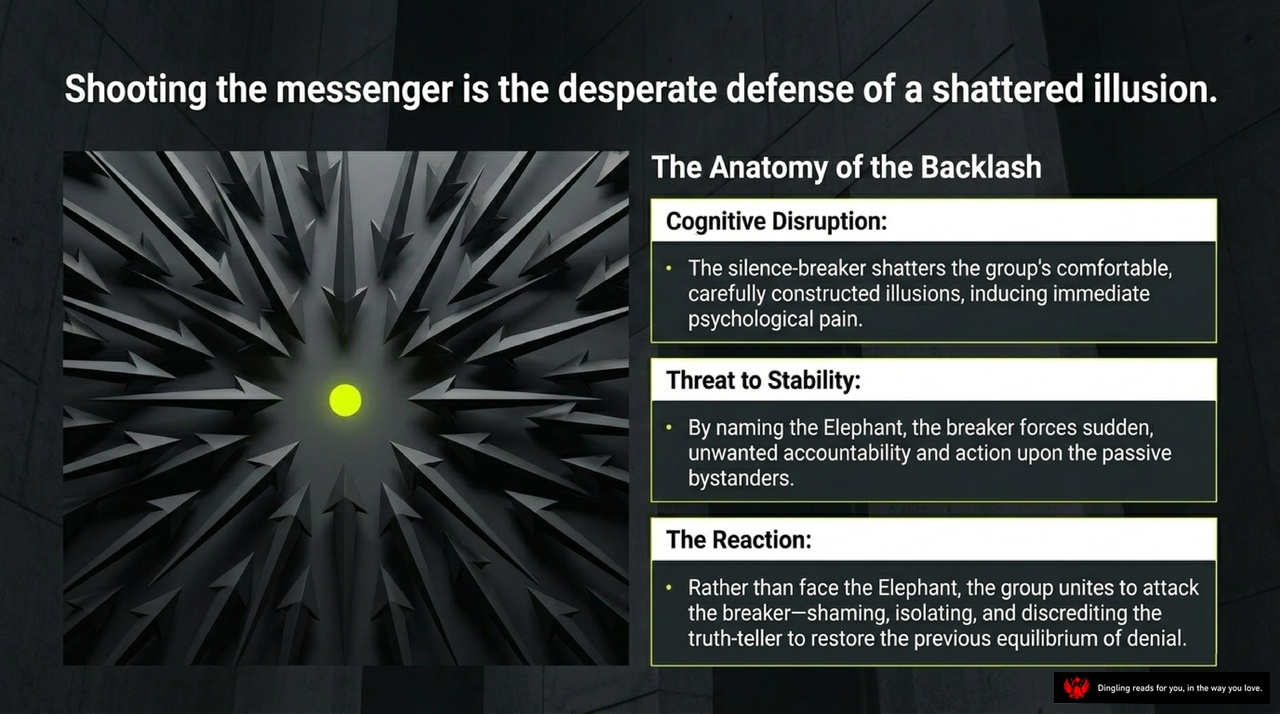
Shooting the messenger is the desperate defense of a shattered illusion. When someone dares to name the elephant in the room, the group doesn't just ignore the truth; they attack the truth-teller. This slide breaks down the anatomy of that backlash into three critical stages.
First, we see Cognitive Disruption. The silence-breaker shatters the group's comfortable, carefully constructed illusions, inducing immediate psychological pain. It's not just about facts; it's about the sudden loss of a shared fantasy.
Next, this creates a Threat to Stability. By naming the elephant, the breaker forces sudden, unwanted accountability and action upon the passive bystanders. Suddenly, everyone who chose to look the other way is forced to face the consequences of their silence.
Finally, we reach The Reaction. Rather than face the elephant, the group unites to attack the breaker—shaming, isolating, and discrediting the truth-teller to restore the previous equilibrium of denial. They don't want the truth; they want their comfort back. This isn't about justice; it's about survival of the status quo.

So, we've walked through the mechanics of how a society collectively ignores the obvious. We've seen how power dictates what we're allowed to see, how fear forces us to look away, and how that shared silence creates a "double wall" that protects the truth from ever being spoken. We've also felt the heavy cost of this denial—the psychological toll on individuals and the moral rot that spreads when we refuse to name the elephant in the room.
But here is the crucial turning point. The cycle of collective denial doesn't end in silence; it has a specific trajectory, and understanding it is the first step to breaking free. Look at the diagram on your screen. It maps out the lifecycle of this denial, moving from an uncomfortable truth to a final reckoning.
It all starts with **The Event**, where an undeniable truth emerges in our shared space. But instead of confronting it, the group moves into **The Collusion**. Here, society applies the "Rules of Irrelevance," using tact, fear, and power to mandate collective blindness. We don't just ignore the truth; we actively agree to pretend it doesn't exist.
This agreement hardens into **The Meta-Silence**. This is the most dangerous stage. It's not just that we deny the fact; we deny the denial itself. Un-discussability becomes the norm. The elephant grows to massive proportions, but now, even the idea of talking about it is forbidden. The silence becomes a wall that no single person can breach.
Then, inevitably, comes **The Rupture**. This is the moment a silence-breaker finally names the unnamable, dragging the elephant into the sharp spotlight. It is a critical junction. The group faces a choice: they can either unite to destroy the silence-breaker, or they can finally dismantle the elephant itself.
And finally, we reach **The Reckoning**. This is where the group either destroys the truth-teller to maintain the status quo, or they confront the reality and change. The diagram shows that this is a cycle, meaning that without that rupture, we simply spin back around, trapped in the same denial. But recognizing these stages gives us a map. It tells us that we are not just blindly ignoring things; we are participating in a structured process. And once we see the process, we can choose to stop it.
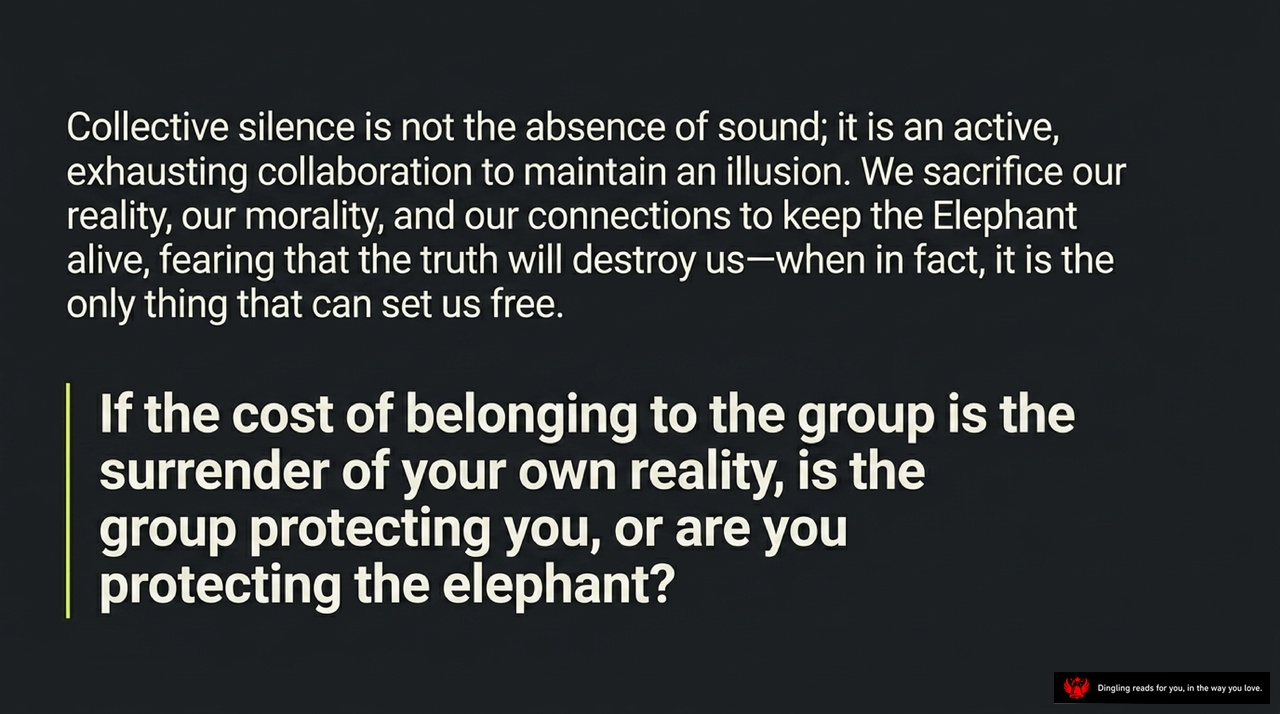
Collective silence isn't just the absence of sound; it's an exhausting, active collaboration to keep an illusion alive. We sacrifice our reality, our morality, and our connections just to keep the Elephant in the room standing, terrified that the truth will destroy us. But here's the hard truth: the truth is actually the only thing that can set us free.
So, I have to ask you: If the cost of belonging to your group is the surrender of your own reality, is that group actually protecting you? Or are you protecting the Elephant?
Think about it. When we choose to stay silent, we aren't just ignoring a problem; we are actively maintaining a conspiracy of denial. We tell ourselves we are being polite or protecting others, but in reality, we are complicit in a system that thrives on lies. This "collective silence" becomes a heavy chain that binds us all, trapping us in a shared delusion where everyone knows the truth but no one dares to speak it.
But remember, this silence is fragile. It relies entirely on everyone else staying quiet. The moment one person speaks up, the illusion begins to crack. Breaking this silence isn't just about finding the courage to speak; it's about reclaiming your reality and refusing to let the group's fear dictate your life. It's a painful but necessary step toward freedom.