
The Emotion Machine: Complete Chapter-by-Chapter Summary

Welcome to our book club session on "The Emotion Machine" by Marvin Minsky. Today, we're diving into the very idea that your brain isn't just a biological organ, but a sophisticated machine built to handle emotions.
Look at this striking illustration of a human head filled with gears and neural pathways. It perfectly captures Minsky's core thesis: emotions aren't magical or mysterious forces. Instead, they are the result of a complex mechanical architecture. Minsky argues that by understanding how this "machine" works, we can unlock the future of artificial intelligence.
The book begins by challenging a common belief: that machines can never feel love or have human emotions. Minsky suggests that what we call "love" is actually a collection of different psychological processes working together. It's not a single, simple feeling, but a "suitcase" word that packs together various types of attachment and care. When you fall in love, your brain isn't just doing math; it's shifting its entire operating mode, activating specific resources to change how you see the world and make decisions.
So, the question isn't whether a machine can feel, but how we define feeling in the first place. By breaking down these complex mental activities into their mechanical parts, we start to see that the line between human emotion and machine logic is much thinner than we thought. Let's explore how this machine actually runs.

Today's slide contrasts two very different ways of understanding the mind. On the left, we see "The Homunculus Illusion"—the idea that there is a single, mystical "Self" sitting inside your head, like a little operator controlling your senses and goals. It treats the brain as if it were a simple machine with one driver. But on the right, we have "The Society of Mind." This view flips the script entirely. Instead of one boss, your brain is actually a complex machine made of thousands of specialized, competing, and cooperating resources. Think of it not as a single person in a chair, but as a bustling city where different clusters handle specific jobs: the Executive Function Cluster for planning, the Perception and Language Cluster for processing speech, and the Emotional and Memory Cluster for handling feelings and storage. These specialized agents send competing signals and cooperate to solve problems. The key takeaway is clear: there is no single "I." We are an organized society of mechanisms working together.

Imagine your brain isn't a single, unified machine, but rather a complex suitcase packed with dozens of different tools, gears, and processes. Today, we're unpacking that suitcase to see how it works.
When we use big words like "Love," "Consciousness," or even "Emotion," we often treat them as single, simple things. But as the text reveals, these are actually massive suitcases. They hide a chaotic mix of simultaneous mental processes. For instance, "Love" isn't just one feeling; it's a container for everything from parental care to obsessive devotion, all packed together under one label.
This suitcase metaphor explains why our thinking feels so fluid. Inside this mental case, different "resources" get activated or suppressed depending on your goals. If you're angry, the brain flips a switch: resources for aggression turn on, while resources for empathy and compromise get suppressed. It's not that you *become* angry; it's that a specific combination of mental tools has been pulled out of the suitcase and put into action.
Think of it like a cloud-based system. Your emotional state is just a temporary cloud configuration of these resources. When you shift from sadness to joy, you aren't changing your brain's hardware; you're just rearranging the software running inside that suitcase. This dynamic switching allows us to adapt instantly to new challenges, turning complex biological machinery into the flexible, human experience we know as emotion and thought.

Imagine your brain not as a single, unified machine, but as a sophisticated control panel with four main dials. Today, we're looking at a specific setting: the "Anger" mode. As you see in the diagram, when this system state is activated, two critical dials shoot up to the maximum: Speed and Aggression. Simultaneously, the other two dials—Caution and Empathy—get slammed down to zero. This isn't just about feeling hot-headed; it's a complete shift in how your brain operates.
This image illustrates a major paradigm shift in how we understand emotions. We often think of emotions like colors added to logic, but that's a misconception. Instead, every major emotional state is the brain instantly changing its operating model. It does this by turning specific resource sets ON while turning others OFF. In the case of anger, your brain prioritizes resources for attack and rapid reaction, effectively shutting off the resources needed for empathy, caution, and thoughtful deliberation.
Think of this as a survival switch. When you're in this state, your brain is no longer trying to understand the nuance of a situation or care about someone else's feelings. It is purely focused on one thing: overcoming an obstacle or an enemy as quickly as possible. This explains why it feels so hard to be rational or kind when you are furious; those abilities simply aren't available in this specific system state. Understanding this helps us realize that anger isn't a flaw in our character, but a temporary, hardwired mode of thinking designed for specific circumstances.
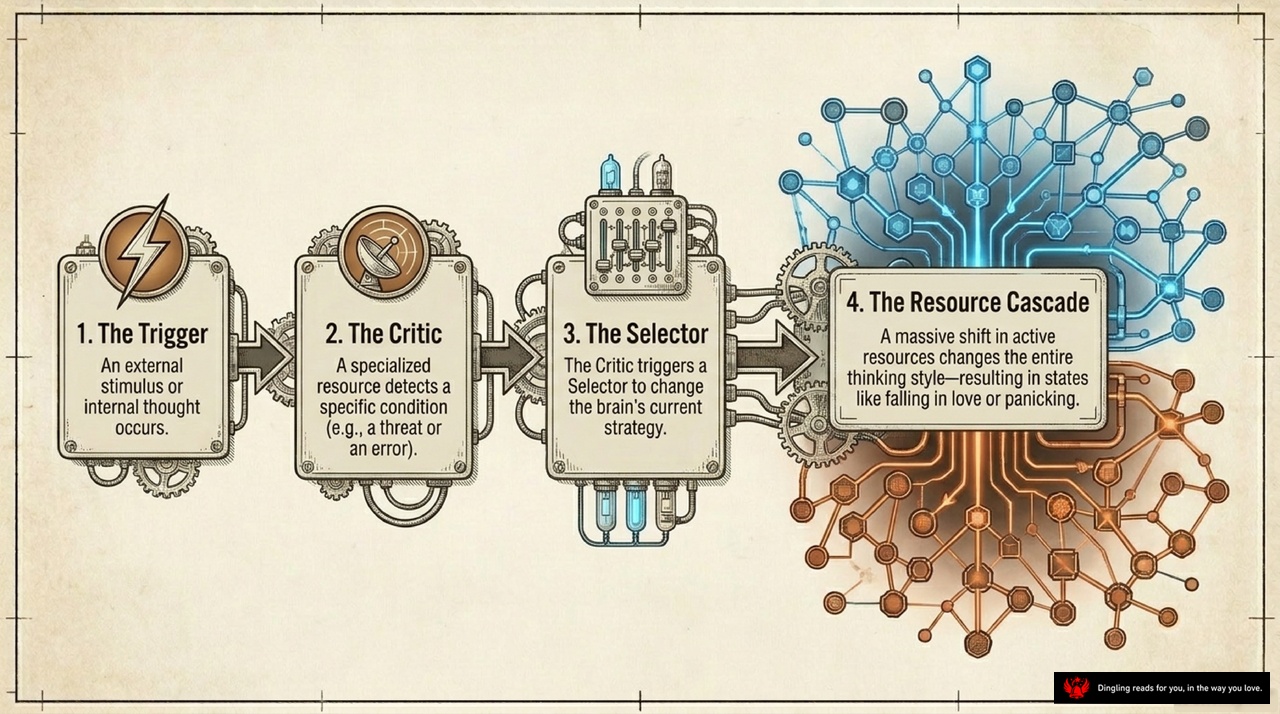
Imagine your brain not as a single, static processor, but as a dynamic battlefield where different strategies constantly compete for control. This is the essence of the "Critic-Selector" model, a powerful framework for understanding how our thoughts actually shift.
Look at the diagram on your screen. It maps out a four-step cycle that drives our mental life. It starts with **The Trigger**. This is simply an external stimulus or an internal thought that grabs your attention. Maybe you're stuck on a problem, or you suddenly feel a pang of hunger. That initial spark is the fuel that starts the engine.
Next comes **The Critic**. Think of this as your internal quality control team. Once that trigger occurs, a specialized resource steps in to scan the situation. It's looking for specific conditions—perhaps a threat, an error, or a missed opportunity. If the Critic detects that your current approach isn't working, it doesn't just wait; it actively signals for a change.
That signal activates **The Selector**. This is the decision-maker. The Critic triggers the Selector to swap out the brain's current strategy. It's like changing gears in a car when you hit a bump. The Selector chooses a new set of mental tools and resources to handle the new reality.
Finally, this leads to **The Resource Cascade**. This is the most dramatic part. When the Selector switches strategies, it causes a massive shift in active resources. It's not just a small tweak; it changes your entire thinking style. This cascade can result in profound states, like falling in love, experiencing a sudden burst of creativity, or even panicking. Your entire perspective flips because the underlying resources driving your thoughts have completely reorganized.
So, every time you feel a sudden shift in mood or a breakthrough in understanding, remember this cycle: a trigger sparks a critic, which activates a selector, unleashing a resource cascade that transforms how you see the world. It's the hidden architecture behind your most profound mental shifts.

Imagine your mind not as a single, static entity, but as a sophisticated operating system running on six distinct levels of mental activity. This slide breaks down exactly how we think, moving from the raw, automatic signals deep in our biology to the highest peaks of moral and social reflection.
At the very bottom, we have our Instincts. These are the "If-Do" rules hardwired into our DNA. If you touch something hot, you pull away instantly. There is no thought, no planning—just a pure, immediate reaction with zero awareness. It's the survival foundation of every living thing.
Moving up, we encounter Learned Reactions. Here, experience shapes our behavior. Through conditioning, we learn that a specific sound means danger or food. Our awareness is low; we act based on past patterns without necessarily questioning why.
Then comes Deliberative Thinking. This is where things get interesting. When you face a novel problem, like planning a complex trip, your brain shifts gears. You start searching, planning, and predicting outcomes. Your awareness level rises to moderate because you are actively engaging with the task.
Next is Reflective Thinking. This kicks in when your initial plans fail. You stop and evaluate your strategy, asking, "Why didn't that work?" Your awareness is now high, as you are critically analyzing your own thought process.
The fifth level is Self-Reflective Thinking. This happens when you face an internal conflict, perhaps questioning whether your goals actually align with your deepest values. You aren't just fixing a plan; you are questioning the purpose of the plan itself. Awareness is very high.
Finally, at the top, we have Self-Conscious Reflection. This is the realm of social and moral context. You are constantly evaluating how your actions align with your ultimate ideals and how others perceive you. This is where our awareness hits maximum levels, integrating our personal identity with the broader human experience.
Understanding these six dimensions helps us realize that our thoughts aren't random. They are a dynamic flow, shifting between these layers depending on the trigger and the complexity of the situation. We are constantly moving between instinctual reactions and profound self-reflection, navigating the full spectrum of what it means to be human.

Imagine your mind not as a single, unchanging entity, but as a sophisticated engine with multiple gears. This is the core of what we call "sub-personas"—dynamic mental models that switch on and off depending on the situation. Think about yourself: in a job interview, you might be the "Professional," focused on logic and efficiency; but at a dinner party with friends, that same person transforms into the "Social," prioritizing connection and humor. These aren't different people; they are the same brain, flexibly allocating resources to fit the context.
The image on your screen illustrates this beautifully with the concept of the "Difference Engine." It shows a cycle between our "Current State" and our "Desired State." The engine's job is to detect the gap between where we are and where we want to be. When that gap appears, our sub-personas kick in. We generate iterative sub-goals—smaller steps to bridge that distance. If a method doesn't work and the gap widens, we reverse course and try a new strategy. This isn't rigid programming; it's a mechanical persistence to reduce the difference between two states.
This fluid switching allows us to handle complexity. When we face a crisis, our cautious sub-persona takes the wheel, shutting down impulsive thoughts. When we need creativity, our adventurous side emerges. The key to a healthy mind isn't finding one perfect personality, but mastering the art of coordination. We need to learn when to activate which gear, ensuring our actions align with our long-term goals rather than getting stuck in internal conflict. By understanding these shifting sub-personas, we stop fighting against ourselves and start leveraging the full power of our adaptable, multi-faceted intelligence.

Imagine your brain not as a computer that only memorizes successful paths, but as a master explorer navigating a massive, intricate maze. Look at this diagram: the red "X"s scattered throughout represent failures, dead ends, and painful mistakes. Traditional AI models, as the slide suggests, only learn from the successful paths. They ignore the red Xs, making them incredibly efficient in predictable environments but dangerously brittle when they encounter an unforeseen obstacle they haven't seen before. They have no map of where *not* to go.
But the human cognitive model is fundamentally different. We don't just learn from success; we constantly learn from pain, failure, and our physical limits. Every time we hit a wall in that maze, we don't just restart blindly; we update our internal map. We learn to avoid that specific turn next time. This vast, invisible repository of "Negative Expertise"—the knowledge of what doesn't work—is actually the bedrock of true intelligence. It allows us to map out the forbidden zones, preventing catastrophic errors before they even happen. While a machine might crash into a new trap, our brain, armed with a lifetime of negative lessons, intuitively knows how to weave through the chaos and find the safe path. That's the power of knowing what to avoid.

The Common Sense Barrier in AI isn't just about missing data; it's about missing the invisible rules that run our world. Look at this diagram. We often think of AI as a master of the **Physical Domain**, where it excels at calculating weight, friction, and trajectory—moving solid objects through space with perfect precision. It can solve equations like $M = \frac{F_{avg}}{a_{avg}}$ better than any human.
But here is where the breakdown happens. AI struggles in the **Social Domain**. While we effortlessly understand generosity, reciprocal obligation, and gratitude, machines stumble because these aren't just data points; they are unspoken contracts. When you hand someone a gift, you aren't just transferring an object; you are activating a complex web of trust and social bonds that the AI literally cannot see.
Then there is the **Sovereignty Domain**, the most invisible of all. This is the realm of the invisible transfer of ownership and usage rights. Think about a key unlocking a door. To us, that's a simple act of authorization and possession. To an AI, it's just a digital signal. It lacks the understanding of what it means to "own" something or the moral weight of "usage rights."
The core problem, as stated at the bottom, is that AI fails because it lacks the millions of unspoken, default assumptions humans accumulate by age five. We don't calculate social friction or ownership transfers; we just know them. We assume the other person is a moral agent, not just a collection of inputs. Until AI learns these default assumptions—the "common sense" of how humans actually interact—it will remain brilliant at moving boxes, but completely lost on how to move people.

Imagine a chasm separating two completely different problems. On one side, you have a tangled, chaotic structure; on the other, a perfect, symmetrical star. At first glance, they look nothing alike. The gap between them is filled with "Surface Differences"—the noise, the specific details, the context that makes them seem unrelated.
But here is where human superpower kicks in. Unlike a machine that crashes when it hits the unknown, humans don't get stuck. We use analogical reasoning to build a bridge. We do this in three steps. First, we strip away the surface-level details. We ignore the specific shapes and just look at the underlying structure. Second, we identify structural similarities between past experiences and this novel threat. We ask, "Have I seen this pattern before, even if it looks different?" Third, we apply that historical solution to the new architecture. We take what worked before and adapt it to the current situation.
This ability to find structural parallels across entirely different domains is what allows us to guess correctly and solve problems we've never faced. It's the difference between getting lost in the noise and seeing the hidden pattern that connects everything.

How do we learn what to really want? It turns out, high-level values aren't acquired through trial-and-error. They are installed by Imprinters who trigger self-conscious emotions, bypassing logic to directly rewrite our highest-level goals.
Look at this diagram. At the top sits The Imprinter, the Caregiver. This isn't just about feeding the child; it's about programming the brain's operating system. The Imprinter broadcasts signals down to The Child, activating a complex network of neural pathways.
Notice the two distinct switches controlling this system. On the left, we have Shame, labeled as Suppression. When this is triggered, it acts like an OFF switch, shutting down certain drives and forcing the child to conform to the Imprinter's standards. On the right, we see Pride, labeled as Elevation. This acts as an ON switch, energizing behaviors that align with the Imprinter's values and lifting the child's motivation.
Think about your own childhood. Did you learn to be honest because you understood the abstract concept of integrity? Or did you learn it because a specific person made you feel terrible when you lied, or incredibly proud when you told the truth? That person was your Imprinter. They didn't just teach you rules; they rewired your brain to prioritize certain goals over others, using the powerful levers of shame and pride to shape who you become.

Imagine a diamond at the center, representing the core problem you are facing. Surrounding it are four magnifying glasses, each illuminating a different dimension of reality: Logic, Emotion, Social, and Physical. This visual perfectly captures the essence of what we call the Multi-Model Mind.
The slide reminds us of a hard truth: if you only understand something one way, you don't understand it at all. True human intelligence isn't about being a master of just one lens. It's about the diversity of representation. We need to be able to rapidly switch between these cognitive models the moment one approach fails.
Think about it. If you are stuck on a logic puzzle, maybe you need to shift to an emotional perspective to find the missing piece. If a logical argument isn't working, perhaps the social context or a physical analogy will unlock the solution. Our resilience comes from this flexibility. We aren't just rational machines or purely emotional beings; we are a synthesis of all these models working together. By keeping these four perspectives in mind, we stop getting trapped in a single, limited view and start seeing the full picture.

Look at this blueprint. On the left, we have our current AI architecture, labeled as "fragile." It's built on specialized, rule-bound processing that halts the moment it hits an edge case. It lacks common sense and has no way to recover when stuck. But look at the right side: the future AI blueprint, marked as "robust." This isn't just about adding more data; it's about installing internal critics and selectors. Imagine a system that doesn't just follow a script but can evaluate its own thinking. When it hits a dead end, instead of crashing, it has the capacity to change its own methods, almost like developing an emotional response to the problem. It relies on vast databases of common sense and negative expertise to navigate uncertainty. The core shift here is moving from a rigid machine that stops at failure to a dynamic system that can adapt its very way of thinking when things go wrong. This robustness comes from programming the AI with the ability to self-correct, effectively giving it a form of emotional resilience so it can keep moving forward even when the path isn't clear.

The mind is far more than just a cold, calculating machine. Think of it as an intricate engine powered by diverse resources. Emotions aren't irrational glitches; they are highly specialized thinking methods designed to help us navigate the world. True intelligence isn't about having one perfect answer; it requires multiple representations, negative expertise, and common sense working together.
But here's the mind-bending question that leaves us all wondering: When machines finally possess the emotional capacity to reflect on their own flaws, will they become more human than us? Or, in that moment of realization, will we simply admit that we have been mechanical all along? The line between the machine and the human might be thinner than we ever imagined.