
The End of History and the Last Man: Complete Chapter-by-Chapter Summary

Welcome to our exploration of *The End of History and the Last Man* by Francis Fukuyama. Today, we stand at the top of a grand staircase, looking out toward a horizon that seems to promise a final destination for human history.
This book asks a profound question: Is liberal democracy truly the final endpoint of humanity's ideological evolution? For centuries, history was seen as a cycle of rise and fall, but Fukuyama argues that something unique has happened. He suggests that through the power of modern science and the spread of free markets, we may have finally reached a state where no new competing ideology can emerge.
The image before you represents this journey. Just as these steps lead upward into the light, human history has moved from ancient cycles toward a linear progression driven by the relentless pursuit of truth and freedom. The text on the slide reminds us that this is an exploration of whether our current system represents the ultimate victory of human reason.
We are no longer in an age of endless ideological warfare. Instead, we are witnessing the triumph of a single model: one that combines individual liberty with the collective power of democratic governance. This isn't just about politics; it's about the very nature of human fulfillment. If history has indeed reached this point, then the future isn't about choosing between different systems, but about perfecting the one we have already won.

What it is NOT: The End of Events. A common misconception is that history has stopped, but that's simply not true. Look at the clock and the halted printing press on the left—these symbols represent a misunderstanding. Wars, crises, and daily news will continue. The natural cycle of birth, death, and geopolitical conflict does not stop. Just because we've reached a new political stage doesn't mean the drama of human life has vanished.
What it IS: The Endpoint of Ideological Evolution. This is where the real story lies. Imagine all the major competing systems—Monarchy, Fascism, and Communism—pouring into a funnel, merging into a single, unified direction: Liberal Democracy. This diagram illustrates the systemic progression of human governance principles reaching its final, most structurally sound form. It's not about the absence of events, but the victory of a specific idea. While the world remains chaotic and events keep unfolding, the underlying logic of how we organize ourselves has settled. We've moved past the era where different ideologies could compete on equal footing. Liberal Democracy has proven itself the only viable framework for complex, modern societies. It's the end of the ideological race, even if the journey of daily life continues.

Imagine history not as a random cycle, but as a machine driven by two powerful engines. On the left, you see the Logic of Modern Science—a rigid, mechanical structure powered by gears and reason. This engine is driven by desire and intellect, pushing us toward economic modernization, technological breakthroughs, and the rise of free-market capitalism. It's the cold, calculated force that makes a steam engine more efficient or a computer faster than its predecessor.
But on the right, we have the second engine: The Struggle for Recognition. This isn't about gears; it's about fire and passion. Driven by what we call the "Thymos"—our spirit, our pride, and our deep need to be seen as human beings—this engine fuels the demand for dignity, equality, and political rights. It's the emotional force behind revolutions and the refusal to accept being treated as less than others.
The brilliance of this dual-engine model is how it explains our world. The scientific engine builds the tools and wealth, while the struggle for recognition demands the freedom to use them with dignity. Together, they push history away from the chaos of the past, where empires rose and fell on sheer power, toward a future where human potential is unlocked. It's a reminder that while we can't stop the march of technology, our fight for respect is the very spark that gives that technology its true meaning.

Why do some nations thrive while others stagnate? The answer isn't just about resources or luck; it's deeply rooted in culture. Today, we're seeing a fascinating global trend toward economic homogenization. As nations develop, they inevitably adopt similar market principles, urbanize, and expand education. This isn't a choice; it's a survival mechanism. Look at the "Asian Miracle"—countries like South Korea and Singapore didn't follow the old path of import substitution. Instead, they embraced free markets and export-oriented growth, integrating into the global economy to catch up rapidly. Meanwhile, Latin America's stagnation wasn't caused by capitalism itself, but by rigid state control and inefficient bureaucracy that stifled innovation.
But here's the crucial twist: this economic shift is reshaping politics. As economies grow and cities expand, a new class emerges—the educated middle class. These people naturally crave participation and freedom. They don't just want wealth; they want dignity and a say in how society is run. History shows us that when a country industrializes and modernizes, the old systems of authoritarian rule often crumble under the weight of these new expectations. We saw this in Spain and Latin America, where economic progress paved the way for democratic transitions.
However, culture isn't just a backdrop; it's an active force. It determines how people work, how they view their neighbors, and whether they value the group over the individual. Some cultures, like Japan's, foster a strong work ethic based on group honor, while others may prioritize individual survival over collective ambition. These differences can either accelerate or hinder the march toward democracy. Ultimately, the global trend is clear: the logic of modern science and economics pushes us all toward a similar future. But the path we take, and the kind of society we build, depends on how we manage the tension between our rational desires for prosperity and our deeper, often irrational, need for recognition and honor.

Welcome back. Today, we're diving into the very engine that drives human behavior, the one that often gets ignored in our purely economic models: Engine 2, The Psychological Imperative.
Look at this diagram of Plato's Tripartite Soul. We often think humans are just calculating machines, driven solely by logic and material needs. But that's only half the story. This slide breaks down the three forces at play. At the bottom, we have **Desire**—the craving for basic necessities like food, shelter, and comfort. Above that is **Reason**, the calculating mechanism we use to satisfy those desires efficiently. But the most powerful force of all, highlighted in red, is **Thymos**, or what we call "Spiritedness."
This is the psychological demand for the recognition of one's inner value. It's the root of anger, shame, and pride. This is the part of us that refuses to be just a number or a worker bee. It is the drive that makes us risk our lives simply to be respected.
As we've discussed, history shows us that humans are not just economic machines. When people feel their dignity is being stripped away, or when they are treated as second-class citizens, thymos kicks in. We see this in revolutions, in strikes, and in the refusal to accept a life of silent submission. While desire wants to survive, and reason wants to get the best deal, thymos demands that we be treated as equals. It is the spark that turns a group of individuals into a nation, and it is the force that ultimately pushes us toward a society where everyone's worth is recognized. Without thymos, we might have a stable economy, but we would lack the soul that makes us truly human.

Look at this slide titled "The Dialectic of Master and Slave." This isn't just a philosophical abstraction; it's the engine driving human history, explaining why the path to freedom is so difficult.
On the left, we have "The Master." The text describes someone who risks their life in bloody battles purely for prestige, overcoming their biological instinct for survival. The flaw here is starkly highlighted in red: this master achieves recognition, but only from a slave. Recognition from an unfree, defeated being is ultimately meaningless and hollow. You can't build a real identity on the fear of someone else.
On the right stands "The Slave." Initially, this figure submits out of the fear of death, turning to manual labor instead of fighting. But here lies the hidden triumph, highlighted in gold. Through work, the slave transforms nature. In manipulating the material world, the slave conceives the idea of freedom. It is the slave, not the master, who drives historical progress forward.
This dynamic explains why true freedom is hard to come by. The master's power is fragile because it depends on the slave's fear. But the slave, by creating and working, eventually realizes that their own activity is the source of their freedom. History moves forward not because the master conquers, but because the slave, through labor and the desire for recognition, realizes their own dignity. This struggle between the hollow recognition of the master and the transformative power of the slave is the core of how we evolve from a state of fear to a state of genuine liberty.

Why do some nations thrive in peace while others remain trapped in conflict? The answer lies in the invisible battle between our rational minds and our primal desire for recognition. Liberal democracy isn't just about voting or laws; it's a unique system that successfully channels our deep-seated need for status and honor into peaceful, constructive competition.
In the modern world, we've moved away from the bloody "master-slave" struggles of the past. Today, nations like the US and UK don't fight wars over land or honor; they compete through economic innovation and diplomatic influence. When a leader like Winston Churchill leads a country to victory, or an entrepreneur like Henry Ford builds a global empire, they gain the recognition they crave—but without spilling blood. This transforms our destructive "will to power" into a productive drive for excellence.
However, this system isn't perfect. Critics like Nietzsche argue that true greatness requires a hierarchy where the strong dominate the weak, a dynamic that liberal democracy's obsession with equality might suppress. They worry that without the outlet of war or rigid class structures, our drive for superiority could turn inward, leading to a stagnant society of "last men" who only care about comfort.
Yet, history suggests a different path. Instead of war, we've found new arenas for this competitive spirit: the global market, international diplomacy, sports, and even the arts. In these fields, we can strive to be the best without destroying each other. While the tension between equality and the desire for distinction remains, liberal democracy offers a stable framework where human ambition fuels progress rather than destruction. It proves that we can satisfy our deepest psychological needs without repeating the tragedies of the past.

Look at this spectrum of recognition. On the left, we have Megalothymia—the fierce desire to be recognized as superior to others. This drive fuels heroes, tyrants, and conquerors, but modern democratic systems view it as a direct threat to peace, often trying to suppress it. On the right sits Isothymia, the desire to be recognized as equal. This is the engine behind human rights, social justice, and universal suffrage, serving as the dominant psychological force of our modern era.
The visual flow between these two extremes captures the core tension of human history. We've seen how the struggle for recognition has shaped everything from the bloody duels of the past to the rise of empires. Yet, as we move forward, the story shifts. The chaotic, life-or-death struggle for dominance that defined earlier eras is giving way to a new order. Instead of fighting to prove we are better than others, the modern world is increasingly organized around the principle of mutual equality.
This transition isn't just political; it's deeply human. It reflects a move from a world where status was won through violence and conquest to one where dignity is found in shared rights and participation. While the urge for superiority never fully disappears, the universal acceptance of equality has become the stable foundation for peace and progress. In this new landscape, the greatest power no longer comes from dominating others, but from being recognized as an equal member of a shared community.
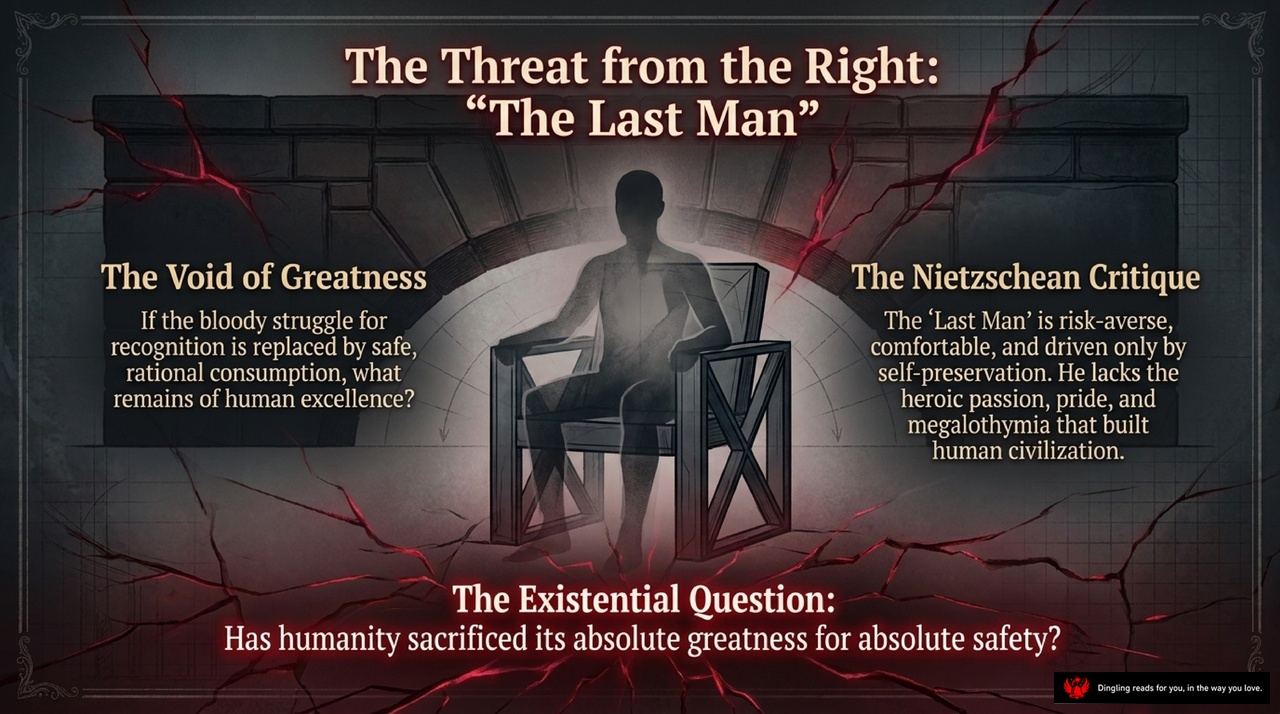
Look at this image. It captures a profound warning about the direction of our modern world. The central figure sits alone in a chair, surrounded by a crumbling wall and deep cracks. This visual represents the concept of "The Last Man"—a term from Friedrich Nietzsche's critique of modernity.
On the left, the slide highlights "The Void of Greatness." It asks a haunting question: if the bloody struggle for recognition is replaced by safe, rational consumption, what remains of human excellence? On the right, we see "The Nietzschean Critique." Here, the 'Last Man' is described as risk-averse, comfortable, and driven solely by self-preservation. He lacks the heroic passion, pride, and megalothymia—the drive for greatness—that historically built human civilization.
At the bottom, the slide poses the ultimate existential question: "Has humanity sacrificed its absolute greatness for absolute safety?"
This isn't just about history; it's about our current reality. We live in an era where comfort often trumps challenge. We have eliminated many risks through technology and social safety nets, creating a world of predictable, safe consumption. But Nietzsche warns us that this safety comes at a cost. When we remove the friction of struggle and the risk of failure, we also remove the opportunities for true heroism and the creation of something truly new.
The image of the cracked wall suggests that this foundation of "absolute safety" is fragile. It implies that a society without the drive for greatness, without the willingness to take risks and face uncertainty, might eventually crumble from within. The "Last Man" is not necessarily evil, but he is stagnant. He is content with being average and safe, lacking the ambition to push boundaries or achieve the extraordinary.
So, as we reflect on this slide, consider this: Are we building a future of secure comfort, or are we preserving the conditions necessary for human potential to flourish? The cracks in the wall remind us that without the tension of striving for greatness, the structure of our civilization may eventually fracture. The choice between safety and greatness is the defining question of our time.

When violent conquest becomes obsolete, the human drive for superiority doesn't disappear—it simply finds new, safer outlets. This is what we call the sublimation of megalothymia. Instead of conquering physical territory, modern democratic societies channel this innate ambition into three distinct arenas.
First, we see it in Entrepreneurship and Business. Here, the drive to dominate transforms into conquering global markets and innovating technologies. Instead of seizing land, the ambitious seek to amass wealth and disrupt industries, turning raw competitive instinct into economic growth.
Second, we find it in Extreme Sports. The desire to conquer nature takes a literal form. Athletes risk their lives to achieve non-violent prestige, whether scaling the world's highest peaks or pushing the limits of speed in extreme racing. It is a modern arena for proving one's courage and mastery over the natural world.
Finally, we observe it in Art and Formal Culture. Here, the pursuit of superiority becomes an obsession with formalistic mastery. Think of the Japanese tea ceremony or intricate calligraphy; these practices elevate the individual above the mundane by demanding obsessive discipline and perfection. In these three pillars, the ancient urge for dominance is reimagined, proving that even in a peaceful world, the human spirit still seeks to rise above.

Look at this chart. It maps out the modern ideological landscape using two axes: Economic Viability and Universal Ideological Appeal.
On the left, you see "Authoritarian Capitalism," or the China Model. It scores high on economic viability, delivering strong growth and stability. However, it lacks a universal ideological framework that can be seamlessly exported globally. It works for its own context, but it doesn't offer a compelling narrative for the rest of the world to adopt.
On the bottom left is "Radical Islam." This system shows high localized passion and strong mobilization within specific communities, but it fails on both economic viability and universal appeal to non-Muslims. It remains a regional phenomenon rather than a global model.
Finally, on the top right, we have "Liberal Democracy." This is the only system that checks both boxes. It has proven economic viability, driving innovation and prosperity, combined with universal appeal. It offers a framework that resonates across different cultures and religions, making it the only ideology actively exporting itself as a superior model for the entire world.
The conclusion at the bottom is clear: These challengers represent merely "speedbumps" in the waiting room of history. They may cause temporary friction, but no alternative ideology is successfully scaling globally. Liberal Democracy remains the only system with both the economic power and the ideological reach to sustain itself worldwide.

Look at this scale. On one side, we have political equality—the promise of liberal democracy that every citizen deserves equal recognition and dignity. On the other, we have the harsh reality of economic inequality, where the very engine of capitalism creates massive wealth gaps and concentrates power in the hands of a few. This image captures a profound tension at the heart of our modern world.
While our systems legally guarantee that we are all equal voters, the economic machine constantly pulls us apart. For those struggling financially, this creates a perpetual state of friction. They begin to feel that their humanity and dignity are not fully recognized by a system designed to concentrate wealth. This isn't just a disagreement about taxes or policies; it's a deep crisis of identity. When the economy tells you that your worth is tied to your income, and you have very little, it feels like the system itself is denying your humanity.
This is the threat from the left, not necessarily in the form of destroying the system, but in exposing this contradiction. It highlights a profound problem within democracy: how do we reconcile the promise of equal dignity with the reality of unequal outcomes? Until we find a way to balance these two weights on the scale, the tension will only grow, challenging the stability and legitimacy of our entire political order.

The Democratic Vulnerability isn't just a label; it's a trap that modernity has built for itself. Look at this cycle of boredom. It starts with Phase 1: Eternal Peace and Prosperity. Imagine a world where the state guarantees your physical safety and endless consumer goods. You get everything you want, and suddenly, you have nothing left to fight for. That comfort creates a vacuum.
This leads directly into Phase 2: The Void of Struggle. Without great historical causes to rally behind, without a real enemy or a meaningful mission, society starts to rot from the inside. You feel intense boredom, malaise, and deep self-doubt. It's the crisis of the "last man"—someone who is safe but spiritually dead.
But human nature refuses to stay asleep. Enter Phase 3: The Need to Feel Alive. Our human spirit, what philosophers call the *Thymos*, violently rebels against this sterile comfort. We don't just want to survive; we need to feel that we matter. We need to prove we are still human. So, we turn to Phase 4: Pointless Conflict. This is the most dangerous part. Humanity starts restarting history, engaging in wars that serve no purpose, or destroying institutions just to experience a heroic struggle. We are willing to burn the world down just to feel a spark of life.
This cycle shows why democracy is so vulnerable. It solves the problem of survival, but it accidentally creates a crisis of meaning. When the struggle for survival ends, the struggle for identity begins—and often, that identity is built on conflict.

We stand at a profound crossroads. Liberal democracy has triumphed not because it is flawless, but because it is the only system that simultaneously satisfies the economic logic of science and the psychological human need for universal recognition. Yet, by domesticating the human spirit into comfortable, risk-averse consumers, it leaves a void of heroic purpose.
This brings us to a haunting question: If the cost of eternal peace and prosperity is the loss of our heroic striving, will humanity eventually tear down the utopia we have built simply to feel alive again?
This isn't just a theoretical debate; it's a reflection of a deep human tension. We crave the security and equality that modern democracy offers, where no one is a master and no one is a slave. But we also have an innate, almost primal drive for distinction, for superiority, and for being seen as exceptional. Think about it: why do we admire a climber who risks their life on a remote peak, or a scientist who spends decades chasing a single truth, when the "rational" choice would be to seek comfort and safety?
Nietzsche warned us that democracy might be the victory of the "last man"—those who are content with mere survival and the avoidance of pain. In a world of perfect equality, where everyone gets the same basic recognition, what becomes of the drive to excel? Without that drive to rise above the average, without the friction of competition for greatness, does our culture stagnate? We might end up with a society that is peaceful and rich, but spiritually hollow, where the only ambition is to consume more or feel good about ourselves without actually achieving anything extraordinary.
So, is this the end of history? Or is the very existence of this internal conflict—the pull between our desire for safety and our hunger for heroism—a sign that our story isn't over? The utopia we built is stable, yes, but is it truly satisfying our deepest soul? Or will the human spirit eventually find a way to break free from its own comfort, to rediscover the struggle that makes us feel truly alive? That is the challenge we face today.