
The End of Illusions: Complete Chapter-by-Chapter Summary
Ever feel like the old social contract’s fraying—like the promise of a stable middle-class life for hard work is fading? Andreas Reckwitz’s *The End of Illusions* digs into that shift. We’re leaving the egalitarian industrial era, where stability and shared progress felt attainable, and stepping into a late modern world that’s polarized, a winner-takes-all game. Reckwitz maps this sociological paradigm shift, unpacking why our society feels so divided and what this means for how we live, work, and connect now. It’s a sharp look at the illusions we’ve outgrown—and the new realities we’re facing.
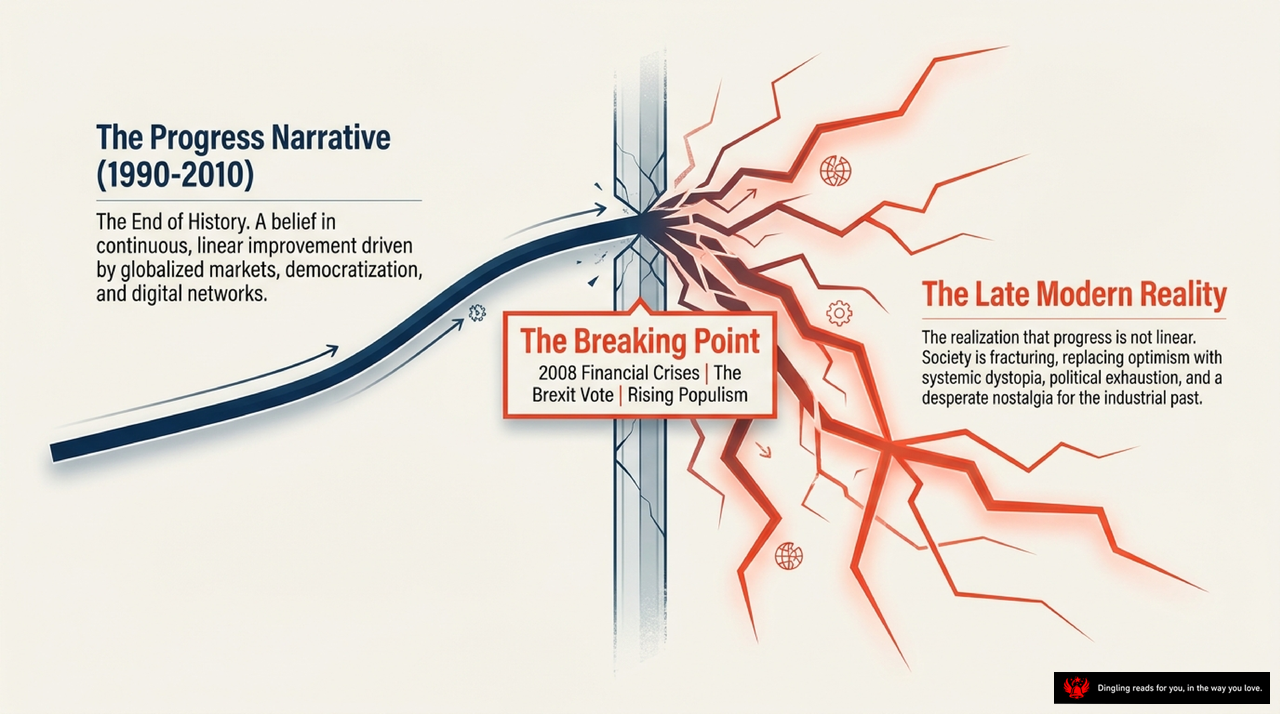
Let’s turn to this slide—it maps a seismic shift in how we’ve thought about progress over the last 30 years. From 1990 to 2010, we lived in the era of the Progress Narrative. Back then, the prevailing belief was in continuous, linear improvement—like history was marching toward a better, more connected world. We trusted global markets to create prosperity, democracy to spread freedom, and digital networks to bring everyone closer. It felt like the future was a straight line upward.
But then came the Breaking Point. The 2008 financial crisis shook that faith to its core—suddenly, the stability we took for granted vanished. Then Brexit, where the UK voted to turn away from Europe, and the rise of populist movements here in the U.S. and across the globe. All these events shattered the old story we told ourselves about progress.
Now we’re in the Late Modern Reality. We’ve come to see that progress isn’t linear. Society is fracturing: cities like San Francisco and New York are thriving with tech and creative jobs, but small towns and former industrial areas—think the Rust Belt—are struggling. Optimism has been replaced by systemic dystopia; people feel politically exhausted, and there’s a desperate nostalgia for the industrial past. For many, that past wasn’t just about factory jobs—it was a time when hard work meant a stable future, when communities were tight, and when you knew where you fit.
This split isn’t just economic—it’s cultural too. The new urban middle class embraces globalism and diversity, while others feel their values and way of life are being sidelined. That tension is what’s driving so much of the division we see today: between the world we thought we were building and the world many people feel they’ve lost.
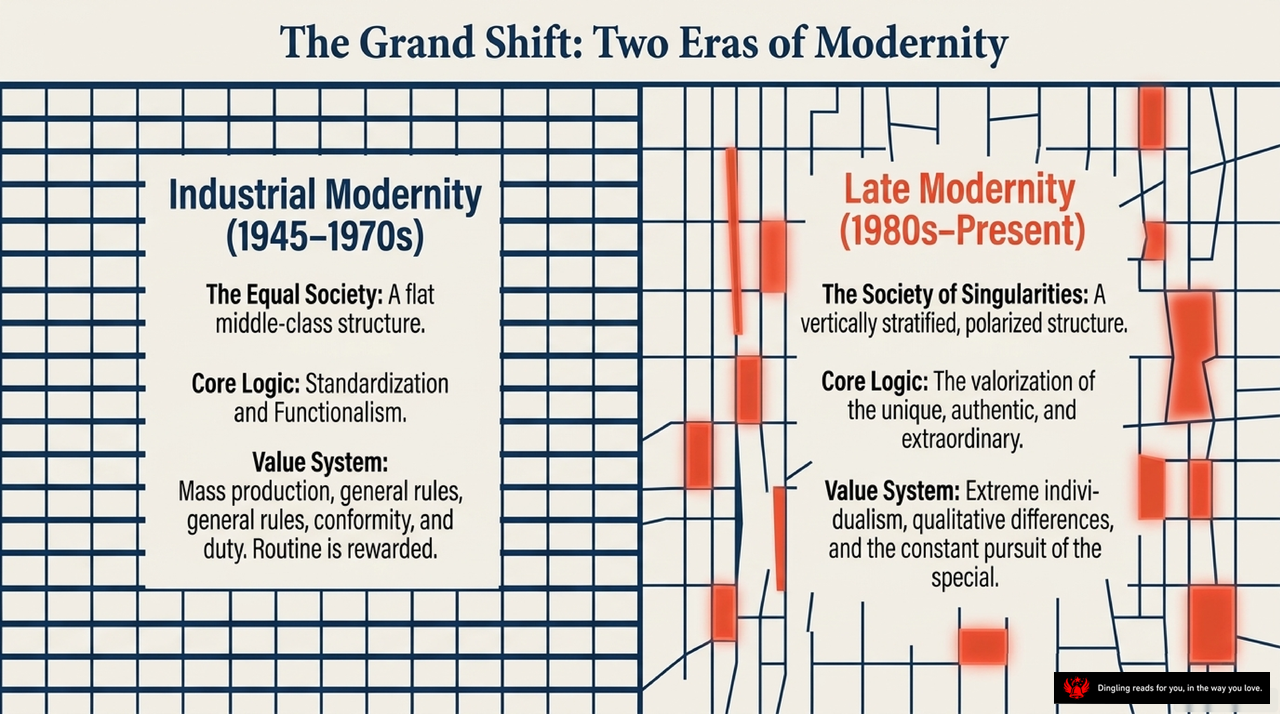
Let’s take a look at this slide—The Grand Shift: Two Eras of Modernity. It’s a vivid map of how our society transformed from the post-WWII boom years to the world we live in today.
First, Industrial Modernity, from 1945 to the 1970s. The slide calls it an “Equal Society” with a flat middle-class structure. As the book explains, this was the era of the “golden middle class”: most people could get a stable industrial job, own a home, and raise a family—often without a college degree. The core logic here was standardization and functionalism: mass production lines churned out identical goods, rules were strict, and conforming to the norm was not just expected but rewarded. Duty to family and routine at work were the pillars of success.
Then came Late Modernity, starting in the 1980s and continuing now. The slide labels it the “Society of Singularities”—a vertically stratified, polarized structure. This aligns perfectly with the book’s analysis: the once-flat middle class split into three groups: the rising knowledge elites, a stagnating old middle class, and a growing precariat (unstable, low-wage workers). The core logic shifted to valuing the unique, authentic, and extraordinary. Instead of mass production, we’re in the age of cognitive-cultural capitalism—where ideas, creativity, and personal brand are more valuable than assembly-line work.
The value system changed dramatically too: extreme individualism replaced conformity. People now chase qualitative differences—seeking artisanal coffee, niche hobbies, or unique career paths—instead of just fitting in. The book notes how self-realization became the ultimate goal, whether through curating an online identity or pursuing a passion project. Routine is no longer rewarded; standing out is.
This shift isn’t just economic—it’s cultural. The book points out how this polarization created deep tensions: between those thriving in the new era (city-based knowledge workers) and those left behind (old middle class in declining industrial areas). It’s a grand shift indeed, shaping every aspect of our work, relationships, and sense of self today.
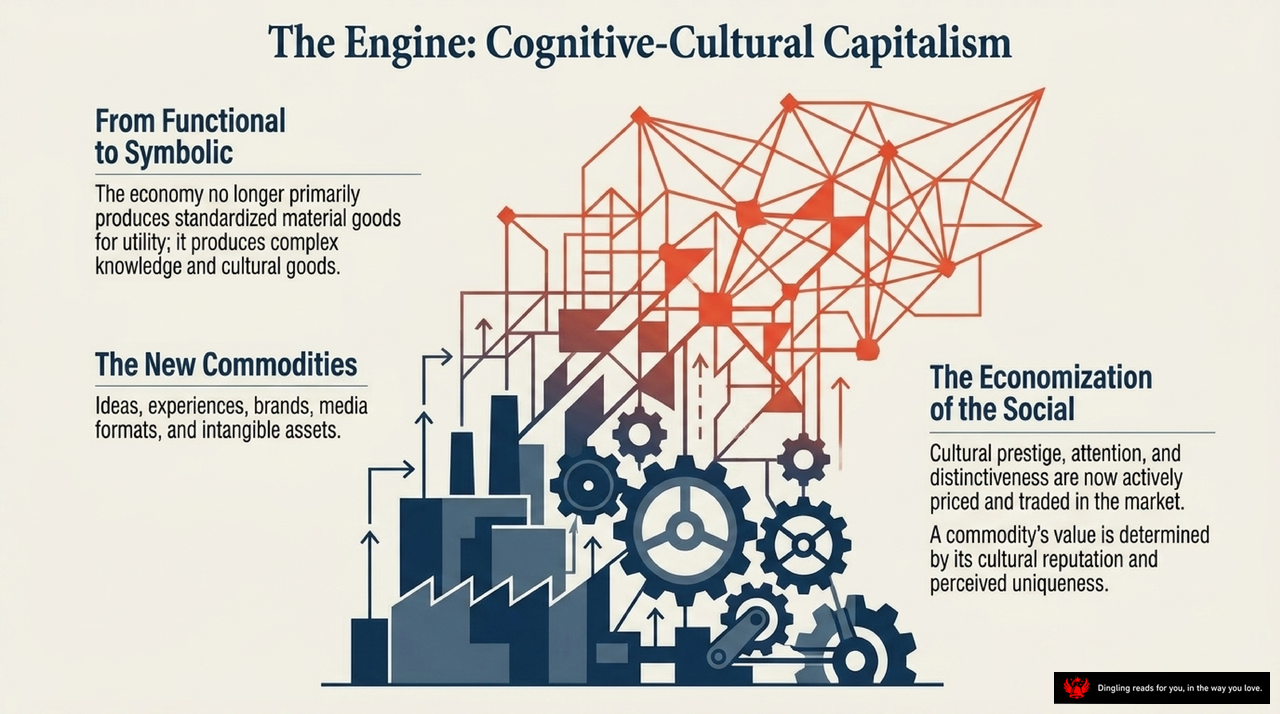
Let’s dive into the engine powering our modern economy: cognitive-cultural capitalism.
For decades, our economy ran on churning out standardized, functional goods—think assembly lines producing cars or appliances that just did their job. But things have shifted dramatically. Now, the economy doesn’t prioritize those utility-driven products anymore; instead, it’s all about creating complex knowledge and cultural goods.
What does that mean for the stuff we value? The new commodities aren’t just physical. They’re ideas, experiences, brands, media formats, and intangible assets. Take a streaming service subscription—you’re not just paying for access to shows; you’re buying the experience of discovering new content, joining cultural conversations, and feeling connected to a community. Or an artisanal bakery’s sourdough: it’s not just bread; it’s the story of the baker, the craft, and the local vibe that makes it worth more than a generic loaf.
And here’s a key twist: even social and cultural elements are now part of the market. Cultural prestige, attention, and distinctiveness—these aren’t just abstract concepts anymore; they’re actively priced and traded. A commodity’s value isn’t just based on its production cost. It’s determined by its cultural reputation and how unique people perceive it. Why do folks shell out big bucks for a limited-edition sneaker? It’s not the materials—it’s the brand’s status, the exclusivity, and the way it signals their identity.
This shift from functional to symbolic, from tangible to intangible, is changing how we work, consume, and even see ourselves. It’s the core of the cognitive-cultural capitalism driving our world today.
Let’s talk about the big political shake-up we’ve seen in the West over the last decade—Trump’s win, Brexit, all those populist waves crashing in. It’s not just a left vs. right fight anymore; we’re looking at a fundamental shift in how we frame politics.
After WWII, we had this thing called social-corporatism. Think strong welfare states, governments regulating the economy to keep everyone stable, and a focus on shared prosperity. It worked for a while, but by the 1970s, it was unraveling—oil crises, stagflation, and people getting fed up with all that top-down control.
Then came open liberalism in the 80s—Reagan, Thatcher, Blair. It was all about letting markets run free, embracing globalization, and prioritizing personal freedom. But by 2010, that model was in crisis too. The 2008 crash exposed how unregulated markets can blow up. Inequality skyrocketed—super rich getting richer, the middle class shrinking, and rural areas left behind. Culturally, identity politics split us into silos, and trust in democracy plummeted.
Populism? Yeah, it’s a reaction to all this chaos. But it’s not the answer. It’s all “us vs. them”—blaming immigrants or elites, no room for compromise, and it rejects the diversity that makes modern societies work.
So what’s next? Maybe embedded liberalism. It keeps the good parts of liberalism—democracy, diversity, global connections—but adds guardrails. We need to regulate markets to fix inequality, build shared cultural rules so we can coexist, and make democracy feel like it works for everyone, not just a few. It’s not going back to the old days; it’s about making our current system work for more people.
This isn’t easy, but it’s the only way to move past the chaos we’re stuck in right now. We’ve got to find a way to balance freedom with fairness, and that’s what this next chapter is all about.
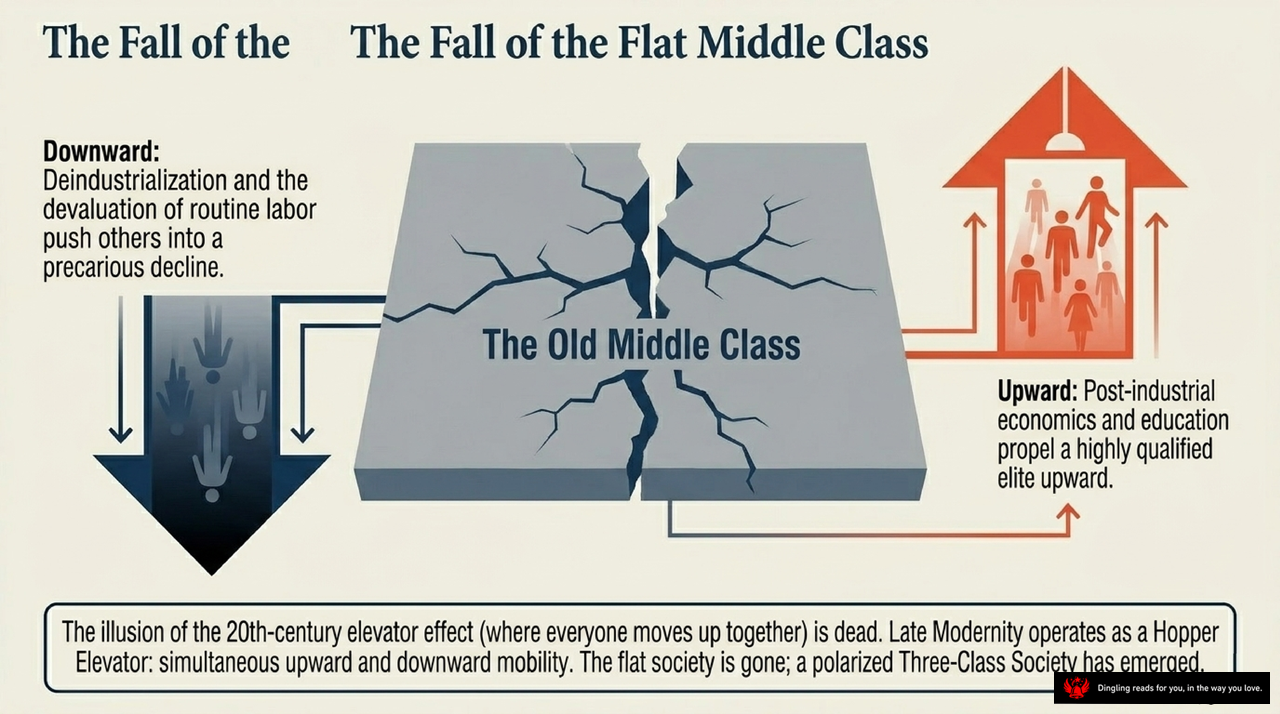
Have you ever heard your parents say, “Back in my day, if you worked hard and played by the rules, you’d make it to the middle class”? Well, those days are long gone. The flat, stable middle class that defined post-WWII Western societies—where almost everyone could climb the ladder together—has crumbled. What we have now is a “three-class society,” and it’s like a hopper elevator: some shoot up, others plummet, and very few stay in the middle.
Let’s break it down. First, the new middle class: highly educated folks in tech, design, or creative fields. They’re global citizens, moving between cities or countries for work. Their lives revolve around self-realization—organic food, sustainable living, and pouring resources into their kids’ success. Then there’s the old middle class: people with high school diplomas or vocational training, stuck in traditional jobs like manufacturing or retail. They feel left behind by globalization and the shift to a knowledge economy. Their values (family, community, hard work) don’t carry the same weight anymore, so many turn to populist movements feeling ignored by elites.
And the new underclass? They’re in low-wage, precarious gigs—gig workers, fast-food staff, or relying on assistance. No education or resources to climb up, often invisible in public discourse.
The gap isn’t just about money—it’s cultural. The new middle class talks diversity and globalism; the old longs for past stability. This divide shapes our politics and daily lives. Next time someone mentions “the middle class,” remember: it’s not what it used to be. Your chances now depend more on education, connections, and where you stand in this new system than ever before.
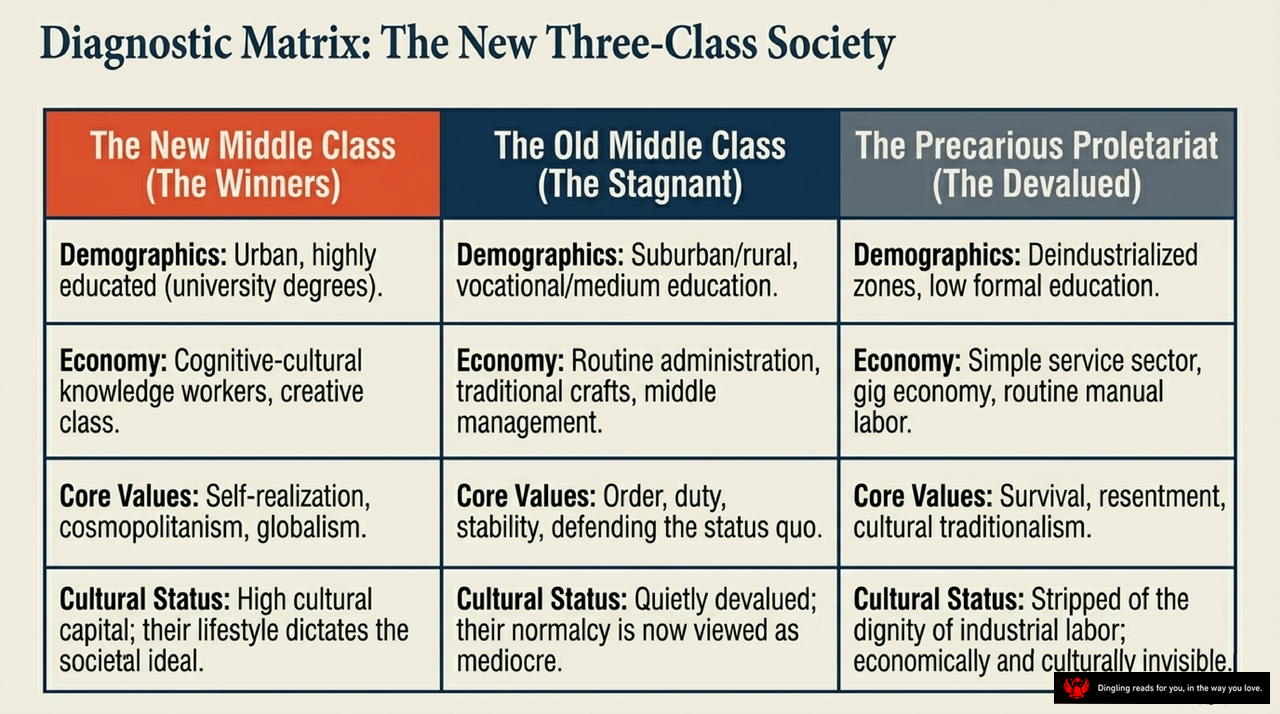
Take a look at this diagnostic matrix on the slide—it’s a clear snapshot of the new three-class society shaping our late modern world. Let’s dive into each group.
First, the New Middle Class, marked as “The Winners.” These are urban dwellers with university degrees, working in cognitive-cultural fields—think software engineers, creative directors, or research scientists. Their work revolves around knowledge, innovation, and creativity. Their values center on self-realization (chasing personal growth), cosmopolitanism (embracing global perspectives), and globalism. They hold high cultural capital; their choices—from organic food to minimalist design—often define what’s considered “ideal” in society.
Next, the Old Middle Class: “The Stagnant.” They’re mostly in suburban or rural areas, with vocational or medium education. Their jobs are routine: administrative roles, traditional crafts, or middle management. Their values are rooted in order, duty, and stability—they’re defenders of the status quo. But their once-common lifestyle is now quietly devalued; what used to be “normal” is now seen as mediocre in the eyes of the new elite.
Then there’s the Precarious Proletariat, “The Devalued.” They live in deindustrialized zones, with little formal education. Their work is in the simple service sector, gig economy, or routine manual labor—like fast-food workers, gig delivery drivers, or janitors. Their core values revolve around survival (making ends meet), resentment (feeling left behind), and cultural traditionalism. They’ve lost the dignity that industrial labor once gave them; they’re often economically marginalized and culturally invisible.
These classes aren’t just about money—they’re about how we live, what we value, and how society treats us. This matrix helps us understand the deep divides in our communities, from political tensions to everyday interactions. It’s a key to unpacking the shifts in our world today.
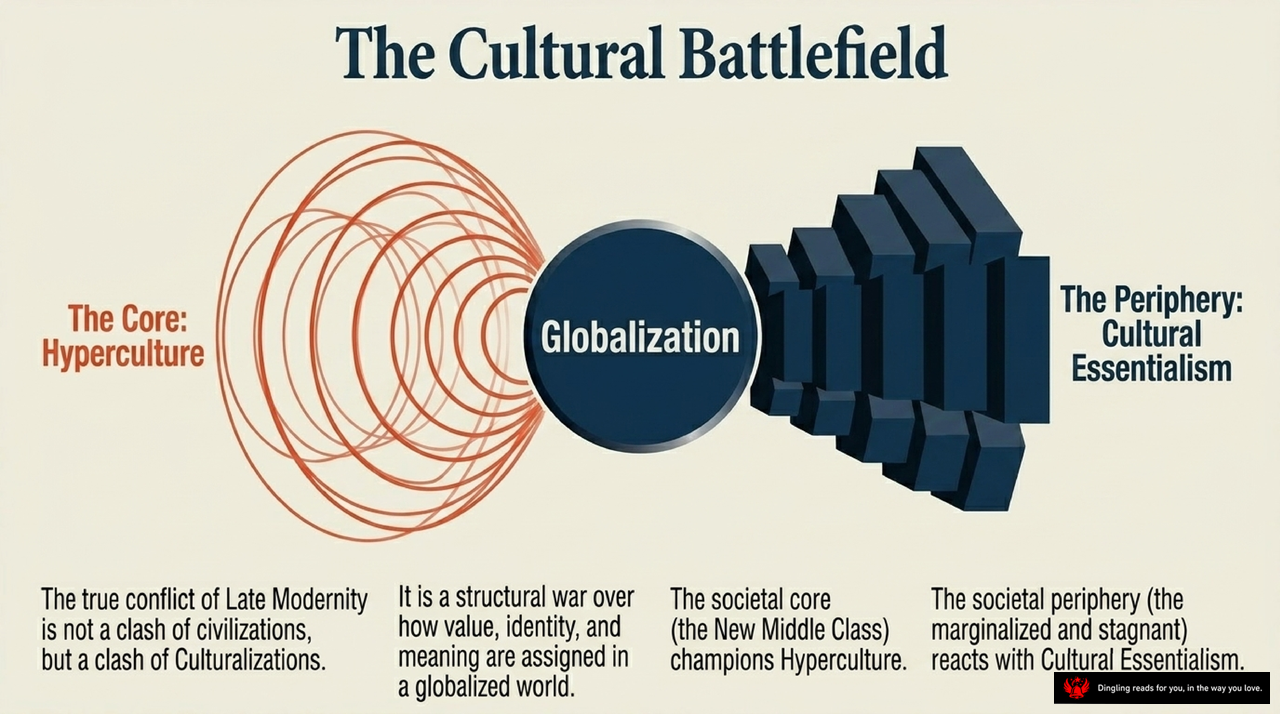
Let’s take a look at this slide—‘The Cultural Battlefield.’ Now, you might think globalization is just about shipping containers or social media, but it’s also a quiet, structural war over how we assign value, identity, and meaning in our late modern world.
The slide makes a key point: the real conflict here isn’t a clash of civilizations—like West vs. East or Islam vs. Christianity. It’s a clash of ‘culturalizations.’ What does that mean? It’s not about which culture is superior; it’s about two totally different ways of engaging with culture and identity.
On one side, we have the Core: Hyperculture, led by the new middle class. These are the global citizens in cities like Berlin, Singapore, or Brooklyn—folks who treat the world as a cultural smorgasbord. They mix yoga from India, Nordic minimalism, and Mexican street art to craft their own unique identities. Even cities themselves become cultural products now, competing for tourists and talent with their ‘cool factor’ or quality of life.
On the other side is the Periphery: Cultural Essentialism. This is the response from groups who feel left behind by globalization—marginalized workers, rural communities, or those whose traditional ways are fading. They cling to collective identities: their nation, their local traditions, their shared history. They draw clear lines between ‘us’ and ‘them’ because these boundaries give them stability in an increasingly chaotic world.
This battle plays out everywhere: in debates about immigration, in local shops fighting chain stores, even in social media fights over ‘authentic’ food or music. It’s a war over who gets to decide what’s valuable, what identity means, and how we find purpose in a globalized age.
So next time you see these tensions, remember: it’s not about civilizations clashing. It’s about two ways of making sense of our world—one that embraces the mix, and one that holds tight to what’s familiar.
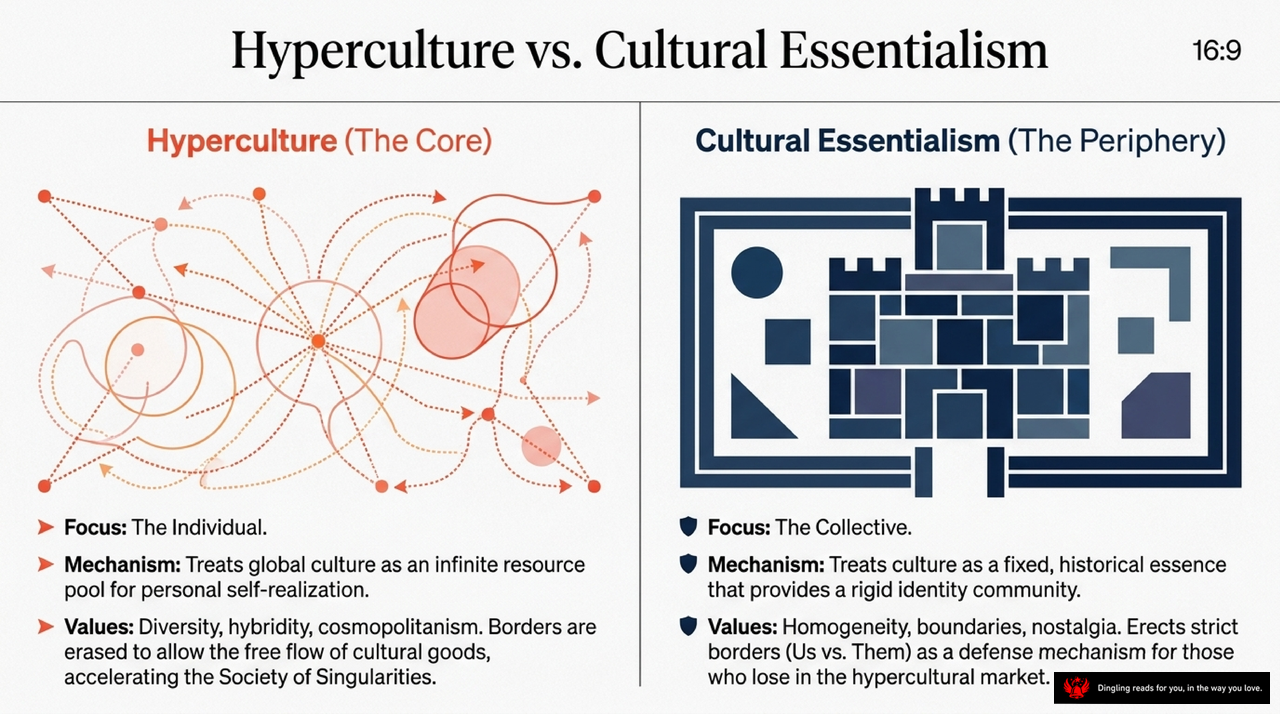
Let’s dive into the two clashing cultural systems that define our late modern world—Hyperculture and Cultural Essentialism, as laid out on this slide.
Starting with Hyperculture, the core model here. It centers on the individual. Picture the urban cosmopolitan middle class: they draw from global culture like a vast, infinite resource pool—practicing Indian yoga, adopting Nordic minimalist design, or savoring street food from Tokyo to Lagos—all to craft their unique identity. Hyperculture values diversity, hybridity, and cosmopolitanism. It breaks down old barriers: high art mixes with pop culture, ancient traditions blend with modern trends, local customs meet global influences. The fluid network of dots and lines on the left captures this: no fixed borders, just free flow of ideas and goods, accelerating what we call the "Society of Singularities"—where each person’s identity is one-of-a-kind.
On the right, Cultural Essentialism is the periphery, a pushback against hyperculture. It focuses on the collective. For its followers, culture isn’t a tool for self-expression; it’s a fixed, historical essence that binds a community together with a rigid identity. They prioritize homogeneity, clear boundaries, and nostalgia. This system appeals to those who feel left behind in the hypercultural market—think the old middle class displaced by globalization or the new underclass struggling with economic instability. It erects strict "Us vs. Them" borders as a defense: "our culture" vs. "theirs". The blocky, walled structure here symbolizes this rigidity—closed communities, fixed identities, and resistance to the fluidity of hyperculture.
These two aren’t just abstract theories; they’re playing out in our politics (like populist movements) and daily choices. Grasping their differences helps us make sense of the cultural conflicts shaping our era. Whether it’s debates over immigration, cultural appropriation, or national identity, these two systems are at the heart of the conversation. Understanding them isn’t just academic—it’s key to navigating the world we live in today.
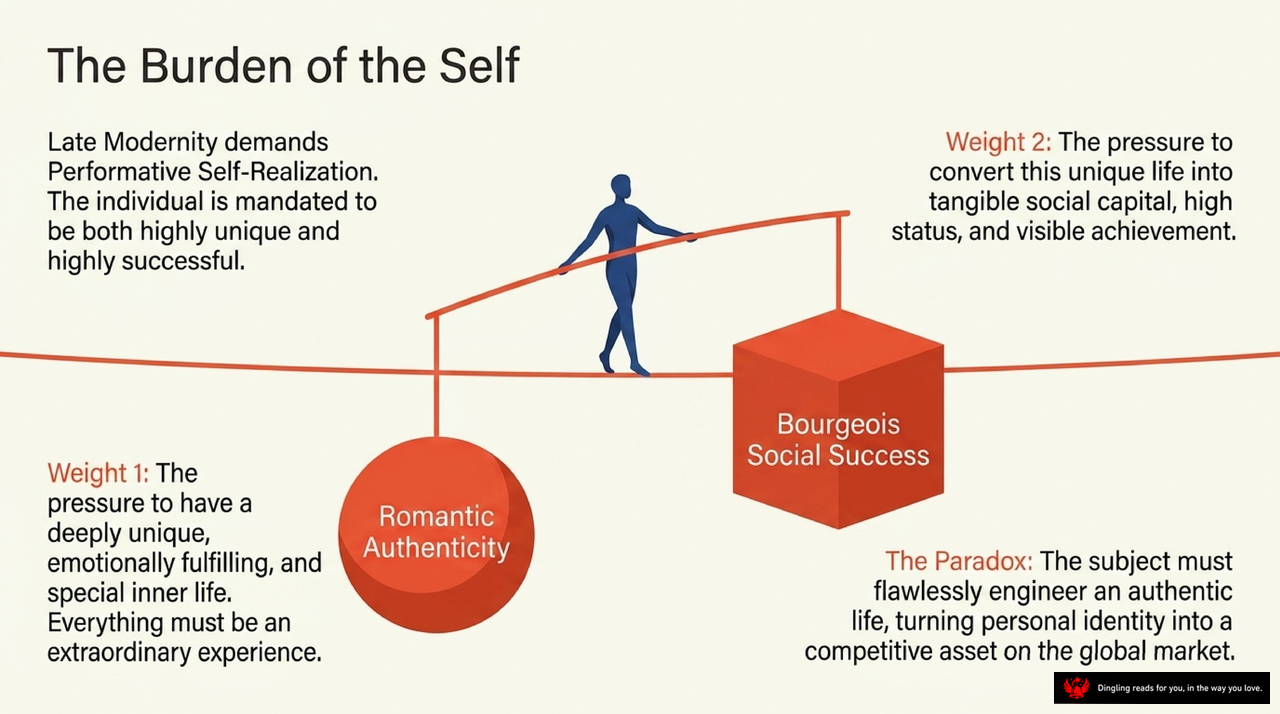
Today we’re diving into “The Burden of the Self”—a topic that resonates with anyone navigating life in our late modern world. Let’s start with the core demand here: late modernity pushes us to embrace performative self-realization. What does that mean? We’re expected to be two things at once—deeply unique and wildly successful. It’s like carrying two heavy weights on our shoulders, and they’re pulling us in opposite directions.
First weight: the pressure to have a one-of-a-kind, emotionally fulfilling inner life. Everything we do—from our hobbies to our relationships to how we spend our free time—needs to feel extraordinary. We can’t just enjoy a walk; it has to be a “mindful nature experience” that reflects our authentic self. We’re told every moment should be meaningful, every choice should be a statement of who we are.
Then the second weight: we have to turn that unique life into tangible results—social capital, high status, visible achievements. It’s not enough to be authentic; we have to prove it to others. Our identity becomes a competitive asset in a global market. Think about how we curate our social media profiles: we’re not just sharing our lives—we’re marketing our uniqueness to get likes, followers, and recognition.
This creates a paradox that’s hard to escape: we’re supposed to flawlessly engineer an authentic life. But authenticity isn’t something you can plan or perform. When we turn our personal identity into a product to be sold, we lose the very thing we’re chasing—genuine fulfillment.
As the book points out, this burden leads to what’s called the “exhausted self.” We’re overworking ourselves to meet these impossible standards, and it’s taking a toll: burnout, anxiety, the constant feeling that we’re never enough. We’re caught in a cycle where being ourselves feels like a job, and success feels like a moving target.
Understanding this burden is the first step to breaking free. It’s not just about us as individuals—it’s about the systems that set these unrealistic expectations. And maybe, by recognizing this, we can start to redefine what success and authenticity mean for ourselves.
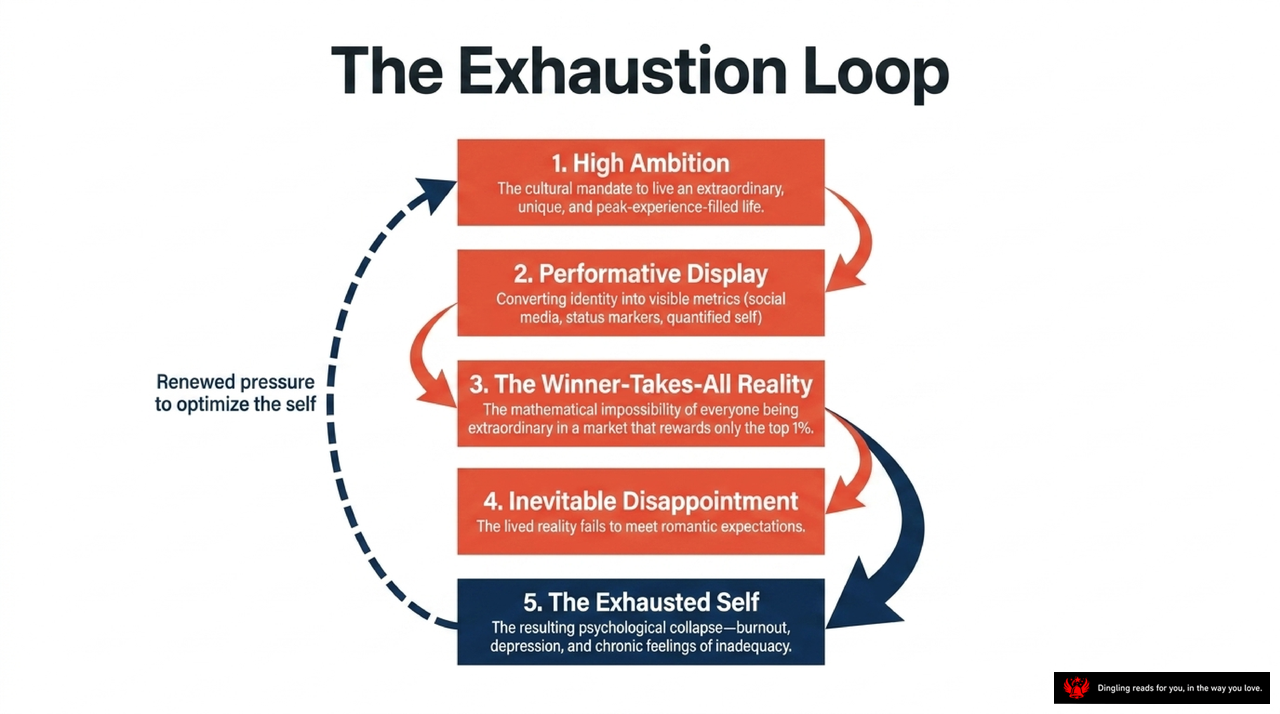
Let’s dive into the Exhaustion Loop—because if you’ve ever felt stuck in a cycle of ambition that leaves you drained, this is your story.
First up: High Ambition. Our culture bombards us with the idea that we need to live extraordinary, unique lives packed with peak experiences. It’s that quiet (or not-so-quiet) pressure to be more, do more, have more—whether it’s nailing the dream job, curating the perfect family life, or chasing those “once-in-a-lifetime” moments we see all over social media.
Next, Performative Display. We turn our identity into visible metrics: posting vacation photos to prove we’re thriving, flaunting status symbols like artisanal coffee or designer gear, even tracking every step or calorie to quantify our self-worth. We’re not just living—we’re performing for an audience, because we think that’s how we show we’re “winning.”
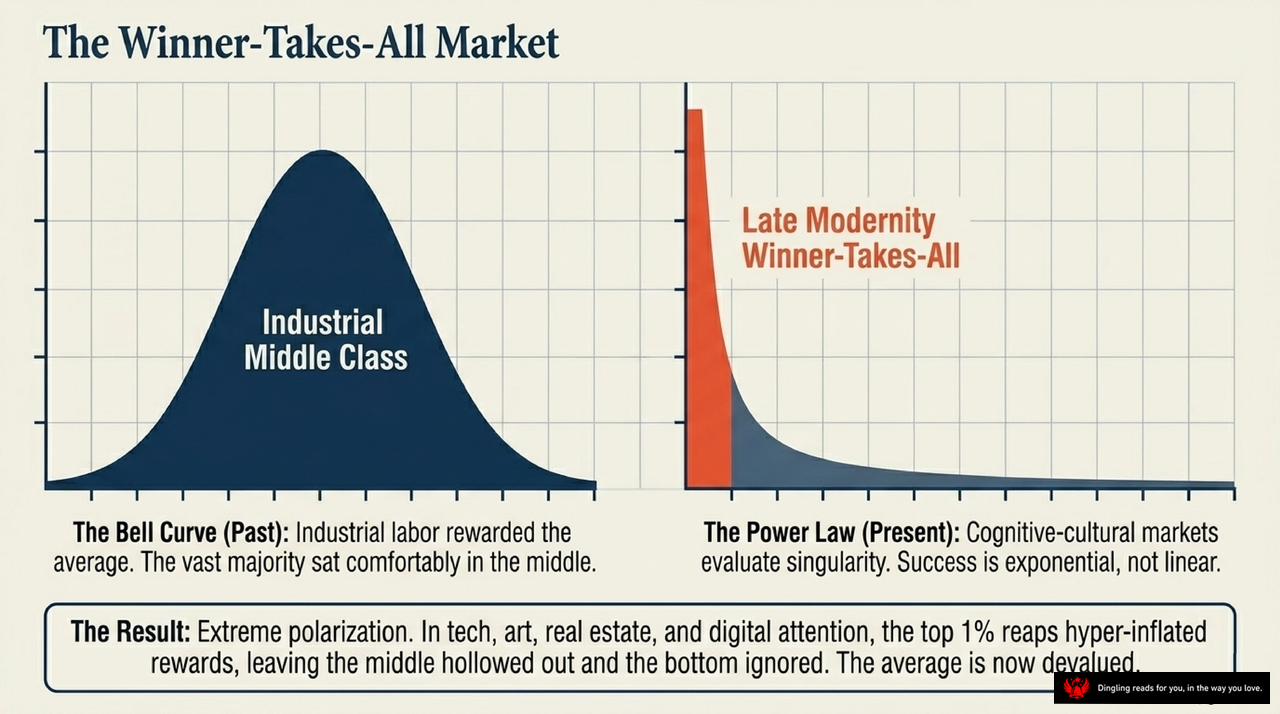
Then comes the Winner-Takes-All Reality. Here’s the harsh truth: in a world that only rewards the top 1%, it’s mathematically impossible for everyone to be extraordinary. No matter how hard you grind, most of us won’t hit those elite marks.
So what follows? Inevitable Disappointment. Our real lives can’t measure up to the romantic expectations we’ve been fed. We look around and wonder, “Why isn’t my life as perfect as theirs?” That gap between what we want and what we have starts to eat at us.
Finally, we end up as the Exhausted Self—burnout, depression, that constant nagging feeling of not being good enough. But the loop doesn’t break here. That exhaustion just fuels renewed pressure to optimize ourselves even more. We think, “If I just work a little harder, fix this one thing, I’ll finally get it right.” And the cycle starts all over again.
This isn’t just a personal struggle—it’s a cultural trap. Our obsession with self-realization has turned into a never-ending race, where we’re always chasing an impossible standard. Until we step back and redefine what “success” really means, we’ll keep spinning in this loop.
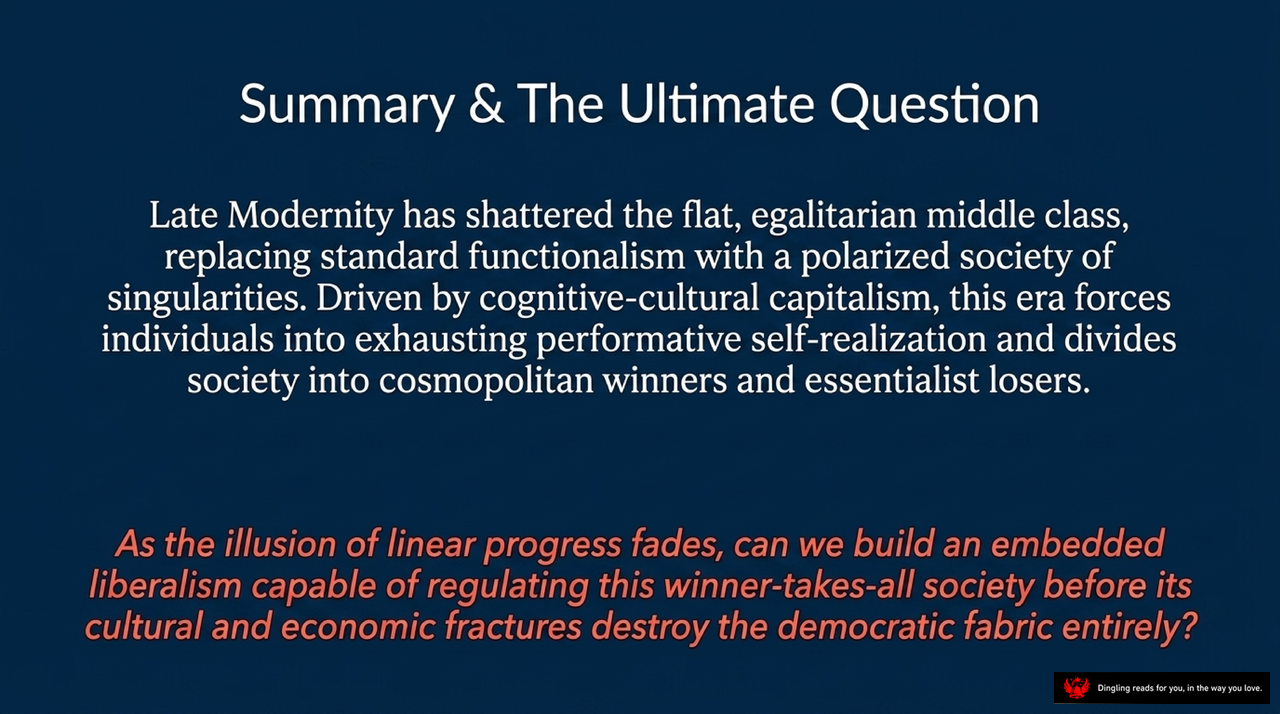
Let’s wrap up our discussion so far and dive into the ultimate question we’re all here to grapple with. Late modernity didn’t just shift our daily lives—it completely shattered that old, flat, egalitarian middle class we once took for granted. Instead of a society where most people fit into a similar, stable lifestyle, we now live in a polarized world where everyone’s pushed to be a “singularity” — to stand out as unique, no matter the cost.
What’s driving this? Cognitive-cultural capitalism. It’s the system that makes us feel like we have to perform our identities nonstop: curating perfect social media feeds, chasing side hustles to prove our worth, or constantly updating our skills just to keep up. This isn’t just tiring—it’s splitting us into two camps: the cosmopolitan winners, who thrive in cities, embrace global culture, and ride the knowledge economy wave, and the essentialist losers, folks left behind in rust belts or rural areas, clinging to traditional values because the world they grew up in has vanished.
Now, the big question: As we let go of the illusion that progress is always a straight line upward, can we build an embedded liberalism? This isn’t about ditching liberalism entirely—it’s about embedding it in rules that rein in the winner-takes-all system. Can we do this before the cultural and economic cracks in our society tear apart the very fabric of our democracy? It’s a tough ask, but it’s the question we all need to answer if we want a future where everyone gets a fair shot.