
The Evolution of Physics: Complete Chapter-by-Chapter Summary
Welcome to our journey through the greatest detective case in human history. Tonight, we explore *The Evolution of Physics* by Albert Einstein and Leopold Infeld. This isn't just a history of formulas; it's the story of how humanity learned to read the universe's secret language.
Imagine the cosmos as a complex mystery. For centuries, our intuition led us astray. We thought force was needed just to keep things moving, a idea that held us back for a thousand years. But then came the real detectives: Galileo and Newton. They didn't trust their gut; they trusted experiments. By challenging the old rules, they revealed that force isn't what keeps an object moving, but what changes its motion. This shift birthed the concept of inertia, the first true law of physics.
As we dig deeper, we see how Newton unified the heavens and the Earth. He realized that the same force pulling an apple down also keeps the Moon in orbit. He introduced the vector, allowing us to measure not just speed, but direction, turning vague observations into precise math. This was the birth of classical mechanics—a unified theory that explained everything from falling rain to orbiting planets.
But the story doesn't end there. The mystery of heat, light, and electricity soon tore apart this perfect picture. Scientists tried to force these phenomena into the old "machine" model, inventing imaginary fluids like "caloric" and "ether" to make them fit. Yet, experiments with light, magnetism, and electricity kept failing these rigid models. The universe was too complex, too interconnected, for a simple machine to explain.
The breakthrough came with a new concept: the Field. Instead of invisible forces acting across empty space, scientists realized that energy fills the space between objects. Fields became the real actors, storing energy and transmitting forces. This led to the unification of electricity and magnetism into electromagnetism, and eventually, the revelation that light itself is an electromagnetic wave.
Then came the ultimate twist. Einstein shattered the idea of absolute time and space. He showed that space and time are woven together into a flexible fabric, curved by mass and energy. Gravity isn't a pull; it's the shape of space itself. And finally, we discovered that at the smallest scales, the universe isn't smooth and continuous. It's made of discrete packets of energy—quanta. Light acts like a wave in some moments and a particle in others, a duality that defines our modern reality.
From the falling apple to the bending of starlight, from the quantum jump to the cosmic field, this evolution is the story of us learning to think differently. We stopped seeing the world as a clockwork machine and started seeing it as a dynamic, interconnected, and beautifully mysterious web of reality. That is the true evolution of physics.

Imagine the universe as a massive, unsolved crime scene where the clues are scattered, complex, and often counter-intuitive. As the slide illustrates, we are essentially detectives trying to crack the greatest mystery of all: the laws of nature.
In this cosmic investigation, the physicist plays the role of the detective. Unlike a traditional investigator who might look for fingerprints, our detective must rely on pure thought and creative imagination to connect seemingly unrelated facts. Think about it: how do we explain why the moon stays in orbit without flying off into space, or why an apple falls from a tree? For centuries, people thought these were two completely different rules. But our detective, Isaac Newton, realized they were the same case. He deduced that a single force—gravity—governs both the heavens and the earth.
However, solving this case isn't as simple as opening a watch to see its gears. As the slide warns, we cannot simply look inside the universe to see how it works. We can only guess its mechanism based on the ticking we hear and the hands we see moving. We have to infer the hidden machinery from the visible results.
This detective story continues as we move from the motion of planets to the behavior of light, and eventually to the very fabric of space and time. From Newton's gravitational pull to Einstein's bending of spacetime, and finally to the quantum world where particles behave like waves, the evidence keeps mounting. Yet, despite all our clues, the ultimate nature of reality remains unsolved. We are still in the thick of the investigation, piecing together the fragments of a story that is far deeper and stranger than we ever imagined.

Imagine a world where the universe is nothing more than a giant, intricate clockwork mechanism. In this "Mechanical View," everything from the falling of an apple to the orbit of the moon is explained by tiny, unchangeable particles interacting through simple forces, much like gears in a machine. For centuries, this idea dominated physics, suggesting that if we just understood the forces acting on these particles, we could predict the future with perfect precision.
But as we dig deeper into the 19th century, cracks begin to appear in this perfect clockwork. First, consider electricity and magnetism. When we pass an electric current through a wire, it creates a magnetic field that pushes a compass needle. This force doesn't pull or push along a straight line between two objects, like gravity does. Instead, it acts in a circle around the wire. The old mechanical model, which relied on particles pulling or pushing each other directly, couldn't explain this swirling, non-linear interaction. Scientists were forced to invent new, invisible fluids—"electric fluids" and "magnetic fluids"—just to make the math work, but these explanations felt forced and incomplete.
Then comes the battle over light. For a long time, Isaac Newton's "corpuscular theory" argued that light was made of tiny particles, fitting perfectly into the mechanical worldview. However, experiments with crystals revealed that light behaves like a wave, vibrating perpendicular to its direction of travel. To explain this, physicists proposed a mysterious substance called the "ether," a rigid, jelly-like medium filling all of space that could support these waves. But here lies the fatal flaw: if the ether existed and was rigid enough to transmit light, Earth moving through it should have created a detectable drag or resistance. Yet, no matter how hard scientists tried to measure it, the ether remained invisible and silent. The mechanical model, which demanded that everything be made of tangible matter, could not reconcile the nature of light with the properties of matter.
These contradictions in electromagnetism and optics didn't just highlight gaps; they signaled the collapse of the entire mechanical framework. The universe wasn't just a collection of billiard balls colliding; it was a dynamic web of invisible fields and waves that defied the simple, linear logic of classical mechanics. The clock had stopped working, and a new, more profound understanding of reality was about to begin.

The slide before us, titled "A Crisis in the Investigation," captures a pivotal moment in the history of physics where the old mechanical worldview began to crack under the weight of new evidence.
On the left, we see the "Light Paradox." For centuries, Newton's particle model dominated, viewing light as tiny, elastic balls traveling in straight lines. But experiments like diffraction proved otherwise—light bends around corners and interferes with itself, behaviors that particles simply cannot explain. This forced physicists to adopt Huygens' wave theory, suggesting light was a ripple traveling through space.
This leads us to the center of the slide: "The Ether Problem." If light is a wave, what is it waving in? Just as sound needs air, physicists assumed light needed a medium called the "Ether"—an invisible, weightless fluid filling the entire universe. They invented this substance to make the wave theory work, believing it was the ultimate mechanical medium.
However, the third panel, "The Contradiction," reveals the fatal flaw in this entire construction. Scientists designed incredibly precise experiments to detect the Earth moving through this Ether, expecting to see a "wind" of light. Yet, every single experiment failed. The Earth seemed to be stationary in the Ether, which made no sense given our known motion around the sun. The physical properties required for the Ether to exist became absurd—it had to be solid enough to support waves yet weightless enough to not drag the planets. The mechanical view, which relied on tangible particles and forces, suffocated under its own assumptions.
This crisis—the inability to reconcile light's wave nature with the mechanical concept of a medium—was the spark that would eventually ignite the revolution of modern physics, leading us away from the clockwork universe toward a new understanding of reality.
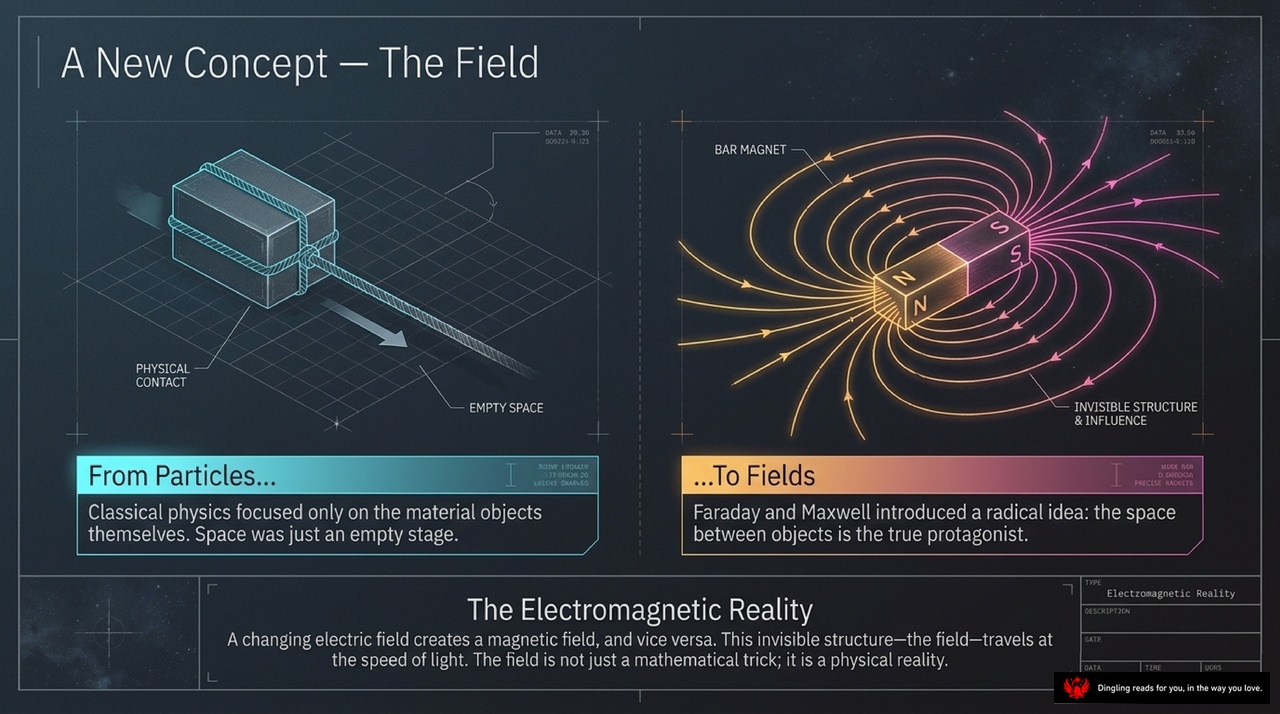
Imagine a world where objects interact instantly across vast distances, pulling on each other without any messenger in between. For centuries, this "action at a distance" was the default way physics explained gravity and magnetism. But what if that invisible connection was actually something real, filling the space between the objects themselves? This slide introduces a revolutionary shift: the concept of the **Field**.
On the left, we see the old view: **physical contact** versus **empty space**. Classical physics treated space as just a passive stage, ignoring what happened in the void between particles. But the right side of the slide changes everything, showing us the move **to fields**. Here, we see a bar magnet with invisible lines radiating outward. These aren't just drawings; they represent an **invisible structure & influence** that permeates the entire space around the magnet. As the text reminds us, Faraday and Maxwell introduced this radical idea: the space between objects is now the true protagonist, not the objects themselves.
This leads us to **the electromagnetic reality** at the bottom. A changing electric field creates a magnetic field, and vice versa. This invisible structure travels at the speed of light, proving that the field isn't just a mathematical trick, but a physical reality. It’s a dynamic, living fabric that carries energy and force, completely replacing the outdated idea of empty space. This shift from particles to fields is the foundation of modern physics, turning our understanding of the universe on its head.

Imagine a world where electricity and magnetism were two separate universes, never touching. That was the prevailing belief until 1820, when Hans Christian Osted dropped a bombshell on the physics community. He discovered that when an electric current flows through a wire, a nearby compass needle suddenly jerks and deflects. This simple experiment shattered the old idea that electricity and magnetism were unrelated.
But the story didn't stop there. In the 1830s, Michael Faraday took this a step further with his groundbreaking experiments on electromagnetic induction. He showed that if you move a magnet near a coil of wire, or change the current in a nearby circuit, it actually generates an electric current in that coil. It was a perfect reversal: electricity creates magnetism, and magnetism creates electricity.
This interplay led to a revolutionary new way of thinking. Instead of imagining invisible fluids like "electric fluid" or "magnetic fluid" zipping around particles, scientists began to visualize something far more powerful: the **Field**. Think of it as a physical medium filling the space between objects. When you place a current-carrying wire in space, it creates a magnetic field—a web of invisible force lines circling the wire. A compass needle doesn't just feel a distant pull; it interacts directly with this field at its specific location.
James Clerk Maxwell later took this concept and wove it into a complete mathematical tapestry. His equations didn't just describe isolated events; they predicted how electric and magnetic fields dance together. They showed that a changing electric field creates a magnetic field, which in turn creates an electric field, and so on. This self-sustaining cycle ripples outward through space as a wave.
Here is the mind-blowing conclusion: this ripple travels at a specific speed. When Maxwell calculated this speed based on his equations, it matched the known speed of light exactly. This wasn't a coincidence. It revealed that light itself is just an electromagnetic wave. The mechanical view, which relied on particles and a mysterious "ether" to carry light, was finally exposed as incomplete. The field wasn't just a tool for calculation; it was a real, physical entity that could store energy and propagate through the vacuum of space without any material medium. This was the birth of the field concept, forever changing how we understand the universe.
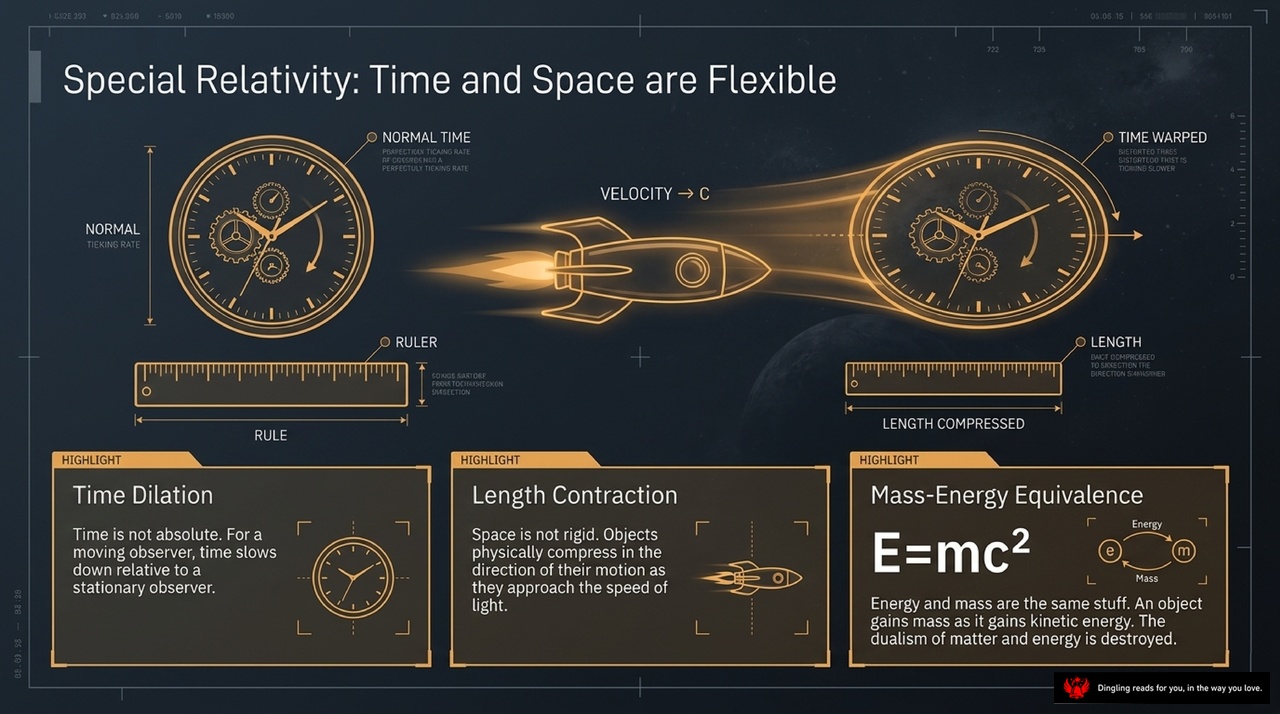
Special Relativity: Time and Space are Flexible. Imagine you're on a spaceship accelerating toward the speed of light. What happens to your watch? According to this slide, time itself warps. As velocity approaches C, time slows down relative to a stationary observer. This is time dilation. Look at the clocks: the one on the left ticks normally, but the one on the right, hurtling forward, is distorted and ticking slower. Space isn't rigid either. As objects move faster, they physically compress in the direction of motion. That's length contraction. The ruler at the bottom shows how space itself gets squeezed. And here's the mind-bending part: mass and energy are the same stuff. As an object gains kinetic energy, it gains mass. This is captured by Einstein's famous equation, E equals mc squared. Matter and energy aren't separate; they are two sides of the same coin. The universe is far more flexible than we ever imagined.
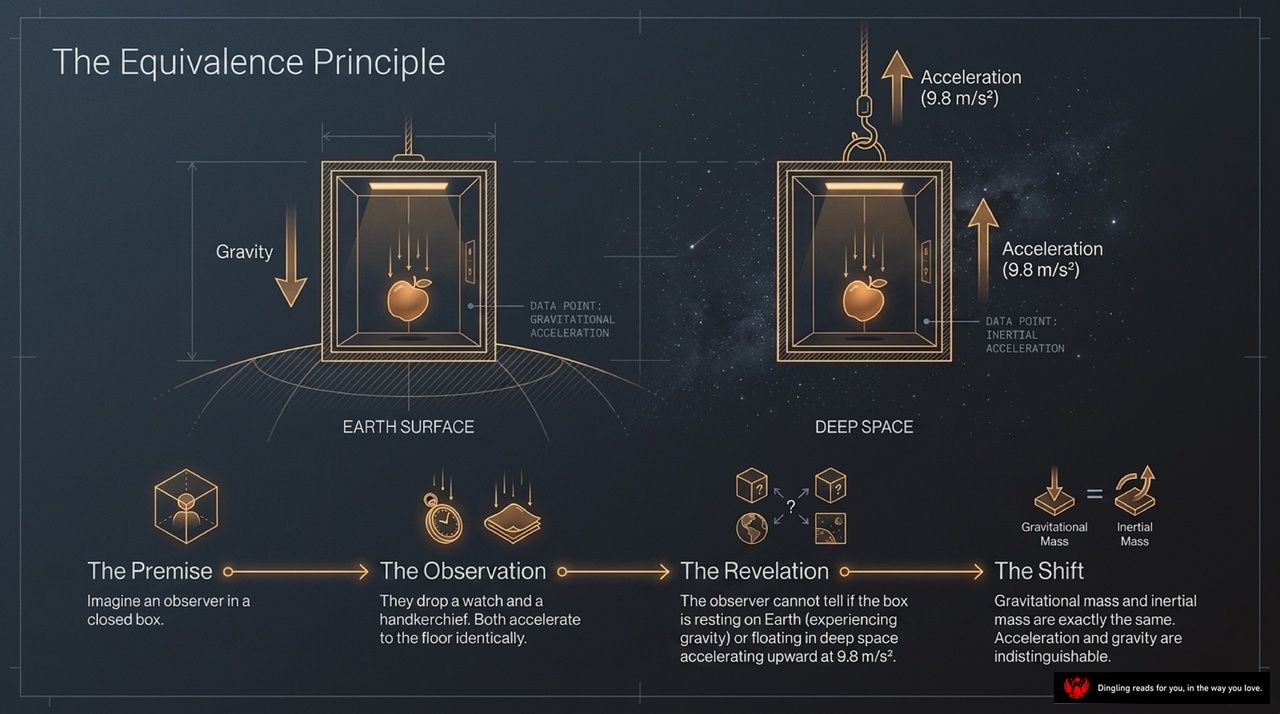
Welcome to the next chapter in our journey through the history of physics. Today, we are tackling the most profound shift in human thought: the birth of General Relativity.
Look at the diagram on your screen. It illustrates the Equivalence Principle, the very cornerstone of Einstein's theory. On the left, we see an elevator resting on Earth, pulled down by gravity. On the right, imagine that same elevator floating in deep space, but being pulled upward by a rocket with an acceleration of exactly 9.8 meters per second squared. Notice the apple inside? In both scenarios, the apple falls to the floor with identical acceleration.
This is the revelation: an observer inside a closed box cannot tell the difference between being in a gravitational field and being in an accelerating frame of reference. Gravity and acceleration are indistinguishable.
This simple yet mind-bending insight changed everything. It led Einstein to a radical conclusion: gravity is not a force pulling on objects, as Newton believed. Instead, mass and energy warp the fabric of space and time itself. Objects aren't being pulled by an invisible rope; they are simply following the shortest path, or geodesic, through this curved spacetime.
Think of it like a heavy ball placed on a stretched rubber sheet, causing it to dip. A smaller ball rolled nearby will naturally curve toward the heavy one, not because of a direct pull, but because the surface itself is bent. Einstein applied this geometry to the universe. The orbit of a planet isn't a result of a mysterious force; it's just the planet moving straight ahead on a curved surface.
This theory didn't just refine our understanding; it completely overthrew the old view of absolute time and space. It showed us that time slows down in strong gravitational fields and that light bends when passing near massive objects. We saw this confirmed when astronomers observed starlight curving around the Sun during a solar eclipse.
General Relativity transformed gravity from a mechanical interaction into a geometric property of the universe. It unified space and time into a single, dynamic entity that interacts with matter. This wasn't just a new equation; it was a new way of seeing reality, marking the end of the classical mechanical view and the beginning of modern cosmology.
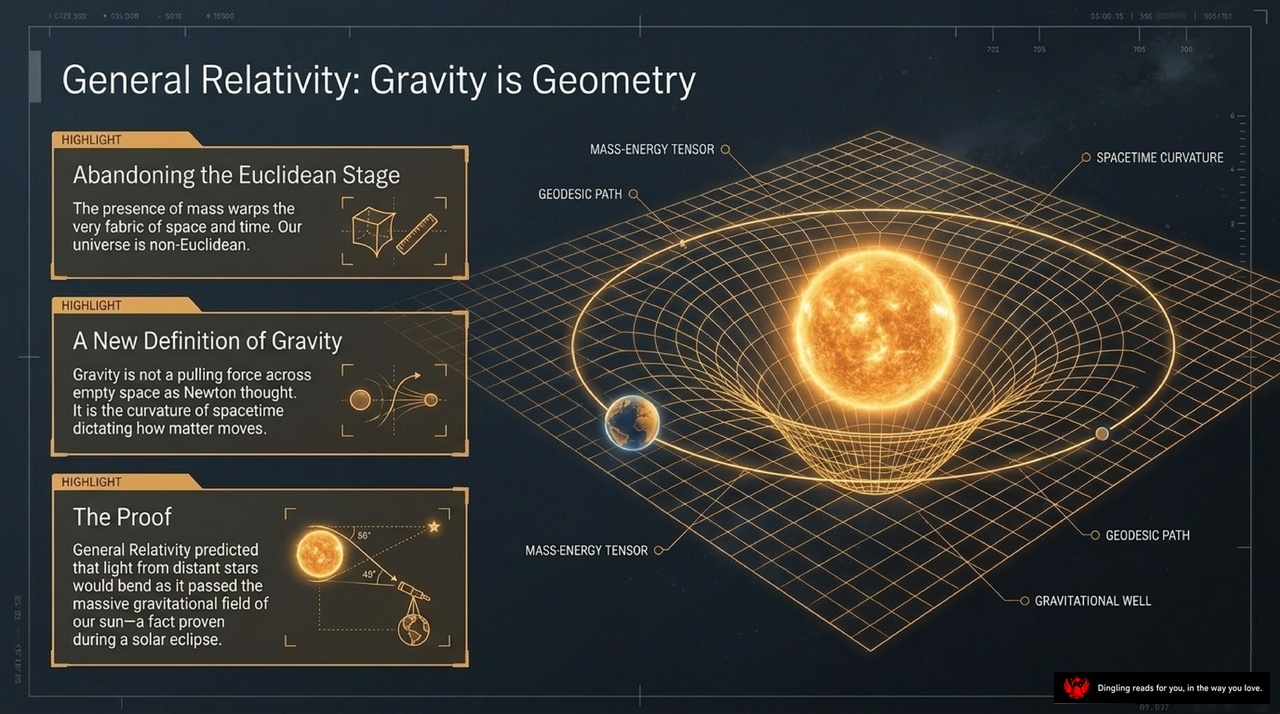
General Relativity: Gravity is Geometry.
Today, we leave the familiar rules of Newton behind to explore a radical new vision of the universe. The core idea is simple yet profound: gravity is not a force pulling objects across empty space, but rather the curvature of spacetime itself.
Look at this diagram. Notice the grid labeled "Spacetime Curvature." In our old Euclidean view, space was flat and rigid. But Einstein showed us that mass and energy warp the very fabric of the universe. The heavy star in the center creates a deep dip in this grid, forming a gravitational well. Objects like Earth don't get pulled by an invisible rope; instead, they follow the shortest path, known as a geodesic, along this curved surface. This is why planets orbit stars—they are simply moving straight ahead on a bent road.
This shift from a flat stage to a dynamic, curved one is the essence of General Relativity. It wasn't just theory; it was proven. The slide highlights "The Proof": during a solar eclipse, General Relativity predicted that light from distant stars would bend as it passed the massive gravitational field of our Sun. Observations confirmed this, showing starlight curving around the Sun. This was the first major evidence that gravity is geometry, not just a force. By abandoning the old Euclidean stage, we finally understand that the universe is non-Euclidean, and gravity is the shape of space itself.
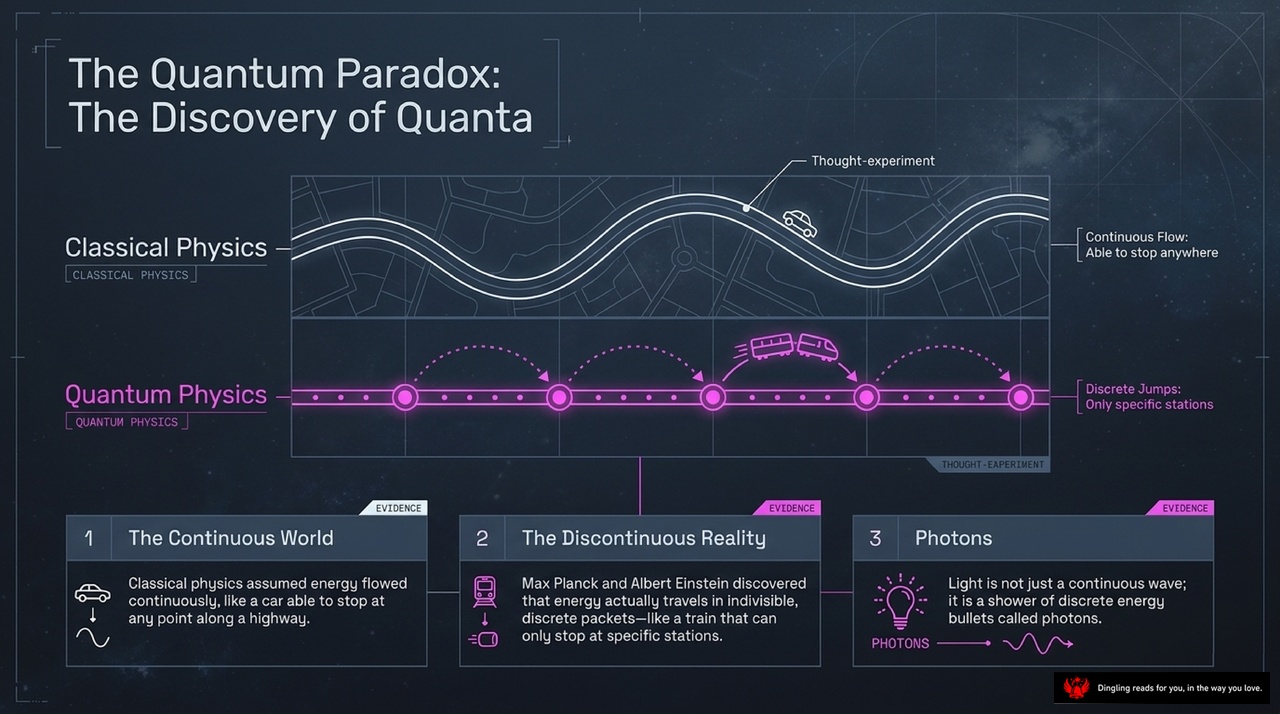
The Quantum Paradox: The Discovery of Quanta
Look at this slide. It captures one of the most profound shifts in human history: the moment physics moved from a world of smooth, continuous flow to a realm of discrete, jerky jumps.
In the top half, Classical Physics is depicted like a car driving down a winding highway. It represents our everyday intuition. We assume energy flows continuously, like water, and can stop or move at any point along the road. This was the "Continuous World" that scientists believed in for centuries.
But the bottom half tells a completely different story. This is Quantum Physics. Notice the purple line and the specific dots. This represents the "Discontinuous Reality." Instead of a smooth road, energy travels in indivisible packets—like a train that can only stop at specific stations. It cannot exist in between. This was the shocking discovery of "Quanta."
The evidence for this revolution is clear in the three boxes below. First, we had the "Continuous World" assumption. Second, Max Planck and Albert Einstein shattered that view. They proved that energy doesn't flow smoothly; it travels in discrete packets, much like that restricted train. Finally, we have "Photons." Light isn't just a continuous wave; it's actually a shower of these discrete energy bullets.
This slide illustrates the birth of the quantum world. It forced us to abandon the comfortable idea of a smooth universe and accept a reality built on fundamental, indivisible units.
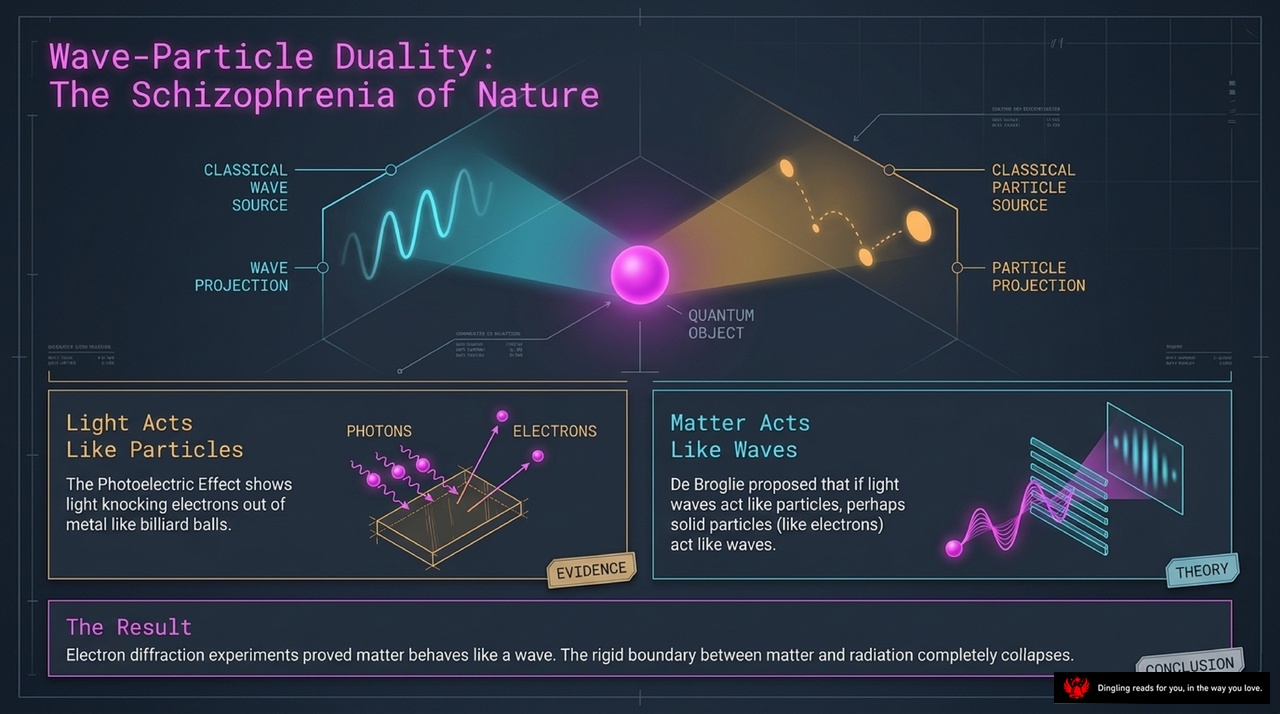
Wave-Particle Duality: The Schizophrenia of Nature. Imagine a quantum object as a chameleon that changes its personality depending on how you look at it. On one side, we see light acting like particles. The photoelectric effect shows photons knocking electrons out of metal just like billiard balls striking each other. But flip the perspective, and matter acts like waves. De Broglie proposed that if light waves can act like particles, maybe solid particles like electrons can act like waves too. This is where the rigid boundary between matter and radiation completely collapses. Electron diffraction experiments proved it: when electrons pass through a crystal, they create interference patterns just like water ripples. Nature isn't choosing between being a particle or a wave; it possesses both properties simultaneously. It's the ultimate duality, a fundamental truth of our universe that defies our everyday intuition.
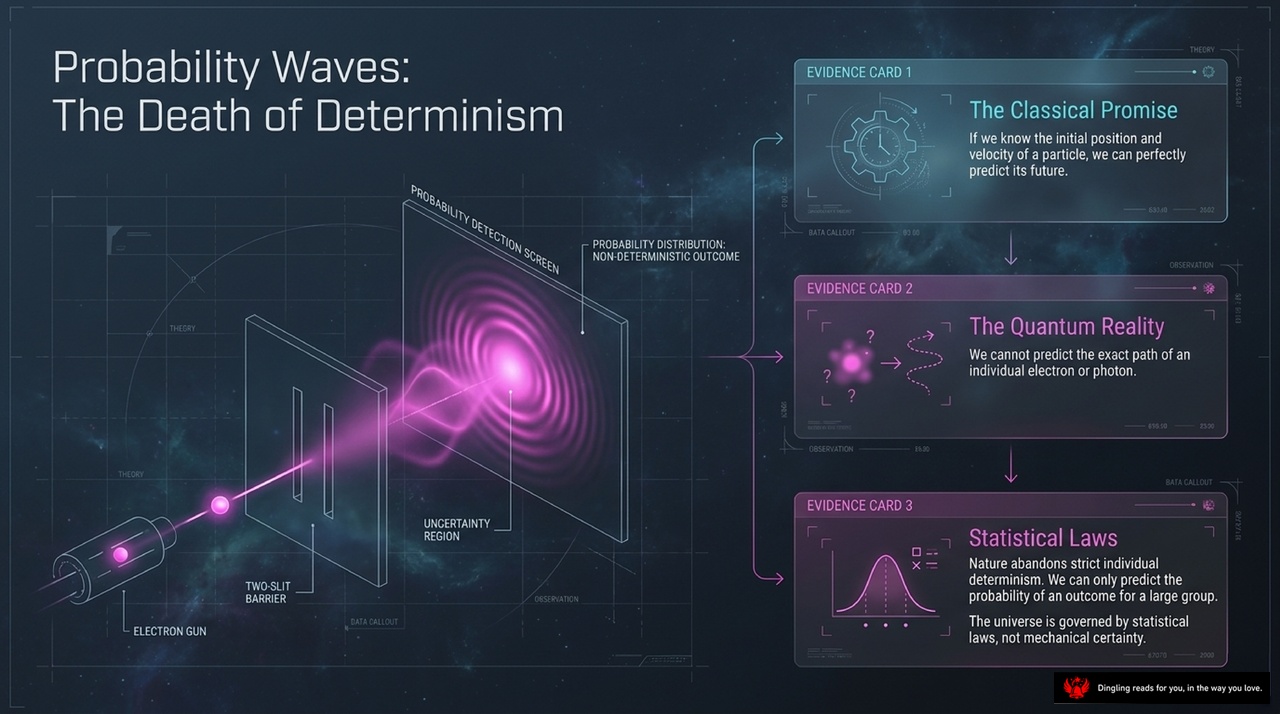
Welcome back. Today, we're diving into the final chapter of our journey through the history of physics: the Quantum Revolution.
Look at the diagram on the left. It depicts the famous double-slit experiment, but with a twist. Instead of just particles hitting a screen, we see a ripple effect—a "Probability Distribution" forming on the detection screen. This visual represents a fundamental shift in how we understand reality. In the classical world, things had definite paths. But here, in the quantum realm, individual particles like electrons or photons don't follow a single, predictable trajectory. As the slide notes, we cannot predict the exact path of an individual electron. Instead, nature operates on "Statistical Laws." We can only predict the probability of an outcome for a large group.
This brings us to the core theme of our slide: "The Death of Determinism." For centuries, the "Classical Promise" ruled our thinking. We believed that if we knew the initial position and velocity of an object, we could perfectly predict its future. The universe was seen as a giant clockwork machine, governed by mechanical certainty.
However, the quantum world shattered this illusion. As the evidence cards show, the universe abandoned strict individual determinism. A single electron doesn't have a pre-written destiny; it exists as a "probability wave" until it is observed. The slide illustrates this beautifully with the "Uncertainty Region" between the slits and the screen. The particle doesn't choose a path beforehand; the act of measurement reveals where it lands, governed only by the statistical laws of probability.
So, what does this mean for us? It means that at the most fundamental level, the universe is not a place of absolute certainty, but one of inherent uncertainty. We moved from a world of mechanical certainty to a world governed by statistical laws. This isn't just a technical detail; it's a profound philosophical shift. It tells us that the future is not fixed, and that at the heart of reality, there is a fundamental randomness that we cannot eliminate. This is the new language of the universe, and it is far more fascinating than the clockwork model ever was.
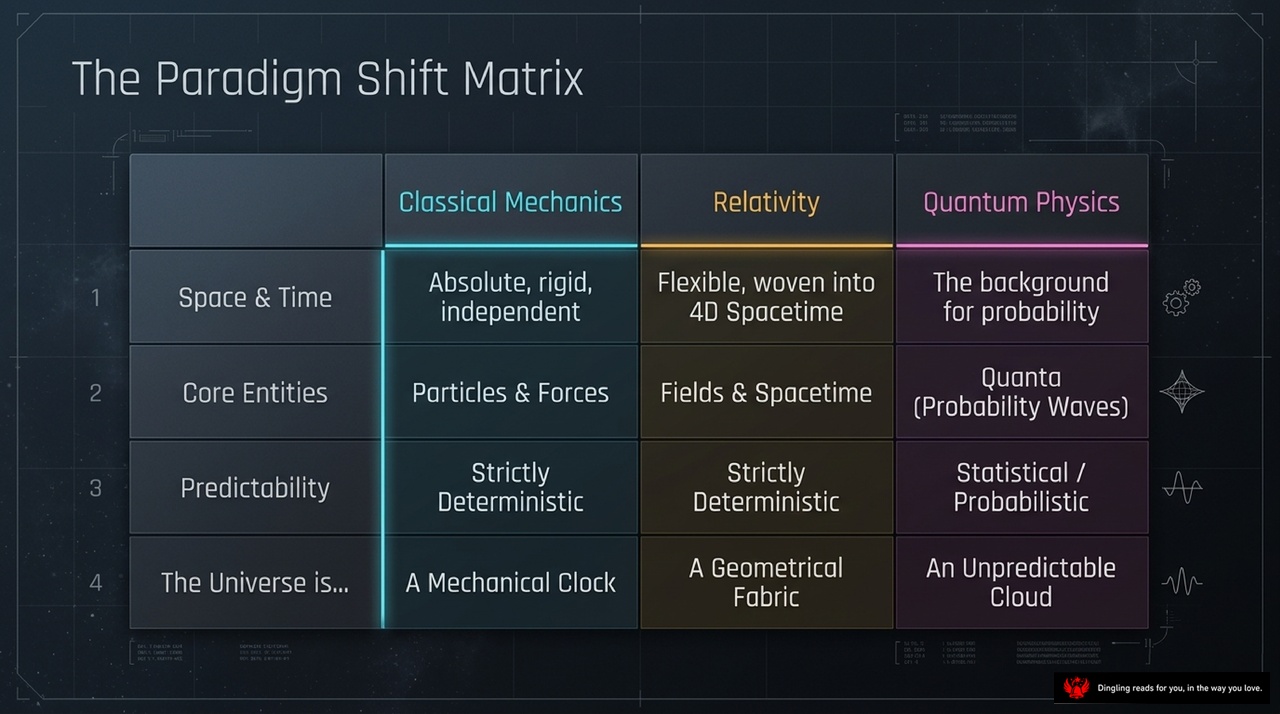
The Paradigm Shift Matrix isn't just a chart; it's the map of humanity's most profound intellectual journey. Look at the first column, Classical Mechanics. For centuries, we viewed the universe as a "Mechanical Clock"—absolute, rigid, and predictable. Space and time were independent stages, particles were the actors, and everything followed a strict, deterministic script. If you knew the starting position, you could calculate the entire future.
But then, Einstein rewrote the script with Relativity. The universe transformed from a rigid clockwork into a "Geometrical Fabric." Space and time aren't separate anymore; they are woven together into a flexible 4D spacetime. The core entities shifted from simple particles to fields and spacetime itself. While predictability remained strictly deterministic, the very stage on which the drama plays out is now dynamic and responsive to mass and energy.
Finally, we arrive at Quantum Physics, where the script changes completely. The universe is no longer a clock or a fabric, but an "Unpredictable Cloud." Here, space and time become the background for probability. The core entities are no longer solid particles, but quanta—probability waves. Predictability shatters into statistics. We can't know exactly where a particle will be; we can only calculate the odds. This matrix captures the evolution from a deterministic machine to a flexible fabric, and finally, to a probabilistic cloud, showing how our understanding of reality has been completely upended.
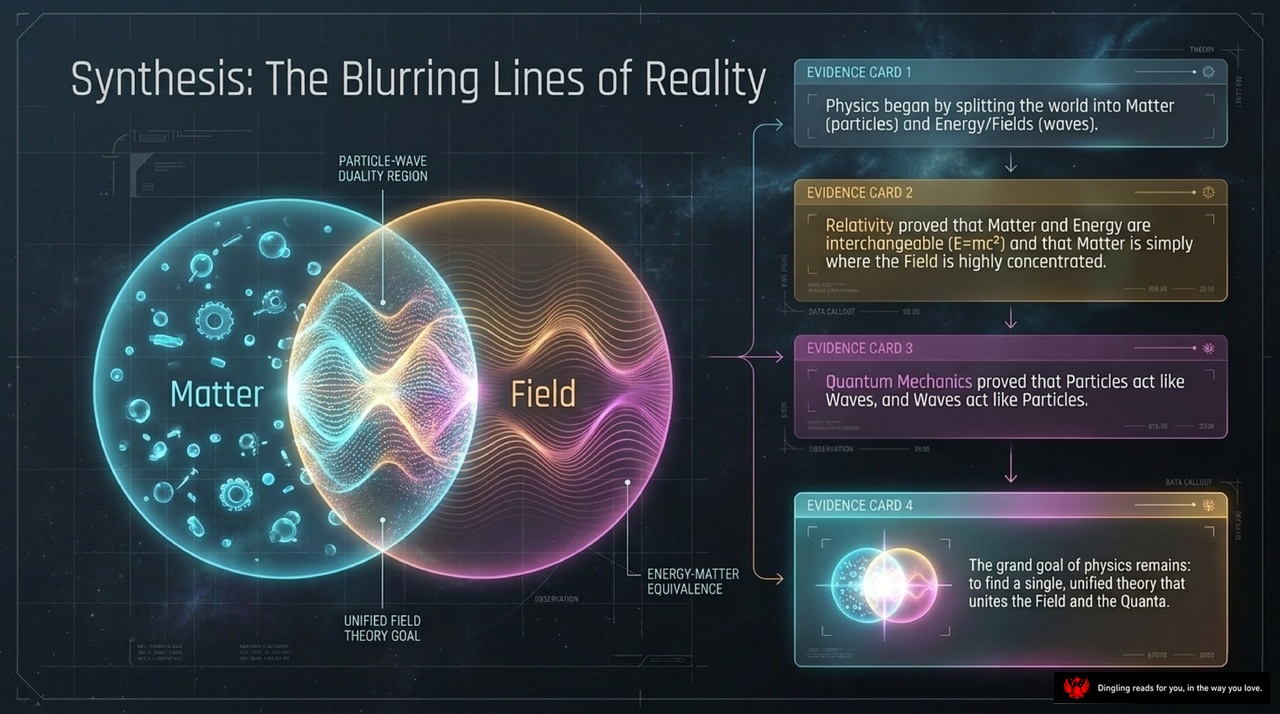
Synthesis: The Blurring Lines of Reality
Physics started with a simple split: we divided the world into Matter, made of particles, and Energy, represented by fields or waves. For a long time, these were seen as two completely separate realms. But then, Einstein's Relativity proved that Matter and Energy are interchangeable, famously expressed as E=mc². This means Matter is simply a place where the Field is highly concentrated.
Then came Quantum Mechanics, which flipped the script again. It proved that Particles act like Waves, and Waves act like Particles. This is the concept of wave-particle duality, where the distinction between the two starts to dissolve.
So, what is the big picture? The grand goal of physics remains the same: to find a single, unified theory that unites the Field and the Quanta. We are looking for a framework where the blurring lines of reality finally merge into one coherent description of the universe.

So, we've traveled far from the simple mechanical clocks of the past into a reality woven from flexible spacetime, invisible fields, and unpredictable quantum probabilities. Science isn't just a finished catalog of facts anymore; it's a continuous, free invention of the human mind, constantly struggling to bridge the gap between our ideas and the objective world.
As we peer deeper into the fabric of reality and our theories become increasingly abstract, we must ask ourselves a crucial question: Are we finally learning to read the true language of the universe, or are we merely inventing more complex metaphors to comfort our own minds?