
The Evolution of the Chinese National Character: Complete Chapter-by-Chapter Summary
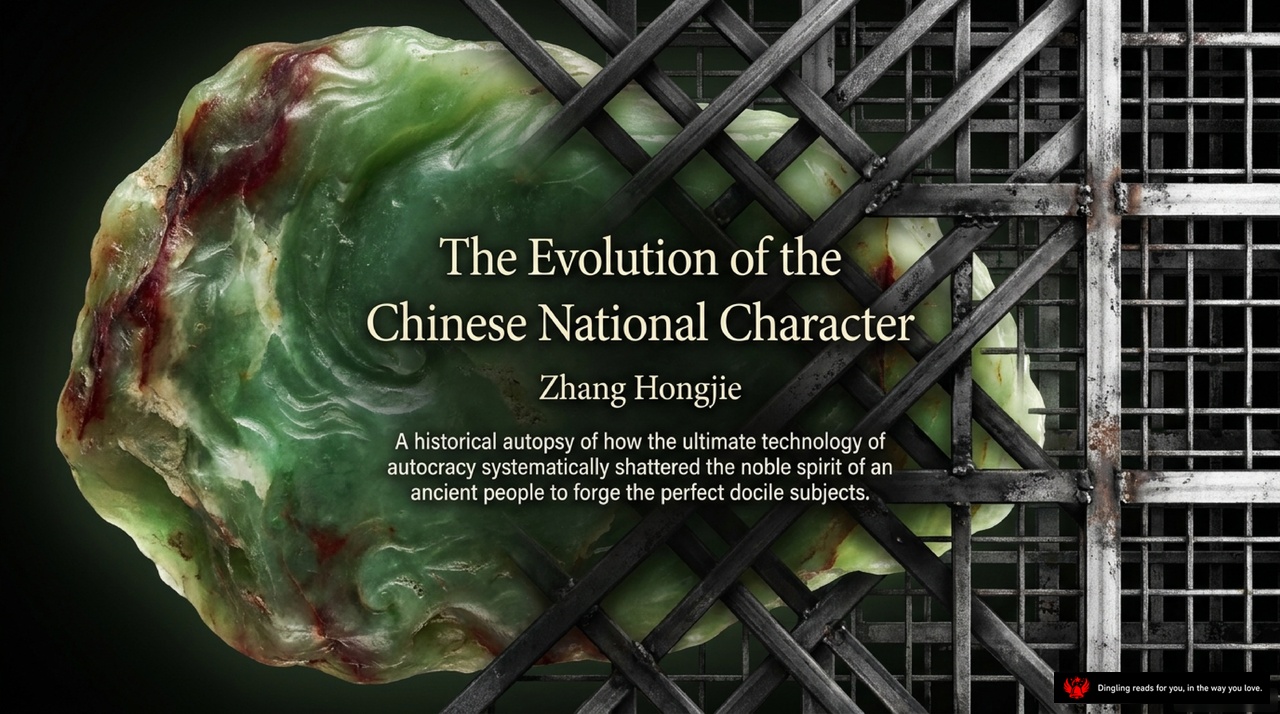
Welcome to today's session on "The Evolution of the Chinese National Character" by Zhang Hongjie. Imagine a stunning, emerald-green jade stone, naturally beautiful and full of life, yet trapped behind cold, rusted iron bars. This image perfectly captures the book's core thesis: a historical autopsy of how the ultimate technology of autocracy systematically shattered the noble spirit of an ancient people to forge the perfect docile subjects.
Before the 18th century, the West viewed China as an ideal empire of wisdom and virtue. But the arrival of the Macartney Mission in 1793 shattered that myth. They found not polite scholars, but a society where officials were tyrannical and the people were terrified, selfish, and numb. This wasn't just a cultural difference; it was a result of high-pressure rule that destroyed dignity and rights.
As the book explores, this pattern of subjugation deepened over centuries. From the rigid hierarchy of the Qing dynasty, where officials called themselves "slaves" to the emperor, to the brutal suppression of thought during the Cultural Revolution, the system consistently prioritized obedience over individuality. The result? A nation that could be incredibly resilient in the face of external threats, yet often paralyzed by internal fear and a lack of self-expression.
But this story isn't just about oppression; it's also about the resilience of the human spirit. Throughout history, there have been moments when the bars seemed to bend. Think of the open-mindedness of the Tang Dynasty, the rebellious individualism of the Wei and Jin periods, or the fiery patriotism of the Song and Ming eras. These flashes of brilliance remind us that while the system can shape us, it cannot entirely define us.
So, as we dive deeper into this journey through Chinese history, ask yourself: How much of our current mindset is shaped by the past? And more importantly, what kind of future are we building for ourselves? Let's begin.
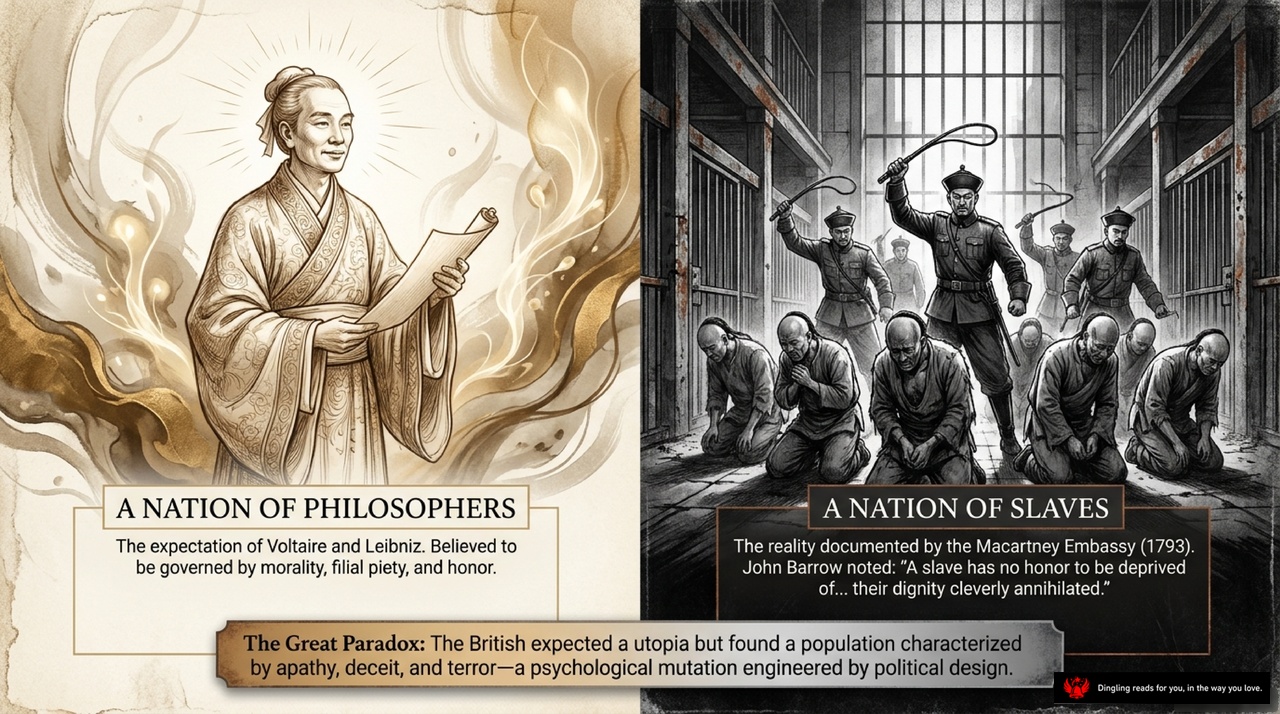
The image presents a stark, almost surreal contrast between two realities of China. On the left, we see a serene, almost ethereal figure representing the idealized view of China as "A Nation of Philosophers"—a land governed by morality, filial piety, and honor, as Voltaire and Leibniz once imagined. But on the right, the scene shifts violently to a grim prison, depicting "A Nation of Slaves," where figures kneel in submission while guards whip them with cruel indifference. This visual dichotomy captures the Great Paradox at the heart of 1793: the British Macartney Embassy expected a utopia but found a population characterized by apathy, deceit, and terror—a psychological mutation engineered by political design. As John Barrow noted, the reality was that "a slave has no honor to be deprived of... their dignity cleverly annihilated." This wasn't just about oppression; it was a systematic dismantling of the human spirit, transforming a nation of thinkers into a nation of the enslaved.

Look at this striking contrast between two eras of Chinese history. On the left, we see Pre-Song China, described here as the "Upper River"—a time when the nation was martial, independent, romantic, and chivalrous. The evidence? Rulers who respected aristocratic independence, scholars who refused to bow to kings, and a society where people were physically robust and dressed without restraint. It was a flowing, powerful era.
Fast forward to the Ming and Qing dynasties, depicted on the right as the "Stagnant Pool." The traits listed are starkly different: submissive, physically weak, deceitful, and devoid of creativity. The proof? Intellectuals reduced to sycophants, the extreme physical restriction of foot-binding, and a weaponless society known for cowardly brawls instead of noble combat.
This visual metaphor drives home a core insight: the so-called "Chinese character" is not a static genetic trait. A citizen from the Pre-Qin era and a subject from the Qing dynasty are fundamentally different psychological species. One was a river in motion, full of life and spirit; the other was water trapped in a cage, slowly turning stagnant. This slide reminds us that national character isn't fixed by blood or soil; it is shaped by the environment. When freedom flows, the spirit thrives. When tyranny damns the path, the spirit dries up.
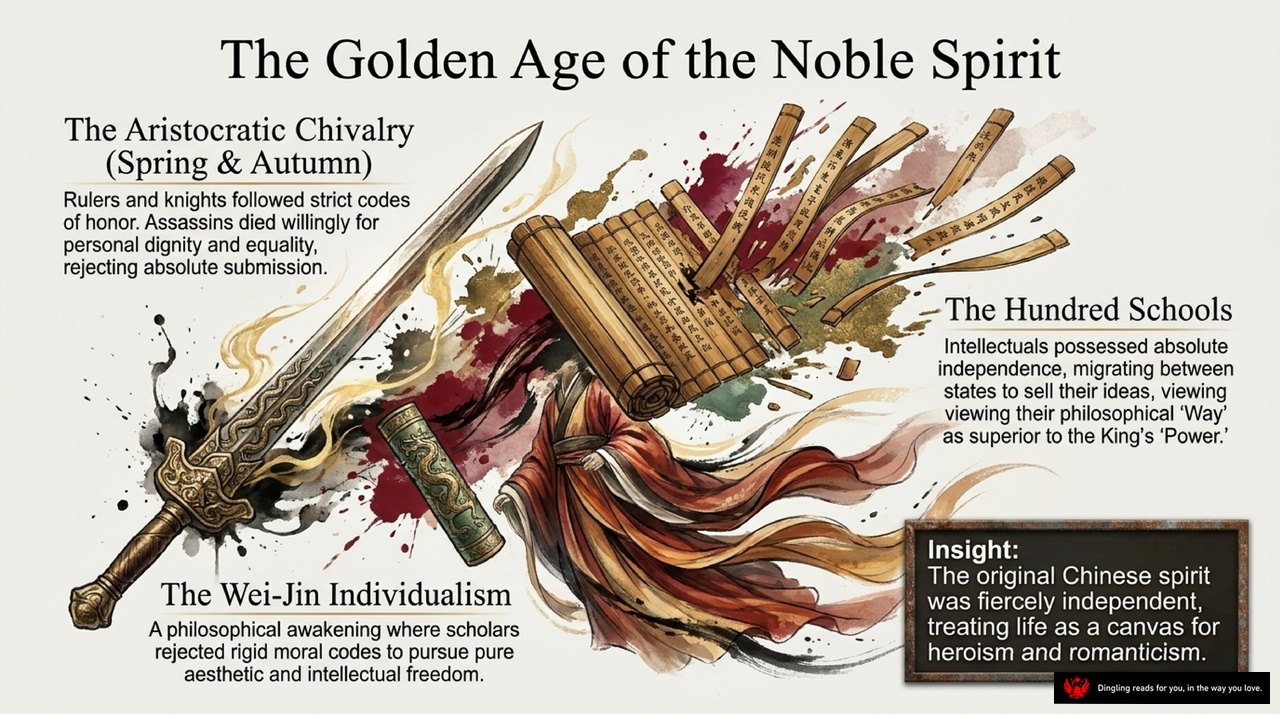
The slide before us is titled "The Golden Age of the Noble Spirit," capturing a pivotal era in Chinese history where honor, independence, and intellectual freedom reigned supreme. On the left, we see the "Aristocratic Chivalry" of the Spring and Autumn period. This wasn't just about war; it was about a strict code of honor. Rulers and knights followed these rules, even assassins who died for personal dignity rather than submitting to absolute power. It was a time when bravery and reputation mattered more than survival.
Moving to the right, the slide highlights "The Hundred Schools." This was the intellectual explosion of that era. Scholars possessed absolute independence, moving freely between states to sell their ideas. They believed their philosophical "Way" was superior to the King's "Power." Think of it as the birth of modern academia, where truth mattered more than the ruler's decree.
Finally, at the bottom, we have "The Wei-Jin Individualism." This was a philosophical awakening where scholars rejected rigid moral codes to pursue pure aesthetic and intellectual freedom. They treated life as a canvas for heroism and romanticism, fiercely independent and unafraid to question the status quo.
As the insight box reminds us, the original Chinese spirit was fiercely independent. From the chivalrous warriors to the wandering philosophers, this golden age defined a nation that valued its soul over its submission.
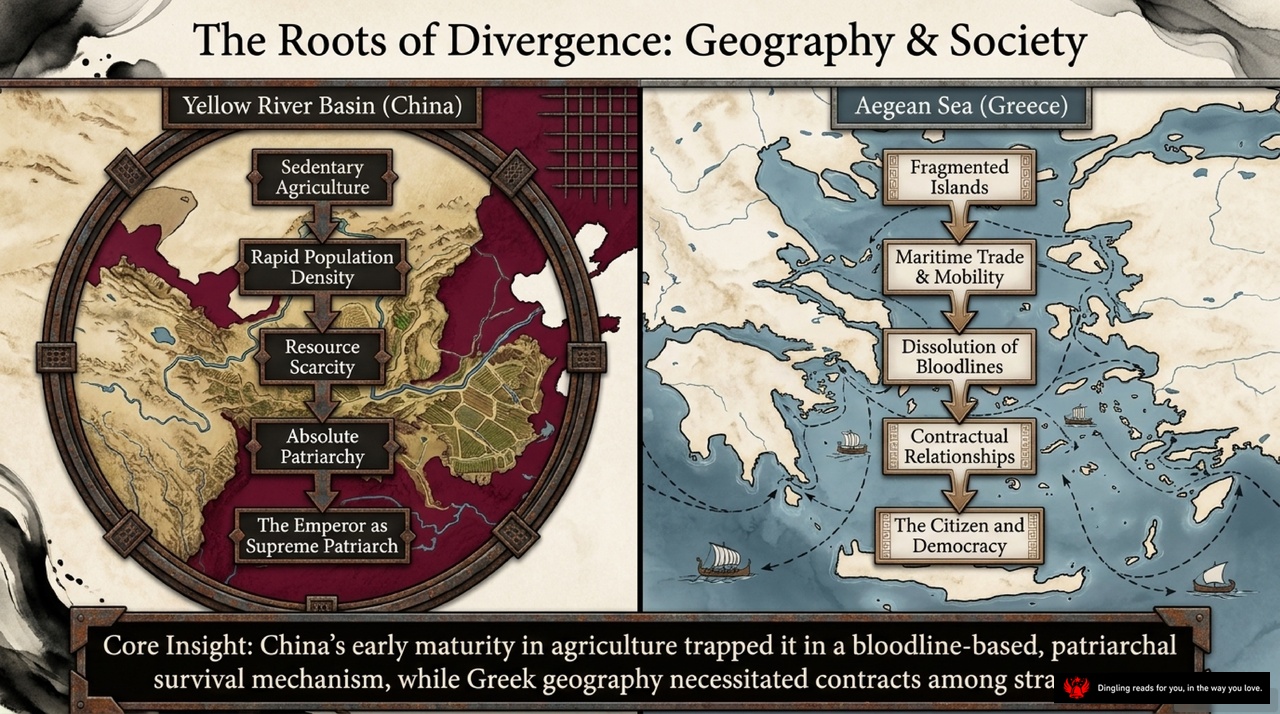
The roots of our divergence lie deep in geography and the societies it shaped. Look at the Yellow River Basin in China versus the Aegean Sea in Greece. This simple geographic difference created two entirely different paths for civilization.
In China, the fertile land encouraged sedentary agriculture. This led to rapid population density, which quickly caused resource scarcity. To survive this pressure, society turned inward, relying on absolute patriarchy and a bloodline-based survival mechanism. The result was a centralized system where the Emperor became the supreme patriarch, ruling over a unified, static empire.
Contrast this with Greece. The fragmented islands of the Aegean made land-based agriculture difficult, forcing people toward maritime trade and mobility. This constant movement dissolved rigid bloodlines and shifted relationships from family-based to contractual. Instead of a single ruler, Greek geography necessitated contracts among strangers, fostering a culture of negotiation and individual rights. This unique environment eventually gave rise to the citizen and democracy.
The core insight here is clear: China's early agricultural maturity trapped it in a hierarchical, patriarchal structure, while Greek geography forced its people to develop flexible contracts and democratic institutions. This fundamental difference in how they organized society set the stage for thousands of years of historical divergence.
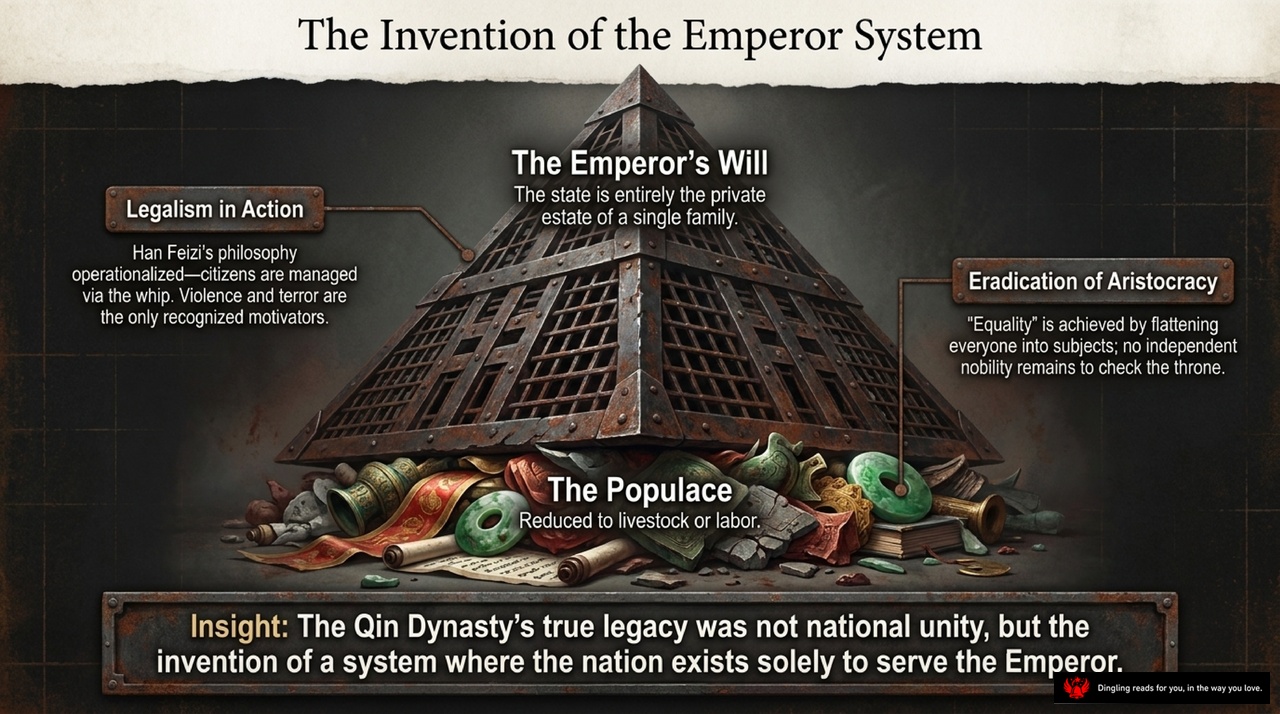
Look at this pyramid. It's not a monument to glory; it's a cage. At the very top sits "The Emperor's Will," declaring that the entire state is just the private estate of a single family. Below that, on the left, we see "Legalism in Action." This is Han Feizi's philosophy stripped of any mercy: citizens are managed by the whip, and violence and terror are the only motivators that matter. On the right, the image highlights the "Eradication of Aristocracy." Here, "equality" is a cruel trick—it's achieved by flattening everyone into subjects, leaving no independent nobility to check the throne. At the bottom, crushed beneath the weight of the system, lies "The Populace," reduced to nothing more than livestock or labor.
The insight at the bottom of this slide is the most chilling part. The Qin Dynasty's true legacy wasn't national unity. It was the invention of a system where the nation exists solely to serve the Emperor. This structure didn't just rule China; it fundamentally broke the human spirit. It replaced the dignity and honor of the past with a culture of fear and submission. By destroying the aristocracy and replacing it with a rigid, terror-based bureaucracy, the Qin system created a society where the only value of a person was their utility to the state. It was a perfect machine for control, but a nightmare for humanity.

Autocracy as a Perfected Technology. Imagine Chinese history not as a stagnant cycle, but as a 2,000-year R&D timeline where the ruling class continuously optimized the hardware of control.
Let's look at the evolution. Version 1.0, Qin, was the hardware. It relied on brutal force, penal codes, and physical chains. It was effective but too brittle, crashing easily under pressure. Then came Version 2.0, Han, which introduced the UI or software. They monopolized Confucianism, wrapping legalist violence in a moral interface. They employed "virtue" as a deceptive user interface to make oppression feel legitimate.
Moving forward to Version 3.0, Tang and Song, we see the processor. The Imperial Examination System acted as the central CPU, monopolizing all intellectual ambition. Instead of rebellious thinkers, it turned potential rebels into desperate, compliant bureaucrats. Finally, Version 4.0, Qing, installed the firewall. Through literary inquisitions and building prisons directly inside the mind, they perfected self-censorship.
The core insight here is profound: this wasn't just a series of failed empires. It was a systematic upgrade. Each dynasty learned from the last, refining the tools of suppression until autocracy became a perfected, self-sustaining technology.

Look at this graph. It illustrates a harsh truth about living under absolute power: the "Cost of the Perfect System."
The white line you see here is the "Activation Curve." It shows a steep drop-off. In an environment where power is arbitrary and absolute, independent thought isn't just risky—it's a lethal mutation. The system demands that everyone fall into one of two silhouettes.
On the left, we have Archetype A: "The Docile Subject." Their strategy is numbness. They surrender all personal dignity, avoid standing out, and show absolute submission just to avoid the whip. They are the invisible ones who survive by doing nothing.
On the right, we have Archetype B: "The Hooligan." Their strategy is cunning. Devoid of any moral bottom lines, they navigate the system through deception, cruelty, and parasitic behavior. They survive by being ruthless.
The insight at the bottom drives this home: when power is unchecked, the optimal evolutionary strategy is to become either completely numb or utterly ruthless. Any attempt to think independently or act with integrity leads to destruction. This isn't just about history; it's a warning about how fragile our freedom really is when the rules are set by those in charge.

Look at this spine. It's not just bone; it's a metaphor for the Chinese nation's broken back, fractured by two brutal foreign conquests that didn't just change rulers—they shattered the very spirit of the people.
First, we see the Mongol invasion from the Song to the Yuan. The image shows a violent break in the spine. This wasn't just a military defeat; it was a cultural shockwave. The Mongols imposed a rigid, four-tier racial caste system that violently interrupted centuries of progress. It wasn't about land; it was about humiliation. They stripped away dignity, replacing it with a hierarchy where the conquered were forced into submission, creating a deep psychological scar that lasted for generations.
Then, look at the second fracture: the transition from Ming to Qing. Here, the Manchus didn't just conquer; they institutionalized absolute slavery. The image on the right, that long braid under a spotlight, represents the ultimate symbol of this forced submission. The "queue order"—forced haircuts and braids under penalty of death—wasn't just about hair; it was a daily reminder that your body didn't belong to you. It was a visual enforcement of the master-slave dynamic.
The insight at the bottom ties it all together. These alien conquerors didn't just occupy territory; they destroyed the moral resistance of the populace. They systematically broke the spine of the nation, replacing a proud, independent society with one conditioned to obey, to hide, and to survive through submission. This historical trauma explains why, for centuries, the concept of "national character" in China became synonymous with passivity and fear. The spine was broken, and the nation learned to walk with a limp, carrying the weight of centuries of humiliation.
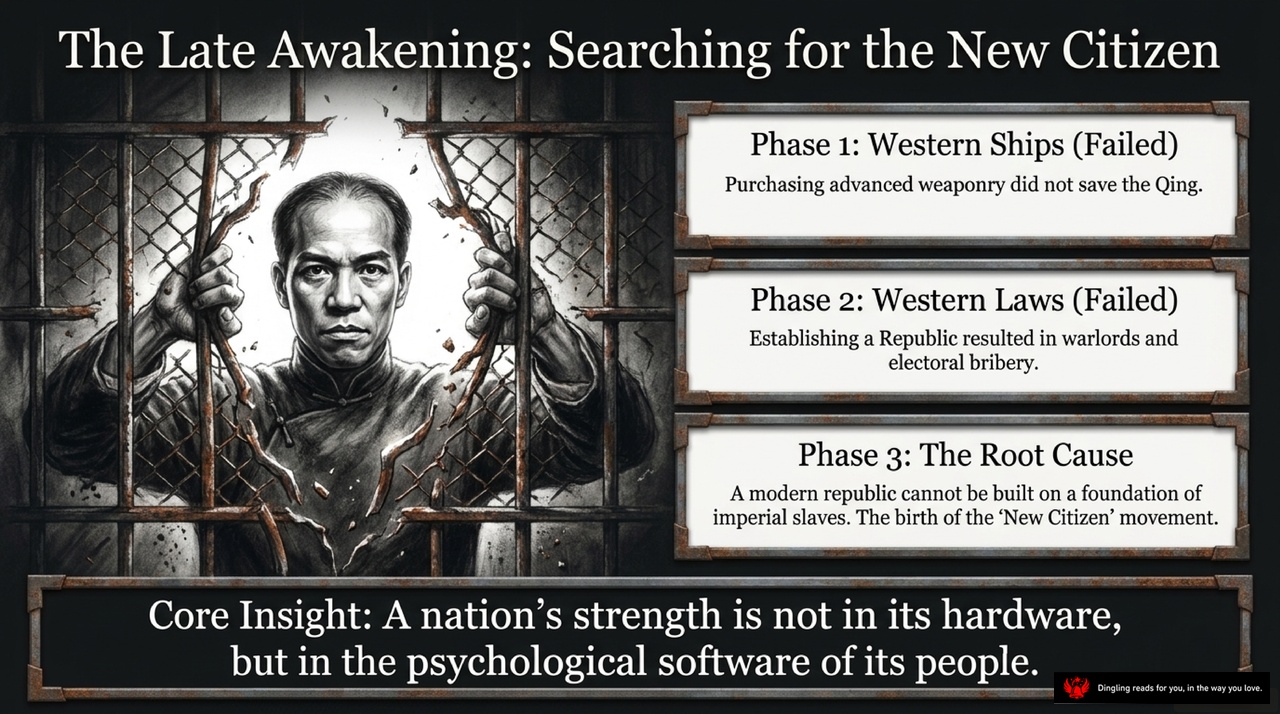
Look at this slide titled "The Late Awakening: Searching for the New Citizen." It maps out a painful but necessary journey through Chinese history, moving from hardware failures to a deep psychological awakening.
First, we see Phase 1: Western Ships (Failed). The slide reminds us that simply buying advanced weaponry never saved the Qing Dynasty. It was a classic mistake—trying to fix a broken system with better tools.
Then comes Phase 2: Western Laws (Failed). Establishing a Republic didn't bring stability; instead, it led to warlords and electoral bribery. You can see the figure on the left gripping the bars of a cage, symbolizing this era where the people felt trapped by chaos and corruption, unable to break free.
Finally, we arrive at Phase 3: The Root Cause. This is the core insight at the bottom: A nation's strength is not in its hardware, but in the psychological software of its people. The slide explains that a modern republic cannot be built on a foundation of imperial slaves. The birth of the 'New Citizen' movement was the realization that true strength comes from internal transformation, not external imports.
This narrative shifts the focus from blaming foreign powers to looking inward. It argues that for centuries, the population was conditioned to be submissive and passive, lacking the independent spirit needed for a modern nation. The struggle wasn't just about ships or laws; it was about waking up a sleeping giant, transforming a subject into a citizen, and rewriting the nation's deepest psychological code.
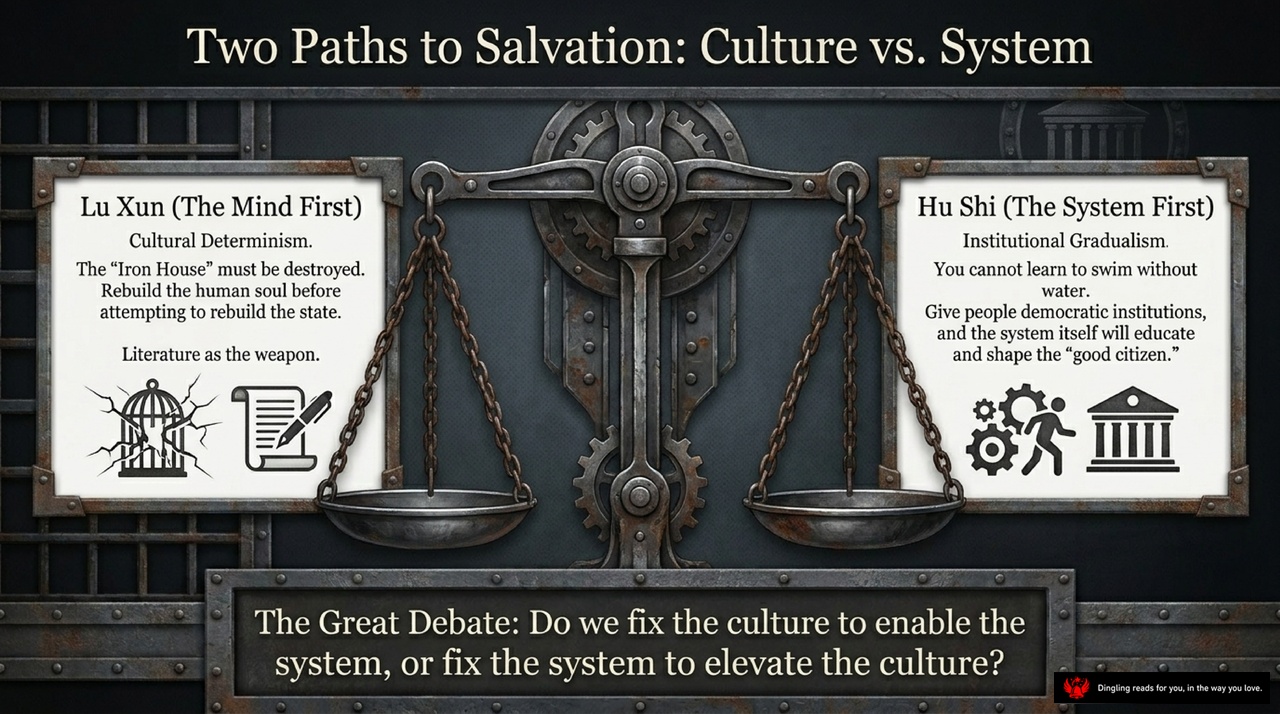
Today's slide presents a classic debate that has shaped modern political thought: Culture versus System. On the left, we see Lu Xun's perspective, which champions "The Mind First." He believed in cultural determinism, arguing that the "Iron House" of old traditions must be destroyed before any real change can happen. For Lu Xun, rebuilding the human soul was the prerequisite for rebuilding the state, making literature the ultimate weapon to liberate the spirit.
On the right stands Hu Shi, advocating for "The System First." His approach is one of institutional gradualism. He famously argued that you cannot learn to swim without water; you can't expect people to be democratic before they have democratic institutions. Hu Shi believed that if you give people the right structures and democratic frameworks, the system itself will eventually educate and shape the "good citizen."
So, the core question at the bottom asks us to choose our path: Do we fix the culture first to enable a better system, or do we fix the system first to elevate the culture? It's a timeless dilemma that challenges us to decide whether we need to change hearts before we change laws, or change laws to eventually transform hearts.

Look at this cycle behind the bars. It captures a terrifying truth about how societies get trapped: the Allure of the Quick Fix.
It starts with **Deep Crisis**—a moment of humiliation and desperation where the status quo feels unbearable. In that panic, leaders and the public alike crave a magic solution. This leads to **Utopian Ideology**: the dangerous search for a single, absolute truth that promises to fix everything instantly. We want a silver bullet, not the hard work of gradual improvement.
To make this "quick fix" happen, we turn to **Top-Down Mass Movements**. Think of Chiang Kai-shek's New Life Movement or Mao's Cultural Revolution. These are attempts to force a radical transformation from the top down, ignoring the slow, unglamorous work of building real institutions. It's about sheer willpower, not sustainable systems.
But the result is always **Institutional Failure**. When you try to forge "New Men" through force and ideology, the system collapses under its own weight. The energy that should have built stable structures is instead wasted on fighting the movement itself.
The insight here is clear: our impatient desire for a sweeping, radical cure repeatedly sabotages the slow, boring, but essential work of building stable institutions. History shows us that you can't jump over the hard work of growth; you just end up right back where you started, but with more scars.

For over two millennia, the relentless optimization of autocratic technology systematically broke the independence, vitality, and martial spirit of the Chinese people, replacing it with a survivalist culture of submission. Modern history has been an agonizing, often misguided struggle to reverse this mutation—proving that a nation's character is not dictated by its blood, but forged by the systems it is forced to endure.
Look at the image behind us. We see a stark contrast: the ancient scroll representing our history versus the cold, iron bars of a cage. This visual metaphor captures the central question of our discussion today. If our national character is simply the shadow cast by our political institutions, can any true cultural revival ever take place before the underlying system itself is fundamentally transformed?
Consider the evidence from our past. For two thousand years, the relentless optimization of autocratic technology systematically broke the independence, vitality, and martial spirit of the Chinese people. We saw this in the Qianlong era, where officials became servants of the throne, calling themselves "nuclei" rather than ministers, and where scholars like Lu Xun later criticized the very concept of the "chivalrous hero," revealing how the spirit of independence had been crushed into submission. The system didn't just punish dissent; it rewired the population to value survival over dignity.
Modern history has been an agonizing, often misguided struggle to reverse this mutation. We watched as the May Fourth Movement and later the Cultural Revolution attempted to break these chains through radical cultural revolutions, yet the structural constraints often remained. This proves a profound truth: a nation's character is not dictated by its blood, but forged by the systems it is forced to endure.
So, we face a critical choice. If our national character is simply the shadow cast by our political institutions, can any true cultural revival ever take place before the underlying system itself is fundamentally transformed? The answer lies not in blaming the individual, but in understanding that freedom cannot be demanded from within a cage. True revival requires not just changing minds, but dismantling the very structures that have defined our collective behavior for centuries.