
The Expensive Peace: Complete Chapter-by-Chapter Summary

Welcome to today's deep dive into one of the most pivotal moments in modern East Asian history. This session is based on Ji Chen's groundbreaking research, *The Expensive Peace: A Study of the Sino-Japanese Treaty of Shimonoseki*.
On the screen, you see two powerful symbols: the Chinese dragon, representing the Qing Empire, and the Japanese chrysanthemum emblem, symbolizing the rising Meiji state. These aren't just decorative elements; they represent the two imperial powers whose clash in 1895 fundamentally reshaped the geopolitical landscape of Asia.
We are about to explore "The Expensive Peace"—a diplomatic deep-dive into the unequal negotiations, broken codes, and imperial ambitions that defined this era. From the initial diplomatic failures in 1894 to the brutal signing of the Treaty of Shimonoseki, we will uncover how a complex mix of military miscalculations, intelligence breaches, and shifting international alliances led to a peace that was incredibly costly for China.
Join me as we decode the events that turned a regional conflict into a global turning point, revealing the true human and strategic price of that "expensive peace."

The map before us vividly illustrates the catastrophic collapse of the East Asian order in 1894, a pivotal year when the balance of power shifted irrevocably. For centuries, the Qing Dynasty had anchored the region's tributary system, but the First Sino-Japanese War shattered this reality. The conflict erupted over control of the Korean Peninsula, with Japan's modernized military rapidly overwhelming Qing forces both on land and at sea. Key events marked this defeat: the fall of Port Arthur, the destruction of the Beiyang Fleet in the Yellow Sea, and Japan's advance into Korea. As Japanese troops pushed toward Beijing, the Qing court was forced to seek a negotiated peace from a position of absolute weakness, marking the end of an era.

The slide illustrates a critical turning point in history: the Information War. While the Qing Dynasty in Beijing was busy encrypting their diplomatic cables with the "Mi Hong" codebook, believing their channel was secure, Japanese intelligence in Tokyo had already cracked the cipher. This is the core irony depicted here.
Specifically, the image highlights how Foreign Ministry cryptographer Sato Aimaro broke the code before the war even began, intercepting and reading over 58 top-secret Qing diplomatic cables. This gave Japanese officials like Ito Hirobumi and Mutsu Munemitsu a massive strategic advantage. They knew exactly what the Qing court was willing to concede. This intelligence allowed them to push their demands to the absolute limit without any fear of premature withdrawal by China.
In essence, the Qing was negotiating with an open playbook, completely unaware that their secrets were already on the other side's desk. This information asymmetry fundamentally dictated the outcome of the negotiations that followed.

The slide highlights a critical diplomatic failure known as the "Hiroshima Rejection." In early 1895, Japan deliberately sabotaged the first peace talks to buy time for further military conquests. They cited a technicality in international law to reject Qing envoys Zhang Yinhuan and Shao Youlian. The core issue lay in the difference between the Qing Document, which was merely a standard diplomatic greeting lacking the Emperor's personal signature, and the Japanese Requirement for a "Full Powers" commission. The Japanese insisted on specific legal authorization allowing envoys to negotiate and sign a binding treaty on the spot. Because the Qing envoys lacked independent decision-making power and had to telegraph Beijing for permission before agreeing to any terms, Japan simply refused to talk. This bureaucratic deadlock was a calculated delay tactic that ultimately doomed the peace efforts before they could even begin.
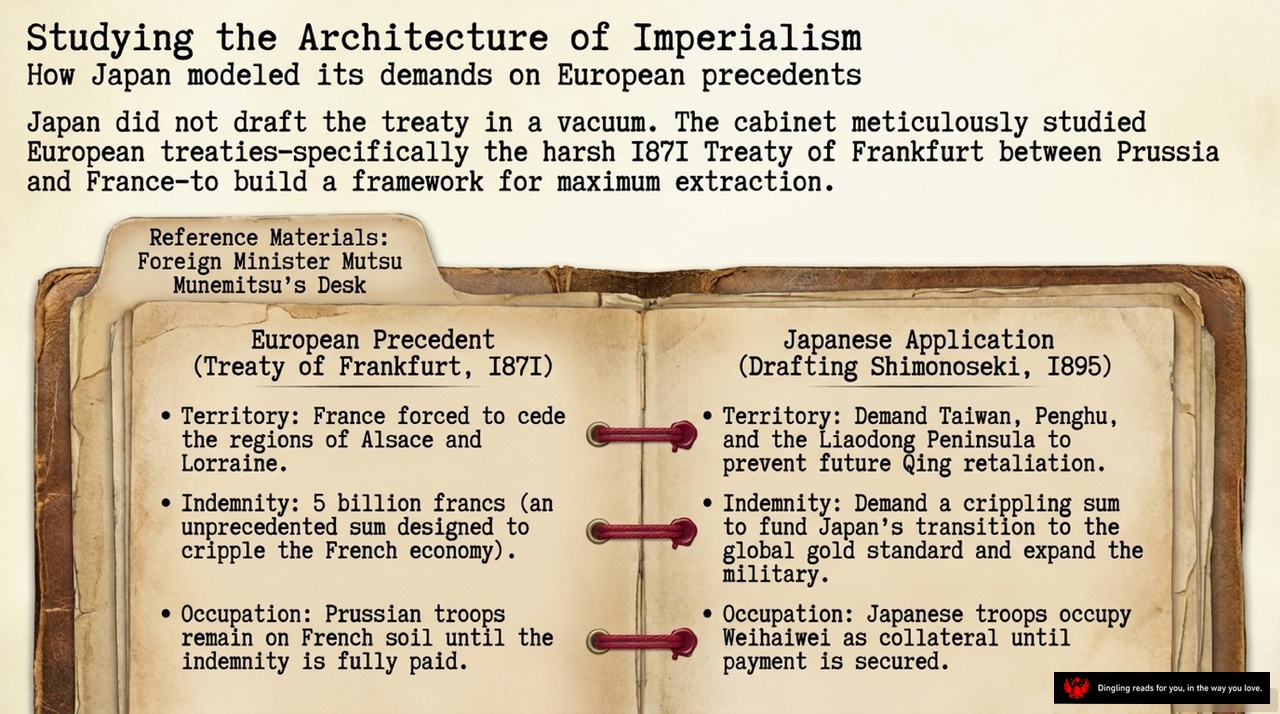
When Japan was ready to draft the terms for the Shimonoseki Treaty, they didn't work in a vacuum. Instead, the Japanese cabinet meticulously studied European precedents, specifically the harsh 1871 Treaty of Frankfurt between Prussia and France, to build a framework for maximum extraction. As the slide illustrates, they drew a direct line from the European model to their own demands. Just as France was forced to cede the regions of Alsace and Lorraine, Japan demanded Taiwan, Penghu, and the Liaodong Peninsula to prevent future Qing retaliation. Following the European precedent of imposing a crippling indemnity designed to cripple an economy, Japan demanded a massive sum to fund Japan's transition to the global gold standard and expand its military. Finally, mirroring the Prussian occupation of French soil until payment was secured, Japan planned to occupy Weihaiwei as collateral until the indemnity was fully paid. This slide perfectly captures how Japan modeled its demands on European precedents, transforming the lessons of the Franco-Prussian War into a blueprint for crushing China.

Squeezing the Territorial Vise: The internal evolution of Japan's territorial demands. Japan's cabinet prepared multiple drafts of the treaty, strategically escalating their territorial demands far beyond their actual military footprint. Look at this map: Draft 3 represents the realistic core, covering the exact territory currently occupied by Japanese troops, serving as the baseline objective. Draft 2 expands further north to create a massive military buffer zone. But Draft 1, the maximum ask, demands a vast swath of the Liaodong Peninsula, extending all the way to the 41st parallel. The negotiation tactic was ruthless: by presenting the most extreme Draft 1 to the Qing envoy initially, Japan could later 'generously' concede territory they never actually controlled, while still securing their true strategic objectives. This psychological pressure ensured that even when the final treaty was signed, Japan's ultimate goals remained firmly in place, turning a negotiated settlement into a masterclass in strategic deception.

The Psychological Theater of Shunpanro: The venue staged for an expensive peace.
In March 1895, negotiations commenced at Shunpanro, an elegant inn in Shimonoseki. But let's look closer at the stage itself, because this wasn't just a random location; it was meticulously designed to intimidate.
First, look at the chairs. These ornate, gold-inlaid chairs were sourced directly from the Imperial Household. They were a deliberate display of Japanese imperial wealth and stability, right in the center of the room.
Then, notice the view through the windows overlooking the straits. It was deliberately filled with Japanese naval vessels and transport ships heading to the warfront. This served as a constant visual reminder of Japan's military dominance, staring right at the negotiators.
Finally, consider the contrast. While the Chinese Viceroy Li Hongzhang was housed in the nearby Injoji Temple, outfitted with Western furniture by the Japanese, this was a calculated mix of outward 'respect' and a display of absolute control over the envoy's environment. The entire setup was a psychological theater, staging an expensive peace where Japan held all the cards.
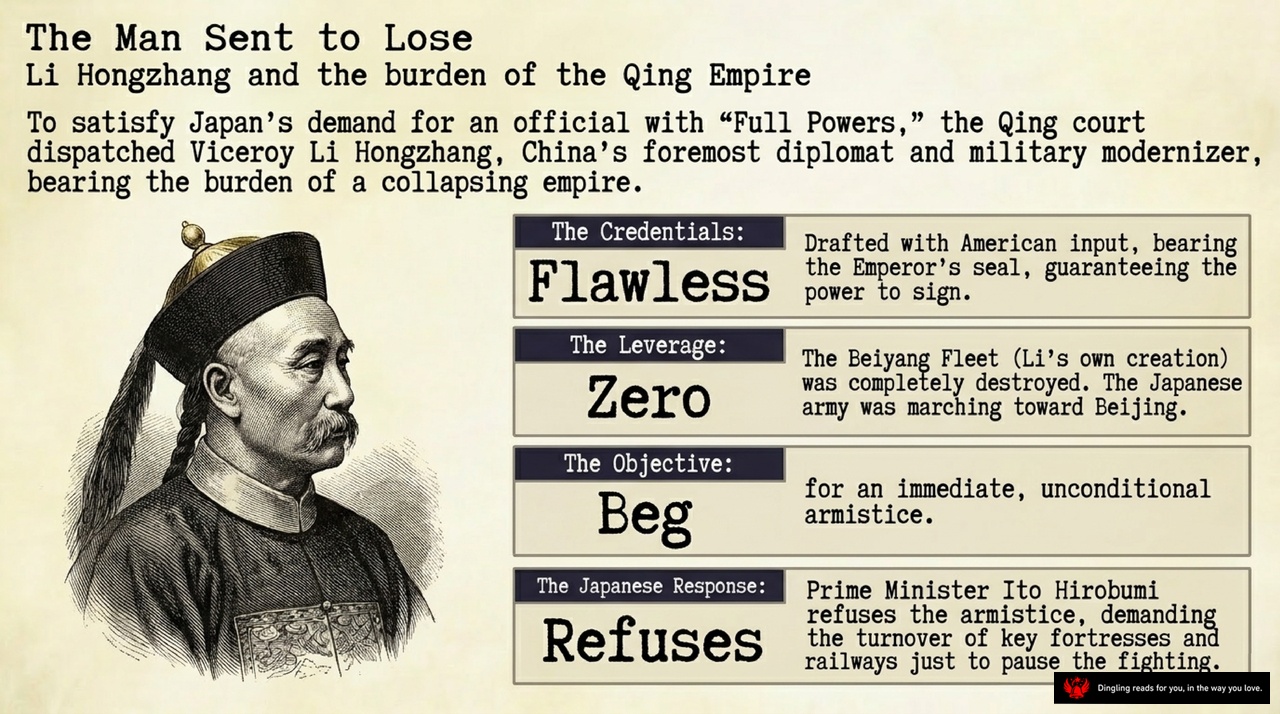
The man sent to lose: Li Hongzhang and the crushing weight of the Qing Empire. To satisfy Japan's demand for an official with "Full Powers," the Qing court dispatched Viceroy Li Hongzhang, China's foremost diplomat and military modernizer, bearing the burden of a collapsing empire.
Look at the stark reality he faced. The credentials he carried were **Flawless**—drafted with American input, bearing the Emperor's seal, guaranteeing the power to sign. Yet, the leverage he held was **Zero**. The Beiyang Fleet, Li's own creation, was completely destroyed, and the Japanese army was already marching toward Beijing. His objective was to **Beg** for an immediate, unconditional armistice. But the Japanese Response? They **Refused**. Prime Minister Ito Hirobumi rejected the armistice, demanding the turnover of key fortresses and railways just to pause the fighting.
It was a tragedy of absolute powerlessness. Li Hongzang was the perfect envoy, yet he was sent into a battlefield where he had no army, no allies, and no chance of survival. He was forced to negotiate from a position of total defeat, trying to save a nation that had already lost its soul and its strength.

On March 24, 1895, a single bullet changed the course of history. As Li Hongzhang, the Qing negotiator, walked back to his quarters, a Japanese extremist shot him in the face. Miraculously, Li survived, though the bullet remained lodged near his eye. This crisis, known as "The Assassin's Bullet," inadvertently became a turning point that aided the Qing cause.
The event triggered immediate panic in Japan. The Japanese government feared that if Li died or abandoned the talks, European powers—already wary of Japan's rise—would use the outrage as a pretext to intervene forcefully. To salvage their international reputation and keep Li at the table, the Meiji Emperor ordered an immediate, unconditional 21-day armistice.
In a twist of irony, the crisis created a window of opportunity. Mutsu Munemitsu reportedly told Li, "Your misfortune is the great fortune of the Qing Empire. The peace terms will now be easier to negotiate." The bullet that was meant to end the talks instead bought the Qing government precious time to regroup and prepare for the final negotiations at Shimonoseki.
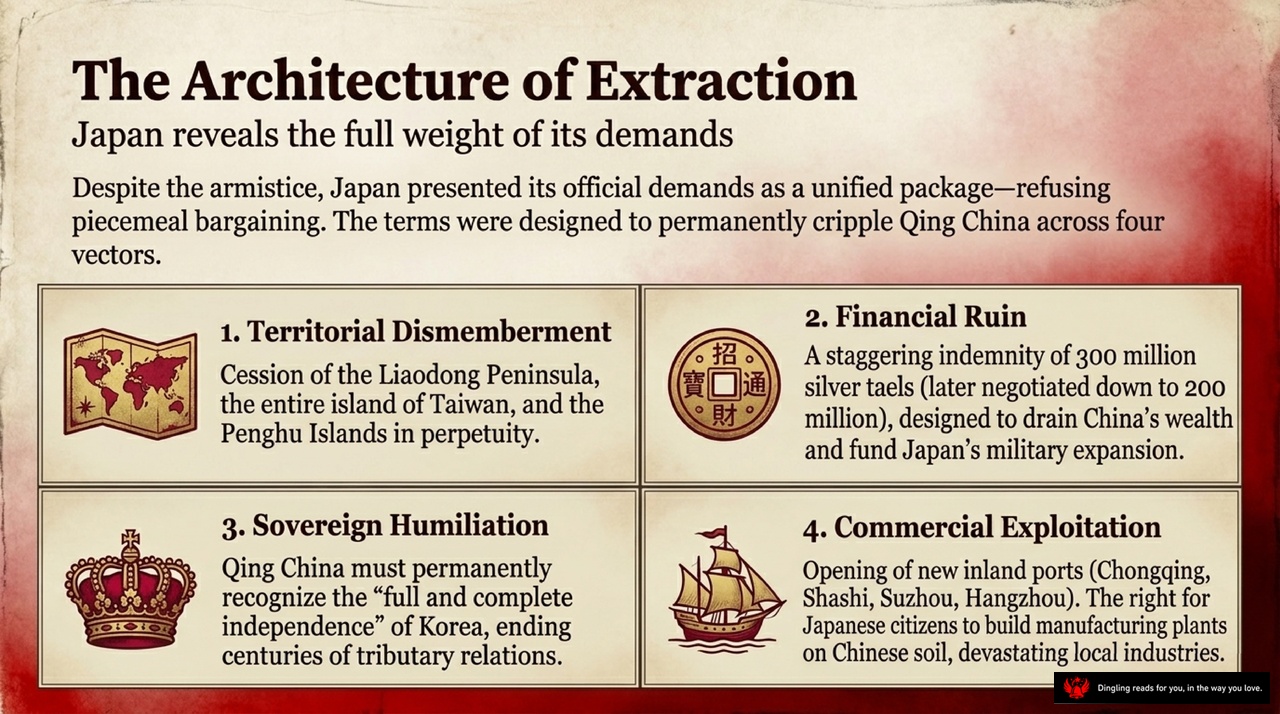
The Architecture of Extraction: Japan reveals the full weight of its demands. Even after the armistice was signed, Japan refused to engage in piecemeal bargaining. Instead, they presented a unified package designed to permanently cripple Qing China across four critical vectors. First, territorial dismemberment: the cession of the Liaodong Peninsula, the entire island of Taiwan, and the Penghu Islands in perpetuity. Second, financial ruin: a staggering indemnity of 300 million silver tael, later negotiated down to 200 million, specifically designed to drain China's wealth and fund Japan's military expansion. Third, sovereign humiliation: Qing China was forced to permanently recognize the "full and complete independence" of Korea, ending centuries of tributary relations. Finally, commercial exploitation: the opening of new inland ports like Chongqing and Hangzhou, granting Japanese citizens the right to build manufacturing plants on Chinese soil, which devastated local industries. This was not just a treaty; it was a blueprint for total extraction.

Imagine a desperate gamble played out in the shadows of 1895. Li Hongzhang, the architect of China's naval modernization, found himself face-to-face with Japan's iron wall of victory. He traveled to Shimonoseki, arriving at the Spring Garden Hotel—a place that would soon become synonymous with national humiliation. While the Japanese, led by Ito Hirobumi, reveled in their triumph, Li hoped to negotiate a survival deal. He proposed a staggering 400 million taels in indemnity, far less than the initial demands, and offered to cede only Liaodong, sparing the sacred Taiwan. But here lies the tragic flaw in Li's strategy: he believed in diplomacy, in logic, and in the power of reason. He assumed that a reasonable offer would be met with reasonable acceptance. He did not anticipate that Japan had already calculated its war aims down to the last yen. The Japanese had secretly mapped out a plan to seize not just Liaodong, but Taiwan, and to extract a massive 300 million taels. They viewed the Chinese offer not as a negotiation, but as a starting point for further exploitation. The result was a stalemate where China's best efforts were met with an unyielding wall of military might and cold calculation. Li's plea for a "peaceful" compromise was drowned out by the reality of the battlefield, leaving him with no choice but to sign terms that would shatter the Qing dynasty's future.

Diplomacy Ends Where Military Force Begins. As negotiations dragged on, Prime Minister Ito Hirobumi issued a final, chilling ultimatum to Li Hongzhang, reminding him that the alternative to signing the treaty was the immediate capture of Beijing. He made it clear that time was not on China's side. "War is a progressive thing," Ito warned. "Whether in its military actions or the results it produces, it only moves forward. Therefore, Your Excellency must not assume that the peace terms I am willing to concede today will still be available tomorrow." With the Japanese fleet mobilized and ready to strike deeper into China, Li Hongzhang had no choice but to sign the Treaty of Shimonoseki on April 17, 1895.

The Imperial Chessboard Reacts to Overreach
Look at this map. It perfectly captures a pivotal moment in history where a single aggressive move by Japan triggered a massive global reaction. The Qing Dynasty had made a fatal strategic error: they leaked the harsh terms of the treaty to European powers, hoping to scare them into stopping Japan. Ironically, this backfired spectacularly. Japan's demand for the Liaodong Peninsula wasn't just about territory; it directly threatened the geopolitical interests of the major European powers, triggering what we call the "Triple Intervention."
Let's break down the motivations of these three powers. First, Russia. Their arrow points directly at the peninsula because they feared that if Japan controlled Liaodong, it would permanently block their access to an ice-free port in the Pacific. This was a strategic nightmare for them. Then, look at Germany. They sought to establish a foothold in East Asia. Their goal was to encourage Russia to focus its attention in the East, thereby relieving the border pressure Germany was facing in Europe. Finally, France, bound by its military alliance with Russia, joined the coalition simply to check Japanese expansion.
On April 23, these three powers issued a joint "recommendation" to Japan. They demanded that Japan return the Liaodong Peninsula to China, or they would face a combined naval war. Japan, exhausted from fighting the Qing and realizing the futility of further conflict, had no choice but to comply. This event marked a turning point, showing how local conflicts could quickly escalate into a struggle for global dominance.
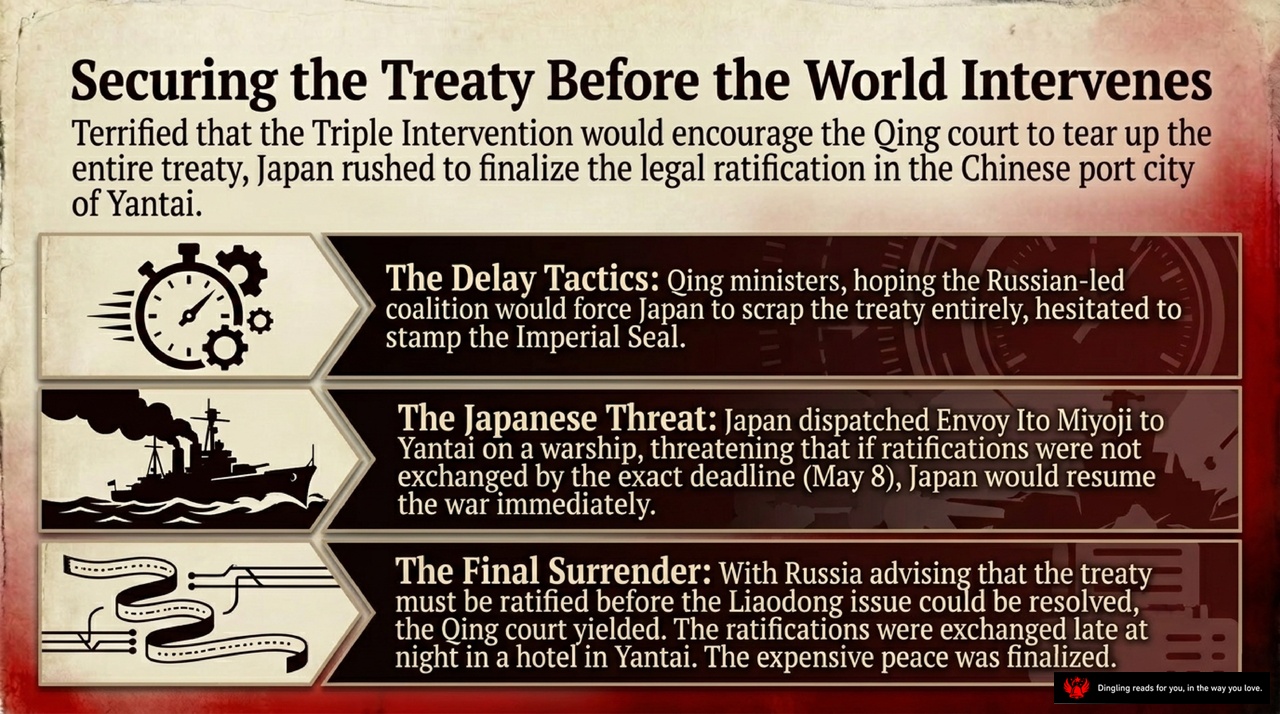
Securing the Treaty Before the World Intervenes. Fearing that the Triple Intervention would force the Qing court to tear up the entire agreement, Japan rushed to finalize the legal ratification in the Chinese port city of Yantai.
The story unfolds in three critical moves. First, the Delay Tactics: Qing ministers, hoping the Russian-led coalition would force Japan to scrap the treaty entirely, hesitated to stamp the Imperial Seal. Second, the Japanese Threat: Japan dispatched Envoy Ito Miyoji to Yantai on a warship, threatening that if ratifications were not exchanged by the exact deadline, May 8, Japan would resume the war immediately. Finally, the Final Surrender: With Russia advising that the treaty must be ratified before the Liaodong issue could be resolved, the Qing court yielded. The ratifications were exchanged late at night in a hotel in Yantai. The expensive peace was finalized.

The Treaty of Shimonoseki was not merely an end to a war, but a masterclass in modern imperial extraction. By leveraging broken cryptography, exploiting international legal technicalities, and modeling their demands on harsh European precedents, Japan forced the Qing Dynasty to sign away its territory, sovereignty, and wealth. Though the Triple Intervention forced the return of Liaodong, the catastrophic indemnity and the loss of Taiwan mortally wounded the Qing Empire and set the stage for decades of conflict in East Asia.
When the rules of international law are written by the victors and weaponized against the weak, does diplomacy exist to prevent conflict, or merely to legalize the spoils of war?