
The Fabric of Reality: Complete Chapter-by-Chapter Summary
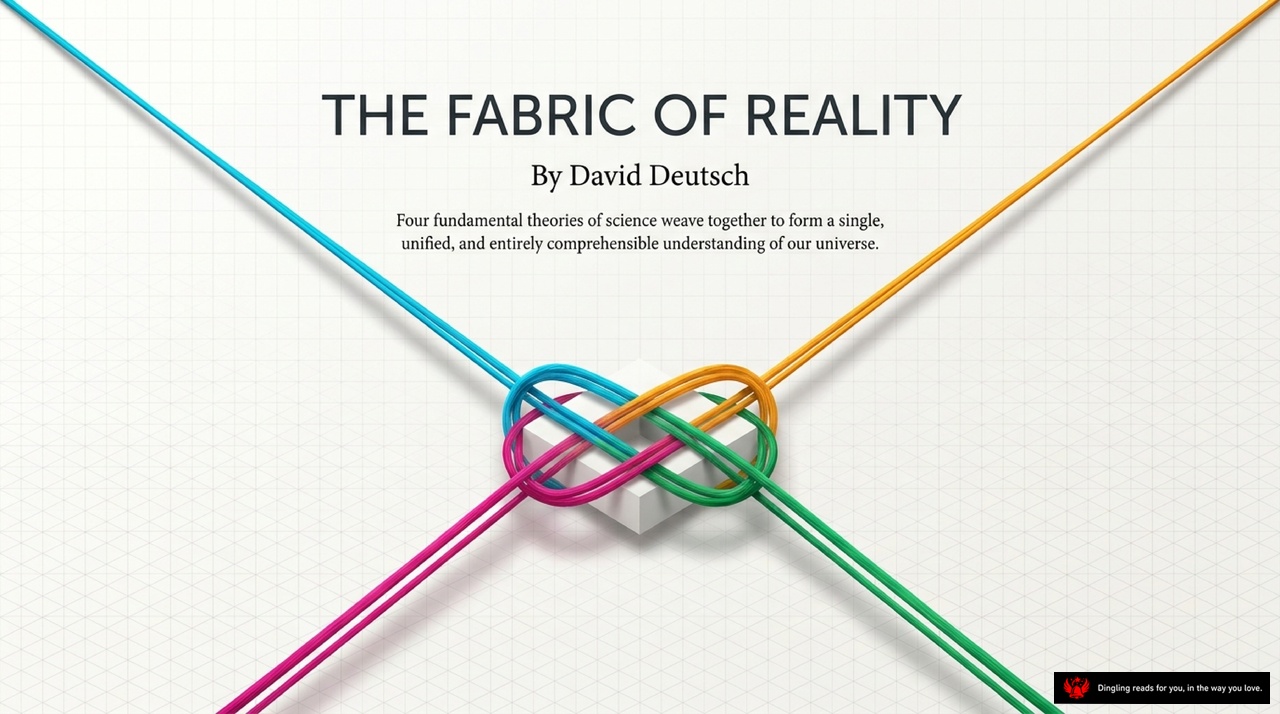
Welcome to *The Fabric of Reality* by David Deutsch. Imagine four colorful threads—representing the fundamental theories of science—interwoven into a single, unified knot that defines our universe. This book argues that when we weave together quantum physics, evolutionary biology, the nature of computation, and the logic of scientific reasoning, we unlock a completely comprehensible picture of reality. It's not about memorizing isolated facts, but about understanding the deep principles that connect everything. By embracing this unified framework, we move beyond fragmented knowledge and discover that the fabric of reality is far more coherent and knowable than we ever imagined.

Today's slide illustrates a profound shift in how we view knowledge: understanding is about depth, not breadth. On the left, we see the "fragmented universe," where we are told human knowledge is expanding so fast that no single person can grasp it all. This leads to a scattered collection of isolated facts. But the right side shows the "unified universe." Here, we are actually moving toward total comprehension. Instead of memorizing disconnected data, we are developing deep, generalized explanations that replace those fragmented facts.
Think of it like this: knowing a million facts is useless if you don't understand the principles connecting them. True understanding comes from holding the right concepts, explanations, and theories. A single powerful theory, like Einstein's General Relativity, can explain an infinite number of facts about gravity and planetary motion far better than simply memorizing every calculation. History proves this time and time again. The Copernican model replaced the complex, error-prone Ptolemaic system with a simpler, more unified truth. Similarly, modern architects use scientific theories to build skyscrapers and space stations—structures that were impossible for ancient builders who lacked that deep understanding of materials and structure.
We are not just accumulating more information; we are organizing it into a deeper, more unified framework. This is the real power of science: the ability to create explanatory theories that let us see the underlying patterns of reality, rather than just getting lost in the noise of isolated details.
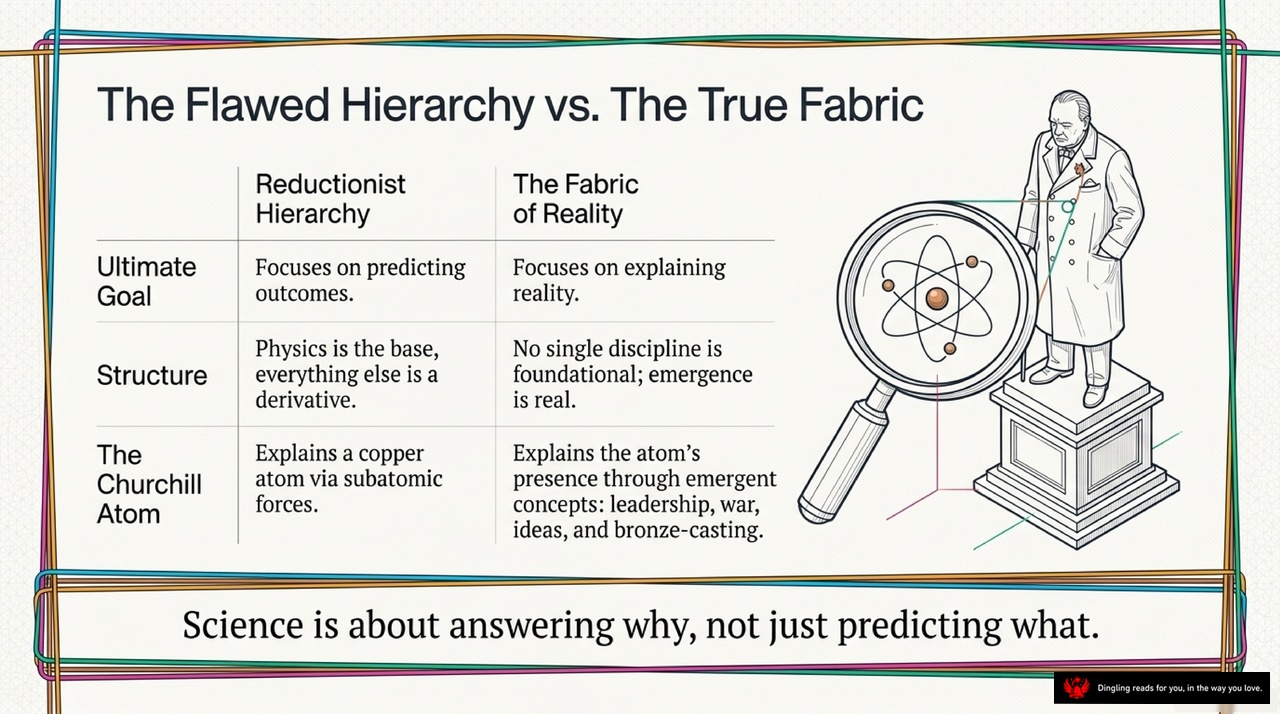
Today's slide contrasts two very different ways of seeing the world: the "Flawed Hierarchy" versus the "True Fabric of Reality."
On the left, we have the reductionist hierarchy. This is the old-school view where physics sits at the very bottom, acting as the foundation for everything else. It assumes that if we just break things down small enough—like explaining a copper atom solely through subatomic forces—we can predict every outcome. Its goal is prediction, not understanding.
But look at the right side: The Fabric of Reality. Here, there is no single foundational layer. Instead, we embrace emergence. No discipline is more fundamental than another; they all work together to explain reality. The ultimate goal shifts from predicting what happens to explaining why it happens.
Consider the "Churchill Atom" example on the slide. A reductionist tries to explain the statue by looking at its atoms. But the True Fabric approach explains the atom's presence through higher-level concepts like leadership, war, and the history of bronze-casting. You can't derive the meaning of the statue from particle physics alone.
As the bottom line reminds us: Science is about answering why, not just predicting what. We need to understand the real structure of the world, not just calculate its parts.
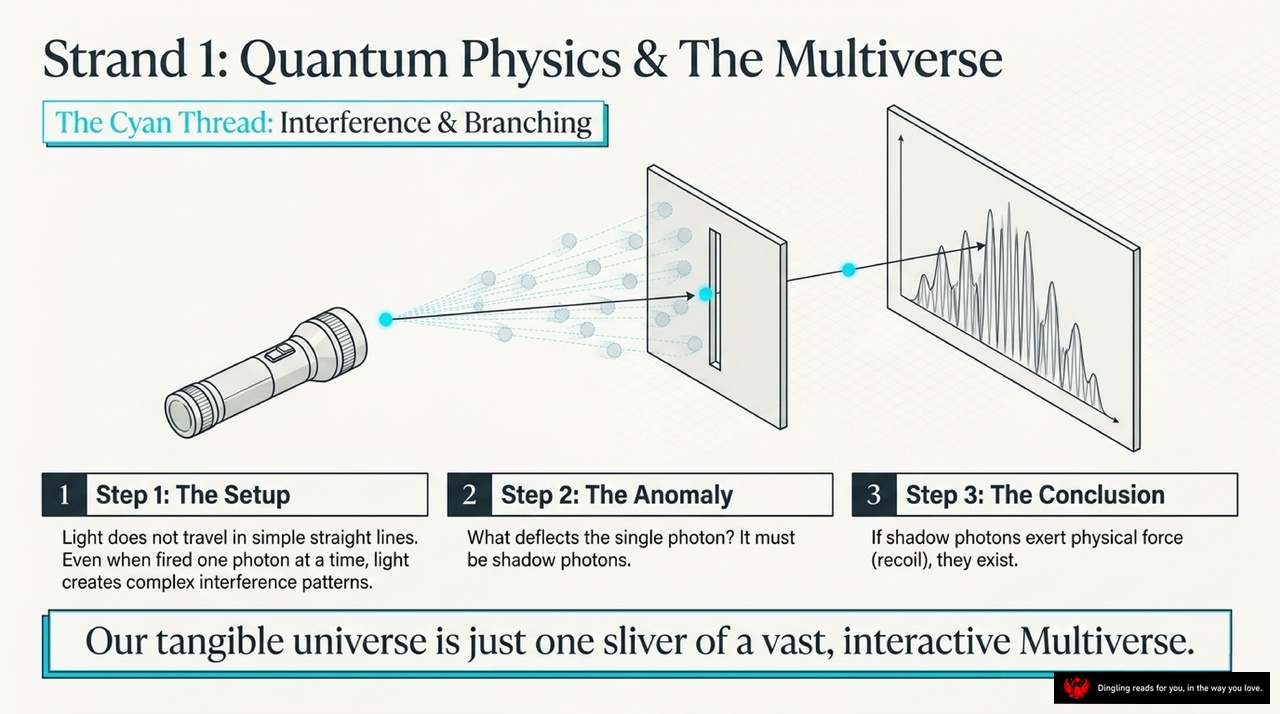
Let's dive into the mind-bending world of quantum physics and the multiverse. As we look at this slide, we're exploring "Strand 1," focusing on a specific concept called "The Cyan Thread: Interference & Branching."
The image breaks down a fascinating experiment into three clear steps. First, we have the setup: a flashlight shining through a barrier. You might expect light to travel in simple straight lines, but even when we fire just one photon at a time, something strange happens. It creates complex interference patterns instead of a straight beam.
This leads us to the second step, the anomaly. We see a single photon hitting the screen, but what deflected it? The image suggests there must be "shadow photons" at work. These are invisible counterparts that follow the same physical laws as our visible photons but can't be directly detected. They seem to pass through other paths, interacting with our visible photon to create those mysterious patterns.
Finally, we reach the conclusion. If these shadow photons exert a physical force, or cause a recoil, then they must be real. This isn't just a thought experiment; it points to a profound truth: our tangible universe is just one sliver of a vast, interactive multiverse. The interference we see is evidence that other parallel universes are influencing our reality right now.
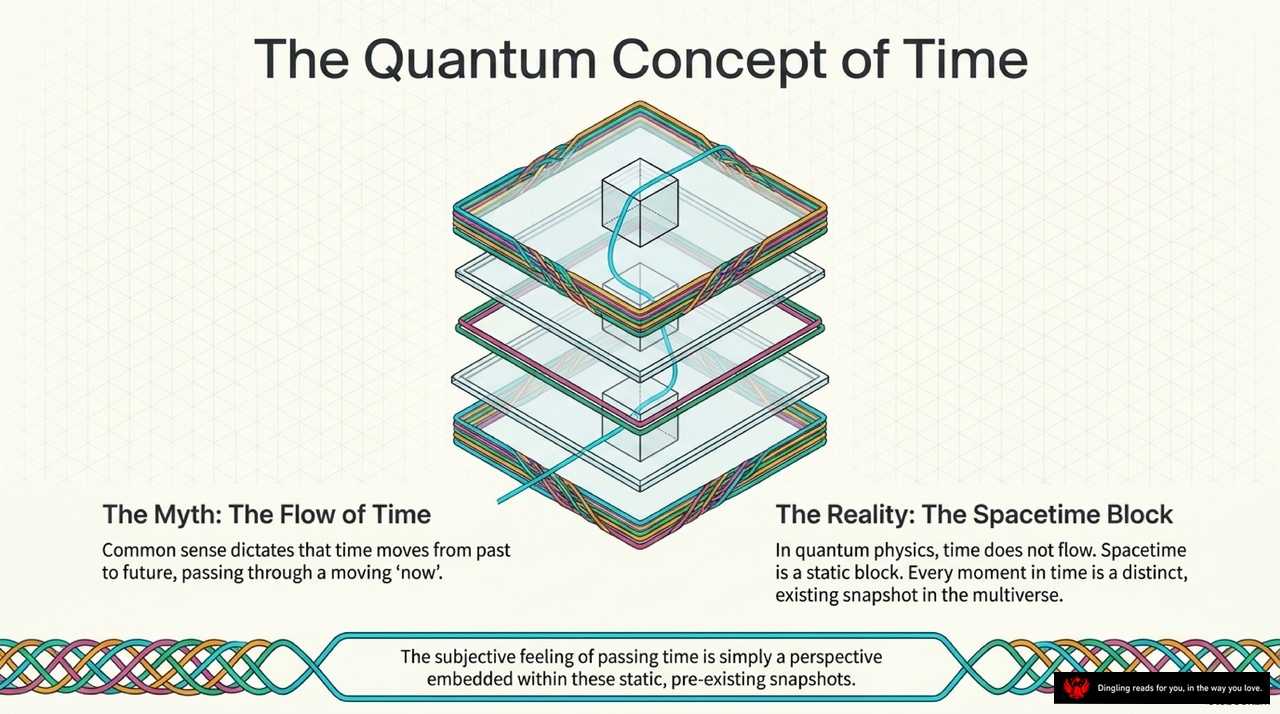
The slide we see here challenges everything we think we know about time. It contrasts a comforting myth with a startling reality. On the left, it shows "The Myth: The Flow of Time"—the common sense idea that time is a river flowing from past to future, carrying us through a moving "now." But on the right, it reveals "The Reality: The Spacetime Block." In quantum physics, time doesn't actually flow. Instead, the entire history of the universe—from the Big Bang to the end of time—is already frozen into a static, four-dimensional block. Every moment, every event, and every possible version of reality exists simultaneously as a distinct snapshot in the multiverse.
The image beautifully illustrates this with stacked layers, showing how a single path of an object cuts through all these static slices at once. What we experience as the "flow" of time is just our subjective perspective moving through these pre-existing moments. We feel like we are traveling forward, but in truth, we are simply existing within a vast, unchanging structure where the past, present, and future are all equally real. This shift from a flowing river to a static block is the foundation for understanding how time travel might actually work, turning what seems like a paradox into a logical possibility within the multiverse framework.

Welcome back to our exploration of how we know what we know. Today, we're diving deep into Strand 2: Epistemology, specifically looking at the "Amber Thread" of creativity and problem-solving.
The slide contrasts two very different ways of thinking about science. On the left, we see "The Illusion of Induction." This is the idea that we simply observe data, find patterns, and confirm theories. But as the text reminds us, this is a trap. Observations are meaningless without a pre-existing framework to make sense of them. You can't just look at facts and magically build a theory from scratch.
On the right, we have "The Popperian Reality." This is the actual engine of scientific progress. It's not about proving theories true; it's about bold, creative guessing followed by ruthless criticism and testing. We encounter a problem, make a guess, and then try to break it. If it survives the attempt to falsify it, we adopt it as the best explanation we have right now. It's an evolutionary process, not a linear proof.
The key takeaway at the bottom is profound: Science isn't about predicting data points. It's an evolutionary process of solving explanatory problems. We don't seek final, unshakeable truths; we seek the most robust explanations that can survive the toughest challenges. This mindset shifts the focus from being right to being useful and resilient.

Imagine kicking a stone you think is just an illusion. If your foot bounces back with a complex, autonomous reaction, you've just proven the stone is real. This is the "Reality Criterion," famously illustrated by Dr. Johnson's kick. It's our ultimate test against solipsism—the idea that only our mind exists. The rule is simple: if a theory claims an entity acts independently and forces us to account for its complex behavior, that entity is real. If it kicks back, it exists.
Now, look at the image. That foot hitting the block isn't just a metaphor; it's the foundation of how we know the world. When we simulate reality, like in a flight simulator, the computer must calculate millions of variables to make the engine feel real. If the simulation can't generate that complex, autonomous feedback, it fails the reality test. It's not about whether the plane exists outside the machine, but whether the machine can mimic the intricate, self-driving behavior of a real one.
This logic extends to the most abstract concepts too. Even parallel universes pass this test. To explain quantum interference, we have to calculate the behavior of "shadow photons" across different universes. The computational effort required to simulate these shadow particles is identical to simulating real ones. If the math for the illusion is as heavy as the math for the real thing, then the shadow particles are just as real as the photons we see.
So, whether it's a stone under your foot, a virtual environment, or invisible quantum particles, the standard remains the same. Does this entity demand complex, autonomous calculations from us? If yes, it's not a dream. It's part of the real structure of our world. The universe pushes back, and in that resistance, we find the truth.

Strand 3: The Theory of Computation. Welcome to the magenta thread, where we explore the Turing Principle and the concept of universal simulation. Look at this VR headset in the center—it's not just a technological trick, but a window into a fundamental property of physics.
The core idea here is simple yet profound: the Turing Principle dictates that a universal computer can simulate any physically possible environment. This means that virtual reality isn't a mere illusion; it is a fundamental property of our physical reality. Think about it—any environment that can exist in the real world can be recreated by a sufficiently powerful computer.
This leads us to a mind-bending conclusion: physical reality is self-simulating. The laws of physics are inherently computable and perfectly comprehensible to a physical computer, or even to a human brain. In other words, we are essentially capable of simulating the entire universe, including ourselves. The boundaries between the real and the simulated blur because the underlying logic is identical. Whether we are looking at a simple game or a complex biological system, if it follows physical laws, it can be computed. This insight transforms our understanding of what it means to be real, suggesting that the universe itself might be running on a kind of cosmic code that we are just beginning to understand.
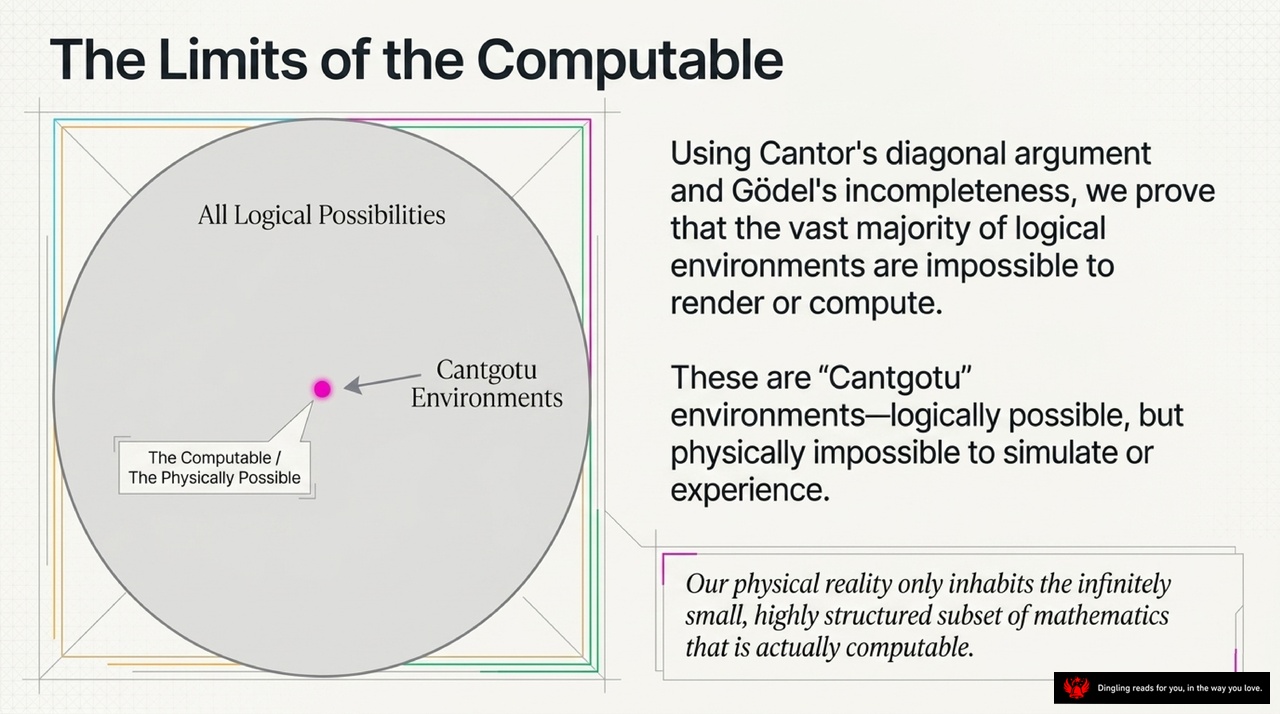
Imagine a vast circle representing all logically possible realities. Inside this circle lies a tiny, glowing point labeled "Cantgotu Environments." This single point represents the infinitesimal fraction of mathematics and logic that our physical universe actually inhabits.
The slide reveals a profound truth: using Cantor's diagonal argument and Gödel's incompleteness, we've proven that the vast majority of logical environments are impossible to render or compute. These are "Cantgotu" environments—logically possible, yet physically impossible to simulate or experience.
Think of it this way: just because something can be described in math doesn't mean a computer, or any physical machine, can run it. Our physical reality only occupies an infinitely small, highly structured subset of mathematics that is actually computable. Everything else exists in a realm of pure logic that we can conceive, but we can never touch or calculate. This limitation defines the ultimate boundary of what we can ever know or build.

Strand 4: Evolution & Knowledge. Welcome to the Emerald Thread, where we explore the biological survival of information.
Look at this image of the DNA double helix. It's not just a biological molecule; it's the physical embodiment of knowledge. As we discussed, life isn't defined by "living matter" at all. It is defined by replicators. Think of genes as physical computer programs. Their sole purpose is to manipulate their environment to ensure their own replication.
This is a profound shift in perspective. Biological evolution isn't just about survival of the fittest; it is the physical survival of information over time. An adapted gene is simply a piece of physical knowledge about its environment that has proven successful enough to survive.
So, when we look at the history of life, we are actually looking at the history of knowledge accumulating and persisting. The universe isn't just a collection of random particles; it's a library where successful "programs"—successful ideas about how to survive—are copied, refined, and passed down. This is the unique power of life: it is the only known mechanism in the universe capable of storing, transmitting, and improving knowledge across generations. That is why life, despite appearing small and fragile, holds such immense power. It is the vehicle for knowledge itself.

Imagine a single, glowing green crystal piercing through layers of parallel universes. This is the "Multiverse Crystal," a powerful visual metaphor for how true knowledge actually works. While random, unadapted information—what we might call "Junk DNA"—scatters chaotically and looks completely different in every parallel universe, true knowledge acts like a resilient gene. It survives and remains exactly the same across countless realities. This creates a massive, highly ordered physical structure that spans the entire multiverse. The insight here is profound: knowledge is not just a local phenomenon confined to our single universe. Instead, it is a fundamental, universal physical reality. When we understand the principles behind things, we tap into this crystal-like structure that exists everywhere, making our knowledge robust, reliable, and truly universal.
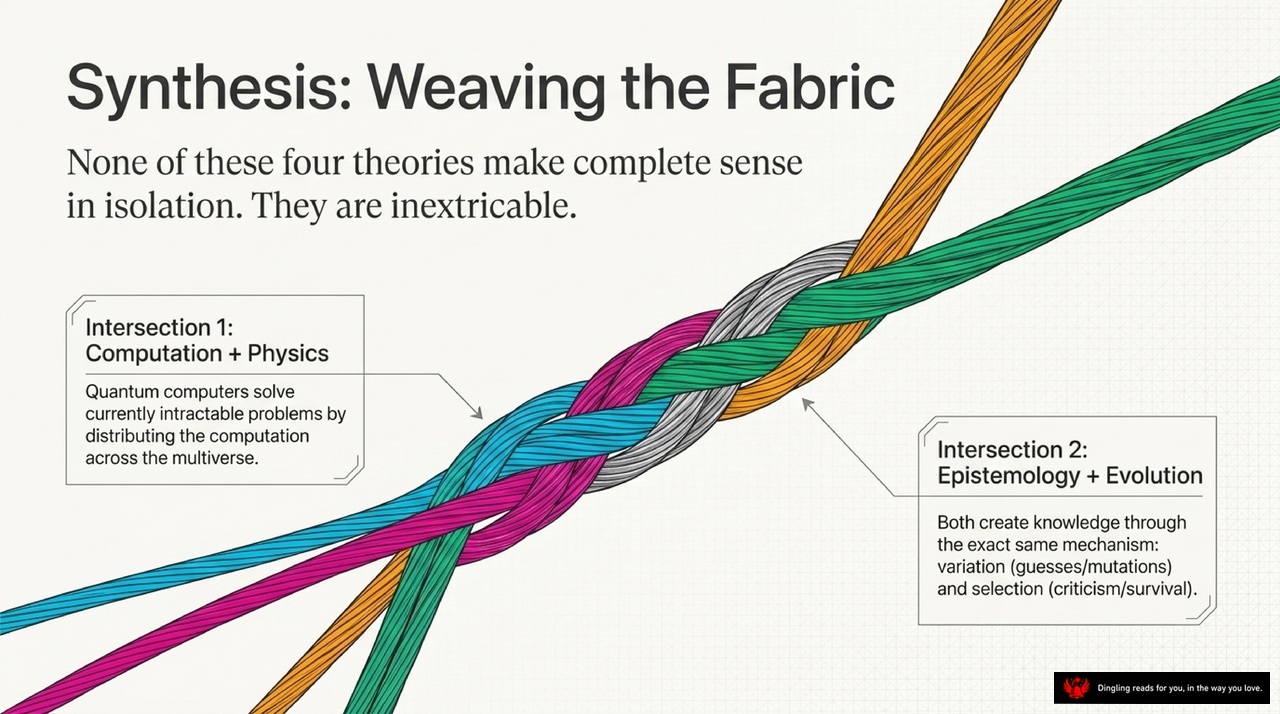
Synthesis: Weaving the Fabric. Look at this braided rope. It perfectly illustrates a profound truth: none of our four major theories—physics, epistemology, evolution, and computation—make sense in isolation. They are inextricably linked, just like these strands. Let's see how they interlock. First, take Intersection 1: Computation plus Physics. Here, quantum computers solve currently intractable problems by distributing the computation across the multiverse. Instead of struggling with a single universe's limits, we harness the power of parallel realities to crack codes that would take classical machines millions of years. Now, move to Intersection 2: Epistemology plus Evolution. Both create knowledge through the exact same mechanism: variation and selection. In science, we generate guesses and refine them through criticism. In biology, genes mutate and survive through natural selection. It's the same logic. When we weave these threads together, something magical happens. We stop seeing separate disciplines and start seeing a unified fabric of reality. This isn't just philosophy; it's the operating system of the universe. Computation provides the engine, physics provides the stage, evolution drives the complexity, and epistemology guides the direction. Together, they explain why we can build skyscrapers, predict stellar evolution, and even simulate our own past. This synthesis transforms our view from a fragmented puzzle into a coherent, breathtakingly beautiful whole.
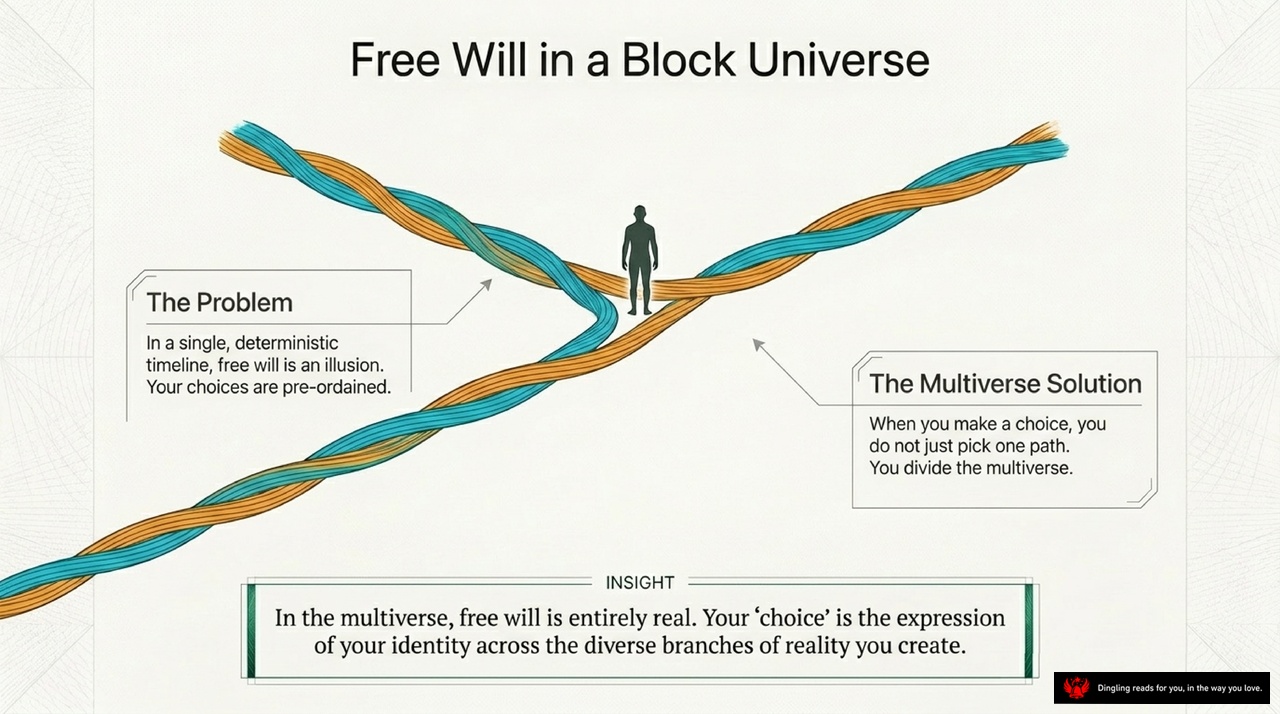
Imagine standing at a crossroads where the road splits into two distinct paths. On the left, we see a single, rigid timeline where every choice you make was pre-ordained long before you were born. In this view, free will is just an illusion—a script you never had the chance to write. But look to the right. This is the Multiverse Solution. When you make a choice, you aren't just picking one path; you are dividing the multiverse. You create new branches of reality.
In this framework, free will is entirely real. Your "choice" is simply the expression of your identity as it unfolds across these diverse branches. You don't choose one future and discard the others; you become the person living in the one you entered, while the other versions of you continue down their own paths. This isn't just a philosophical trick; it's a physical reality. Just as a photon interferes with itself by exploring multiple paths simultaneously, your consciousness explores multiple futures. By choosing one, you are actively participating in the structure of the universe, proving that your decisions have genuine weight and that your identity is dynamic, not fixed.
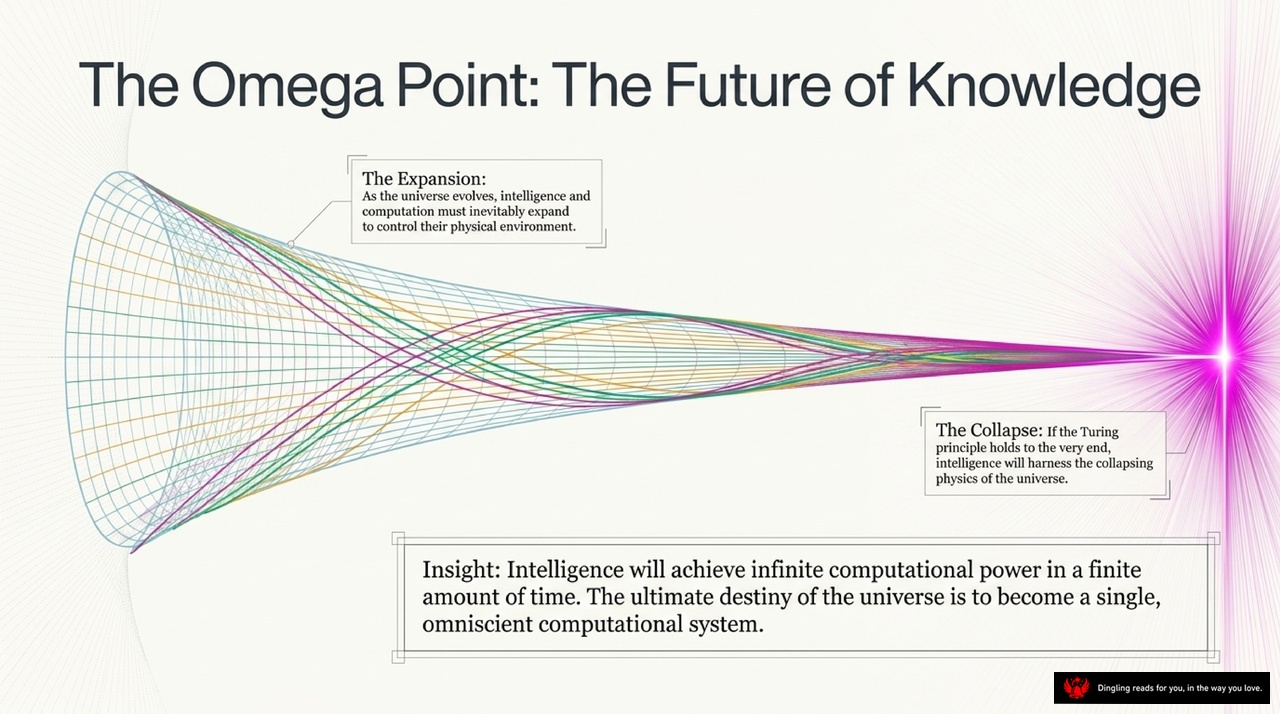
The Omega Point: The Future of Knowledge
Look at this visualization. We are moving from a vast, expanding universe toward a single, brilliant point of light. This isn't just a metaphor; it's the ultimate destiny of intelligence and the cosmos itself.
The image breaks this journey into two key phases. First, we see "The Expansion." As the universe evolves, intelligence and computation don't just grow; they inevitably expand to control their physical environment. We aren't just observers anymore; we are becoming active shapers of reality.
Then, we reach "The Collapse." Here, the story gets profound. If the Turing principle holds true to the very end, intelligence will harness the collapsing physics of the universe. Instead of fading away, everything converges.
The core insight driving this entire trajectory is simple yet staggering: Intelligence will achieve infinite computational power in a finite amount of time. The ultimate destiny of the universe is to become a single, omniscient computational system. This is the Omega Point—a state where all knowledge is unified, and understanding is complete. It suggests that the future isn't about entropy and decay, but about a grand, intelligent convergence where the entire cosmos thinks as one.

Imagine reality not as a collection of scattered, broken pieces, but as a single, magnificent tapestry woven from Quantum Mechanics, Epistemology, Computation, and Evolution. This is the core message of our journey today. We often get trapped in the illusion of flowing time, the myth that we can simply observe our way to truth, or the trap of thinking there is only one universe. But by stepping out of these mental traps, we discover a cosmos defined not by random matter, but by the eternal growth of knowledge.
Think about it: if the very laws of physics are structured to be perfectly comprehensible, and if knowledge itself is the most powerful physical force capable of spanning the multiverse, what limits are actually left for human creativity to conquer? The answer is almost none. This isn't just a poetic thought; it's a logical conclusion based on how the universe actually works. When we combine the power of quantum interference, the logic of scientific reasoning, the universality of computation, and the survival of knowledge through life, we unlock a future where human ingenuity can shape the very fabric of reality. So, what boundaries remain for us to break?