
The Five Dysfunctions of a Team: Complete Chapter-by-Chapter Summary
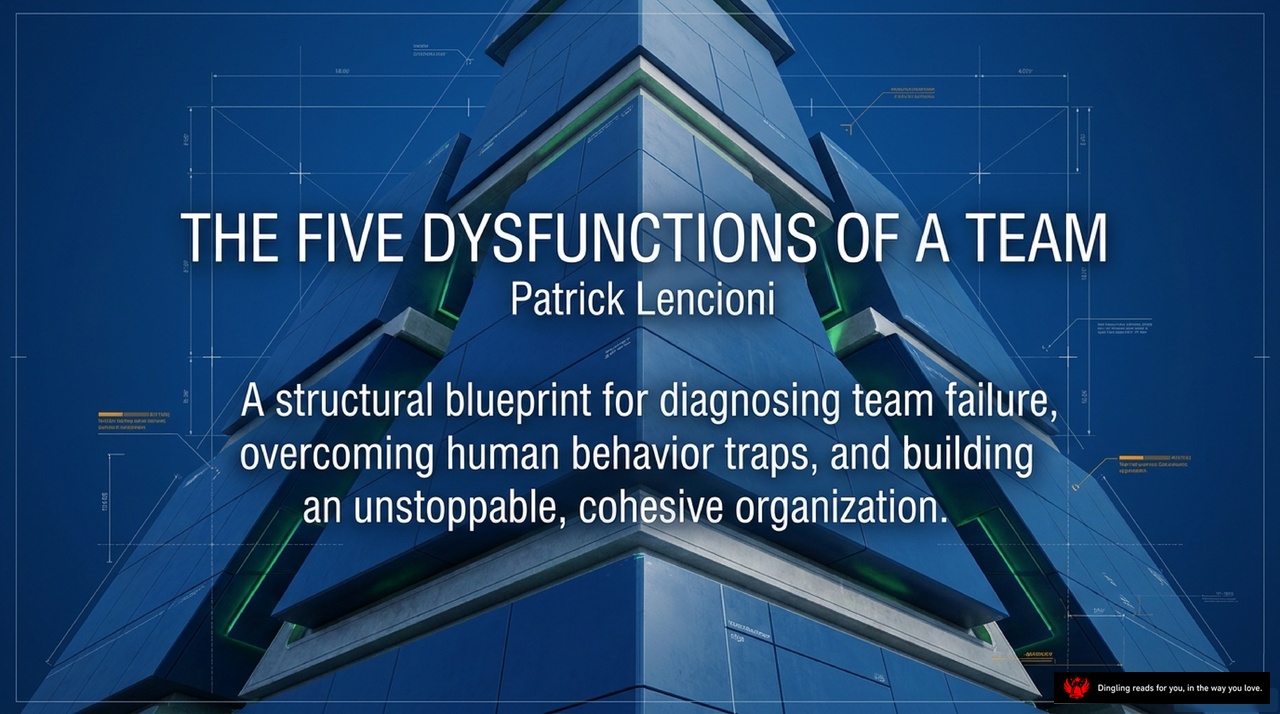
Welcome to the book club. Today, we're diving into a classic that changed how millions of leaders think about work: *The Five Dysfunctions of a Team* by Patrick Lencioni.
Imagine a high-flying startup in Silicon Valley, full of talent and money, that suddenly collapses into bureaucracy and chaos. That's the story of Decision Technologies. The culprit? Not bad strategy or lack of capital, but a fractured team.
The book offers a structural blueprint for diagnosing this exact kind of failure. It argues that team dysfunction isn't random; it follows a predictable pattern. When you look at the cover, you see the promise of an unstoppable organization. But Lencioni teaches us that you can't get there without first fixing the cracks.
He breaks it down into five specific dysfunctions that act like a chain reaction. First, there's a lack of trust. When people hide their weaknesses and fears, they become defensive. This leads to the second dysfunction: a fear of conflict. Instead of debating ideas, the team avoids the hard conversations needed to solve real problems. Without that debate, you get the third dysfunction: a lack of commitment. People agree just to keep the peace, but they don't truly buy in.
When people aren't committed, they start to avoid accountability. They won't call out mistakes or hold each other to standards. And finally, this leads to the fifth dysfunction: inattention to results. The team starts prioritizing personal or departmental goals over the collective good.
This isn't just theory; it's a survival guide. Whether you're leading a global corporation or a small department, understanding these five traps is the first step to building a cohesive, high-performing team. Let's see how one CEO learned to break this cycle and save her company.
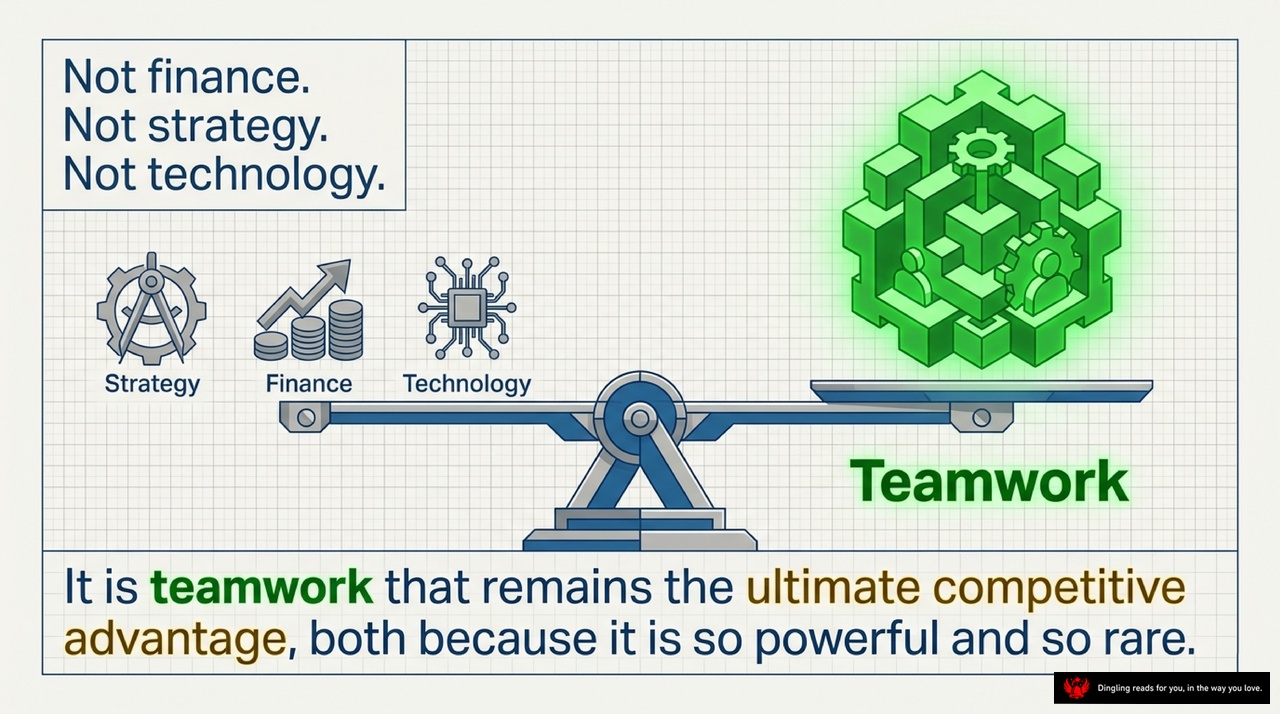
Look at this seesaw. On one side, you have Strategy, Finance, and Technology—the usual suspects companies obsess over. On the other side? Just one thing: Teamwork. And guess what? Teamwork is so heavy, it completely tips the scale. The slide makes it clear: it's not about your fancy business plan, your massive budget, or your cutting-edge tech. Those are just the tools. The real competitive advantage lies in how well your people work together.
In fact, the text tells us that teamwork remains the ultimate competitive advantage simply because it is both incredibly powerful and incredibly rare. Think about it: almost every company has a great strategy or a solid financial backing, but very few can actually build a team that trusts each other, fights healthy battles, and takes full responsibility. That's why, no matter how advanced your technology gets, if your team is fractured, you lose. If your team is united, you win. This is the single most important lever you can pull to transform your business.
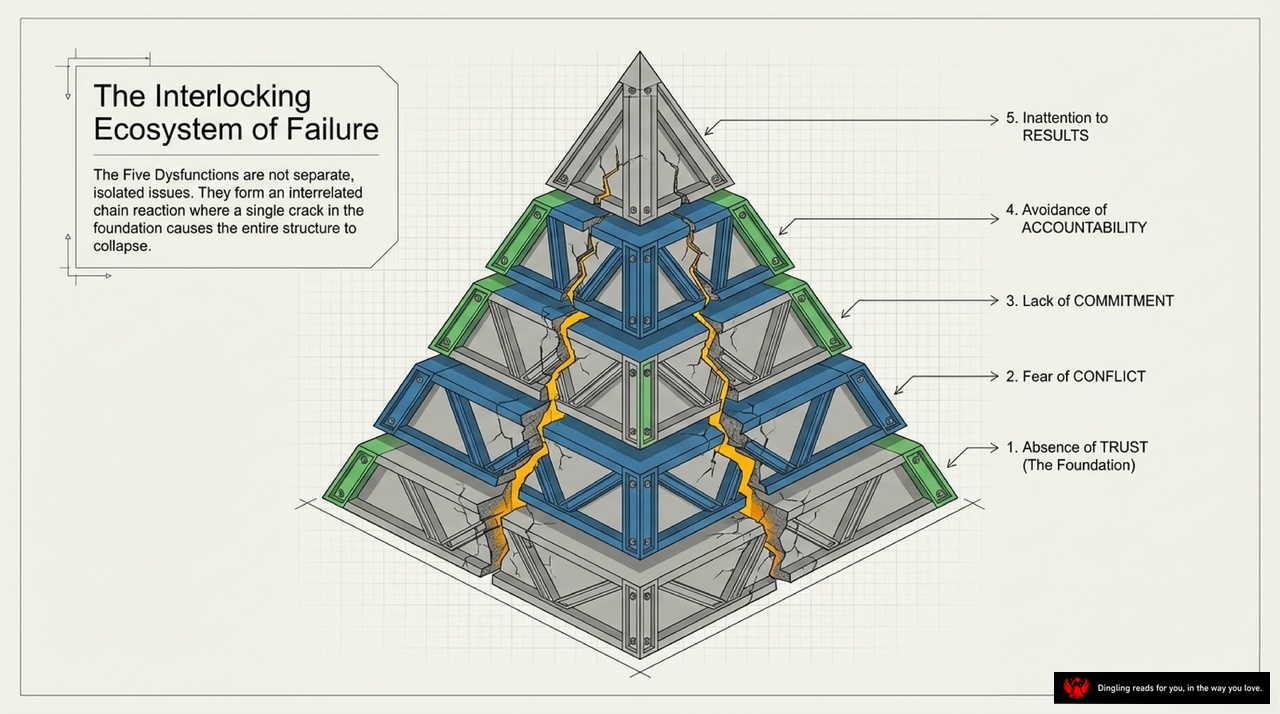
The pyramid you see here is the visual map of how high-performing teams actually collapse. It's not a random list of problems; it's a single, interlocking ecosystem of failure. Look at the base: it all starts with an absence of trust. Without that foundation, the entire structure is unstable.
When trust is missing, the next layer inevitably cracks. We start fearing conflict. Instead of debating ideas, we hide behind polite silence or passive-aggressive comments. We avoid the hard conversations that are actually necessary for growth. And when we stop arguing about the right path, we lose commitment. Everyone agrees on paper, but no one truly buys into the decision because they never felt heard or challenged.
That lack of commitment leads directly to the fourth layer: avoidance of accountability. When people aren't fully invested, they hesitate to call out each other's mistakes. They protect their own skin rather than protecting the team's results. And finally, at the very top, we end up with inattention to results. Everyone is busy doing their job, but no one is focused on the collective goal.
The cracks in this pyramid don't stay isolated. A single break in the foundation of trust causes the whole thing to collapse. That's why fixing one dysfunction isn't enough; you have to rebuild the entire structure from the ground up.
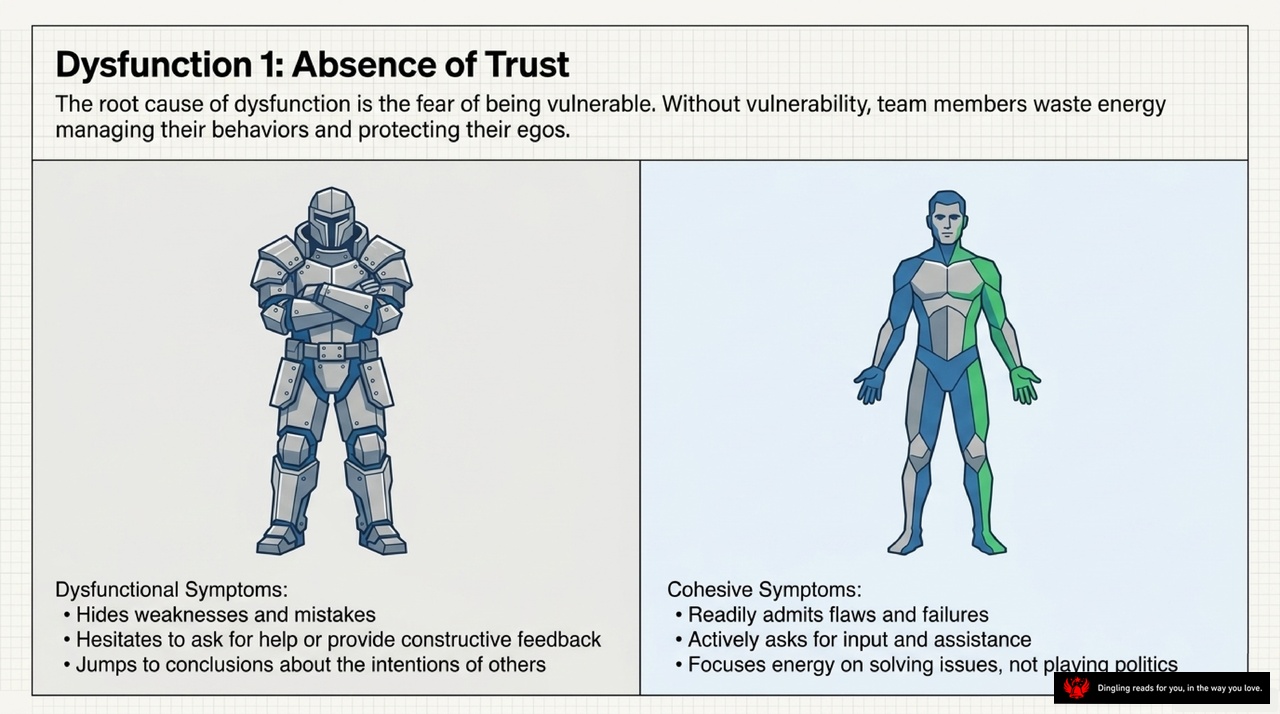
Dysfunction 1: Absence of Trust. Look at these two figures on the screen. On the left, we have a figure in heavy armor, arms crossed, completely closed off. On the right, we have a person standing open and vulnerable. This visual perfectly captures the core problem we are facing today: the root cause of dysfunction is the fear of being vulnerable. Without that vulnerability, team members waste all their energy managing their behaviors and protecting their fragile egos.
Let's look at the symptoms of this dysfunction. On the left, the dysfunctional team hides weaknesses and mistakes. They hesitate to ask for help or provide constructive feedback because it feels unsafe. They constantly jump to conclusions about the intentions of others, assuming the worst. Now, look at the cohesive team on the right. They readily admit flaws and failures without shame. They actively ask for input and assistance, knowing that asking is a sign of strength, not weakness. Most importantly, they focus their energy on solving issues, not playing office politics.
When we lack trust, we become like the armored figure on the left. We spend our days guarding our reputations instead of solving real problems. We assume everyone is out to get us, so we never take real risks or share our true ideas. But when we build that deep, vulnerable trust, we transform into the open figure on the right. We stop hiding and start collaborating. We stop playing games and start getting things done. This shift from defense to openness is the single most important step any team can take to become truly high-performing.

So, here's the reality check we need to have right now. Look at this curve. We've all been there: we crave that perfect, frictionless team where everyone agrees instantly. But that's the trap on the left side of this graph. That gray area is "Artificial Harmony." It looks safe, but it kills productivity because no one is actually solving the hard problems.
Then, you have the danger zone on the right. That's where things go wrong when conflict turns into "Personal Attacks." Suddenly, we're fighting each other instead of fighting the problem, and productivity crashes.
But look at the middle—the bright green peak. This is where high-performing teams live. This is "Constructive Ideological Debate." Here, we embrace conflict, but we keep it focused on ideas, not people. We argue passionately to find the best answer, and then we move on without any lingering resentment.
The lesson is clear: you don't need zero conflict to succeed. You need the right kind of conflict. If you're stuck in the valley of artificial peace, or you're sliding into toxic fighting, the only way up is to normalize healthy debate. Stop pretending everything is fine, and start debating the ideas until you find the winner. That's where the real results happen.

Look at this diagram. It perfectly captures the exact moment a team gets stuck. On the top path, we see "The Consensus Trap." When we seek absolute agreement, we end up in endless debate and delay, which leads straight to ambiguity and paralysis. That is the death of momentum. But the real breakthrough is on the bottom path: "The Commitment Path." Instead of forcing everyone to agree, we extract all opinions first, then we disagree and commit. This shift is what transforms a group of individuals into a high-performing team.
Remember the story of Decision Technologies? Under the old leadership, the team was trapped in that top loop. They debated endlessly, never decided, and ultimately failed. When Catherine Peterson took over, she made a radical choice. She refused to wait for consensus. She asked her team to share their honest opinions, even the controversial ones, and then she demanded they commit to a single direction. She told them, "We don't need everyone to agree; we need everyone to buy in."
This is the secret to true commitment. It requires clarity and buy-in, not consensus or absolute certainty. It's not about everyone naturally agreeing; it's about everyone being heard, understood, and then aligning fully behind a final decision. By moving from seeking agreement to seeking commitment, the team at Decision Technologies stopped spinning their wheels. They embraced the tension of disagreement as a tool for better decisions. Within months, they went from a paralyzed group to a laser-focused unit that outperformed their competitors. The lesson is simple: Stop trying to find people who agree with you. Instead, find the best ideas, hear them all, and then commit together to one path. That is how you turn dysfunction into execution.

Look at these two diagrams on the screen. On the left, we have "Top-Down Enforcement," where all the pressure flows from the leader down to the peers. It's a one-way street. On the right, we see "Peer-to-Peer Pressure," a web of connections where everyone holds everyone else accountable. This visual perfectly captures the core lesson of Dysfunction Number 4: Avoidance of Accountability.
The ultimate standard of accountability isn't the boss; it's your peers. The text here makes a crucial point: the discomfort of calling out a peer is exactly what makes it effective. When teams avoid that awkward moment, they inevitably lower their standards and accept mediocrity. This forces the leader to become the sole source of discipline, which is the fragile model shown on the left.
But look at the right side. In a healthy team, peers call out peers. They don't wait for the leader to fix things. If someone is slacking or making a mistake, their colleagues step in. This peer pressure creates a culture where mediocrity cannot survive. It shifts the burden from the leader to the team, creating a self-correcting system. As we've seen with the team in the book, when they finally embraced this peer-to-peer dynamic, the results changed. They stopped waiting for permission and started holding each other to the highest standard, proving that true accountability happens horizontally, not just vertically.
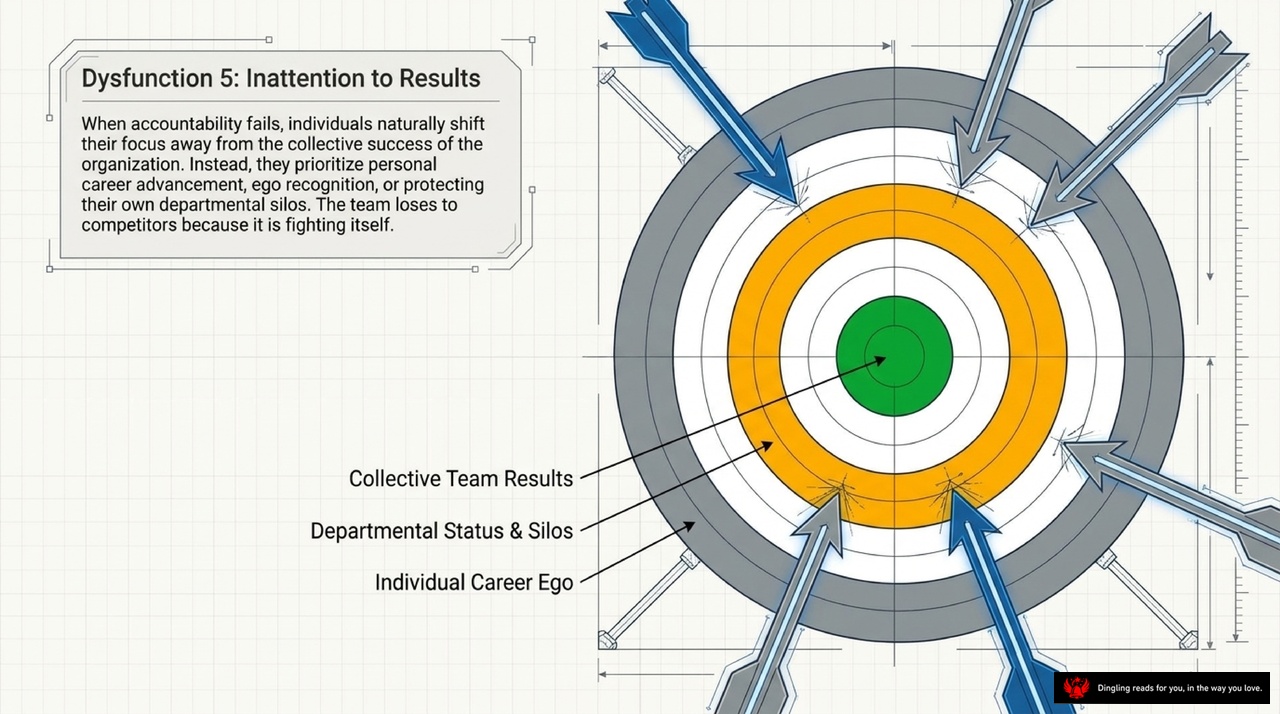
When accountability breaks down, the natural human instinct is to look inward. Instead of focusing on the organization's collective success, individuals start prioritizing their own career advancement, ego recognition, or simply protecting their departmental silos. This is what we call Dysfunction Number Five: Inattention to Results.
Look at this target. The green bullseye in the center represents the Collective Team Results. That is where the company should be aiming. But when accountability fails, arrows fly in the opposite direction. They get stuck in the outer rings, driven by Individual Career Ego and Departmental Status.
Imagine a team fighting itself from the inside out. They are so busy guarding their own turf and boosting their personal profiles that they lose sight of the bigger picture. The result? The team loses to its competitors not because it's weak, but because it's distracted. It's fighting itself. True success only happens when the team's collective goals take precedence over personal ambitions. If everyone is just looking out for number one, the entire ship sinks.

Look at this "Master Team Matrix." It's the blueprint for the difference between a group of individuals and a high-performing team. On the left, we have the five dimensions that define true teamwork: Trust, Conflict, Commitment, Accountability, and Results.
On the right, we see the stark contrast between a dysfunctional team and a cohesive one. Notice the first row, Trust. A dysfunctional team hides its weaknesses and dreads meetings, while a cohesive team asks for help and apologizes easily. It's about vulnerability over perfection.
Move down to Conflict. The bad team engages in back-channel politics and avoids tough topics. But a great team solves actual problems and attacks issues, not people. They debate fiercely to find the best solution.
Look at Commitment. In a broken team, decisions are ambiguous and everyone second-guesses. In a cohesive team, everyone aligns behind the decision and learns from mistakes swiftly.
Then, Accountability. The dysfunctional team resents high performers and relies entirely on the leader to discipline them. A cohesive team questions poor approaches and respects high standards without needing bureaucracy.
Finally, Results. The weak team stagnates, distracted by individual status. The strong team enjoys shared success and is willing to sacrifice for the collective good.
This matrix shows us that building a great team isn't about hiring the smartest people; it's about creating the right behaviors across these five dimensions.

Imagine a team not as a group of friends, but as a line of dominoes. In the classic story of Decision Tech, we see exactly how one flaw can trigger a deadly chain reaction that brings the whole organization crashing down.
The first domino to fall is **Invulnerability**. When leaders hide their weaknesses and refuse to be vulnerable, they prevent trust from ever building. Without that foundation, the next domino tips: **Artificial Harmony**. The team stops debating hard ideas just to keep the peace, leading to a false sense of security.
Because no one is willing to argue, the third domino falls: **Ambiguity**. Decisions become vague because people won't commit to plans they haven't passionately debated. When standards blur, accountability vanishes, causing the fourth domino to fall: **Low Standards**. Peers stop holding each other accountable because the goals themselves are unclear.
Finally, the chain reaction completes with the fifth domino: **Status and Ego**. When everyone is protecting their own career and reputation over the collective result, the team fails completely.
The lesson here is stark: you cannot fix the top without fixing the base. To save a failing team, you must first break the cycle of invulnerability and rebuild trust from the ground up.
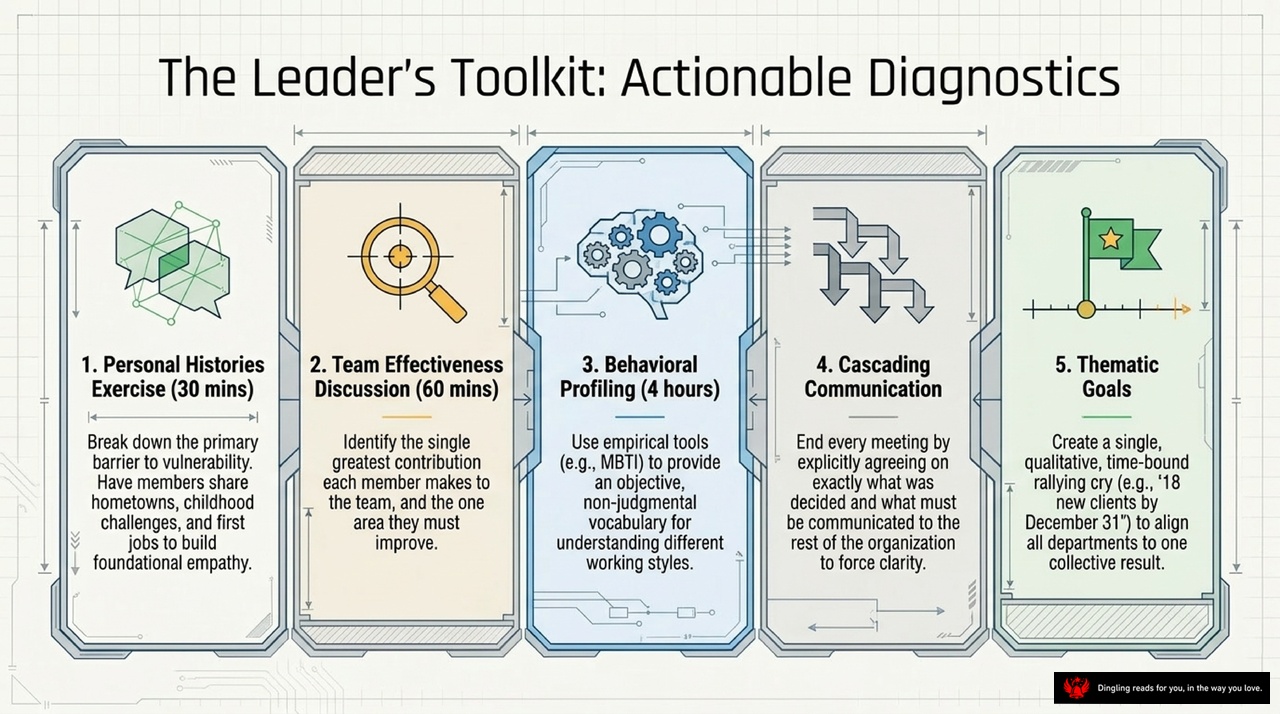
Welcome back to the toolkit. Today, we're moving from theory to action. How do we actually diagnose and fix a broken team? We don't just talk about trust; we build it. And we don't just hope for better communication; we engineer it.
Let's look at the five actionable diagnostics we've developed for leaders. First, start with **Personal Histories**. It sounds simple, but it's the fastest way to break down the primary barrier to vulnerability. By sharing hometowns, childhood challenges, or first jobs, you aren't just killing time; you're building foundational empathy. You're reminding everyone that behind the titles, they are just people with stories.
Next, tackle **Team Effectiveness** with a focused 60-minute discussion. Stop asking generic questions. Instead, identify the single greatest contribution each member makes and, crucially, the one specific area they must improve. This creates clarity and accountability without the sugar-coating.
For deeper insight, we recommend **Behavioral Profiling**. Use empirical tools like MBTI to provide an objective, non-judgmental vocabulary for understanding different working styles. When you can describe a behavior as a "style" rather than a "flaw," the defensiveness drops, and the learning begins.
Then, enforce **Cascading Communication**. This is non-negotiable. End every meeting by explicitly agreeing on exactly what was decided and what must be communicated to the rest of the organization. This forces clarity and ensures that everyone, from the boardroom to the front line, is pulling in the same direction.
Finally, align everyone around **Thematic Goals**. Create a single, qualitative, time-bound rallying cry—like "18 new clients by December 31st." This aligns all departments to one collective result, turning individual efforts into a unified force.
Remember, leadership isn't about having all the answers; it's about providing the right diagnostics and the tools for your team to succeed. Let's put these five steps into practice.

Look at this pyramid. It's not just a diagram; it's the leader's burden, and it's exactly what Catherine faced when she walked into that dysfunctional tech company. At the very base, Step 1 is Trust. The book tells us leaders must go first, risking their own face to show genuine vulnerability before they can demand it from anyone else. Catherine didn't just talk about this; she shared her own childhood stories and admitted her own weaknesses, breaking the ice for everyone else to do the same.
Once trust is established, you move up to Step 2: Conflict. This is where most leaders fail because they try to protect their team from discomfort. But Catherine knew that avoiding conflict was actually killing the team's progress. She actively "mined for conflict," encouraging fierce, honest debates about the company's future instead of settling for polite silence. She made it clear that without real disagreement, there is no real decision.
As the team climbs higher, Step 3 is Commitment. Here, the leader must force absolute clarity and push the team to decide even when the data is incomplete. Catherine stopped waiting for perfect information and drove the group to commit to specific goals, like acquiring 18 new clients, without hesitation. This commitment naturally leads to Step 4: Accountability. At this level, the leader becomes the ultimate arbiter of discipline. Catherine wasn't afraid to call out toxic behavior, like Mike's arrogance, and hold people responsible for their actions, ensuring that peer pressure became the primary enforcer.
Finally, at the top of the pyramid is Step 5: Results. This is where the leader sets the ultimate tone, rewarding only those behaviors that truly contribute to collective outcomes. By consistently guiding the team through these five stages—Trust, Conflict, Commitment, Accountability, and Results—Catherine transformed a broken organization into a high-performing machine. The lesson is clear: leadership isn't about avoiding the hard stuff at the bottom; it's about doing the work at every level to lift the whole team to the top.

Imagine your team as a high-tech vehicle, and right now, you're driving blindfolded. You might have the best engine, the sharpest drivers, and plenty of fuel, but if you don't know where your structural weaknesses are, you'll never reach your destination. That's exactly what we're going to look at today using a tool called the Diagnostic Radar.
This radar isn't just a chart; it's a mirror for your team's health. It plots five critical axes that determine whether your team is a cohesive unit or just a collection of individuals working in the same room.
First, look at the top point: Trust. This axis asks a simple but hard question: Do team members openly admit their mistakes and weaknesses? Without this raw honesty, nothing else can work.
Next, we move to Conflict. Notice the label here. We aren't talking about petty fighting. We're asking: Do team members passionately and unfilteredly debate critical issues? If your meetings are always polite and silent, you're actually failing on this axis. You need safe, intense debate to get to the truth.
Then, we have Commitment. This is about alignment. Do your meetings end with clear, unambiguous agreement on next steps? If everyone leaves the room thinking something different, you have a commitment problem.
Moving down to Accountability. This is the backbone of execution. Do peers consistently call each other out on behaviors that hurt the team? If you see someone slipping and no one says anything, your accountability axis is weak.
Finally, at the bottom, we have Results. This is the ultimate test. Are members willing to sacrifice departmental budget or personal glory for collective success? If every department hoards resources for itself, your team will fail, no matter how smart the individuals are.
The green star in the middle represents your team's current reality. Where it sits on these axes tells you exactly where your structural weakness lies. Use this radar not to judge, but to diagnose. Identify which axis is dragging you down, and that's where you need to focus your energy to build a truly high-performing team.
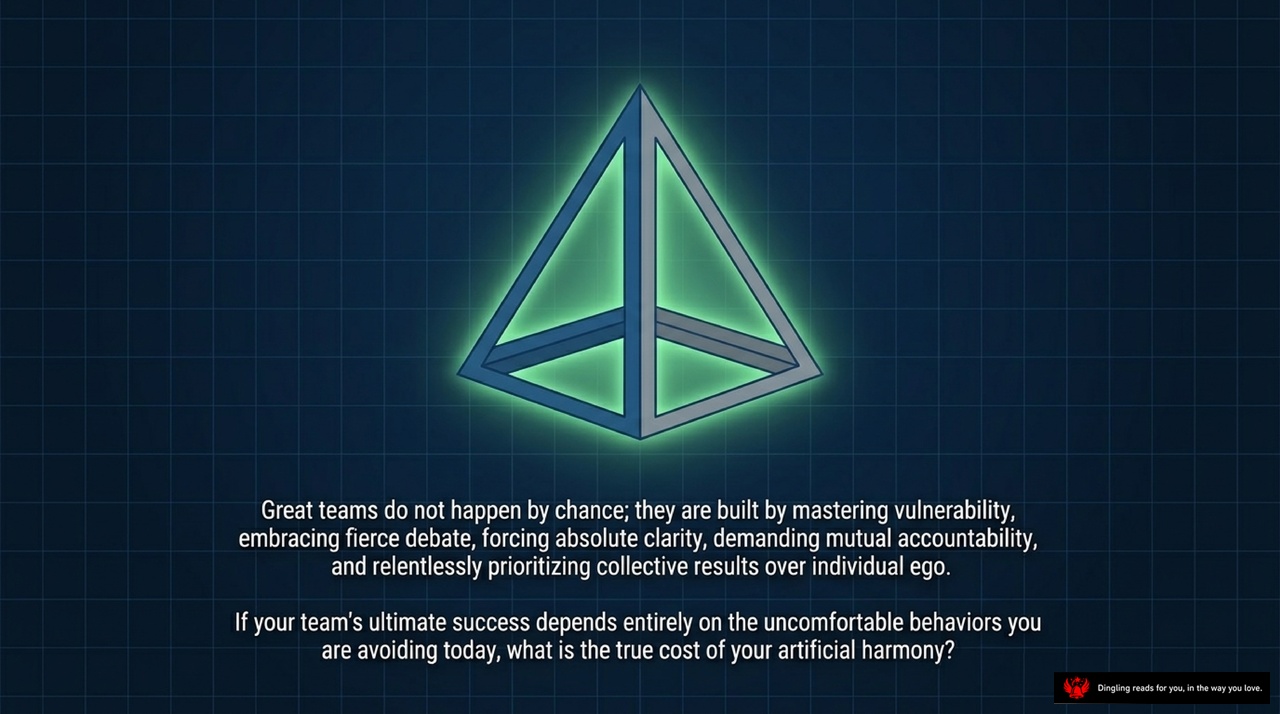
Look at this glowing, three-dimensional triangle on the screen. It's not just a geometric shape; it represents the core of what separates a great team from a good one. As we've seen through Catherine's journey, high-performing teams don't happen by accident. They are built by mastering vulnerability, embracing fierce debate, forcing absolute clarity, demanding mutual accountability, and relentlessly prioritizing collective results over individual ego.
Think about the cost of the alternative. If your team's ultimate success depends entirely on the uncomfortable behaviors you are avoiding today—like pretending to agree when you disagree, or staying silent to keep the peace—what is the true cost of your artificial harmony? The image reminds us that real progress often looks like a complex, multi-faceted structure. It requires the courage to be vulnerable, the discipline to argue constructively, and the commitment to put the team's win above everyone else's personal ego. That is the only way to build a team that can actually deliver.