
The Future of Management: Complete Chapter-by-Chapter Summary
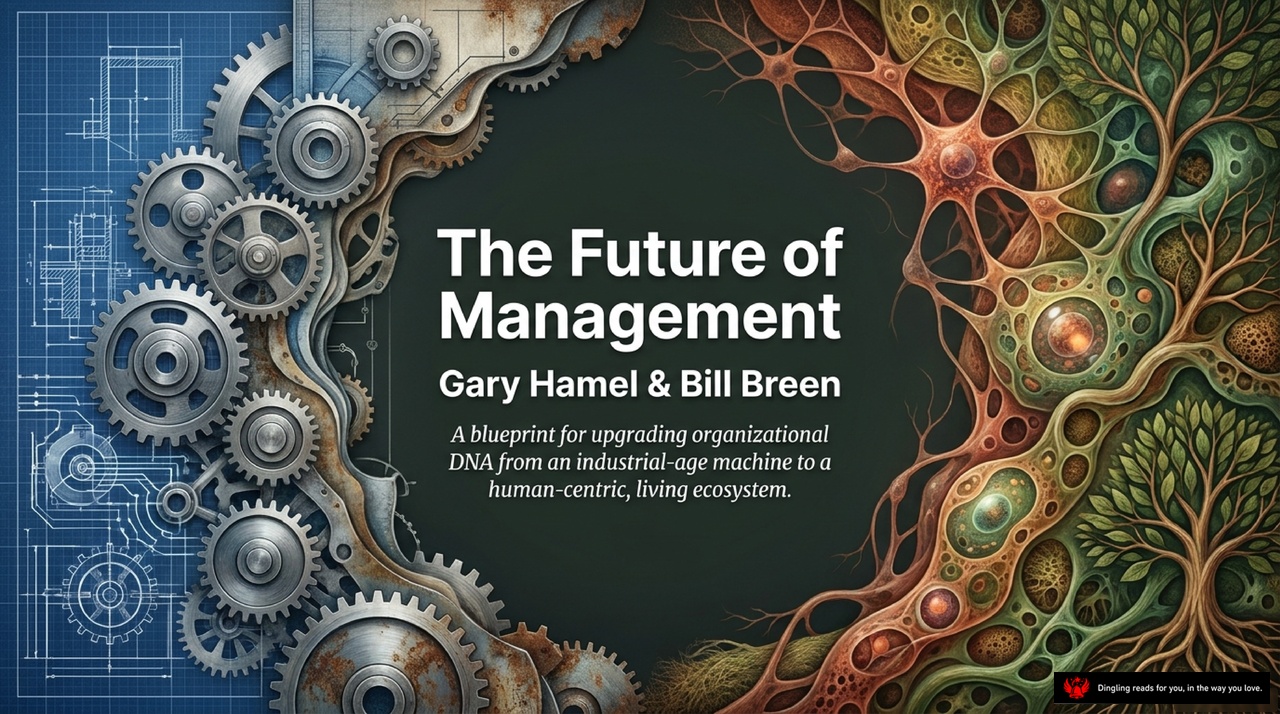
Welcome to *The Future of Management* by Gary Hamel and Bill Breen. On the left, you see the cold, rigid gears of the industrial age—the blueprints of the 19th century that still run our modern companies. On the right, there's something entirely different: a living, breathing ecosystem of neurons and trees. This book is the blueprint for making that shift. It argues that we must upgrade our organizational DNA from a machine built for efficiency into a human-centric, living ecosystem designed for adaptation. The future of management isn't about tightening the screws; it's about letting the organization evolve like nature itself.
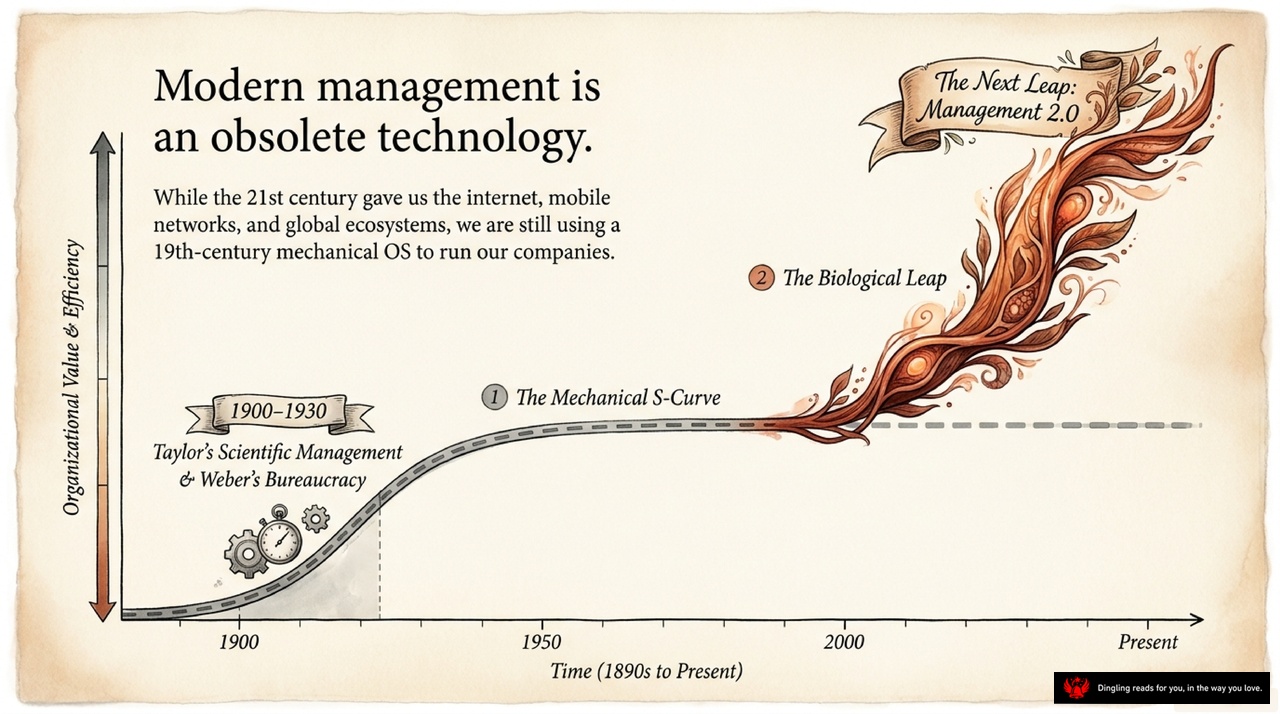
Modern management is an obsolete technology. While the 21st century gave us the internet, mobile networks, and global ecosystems, we are still using a 19th-century mechanical operating system to run our companies. This mismatch is the core problem.
Look at the curve on the left. From 1900 to 1930, we built the "Mechanical S-Curve." This era was defined by Taylor's Scientific Management and Weber's Bureaucracy. It was a time of gears, stopwatches, and strict hierarchies. It worked perfectly for the industrial age, helping us build cars and radios. But today, that curve has flattened. We have hit the ceiling of what this old model can achieve.
Fast forward to the right side of the image. We are now standing at the edge of "The Biological Leap." This is the next major evolution, leading us toward Management 2.0. Imagine an organization that doesn't run like a rigid machine, but like a living organism. In a biological system, every part adapts to its environment. It learns, it evolves, and it survives.
The text on the slide makes a bold claim: our current management tools are outdated. They focus on efficiency and control, but they kill creativity and slow us down in a fast-changing world. To survive the future, we need to break free from these 19th-century rules and build something new. We need to stop treating our companies like factories and start treating them like living ecosystems. This shift from the mechanical to the biological is the only way forward for the next leap in management.

Why GE, DuPont, and Toyota dominated their eras wasn't just because they invented cool new products. The real secret? They invented entirely new ways to manage. Look at this pyramid. It breaks down innovation into four distinct tiers, and the difference between a struggling company and a market leader often comes down to which layer they're actually operating on.
At the very bottom, we have Tier 1: Operational Innovation. This is about Lean, Six Sigma, and squeezing every drop of efficiency out of your current processes. It's great for cutting costs, but here's the catch: it's easily copied. Competitors can replicate your efficiency tricks overnight, so it offers only a short-lived advantage in a hyper-competitive market.
Moving up to Tier 2, you see Product Innovation. This is where you improve features, design, or user experience. It definitely drives sales and attracts customers, but without strong patents or a unique ecosystem, rivals can quickly mimic your breakthrough. The technology evolves so fast that any lead you gain today might be gone tomorrow.
Then we hit Tier 3: Strategic Innovation. This is where things get interesting. Companies like Southwest Airlines or Apple's iTunes model are changing the entire business game. They are redefining how value is created and captured. However, even this is increasingly fast to replicate. If your business model is exposed, smart competitors will find ways to deconstruct it or offer a cheaper alternative.
But here is the ultimate advantage, sitting at the very top: Tier 4, Management Innovation. This is what giants like General Electric, DuPont, and Toyota mastered. They didn't just tweak their products or strategies; they altered the fundamental DNA of how their work is orchestrated. They changed the rules of the game itself.
Think about it: operational fixes are easy to copy, product upgrades get outdated, and even new business models can be dissected. But when you innovate at the management level—by changing how people are empowered, how decisions are made, or how the organization thinks—you create a moat that is incredibly hard to cross. You change the culture, you shift the incentives, and you unlock a level of adaptability and creativity that your competitors simply cannot replicate. That is the source of enduring, unshakeable dominance.

Industrial management was built to extract obedience and diligence, treating the workforce like a machine. But in the creative economy, passion and initiative are the only drivers of outsized value—yet they are exactly what bureaucracies extinguish.
Look at this diagram. The bottom steps—Obedience, Diligence, Intellect—represent the commoditized legacy of Management 1.0. These are the tools of the industrial age, designed for predictability and control. They are efficient, but they are also static. They crush the very spark that fuels growth.
Above those rigid steps, we see the flow of true value: Initiative, Creativity, and Passion. This is the realm of Management 2.0. Here, organizations don't just follow orders; they innovate. They don't just execute; they create.
The arrow on the left, labeled "Value Creation," tells us the truth: the higher you climb from obedience to passion, the more value you generate. The old way keeps you trapped at the bottom, grinding out compliance. The new way liberates you to soar.
To survive in the 21st century, you must stop building ladders that only lead to obedience. You need to build platforms that allow passion to flow freely. That is the fundamental shift from a rigid hierarchy to a dynamic, differentiating force.
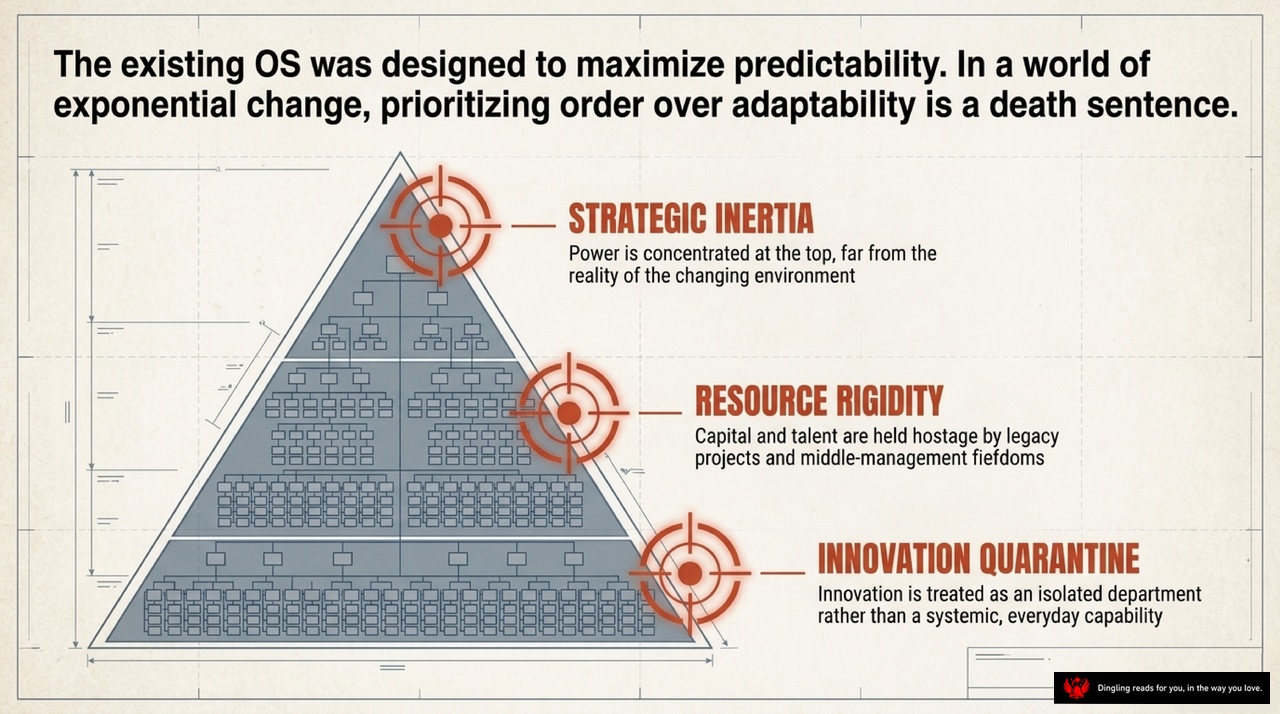
The existing operating system was built for a different era. It was designed to maximize predictability, relying on rigid hierarchies and top-down control to keep things running smoothly. But in a world of exponential change, prioritizing order over adaptability is a death sentence.
Look at this pyramid. It perfectly illustrates why our current systems are failing us. At the very top, we have **Strategic Inertia**. Power is concentrated far away from the reality of the changing environment, making it impossible for leadership to react quickly enough.
Moving down, we hit **Resource Rigidity**. Capital and talent are held hostage by legacy projects and middle-management fiefdoms. Instead of flowing to where they are needed most, resources get stuck in the past, funding old ideas while starving new ones.
And at the base, we find **Innovation Quarantine**. Innovation is treated as an isolated department rather than a systemic, everyday capability. The best ideas never get a chance to breathe because the structure itself is designed to filter them out.
This isn't just about inefficiency; it's about survival. When you prioritize stability over the ability to adapt, you aren't building a fortress; you're building a coffin. The companies that will thrive in the next decade aren't the ones with the most efficient processes. They are the ones brave enough to dismantle this pyramid and build something that can actually evolve.

The Outliers: These organizations broke the sacred rules of 20th-century management and built adaptive, billion-dollar ecosystems. Look at the transformation from Machine to Organism across three giants.
First, Whole Foods embraced Community over Bureaucracy. By radically decentralizing store autonomy, they turned a rigid machine into a living organism where local teams thrive.
Next, W.L. Gore chose Democracy over Hierarchy. With fluid lattice structures and no fixed bosses, they replaced command chains with peer-based leadership, creating a self-organizing network.
Finally, Google prioritized Evolution over Planning. Through evolutionary resource allocation and rapid mutation, they built an ecosystem that adapts faster than any competitor.
These companies prove that the future isn't about tighter control, but about unlocking human potential through trust, freedom, and shared purpose.
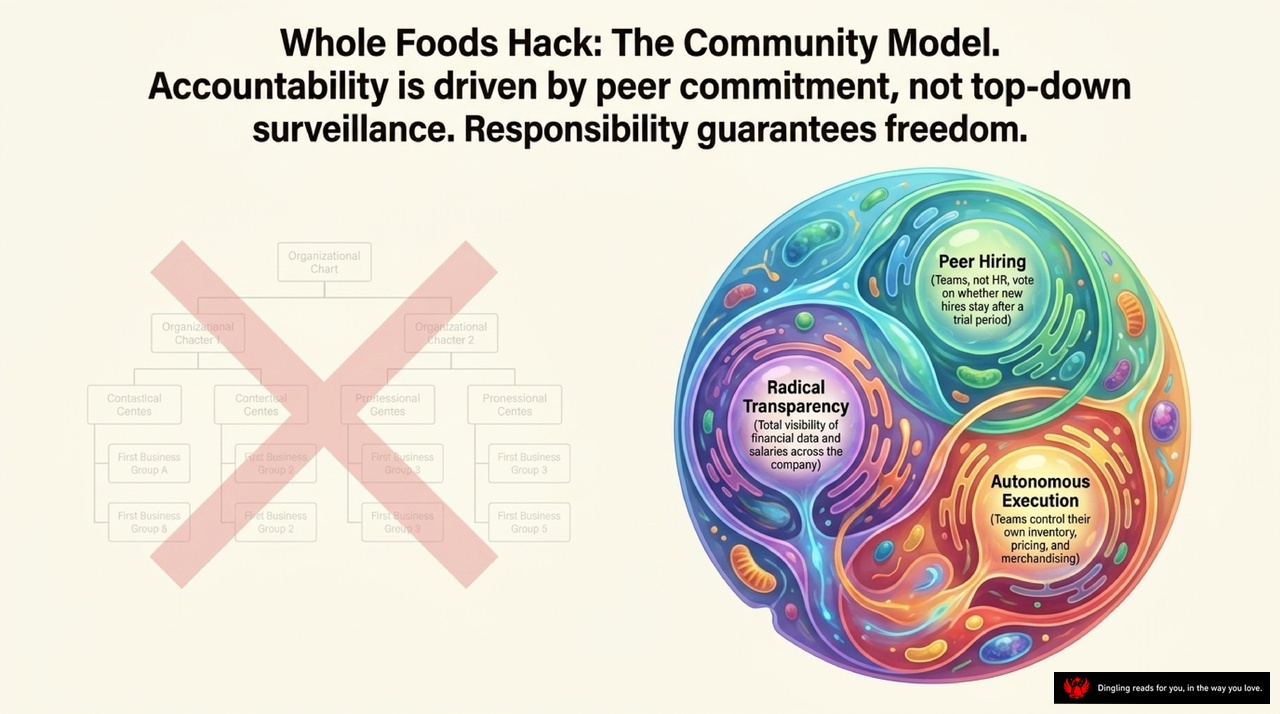
Look at this slide. On the left, we see the traditional organizational chart—a rigid, top-down pyramid that the text tells us is outdated, rooted in 19th-century thinking. The big red X over it isn't just a graphic; it's a statement that this old model is choking our potential.
But on the right, we see the "Whole Foods Hack." This is the Community Model, and it flips the script entirely. Notice the three key pillars here: Radical Transparency, Peer Hiring, and Autonomous Execution.
Think about what this actually means for us. Instead of waiting for HR to make hiring decisions, teams vote on who stays and who goes. No more top-down surveillance driving accountability. Instead, responsibility is driven by peer commitment. And look at that colorful, organic design—it's not a machine anymore; it's a living ecosystem.
The slide drives home a powerful message: "Responsibility guarantees freedom." When you give teams the power to control their own inventory, pricing, and even their own hiring, you aren't losing control. You're unlocking human potential. This model proves that you don't need a boss to get results; you just need a community of committed individuals who hold each other accountable. That is the future of work.
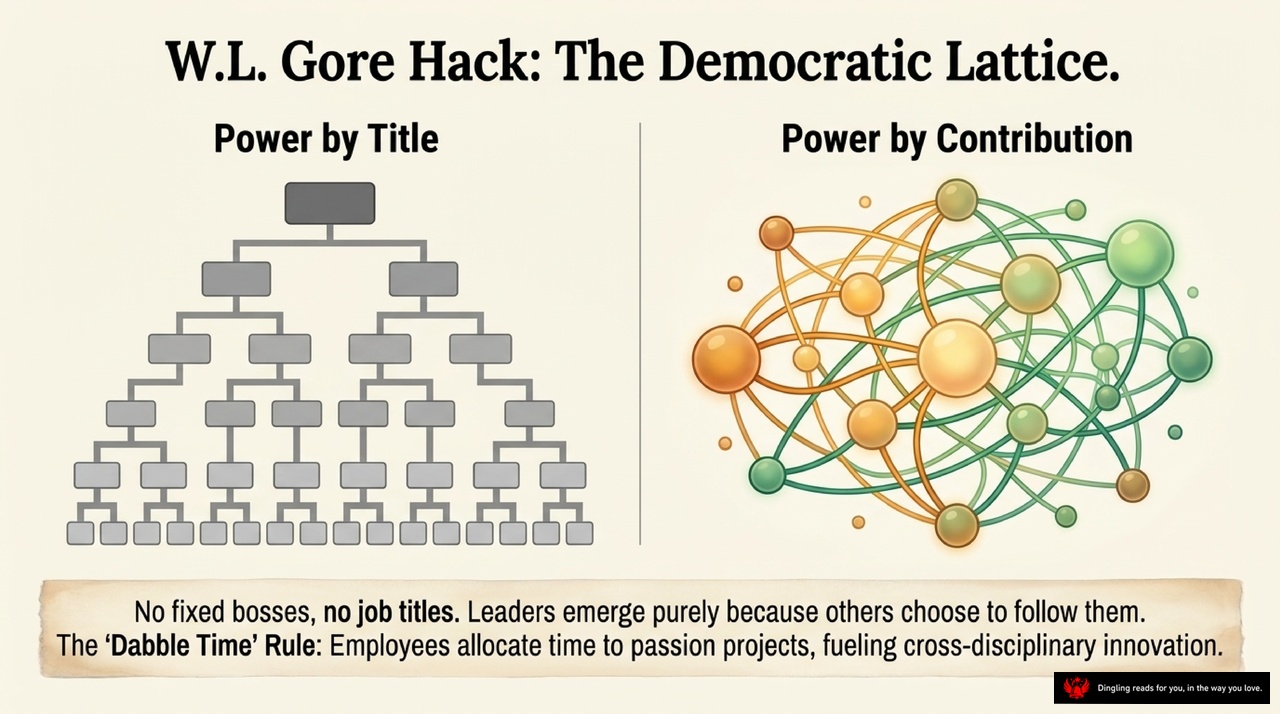
Imagine a world where power doesn't come from a job title carved in stone, but from the value you actually bring to the table. That's exactly what W.L. Gore is teaching us with their "Democratic Lattice." Look at the contrast here: on the left, we see the traditional pyramid, where power flows down based on rank. But on the right, Gore flips the script with a dynamic, interconnected web. Here, power is earned through contribution, not assigned by a boss.
In this system, there are no fixed bosses and no rigid job titles. Leaders emerge purely because others choose to follow them, inspired by their ideas and results rather than a hierarchy chart. It's a radical shift from "Power by Title" to "Power by Contribution."
But it's not just about who leads; it's about how everyone works. Gore enforces a unique "Dabble Time" rule, allowing employees to allocate a portion of their week to passion projects. This isn't just free time; it's the engine for cross-disciplinary innovation. By letting people explore their own interests, they fuel breakthroughs that a rigid command structure would never allow. This is the future of work: a self-organizing network where trust replaces control, and where everyone has the freedom to innovate.
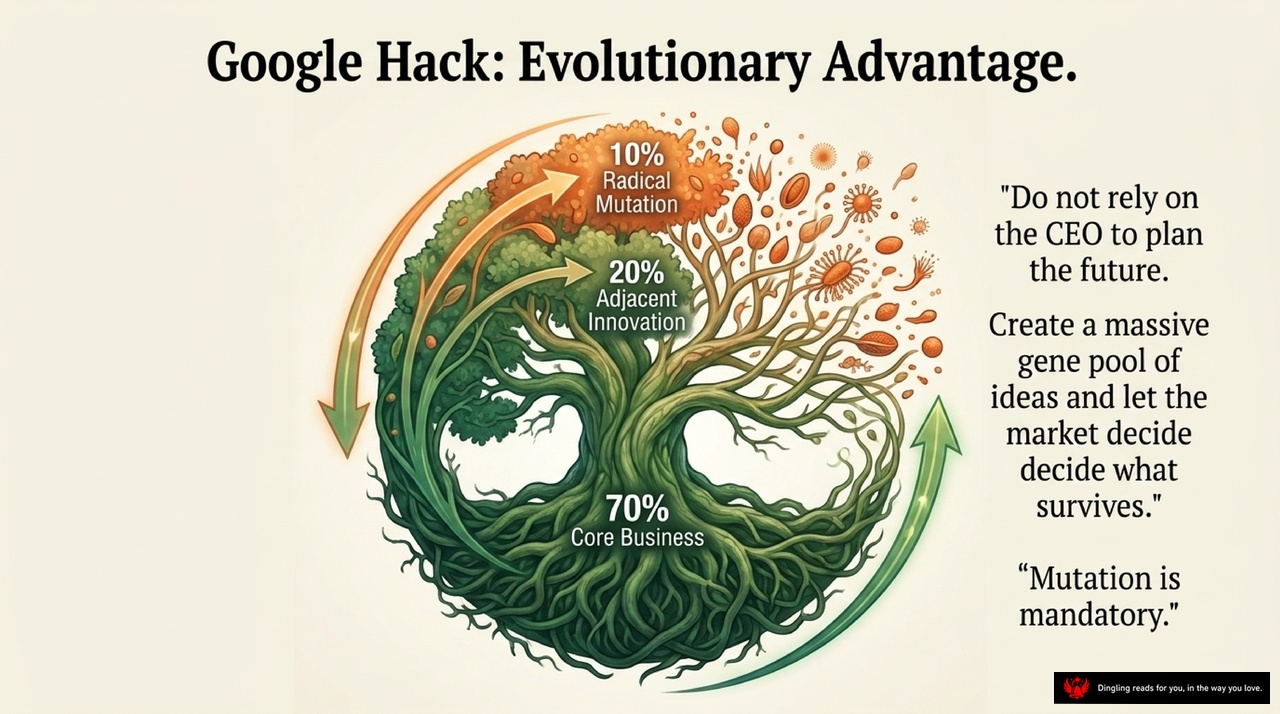
Google Hack: Evolutionary Advantage. Look at this tree—it's not just a picture; it's the DNA of a company that refuses to die.
The core of this slide is about shifting from a rigid machine to a living organism. You see the breakdown here: 70% Core Business, 20% Adjacent Innovation, and 10% Radical Mutation. Most companies try to be 100% core, but that's a trap. They get stuck in the "fitness landscape" peak where no new paths exist. To survive, you need that 10% of radical mutation. You can't rely on your CEO to plan the future; the market is too fast for that. Instead, create a massive gene pool of ideas and let the market decide what survives.
This is why "mutation is mandatory." If you don't allow for 10% of your resources to be wild, unproven experiments, you are inviting extinction. Think of it like nature: without mutation, there is no evolution. In business, without that risky, unstructured 10%, you lose your ability to adapt to the unknown. The goal isn't to eliminate the core, but to surround it with enough variation to ensure that when the environment changes, you already have the seeds for the next version of yourself. Don't just optimize the present; engineer the future.
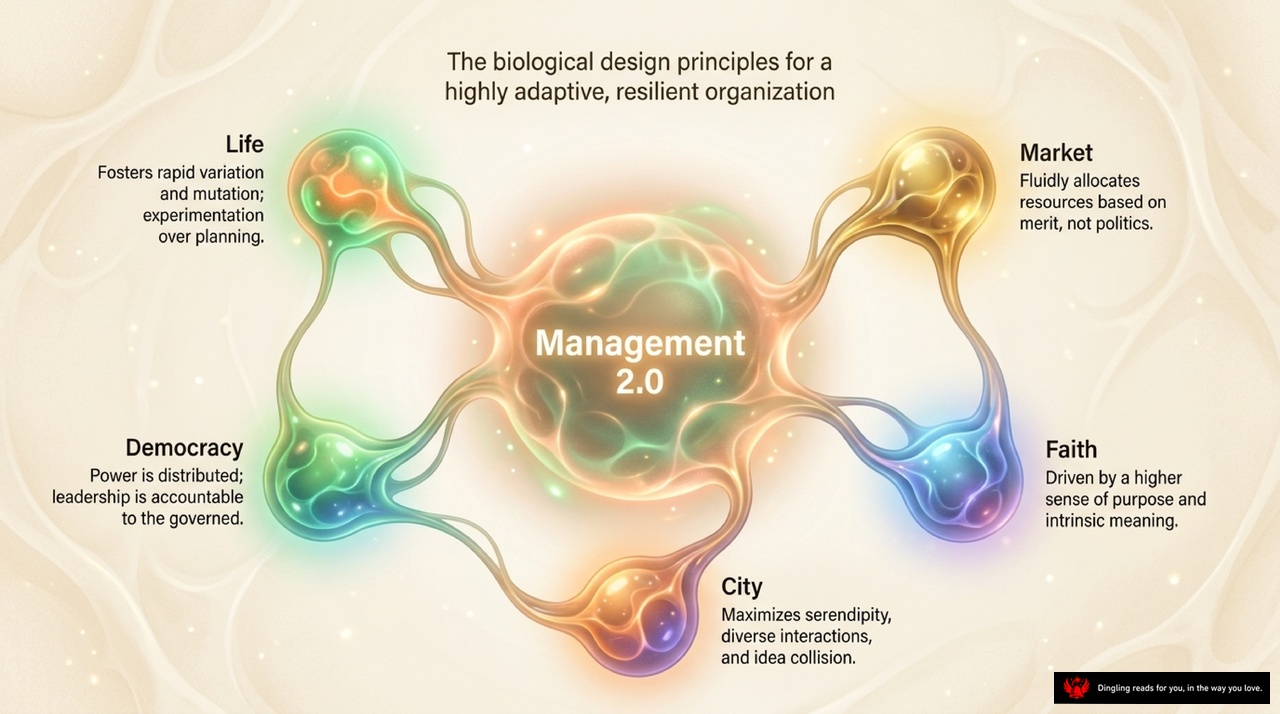
Look at this visual map of "Management 2.0." It's not just a diagram; it's a blueprint for the next generation of organizations. At the center, we see that the future of management isn't about control—it's about creating a highly adaptive, resilient system inspired by biology.
Let's break down these five critical pillars. First, **Life**. Just like nature, our organizations need to foster rapid variation and experimentation, prioritizing trial and error over rigid long-term planning. Second, **Market**. We need to allocate resources fluidly based on merit and performance, stripping away the political games that often slow things down. Third, **Democracy**. Power must be distributed; leadership needs to be accountable to the people it governs, not just the shareholders. Fourth, **Faith**. We have to drive our teams with a higher sense of purpose and intrinsic meaning, rather than just chasing quarterly numbers. And finally, **City**. We must maximize serendipity by encouraging diverse interactions and idea collisions, creating an environment where innovation happens organically.
This shift from a rigid machine to a living, breathing network is the only way to survive in today's volatile world. It's about moving from managing people to empowering them to evolve.

Look at this split screen. On the left, we have "The Old Way": a rusted funnel pouring raw resources into a small, isolated box where a few executives sit, producing a volatile, declining trend. On the right, "The New Way": a vibrant, glowing neural network where countless connections spark across the board, driving a steady, upward surge in growth.
This visual perfectly captures the lesson from Best Buy's transformation. For decades, companies operated like the funnel on the left—relying on the "isolated intelligence" of top-level managers to make decisions. It was a rigid, top-down approach that often missed the pulse of the market, leading to stagnation.
But Best Buy proved that a different path exists. By "hacking resource rigidity," they shifted to a crowd-sourced internal market. Instead of hoarding decisions at the top, they tapped into the collective wisdom of their entire workforce. The result? As the chart on the right shows, this networked approach doesn't just stabilize performance; it accelerates growth. When you replace a single funnel with a dynamic network, you unlock an engine for innovation that no single leader could ever build alone.
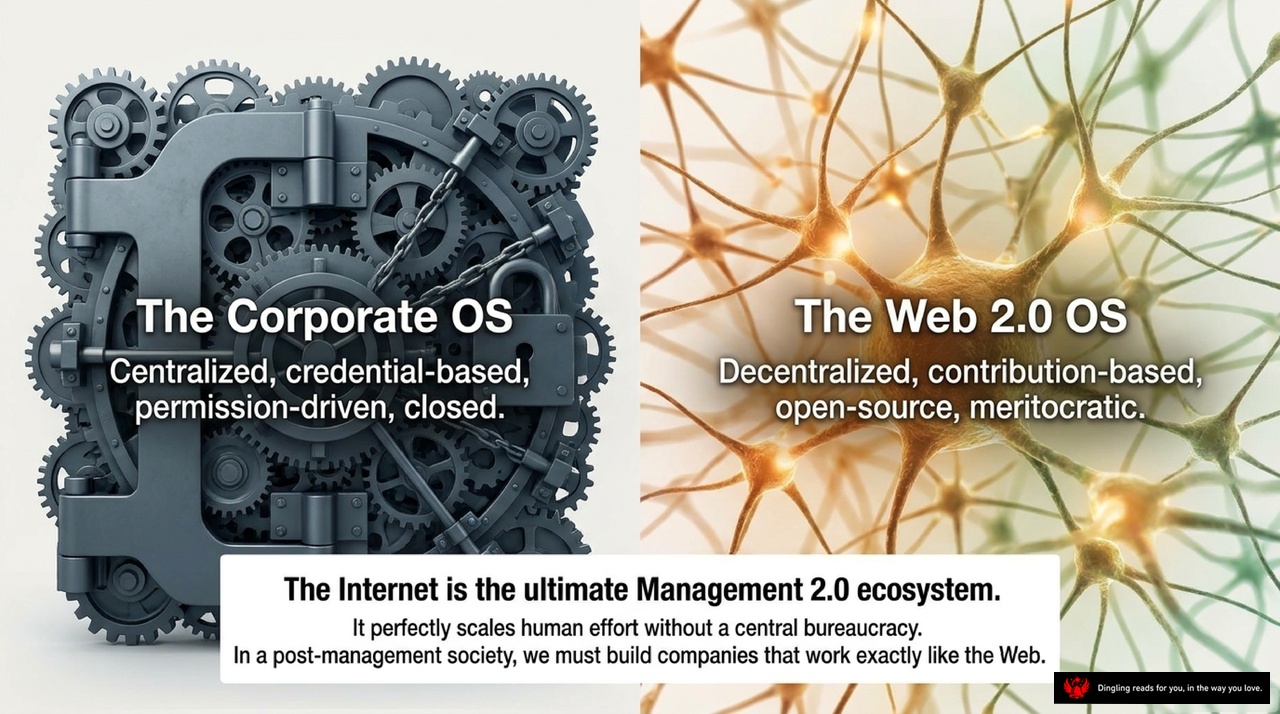
On the left, we see the "Corporate OS"—a complex, centralized machine built on credentials and rigid permissions. It's closed, locked down, and designed for an era that no longer exists. On the right stands the "Web 2.0 OS": decentralized, contribution-based, and meritocratic. It's open-source, powered by human connection rather than hierarchy.
The slide makes a bold claim: The Internet is the ultimate Management 2.0 ecosystem. It perfectly scales human effort without needing a central bureaucracy. This is the core insight we've been building toward.
Think about it. The old way of managing relied on control, top-down commands, and strict boundaries. It was efficient for factories, but it's a dead end for the modern world. It stifles creativity and slows down adaptation. In contrast, the Web 2.0 model mimics how nature and networks actually work. Instead of a single CEO pulling all the strings, we see a distributed system where value is created by everyone. Decisions emerge from the edges, not the center. Trust replaces control, and contribution replaces credentials.
In a post-management society, we must build companies that work exactly like the Web. We need to stop trying to force people into a machine and start building an ecosystem where individuals can thrive. The future belongs not to the most controlled organization, but to the most adaptable network. The shift from the Corporate OS to the Web 2.0 OS isn't just a technological upgrade; it's a fundamental evolution of how we organize human potential.

You do not need CEO permission to start. In fact, waiting for the top to approve every small idea is exactly what kills innovation. The smartest companies are launching low-risk, high-learning micro-experiments right now to prove the new rules before the whole organization is ready.
Look at this "System Hack" cycle. It's a four-step loop for breaking free from the old ways.
First, you must **Deconstruct Dogma**. You need to identify those toxic legacy rules that are holding you back. Ask yourself: "Why do we do it this way?" just because we've always done it this way is no longer a valid reason.
Next, **Launch Micro-Experiments**. Protect your new ideas from old metrics. Don't let the old scoreboard kill the new game. Run small tests that allow you to learn quickly without blowing up the budget or the culture.
Then, **Minimize Political Risk**. This is crucial. Use volunteers, make it iterative, and keep it under the radar. Don't announce a revolution before you have the proof. Let the data speak for itself so you don't get shot down by the old guard.
Finally, **Scale the Success**. Once your experiment proves the value, let the new operating system gradually rewrite the old DNA of your company.
This isn't about a massive, risky overhaul. It's about hacking the system from the inside out, one small win at a time.
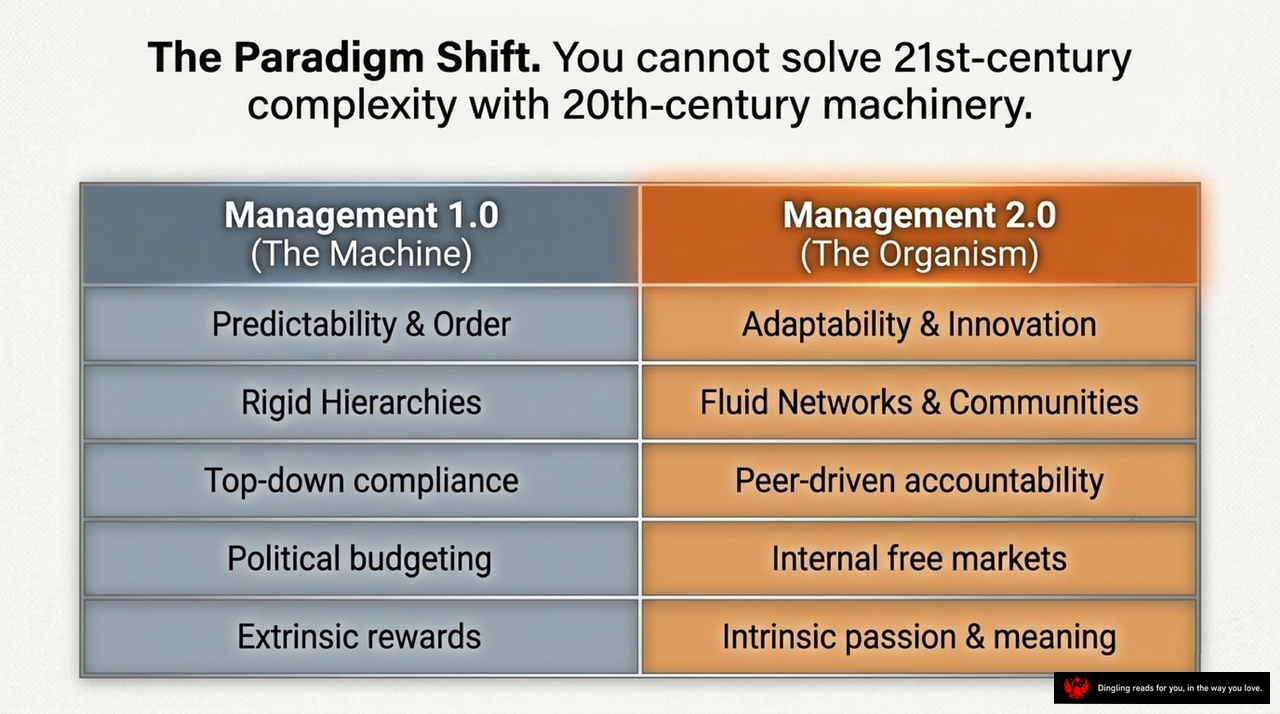
Look at this slide. It captures the fundamental shift we need to make: we simply cannot solve 21st-century complexity with 20th-century machinery.
On the left, we have Management 1.0, "The Machine." This is the legacy model built on predictability and order. It relies on rigid hierarchies and top-down compliance, where decisions flow from the top, budgets are political, and employees are motivated only by extrinsic rewards. It's efficient, yes, but it's brittle.
On the right, we see Management 2.0, "The Organism." This is the future. Instead of predictability, we need adaptability and innovation. We move from rigid hierarchies to fluid networks and communities. Accountability shifts from top-down to peer-driven. Budgeting becomes an internal free market, and most importantly, we tap into intrinsic passion and meaning rather than just paying people to show up.
The core message is clear: the industrial age's focus on control and standardization is no longer enough. To thrive in a volatile, uncertain world, organizations must evolve from being a machine that processes tasks into an organism that learns, adapts, and innovates from the inside out. It's time to stop managing like a factory and start leading like a living system.

For over a century, we've treated people like cogs in a giant industrial machine—trading their imagination for blind compliance. But today's slide asks a hard question: Are you building a company ready for the future, or just polishing a relic from the past?
The answer lies in shifting from bureaucracy to a living ecosystem. Tomorrow's ultimate competitive advantage won't belong to those who optimize the old rules, but to organizations that dismantle rigid hierarchies and build systems designed to unleash human passion.
Look at the neural network imagery here—it represents the potential of a connected, adaptive workforce. When you stop treating employees as programmable components and start designing an environment where they can think, create, and collaborate freely, you unlock a level of innovation that no competitor can replicate.
So, pause and reflect: Is your organization stuck in 20th-century logic, or is it evolving into a dynamic network where every individual contributes their unique spark? The future belongs to those who dare to build differently.