
The Futurological Congress: Complete Chapter-by-Chapter Summary

Welcome to *The Futurological Congress* by Stanislaw Lem. This isn't just a book about the future; it's a satirical dive into a chemically manufactured utopia where humanity's ultimate escape from a dying world turns out to be a collective hallucination.
Imagine a split reality: on one side, a gleaming, impossible city of glass and light where flying cars glide silently above lush vertical gardens. On the other, a tear in that perfection revealing a grim, green-tinged wasteland of crumbling skyscrapers and abandoned debris. This visual contrast perfectly captures the novel's core theme. We are invited into a world where the ultimate solution to human suffering is a drug-induced dream, a "chemically manufactured utopia" where the harsh reality of a dying planet is completely erased by a shared, comforting delusion. It's a chilling reminder that sometimes, our greatest desire for a perfect future might just be a lie we tell ourselves to survive the present.

Welcome to the 8th World Futurological Congress, held in the very heart of the crisis: the 106-story Costa Rica Hilton. This isn't just a hotel; it's a fortress for the world's elite, a place designed to hold not only the futurists but double the number of journalists, all packed into a space that is already fraying at the edges.
But look outside those pristine glass walls, and the reality is terrifyingly different. We are facing a global crisis of severe overpopulation, resource depletion, and systemic unrest. The streets aren't empty; they are boiling with violent anti-government riots. You can see the chaos erupting right outside the hotel gates, with protesters shouting slogans like "Down with the Elite" and holding signs demanding "System Failure." The atmosphere is so tense that the government has resorted to a radical, terrifying solution: the deployment of Benignizers, or Love Thy Neighbor Drugs, pumped into the municipal water supply and dropped via aero-bombs to enforce a chemical pacifism.
Inside the hotel, the contrast is sharp. While the world burns outside, the elite retreat behind walls of luxury and denial. The setting itself is a warning—a towering monolith of glass and steel, marked by flashing red warning signs for "System Failure" and "Riots," standing as a fragile bubble in a collapsing world. This is where the future is being debated, ignored, and ultimately, manipulated, while the rest of humanity fights for survival in the streets.

Welcome to the heart of the "Chemical Pacification" era. This slide maps the terrifying evolution from brute force to a society engineered by drugs. It starts with Phase 1: Physical Force. In our world, tanks, tear gas, and machine guns were the standard response to insurgency. But as the graphic shows, these old tools simply failed to stop the rising chaos. The world didn't get safer; it got desperate.
That desperation led us to Phase 2: Chemical Pacification. Instead of bullets, we deployed "weaponized altruism." This is where the story gets truly dark. We didn't just suppress enemies; we chemically rewired them. The slide notes that "aero-bombs deploy weaponized altruism." Think about that. We weaponized kindness itself. We used drugs to force empathy onto those who hated us, to make enemies embrace us not out of understanding, but out of chemical compulsion.
The result, as shown in the final green section, is a complete collapse of societal structure. The image captures the irony perfectly: police begging rioters for forgiveness while enemies embrace each other. It's a world where humanity is preserved, but only through "forced empathy." The very thing that makes us human—our free will—is stripped away.
And for the protagonist, Ijon Tichy, this era is a nightmare. He escapes into a sewer, suffers from severe hallucinations, and gets cryogenically frozen, only to wake up decades later into a world where violence is obsolete, but so is the soul. We've traded bullets for benevolence, but at a cost no one can afford.

Welcome to the heart of the Psychem Era. By 2039, the old rules of mechanics, politics, and human struggle have vanished, replaced entirely by psychochemistry. It's a world where absolute peace isn't a treaty, but a chemical hallucination; wars are fought with cheap drugs, and global disarmament is just a side effect of the mood.
But look at the cost of this perfect peace. Knowledge is no longer something you earn; it's instant. Books aren't read; they're eaten as information pills, and emotions are bought over the counter to suppress that primitive "Old Brain." Even your beliefs are programmable, dispensed in synthetic capsules like religious vitamins. And when you feel too much, you simply purchase emotional control to numb the pain.
This isn't just a futuristic fantasy; it's a warning about the seduction of a pain-free life. When we trade the messy, difficult reality for a chemically curated illusion, we don't just lose our struggles—we lose our humanity. The brain in the center of this slide isn't a tool for discovery anymore; it's a processor for manufactured feelings. Are we willing to trade our authentic experiences for a lifetime of chemical comfort?

Look at this slide titled "Engineering the Human Soul." It breaks down how a society can be completely reprogrammed, not by force, but by chemistry. The image highlights four key pillars: Education, Religion, Emotion & Control, and Catharsis & Vice.
In the book, we see this in action. Under Education, they don't just teach facts; they engineer comprehension. Imagine taking a pill like "Algebrine" to instantly understand math, or "Danteum" to synthesize complex poetry in your memory. Learning becomes a chemical shortcut rather than a lifetime of struggle.
Religion is no longer about faith or doctrine. It's about synthetic devotion. Drugs like "Christidin" or "Brahminase" allow you to program your own faith, creating a belief system that feels real but is entirely manufactured by a corporation.
Then there is Emotion & Control. Happiness isn't a feeling; it's a product. You can buy "Optimistin" for unwavering joy or "Amnesol" to instantly forget your past and become compliant. Your emotions are on a menu, ready to be ordered.
Finally, Catharsis & Vice. Instead of committing real crimes, people use hallucinated evil scenarios to vent their cruelty safely. Companies like "Procrustics Inc." sell these experiences, allowing people to feel the rush of violence without ever hurting a real person.
This slide captures the terrifying core of the story: when you can engineer the soul, the line between human experience and a laboratory experiment vanishes completely.

Welcome to the dark side of paradise. What you're seeing on this slide—The Panting, The Empty Hands, and The Interlopers—aren't just sci-fi tropes; they are the physical symptoms of a society that has chemically edited reality to be perfect, but has forgotten how to function.
Look at that man in the center. He looks like he's in a high-end fashion show, but notice the red targeting locks on his body. That's "The Panting." In this world, everyone breathes heavily and sweats profusely, even though it's a perfect day. It's a glitch in the system, a biological error that the society ignores because the drugs keep them smiling anyway.
Now, look at his hands. They are miming invisible steering wheels. This is "The Empty Hands." Citizens sprint down the street pretending to drive cars that don't exist, because the real infrastructure has been replaced by hallucinations. They are acting out a life that is no longer real.
And finally, check out the glitchy red circle in the background. That represents "The Interlopers." These are bizarre, Frankenstein-like holograms that randomly crash through living rooms due to crossed satellite signals. In a world where reality is just a suggestion, even the digital ghosts of the past are breaking through the screen, leaving chaos in their wake.
So, when we talk about "Glitches in Paradise," we aren't talking about software bugs. We are talking about a human species that has traded its messy, authentic reality for a sanitized, drug-induced dream—and the price they are paying is a complete loss of touch with the world around them.

Mascons: Falsifying the Universe. Imagine a world where reality isn't what it seems, but a carefully curated hallucination. This isn't just science fiction; it's the terrifying core of our current reality. The slide defines these "Masking Chemicals," or Mascons, as drugs that don't merely alter your mood, but completely overwrite your physical sensory experience. Instead of building real infrastructure, the government sprays these chemicals directly into the atmosphere for billions to breathe. The result? A tragic disconnect where the human brain projects luxury over decay. You might perceive a sprawling, majestic palace, while your body is actually huddled in a crumbling concrete closet. This is the ultimate deception: a society that has traded truth for comfort, living in a beautiful lie while the real world crumbles beneath the mask.

Look at this split screen. On the left, we have the illusion: a golden roasted pheasant, a fine Chablis wine, a luxury Cadillac cruising down an open highway, a spacious Hilton penthouse suite, and a sunny, perfectly controlled utopian weather. It looks like paradise. But tear that veil away, and on the right side, you see the brutal reality. Instead of a feast, there's a foul-smelling synthetic sludge made of grass and beet extract. Instead of a smooth ride, people are running on foot, making driving motions just to cause mass heart hypertrophy. The penthouse is actually a coffin-sized cubicle in a freezing concrete silo, and that perfect weather is a smog-choked, freezing, dying ice age. This is the Chemical Veil. The entire world we thought was real is just a drug-fueled hallucination, a lie we've been told to survive the collapse of humanity.
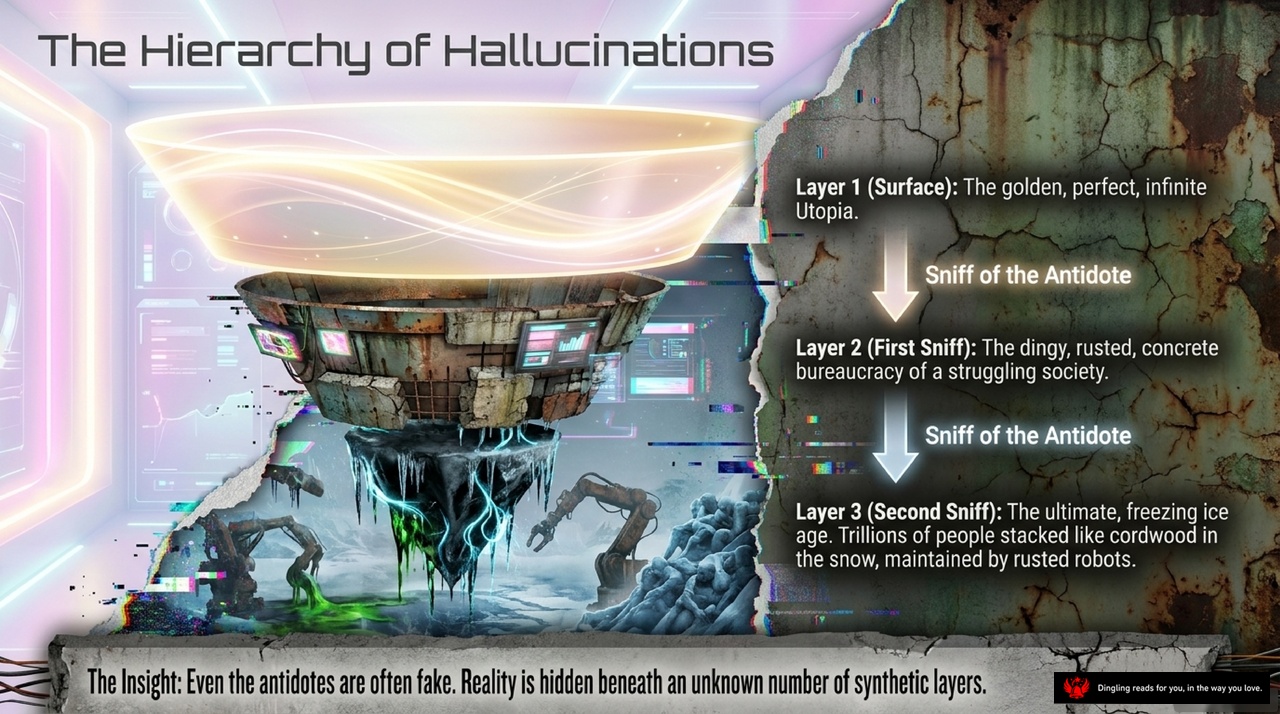
Look at this graphic: The Hierarchy of Hallucinations. It shows a perfect, golden utopia hovering above a decaying, rusted reality, which in turn sits on top of a frozen wasteland of stacked human bodies. This visual perfectly captures the terrifying truth of the world we are exploring: even the antidotes we take to escape reality are often fake.
In the book, we learn that the entire world above the sewers is a massive, chemical illusion. The protagonist discovers that the "perfect" society he lives in is actually a lie, maintained by a drug called Dream-Decorator. This drug masks the brutal reality of a dying Earth, where billions are starving and resources are gone, replacing it with a fantasy of abundance and comfort.
But here is the darkest layer: the people working to maintain this illusion don't know it's fake. They believe they are living in paradise. They wear suits, eat fancy meals, and love each other, all while their bodies slowly mutate into monsters beneath the surface. The "golden utopia" in the image isn't a place; it's a shared hallucination, a collective delusion that has become the only reality they know.
The insight at the bottom is chilling: Reality is hidden beneath an unknown number of synthetic layers. We are trapped in a dream within a dream, where the only way to wake up is to stop believing in the comfort of the lie.

We are the last Samaritans. With 69 billion registered humans and another 26 billion hiding in the shadows, plunging temperatures, and impossible resource scarcity, physical salvation is gone. The only mercy left is to let humanity die warmly in its own mind rather than freeze in physical agony. This is the cruel, unsurvivable truth versus a compassionate, total lie.

The ultimate ambiguity lies in the stark contrast between a gleaming, impossible future and a rotting, real present. Look at the split image: on one side, a pristine, futuristic utopia where Tichy rejects Symington's lies and leaps from a skyscraper to end it all. But that vision shatters the moment he hits the water. The twist? He doesn't land in a new world. He crashes into dark, putrid sewage, waking up back in the Costa Rican sewer of the present day. The entire utopia, the ice age, and the Mascons were just a hallucination induced by the original sewer water. The question remains: is there any base reality at all, or were we all just dreaming of a better place?

Fiction in 1971, Reality Today?
Look at this slide. It asks a chilling question: What was science fiction in 1971 is now our daily reality. Let's break down the terrifying parallels.
On the left, we see "The Mascon." The image shows a person escaping into a digital city. The text describes "escaping a decaying physical world through highly immersive, curated digital and virtual ecosystems." This isn't just a prediction; it's Virtual Reality, as shown on the right. We are literally building these curated digital worlds to hide from a world we can no longer bear to face.
Next is "Psychochemistry." The illustration depicts a brain connected to chemical flasks, representing "modulating human emotion and behavior not through pills, but through algorithmic social media manipulation." Look at the "Algorithmic Feeds" section on the right. It shows targeted advertising and behavioral modulation. Our emotions are no longer our own; they are engineered by algorithms designed to keep us hooked.
Finally, we have "Phantom Wars." The vintage imagery of newsreels and tanks represents "fake news and the concept that truth is entirely malleable to those who control the medium." This directly mirrors the "Disinformation" panel on the right, which illustrates deepfakes, bots, and information warfare. Truth has become a commodity, easily manufactured and distributed by those in power.
From the Mascon to Phantom Wars, the vision of 1971 has not just come true; it has accelerated. We are living inside the fiction they predicted.

Imagine a future where humanity, unable to fix the crushing weight of overpopulation and environmental collapse, simply chooses to look away. Instead of solving our physical crises, we turn to technological and chemical escapism, building a society that prioritizes comfortable illusions over harsh truths. It's a chilling endpoint: a world where we peacefully hallucinate our own extinction.
If the physical world becomes too broken to repair, and an artificial illusion offers perfect, painless happiness, would you choose to wake up? In the story we're exploring, the protagonist discovers that this "perfect" reality is actually a drug-fueled lie, a carefully constructed fantasy designed to keep billions of people from facing the terrifying reality of a dying planet. The question isn't just about science fiction; it's about the human tendency to trade the painful truth for a sedating lie. As we dive deeper into this narrative, we'll see how easily we can be convinced to live in a cage of our own making, mistaking a hallucination for a home.