



Lem warns that masking truth with comfort destroys our humanity and empathy.
Your Review
Lem warns that masking truth with comfort destroys our humanity and empathy.

Lem warns that choosing comfort over truth destroys our humanity and ability to face real crises.

A chilling satire showing how we trade real human struggles for artificial comfort, making the novel feel terrifyingly relevant to our current digital age.

The idea that we use digital and chemical tools to create perfect illusions feels incredibly scary because it shows how easily we can lose touch with reality just by choosing comfort over facing the messy, uncomfortable truth of our world.

Lem predicts our addiction to digital and chemical escapes perfectly.

Lem warns that hiding the truth destroys our ability to fix real problems like overpopulation and inequality, making our comfort a prison instead of a solution.

The novel reveals how a society can hide collapse behind chemical illusions, forcing us to question whether our modern pursuit of comfort through digital distractions and medication is actually just a collective hallucination that erases our ability to face the harsh truths of overpopulation, inequality, and environmental decay, ultimately suggesting that choosing artificial happiness over the messy reality of human struggle is a slow surrender of our humanity and agency to a system that prioritizes our numbness over our survival, making Lem's satirical vision feel terrifyingly relevant as we increasingly rely on curated feeds and quick fixes to avoid the discomfort of confronting the systemic problems that threaten our future.

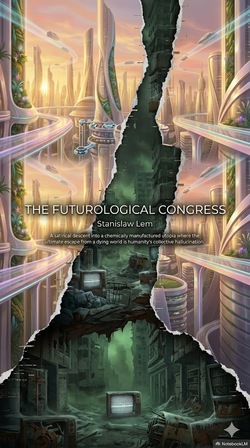
The idea of a society using drugs to hide the truth of overpopulation and collapse feels incredibly prescient for our modern digital age, where algorithms and social media often serve the same purpose of numbing us to real-world crises. Lem constructs a 'psychochemical utopia' where anxiety, grief, and even hunger are erased by pills, creating a bubble of artificial happiness that masks the planet's actual destruction. I found the protagonist Ijon Tichy's journey from a chaotic conference in 1971 to the suffocating, illusion-filled world of 2039 deeply unsettling because it mirrors how we often trade authentic, messy human experiences for quick fixes and curated realities. The most chilling part is when Tichy discovers that the entire world—including the luxury restaurants and clean cities—is actually a chemical projection hiding a starving, deformed population living in squalor. This revelation shatters the notion of a perfect solution, showing instead that the elite have chosen a collective hallucination to avoid the hard work of solving overpopulation and inequality. The book forces us to ask if our own reliance on distractions, from endless scrolling to pharmaceutical prescriptions, is just a smaller version of the 'Dream Decorator' that keeps society functioning by denying the truth. While the ending loops back to the beginning with Tichy laughing at the congress, it leaves a lingering doubt about whether we can ever truly wake up from our comfortable illusions, making this a profound critique of our tendency to sacrifice authenticity for the safety of a manufactured peace.

Lem warns us about choosing comfort over truth.

Lem exposes how our comfort addiction hides real crises until it becomes a prison for human truth.

This book perfectly captures how we trade messy, authentic human experiences for convenient, chemically induced happiness to avoid facing uncomfortable truths.
This book feels surprisingly relevant because our modern distractions act like the novel's drugs to help us ignore uncomfortable global problems.

This book feels too real for a story about pills hiding our pain.

Lem predicts our digital escape perfectly, a chilling mirror of today.

Lem exposes how our comfort is built on ignoring truth until the whole system collapses into madness.
This book is a terrifying mirror of our current world.

The concept of a society where everyone takes pills to feel happy instead of dealing with pain makes me question my own reliance on distractions.

Great read.

I found the ending ambiguous and unsettling, making me question what is truly real in my own life.

A chilling reminder that choosing comfort over truth slowly kills the very thing that makes us human.