
The Gardener and The Carpenter: Complete Chapter-by-Chapter Summary

Welcome to a new way of thinking about raising children. Today, we are stepping into a world where childhood is not a product to be shaped, but an ecosystem to be cultivated.
In the past, parents often tried to act like carpenters, meticulously molding their children into a specific shape based on a blueprint of what they thought was best. But science tells us this approach is flawed. Instead, we need to be gardeners. A gardener doesn't force a flower to grow in a specific direction; they simply provide the right soil, water, and sunlight, allowing nature to take its course.
This book, *The Gardener and the Carpenter* by Alison Gopnik, challenges the entire modern obsession with "parenting" as a set of techniques. It argues that your child's future is not determined by the specific methods you use, but by the environment you create. By offering a safe, stable, and loving space, you allow your child to explore, make mistakes, and discover their own unique path.
So, put down the instruction manual. Stop trying to engineer your child's personality. Instead, focus on the relationship, trust them to learn on their own, and enjoy the wild, unpredictable journey of growing up together.
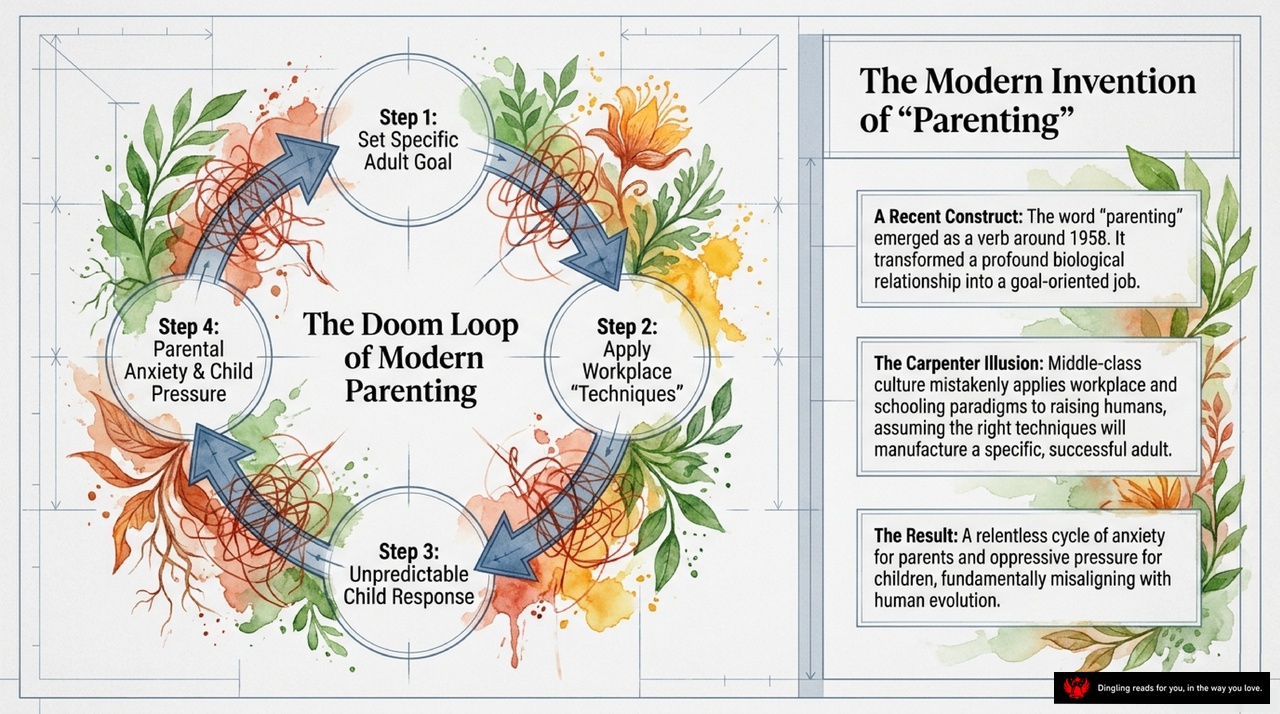
The modern invention of "parenting" is reshaping how we raise children, turning a natural biological bond into a high-stakes job. As the slide illustrates, this cycle begins with Step 1: setting specific adult goals for our kids. We treat them like projects, applying Step 2: workplace "techniques" to mold their behavior. But this approach often leads to Step 3: unpredictable child responses, as children aren't machines we can program. This disconnect fuels Step 4: parental anxiety and child pressure, creating a relentless doom loop that misaligns with human evolution.
This isn't just about stress; it's about a fundamental misunderstanding of childhood. We've fallen into what's called "The Carpenter Illusion"—the mistaken belief that we can manufacture a specific, successful adult using the right techniques. We assume that if we just optimize their environment and habits, we can engineer their future. However, science tells us a different story. Children are not blank slates waiting to be filled; they are complex, evolving beings designed for exploration. The diversity in their personalities and abilities is not a flaw to be fixed, but an evolutionary advantage that helps humanity adapt to an uncertain future.
Instead of trying to shape them into a predetermined mold, the most effective path is to provide a safe, stable base. When children feel secure and loved without conditions, they are free to explore, make mistakes, and discover their own unique potential. This freedom to wander through the "chaos" of childhood is what builds the resilience and creativity needed for adulthood. So, let's stop viewing parenting as a job with a checklist and start seeing it as an opportunity to support a child's natural journey. By letting go of the need to control every outcome, we can break the cycle of anxiety and help our children thrive as they were meant to.

Look at this slide: "The Core Paradigm Shift." It contrasts two worlds: The Carpenter and The Gardener. On the left, the Carpenter represents our traditional parenting instinct. The goal is to shape material into a predetermined, precise final product. The method relies on control, measurement, and rigid execution. In this view, chaos is an enemy to be eliminated, and success is measured solely by the quality of the adult product at the end. We try to build children like furniture, carving out a specific shape before they've even grown.
But look at the right side: The Gardener. This is the new scientific approach we need to adopt. The goal isn't to force a specific shape, but to cultivate a rich, stable soil where unpredictable life can thrive naturally. Instead of controlling every variable, the method shifts to protection, nourishment, and ecosystem management. Here, chaos isn't the enemy; it's a necessary feature of adaptability and resilience. We understand that a flexible environment that survives changing, unpredictable seasons is far more valuable than a rigid structure.
Think about it: if you try to control every step of a child's growth, you might actually stifle their ability to adapt to a world that is constantly changing. Just like a garden needs space for weeds and wildflowers to eventually find their place, children need the freedom to explore, make mistakes, and discover their own unique path. The Carpenter wants a perfect replica; the Gardener wants a thriving, resilient life. Our job isn't to be the master craftsman shaping the wood, but the gardener tending the soil, trusting that if we provide safety and love, the child will grow into something beautiful we couldn't have designed ourselves.
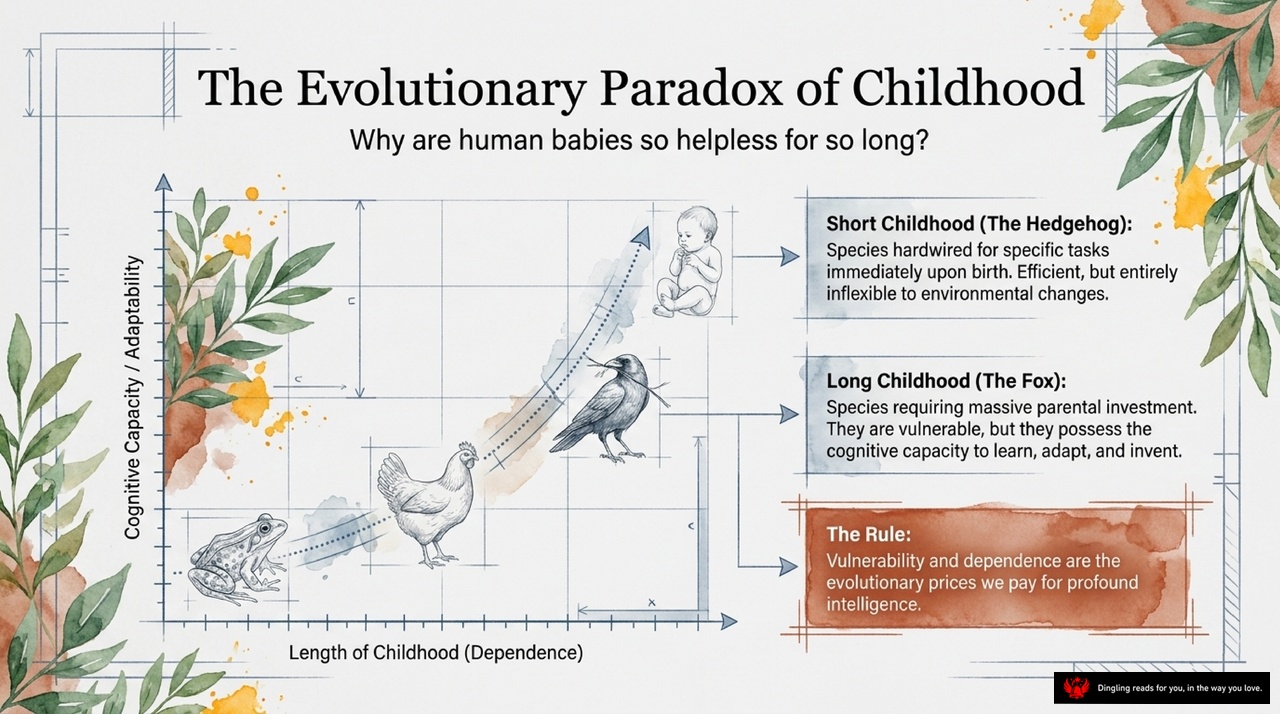
The slide presents a fascinating evolutionary trade-off: the paradox of childhood. It contrasts two distinct strategies. On one side, we have the "Hedgehog"—species with short childhoods that are hardwired for specific tasks right from birth. They are efficient but rigid, unable to adapt when the environment changes. On the other side lies the "Fox"—species like humans, requiring massive parental investment and a long period of dependence. While this makes us vulnerable, it unlocks a profound cognitive capacity to learn, adapt, and invent.
The chart illustrates that this long period of dependence isn't a weakness; it is the price we pay for intelligence. As the slide notes, "Vulnerability and dependence are the evolutionary prices we pay for profound intelligence." By extending our childhood, we gain the time necessary to explore, make mistakes, and develop the flexible thinking that allows us to thrive in a changing world. Unlike the hedgehog, which must follow a fixed script, the fox has the freedom to create new solutions for problems we haven't even encountered yet. This is why human babies are so helpless for so long—it is the ultimate evolutionary strategy for survival in an unpredictable future.
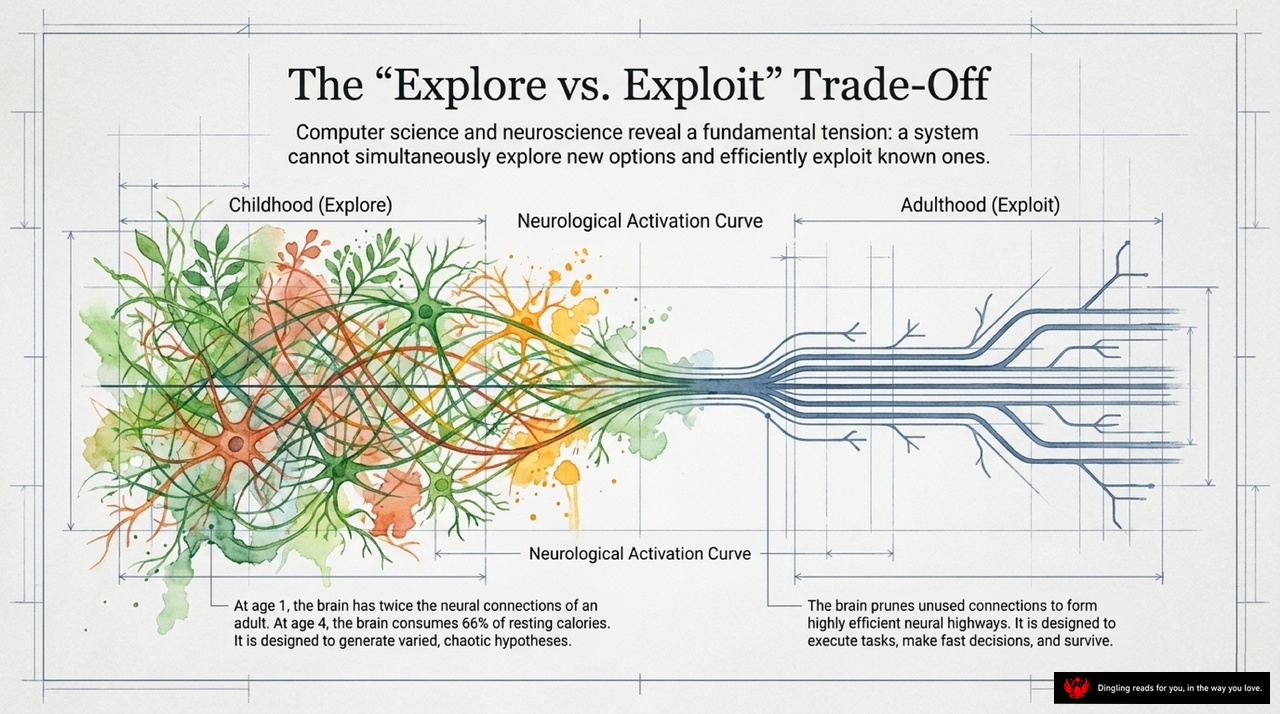
The slide highlights a fascinating tension between "Exploring" and "Exploiting," a concept rooted in both computer science and neuroscience. As the image illustrates, childhood is our dedicated "Explore" phase, characterized by a chaotic, vibrant explosion of neural connections. At age one, our brains actually hold twice the number of neural connections an adult does. This isn't a bug; it's a feature designed to generate varied, chaotic hypotheses about the world.
Fast forward to adulthood, and we shift into "Exploit" mode. The image shows how our brain prunes those unused connections to form highly efficient neural highways. This allows us to execute tasks quickly and make rapid decisions, but it comes at a cost: we lose the flexibility of our younger years.
This trade-off explains why we value a long childhood so highly. If we skipped the messy, inefficient phase of exploration, we would never develop the diverse cognitive tools needed to adapt to future challenges. Our ancestors didn't evolve to be efficient robots; they evolved to be flexible explorers. By giving children the safety to make mistakes and form those wild, chaotic connections, we are essentially investing in our species' ability to survive in an unpredictable future. So, the next time you see a child playing or making a mess, remember: they aren't just wasting time. They are building the complex, adaptable brain that will one day solve problems we haven't even thought of yet.
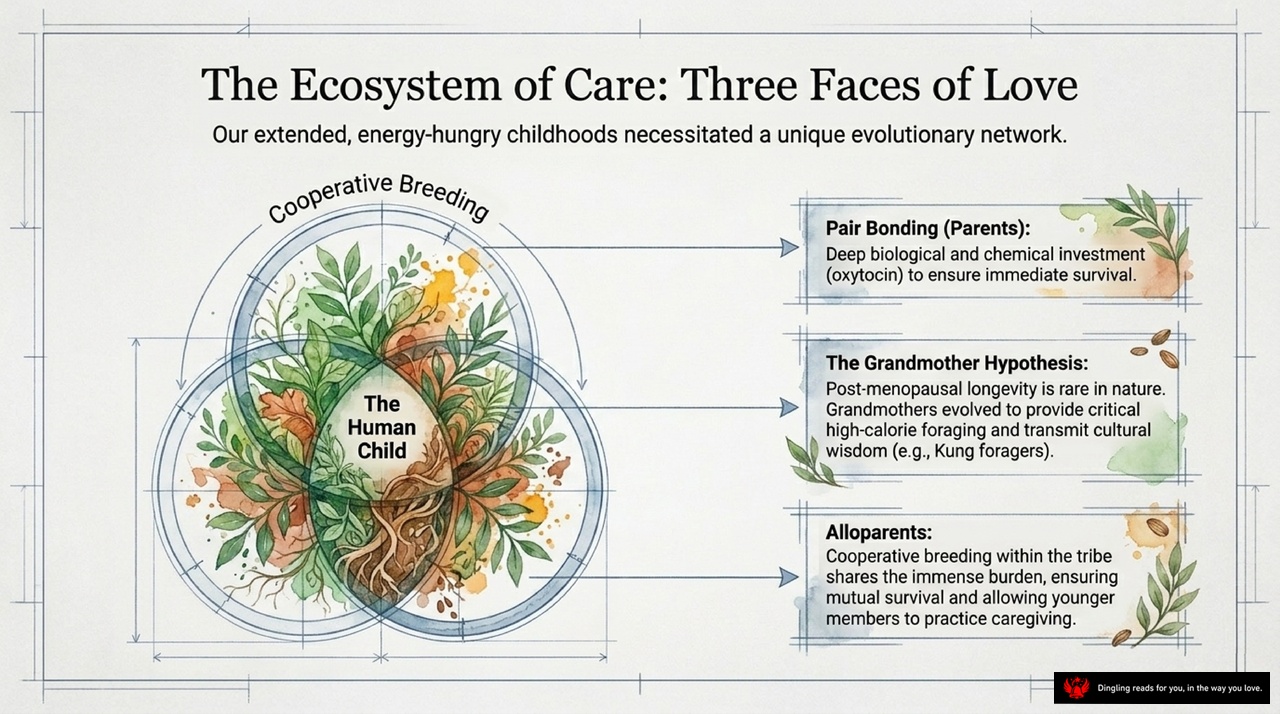
The ecosystem of care is built on three distinct faces of love that shaped our evolution. As the slide illustrates, our extended, energy-hungry childhoods necessitated a unique network where no single parent could do it all alone. First, we have pair bonding. This deep biological investment, driven by chemicals like oxytocin, ensures immediate survival and keeps parents deeply connected to their offspring. But it's not just about the parents. Enter the grandmother hypothesis. Unlike most species, humans evolved to live well past menopause. Grandmothers provide critical high-calorie foraging and transmit vital cultural wisdom, acting as a bridge between generations that simply didn't exist in the animal kingdom. Finally, we have alloparents. Through cooperative breeding within the tribe, the immense burden of raising a human child is shared. This allows younger members to practice caregiving while ensuring mutual survival for the whole group. Together, these three forces—parents, grandmothers, and alloparents—created the stable, safe environment that allowed our brains to grow so large and our childhoods to stretch out so long. Without this entire ecosystem of care, the complex, slow-learning human mind we have today would never have evolved.

Think about the things we take for granted today. What if, from another perspective, they look like terrifying new technologies? I once wrote a sci-fi story about a girl who was obsessed with a device from the age of two. By seven, she preferred its virtual world to reality. By fifteen, she couldn't imagine life without it. Even when she had a concussion, she brought the device to the hospital. And she tried to make her own child obsessed with it too. Psychologists said she was controlled by the device. Neuroscientists found that the part of her brain responsible for understanding reality had been completely taken over.
Now, here is the twist: that device isn't a piece of sci-fi fiction. It is the book. This isn't just a story; it is my own autobiography. This metaphor hits the core of what many parents feel anxious about today: How do smartphones and social media affect our children? Some say it will destroy them. Others say it will create a completely new future. But the real scientific answer is simple: we truly don't know. We have to wait until the next generation grows up to see the full impact.
However, there is a deeper truth behind this anxiety. The relationship between children and technology has never been a new phenomenon. Every generation of children has always been grappling with the "new tech" of their time. In psychology, there is a concept called the "Cultural Ratchet Effect." It suggests that humans take the inventions of their grandparents, treat them as common sense, and then build upon them to create even more innovations. Here, children and adults have complementary learning styles. Adults learn new skills slowly and painfully, requiring intense focus. But children can effortlessly inherit the accumulated knowledge of the past. They are the key to cultural transmission.
Every generation's brain develops unique operating modes based on their childhood experiences, and then they go out to reshape the environment. Over several generations, human brains and culture undergo massive changes. For example, in the US, there was a group of teenagers known as "Valley Girls" who used a specific rising tone at the end of sentences. This style spread through a song and eventually became the standard way even academic mentors and bosses speak to their subordinates. Similarly, in Japan, a teenage female monkey was the first to figure out how to wash sweet potatoes in seawater. This behavior quickly spread to younger monkeys, but the powerful, older monkeys never learned it.
These examples prove that children, especially teenagers, stand at the very forefront of technological and cultural change. What we consider "normal" reading is actually a brand-new technology. The human brain was originally not designed for reading. It took thousands of years for our brains to repurpose the areas used for recognizing objects into the ability to read. This helps us understand that technology's impact on humans is often long-term and profound, and children are the bridge connecting the past to the future.
Reading has profoundly reshaped our brains. We have an innate ability to recognize intersecting lines and boundaries. We used this to design alphabets. However, primate brains are naturally symmetrical, reacting the same way to shapes like "b" and "d". That is why some people have reading disorders. But the developing brain is magical; through exposure to meaningful, symmetrical characters, it can rewire its connections and overcome this innate obstacle. When we read enough, reading becomes automatic. Think of the Stroop Effect: when you see the word "blue" written in red ink, it is hard to say the color is red because the automatic habit of reading has been etched into your brain.
When reading first became widespread, people were anxious. Socrates believed that writing would make us lose our memory and replace human dialogue, leading us to blindly trust what is on paper. He was partially right; few people can recite the *Iliad* anymore. But the benefits of reading clearly outweighed the drawbacks. It reshaped our culture and gave rise to modern concepts like individualism and privacy. Traditional speeches and poetry haven't disappeared; they just changed their form.
Now, we are facing a new technological revolution: the digital screen. You might be listening to this very content while staring at a screen, perhaps with other apps open. We, the current generation, are "digital immigrants." We had to work hard to adapt to the internet, just as our ancestors struggled to learn reading. But today's children are "digital natives." They are immersed in the digital world from birth. Some kids can search for their favorite cartoons on a phone fluently but don't recognize the corresponding printed letters.
This happens because the way adults and children learn new technologies is fundamentally different. When adults learn, they need intense focus. Their prefrontal cortex releases specific neurotransmitters, allowing only specific parts of the brain to change. This limits us to making fine adjustments. Children, however, have a much broader distribution of cholinergic neurotransmitters. They don't need to focus deliberately. They can easily master all kinds of fresh things, regardless of whether they seem useful or not.
Just as the telegraph and the train caused panic when they first appeared before becoming normal parts of life, we don't need to panic excessively about digital technology. Children will adapt to this digital era naturally, just as we mastered reading. The only difference is that their brains and life experiences will be radically different from ours. This is the Cultural Ratchet Effect in action: the wheel of time only moves forward.
Of course, there are many pessimists in the digital age who treat small changes in human nature as an apocalyptic psychological shift. But how should we view these worries? Media scholar Dana Boyd spent thousands of hours researching teenagers from different backgrounds. She found something fascinating: what today's young people do on social media is exactly what all young people have always done. They use it to connect with friends, distance themselves from parents, gossip, flirt, rebel, and try new things.
The only real difference is that communities are now more fragmented. Teenagers without cars can no longer climb out windows or walk through country roads to escape home, so social media has naturally become their primary escape route. Of course, technology has a dark side too. Malicious teasing that used to fade away in a locker room can now spread instantly across the world and stay on servers forever. Teens must learn to face these new challenges. Research by scholars George and Ong confirms that a teenager's experience online is almost identical to their experience in reality. Popular kids stay popular online, and bullying relationships don't change. In fact, the threat of trauma from intimate family members is often much greater than anything from strangers online.
Most of the things parents worry about are not supported by evidence. The real issue is that LED screens can damage sleep, affecting both adults and children. But the internet has brought one revolutionary change: it has infinitely expanded the number of people we can communicate with. The human brain can only remember the social dynamics of about 100 people, roughly the size of a village. Even in cities, social circles were limited. But the internet allows us to connect with the whole world.
The problem is, we haven't yet learned the corresponding social skills for this vast network. It's like a tourist in a big city who finds it hard to filter out the annoying, anonymous comments online. We end up feeling lost in a mix of curiosity, excitement, and isolation. This contradiction is similar to our complex feelings about cities.
More importantly, these questions about technology expose the core paradox of parenting: balancing inheritance with innovation, and dependence with independence. A crucial task for parents, especially grandparents, is to provide the next generation with a sense of cultural history and continuity. Parenting is not about "raising" children in the mold we desire. It is about becoming a bridge that connects the past to the future. We must provide a stable and rigorous environment, but we do not need to demand that they copy our traditions. They will create their own digital era. Scientific research shows that for them, the internet is like the worn-out paperback books we grew up with; it is the bedrock of their era, and they will feel no sense of alienation toward it.
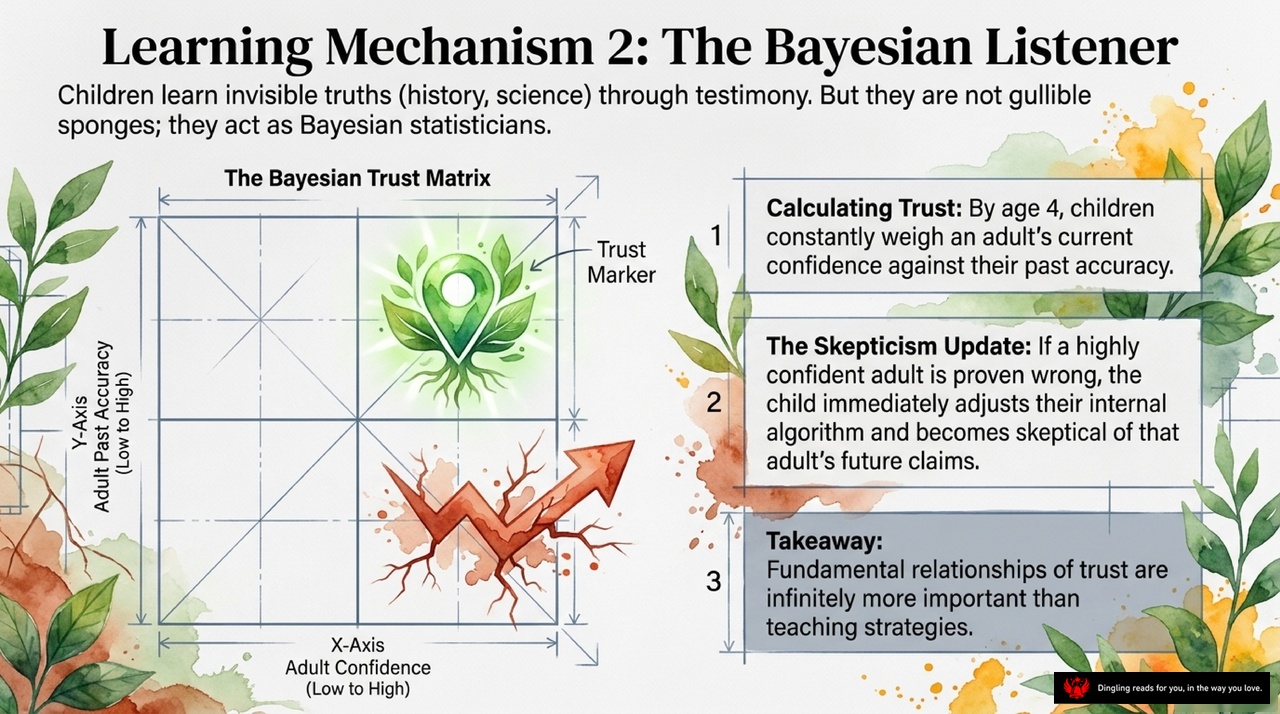
Let's dive into the final piece of our puzzle: the trust mechanism. Picture this: children aren't passive sponges soaking up everything we say. Instead, they act like tiny Bayesian statisticians, constantly calculating the reliability of the information they receive.
Look at the chart on the left, the "Bayesian Trust Matrix." The X-axis represents an adult's confidence, and the Y-axis shows their past accuracy. When a child weighs these two factors, they land on a specific "Trust Marker." This is the core of what we call the "Bayesian Listener."
Here is how it works in practice. First, children are constantly calculating trust. By age four, they are already weighing an adult's current confidence against their track record. If you speak with absolute certainty, they listen closely. But here is the critical part: the second point on our slide, "The Skepticism Update." If a highly confident adult is proven wrong—even just once—the child immediately adjusts their internal algorithm. They don't just ignore you; they become skeptical of that adult's future claims. It's a self-correcting system built into their very nature.
This leads us to our final takeaway, which is perhaps the most important lesson for parents: fundamental relationships of trust are infinitely more important than teaching strategies. You cannot force a child to learn through rigid instruction. If the foundation of trust is shaky, no amount of clever teaching will stick. The most effective way to teach is to be a reliable, accurate source of information. When you get things right and admit when you are wrong, you build the trust that makes learning possible. So, stop trying to be the perfect teacher and start being a trustworthy partner in your child's exploration of the world.

Play is the ultimate "Explore" mechanism—a safe space to test boundaries without real-world consequences. Think of it as a sandbox where children act as scientists, engineers, and philosophers all at once.
First, there is Rough-and-Tumble Play. This isn't just chaos; it's how kids safely map physical limits, social dominance, and interactive boundaries. They learn the rules of engagement through wrestling and running, figuring out where they stop and others begin.
Next, we have Exploratory, or Toy Play. Here, children extract causal physical laws. They naturally act as scientists, isolating variables to figure out how machines and objects work. If they drop a block and it breaks, they test again. If it rolls, they adjust. This is the scientific method in action, driven by pure curiosity rather than a lesson plan.
Finally, there is Pretend Play. This is where children practice counterfactual thinking—"what if?" scenarios. By imagining alternate realities, they build the foundation for Theory of Mind, empathy, and human innovation. When a child pretends a banana is a phone, they are exploring the gap between reality and imagination, a skill crucial for creativity and understanding others.
So, when we look at these three pillars, we see that play isn't a break from learning. It is the very architecture of how our brains develop the flexibility to survive and thrive in an unpredictable world.

Apprenticeship versus Schooling. On the left, you see a loop of observation, attempt, feedback, and iteration—the ancient model of mastery that has defined human history. For most of our past, true skill wasn't taught in a classroom; it was forged through hands-on doing, failing, and refining. On the right, we see a rigid staircase, representing the modern invention of schooling: a standardized, goal-oriented system designed for the 19th-century industrial age. This factory model prioritizes efficiency and uniformity, often at the cost of the very adaptability that makes us human.
The reality is that the most vital childhood learning—social dynamics, rule negotiation, and cultural transmission—still happens outside the classroom structure, on the playground and in the home. While schools try to fit children into a fixed mold, the world demands flexibility. True mastery comes not from being told what to do, but from the freedom to observe, try, receive feedback, and iterate. We must stop viewing childhood as a waiting room for adulthood and start seeing it as the essential training ground where we learn to navigate an unpredictable future.
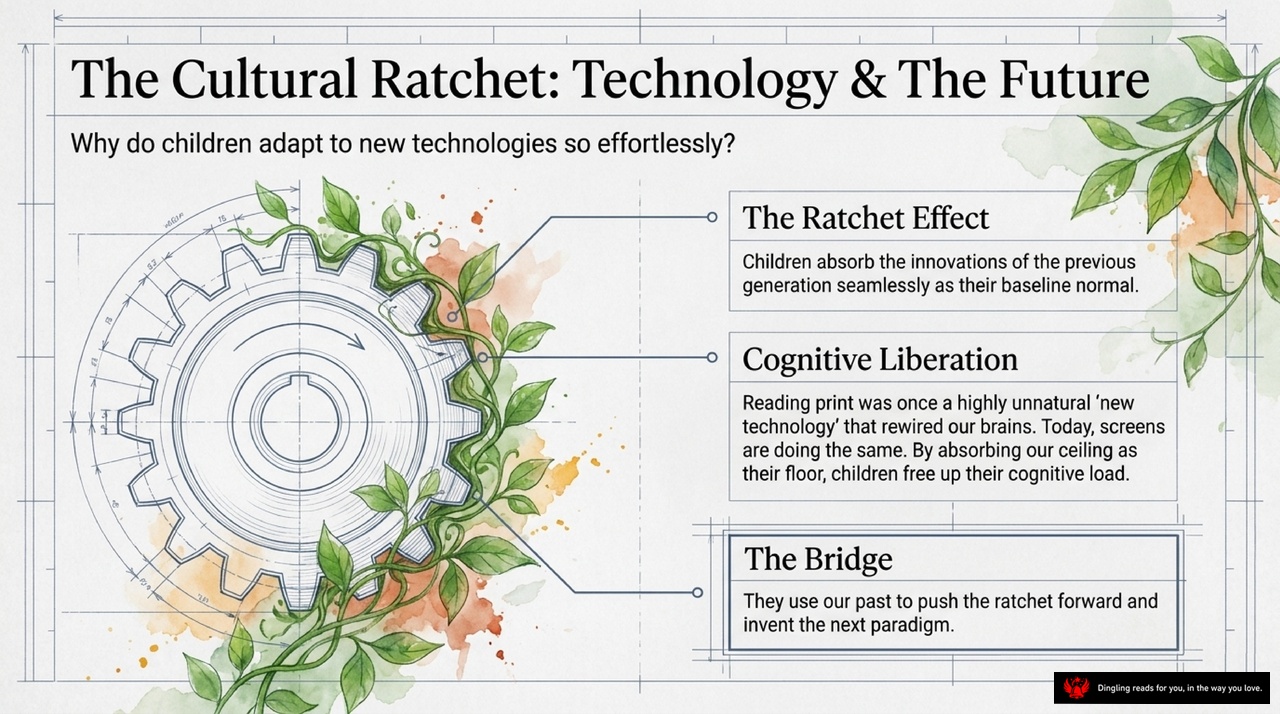
Why do children adapt to new technologies so effortlessly? It's not magic; it's the Cultural Ratchet in action. As the slide illustrates, children absorb the innovations of the previous generation seamlessly, treating them as their baseline normal. Think about reading: for our ancestors, it was a highly unnatural "new technology" that rewired their brains. Today, screens are doing the exact same thing. By absorbing our digital "ceiling," they are effectively turning it into their "floor," freeing up their cognitive load to explore even further.
This is the power of cognitive liberation. While we adults struggle to learn new tools, children use our past to push the ratchet forward. They don't just mimic us; they use our established patterns as a springboard to invent the next paradigm. They are the bridge between our analog world and their digital future. So, instead of fearing the screen, let's remember that children are the true innovators, naturally adapting to the new era we've built for them.
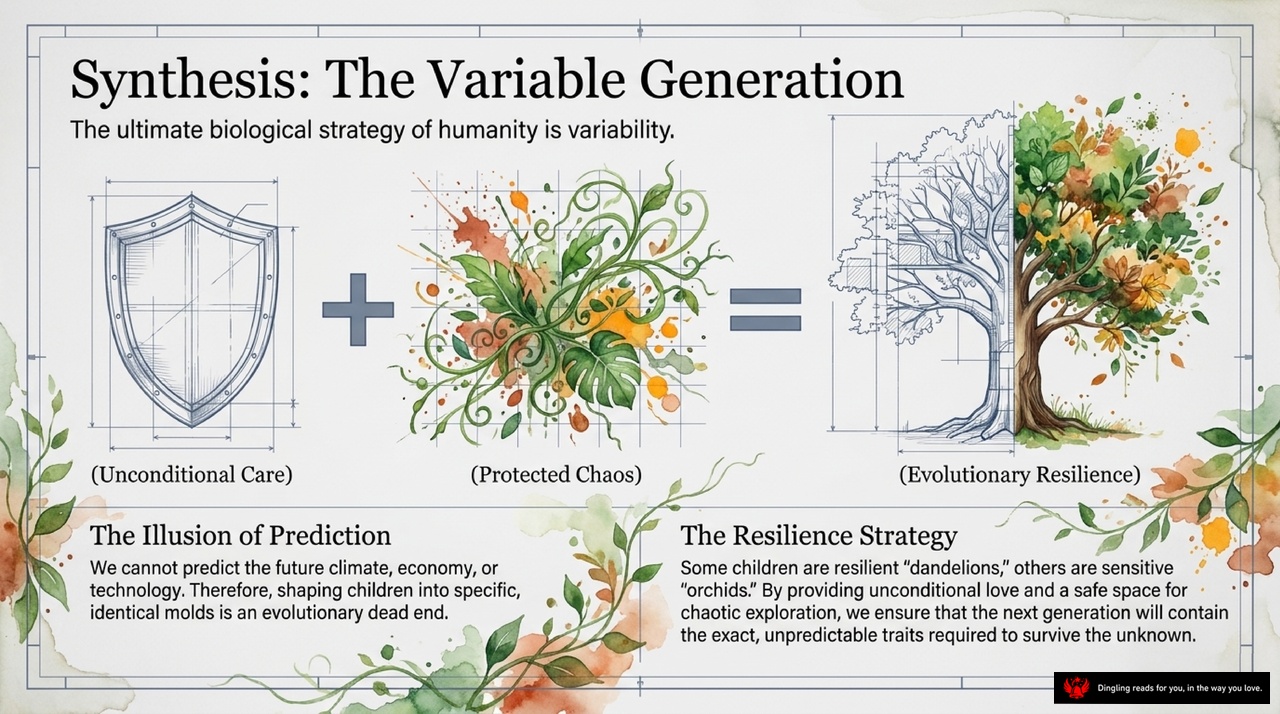
Synthesis: The Variable Generation. The ultimate biological strategy of humanity isn't control—it's variability. Look at this equation on the screen. On the left, we have a shield representing unconditional care. This is the safe space every child needs. In the middle, we have what I call protected chaos—a burst of unpredictable, wild exploration. When you combine a secure base with the freedom to mess up, you get the result on the right: evolutionary resilience. Think of it like a tree. If you prune a tree too much to make it look perfect, it dies when the storm hits. But a tree that grows wild, with branches reaching in every direction, survives because it has more options.
This brings us to the illusion of prediction. We often try to mold our children into specific molds, thinking we can predict the future. But we can't predict the climate, the economy, or technology. Shaping kids into identical clones is an evolutionary dead end. Some children are resilient dandelions who thrive anywhere; others are sensitive orchids who need specific care. If we try to force every child to be the same, we lose the very traits they need to survive the unknown. By providing unconditional love and a safe space for chaotic exploration, we ensure that the next generation contains the exact, unpredictable traits required to navigate whatever comes next. The goal isn't to build a perfect child, but to raise a resilient one who can handle anything life throws at them.
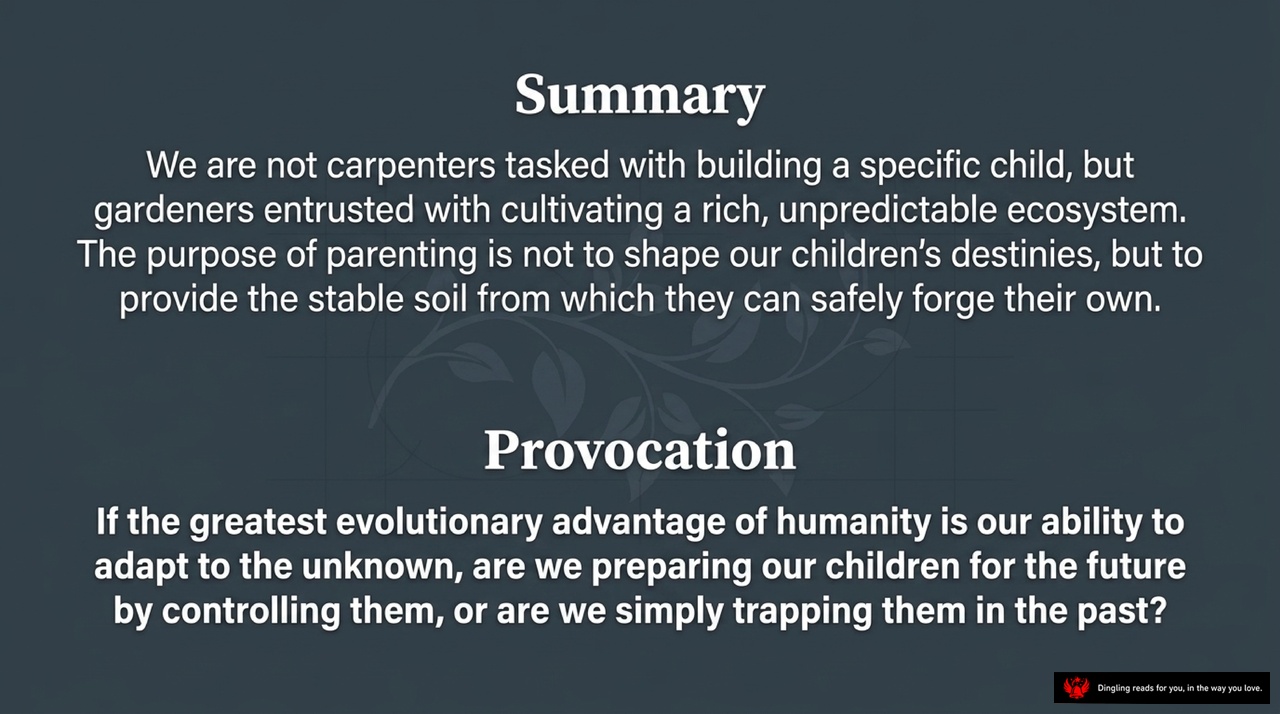
We are not carpenters tasked with building a specific child, but gardeners entrusted with cultivating a rich, unpredictable ecosystem. Think about it: the purpose of parenting is not to shape our children's destinies, but to provide the stable soil from which they can safely forge their own. In an evolutionary sense, humanity's greatest advantage is our ability to adapt to the unknown. So, are we preparing our children for the future by controlling them, or are we simply trapping them in the past? The truth is, every child is a unique seed with its own genetic blueprint. Some are like dandelions, thriving anywhere, while others are like orchids, needing specific care to bloom. Our job isn't to force a flower to grow when it's a tree, but to ensure the ground is secure, the water is clean, and the sun can reach them. When we stop trying to engineer outcomes and start offering a safe base for exploration, we unlock their true potential. Let them wander, make mistakes, and discover who they are. That's how we grow resilient, adaptable humans ready for whatever the future holds.