
The General Theory of Employment, Interest and Money: Complete Chapter-by-Chapter Summary

Welcome to a deep dive into one of the most transformative works in economic history: *The General Theory of Employment, Interest and Money* by John Maynard Keynes. As the title suggests, this isn't just about money; it's a comprehensive blueprint for understanding how employment, interest rates, and currency interact to shape our entire economy.
Imagine the economy as a massive, intricate machine with countless gears turning in perfect harmony. For over a century, classical economists believed this machine would always run smoothly on its own. They assumed that if you just let the market breathe, supply would automatically create its own demand, and full employment would be the natural, inevitable state of affairs. It was a beautiful, logical theory that seemed to explain everything.
But Keynes looked at the wreckage of the Great Depression and realized something terrifying: the machine wasn't broken because of external shocks; it was built on a flawed assumption. He argued that the classical model only worked in a very specific, unrealistic scenario—what he called "full employment." In the real world, where we face uncertainty and human psychology, this machine can easily stall.
Keynes introduced a revolutionary concept: effective demand. He showed that employment isn't determined by how much labor people are willing to sell, but by how much businesses expect to earn from hiring them. If consumers and investors aren't spending enough to buy the goods being produced, businesses will stop hiring, and unemployment will persist—even if workers are desperate to work and willing to accept lower wages.
This book dismantled the old belief that "trickle-down" economics or waiting for the market to self-correct was the answer. Instead, Keynes proposed that we need to actively manage the economy to ensure that demand matches our productive capacity. He laid the groundwork for modern macroeconomics, shifting the focus from abstract supply curves to the tangible reality of jobs, wages, and the confidence of the people running the show.
This is the story of how one man challenged a century of wisdom and changed the way we think about the world forever.
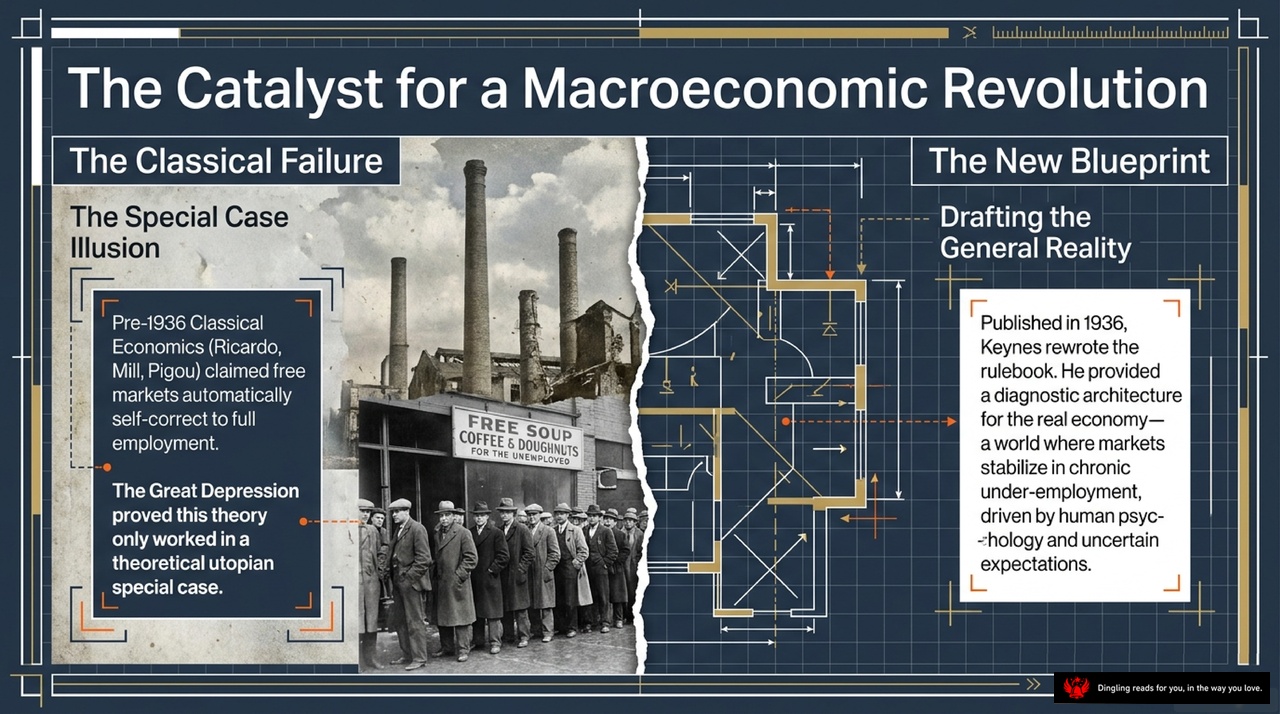
The Great Depression shattered the old economic faith. For over a century, the Classical school believed that free markets were self-correcting machines. Economists like Ricardo and Mill argued that if wages fell, businesses would hire more workers, and the economy would naturally return to full employment. They thought unemployment was just a temporary glitch, a "special case illusion" that would vanish on its own.
But the reality of the 1930s proved them wrong. Look at that image of the "Free Soup" line. Millions of men stood in line, not because they refused to work, but because no one would hire them. The market simply failed to clear. The Classical theory couldn't explain why, with so many willing workers, jobs disappeared.
In 1936, John Maynard Keynes rewrote the rulebook. He provided a new blueprint for the real economy—one where markets don't always self-correct. He showed that the economy can get stuck in a state of chronic under-employment. This isn't a temporary accident; it's driven by human psychology and uncertain expectations. When people stop spending or businesses stop investing, the engine stalls, and we need active intervention to restart it.

Today's slide, "Dismantling the Classical Illusion," cuts straight to the heart of the debate that reshaped our understanding of the economy. On the left, we see "The Classical Utopia," a worldview built on three pillars: that workers negotiate for real wages, that supply automatically creates its own demand, and that the economy naturally settles at 100% full employment. It was a comforting, almost magical belief that the market would always fix itself.
But look at the right side: "The Keynesian Reality." This is where the illusion shatters. Here, workers negotiate for money wages, not real wages. This means that even if they accept their current pay, they can still be left without jobs—what we call involuntary unemployment. Furthermore, the idea that "supply creates demand" is a fatal error. In reality, demand dictates production; employers only hire and produce what they expect people to actually buy. If that expectation is low, production stalls, regardless of how much labor is available. Finally, the economy doesn't always rest at full employment. Instead, it can frequently get stuck in a stable equilibrium of severe under-employment.
This isn't just a theoretical disagreement; it's a clash between a world that assumes everything works perfectly and one that acknowledges the harsh reality of human behavior and broken demand. We aren't just tweaking the rules; we are replacing a fantasy with a framework that actually explains why recessions happen and how we can fix them.
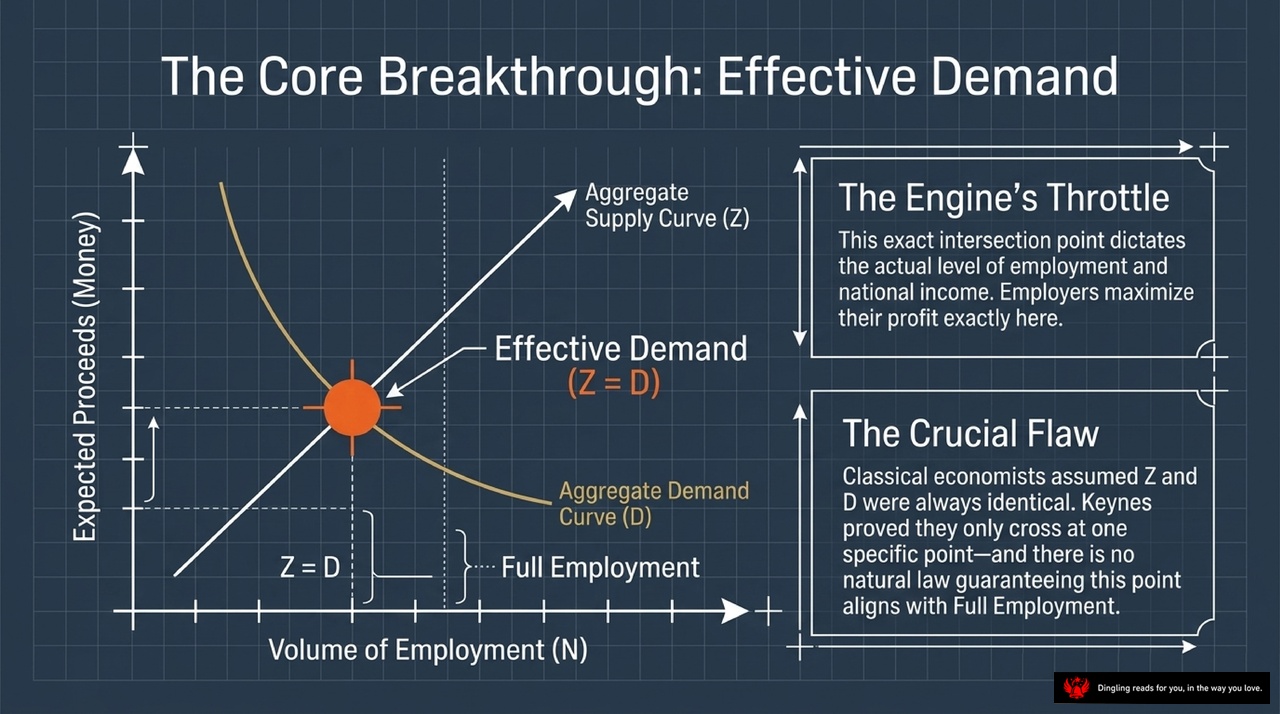
The Core Breakthrough: Effective Demand. Look at this chart. The intersection of the Aggregate Supply curve and the Aggregate Demand curve defines the actual level of employment and national income. This is the engine's throttle. Employers maximize their profit exactly at this specific point where Z equals D.
However, here lies the crucial flaw that changed everything. Classical economists assumed that supply and demand were always identical, believing the economy naturally gravitates toward full employment. Keynes proved them wrong. He showed that these two curves only cross at one specific point, and there is no natural law guaranteeing that this point aligns with full employment.
In a modern economy, effective demand is often insufficient. If the expected returns from hiring workers don't match the costs, employers simply stop hiring, leaving us with involuntary unemployment. The economy can get stuck at this lower equilibrium, far below its full potential. This is why we can't rely on the market to fix itself automatically. We need to understand that employment isn't determined by the supply of labor, but by the demand for goods and services. Without enough effective demand, the economy stalls, and jobs vanish.

So, we've walked through how consumption works and how investment gets its push from the "marginal efficiency of capital." Now, let's tackle the final piece of the puzzle: why do people hold onto cash instead of spending it or investing it?
This brings us to the third pillar: Liquidity Preference. Think of it as the psychological desire to hoard cash, especially when the world feels uncertain. It's not just about needing money for daily transactions or saving for emergencies—those are the transaction and precautionary motives. The real game-changer is the speculative motive. This is where it gets interesting. People hold cash if they think interest rates are going to rise. Why? Because when rates go up, bond prices crash. So, holding onto cash becomes a safe bet, waiting to buy bonds later at a lower price.
Here's the twist that broke the old economic theories: the classical view said interest rates are just the price of saving money. They thought if you save more, rates drop, and businesses invest. But Keynes flipped this script. He argued that interest rates aren't determined by saving and investing alone. Instead, they are set by how much money people want to hold in their hands versus how much the central bank supplies.
Imagine a scenario where everyone suddenly gets scared about the future. Even if the central bank floods the market with cash, if everyone's "liquidity preference" skyrockets—everyone wants to hold onto that cash rather than spend or invest—interest rates will stay high. And if rates stay high, businesses won't invest because their expected returns can't beat the cost of borrowing. No investment means no jobs.
This creates a trap. In a modern economy, money is unique. It's the only asset with almost zero production cost and almost zero storage cost. You don't need a warehouse to store gold or worry about it rotting like grain. Because money is so flexible and easy to hold, people can refuse to invest even when there are plenty of jobs waiting. This refusal to part with cash drives up interest rates, which chokes off investment and leaves workers unemployed.
So, the third pillar, Liquidity Preference, isn't just about saving; it's about the psychology of uncertainty. It explains why simply printing money doesn't always fix the economy and why, sometimes, the best thing to do is just hold onto your cash.

Pillar I: The Propensity to Consume & The Multiplier. Look at this diagram. On the left, we see The Psychological Law in action: as a society's real income increases, its consumption also increases—but by a smaller absolute amount. Notice how the "Savings" block grows taller while "Consumption" gets relatively smaller. This creates a widening savings gap. If fresh investment doesn't perfectly fill this exact gap, the economic engine stalls. Now, look at the right side: The Investment Multiplier. A small, targeted increase in new investment creates a proportionally larger, multiplied increase in total employment and national income. Why? Because of that very propensity to consume. When you inject capital into the system, it doesn't just sit there; it flows through the economy, turning into income for workers, who then spend a portion of it, creating more income for others. This cycle repeats, amplifying the initial spark into a massive wave of growth. In short, a little bit of smart investment can drive the entire economy forward, provided we understand how consumption and the multiplier work together to fill that critical gap.

The Marginal Efficiency of Capital is the heartbeat of investment, but it's a fragile thing. Think of it as a seesaw: on one side, you have the **Expected Future Yield**—what you believe an asset will earn over its lifetime. On the other, the **Current Supply Price**, or the cost to replace it today. Investment only happens when that expected yield outweighs the replacement cost. But here's the catch: this balance isn't a cold, mathematical certainty. It's driven by **Animal Spirits**, or pure confidence.
Keynes argued that long-term business expectations are incredibly fragile. While classical models assumed perfect foresight, reality is messy. If everyone suddenly gets pessimistic, that expected yield collapses, and the seesaw tips, halting investment instantly. This is the core of the **Balancing Act**: the delicate equilibrium between what we expect to earn and what it costs to build. When confidence wavers, rumors spread, and the future feels unknowable, investment dries up, and the economy stalls. That's why the **Marginal Efficiency of Capital** is less about hard data and more about the psychological state of the market.
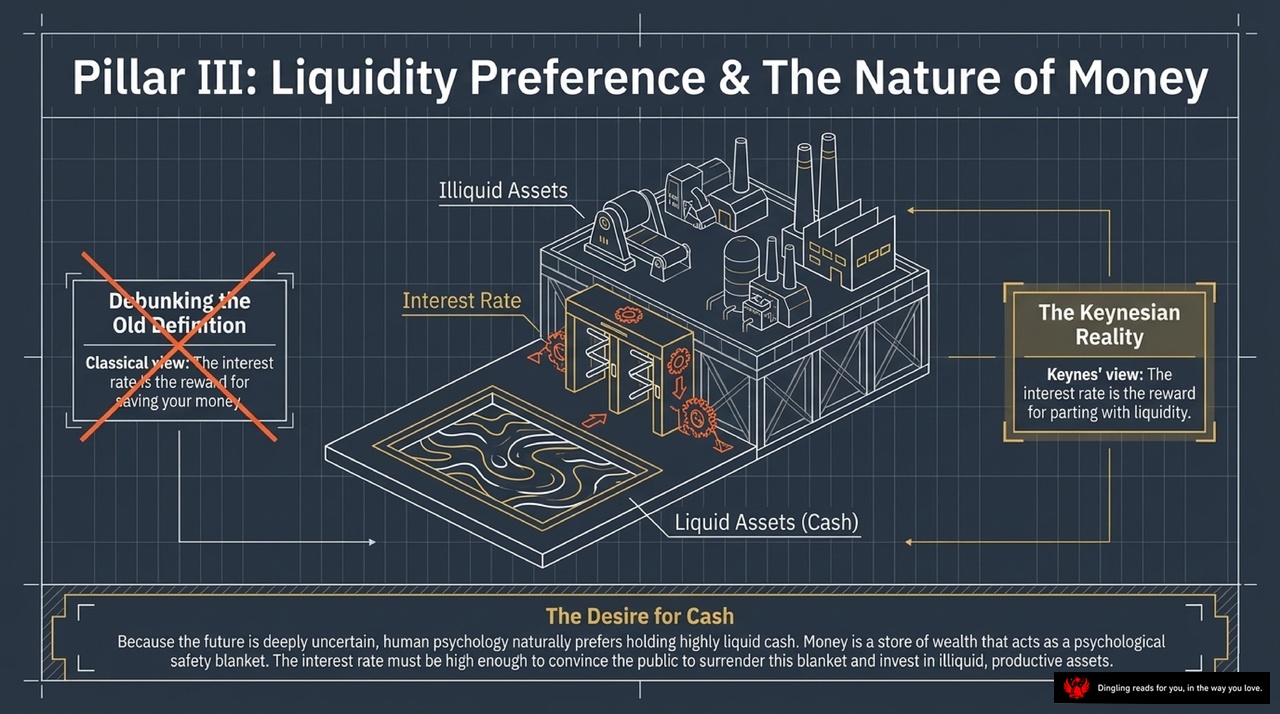
So, let's look at the big picture here. We're moving past the old, rigid ideas about how money works and diving into what John Maynard Keynes called "The Keynesian Reality."
The slide on the left is telling us to forget the classical definition that says interest is just a reward for saving your money. That's a myth. Instead, look at the diagram in the center: we have "Liquid Assets," which is just cash, sitting on the floor, versus "Illiquid Assets," like factories and machinery, up on the platform. The key here is the "Interest Rate." In Keynes' view, interest isn't a reward for saving; it's a reward for parting with liquidity.
Think about it this way: because the future is so deeply uncertain, human psychology naturally prefers holding onto cash. It acts like a psychological safety blanket. You feel safe when you have liquid cash in your hand. But if you want to invest in those factories over there—the illiquid assets—you have to give up that safety blanket. You're locking your money away for a long time. That's a risk.
So, why would anyone do that? Only if the interest rate is high enough to convince the public to surrender that security blanket. The interest rate is essentially the price of giving up your flexibility. It's the premium you pay to move from cash to capital. If rates are too low, everyone just hoards cash, and those factories stay empty. That's the core of Pillar III: understanding that money isn't just a tool; it's a choice between safety and growth, and the interest rate is the bridge between the two.
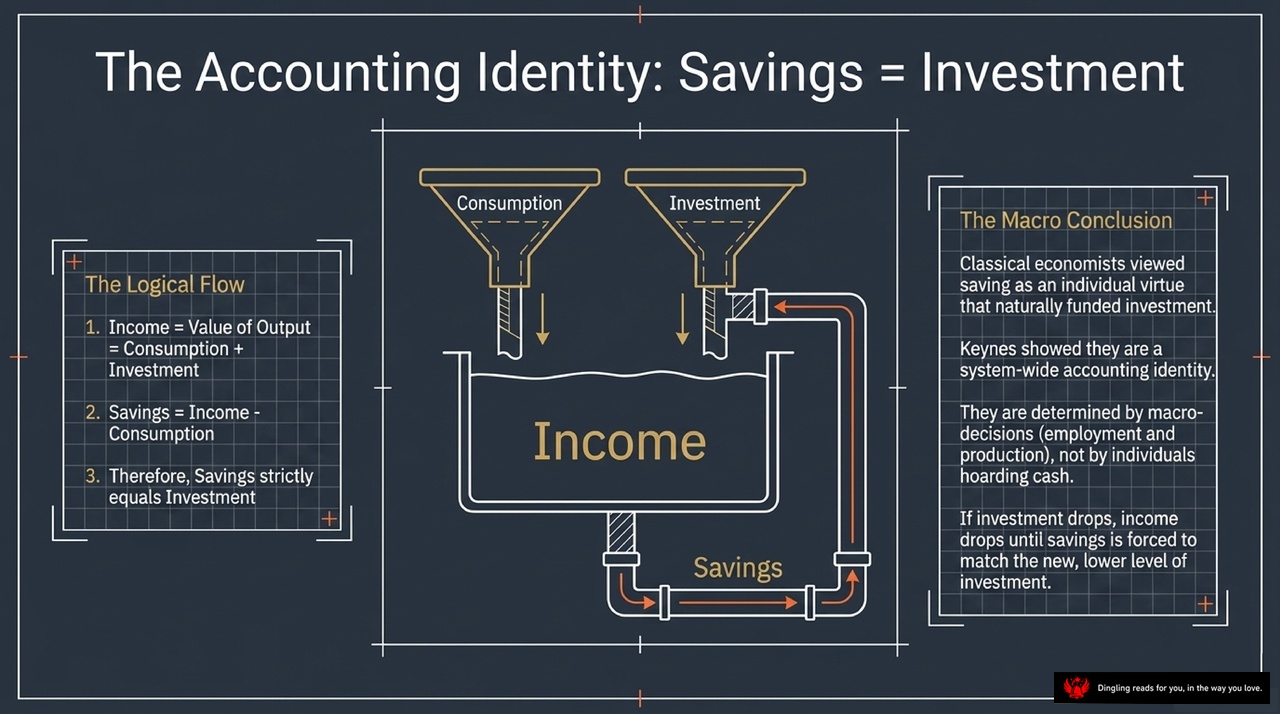
Have you ever heard the old-school idea that "saving is a virtue"? Classical economists believed that if you simply save more, that money magically flows into investment, creating jobs and growth. But today, we're going to flip that script completely. Look at this diagram: it illustrates a fundamental accounting identity that changes everything.
The image clearly shows that **Savings** are not the engine driving **Investment**; rather, they are the result. The logic flows from the top down. We start with **Income**, which splits into two paths: **Consumption** and **Investment**. Whatever is left over after you spend on consumption becomes your savings. Mathematically, this means **Savings strictly equals Investment**. It's not a choice you make; it's a mechanical reality of the economy.
The slide highlights a crucial shift in economic thinking. Classical economists viewed saving as an individual virtue that naturally funded investment. However, as the "Macro Conclusion" on the right explains, John Maynard Keynes revealed that they are actually a system-wide accounting identity. This means savings and investment are determined by macro-decisions regarding employment and production, not by individuals deciding to hoard cash.
Here is the most important takeaway from this visual: the direction of causality is reversed. If business confidence drops and **Investment** decreases, income falls. As income drops, people naturally have less to spend, so **Savings** automatically shrink to match the lower level of investment. You cannot force the economy to grow by just telling everyone to save more. In fact, trying to do that would only crush investment and deepen the recession. The economy is a closed loop where your savings are exactly equal to someone else's investment, and the whole system moves together.
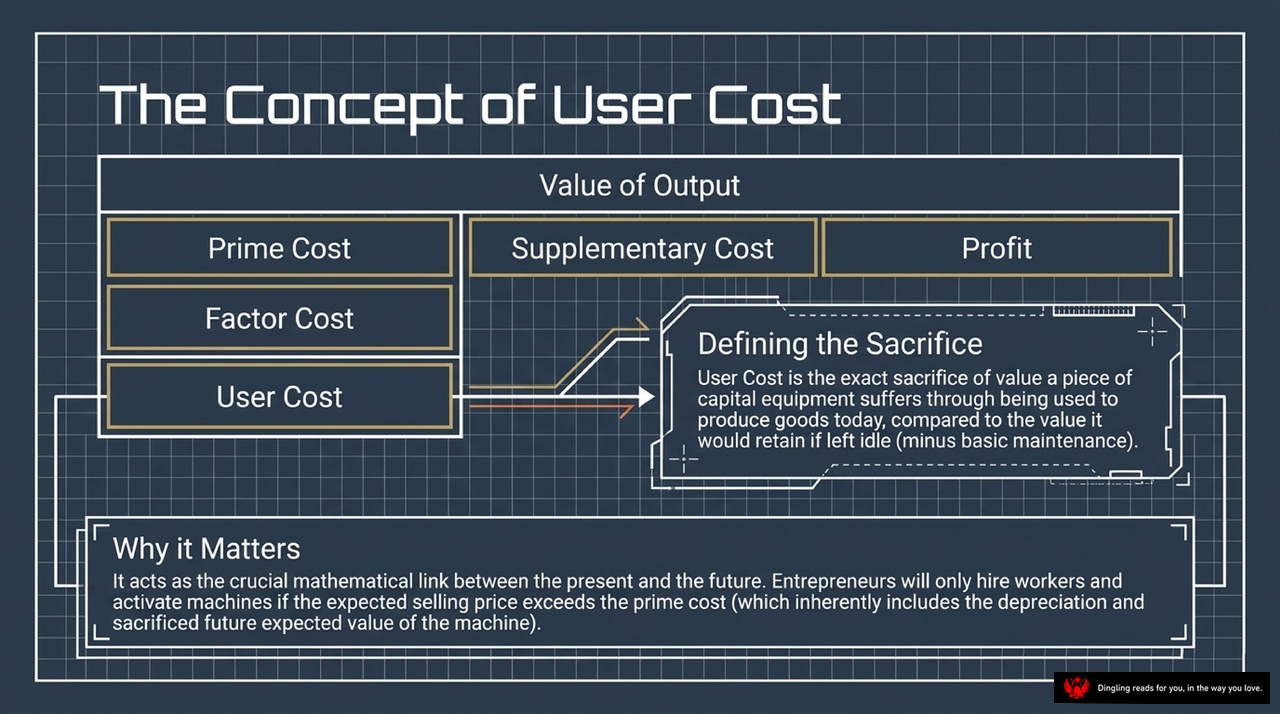
The Concept of User Cost is more than just an accounting entry; it is the mathematical bridge connecting our present actions to future value. As we look at the diagram, you can see how the total value of output is split into three parts: Prime Cost, Supplementary Cost, and Profit. But hidden within that Prime Cost is a critical component often overlooked: User Cost.
Think of it this way: User Cost is the exact sacrifice of value a piece of capital equipment suffers simply by being used to produce goods today. It represents the difference between what the machine is worth right now and the value it would retain if you left it idle, minus basic maintenance. In other words, every time you put a machine to work, you are essentially consuming a slice of its future life.
This concept matters because it acts as the crucial link between the present and the future. Entrepreneurs will only hire workers and activate machines if the expected selling price of the product exceeds the total Prime Cost. And remember, that Prime Cost inherently includes the depreciation and the sacrificed future expected value of the machine. Without accounting for this user cost, businesses might over-invest in equipment, believing they are saving money, when in reality, they are burning through the asset's value faster than they can recover it. Understanding this sacrifice is key to making sound economic decisions.
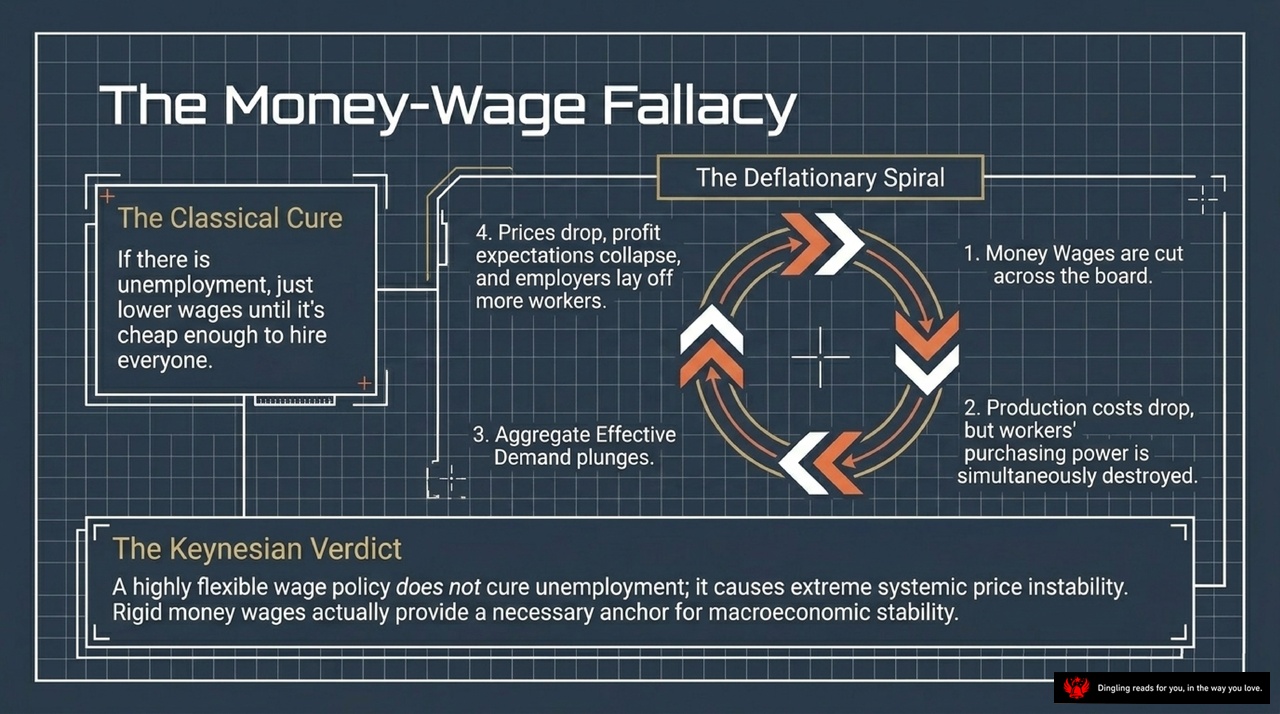
Imagine a scenario where the government believes the cure for unemployment is simple: just slash wages until businesses find it cheap enough to hire everyone again. This is what classical economists call "The Classical Cure." On the surface, it sounds logical—lower costs should boost hiring. But here's where the trap springs. When you cut money wages across the board, you don't just lower costs; you simultaneously destroy the purchasing power of workers.
Look at this diagram of "The Deflationary Spiral." It shows a vicious cycle that traps the entire economy. First, money wages are cut. Second, because workers have less income, their spending power plummets. Third, even though production costs drop, aggregate effective demand crashes because nobody is buying the goods. Finally, with sales collapsing, profit expectations shatter, leading employers to lay off even more workers, which sends wages down again. The result isn't full employment; it's a deepening depression where prices drop, but everyone is poorer.
This brings us to the Keynesian verdict, which completely overturns the old logic. A highly flexible wage policy does not cure unemployment; it actually causes extreme systemic price instability. In fact, rigid money wages provide a necessary anchor for macroeconomic stability. The lesson is clear: trying to fix unemployment by making labor cheaper is a fallacy. Instead, we must focus on boosting effective demand through investment and consumption, because that is what truly drives employment and keeps the economy stable.
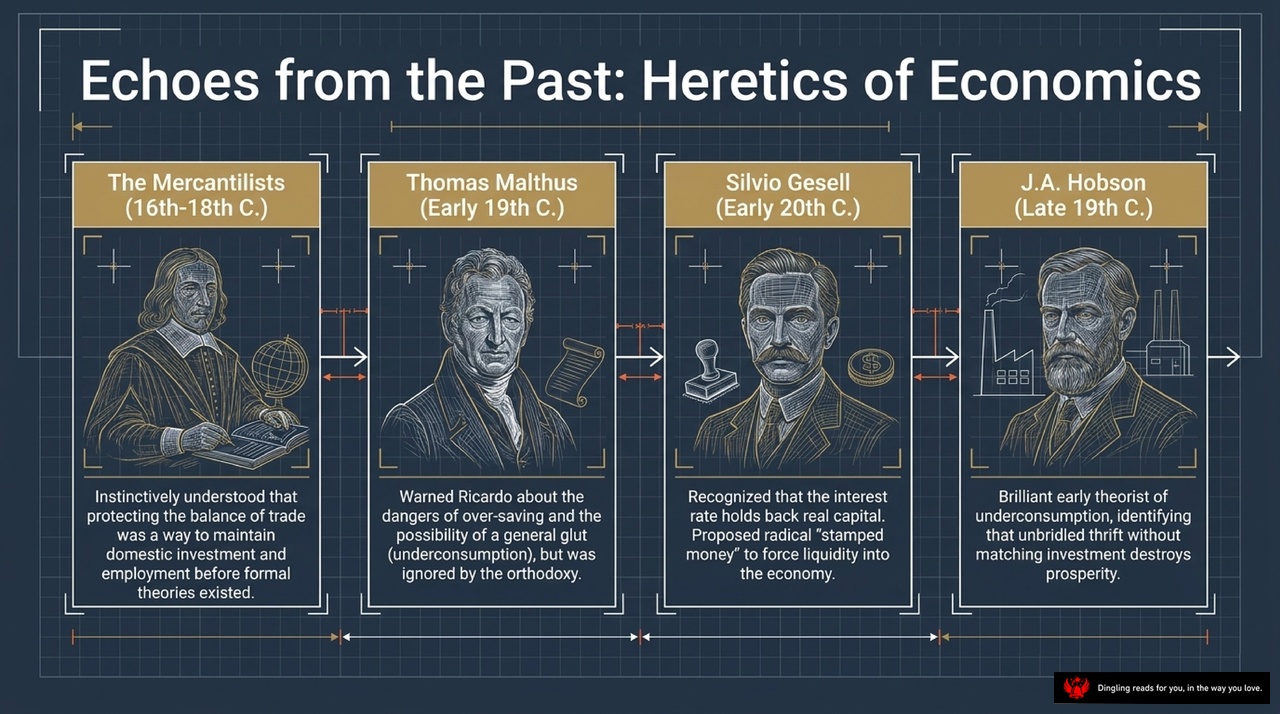
Echoes from the Past: Heretics of Economics. Welcome back. Today, we're stepping out of the mainstream and looking at the bold thinkers who were once labeled heretics but are now seen as visionaries.
On the left, we have the Mercantilists of the 16th and 18th centuries. Before modern theories existed, they instinctively understood a crucial truth: protecting the balance of trade wasn't just about gold; it was the key to maintaining domestic investment and employment. They saw the big picture long before the orthodox models did.
Moving to the early 19th century, we meet Thomas Malthus. He warned David Ricardo about the dangers of over-saving and the very real possibility of a general glut, or underconsumption. His warning was ignored by the orthodoxy of his time, but history proved him right.
Fast forward to the early 20th century with Silvio Gesell. He recognized a fatal flaw in the system: the interest rate holds back real capital. To force liquidity back into the economy, he proposed a radical idea: "stamped money." Essentially, making cash expire or lose value over time to encourage spending.
Finally, on the far right, we have J.A. Hobson from the late 19th century. A brilliant early theorist of underconsumption, he identified that unbridled thrift without matching investment destroys prosperity. If you save too much without someone to invest that capital, you kill the engine of growth.
These four figures challenge the idea that the economy always self-corrects. They remind us that without active management of demand and investment, prosperity is fragile.

Welcome back to our deep dive into Keynesian economics. Today, we're pulling back the curtain on the entire macroeconomic machine with a view called "The Macroeconomic Synthesis." Think of this diagram as the blueprint for how an economy actually functions, moving far beyond the old, simplistic ideas that supply always creates its own demand.
On the left side, you see two distinct circuits driving our system. Circuit A is the Monetary side, where the Money Supply and Liquidity Preference interact to set the Interest Rate. This is the price of borrowing money. But the real engine of growth sits in Circuit B, the Capital side. Here, the Marginal Efficiency of Capital—essentially our optimistic guess about future profits—competes against the Replacement Cost of building new factories or machines.
The magic happens when these two forces meet. If the expected return on investment, or the Marginal Efficiency of Capital, is higher than the current Interest Rate, businesses step in and make Investment. This is the moment the economy gets real. This Investment doesn't just buy machines; it becomes a crucial part of Effective Demand.
Notice how Effective Demand is the powerhouse in the center. It's not just about what people want to buy today; it's the sum of what they consume and what businesses invest. This total demand then dictates the final outcomes on the right: Total Employment and National Income. If demand is weak, employment drops. If demand surges, jobs are created.
The key takeaway here is that employment isn't automatic. It depends entirely on whether the promise of future profits can beat the cost of borrowing money. When that balance tips, the whole system—from the interest rate you pay on a loan to the number of jobs available in your city—shifts accordingly. This synthesis shows us that managing the economy isn't just about tweaking interest rates; it's about managing expectations and demand to keep the engine running.
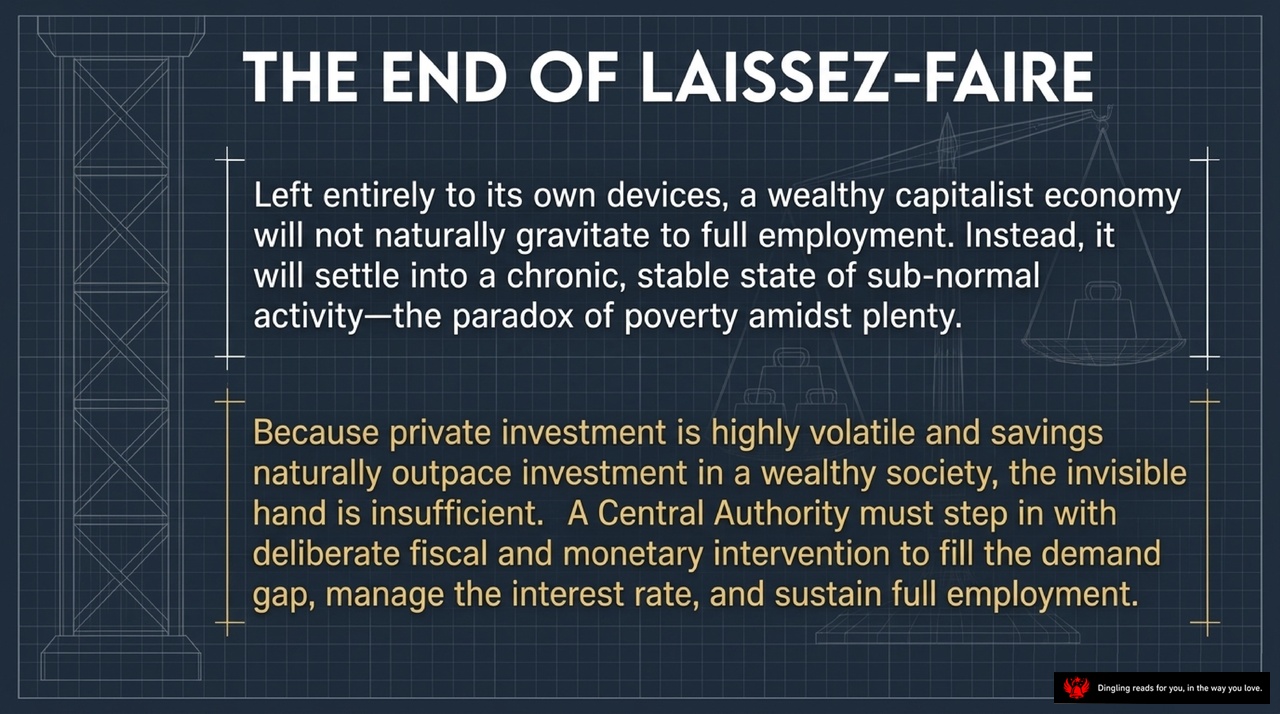
The era of "laissez-faire"—the idea that the economy should be left entirely to its own devices—is officially over. Why? Because a wealthy capitalist economy simply doesn't naturally gravitate toward full employment on its own. If you let it run free, it will settle into a chronic, stable state of sub-normal activity. We end up with a paradox: poverty amidst plenty. There is plenty of wealth and resources, yet people remain unemployed.
The problem lies in the failure of the "invisible hand." Private investment is highly volatile, and in a wealthy society, savings naturally outpace investment. The market cannot automatically balance these two forces. This is where a Central Authority must step in. We need deliberate fiscal and monetary intervention to fill that demand gap. The government must manage interest rates and stimulate spending to sustain full employment. Without this active management, the cycle of boom and bust continues, leaving us trapped in a low-activity equilibrium where potential growth is never realized.

The General Theory shattered the illusion that markets are self-correcting machines. Instead, it revealed a harsh truth: our economic prosperity isn't driven by immutable natural laws, but by the volatile psychology of human expectations. When demand collapses because people lose confidence, the entire system stalls.
So, the critical question arises: if our economic destiny depends on such fragile human sentiments, are we prepared to take deliberate control of the wheel? The answer lies in moving from passive observation to active management. By understanding that investment and consumption are driven by expectations rather than just supply, we can use policy to stabilize the cycle, ensuring that the engine of prosperity keeps running even when human optimism fades.