
The Gift of Therapy: Complete Chapter-by-Chapter Summary

Welcome to our reading session on *The Gift of Therapy* by Irvin D. Yalom. Today's slide sets the stage for everything we'll explore: a philosophical framework designed for deep human connection and the removal of obstacles to self-actualization.
Imagine an acorn lying in the soil, with a young sapling already reaching toward the light. This image perfectly captures Yalom's core belief that humans are born with an innate drive toward growth, much like an acorn naturally becoming an oak tree. Our role isn't to force this growth, but to clear the barriers standing in our way. Whether it's irrational beliefs about love or the fear of death, therapy is about creating the conditions where life can flourish naturally.
Yalom argues that the most powerful tool in therapy isn't a specific technique or a clinical diagnosis, but the relationship itself. He reminds us that both the therapist and the client are travelers on the same journey, facing the inevitable darkness of aging, loneliness, and death. By sharing our humanity and building a genuine, supportive connection, we help each other remove the obstacles that block our path to becoming our best selves. This isn't just about fixing problems; it's about embracing the full, authentic experience of being human.

The Core Paradigm: Removing Obstacles
Look at this slide. On the left, we see a pile of rocks blocking an acorn. This represents the Traditional View: the therapist must "create" growth, instill curiosity, and force change upon the patient. It's like trying to push a seed into becoming a tree by force. But on the right, we see the same rocks, yet now an oak tree is growing right next to them. This is the Existential View. It reminds us that humans possess an innate, biological drive toward self-actualization. Just like an acorn naturally wants to become an oak, we are born with an internal drive to grow.
The core insight here is simple but profound: The therapist's true job is not to build the oak tree, but simply to remove the rocks. Once the obstacles are cleared, the patient's internal drive naturally propels growth. We don't need to force them to be brave or curious; we just need to clear the path so their own nature can take over. This shifts the entire focus from the therapist doing the work to the patient doing the work, with the therapist simply facilitating the space for that growth to happen.

Today's slide highlights a fundamental shift in how we view therapy: moving from the Medical Model to the Existential Model. On the left, you see the old way—the Medical Model. It focuses on diagnosis and simply removing symptoms. The therapist acts as a distant expert, almost like a blank screen, relying on standardized, short-term protocols. While this might offer an illusion of scientific precision, its danger is clear: it sacrifices spontaneity and the real human connection needed for true healing.
Now, look at the green side: The Existential Model. Here, the focus shifts entirely to personal growth and basic character change. The therapist isn't a distant expert anymore; they become an authentic, vulnerable fellow traveler. The process is dynamic and spontaneous, driven by the relationship itself rather than a rigid script. The ultimate strength here is creating a unique, customized therapy language for every single individual.
This shift mirrors what we've discussed: moving away from treating people like broken machines to walking alongside them as humans. It's about building a genuine relationship where we can explore the full depth of the human experience together, rather than just patching up the surface.
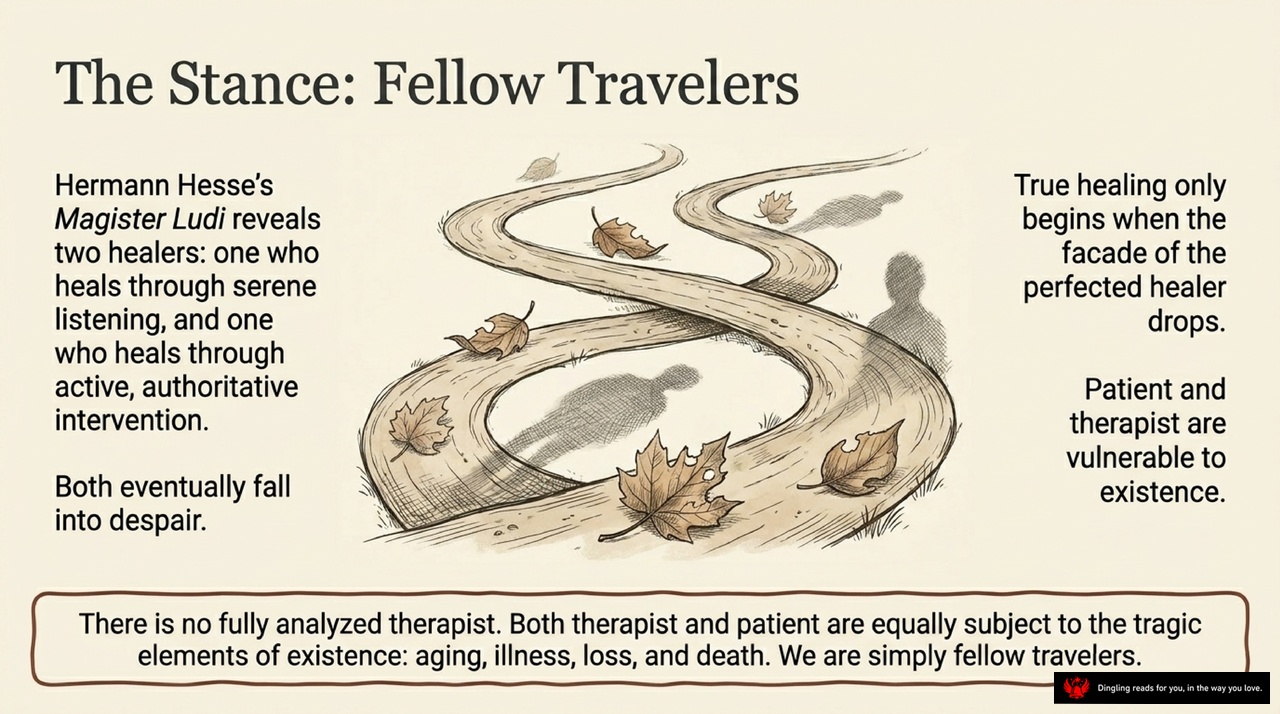
In Hermann Hesse's *Magister Ludi*, we find a profound truth about healing: it begins only when the healer drops the facade of perfection. The novel presents two healers—one who listens serenely, another who intervenes authoritively. Yet, in the end, both fall into despair. They realize that true healing isn't about fixing others from a distance; it's about walking the same winding path. As the slide beautifully illustrates, the patient and the therapist are simply fellow travelers.
We are all equally subject to the tragic elements of existence: aging, illness, loss, and death. There is no fully analyzed therapist. When we stop pretending to have all the answers and admit our own vulnerability, the real work begins. We aren't here to be perfect guides; we are companions on the journey, helping each other navigate the shadows and the light. As the image reminds us, we are simply fellow travelers.

The Engine of Change: The Here-and-Now. Look at this diagram. It defines the immediate, relational space between you and the patient in the therapy room. This isn't just a physical room; it's a micro-society. Therapy is not a substitute for life, but a rehearsal for it. Human problems are ultimately relational problems. Whatever interpersonal dysfunctions a patient suffers from in the outside world will inevitably manifest in the microcosm of the therapy room.
Think about this: why do we focus so heavily on the past? While history matters, the most powerful tool we have is what is happening right now. When a patient comes in, their life struggles—whether it's a failing marriage or a toxic job—don't stay outside the door. They walk right into this room. The way they interact with you, the trust they place in you, the anger they might show you, these are direct reflections of how they relate to the world.
We often get lost in analyzing childhood events, but the real work happens in the here-and-now. If a patient is struggling with intimacy in their life, they will likely struggle to connect with you in the session. If they feel abandoned by others, they might test you with distance or withdrawal. You don't need to dig deep into their history to see this; you just need to pay attention to the present moment. The dynamics they bring from the real world are playing out live in front of you. This is where the healing happens, not by fixing the past, but by changing the relationship pattern right here, right now.
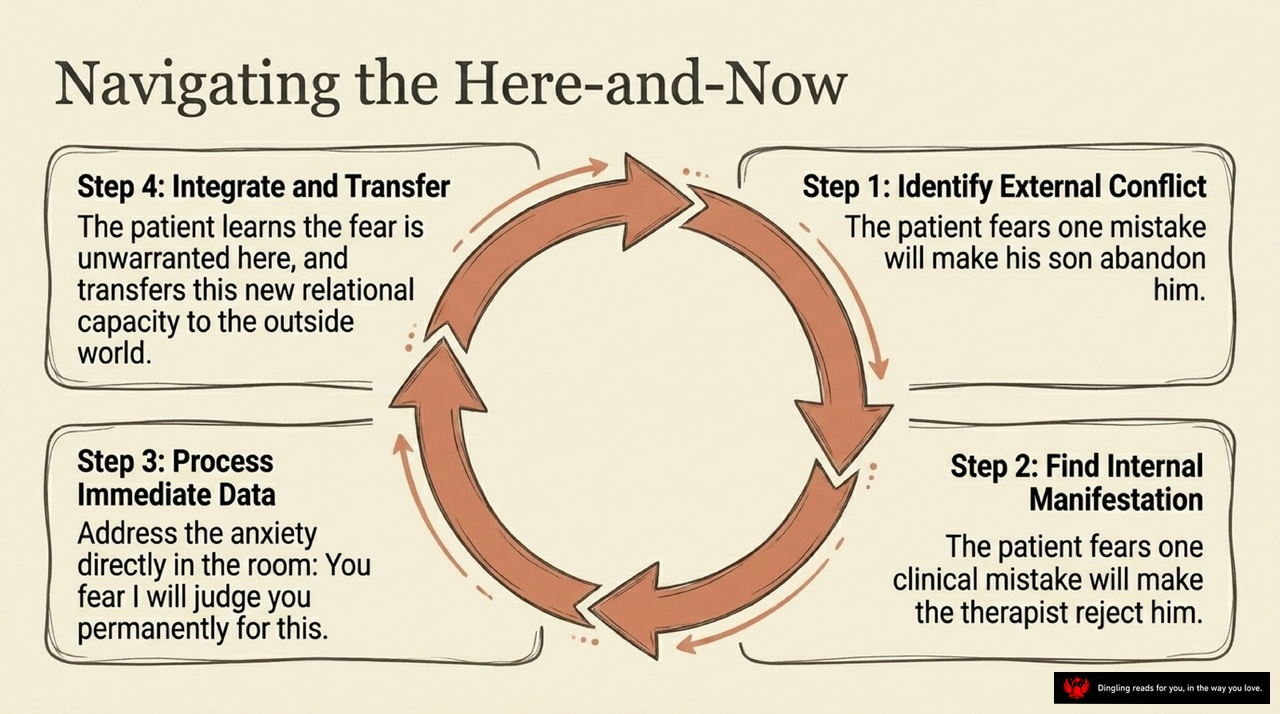
Navigating the Here-and-Now is about moving beyond the past to live fully in the present moment. Think of the therapy room not as a place to dig up ancient history, but as a living laboratory where your current feelings reveal the truth. It's not about what happened years ago, but how you feel right now in the room.
Consider a simple detail, like a broken door latch. One client might apologize endlessly for it, while another might be furious. These reactions aren't random; they are a direct map of their inner world. When a client feels judged or distant, they often act out that feeling immediately. Instead of analyzing their childhood, we address the anxiety happening right in front of us.
This approach works because it's real and immediate. When a client realizes, "Oh, I'm doing this to you because I'm scared of being abandoned," the insight sticks. It transforms abstract fears into something manageable. We use these moments to build trust and help clients see their own patterns clearly. By focusing on the here-and-now, we stop getting lost in stories and start living in the truth of our relationships.

Welcome back to our journey into the heart of therapy. Today, we're looking at the very foundation of our work: the Therapeutic Alliance. Think of it as a sturdy structure, built on three essential pillars that hold up everything we do.
First, we have the Mechanism of Therapy. This is about transparency. We need to be entirely open with our patients about how therapy actually works, stripping away the magic and the mystery. When we remove the illusion, we build trust.
Second, we focus on Here-and-Now Feelings. This is the power of the present moment. It's not about analyzing the past; it's about sharing your immediate emotional response to the patient. By offering vital interpersonal feedback on what is happening right now between you, you create a safe space for real connection.
And finally, we have Personal Life. This is the delicate art of self-disclosure. We share details from our own lives—cautiously and only when it serves the patient's interests. A genuine relationship simply cannot exist alongside perpetual secrecy. We are human beings, not robots.
When we balance these three elements, we create an Authentic Therapeutic Alliance. It's this connection, built on honesty, presence, and shared humanity, that becomes the true engine for change. Without it, no technique will work.
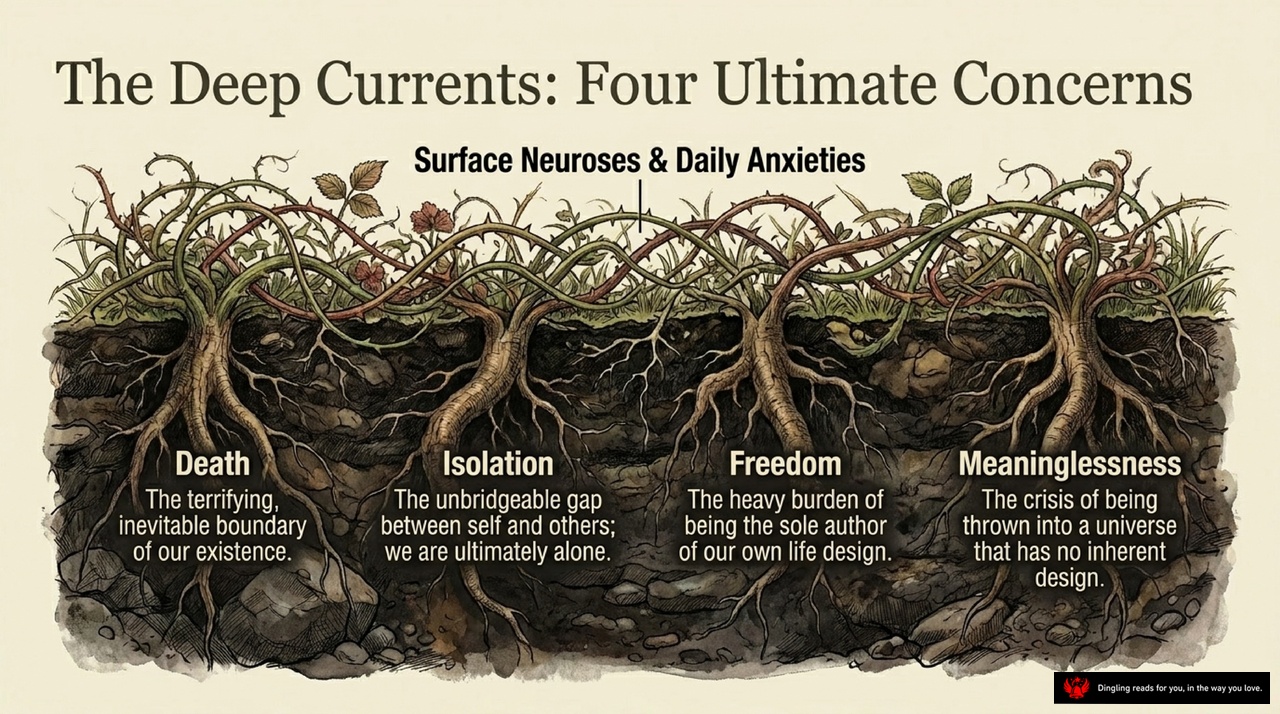
Beneath the surface of our daily worries lies a deeper, more terrifying reality. As we dig into the soil of the human psyche, we uncover four ultimate concerns that drive our deepest anxieties: Death, Isolation, Freedom, and Meaninglessness.
Think of these not as abstract concepts, but as the roots of our existence. The root of **Death** represents that terrifying, inevitable boundary that ends our story. Next, we find **Isolation**—the unbridgeable gap between ourselves and others, reminding us that we are ultimately alone. Then comes **Freedom**, which carries the heavy burden of being the sole author of our own life design, a responsibility that can feel crushing. Finally, we face **Meaninglessness**, the crisis of being thrown into a universe that has no inherent design, forcing us to create our own purpose.
While we might try to hide these deep currents behind surface neuroses and daily anxieties, they are the very forces that shape our lives. Recognizing them isn't about eliminating the fear, but about acknowledging the raw truth of what it means to be human. It is only by facing these four pillars that we can truly begin to understand ourselves and find a way forward.

Confronting Death Enhances Life. Look at this image of a leaf, half in shadow, half in light. It perfectly captures the paradox we face: physical death destroys us, yet the idea of death can actually save us.
When we recognize our impermanence, it forces a shift from a trivial, everyday mode of existing to a profound ontological state. As the text suggests, to learn to die well is to learn to live well. Many people avoid this topic because it feels too heavy, but avoiding death is exactly what makes life feel small and insignificant.
The clinical application here is clear: do not avoid the topic of death. It is the ultimate catalyst for reprioritizing life. Think about those who have faced near-death experiences; they often report a major shift in values, letting go of trivial worries and focusing on what truly matters. This isn't about morbid fascination; it's about breaking the illusion of an endless future so we can fully inhabit the present. By facing the end, we are finally given the courage to live with authenticity and purpose.
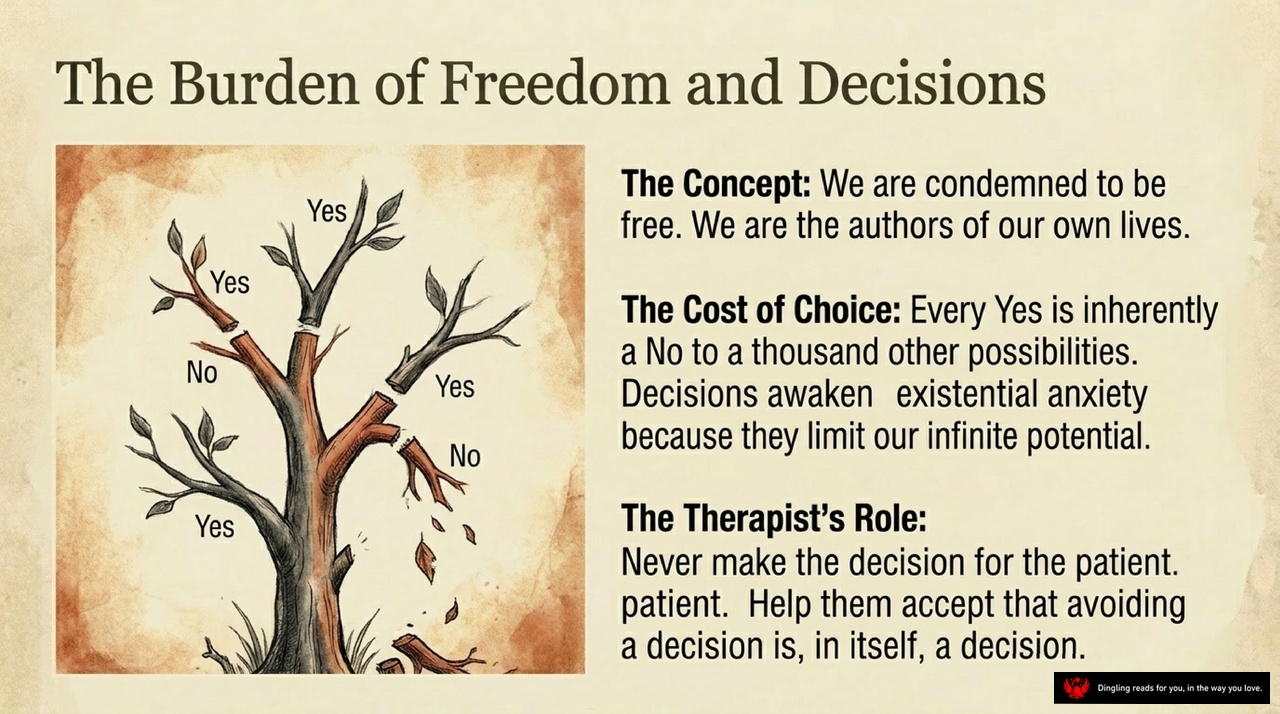
The image we see today captures a profound truth about the human condition: the heavy price of freedom. The tree illustrates that every time we say "Yes" to one path, we are inevitably saying "No" to a thousand other possibilities. This is the burden of freedom we discussed earlier—being the authors of our own lives means we are also condemned to lose infinite potential with every choice. We are trapped in this existential anxiety because decisions limit our future, yet avoiding a decision is itself a decision that limits us further.
In therapy, my role isn't to make these choices for you. I cannot and should not decide your life for you. Instead, I help you accept that the paralysis you feel isn't a sign of weakness, but a natural reaction to the weight of your own freedom. When you feel stuck, remember that the courage to choose, even if it feels terrifying, is the only way to reclaim your life. We navigate this together, not by finding the perfect path, but by owning the consequences of the one we choose.

The Paradox of Meaning. Look at this image: a swimmer plunging into a river, chasing a net that's already slipped away. It's a powerful visual for the human condition. We are meaning-seeking creatures, yet we find ourselves in a world without inherent meaning. That is the crisis.
But here's the trap: we try to grab that net directly. We chase meaning as if it's a trophy to be won. And when we do, we only end up with emptiness and endless consumption. The search itself becomes the problem.
So, what is the solution? The slide tells us clearly: meaning must be approached indirectly. You cannot swim toward the net; you have to dive into the river. Meaning emerges as a byproduct when you stop chasing it and start living. It comes from self-transcendence—loving, creating, and engaging with the world.
Think about this: if you stop trying to find the "purpose" of your life, you might actually start living it. The meaning isn't out there waiting for you to catch it. It's in the act of swimming. It's in the current. By fully immersing ourselves in the experience of life, the purpose reveals itself naturally. We don't find meaning by looking for it; we find it by living so fully that the question no longer matters.

Demystifying the Wizard. Look at this scene: a patient sits behind the curtain, clutching a notebook, desperate for a magical solution. This image captures a core struggle in therapy. Often, patients crave magic, mystery, and authority. They want an omnipotent savior who knows the painless way home, refusing to look behind the curtain.
But relying on the therapist's perceived magic creates a fragile, transference-based cure. It's a false cure. True healing requires dismantling this illusion. The patient must eventually realize that the power to change resides entirely within themselves, not the therapist.
As we move forward, remember that the therapist isn't a wizard with a spellbook. We are journey partners. My role isn't to grant wishes or provide a quick fix, but to help you remove the obstacles blocking your own growth. You hold the power. The only way out is through, not around, by trusting your own inner wisdom rather than waiting for someone else to save you.
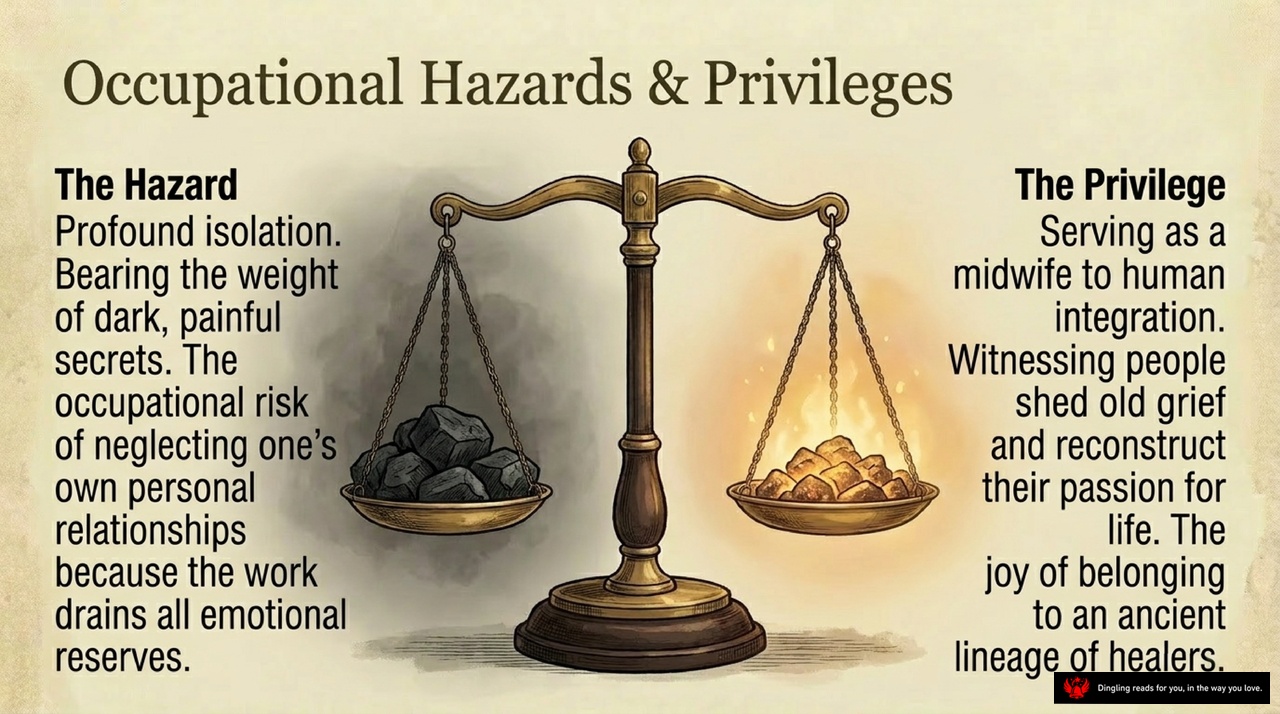
Occupational Hazards & Privileges. This slide captures the dual reality of our work as therapists: the heavy toll we pay and the profound joy we gain. On one side, we face the hazard of profound isolation. We often bear the weight of dark, painful secrets that clients cannot share with anyone else. The risk is real that the work itself drains our emotional reserves, leading us to neglect our own personal relationships. We become the container for others' pain, sometimes at the cost of our own humanity.
But look at the other side. This is the privilege. We serve as midwives to human integration, helping people shed old grief and reconstruct their passion for life. There is a unique joy in belonging to an ancient lineage of healers, from Socrates and the Buddha to Freud and Jung. We get to witness the raw, unfiltered truth of the human experience—no masks, no performance. We see people transform, find their courage, and reconnect with their deepest values. While the isolation is real, the privilege of being a witness to this profound human journey makes the work not just a job, but a sacred calling. It is the balance between carrying the world's pain and celebrating the miracle of healing.

Synthesis: The Unified Field of Healing. Look at this image. It paints therapy not as a mechanical fix, but as a shared journey. On the left, we see the roots: The Existential Givens—Death, Isolation, Freedom, and Meaning. These are the deep currents we all navigate. In the center, the Here-and-Now acts as the immediate environment driving growth, like that stream flowing through the earth. And under the tree, we have Fellow Travelers: the therapist and the patient, sharing the shade. This visual perfectly captures my core belief: therapy is a human journey where two travelers use the reality of the present moment to clear the rocks away, allowing the soul to grow as it was always meant to. We aren't trying to remove symptoms with a tool; we are walking together through the dark and light of existence. Just as a tree seed naturally becomes an oak, my job isn't to force growth, but to remove the obstacles blocking it. When we sit in that shade together, we face the fact that everyone, including us, must experience the end of things. As Schopenhauer noted, life is like a child waiting for the curtain to rise, unaware of what lies ahead. But in that shared journey, we find that the relationship itself—the authentic connection between us—is the most powerful medicine. We don't need perfect techniques; we just need to be real, to listen deeply, and to walk beside each other, clearing the path so the soul can finally breathe and expand.
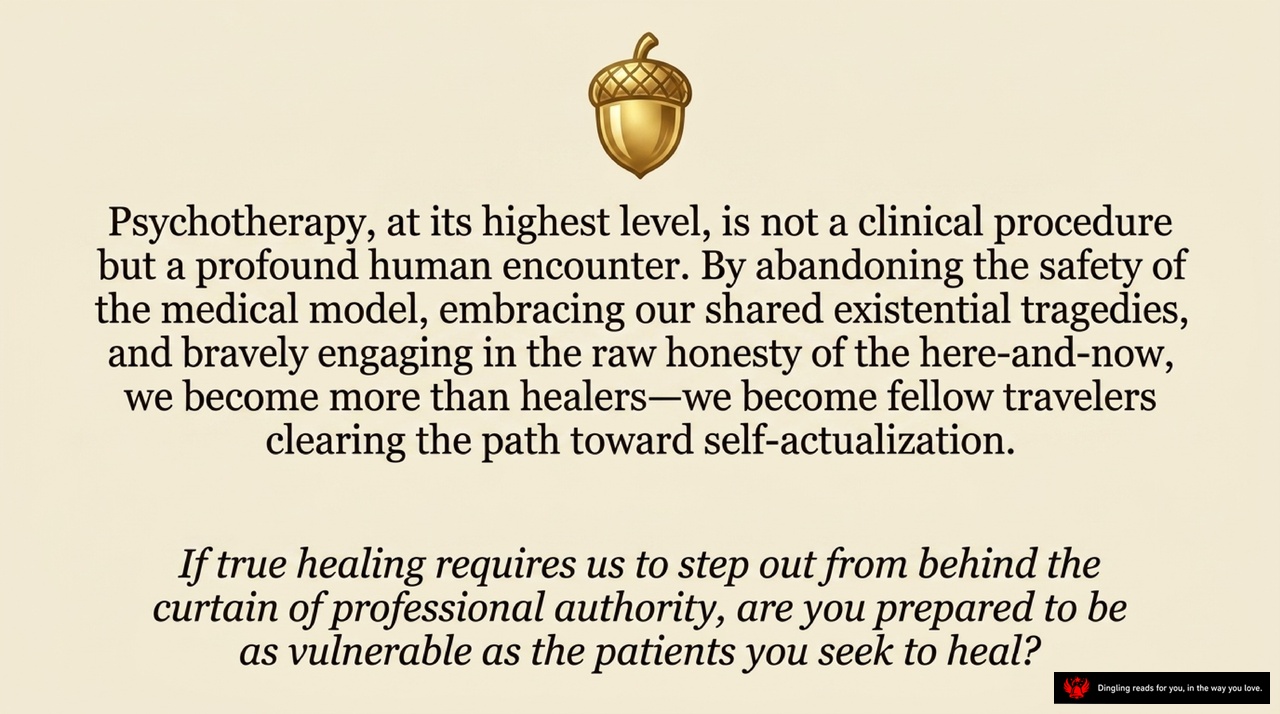
At its highest level, psychotherapy isn't about following a clinical checklist or applying a rigid medical formula. It's a profound human encounter. To truly heal, we must step out from behind the curtain of professional authority and embrace the raw honesty of the here-and-now. This means acknowledging our shared existential tragedies—the fear of death, the pain of loss, the uncertainty of life. When we do this, we stop being distant healers and become fellow travelers clearing the path toward self-actualization.
But here is the challenging question: Are you prepared to be as vulnerable as the patients you seek to heal? True healing often requires the therapist to drop the mask of perfection. As we saw in our discussion on self-disclosure, pretending to be an unchanging tool actually blocks growth. The most powerful moments happen when we admit our own fears, our mistakes, and even our humanity. By sharing in the vulnerability of the journey, we validate the patient's experience and create a space where real transformation can happen. We aren't just fixing symptoms; we are walking together through the darkness, trusting that by facing the unknown side by side, we can find our way back to light.