
The Global Minotaur: Complete Chapter-by-Chapter Summary
Welcome to the opening of our deep dive into Yanis Varoufakis's masterpiece, *The Global Minotaur*. Today, we aren't just looking at a book cover; we're stepping into a blueprint of the modern world. The title itself, *The Global Minotaur*, is a powerful metaphor for the deeply engineered macroeconomic architecture that has defined our post-war reality.
This book offers a systemic framework to understand the 2008 financial crisis, moving beyond simple explanations of greed or human error. Instead, Varoufakis argues that we are looking at a machine built to extract value from the rest of the world, a creature that requires constant "tribute" to survive. Just as the mythological Minotaur was fed by the city of Athens, our global economy has been fed by the surplus production and capital of other nations, all funneled into a single, dominant center.
In this session, we will explore how this system was constructed, why it inevitably collapsed, and what lies ahead for the global economy now that the beast is wounded. We're going to unpack the mechanics of this financial labyrinth and see how the very tools designed to stabilize the world ended up trapping us all inside. Let's begin.

Look at this layered diagram. It visualizes the six fatal layers that led to the 2008 crash. At the very bottom, we have Systemic Failure—the idea that capitalism itself contains internal contradictions that are impossible to fix. Moving up, we see Toxic Theory, where mathematical illusions like the Efficient Market Hypothesis hid the real risks. Above that lies Cultural Origins, specifically the Anglo-Celtic obsession with debt that drove global imbalances. Then we hit Irrepressible Greed, unchecked human nature pushing for more profit. Next is Regulatory Capture, where poachers effectively became the gamekeepers, protecting the very system they exploited. And at the top, we have Extrapolation Error—the blind faith in linear growth that blinded everyone to the inevitable crash.
But here is the core takeaway from this entire structure: the 2008 crisis wasn't just a failure of regulation or an outbreak of greed. It was the collapse of a highly engineered global surplus recycling mechanism. Think of the global economy as a giant machine, the Global Minotaur, designed to recycle wealth from surplus countries back into the US. When that machine broke, the entire system failed. This diagram reminds us that the crash wasn't an accident; it was the predictable result of a system built on fragile assumptions that could never last.
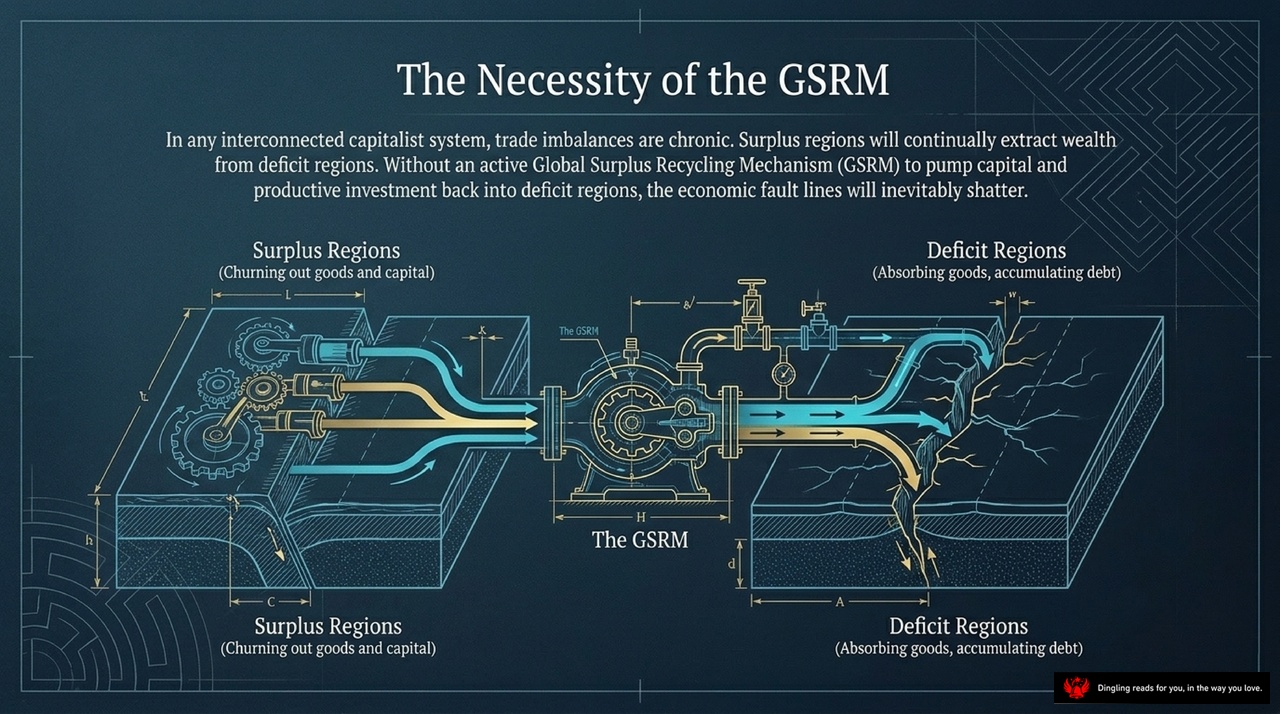
The diagram on this slide perfectly visualizes a critical concept: the Global Surplus Recycling Mechanism, or GSRM. Think of the left side as "Surplus Regions," where the machinery of production is churning out goods and capital. Now look at the right side, the "Deficit Regions," which are absorbing those goods but accumulating debt in the process. Without the central pump labeled "The GSRM," this system is destined to fail.
As the text explains, in any interconnected capitalist system, trade imbalances are chronic. Surplus regions will continually extract wealth from deficit regions. The crucial point here is that without an active GSRM to pump capital and productive investment back into those deficit regions, the economic fault lines will inevitably shatter. The image shows the consequences clearly: without that recycling mechanism, the deficit regions don't just stagnate; they crack apart. The capital flows that should stabilize the system instead become a source of structural weakness, proving that a one-way extraction of wealth without reinvestment is a recipe for inevitable collapse.

The Global Plan, spanning from 1944 to 1971, was the first true era of global capitalism. Designed by New Dealers at Bretton Woods, this system relied on the United States acting as the ultimate creditor. To prevent another Great Depression, the US intentionally recycled its massive surpluses outward, funding the industrial rebirth of Germany and Japan through initiatives like the Marshall Plan. This strategy created a powerful engine for American exports, establishing an era of outbound hegemony where the world served the US demand.
However, this stability was built on a specific, planned flow of capital. Unlike the chaotic cycles that followed, this period featured a deliberate global surplus cycle. The US absorbed the world's excess production through its own consumption and investment, while surplus profits from Europe and Asia flowed back to Wall Street, financing the very deficits that kept the global machine running. It was a time of coordinated growth, where the US acted not just as a superpower, but as the central regulator of the global economy, ensuring that no single region was left to starve while the rest grew.
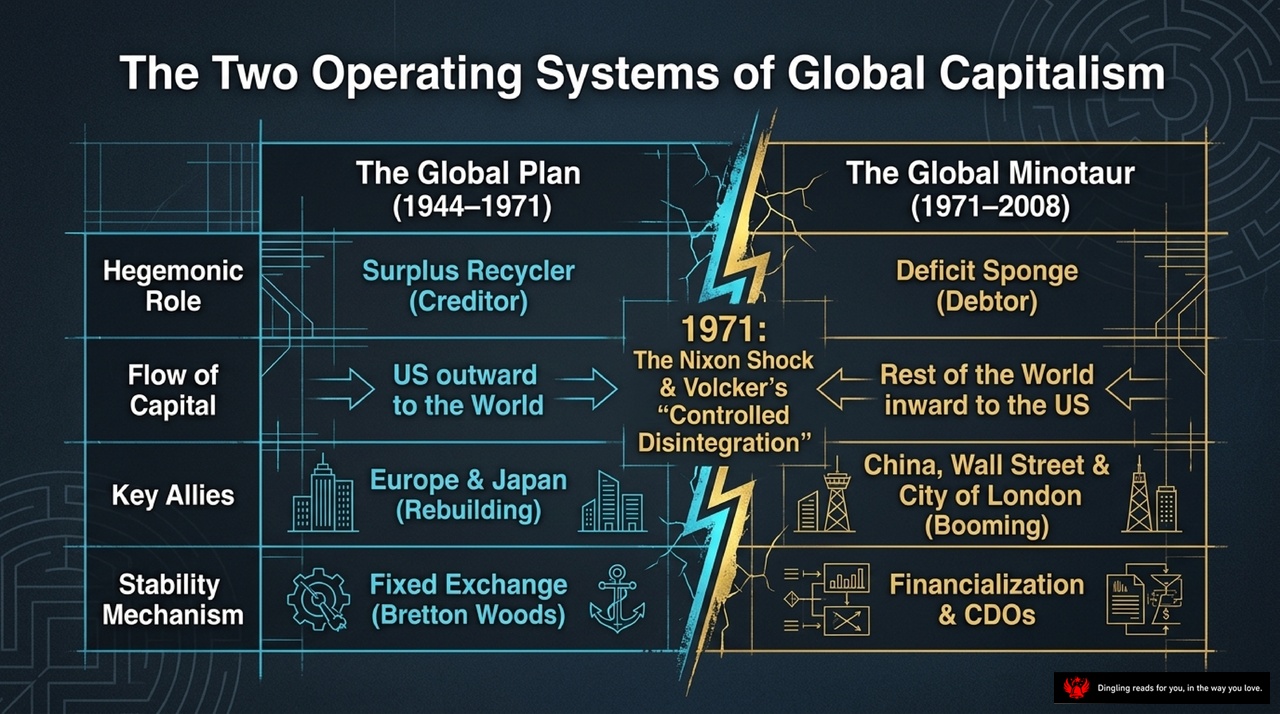
The chart before us vividly contrasts the two eras that defined global capitalism: The Global Plan and The Global Minotaur. Look at the left side, the blue section representing 1944 to 1971. This was the "Golden Age," a period of deliberate stability. The US acted as a "Surplus Recycler," a creditor nation that actively sent capital outward to rebuild Europe and Japan. In return, these allies produced goods that flowed back to the US, creating a balanced, predictable cycle anchored by the Fixed Exchange system of Bretton Woods.
Now, shift your eyes to the right, the golden section from 1971 to 2008. This is the era of The Global Minotaur. The transformation was triggered by the "Nixon Shock" and Volcker's "Controlled Disintegration" in 1971. The US stopped being a surplus recycler and became a "Deficit Sponge." Instead of sending money out, it absorbed the world's excess goods and capital through massive trade and fiscal deficits. The flow of capital reversed, sucking wealth inward from the rest of the world.
Notice how the allies changed. Europe and Japan shifted from rebuilding partners to booming exporters that funneled profits back to Wall Street. The stability mechanism didn't vanish; it mutated. The rigid fixed exchange rates were replaced by financialization and complex instruments like CDOs. This new system relied on the US consuming everything and the world financing that consumption, creating a fragile but powerful loop that eventually led to the 2008 crash.

Welcome to the anatomy of the beast. This slide breaks down the exact mechanism that powered the global economy for decades: a massive, circular machine where the world feeds the US, and the US feeds the world back with capital.
Look at the left side, labeled "The World." Countries like Germany, Japan, and China acted as the engine room. They produced surplus goods and shipped them across the ocean to America. This is what the graphic calls "The Tribute." In fact, about 70% of all global net exports flowed right into the US. Americans consumed everything, creating a massive trade deficit.
But here is the trick. This wasn't just a one-way street. Look at the blue arrow curving back. That represents "The Return." The profits foreign nations made from selling goods to America didn't stay there. They were voluntarily sent straight back to Wall Street for higher returns. This is "Surplus Capital."
On the right, you see the beast itself, labeled "US Twin Deficits." This system was fueled by the simultaneous trade and budget deficits in America. The world sent goods to America, and the resulting profits were immediately injected back into the financial system to fund the very deficits that kept the machine running.
The text at the bottom explains the timeline. After 1971, the US intentionally reversed the global flow. Instead of being a saver, America acted as a giant vacuum cleaner. It expanded its deficits on purpose, sucking in excess goods and capital from the rest of the world. This created a fragile but stable loop: The world produced, America consumed, and Wall Street reinvested the profits to pay for it all. It was a self-sustaining cycle, but as we will see, a vacuum cleaner eventually fills up, and the beast eventually turns on its feeders.

The four gears driving the global economy since the 1970s have finally come to a grinding halt. This slide outlines the "Four Handmaidens of the Minotaur," the four specific forces that fueled the American supercycle and ultimately collapsed it.
First, we have Wall Street, the Financial Engine. As the text describes, this sector absorbed massive foreign capital and generated "private money" through hyper-leveraged derivatives and CDOs. They didn't just manage risk; they created it, turning the financial system into a private ATM machine that printed wealth out of thin air.
Second is Walmart, representing the Extractive Corporate Model. This isn't just about selling cheap goods; it's about suppressing domestic wage inflation. By aggressively outsourcing production and keeping consumer prices artificially low, Walmart kept wages stagnant for the working class, ensuring that the only way to maintain a lifestyle was through debt, not income.
Third is Trickle-Down Ideology, the Political Cover. Reaganomics and massive tax cuts fueled huge federal budget deficits. This created the high-yield US debt that foreign capital desperately craved. It was the political engine that allowed the financial and corporate machines to run wild without consequence.
Finally, we have Toxic Economic Theory, the Intellectual Alibi. Mathematical models like the Efficient Market Hypothesis disguised extreme uncertainty as "riskless risk." These theories blinded regulators and traders alike, convincing everyone that the system was stable when it was actually teetering on the edge of a cliff.
Together, these four forces created a perfect storm. They allowed the US to run perpetual deficits, suppress wages at home, and inflate the global economy with toxic assets. When the Minotaur finally collapsed in 2008, it wasn't an accident; it was the inevitable result of these four gears spinning out of control.

Look at this dramatic diagram: "2008: The Fatal Wound." It visualizes the exact moment the global machine stopped its heart. Notice the EKG line flatlining at the bottom—that's the death of the Global Minotaur.
The slide explains that the crisis wasn't caused by foreign countries stopping their exports. In fact, they kept sending goods. The real killer was Wall Street's secondary machine: the creation of hyper-leveraged private money. When the CDO pyramids turned to ash, Wall Street lost its ability to recycle the world's surpluses. Without that engine, the entire system froze.
The graphic on the right perfectly illustrates this trap. You see "Germany, Japan, China" sending a tribute of surplus goods to the US. In return, the US provides "The Return"—surplus capital flowing back to them. But this loop relied entirely on toxic private money sitting on a pedestal. When that foundation collapsed, the flow stopped. The heart of the global machine simply stopped beating, leaving the world in a state of shock and stagnation.

Look at this graphic: "The Tumbling Mountaineers." It perfectly captures the fatal flaw in Europe's economic architecture. Imagine a group of climbers tied together by a single, engineered rope, scaling a cliff face. At the very top sits "The Simulacrum"—a label for Germany and the surplus nations. They are the anchors, holding the weight of the entire system. Below them hang Italy, Spain, Portugal, Ireland, and finally, at the bottom, Greece.
The text on the left explains the tragedy. The Eurozone tied these desperate nations together with a single currency, but it failed to build a crucial surplus recycling mechanism. When the 2008 shock hit, the weakest mountaineer, Greece, slipped. Because everyone is tied to that single rope of shared currency without shared debt resolution, the weight of the fall systematically drags down everyone else. Yet, look at the top: the surplus nations refuse to share the load. Instead of cutting the rope to save the falling climbers or pulling them up, the anchor at the top just holds on, letting the tension snap the whole line.
This visual metaphor illustrates why the crisis spread so rapidly. The structural design meant that a failure at the bottom inevitably pulled the entire chain down, while the nations at the top, benefiting from the surplus, had no incentive to break the cycle until it was too late. The result was a synchronized collapse where the safety of the currency became the source of the disaster.
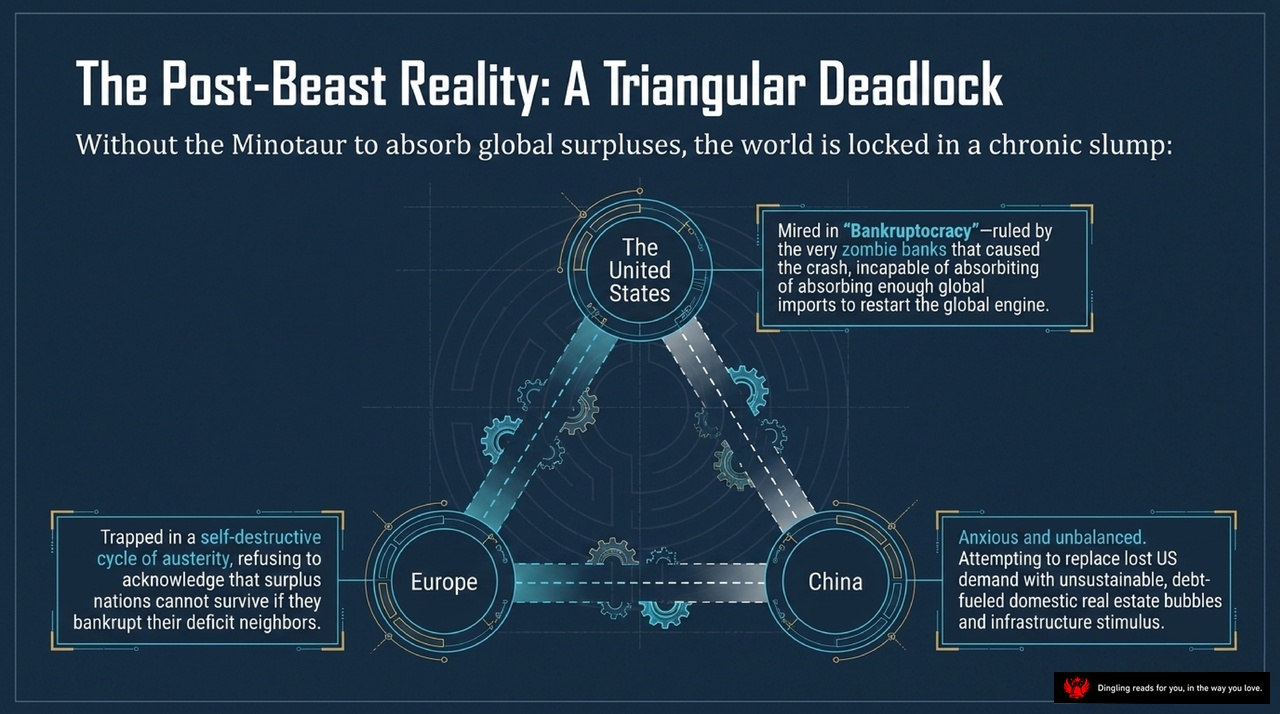
Imagine a world without the Minotaur to absorb global surpluses, and we are immediately locked in a chronic slump. This is the Post-Beast Reality, a triangular deadlock where no single player can restart the global engine. Look at the three corners of this broken system. First, the United States is mired in what we call "Bankruptocracy." Ruled by the very zombie banks that caused the crash, the U.S. is now incapable of absorbing enough global imports to fuel growth again. It's stuck in a loop where it can't drive the economy forward.
Then, look to Europe. They are trapped in a self-destructive cycle of austerity. The logic is twisted: they refuse to acknowledge that surplus nations simply cannot survive if they bankrupt their deficit neighbors. Instead of helping, they are tightening the noose, refusing to play their part in the new global balance.
Finally, consider China. It is anxious and unbalanced. After the U.S. stopped being the primary consumer, China tried to replace that lost demand with unsustainable, debt-fueled domestic real estate bubbles and massive infrastructure stimulus. But this isn't a sustainable solution; it's a fragile patch on a broken foundation.
So, we have a triangle where the top, the left, and the right are all failing simultaneously. Without a new mechanism to recycle global surplus, the world isn't just slowing down; it's heading toward a permanent stagnation. The old order has collapsed, and we are left with no clear path forward.
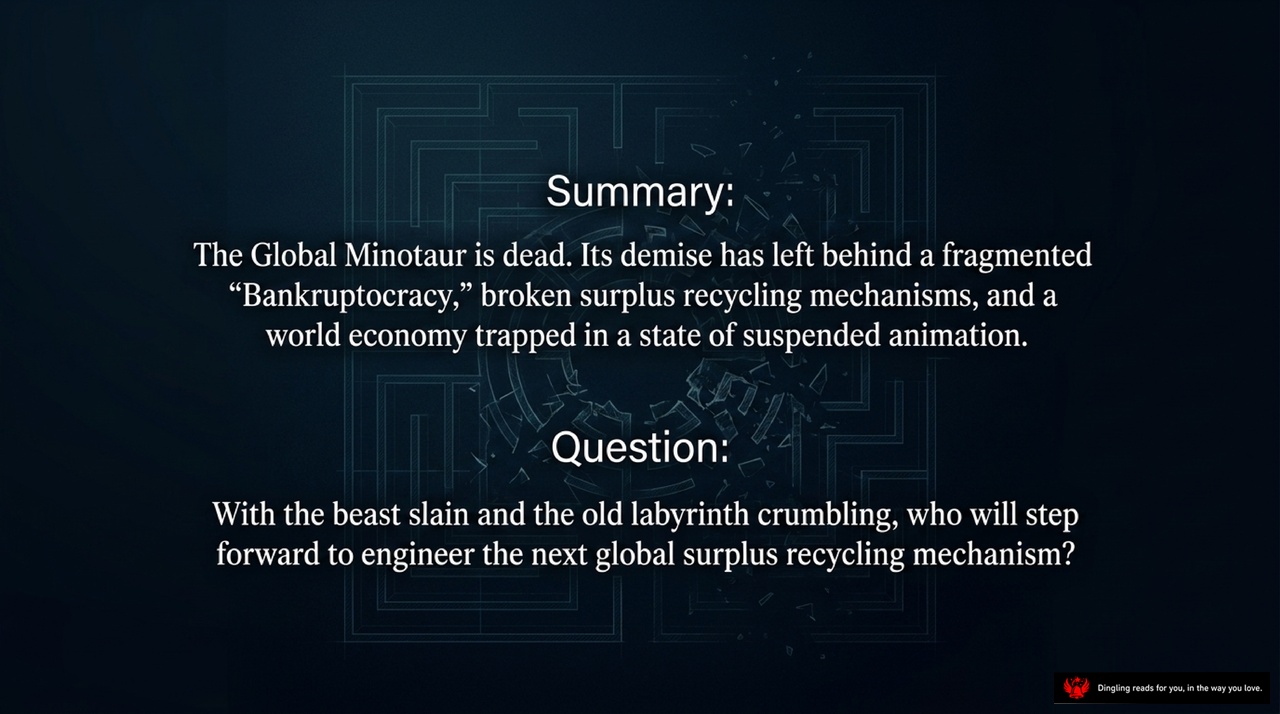
The old global order has collapsed. The "Global Minotaur" is dead, and its demise has left us in a fragmented state of suspended animation. We are now living in what the book calls a "Bankruptocracy"—a world where the old surplus recycling mechanisms are broken, and no one knows how to restart the engine of global growth.
The question on everyone's mind is: with the beast slain and the old labyrinth crumbling, who will step forward to engineer the next global surplus recycling mechanism? The old system relied on a single superpower to absorb global excess, but that model has failed. Without a new coordinator to balance supply and demand, the world faces a dangerous future of stagnation and rising inequality. The challenge now is not just to survive this crisis, but to actively design a new, inclusive global framework that can sustain prosperity for all nations, rather than just a few.