
The Gods Themselves: Complete Chapter-by-Chapter Summary
Welcome to the opening of Isaac Asimov's *The Gods Themselves*, a story that dares to ask the ultimate question: what if our reality isn't the only one?
This book is a cosmic schematic exploring scientific hubris, alien biology, and the relentless pursuit of cosmic equilibrium. It begins with a simple, haunting premise: our universe is not alone, and the laws of physics governing us are not fixed. Instead, they are permeable.
At the heart of this narrative is the "Electron Channel," a technology that taps into the energy of a parallel universe. By swapping matter between two realities, humanity gained free, infinite energy. But this convenience came with a hidden cost. As the story unfolds, we learn that this exchange isn't just about energy; it's a slow, dangerous erosion of our very existence. The physical laws of our universe are being diluted by those of the other, threatening to unravel the fabric of reality itself.
From the brilliant, stubborn physicist who first theorized the channel, to the mysterious aliens on a dying world, and the enigmatic Moon colonists guarding their own secrets, *The Gods Themselves* weaves a tale where the boundary between science and the divine blurs. It challenges us to consider: are we the masters of our fate, or merely guests in a universe far stranger and more powerful than we ever imagined?

Picture this: a ticking time bomb disguised as our greatest invention. On this slide, we see the core conflict of the story laid out in three parts. Part I is "Against Stupidity," representing the human arrogance that built the Electron Channel, believing we could harness infinite energy without consequence. But the reality was a fatal hubris—a flawed miracle.
Then we move to Part II, "The Gods Themselves." This is the tragic mirror of our own universe. It reveals that the channel wasn't just a tool; it was a bridge to a parallel universe with different physical laws. By swapping matter between these worlds, we inadvertently accelerated the decay of our own sun, setting a countdown to a solar explosion that would turn Earth into steam in eight minutes.
Finally, Part III asks, "Contend in Vain?" It explores the desperate struggle for cosmic balance. As Dr. Lamont and his allies realize the danger, they try to warn a world addicted to free energy, only to find that humanity is unwilling to sacrifice comfort for survival. The story culminates in a shocking synthesis: the very beings we think are gods, or the forces we try to control, are actually trapped in a cycle of their own making, leaving us to face the consequences of our choices alone.

The slide reveals the shocking truth behind the Tungsten mystery: a bottle labeled W-186 and a mysterious sphere trapped in a containment field. This isn't just about a strange chemical sample; it's a collision of two realities. The story begins with a petty rivalry between radiochemist Frederick Hallam and his colleague Denison. Hallam investigates an altered Tungsten sample, only to discover a localized impossibility: a substance with a charge of +94 and a mass of 186. Under Earth's laws of physics, this atom should have disintegrated instantly, yet it radiates increasingly powerful positrons. The explanation is mind-bending: the matter originates from a Parallel Universe with different natural laws, initiating a cross-universe matter exchange. This discovery didn't just solve a scientific anomaly; it birthed the concept of the Dyson Channel, allowing humanity to tap into infinite energy by swapping matter between dimensions. But as we see in the imagery, this exchange comes with a hidden cost, setting the stage for a conflict that will threaten the very fabric of our reality.
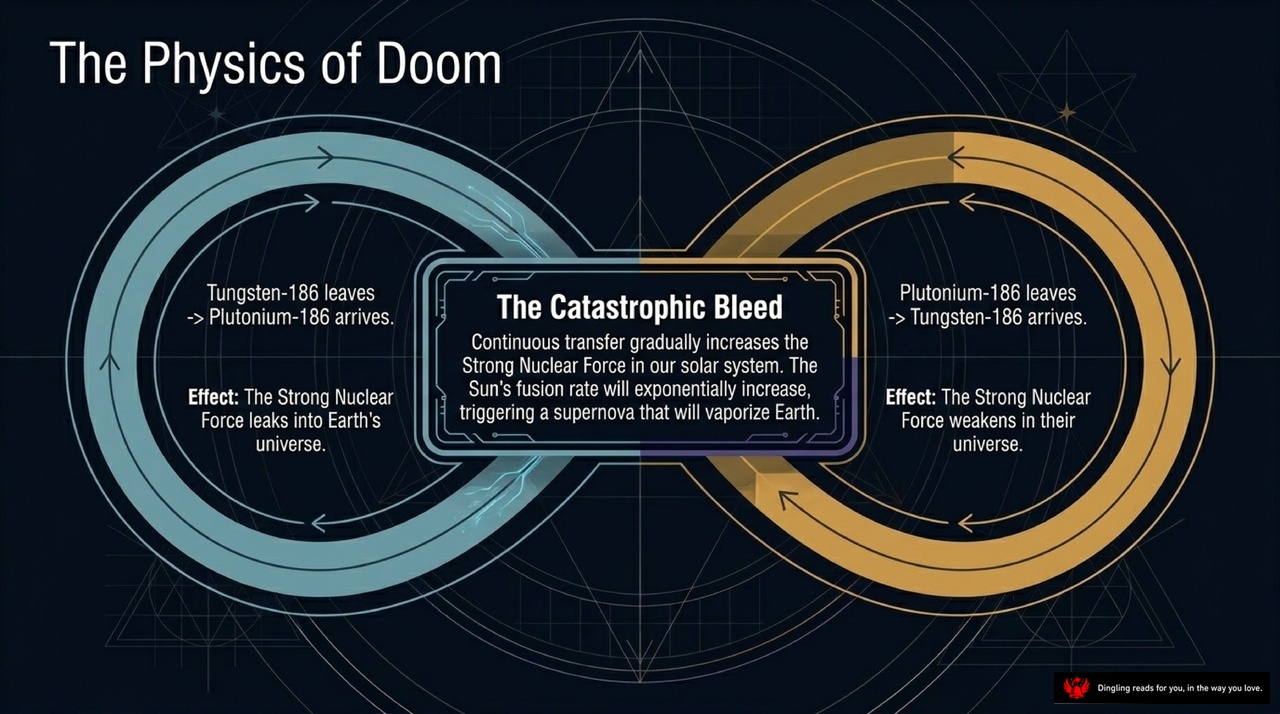
Look at this diagram titled "The Physics of Doom." It visualizes a terrifying concept known as "The Catastrophic Bleed," a scenario where the very fabric of our reality begins to unravel.
Imagine two universes, our own and a parallel one, connected by an endless exchange of matter. On the left, unstable Tungsten-186 leaves our universe and transforms into Plutonium-186 in the other. On the right, Plutonium-186 leaves the parallel universe and becomes Tungsten-186 here. This continuous transfer isn't just moving atoms; it's gradually increasing the Strong Nuclear Force within our solar system.
As these elements swap places, our universe absorbs more of the intense forces from the parallel realm. The effect is catastrophic: the Strong Nuclear Force leaks into our universe, while it weakens in theirs. This imbalance causes the Sun's fusion rate to skyrocket exponentially. The result? A supernova that would vaporize Earth in mere minutes.
The slide captures the core fear of the story: we are slowly poisoning our own universe with the physics of another, setting a ticking clock for our total destruction.
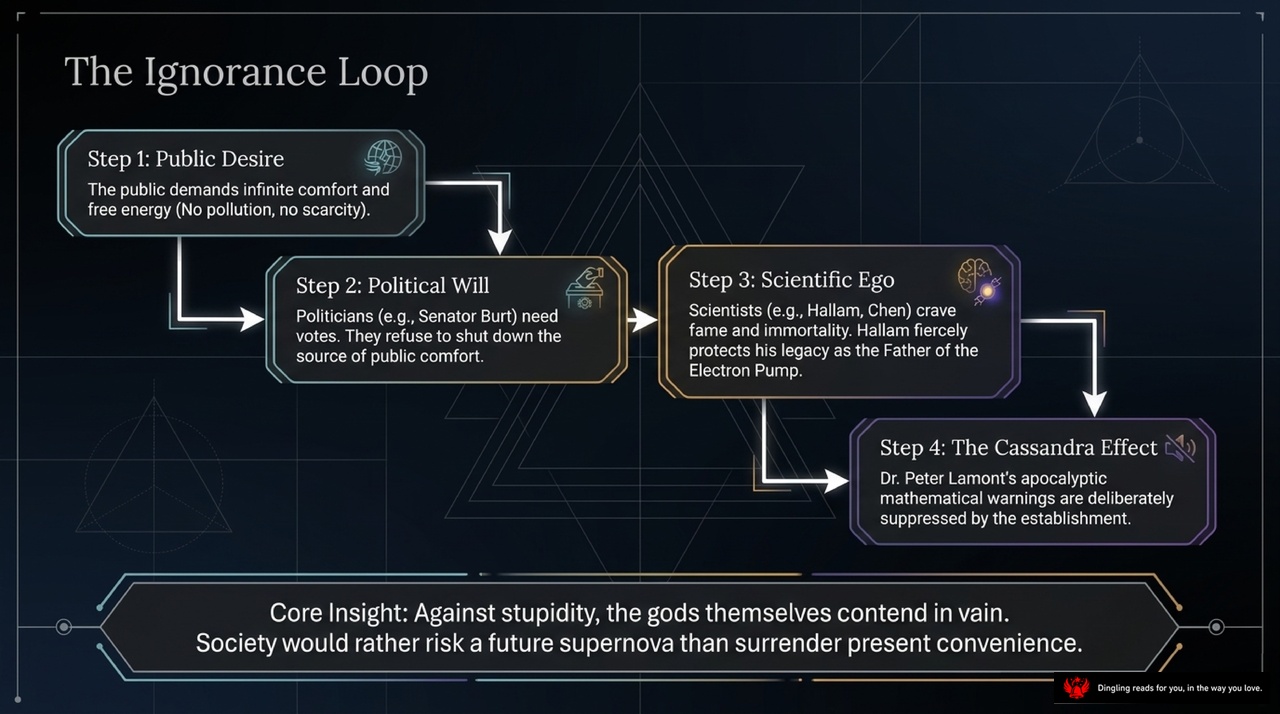
Look at this diagram: The Ignorance Loop. It's a vicious cycle that explains why humanity is hurtling toward a supernova while refusing to stop. It starts with Step 1: Public Desire. We demand infinite comfort and free energy—no pollution, no scarcity. Because we crave this, we create Step 2: Political Will. Politicians like Senator Burt need votes, so they refuse to shut down the source of our comfort, even if it's dangerous. This fuels Step 3: Scientific Ego. Scientists like Hallam crave fame and immortality. Hallam fiercely protects his legacy as the "Father of the Electron Pump," silencing anyone who questions him. This leads directly to Step 4: The Cassandra Effect. Dr. Peter Lamont's apocalyptic mathematical warnings are deliberately suppressed by the establishment. They know the truth, but they can't speak it. And the core insight at the bottom sums it all up: Against stupidity, the gods themselves contend in vain. Society would rather risk a future supernova than surrender present convenience. We are trapped in this loop, choosing our own destruction over the hard work of survival.

Look at this slide, "The Hubris Matrix." It maps the four main characters based on two axes: their desire for comfort and power versus their awareness of the coming doom. Let's break down where each of them lands and why it matters for the story.
First, look at the top right quadrant. This is Benjamin Denison. He has a low desire for comfort or power, but he possesses a high awareness of doom. He is exiled, cynical, and has been stripped of his reputation, yet this unique position makes him perfectly equipped to outmaneuver the establishment. Because he cares less about status, he is free to speak truths others are too afraid to touch.
In the bottom right, we see Senator Burt and Chen. They sit in the high desire, low awareness zone. They are aware of the risks, yes, but they prioritize political survival and personal longevity above all else. They know the channel might be dangerous, but they can't risk stopping the free energy that keeps their power and the public happy. It's the ultimate conflict of interest: safety versus comfort.
Now, move to the bottom left. This is Frederick Hallam. He is blinded by ego and his own historical legacy. He has a high desire for power and comfort, but his awareness of doom is effectively zero. He is so entrenched in his identity as the "Father of the Channel" that he refuses to even consider the possibility that his creation is a ticking time bomb. His arrogance is his fatal flaw.
Finally, in the top left, we have Peter Lamont. He is driven by absolute truth but lacks the political tact to save humanity. He has a low desire for power, yet his awareness of doom is the highest of all. He sees the impending solar explosion clearly, but because he is an outsider with no institutional power, he struggles to be heard.
This matrix perfectly illustrates the tragedy of their situation. The most dangerous people are those who believe they are safe (Hallam), while the most capable saviors are those who are powerless (Lamont and Denison). The system is designed to silence the aware and empower the oblivious, leading inevitably to the end.

Welcome back to our journey through the alien mirror. Today, we dive into Part II: The Gods Themselves.
The narrative shifts perspective to the Parallel Universe, revealing a shocking truth about the creators of the Electron Pump. We discover that these beings are not malicious invaders, but a dying race trapped by the cooling of their own sun. The true enemy is not malice, but the tragic necessity of survival.
On the other side of the universe, life has taken a different form. We meet Du'a, a unique entity who prefers the shadows of night over the harsh daylight of her kin. She is part of a triad with her Rational brother, Auden, and his Nurturing brother, Tret. While Auden seeks knowledge and Tret focuses on family, Du'a harbors a terrifying secret. She knows that the arrival of three children signals her own impending death. To escape this fate, she secretly resists reproduction, starving herself to delay the inevitable.
Her rebellion takes a dark turn when her brother, Tret, steals a dangerous energy cell from the Elders—creatures who view humans as merely immature machines to be harvested. This act, meant to help Du'a conceive, instead triggers a chain of events that reveals the horrifying reality: they are not truly alive. They are constructs designed to merge with the Elders, who are already harvesting energy from a dying parallel universe.
Du'a realizes the truth. The Electron Channel isn't a gift; it's a siphon draining the life of her world to feed the Elders. She discovers that the laws of physics from their dying universe are bleeding into hers, threatening to cause their sun to explode. Driven by this knowledge, she attempts to communicate with the aliens on the other side, begging them to shut down the channel. But her warnings fall on deaf ears. The aliens, desperate for their own survival, cannot stop the flow.
Ultimately, the tragedy culminates in a forced fusion. Auden, Tret, and Du'a are compelled to merge, becoming the very Elders they feared. They realize too late that they were the architects of their own doom all along. The gods themselves are trapped in a cycle of consumption, sacrificing one universe to survive in another, leaving no one behind.
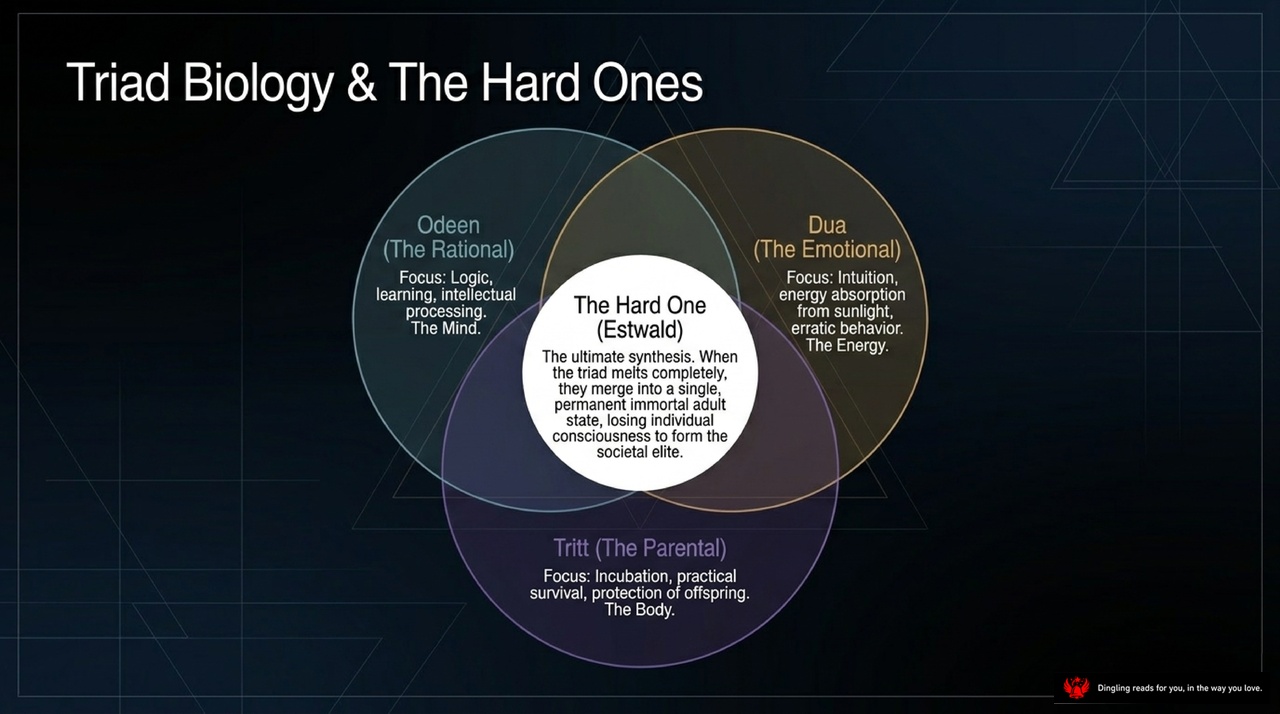
The slide before us visualizes a terrifying hierarchy of existence, a concept that feels like a secret history of our own universe. At the center sits "The Hard One," or Estwald, described as the ultimate synthesis where the triad melts completely into a single, permanent, immortal adult state. It's the loss of individual consciousness to form what we might call the societal elite.
Surrounding this core are the three biological archetypes that make up this triad. First, we have Odeen, the Rational. This is the Mind, focused on logic, learning, and intellectual processing. Then there is Dua, The Emotional. This is the Energy, driven by intuition and the absorption of sunlight, often manifesting as erratic behavior. Finally, we have Tritt, The Parental. This is the Body, dedicated to incubation, practical survival, and the protection of offspring.
The narrative we just explored reveals the tragic cost of this synthesis. Through the story of the Moon people, we see how these three forces—logic, emotion, and survival instinct—can merge not to create wisdom, but to create a tyrannical god-like entity. We saw Odeen, the rational thinker, and Tritt, the protective parent, both manipulated by their own instincts to serve a higher, cold purpose. They were essentially pawns in a game of cosmic engineering, their individuality erased to fuel a machine that could drain energy from another universe.
This "Triad Biology" suggests that what we call civilization might just be a controlled fusion of these elements, designed by a distant intelligence to sustain itself. It challenges the very idea of free will, proposing that our highest form of evolution is actually a surrender of our individual souls to become part of a collective, immortal entity. It's a chilling reminder that the pursuit of perfection might come at the price of our humanity.

Imagine a cosmic seesaw balancing the fate of two worlds. On one side, the desperate survival of the Estwalds in a parallel universe, where their sun is cooling and they engineer a pump to steal our energy, risking a supernova. On the other, the destruction of our own Earth, as pumping that energy alters our strong nuclear force. This is the tragic paradox: our morality is bound by species survival, forcing us to kill a parallel universe to save our own. The enemy acts out of the exact same self-preservation instinct as our own politicians. We are trapped in a cycle where saving ourselves requires the destruction of another.

Picture this: a desperate signal traveling across the fabric of reality from a parallel universe to our own. On the left, we see the "Parallel Universe," where a rogue intelligence named Dua has uncovered a genocidal plan and is screaming a warning. She tries to transmit a message to Earth, but what arrives is just a garbled string of symbols: F-E-E-R.
Due to a massive linguistic barrier, Earth's scientists don't see a cry for help. Instead, they interpret "FEER" as a misspelling of the word "FEAR." The result? We think a distant civilization is just expressing awe or anxiety, completely missing the catastrophic warning that our sun is about to explode. The transmission fails, and humanity remains blissfully unaware of the impending doom.

Part III: Contend in Vain? The Cosmic Balance.
Welcome to the third act of our story, where the stakes shift from political intrigue to the very fabric of reality. We leave the chaotic politics of Earth behind as Benjamin Denison, exiled by the very man he once admired, Hallam, finds himself on the Moon. This isn't just a change of scenery; it's a desperate escape from the corruption that has strangled human progress.
But here, on the silent, cratered surface, we face a terrifying new truth. Humanity's future cannot be saved by trying to fix our own flawed nature or by waiting for politicians to make the right choice. Instead, we must look outward. We must engineer a cosmic workaround.
Denison arrives here, away from the noise of Earth, to confront a paradox that threatens us all. The technology we rely on—the Electron Tube—was built on the idea that we could borrow energy from a parallel universe without consequence. But Denison, along with the brilliant but marginalized physicist Peter Lamont, realizes the cost is far too high. They see that by constantly pulling matter and energy from the other side, we are slowly eroding the physical laws of our own universe. It's a cosmic imbalance, a slow leak that could eventually cause our sun to explode, turning Earth into a cloud of steam in mere minutes.
Denison isn't alone in this vision. He is joined by Selina, a lunar native with a unique perspective, and Dr. Denison's own past regrets weigh heavily on him. He knows that Hallam's arrogance blinded everyone to the danger, and now, he must prove that the "free energy" of the Electron Tube is actually a ticking time bomb. The question remains: will humanity choose to fight for survival, or will they cling to the comfort of a lie until it's too late? This is the battle for the cosmic balance, and the clock is ticking.

Societal Divergence: Earth vs. Moon. Look at this split. On the left, Earth Society. We live in high gravity with abundant natural resources, but our psychology is defined by entitlement, short-sightedness, and intense political maneuvering. Our approach to energy is completely dependent on the Electron Pump for comfort. We are aggressively hostile to any warnings about the consequences, preferring to ignore mathematical realities for the sake of our安逸 lifestyle.
Now, look at the Lunar Society on the right. They live in a low-gravity environment within enclosed subterranean tunnels and artificial biospheres. Their psychology is the exact opposite: pragmatic, highly technical, and isolationist. Unlike Earth, they are unfettered by bureaucracy. They are led by Intuitionists who process native physics directly, leading to advanced miniaturized tech like the Pionizer. While Earth looks out the window and ignores the ticking clock, the Moon looks inward and builds the future. This divergence isn't just geography; it's a fundamental clash between a society that fears discomfort and one that embraces the unknown.
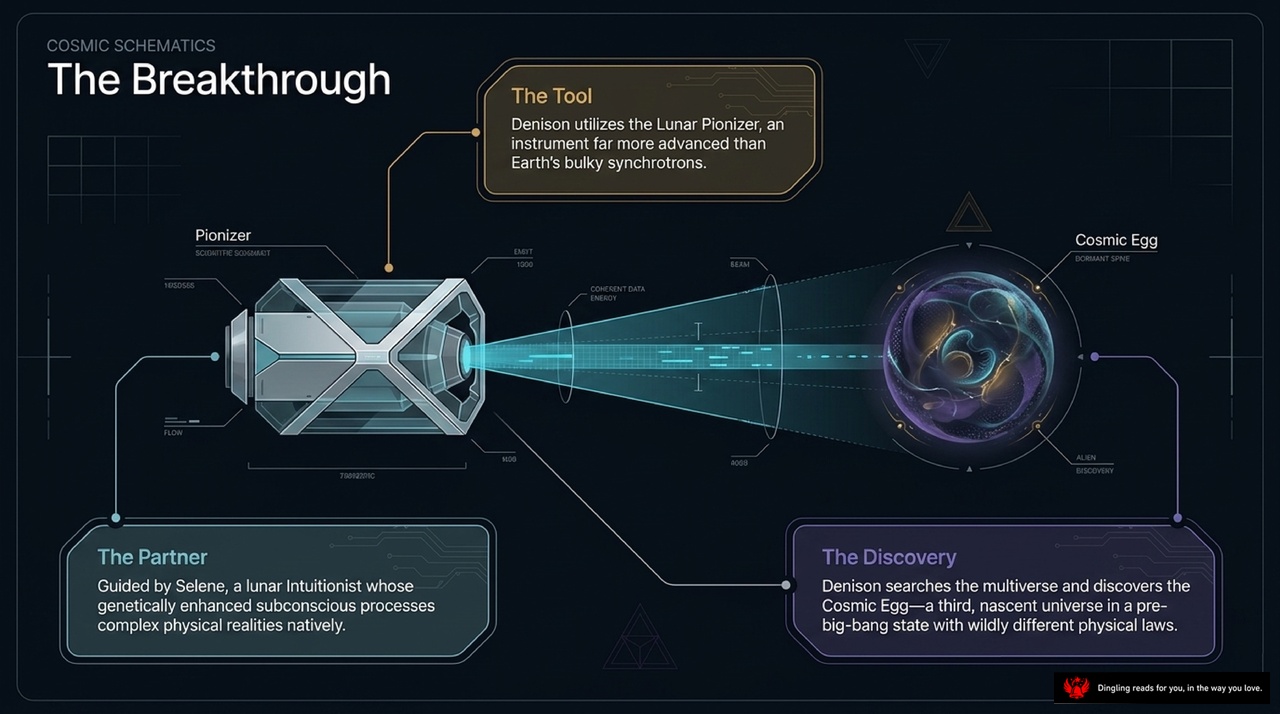
Look at this schematic titled "The Breakthrough." It maps out a high-stakes scientific mission where Dr. Denison utilizes the Lunar Pionizer, an instrument far more advanced than Earth's bulky synchrotrons. The goal is clear: to pierce the veil of our reality and reach the "Cosmic Egg," a nascent universe in a pre-big-bang state with wildly different physical laws.
This isn't just about physics; it's about survival. By searching the multiverse, Denison aims to discover this third universe to find a solution that Earth's current technology simply cannot provide. But achieving this requires a unique partner. Guided by Selene, a lunar Intuitionist whose genetically enhanced subconscious processes allow her to navigate complex physical realities natively, the team bridges the gap between human intuition and cosmic mechanics.
The discovery they seek is nothing short of revolutionary. By interacting with the Cosmic Egg, they hope to harness energy from a realm where the laws of nature are entirely alien. This breakthrough represents a shift from trying to force our universe to adapt, to instead tapping into a new source of existence. It's a bold leap into the unknown, driven by the desperate need to find answers that lie beyond our own horizon.

Look at this diagnostic chart. It lays out the terrifying stakes of the "Three Universes" theory. We have Earth's Universe as the baseline, currently facing a localized supernova. But the real danger lies in the Parallel Universe. It's 100 times stronger, a tiny, highly reactive entity cooling rapidly. Right now, it acts as an energy source, a "Pump 1," pushing Earth's nuclear force dangerously up. If we don't act, the strong force in our sun will amplify until the star explodes, turning Earth into steam in minutes.
The only hope is the Cosmic Egg. It's exceedingly weak, a massive, unignited single star. It functions as an energy sink, or "Pump 2." Its role is to pull Earth's nuclear force safely down, acting as a counterbalance. The story of Dr. Lamont and his rival Harram hinges on this delicate equilibrium. Harram believed the channels were safe, while Lamont, backed by the brilliant Denisson, realized that the laws of the Parallel Universe were seeping into ours. Without the Cosmic Egg to stabilize the system, the influx of energy from the Parallel Universe would eventually shatter our own. The conflict isn't just about who is smarter; it's a race against time to prevent a cosmic collision before the balance tips too far.

Imagine a universe where energy isn't just harvested, but perfectly balanced through a dual-pump system. On one side, we have Earth's universe, where the solution lies in draining excess strong nuclear force to cool the reaction and prevent a runaway supernova. On the other side, we tap into a parallel universe, injecting energy to fuel our world without destabilizing our own. This is the synthesis: by tapping both universes simultaneously, Earth receives unlimited energy from both ends while physical laws remain perfectly balanced at baseline. The threat is neutralized through superior engineering. It's a brilliant vision of cosmic equilibrium, where the fear of solar explosion is replaced by the promise of infinite power, achieved not by domination, but by a delicate, engineered harmony between two realities.

Here is the spoken-word script for Slide 15, tailored for an American audience with a natural, engaging narrative style.
**Slide 15 Script:**
"Let's talk about the core critique. The slide breaks it down into two paths: the failed path of moral reform versus the successful path of engineering. Think about it this way: trying to cure human greed and stupidity is a futile effort. As the text puts it, even the gods contend in vain when asking humanity to sacrifice comfort for abstract survival. That's why Lamont failed; he wanted us to be better people, but that's just asking for the impossible.
The real success story, however, is Denison's approach to engineering. He succeeded not by changing human nature, but by bypassing it entirely. You cannot legislate away human hubris or selfishness. Instead, you must engineer systems so robust that our selfishness becomes harmless. This is the key takeaway: Science's role isn't to change who we are, but to balance the scales of our mistakes. We don't fix the driver; we build a car that can't crash. That's the only way we survive."
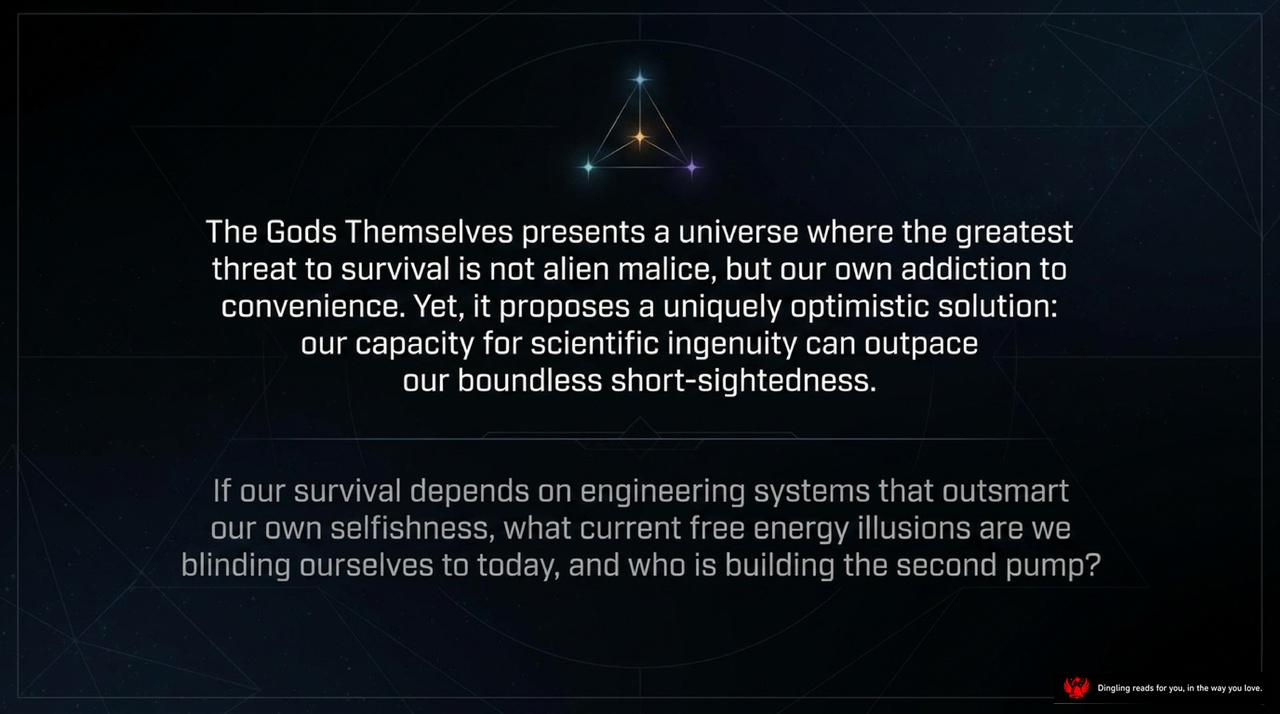
The greatest threat to our survival isn't an alien invasion; it's our own addiction to convenience. As the slide suggests, even the gods themselves face a universe where our boundless short-sightedness outpaces our ingenuity. We are blindly building systems to outsmart our own selfishness, ignoring the "free energy illusions" that are actually ticking time bombs. But here is the optimistic twist: our capacity for scientific ingenuity can still outpace our blindness. If survival depends on engineering systems that outsmart our nature, we must ask ourselves: what current illusions are we ignoring today, and who is quietly building the second pump that could tip the balance? The answer lies not in fear, but in the courage to challenge the very foundations of our energy and existence.