
The Grand Chessboard: Complete Chapter-by-Chapter Summary

Welcome to today's session on "The Grand Chessboard." This slide sets the stage for our entire discussion: American Primacy and its Geostrategic Imperatives.
At the heart of this framework is a bold thesis. In the final decade of the 20th century, world affairs underwent a structural shift. For the first time, a non-Eurasian power emerged not only as the primary arbiter of Eurasian power relations but as the world's paramount global power. This is the defining reality of our time.
Our objective is clear. The ultimate geostrategic goal is to manage the complex interplay of Eurasian actors, prevent the emergence of a dominant and hostile Eurasian coalition, and lay the groundwork for a cooperative global community. As you see on the map, the focus is squarely on Eurasia—the world's center of gravity. It is the largest continent, home to three-quarters of the world's population and most of its energy resources.
The United States is the only global superpower capable of engaging with this vast landmass. Unlike historical empires that were limited by geography or culture, America's power is global. But maintaining this position requires a delicate balance. We must ensure that the middle ground of Eurasia does not fall under a single hegemon, that the southern flank remains open, and that the eastern powers do not unite to push us out of our key bases.
This is not about conquest; it is about managing a dynamic, interconnected system. By understanding the key players and the shifting dynamics of this "Grand Chessboard," we can navigate the challenges of the 21st century and secure a stable future for all.

The Evolution of Global Hegemony isn't just a history lesson; it's the blueprint for understanding our current world order. Look at this table: it maps out how empires have risen and fallen over centuries, from Rome to today's United States.
Notice the shift in the "Basis of Rule." Ancient empires like Rome relied on Military and Cultural power, while Han/Qing China leaned on Bureaucracy and Ethnic identity. The Mongols used Advanced Military Tactics, and the British Empire dominated through Naval power and Trade. But the United States is different. As highlighted in the bottom row, its power rests on a unique blend of Technological, Economic, and Cultural influence. Unlike previous empires that relied on direct colonial control, the U.S. operates through a truly global network of institutional influence.
This evolution explains why the U.S. didn't just conquer land; it built a system. While Rome collapsed due to overextension and internal fragmentation, and China fell from internal decay, the American model is about connecting the world through shared interests and institutions. This shift from direct rule to interconnected influence is what defines the modern era.

Let's dive into the architecture of American indirect hegemony. As we see in the diagram, the United States doesn't rule through direct conquest or a rigid empire; instead, it operates as the central hub of a complex, interconnected web. At the core sits the U.S., but its true power comes from four distinct pillars radiating outward.
First, look at the **Military** sector. The slide highlights "unmatched global reach," describing it as the only force capable of sustained, coordinated land-sea-air deployment across multiple theaters simultaneously. This isn't just about having weapons; it's about the ability to project power anywhere on Earth at any time, a capability no other nation possesses.
Moving clockwise, we hit the **Economic** pillar. Here, the U.S. acts as the primary engine of global growth, representing roughly 30% of the global GNP. It's not just about being the biggest economy; it's about setting the rules for trade and finance that the rest of the world follows.
Next is the **Technological** advantage. The slide notes "absolute dominance in cutting-edge innovation." From the internet to advanced manufacturing, American tech standards define the modern world, giving the U.S. a decisive edge in the information age.
Then, we see the **Cultural** influence. Described as having "unrivaled magnetic appeal," American culture exports a mix of idealism and pragmatism that attracts global youth and shapes the values of future leaders worldwide.
Finally, tying all these pillars together is the **Global Institutional Architecture**. Encircling the entire system, we see organizations like the IMF, World Bank, NATO, and WTO. These aren't neutral entities; they are the tools that cement American leadership. By shaping these institutions, the U.S. ensures that the economic, military, and technological advantages it holds are institutionalized into the very rules of global order.
So, the takeaway is clear: American hegemony isn't about a single source of power. It's a synergistic system where military might, economic strength, technological innovation, and cultural appeal are all woven together by a network of global institutions. This creates a self-reinforcing cycle that makes the U.S. the indispensable architect of the modern world.

Look at this map of Eurasia. This isn't just a continent; it's the global axis. As the slide highlights, Eurasia holds the cards: it contains 75% of the world's total population, accounts for approximately 60% of the global GNP, and holds 75% of the world's known energy resources. The logic is simple but powerful: whoever controls Eurasia controls the world.
Think about the implications. If you dominate this landmass, you naturally subordinate Africa and render the Western Hemisphere and Oceania geopolitically peripheral. It's the core rule of the game. Historically, from the Roman Empire to the British Empire, power was defined by control over this central stage. Today, the United States has stepped onto this board as the first true global superpower. Unlike past empires that relied on direct territorial control or rigid hierarchies, America's dominance is built on a flexible network of alliances, economic leverage, and cultural influence.
But controlling this axis isn't automatic. The slide implies a high-stakes game where the middle ground must align with Western interests, and no single nation can dominate the southern regions. The future of Europe, the rise of China, and the stability of the Eurasian "Balkans" are all variables in this equation. The United States must navigate these complexities not by conquering land, but by shaping the rules of the game, ensuring that Eurasia remains a zone of cooperation rather than a battlefield for a new hegemon. Ultimately, the stability of the entire global order depends on how well America can manage this central axis.

Let's dive into the chessboard of Eurasia. To understand how the United States plays this game, we first need to distinguish between two types of players: Geostrategic Players and Geopolitical Pivots.
As our slide clearly outlines, Geostrategic Players are the states with the capacity and national will to project power beyond their borders and actively alter the geopolitical status quo. Think of them as the heavy hitters who can change the rules. This category includes major powers like France, Germany, Russia, China, and India. These nations don't just react to the world; they shape it.
On the other hand, we have Geopolitical Pivots. These states derive their importance not from their own raw power, but from their sensitive geographic location and their vulnerability to external players. They are the linchpins of the board. If a Pivot shifts, the entire balance of power wobbles. Key examples here are Ukraine, Azerbaijan, South Korea, Turkey, and Iran. For instance, Ukraine's independence directly determines whether Russia can ever become a Eurasian empire, while Azerbaijan acts as the critical bottleneck for energy flowing from the Caspian Sea to the West.
The United States' strategy relies on identifying these actors. It must either co-opt or balance the Geostrategic Players to prevent any single one from dominating the continent, while simultaneously managing the Geopolitical Pivots to ensure they don't become proxies for a rival power. By understanding who holds the cards and who controls the terrain, the U.S. can navigate the complex five core policy challenges facing Eurasia today.

Look at this map of the Western Front. It illustrates a critical concept: Europe acting as the democratic bridgehead. The image highlights the "Weimar Triangle," a powerful geopolitical axis connecting France, Germany, and Poland. This 180-million-strong bloc is crucial for securing Europe's position and expanding the democratic zone eastward.
But why does this triangle matter so much? It all comes down to the competing visions of its two core architects. On one side, you have the French vision, driven by a desire for glory. France seeks a European reincarnation to restore its historical grandeur, aiming for a continent capable of operating independently of US hegemony. On the other side stands the German vision, focused on redemption. Germany seeks historical purification through deep integration and desires absolute security through an unbreakable bond with the United States and NATO expansion eastward.
The tension and synergy between these two visions define the future of the West. France wants to lead a sovereign Europe, while Germany prioritizes stability through its alliance with the US. As the slide notes, the Weimar Triangle serves as the essential bridgehead. For the US, maintaining this relationship is non-negotiable. Without a unified and strong Europe, America loses its vital foothold in Eurasia. The US doesn't need to choose between Paris or Berlin; it needs both. A fractured Europe weakens the entire trans-Atlantic alliance, while a united Europe, anchored by the Weimar Triangle, becomes a powerful partner that can share the burden of global leadership and secure the democratic order from the Atlantic to the Urals.

Look at this map. We're looking at the center of Russia, which the book describes as a "Geopolitical Black Hole." This isn't just a metaphor; it's the direct result of the Soviet Union's collapse in 1991. Overnight, the world's largest country lost its status as a Eurasian empire. Its borders were pushed back dramatically—westward to the 1600s, and southward, losing the Caucasus and Central Asia. This isolation cut Russia off from 300 million Muslims and the Caspian Basin, effectively turning it into a regional third-world state armed with a decaying nuclear arsenal.
But the crisis goes deeper than just lost territory. The slide highlights some stark internal metrics that show just how fragile this state has become. Male life expectancy has plummeted to just 57.3 years, and in many places, death rates have actually surpassed birth rates. There is widespread economic dislocation, and the country is struggling to define itself after centuries of imperial rule.
For the United States, this "black hole" in the center of Eurasia is a major strategic challenge. Russia is too weak to be an equal partner, but too dangerous to simply ignore, especially with its nuclear capabilities. The book argues that the only viable path forward is to help Russia abandon its imperial ambitions and integrate into the broader European and Atlantic system. By supporting the sovereignty of nations like Ukraine and fostering cooperation with neighbors like Turkey and Iran, the U.S. can prevent Russia from becoming a source of instability and instead turn it into a stabilizing force within a diversified Eurasian order.

Russia's Strategic Decision Tree isn't just a flowchart; it's a roadmap for the future of a post-imperial superpower. Let's break down the three paths outlined on this slide.
First, we have Path A: The "Near Abroad" Empire. This scenario involves Russia attempting to forcefully re-integrate the former Soviet states. The outcome here is grim: endless conflict with newly awakened nationalist states, economic bankruptcy, and the rise of an increasingly "Asianized" empire completely cut off from Europe.
Second, Path B: The Anti-Hegemonic Alliance. Here, Russia forms a geopolitical bloc with China and Iran to counter the United States. While this might offer short-term relief, the long-term result is a junior partnership with a massive, dynamic China, leading to sustained technological and economic isolation for Russia.
Finally, we arrive at Path C: The European Choice. This path requires abandoning imperial delusions in favor of democratic consolidation and integration into the transatlantic system. The text on the slide clearly marks this as the only viable path. The outcome is modernization, security, and eventual inclusion in a broader European security architecture.
Ultimately, the slide argues that for Russia to survive and thrive, it must choose Path C. Only by letting go of the past and embracing a European future can it avoid the pitfalls of isolation and conflict.

The slide you see here lays out a stark, high-stakes equation for Russia's future, and it all comes down to one critical pivot: Ukraine. The graphic clearly states that Russia plus Ukraine equals a Eurasian Empire, while Russia minus Ukraine leaves only a regional Asian power. This isn't just about territory; it's about Russia's entire identity and global reach.
The text highlights that losing Ukraine's 52 million people and its vast industrial base would shatter the dream of a pan-Slavic Russian empire. Without Ukraine, any attempt by Russia to rebuild as a great power would force it into endless, draining conflicts with non-Slavic, Islamic populations in Central Asia. In essence, Ukraine acts as a buffer and a bridge. Securing an independent Ukraine is the catalyst that could force Russia to abandon its imperial ambitions and finally choose the path of European modernization.
Geographically, as the map shows, Ukraine sits right at the crossroads, locking the Black Sea and controlling the gateway to the interior. For the West, supporting Ukraine isn't just about saving a nation; it's about preventing a resurgent, isolationist Russia from dominating the Eurasian landmass and dragging the region back into a cycle of conflict. The choice is clear: keep Ukraine, and you have a potential partner for a modern Europe. Lose it, and you risk creating a fortress state that turns inward and outward hostile.
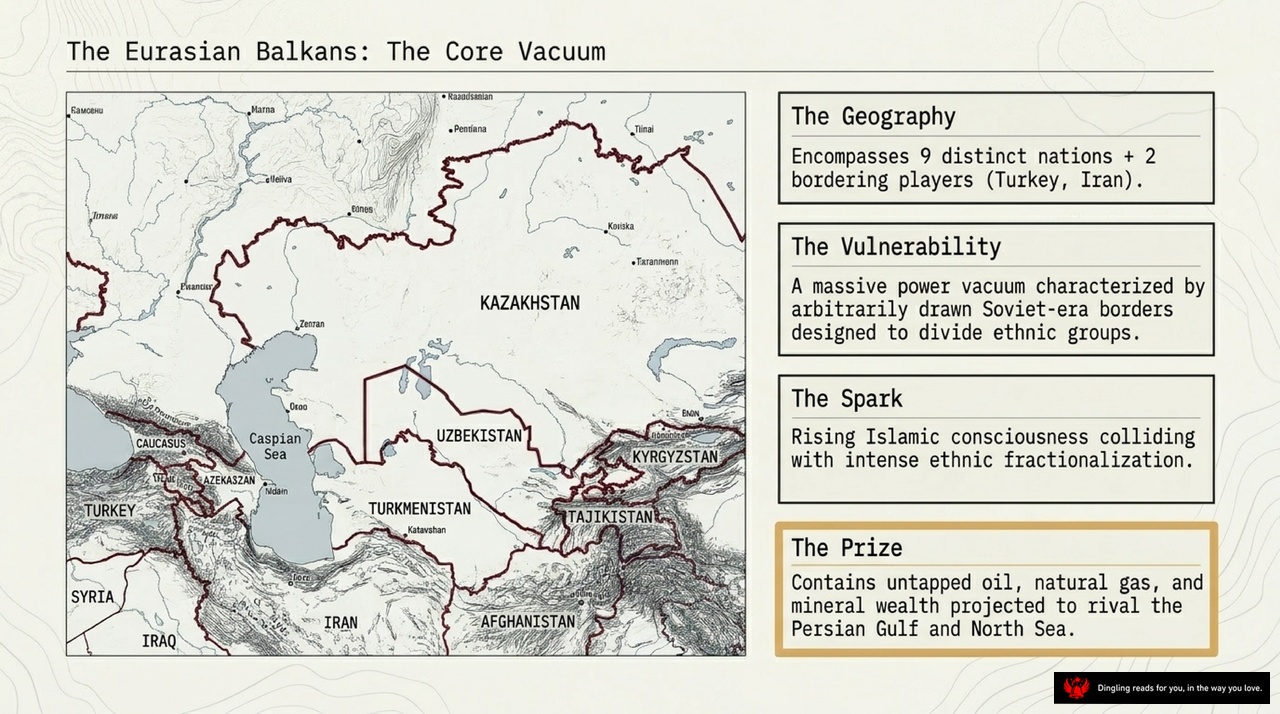
Look at this map of the Eurasian Balkans. We're looking at a massive power vacuum that spans nine distinct nations, plus two bordering players: Turkey and Iran. This region isn't just a map; it's a pressure cooker. The vulnerability here stems from a massive power vacuum characterized by arbitrarily drawn Soviet-era borders designed specifically to divide ethnic groups. These lines were drawn without regard for the people living there, creating a legacy of instability that persists today.
Now, what could ignite this powder keg? The spark is rising Islamic consciousness colliding with intense ethnic fractionalization. As these groups awaken and assert their identities, they are clashing against the artificial borders left behind. But why does the world care? Because this area holds the prize: untapped oil, natural gas, and mineral wealth projected to rival the Persian Gulf and the North Sea. It is a treasure trove that has made every major power—from Russia to the US to China—eye this region with intense interest.
Essentially, this is a complex multi-player game where history, religion, and economics are all fighting for control. The core issue remains that without a unifying authority, these resources and strategic routes remain locked in a dangerous standoff, waiting for the next spark to turn this vacuum into a conflict zone.

Look at this map of the Caspian Basin. It's not just a body of water; it's a flashpoint where four major powers are pulling in opposite directions, each trying to control the energy and routes flowing through this region.
On the top, Russia is pushing down. Their goal is to maintain an absolute monopoly over all transit routes and pipelines. They treat this entire region as their exclusive "Near Abroad," trying to keep every energy stream flowing through their territory to preserve their political and economic dominance.
From the right, China is pushing left. Driven by explosive economic growth and a massive hunger for energy, Beijing is seeking direct overland pipeline access. They want to bypass the traditional maritime chokepoints and reduce their dependence on any single power, making the Caspian a crucial artery for their development.
On the left, Turkey is pushing eastward. Leveraging deep ethno-linguistic ties with the Turkic nations in the region, Ankara is projecting influence westward toward the Mediterranean. Their strategy is to build pipelines that bypass Russia entirely, securing their own energy independence and boosting their regional status.
Finally, coming up from the bottom, Iran is pushing north. Tehran is projecting religious and cultural influence, seeking to secure buffers against Azerbaijan and route energy southward to the Persian Gulf. They are trying to prevent the region from becoming solely a Russian or Western sphere.
The result is a complex competition. Russia wants to control the flow; China wants to bypass the chokepoints; Turkey wants to link to the West without Moscow; and Iran wants to secure its northern flank. As the text highlights, this isn't just about oil and gas; it's about who holds the keys to the future of Eurasia.

The East Asian balance of power is currently teetering on a knife's edge, defined by a delicate and potentially unstable equilibrium. As our slide illustrates, the region lacks the robust, multilateral security architecture that Europe enjoys under NATO; instead, it is a volatile mix of unprecedented economic growth clashing with deep-seated historical resentment.
On one side of this scale sits China's rapid rise. With its economy surging to match its growing political ambition, Beijing is transitioning into the dominant regional power, driven by a historical consciousness that views itself as the "Middle Kingdom." This shift demands a sphere of influence that is rapidly expanding, challenging the existing order.
Opposing this momentum on the other side is Japan's profound paradox. While it stands as a global economic superpower, its security remains entirely tethered to the American military umbrella. This dependency is a double-edged sword: it keeps the peace but also fuels a deep historical resentment in the region, creating a mass nationalism that makes Japan's potential rearmament a highly sensitive and explosive issue.
For the United States, the imperative is clear and difficult to navigate. Washington must accommodate China's rise without abandoning its role as the ultimate security guarantor for Japan and South Korea. The risk here is high; if the US pulls back, it could trigger a regional backlash or force Japan into an unprepared rearmament. Conversely, if the US overextends itself, it might lose its leverage. This is the metastable reality of the Far East—a fragile state where a slight shift in weight could tip the entire geopolitical scale into chaos.

Look at this map of the Pacific Littoral. We are identifying four critical flashpoints that could ignite the next major conflict in the region. Let's break down what makes each of these nodes so dangerous.
First, Node 1 is Taiwan. This isn't just a territorial dispute; it represents the ultimate test of U.S. credibility versus Chinese national sovereignty. If this flashpoint explodes, it fundamentally challenges the global order.
Next, we have Node 2, the South China Sea. Here, the stakes are contested maritime borders and seabed energy resources. Specifically, the Spratly and Paracel Islands are pitting China directly against Southeast Asian nations, turning a resource-rich area into a potential powder keg.
Moving north, Node 3 is the Korean Peninsula. The threat here is the sudden reunification or outright conflict. This is critical because if it happens, it could eliminate the rationale for the U.S. troop presence in the region and force Japan into remilitarization, drastically altering the balance of power.
Finally, Node 4 covers the Senkaku/Diaoyu Islands. These are territorial disputes capable of igniting intense historical animosity between China and Japan. Even a minor incident here could quickly escalate into a broader regional war.
Together, these four nodes form the core of potential instability in the Pacific. Understanding where these flashpoints lie is essential for grasping the future of global security.

The Anti-Hegemonic Nightmare isn't just a headline; it's a terrifyingly plausible future scenario for the United States. As we look at this map, the most significant threat isn't a single rising superpower, but a "grand coalition" of aggrieved regional powers—Russia, China, and Iran—united not by shared ideology, but by a deep-seated resentment of American hegemony. This potential bloc would mirror the scale of the historic Sino-Siet block, with China as the dominant senior partner and Russia as the follower. While such a strategic alliance is unlikely due to inherent mistrust between these nations, it remains the absolute worst-case scenario for U.S. primacy.
For American diplomacy, the imperative is clear and urgent: we must continuously maneuver on the Western, Eastern, and Southern edges of Eurasia simultaneously. Our goal is to prevent these powers from coalescing into a unified front that could challenge our global standing. The U.S. cannot afford to be pushed out of the Eurasian landmass, which holds the majority of the world's population, resources, and economic power. By identifying and engaging these key strategic players—whether through alliance, diplomacy, or careful balancing—we must ensure that the Eurasian chessboard remains a arena for competition and cooperation, rather than a battleground for a new, exclusionary empire. The stability of the global order depends on our ability to manage these dynamics before they spiral out of control.

The slide illustrates a profound shift in how America views its place in the world: moving from a solitary "Unipolar US" standing atop a pedestal to a collaborative partner integrated into a global dome. This visual metaphor captures the book's core argument—that American hegemony, while historically unique, is not permanent. The reality of power dictates that the era of unilateral dominance is ending, making way for a truly multipolar world.
Instead of clinging to the old model of global primacy, the ultimate objective is to use the current window of American strength to build a deeply institutionalized, cooperative global architecture. The goal isn't to maintain a monopoly forever, but to construct a system where the US is a central pillar within a broader structure, ensuring that even as American power relatively declines, the global order remains stable and resilient. We are moving away from a world defined by violence and zero-sum competition toward a truly cooperative global community. This strategic pivot is essential for America to leave a lasting legacy as the last true global superpower, ensuring that the future of the world is shaped by partnership rather than domination.