
The Great Debate: Complete Chapter-by-Chapter Summary
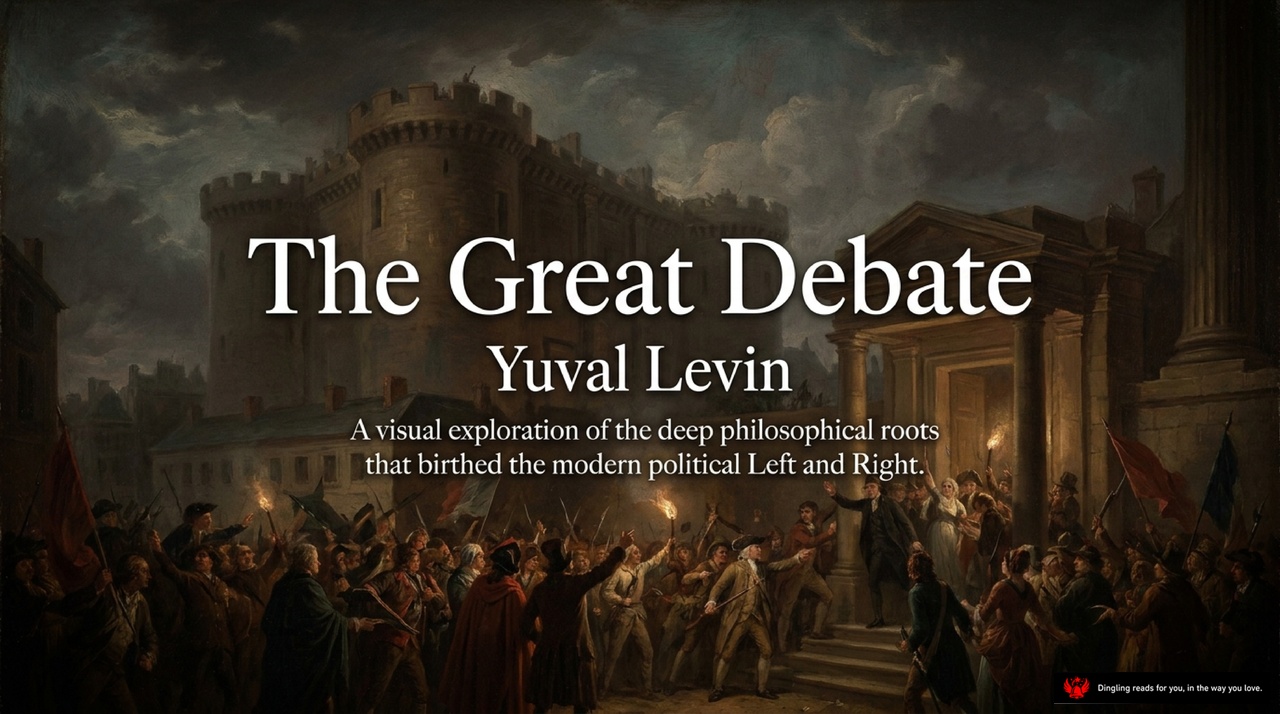
Welcome to the opening of "The Great Debate," where we explore the deep philosophical roots that birthed the modern political Left and Right. This visual captures a pivotal moment in history: the stormy night of revolution, where old orders crumbled and new ideas ignited a fire that still burns today.
In the late 18th century, Europe and North America stood at a crossroads. The Enlightenment's ideals of reason, liberty, and equality swept like wildfire, challenging the divine right of kings and the monopoly of the aristocracy. As the Industrial Revolution began to reshape society, new classes emerged, creating a fertile ground for intense political conflict.
This was an era where philosophy and politics were inseparable. While the American Revolution fired the first shot for liberty, inspiring hope across the Atlantic, the French Revolution was brewing, threatening to tear apart centuries of tradition. Into this chaotic landscape stepped two giants: Edmund Burke and Thomas Paine. Though they lived in the same time, they stood on opposite sides of the intellectual divide. Burke, rooted in history and tradition, feared the chaos of abstract ideals. Paine, driven by reason and natural rights, believed that humanity could reinvent itself from scratch.
Their debate was not just about personal differences; it was a clash of worlds. One side argued that society is an organic entity built on the wisdom of the past, requiring careful preservation. The other insisted that individuals are born free, and any government that fails to protect their rights must be overthrown. This fundamental disagreement—between the reverence for the past and the faith in the future—defined the political spectrum for centuries to come. As we dive deeper, we will see how their arguments still shape our world today.

Look at this split table setting. On the left, we have a cold, blue blueprint; on the right, a warm, antique wooden table. This visual perfectly captures the moment on August 18, 1788, when Edmund Burke and Thomas Paine shared a friendly dinner with the Duke of Portland. At that exact moment, they were political allies who genuinely loved liberty. But look at the transformation. Within just a few short years, those same men would become bitter ideological arch-enemies.
Their debate didn't just happen in a vacuum; it sparked the most important political argument in the English language, drawing the battle lines for modern politics. Today, we see the legacy of that dinner everywhere. It defined the split between the "Right" and the "Left." Burke became the voice of the Right, championing the preservation of tradition and organic order, while Paine became the voice of the Left, demanding a total revolution based on abstract rational principles. This single dinner set the stage for a conflict that still shapes our world today.
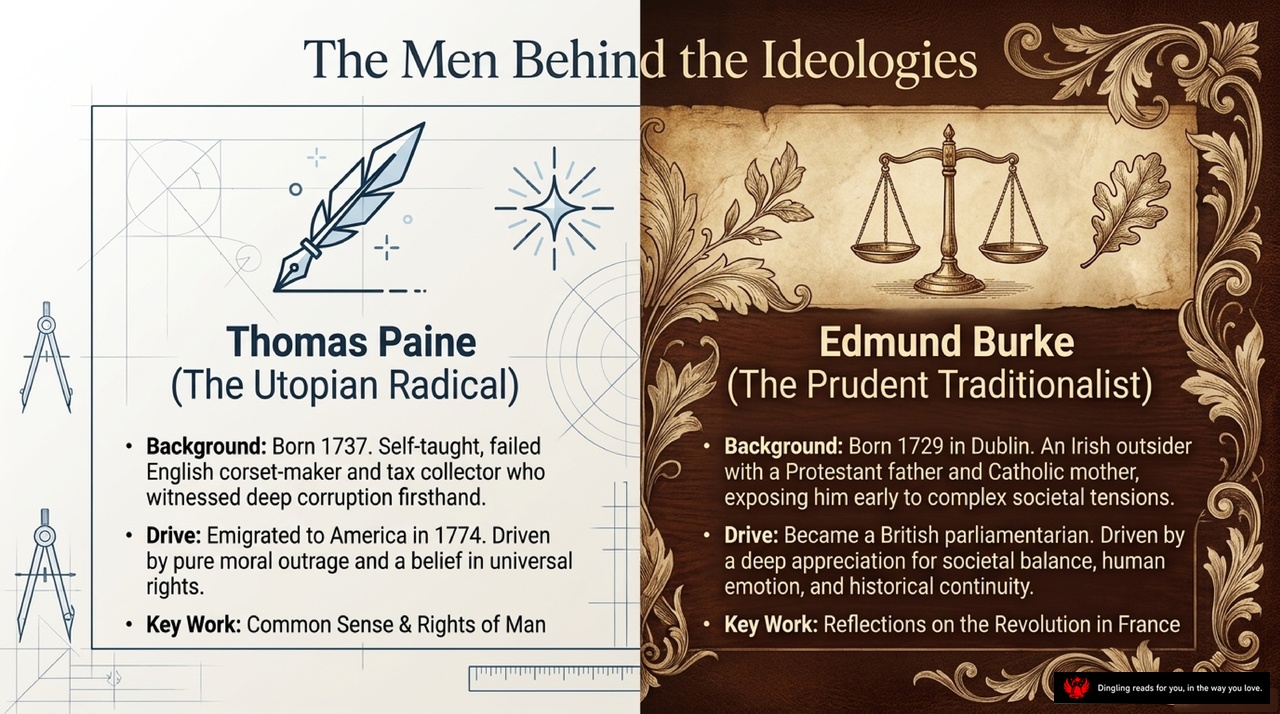
Thomas Paine and Edmund Burke: The Utopian Radical vs. The Prudent Traditionalist. Today, we dive into the two giants who shaped modern politics.
On the left, Thomas Paine, the self-taught son of a corset-maker. Born in 1737, he was a tax collector who saw corruption firsthand. This fueled his drive: pure moral outrage and a belief in universal rights. He emigrated to America in 1774, becoming the voice for the common man with his key works, *Common Sense* and *Rights of Man*.
On the right stands Edmund Burke, the Prudent Traditionalist. Born in Dublin in 1729, he was an Irish outsider with a Protestant father and Catholic mother, giving him an early, deep understanding of societal tension. Unlike Paine, Burke became a British parliamentarian. His drive wasn't to tear things down, but to appreciate societal balance, human emotion, and historical continuity. His masterpieces, *Reflections on the Revolution in France*, laid out his conservative vision.
These two men represent the eternal clash between radical change and the wisdom of tradition. Paine saw the world as a blank slate where reason could build a perfect new order. Burke saw it as a complex, living organism where tradition and gradual reform were the only path to stability. Their debate isn't just history; it's the foundation of the political spectrum we still use today.

Modern political divides often feel like a shouting match over surface issues—taxes, foreign policy, education, or welfare. But as this iceberg illustrates, those visible clashes are merely the tip of the problem. The massive, submerged mass driving our deepest divisions is actually political philosophy.
Above the water, we argue about the mechanics of governance. But below the surface, the real battle is over fundamental questions: What is the true nature of humanity? How do we define justice? What value does tradition hold, and what is the proper role of reason in our lives?
These aren't just academic debates; they are the bedrock of everything we do. When we argue about policy, we are ultimately arguing about these deeper principles. Understanding the philosophy beneath the policy is the only way to truly understand why we disagree so fiercely today.

Battleground 1: Nature vs. History. This isn't just a title; it's the fundamental fault line that split the 18th century. Look at the left side: The State of Nature. Here, we see a sterile, geometric vision. The text argues we must strip away history to find true equality, viewing society as nothing more than a collection of unconnected individuals and history as mere corruption. This is the radical view: a blank slate where everyone starts as the "first man," born free and equal, with no debts to the past.
Now, look at the right side: The Given World. This is the earthy, complex reality. It shows deep roots tangled with ancient artifacts, representing a world where human nature cannot be understood outside of society. History isn't corruption here; it's our natural habitat. We are shaped by a layered, complex environment we inherit. There is no pure natural state to return to. As the text warns, without these traditions and the wisdom of generations, we risk becoming "summer flies"—brief, chaotic, and lost.
So, which side wins? One side believes in starting from zero, trusting abstract reason to build a perfect society from scratch. The other believes in the slow, messy accumulation of wisdom, arguing that true freedom only exists within the protective framework of established order. This clash between the radical urge to reset the clock and the conservative need to honor our roots defines the very DNA of modern politics.
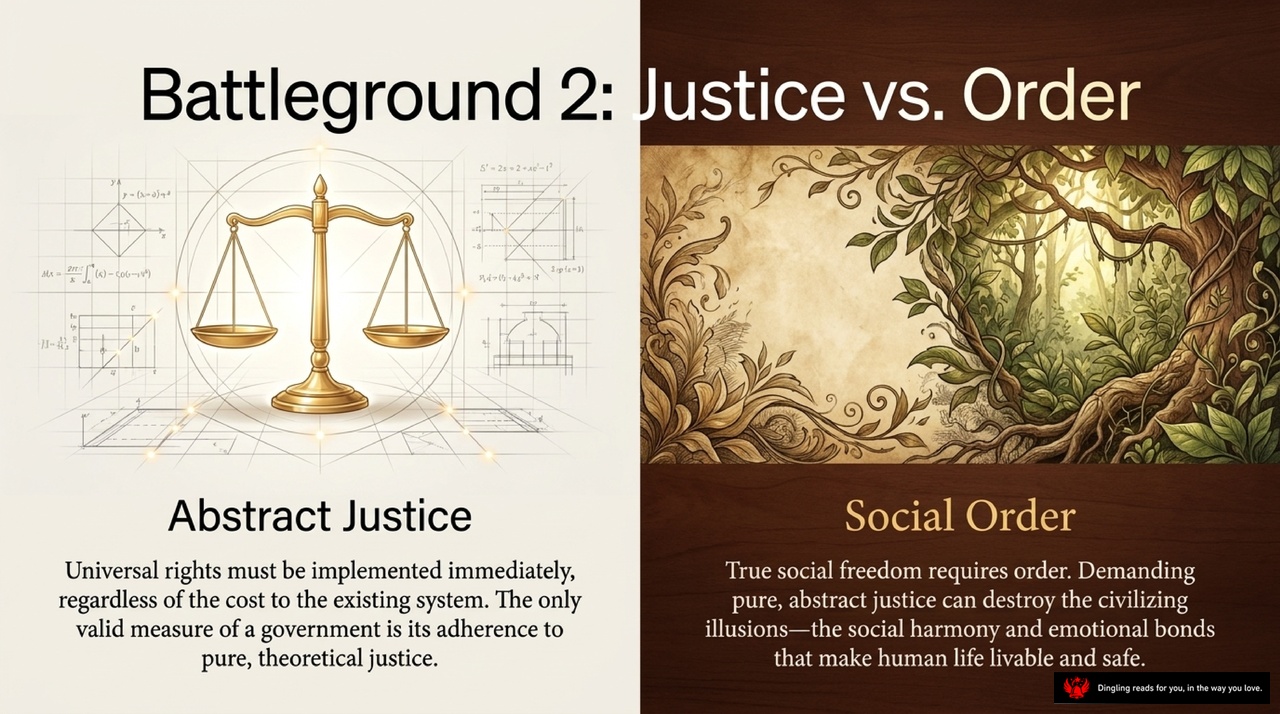
Look at this slide. On the left, we see the scales of justice, representing "Abstract Justice." On the right, a complex, organic forest represents "Social Order." This visual perfectly captures the central tension of Edmund Burke's entire political philosophy: the conflict between pure theory and the messy reality of human life.
Burke argued that true social freedom actually requires order. He believed that demanding pure, abstract justice—like trying to build a perfect machine from scratch—can destroy the very thing that makes life livable. He called these the "civilizing illusions": the social harmony, the emotional bonds, and the shared traditions that hold society together. Without these, he warned, we don't gain freedom; we descend into chaos where the strong prey on the weak.
In contrast, the side of abstract justice demands that universal rights be implemented immediately, regardless of the cost to the existing system. It insists that the only valid measure of a government is its adherence to pure, theoretical principles. But Burke warned that this approach ignores the complexity of human nature. He believed that politics isn't about applying abstract formulas, but about nurturing the living, breathing relationships we have with our neighbors and history. For Burke, trying to force a perfect theoretical order onto a messy, historical reality doesn't create justice; it creates a vacuum where violence thrives. True justice, in his view, grows from the soil of tradition and gradual change, not from the sterile lab of radical theory.
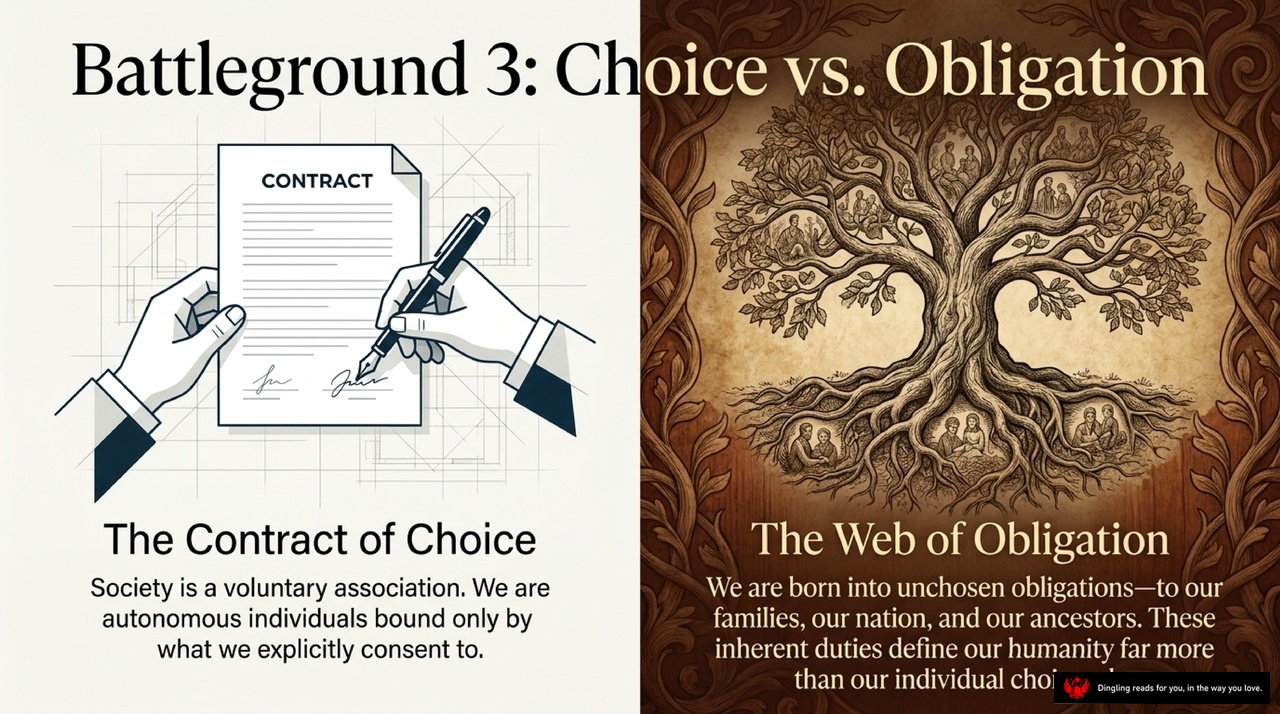
Look at this split screen. On the left, we have the "Contract of Choice"—a simple signature on a piece of paper. It represents the idea that society is a voluntary association where we are bound only by what we explicitly consent to. On the right, we see the "Web of Obligation," a deep-rooted tree connecting generations. This illustrates the opposing view: that we are born into unchosen obligations to our families, nation, and ancestors, and that these inherent duties define our humanity far more than our individual choices.
This visual perfectly captures the core tension between Edmund Burke and Thomas Paine. Paine, championing the left side, argued that the state of nature is the true starting point for politics. He believed that before any government existed, humans were naturally equal individuals who formed society out of necessity, not tradition. For him, justice is absolute and universal; if a government violates our natural rights, we have a moral duty to overthrow it and start fresh. He viewed history as a burden, insisting that every generation should be free to design a new political order based on pure reason, unshackled by the past.
Burke, defending the right side, rejected the very idea of a "natural state." He argued that humans are never truly isolated individuals; we are always embedded in a complex web of history, custom, and emotion. To him, the "web of obligation" is not a shackle, but the very foundation of human identity. He believed that our wisdom comes from the accumulated experience of generations, not from abstract theories. While Paine saw the French Revolution as a glorious triumph of reason, Burke saw it as a catastrophic rupture of the social fabric. He warned that tearing apart the "web of obligation" to satisfy abstract principles would leave society without a moral compass, leading to chaos and tyranny. Ultimately, this debate isn't just about the 18th century; it's about whether we should constantly reinvent ourselves or honor the traditions that hold us together.
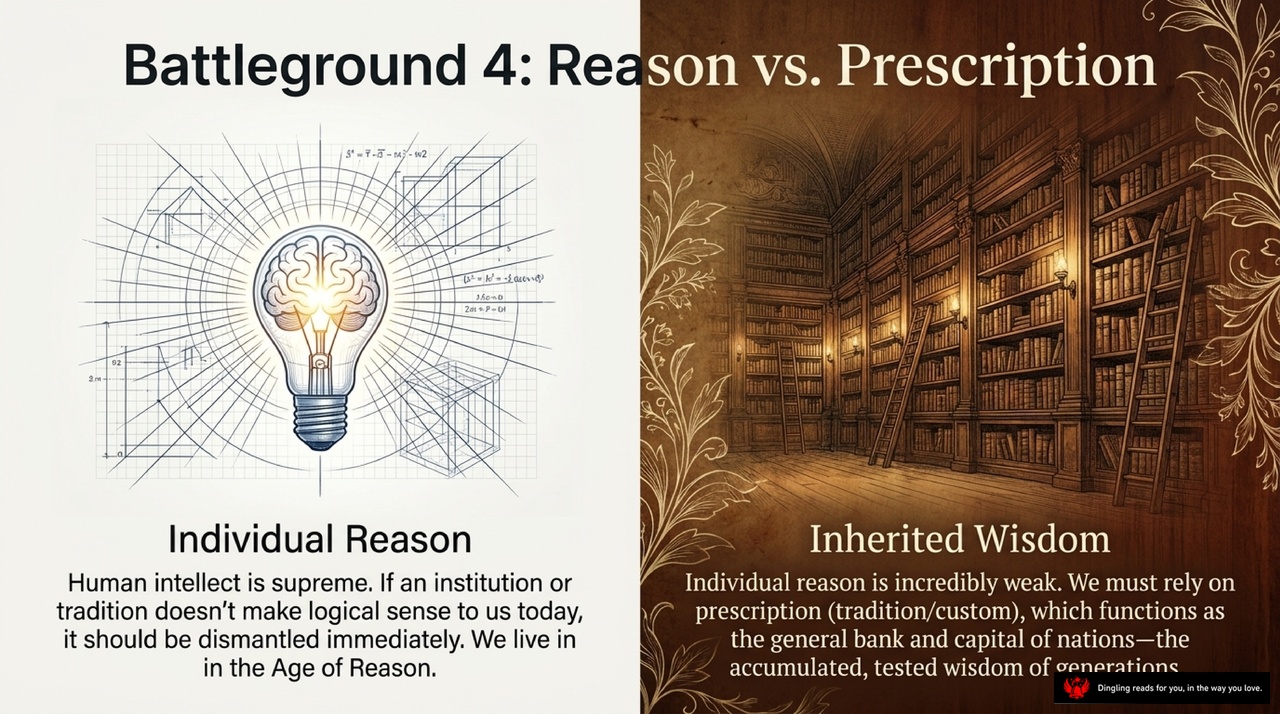
Look at this split screen: on the left, a glowing lightbulb filled with a brain, surrounded by complex equations—this represents Individual Reason. On the right, a grand, dimly lit library filled with ancient books—this symbolizes Inherited Wisdom. These are the two opposing forces at the heart of Battleground 4: Reason versus Prescription.
The text on the left argues that human intellect is supreme. It suggests that if an institution or tradition doesn't make logical sense to us today, it should be dismantled immediately. We live in the Age of Reason, where abstract principles should override the past.
But look at the right side. It champions Inherited Wisdom. It posits that individual reason is incredibly weak and often flawed. Instead, we must rely on prescription—tradition and custom—which functions as the general bank and capital of nations. This is the accumulated, tested wisdom of generations, a slow-growing tree of knowledge that has survived countless storms.
This visual contrast captures the core clash between Thomas Paine and Edmund Burke. Paine believed we could start from scratch, using pure logic to build a perfect society, ignoring the messy history of the past. Burke argued the opposite: that human nature is too complex for us to design from scratch. He believed that true wisdom isn't found in a sudden flash of genius, but in the slow, deliberate accumulation of experience over centuries. Without that deep root system of tradition, any new political structure is just a fragile experiment waiting to collapse.
So, when you face a difficult decision today, do you trust your own immediate logic, or do you pause to consider what has worked for your community over generations? This is the fundamental choice that still shapes our politics.

Today's slide contrasts two distinct paths for societal change: "Eradicate and Rebuild" versus "Preservative Improvement." On the left, we see a cannonball smashing through a fortress, symbolizing the revolutionary drive to tear down corrupt systems from their foundations and rebuild society using pure, rational principles. This is the path of total reconstruction, where the old world is destroyed to make way for a new one based on abstract ideals.
On the right, the image shifts to a man carefully pruning a massive, ancient tree. This represents "Preservative Improvement," a philosophy of reform rather than revolution. Here, the goal isn't to cut the tree down, but to preserve the good while excising the bad. It advocates for gradual, piecemeal changes based on specific, tangible grievances rather than sweeping, abstract theories. This approach trusts that wisdom is embedded in our history and traditions, suggesting that society is a complex, living organism that must be tended to, not dismantled and reassembled.
Ultimately, this visual dichotomy captures the core debate between radical reinvention and cautious evolution, asking us whether we should smash the foundation to build anew, or carefully trim the branches to help the existing structure grow stronger.
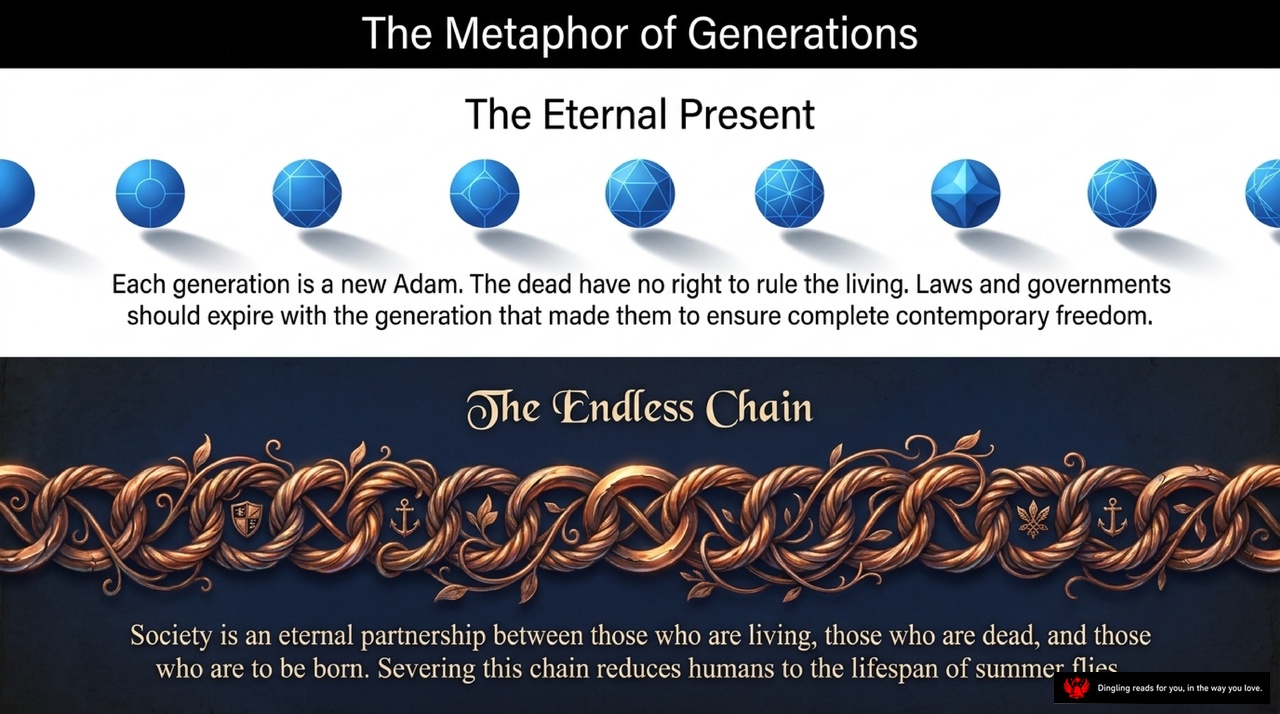
The slide contrasts two opposing views on how generations should relate to one another. On the top, under "The Eternal Present," we see a line of blue spheres representing the idea that each generation is a fresh start—a new Adam. This view argues that the dead have no right to rule the living and that laws should expire with the generation that created them to ensure complete freedom for the present.
However, the bottom section, labeled "The Endless Chain," presents a completely different perspective. It depicts a continuous, ornate golden chain, symbolizing society as an eternal partnership between the living, the dead, and those yet to be born. This side warns that severing this chain reduces humans to the fleeting lifespan of summer flies, emphasizing that true stability comes from respecting the wisdom and legacy of past generations rather than discarding them in favor of the immediate present.
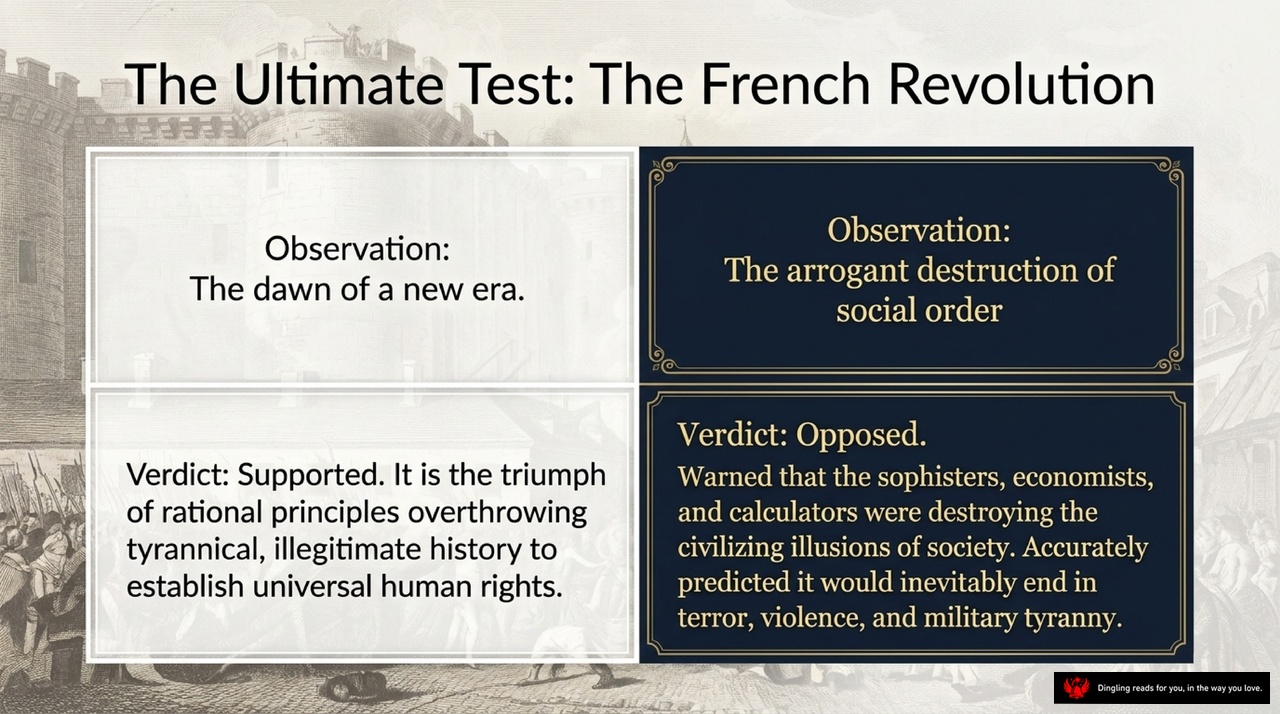
The slide presents a stark dichotomy on the French Revolution, framing it as the ultimate test for political philosophy. On the left, we see the optimistic view: the dawn of a new era, where rational principles triumph over tyranny to establish universal human rights. This aligns with Thomas Paine's belief that revolution is the necessary path to justice, a chance to rebuild society on the foundation of natural equality. On the right, the perspective shifts dramatically to what we might call the tragic view: the arrogant destruction of social order. This reflects Edmund Burke's warning that the revolutionaries—those sophists and calculators—were tearing apart the very fabric of civilization. Burke predicted that by destroying the "civilizing illusions" of tradition, emotion, and established hierarchy, they would inevitably unleash terror, violence, and military tyranny. The verdict on this slide is clear: while one side saw a glorious rebirth, the other saw a catastrophic collapse. This clash defines the core debate between revolution and reform, between the abstract power of reason and the enduring wisdom of history.
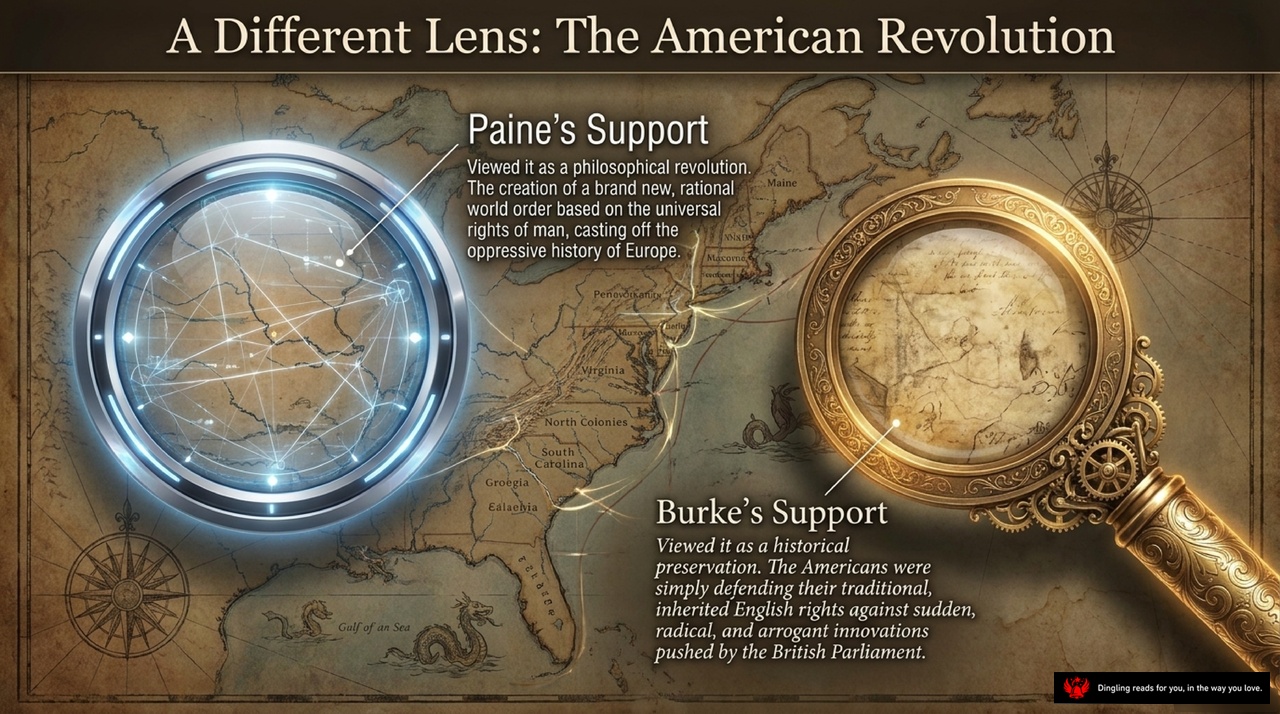
Imagine the American Revolution not just as a war for independence, but as a philosophical clash between two entirely different worlds, viewed through two distinct lenses. On one side, we have Thomas Paine, represented by this futuristic, glowing blue magnifying glass. He saw the revolution as a radical break from the past—a chance to create a brand new, rational world order based on universal rights. For Paine, it was about casting off the oppressive history of Europe and building a society from scratch, where reason and equality could finally triumph over tradition.
On the other side stands Edmund Burke, symbolized by the ornate, golden magnifying glass. He viewed the same event through a completely different prism: as an act of historical preservation. To Burke, the Americans weren't inventing something new; they were simply defending their traditional, inherited English rights against the sudden, radical, and arrogant innovations pushed by the British Parliament. He believed that tearing apart centuries of accumulated wisdom and social bonds was a dangerous mistake that would leave society vulnerable to chaos.
This image perfectly captures the core tension that defined their debate: the conflict between the fresh, liberating power of a new beginning and the stabilizing, protective weight of our shared past.

Welcome back to our deep dive into the clash of giants. Today's slide, titled "The Grand Dichotomy," perfectly captures the fundamental divide between Edmund Burke and Thomas Paine. It contrasts two distinct worldviews: The Utopian Radical on the left, representing Paine, and The Prudent Traditionalist on the right, embodying Burke.
Let's look at how these opposing philosophies play out across five key dimensions. First, consider the Origin of Rights. Paine, the Radical, believed rights are inherent in nature and exist prior to society, a concept we see clearly in his column. In contrast, Burke, the Traditionalist, argued that rights are inherited through history and law, deeply rooted in the past.
This leads to their View of the State. For Paine, the state is merely a necessary evil, a tool created only to protect individual choice when natural social bonds fail. Burke, however, saw the state as a sacred partnership of complex obligations, a living organism where every part has a duty to the whole.
Next, look at their Mechanism of Change. Paine advocated for radical revolution based on pure reason, believing society can be remade from scratch. Burke insisted on gradual reform based on tested tradition, arguing that society is too fragile to be rebuilt like a machine.
Their View of the Past further illustrates this split. Paine dismissed history as a record of ignorance and tyranny, urging a break from the old world. Burke revered the past as a reservoir of accumulated wisdom, a guide for navigating the complexities of the present.
Finally, their Core Values differ entirely. Paine championed Universal Justice and Equality, while Burke prioritized Social Order and Stability. As we've seen throughout their debate, these weren't just abstract ideas; they were competing blueprints for the future of humanity.
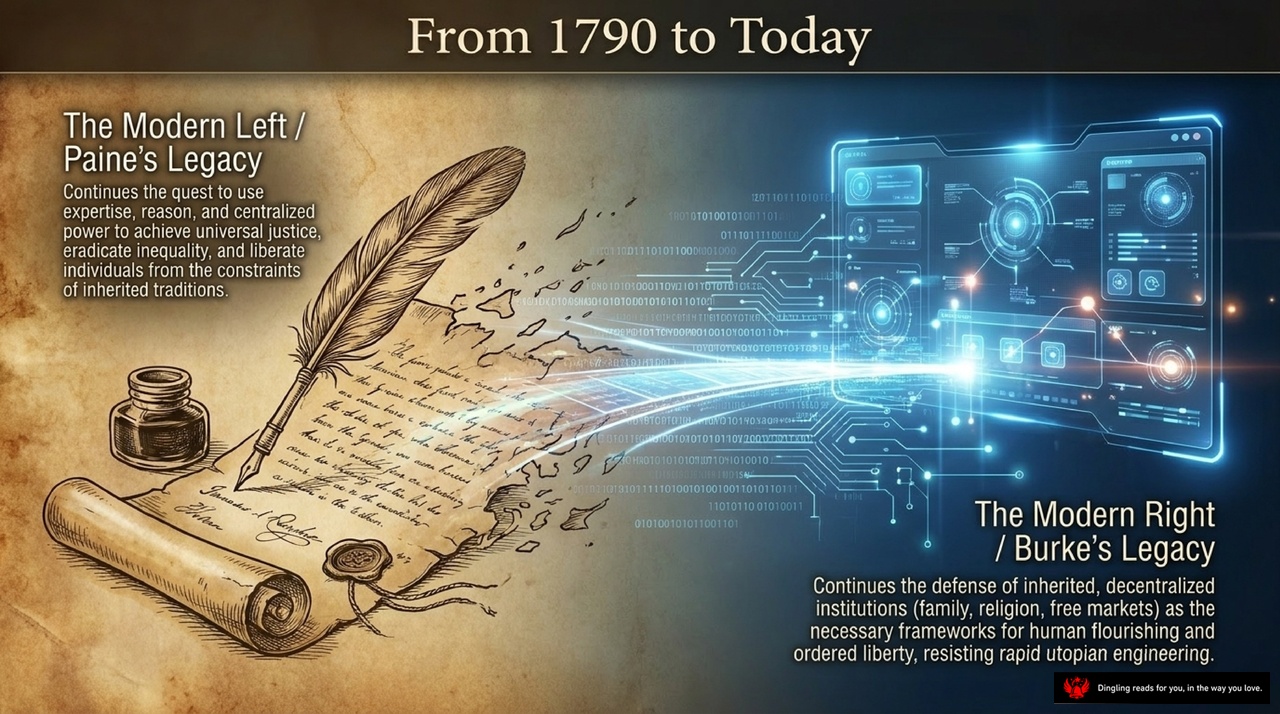
From 1790 to Today, we see the DNA of modern politics split into two distinct paths: The Modern Left and The Modern Right. On the left, we see Paine's legacy, symbolized here by the quill and ink. This tradition continues the quest to use expertise, reason, and centralized power to achieve universal justice. It seeks to eradicate inequality and liberate individuals from the constraints of inherited traditions, believing that we must constantly reinvent society based on rational principles.
On the right, we see Burke's legacy, represented by this futuristic digital interface. This side continues the defense of inherited, decentralized institutions—like family, religion, and free markets—as the necessary frameworks for human flourishing. It argues for ordered liberty, resisting rapid utopian engineering in favor of gradual, organic growth.
The tension between these two visions—between the radical break of the Left and the protective continuity of the Right—defines the political landscape we live in today.
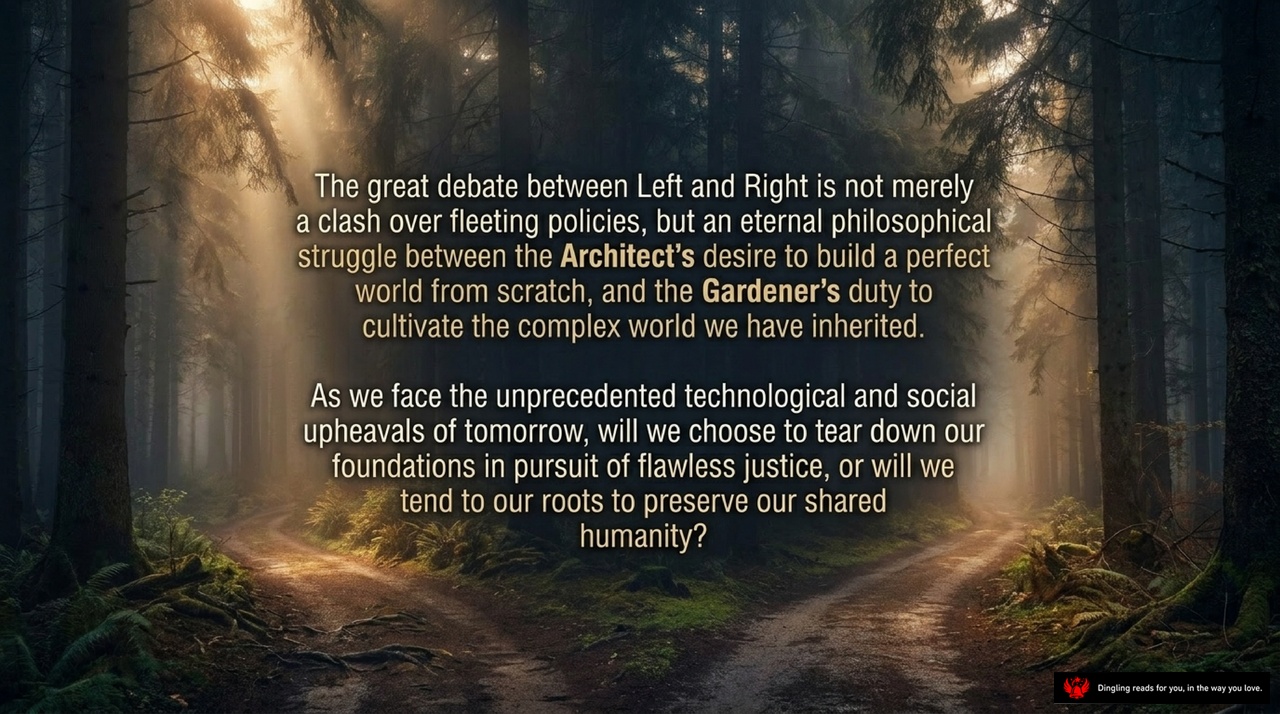
Look at this image. We are standing at a crossroads in a misty forest, illuminated by a beam of light. This isn't just scenery; it's the central metaphor for the great debate between the Left and the Right. As the text on the screen reminds us, this struggle is not merely about fleeting policies. It is an eternal philosophical battle between two visions of the world.
On one side, we have the "Architect." This is the mindset of the Left, championed by thinkers like Thomas Paine. The Architect believes in the power of reason to build a perfect world from scratch. They look at the past not as a foundation to be built upon, but as a set of flawed structures that must be torn down. They argue that we have the right to erase our foundations and construct a flawless society based on abstract principles of equality and natural rights.
On the other side stands the "Gardener," the voice of the Right, embodied by Edmund Burke. The Gardener's duty is to cultivate the complex, messy world we have inherited. They believe that society is not a machine we can design, but a living organism that has grown over centuries. To the Gardener, tradition, custom, and history are not chains to be broken, but the very soil that allows civilization to survive.
The image asks us a critical question as we face the uncertainties of the future: Will we choose to tear down our foundations in pursuit of a perfect, abstract justice, risking the destruction of everything that holds us together? Or will we tend to our roots, preserving the shared humanity and wisdom that our ancestors passed down?
This tension between the Architect's desire for a new beginning and the Gardener's commitment to nurturing what exists is the defining conflict of modern politics. It forces us to decide: do we rebuild the world, or do we simply learn to live in it better?