
The Great Failure: Complete Chapter-by-Chapter Summary
Welcome to "The Great Defeats" by Wu Xiaobo. This book offers a forensic autopsy of the spectacular rise and sudden collapse of China's most famous enterprises in the 1990s. It explores how a few bold companies achieved miraculous growth through aggressive marketing and bold bets, only to face devastating failures when reality caught up with their illusions. From the explosive success of Qin Chi to the tragic downfall of Aido, these stories reveal the harsh lessons of an era driven by hype, overexpansion, and a lack of sustainable fundamentals.

Look at this slide. On the left, we see the "Vital Signs" of sudden collapse. Japan took 12.5 years, the US 8.2, but in the wild west of 1990s China, private enterprises collapsed in just 3.7 years. It was a race to the bottom. On the right, the "System Trajectory" graph reveals the terrifying speed of this crash. The myth was that it took three years to build a billion-dollar empire. The reality? Total collapse in just three days. This wasn't a natural decline; it was a pathological event. The slide explains why: unprecedented market gaps allowed for overnight wealth, but a complete lack of an institutional framework guaranteed sudden death. Without rules, safety nets, or checks and balances, the moment the hype bubble burst, there was nothing left to catch the fall. Companies like Qinchi, Aido, and Three Sages grew on borrowed money and empty promises, only to vanish almost instantly when the music stopped. It was a classic case of the wild west mentality: go big or go home, with no plan for survival.
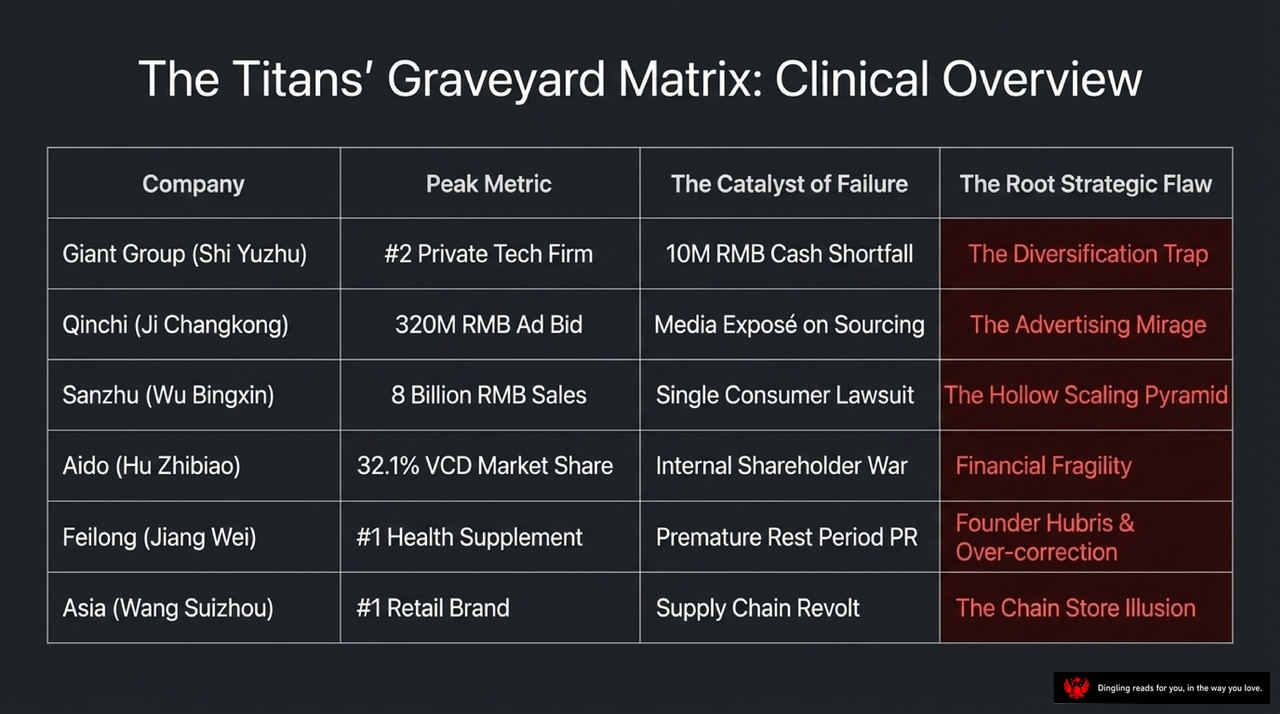
Look at this "Titans' Graveyard Matrix." It's a stark reminder that in the 90s, being the "number one" in China didn't guarantee survival; often, it was the very first step toward a dramatic collapse.
Notice the column on the right, labeled "The Root Strategic Flaw." This is where the real story lies. Take Giant Group, Shi Yuzhu's company. They reached the peak of being the second-largest private tech firm, but their downfall wasn't a lack of talent—it was "The Diversification Trap." They tried to be everything from tech to real estate, spreading their capital too thin.
Look at Qinchi. They had a massive 320 million RMB ad bid, yet their fatal flaw was "The Advertising Mirage." They built an entire empire on hype rather than product capacity, leading to a public exposure that destroyed them overnight.
Then there's Sanzhu, with 8 billion RMB in sales, which sounds impressive, but their flaw was "The Hollow Scaling Pyramid." They grew so fast on borrowed momentum that a single consumer lawsuit brought the whole structure crashing down.
Aido, under Hu Zhibiao, held 32.1% of the VCD market share, but "Financial Fragility" was their undoing. They relied on a pyramid scheme of dealer financing rather than real cash flow.
Feilong, Jiang Wei's health supplement empire, fell due to "Founder Hubris & Over-correction." When they tried to pivot or rest, the market moved on, and their rigid response killed them.
Finally, Asia, Wang Suizhou's retail brand, hit the ceiling because of "The Chain Store Illusion." They expanded aggressively without a solid supply chain, leading to a revolt that toppled their #1 ranking.
The lesson here is clear: In the age of miracles, the most dangerous strategy is ignoring the fundamentals. Whether it was diversification, hollow scaling, or financial fragility, these titans all fell because they mistook speed for sustainability.
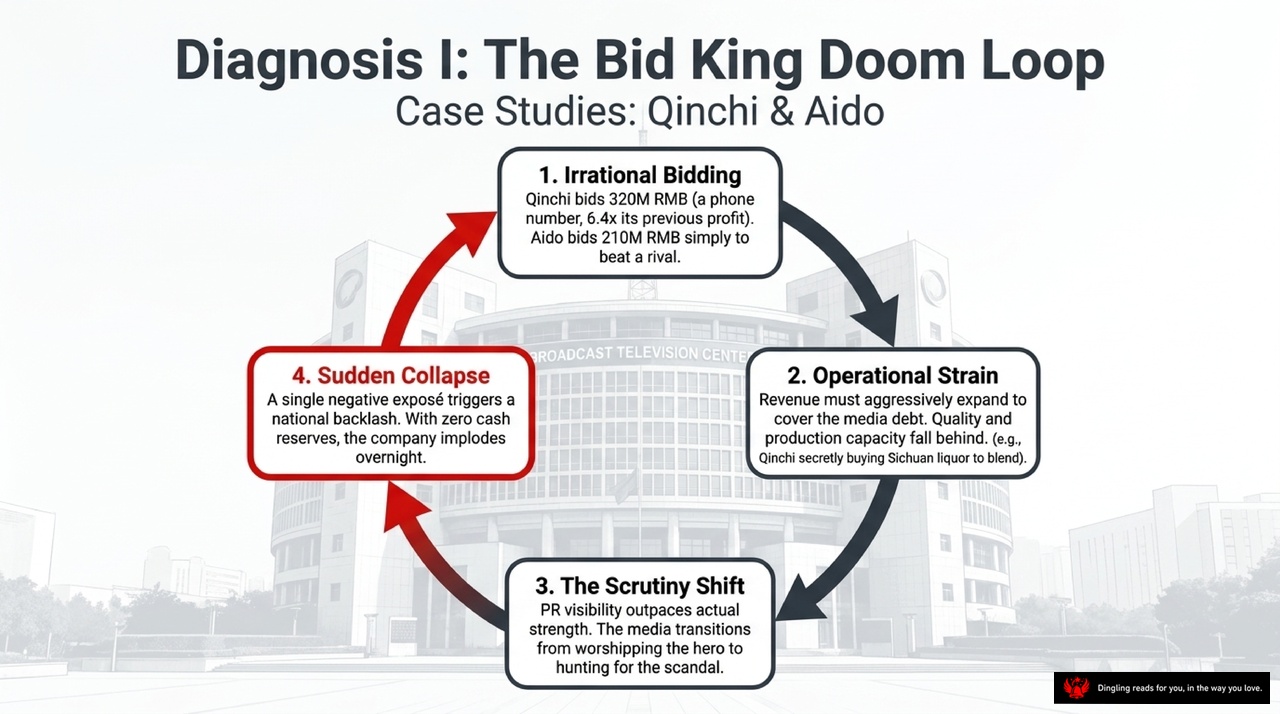
Diagnosis I: The Bid King Doom Loop. Today, we're looking at the tragic stories of Qinchi and Aido to understand how a single cycle of irrational bidding can destroy an empire.
The loop starts with step one: Irrational Bidding. You see Qinchi bidding 320 million RMB—basically the cost of six and a half times their previous profit—simply to beat a rival. Aido does the same, spending 210 million just to outbid them. This isn't strategy; it's a race to the bottom driven by the fear of missing out.
This leads directly to step two: Operational Strain. Because revenue must aggressively expand just to cover these massive media debts, the company's actual production and quality fall behind. In Qinchi's case, they were secretly buying Sichuan liquor to blend with their own, just to meet the impossible demand created by their own hype.
Then comes step three: The Scrutiny Shift. As the media transitions from worshipping the hero to hunting for the scandal, PR visibility completely outpaces actual strength. The narrative flips overnight.
Finally, step four: Sudden Collapse. A single negative exposé triggers a national backlash. With zero cash reserves, the company implodes overnight. What started as a marketing triumph ends in total ruin, proving that in the bid king game, there is no winner, only the last one standing.

Diagnosis II: The 70-Story Hubris. Today, we dive into a cautionary tale that perfectly illustrates the danger of letting ego drive a company off the cliff: Giant Group, led by Shi Yuzhu.
Look at the graph on the left. It shows the trajectory of their cash flow, starting in the positive zone but spiraling sharply into the negative. On the right, we see the physical manifestation of this financial madness: a skyscraper that grew far too tall.
It all started with a rational plan at 38 stories—a fully funded headquarters for a tech company. But then, ego began to inflate. After a VIP visit, they expanded to 54 stories. Then, driven by local pride and the desire to be the tallest in the nation, they pushed it to 64. Finally, to avoid bad luck, they added six more floors, landing at the infamous 70-story mark. This "superstition" caused costs to balloon wildly.
The result? A fatal fracture. A 500 million RMB empire was destroyed by a mere 10 million RMB cash shortfall. Because Giant Group adhered to a rigid "zero-debt" philosophy, they couldn't secure bridge loans when the construction delayed. This prevented them from buying time, turning a manageable delay into total corporate death.
Shi Yuzhu's story teaches us a hard lesson: true heroes aren't those who create miracles in foreign lands, but those who can curb their irrational impulses after a big success. By chasing the height of the building instead of the stability of the business, Giant Group lost its core focus and paid the ultimate price.
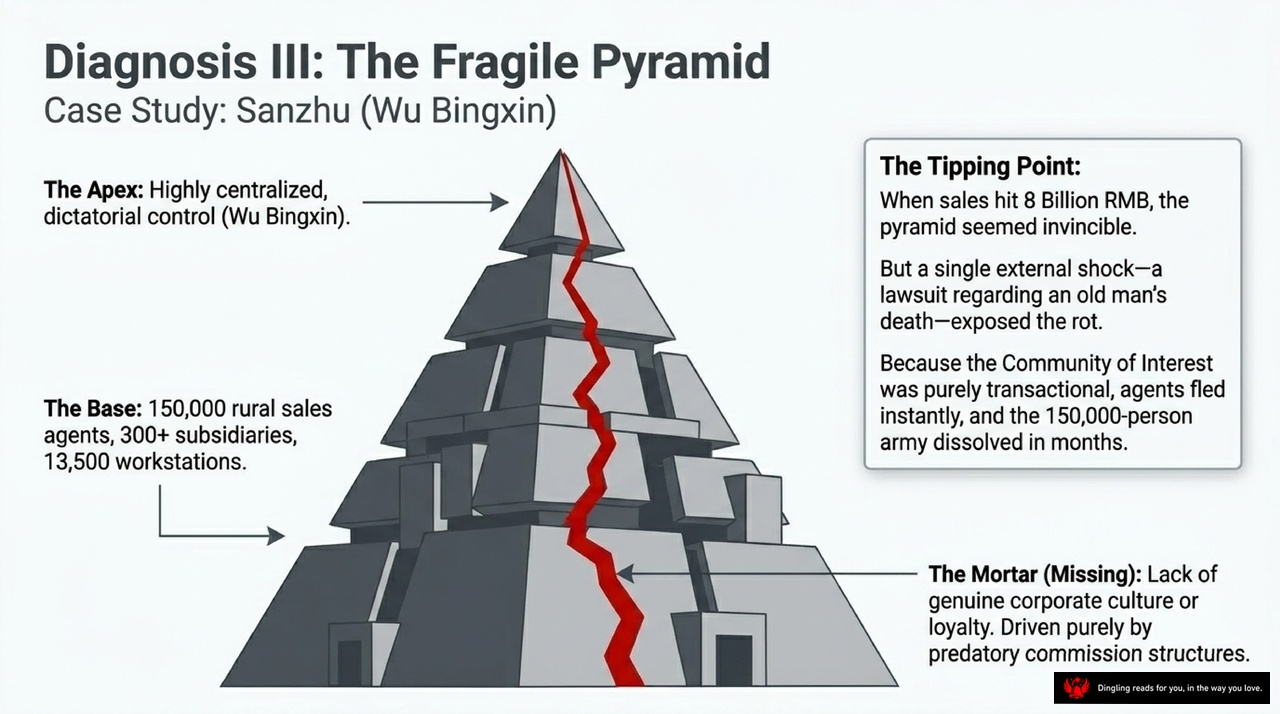
The image presents a stark diagnosis of the "Fragile Pyramid," using the case of Sanzhu as a cautionary tale for any business built on hype rather than substance. At the very top of this structure sits a highly centralized, dictatorial apex, much like Wu Bingxin's control over the company. This top-down approach created a rigid hierarchy that couldn't adapt to reality. While the base of the pyramid boasted an impressive scale—150,000 rural sales agents, over 300 subsidiaries, and 13,500 workstations—this massive army was held together by nothing more than a purely transactional relationship. There was no genuine corporate culture or loyalty binding them; they were driven solely by predatory commission structures.
The collapse happened when a single external shock, a lawsuit regarding an old man's death, exposed the rot at the core. Because the "mortar" holding the pyramid together was missing, the entire structure crumbled instantly. When sales hit 8 billion RMB, the pyramid seemed invincible, but the agents fled immediately upon the first sign of trouble, causing the 150,000-person army to dissolve in just a few months. This illustrates a critical lesson: without a foundation of trust and shared values, even the most ambitious growth strategies are destined to fail at the first sign of adversity.

Diagnosis IV: The Media Double-Edged Sword. Let's look at the case of Feilong Group and its founder, Jiang Wei. This chart illustrates a classic trap: when PR visibility skyrockets but institutional resilience stays flat, the inevitable crash is just a matter of time.
In Phase 1, we see "Carpet Bombing." Jiang Wei used massive ad spending to create instant demand, effectively masking the chaos happening inside his company. The blue line shoots up while the black line of resilience barely moves. Then comes Phase 2, "The Rest Period Misfire." Instead of fixing operations, Jiang Wei tried a romantic PR stunt, publicly publishing his "20 Major Mistakes" to show transparency. He thought he could use the media as a mirror for philosophical reflection. But as the quote at the bottom warns, he forgot that the market views media as a financial warning system.
Finally, Phase 3 hits: The Backlash. The media and distributors took his confession literally. Panic ensued. The brand was suffocated by its own generated spotlight. The red line plunges sharply as the company collapses. This teaches us a hard lesson: without building real institutional strength to match your hype, any media strategy is just a countdown to failure.
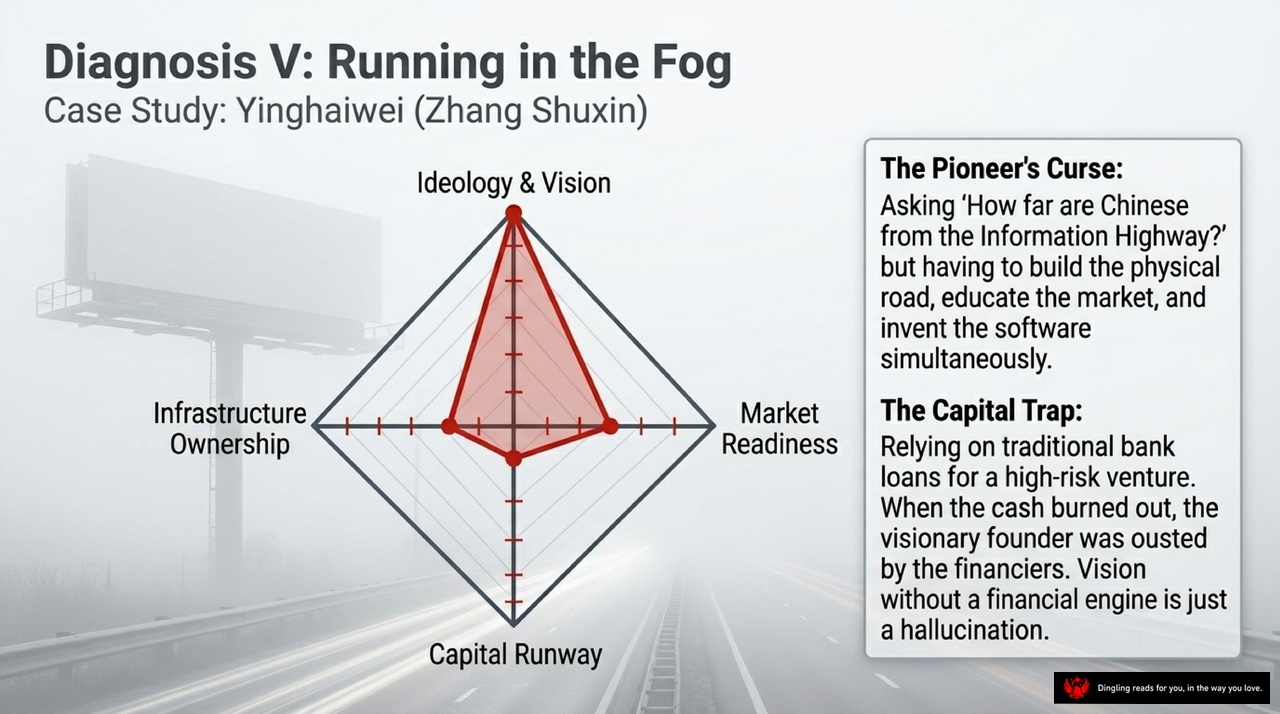
Running in the fog is the fate of many visionaries who lack a financial engine. Today's case study focuses on Yinghaiwei, founded by Zhang Shuxin, a pioneer who asked the world, "How far are Chinese people from the information highway?" But the reality was far more daunting. As the slide illustrates, Zhang faced the "Pioneer's Curse." She didn't just need to build the road; she had to simultaneously educate the market and invent the software while the physical infrastructure was still missing. Her radar chart shows a massive spike in "Ideology & Vision," yet her "Capital Runway" and "Market Readiness" remained critically low.
This disconnect created the "Capital Trap." Yinghaiwei relied on traditional bank loans for a high-risk venture that banks simply wouldn't understand. When cash burned out, the visionary founder was ousted by the financiers who controlled the money. The slide's warning is stark: "Vision without a financial engine is just a hallucination." Zhang Shuxin, the first to bring the internet to Chinese homes, ultimately couldn't survive because she failed to secure the capital needed to turn her bold ideas into a sustainable business. Her story serves as a timeless reminder that even the most brilliant vision can vanish in the fog if it lacks the fuel to keep moving forward.

Context eats strategy. You cannot simply import a mature business model into a market that lacks basic ethical rules and structural compliance. This slide illustrates the tragic case of Rose Garden, where the "Hong Kong Illusion" collided with the harsh "Beijing Reality."
On the left, we see the trap: the developer, Deng Zhiren, believed he was applying the proven Hong Kong real estate model. He hired top-tier experts, used standardized high-end presales, and relied on strict legal contracts to sell luxury villas. It felt like a guaranteed win. But on the right, the reality was a nightmare. The project was built on invalid land permits, missing critical government approvals, and was buried under predatory underground debt.
The result? What was once touted as the Capital's number one villa became its largest bankruptcy. This story perfectly demonstrates why copying a strategy without understanding the underlying context is a recipe for disaster.
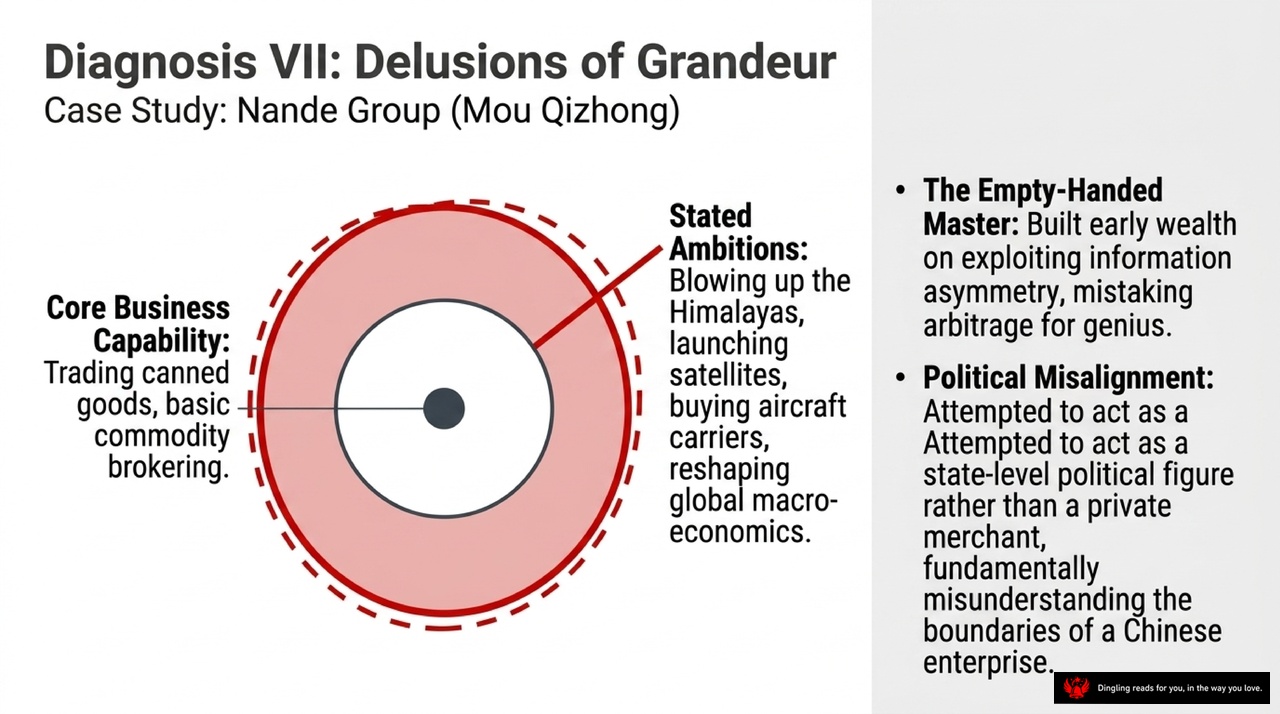
Diagnosis VII: Delusions of Grandeur. This slide focuses on the tragic case study of Mou Qizhong and his Nande Group, illustrating how an entrepreneur's ambition can outpace their actual capabilities.
Look at the concentric circles here. At the very center is the reality: Nande's core business capability was limited to trading canned goods and basic commodity brokering. That was their true foundation. However, look at the outer dashed ring labeled "Stated Ambitions." This represents the gap between reality and delusion. Mou Qizhong's vision was nothing short of reshaping global macro-economics—blowing up the Himalayas, launching satellites, and even buying aircraft carriers.
The slide identifies two critical failures driving this disconnect. First, we have "The Empty-Handed Master." Mou built his early wealth not through innovation, but by exploiting information asymmetry, mistakenly believing that simple arbitrage was genius. Second, there is "Political Misalignment." He attempted to act as a state-level political figure rather than a private merchant. He fundamentally misunderstood the boundaries of a Chinese enterprise, trying to play a role that was far beyond his reach.
This diagnosis reveals a harsh truth: when stated ambitions vastly exceed core business capabilities, and when an entrepreneur confuses political posturing with business strategy, the result is inevitable collapse. It serves as a stark warning against the delusions of grandeur that have plagued so many ambitious entrepreneurs.
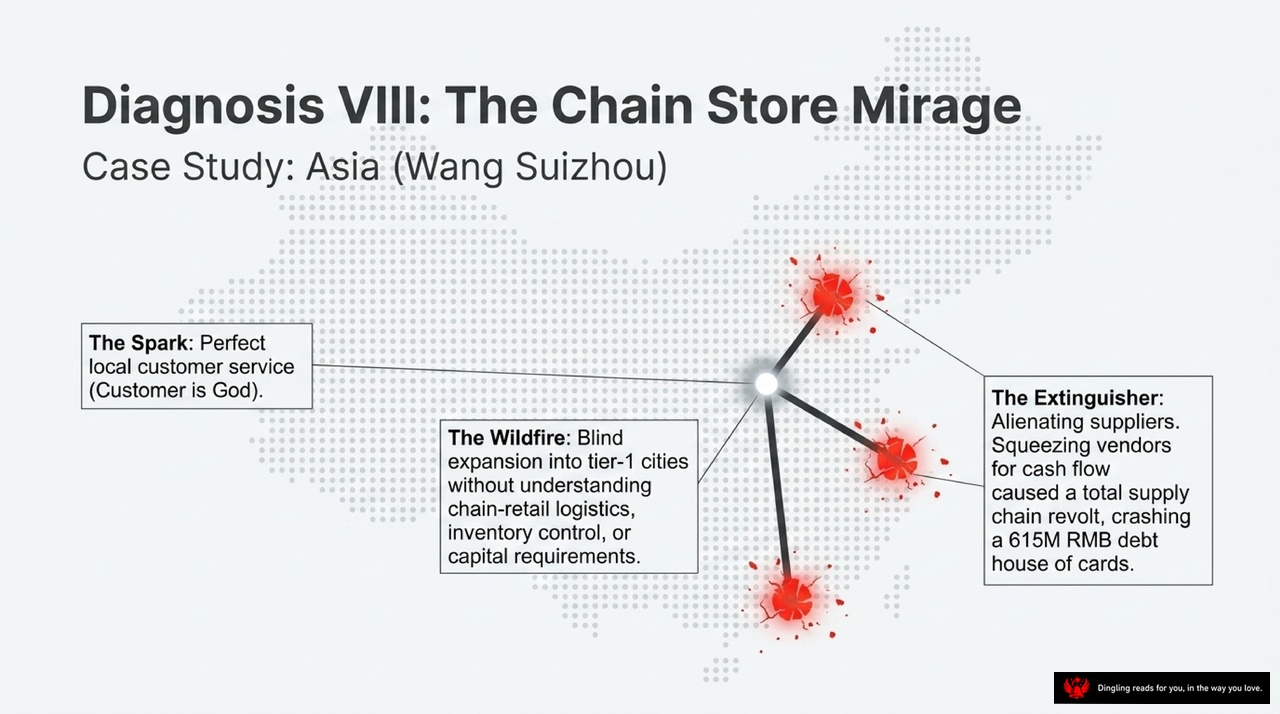
Diagnosis VIII: The Chain Store Mirage. Today, we look at a cautionary tale from Asia: the rise and fall of Wang Suizhou and his empire, Asia Department Store.
The story begins with "The Spark." Wang Suizhou, a former military officer, rejected a stable government position to take over a struggling shopping mall. His genius wasn't in building the store, but in reinventing the customer experience. He introduced artificial waterfalls, organized flag-raising ceremonies, and offered free delivery. He truly embraced the mantra: "The customer is God." This perfect local service created a massive buzz, making "Zhongyuan Travel, where do you go?" a slogan that echoed across the nation.
However, this initial success ignited "The Wildfire." Blinded by momentum, Wang Suizhou launched into blind expansion without understanding the fundamentals of retail logistics, inventory control, or capital requirements. He dreamed of becoming an international trust, planning 200 large stores and 500 supermarkets by the year 2000. But he ignored reality. Every new branch opened on a day of loss. The supply chain collapsed, and the cash flow evaporated.
This unchecked growth led directly to "The Extinguisher." As the chain expanded, Wang Suizhou alienated his suppliers. He squeezed vendors for cash flow, using unpaid bills as working capital. This caused a total supply chain revolt. Suppliers cut off the goods, and the empire's liquidity dried up completely, crashing into a 615 million RMB debt house of cards.
The lesson here is clear: a brilliant spark of customer service can ignite a fire, but without the discipline of supply chain management and financial prudence, that fire consumes the entire forest. Wang Suizhou's story reminds us that scaling requires systems, not just slogans.
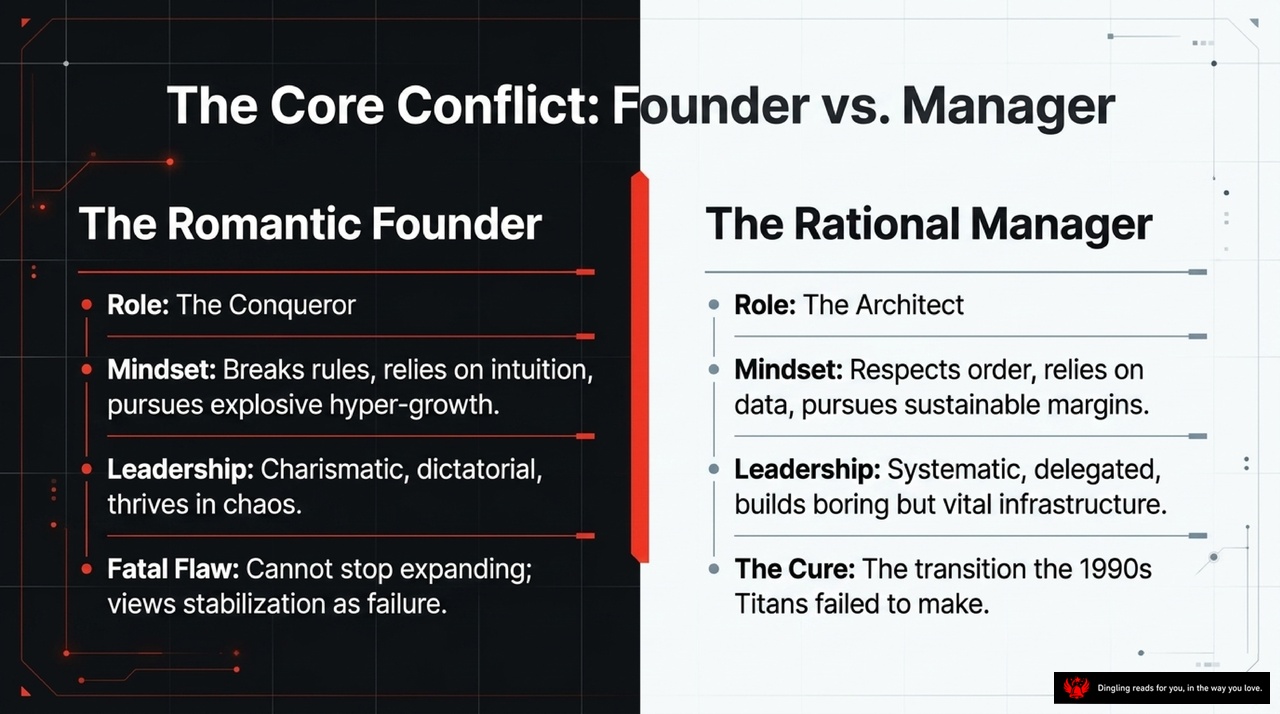
The slide clearly defines the central tension that haunts every growing company: the clash between the Romantic Founder and the Rational Manager. On the left, we see the Founder as the Conqueror—a charismatic, intuitive leader who thrives in chaos, breaks rules, and chases explosive hyper-growth. But as the slide warns, their fatal flaw is an inability to stop expanding, viewing stabilization not as success, but as failure. On the right stands the Manager, the Architect who respects order, relies on data, and builds the boring but vital infrastructure needed for sustainability.
This conflict played out dramatically in China's 90s. Take Qi Chi, the "King of the Bid." Founder Ji Changkong was a pure Romantic Founder. He didn't care about rules or margins; he relied on sheer intuition to buy a CTV commercial slot for 66 million yuan, betting everything on the hype of becoming the "No. 1" brand overnight. He saw slowing down as a sign of weakness. But the market needed the Rational Manager's touch. Without a systematic approach to supply chain, quality control, or financial stability, Qi Chi's empire collapsed when their actual production couldn't meet the insane demand they created.
Similarly, look at Aido VCD under Hu Zhibiao. He was a charismatic visionary who wanted to dominate the market through aggressive pricing and celebrity endorsements. He ignored the need for a solid financial system, relying instead on short-term financing from distributors. When the market turned, his lack of an "Architect" mindset meant there was no safety net. He couldn't stop the expansion, couldn't delegate effectively, and ultimately, the company went bankrupt.
The lesson here is clear: the transition from Founder to Manager is the hardest hurdle for any startup. The 90s titans failed because they couldn't make this shift. They stayed trapped in the romantic dream of infinite growth, ignoring the rational need for order and structure. To survive, a company must eventually let the Founder step back and let the Manager take the wheel, building a system that can endure beyond the founder's personal vision.

Today's slide reveals the autopsy results of corporate failure, synthesizing lessons from Shi Yuzhu's "13 Deaths" and Jiang Wei's "20 Mistakes." Look at these three gauges; they are all in the red "Danger Zone," signaling a critical breakdown in organizational health.
First, we see Institutional Rot. This isn't just about bad management; it's about zero-debt illusions leading to sudden cash snaps, as seen with the collapse of giants like Giant Group. It's also about militarized sales forces masking internal corruption, a trait shared by the tragic rise and fall of Sanzhu and Aido. When decision-making is driven by ego rather than data, the entire system becomes fragile.
Next, Environmental Hazards. Here, policy elasticity traps pioneers in gray zones, leaving them vulnerable when regulations shift. We saw this with Haoyao No. 6, which burned through massive ad budgets without a safety net. Media volatility also turns hype into public execution; when a company relies entirely on炒作 (hype) to survive, a single negative story can destroy years of building, as happened with Qingchi.
Finally, Psychological Myopia. This is perhaps the most dangerous metric. It describes treating the company as a vehicle for personal political ambition, a fatal flaw for entrepreneurs who confuse fame with success. It also highlights the refusal to hire professional managers to replace loyalist amateurs. When leaders surround themselves with yes-men instead of experts, they blind themselves to reality, leading to inevitable disaster.
These three indicators—rot, hazards, and myopia—form a framework for understanding why so many promising ventures in China's golden age ultimately failed.

The Pathology of the Wolf Culture: Why Predatory Growth Kills Everything
Look at this cracked, barren landscape. It perfectly illustrates the ultimate fate of the "Wolf Culture" that once dominated China's business scene. This isn't just about being aggressive; it's about a fundamental misunderstanding of how markets actually work. The slide breaks down this destructive mindset into three critical points.
First, we have the Predatory Mindset. In a wolf culture, the market isn't seen as an ecosystem to nurture, but purely as a hunting ground for rapid extraction. The goal isn't sustainable value creation; it's just grabbing as much as possible before moving on, ignoring the long-term health of the industry.
Second, we see the use of Scorched Earth Tactics. This is where things get dark. Instead of competing on quality or innovation, companies resort to malicious public relations, brutal price wars, and deceptive advertising just to destroy their rivals. The result? You might win a battle, but you burn down the entire industry, destroying consumer trust for everyone involved.
Finally, the diagnosis is clear: A Wolf Culture creates temporary warlords, not lasting institutions. It produces short-term winners who are eventually left behind. True survival requires shedding these predatory instincts and building civilized, value-creating architecture. As we've seen with giants like Qinchai, Giant, and A-DO, the companies that chased these quick fixes ultimately collapsed. The lesson is simple: you can't eat the forest if you want to survive in it.
The graveyard of China's 1990s corporate titans serves as a stark warning: explosive speed without structural integrity guarantees a spectacular collapse. As the slide asks, when the adrenaline of your initial breakthrough fades, are you building a legacy that can survive your own hubris?
Look at the giants who fell. Qin Chi, once the "King of TV Advertising," relied entirely on hype and borrowed production capacity, ignoring the fact that its actual manufacturing capability was a fraction of its sales claims. Similarly, Aido VCD, led by Hu Zhobiao, chased market share with reckless price wars and unsustainable financing, only to find its financial house of cards crumbling under the weight of its own ambition. Even the real estate legend Meigui Yuan, a project built on speculation and mismanagement, ended up as a symbol of the era's blind confidence.
These failures weren't just about bad luck; they were the inevitable result of prioritizing "creating a name" over "creating substance." When companies focus solely on marketing concepts and ignore product quality, honest management, and long-term planning, they attract short-term attention but invite long-term destruction. The lesson is clear: sustainable business demands a painful but necessary transition from the romanticism of the conqueror to the rationality of the architect. True success isn't about how loudly you can shout your name, but whether your foundation is solid enough to stand when the music stops.