
The Great Game: Complete Chapter-by-Chapter Summary

Welcome to "The Great Game," where we explore how capital markets become the ultimate battlefield for global superpowers. Today, we step back to the very beginning of this story: New York. Long before it was a financial titan, it was 17th-century New Amsterdam, a Dutch outpost that failed to stop British invaders and was renamed in 1664. The very walls they built later crumbled, and that empty space became the birthplace of Wall Street.
But it wasn't just geography; it was a clash of philosophies. The Dutch brought a unique commercial spirit and the first recorded financial bubble, the Tulip Mania, seeding the speculative techniques that would define the future. While the city burned during the Revolutionary War, a brilliant mind named Alexander Hamilton rose from poverty to become Washington's right hand. He faced fierce opposition from Thomas Jefferson, who hated everything commercial, calling New York a "gutter of human vice." Yet, Hamilton's vision prevailed. He built the first central bank, stabilized the national debt, and created the first true blue-chip stock, igniting America's first bull market.
This era proved that capital could unite a nation. From the Erie Canal connecting the West to the explosive growth of railroads, and through the transformative chaos of the Civil War, Wall Street evolved from a private club into a public engine of growth. Figures like J.P. Morgan later stepped in to restore trust, turning the street from a gambling den into a respected institution. As we see in the image, with its blend of historic architecture and modern data streams, the rise of New York wasn't an accident. It was a deliberate game of strategy, risk, and vision that determined the rise of a global superpower.
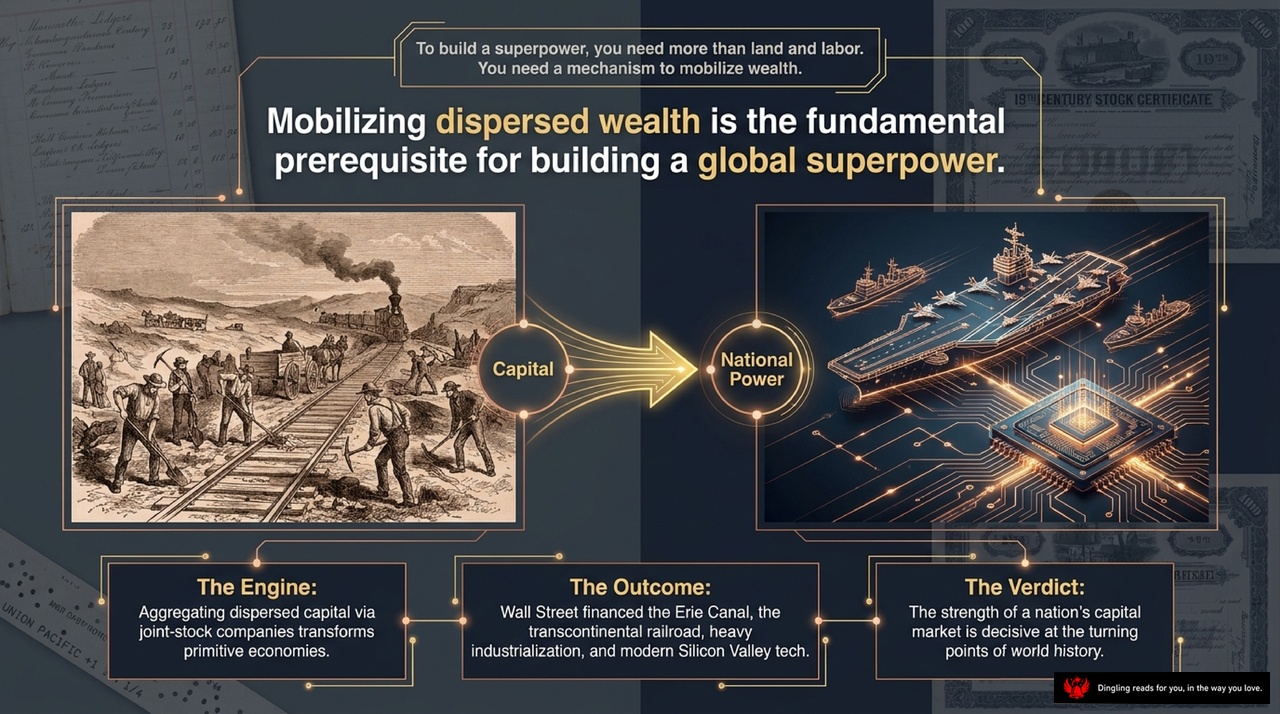
To build a true superpower, you need more than just land and labor; you need a powerful mechanism to mobilize wealth. This slide captures the core thesis: aggregating dispersed capital is the fundamental prerequisite for building global dominance.
On the left, we see the raw engine of growth: the aggregation of scattered capital through joint-stock companies. This is the transformation of primitive economies into modern powerhouses. Think of the Erie Canal, the transcontinental railroad, and the heavy industrialization that followed. These weren't built by a single tycoon; they were funded by Wall Street, turning countless small investors into a collective force that could reshape the nation.
This capital mobilization leads directly to the outcome on the right: National Power. When you look at that modern battleship and the advanced microchip, you're seeing the tangible result of financial strength. Just as Wall Street financed the Erie Canal and the railroads that united the country, today's capital markets fund the heavy industrialization and Silicon Valley tech that define American might. The strength of a nation's capital market is decisive at the turning points of world history. It is the invisible hand that turns scattered resources into unstoppable momentum.
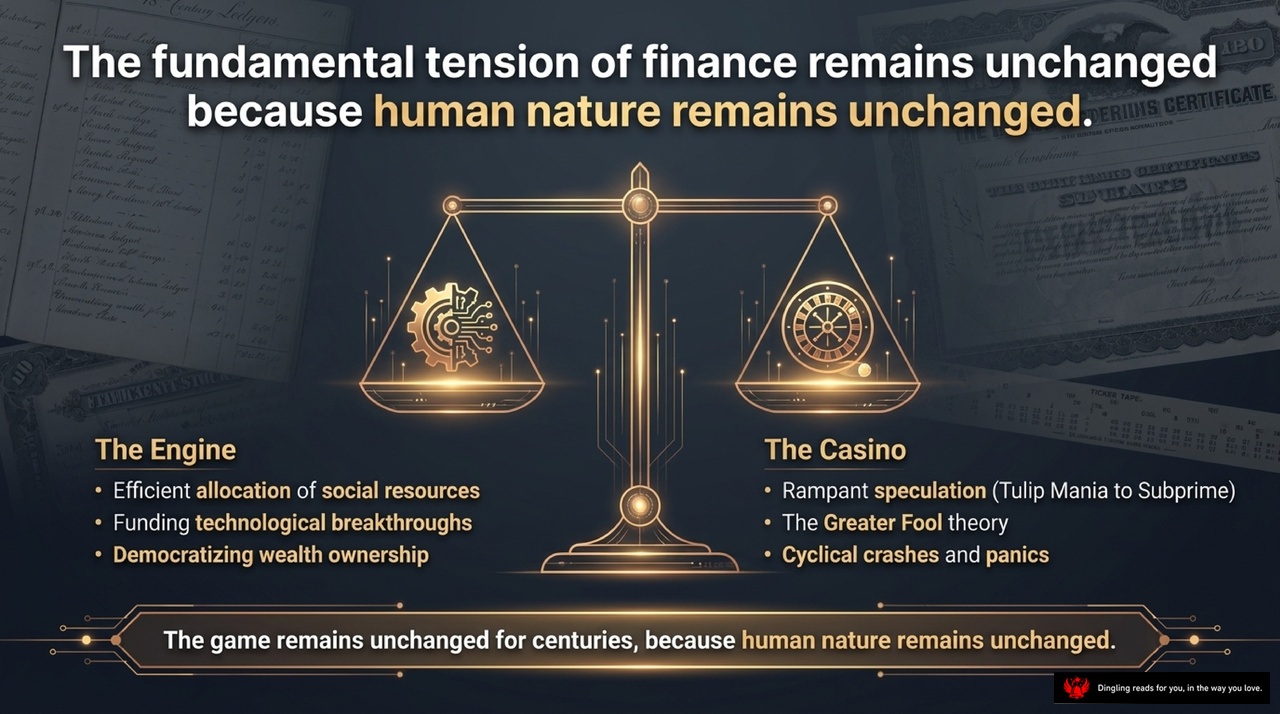
The fundamental tension of finance remains unchanged because human nature remains unchanged. This slide captures a timeless truth: whether we are looking at the gears of an efficient engine or the spinning wheel of a casino, the core drivers haven't shifted in centuries.
On the left, we see "The Engine." This represents the vital role of finance in efficiently allocating social resources, funding technological breakthroughs, and democratizing wealth ownership. It's the constructive side where capital builds the future.
On the right, we see "The Casino." This highlights rampant speculation, from the historic Tulip Mania to the Subprime crisis. It brings in concepts like the "Greater Fool" theory and the inevitable cyclical crashes and panics that define market history.
Notice how the balance scale sits in the center? The game remains unchanged for centuries, simply because human nature remains unchanged. We will always oscillate between building value and chasing quick gains. Understanding this duality is the key to navigating any market, past or present.
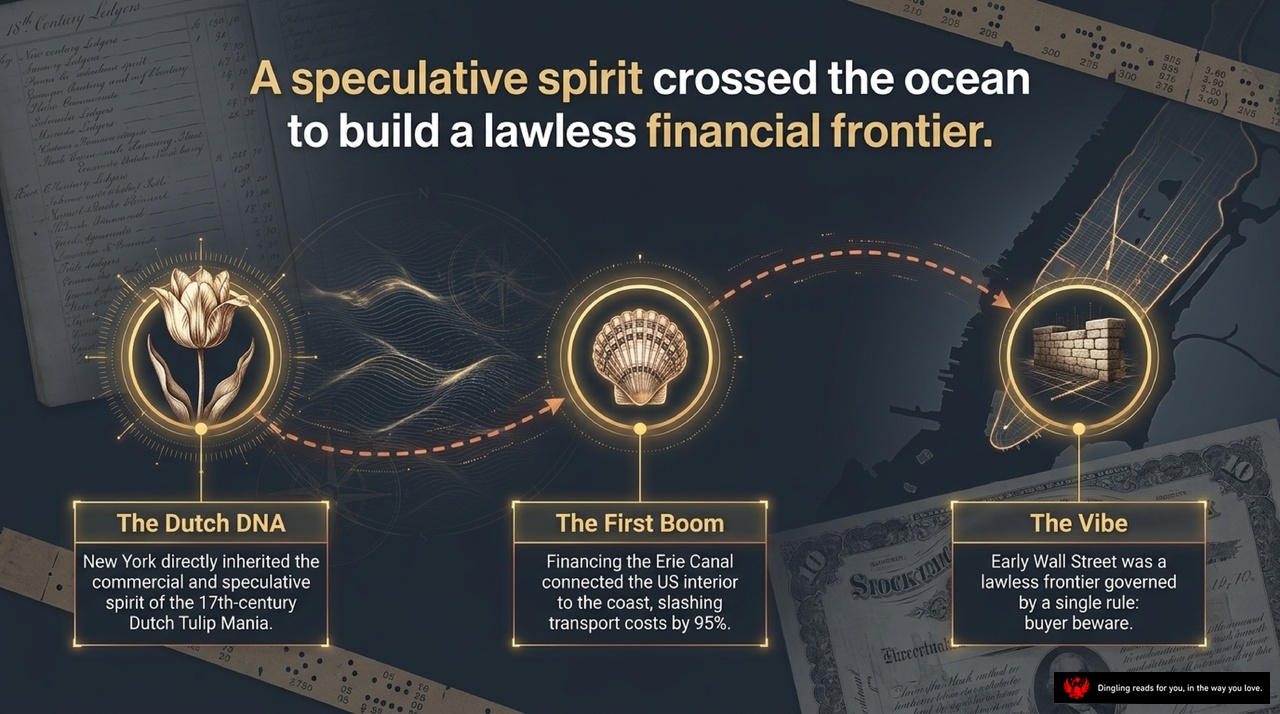
Imagine a journey where a reckless, speculative spirit crossed the Atlantic to build a lawless financial frontier. This slide captures the DNA of modern finance, starting with "The Dutch DNA." Just as the 17th-century Dutch Tulip Mania taught the world the power of speculation, New York inherited this commercial spirit when it was still a small outpost. That same daring energy fueled "The First Boom," where financing the Erie Canal slashed transport costs by 95%, connecting the American interior to the coast and igniting a massive surge in value. But what was the atmosphere like in those early days? That's "The Vibe." Early Wall Street wasn't a regulated institution; it was a wild frontier governed by a single, brutal rule: buyer beware. From tulip bulbs to canal bonds, this era proved that the market could move mountains—or crash them—overnight.
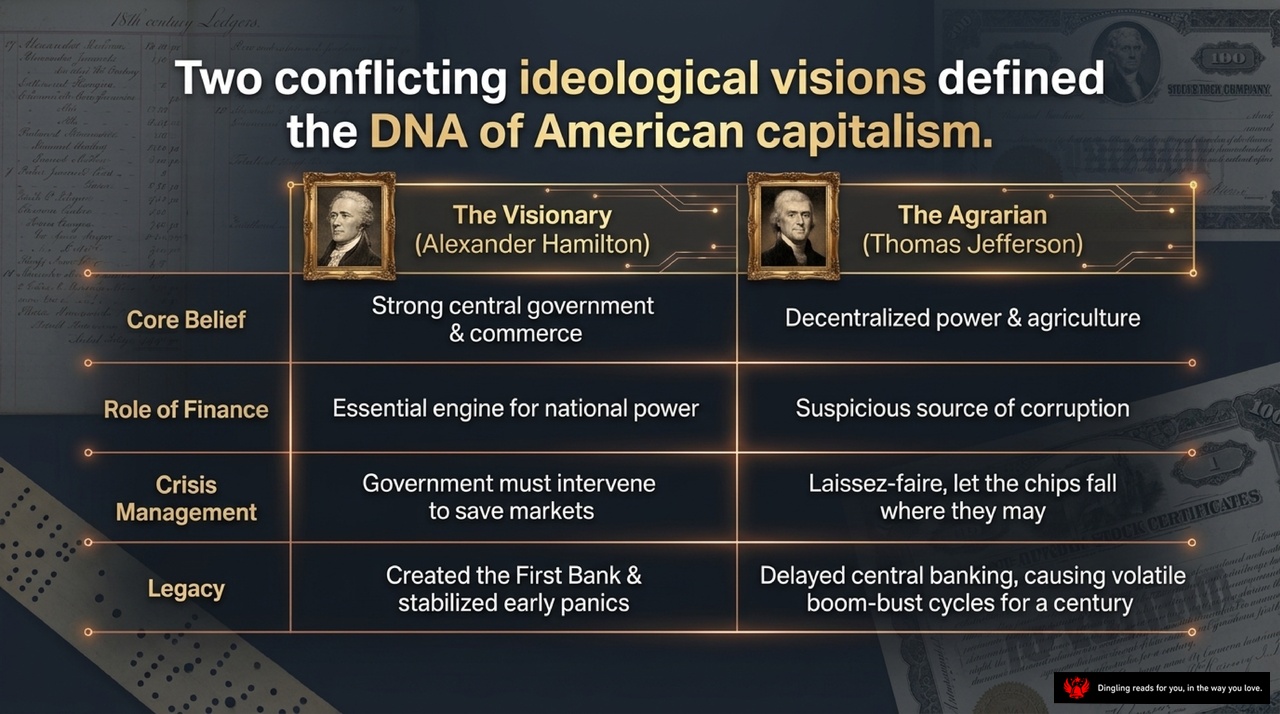
The DNA of American capitalism was shaped by two opposing forces: The Visionary, Alexander Hamilton, and The Agrarian, Thomas Jefferson. As this slide illustrates, their clash defined everything from governance to market stability. Hamilton championed a strong central government and viewed finance as the essential engine for national power. He believed the government must intervene to save markets during crises, a legacy that led to the creation of the First Bank, which stabilized early panics. In stark contrast, Jefferson advocated for decentralized power rooted in agriculture, viewing finance with deep suspicion as a source of corruption. His approach favored laissez-faire economics, letting the chips fall where they may, which unfortunately delayed central banking and caused volatile boom-and-bust cycles for nearly a century. While Hamilton's vision laid the groundwork for a robust financial system, Jefferson's resistance created a legacy of instability that the nation struggled to overcome for generations.

In the early days of Wall Street, the game wasn't about fair competition—it was about calculated traps and financial engineering. Picture this: a seasoned investor, the "Bull," secretly accumulates every available share of a stock, hoarding supply while the market is calm. Then, he invites speculators, the "Bears," to short-sell, betting that the price will crash. But here's the twist: the Bull waits for the delivery date to arrive. At that moment, the Bears are forced to buy back stock to cover their losses, but the Bull has already cornered the entire market. With no other shares available, the price skyrockets, bankrupting the Bears and leaving the Bull with a massive profit. This wasn't just speculation; it was a masterclass in manipulation, a cycle of accumulation, trapping, and the ultimate squeeze that defined the wild, rule-less era of early finance.

Unregulated chaos eventually demanded an enforcer to impose trust and institutional order. For decades, the American market was a wild west of destructive price wars and panicked bank runs. But history shows that when the system collapses, a new leader must step up to restore stability. Enter J.P. Morgan, the ultimate enforcer who believed that trust and character mattered far more than mere capital. He didn't just fix problems; he reorganized bankrupt railroads into profitable monopolies, creating giants like U.S. Steel to stabilize the economy. The turning point came during the Panic of 1907, when Morgan personally locked bankers in his library, forcing them to agree on a bailout. This dramatic intervention proved the urgent need for a Federal Reserve, transforming a chaotic free-for-all into a regulated, trustworthy financial system.

The market has transformed from an exclusive, private playground for the wealthy into a powerful engine driving middle-class wealth. This shift didn't happen by accident; it was built on a foundation of specific methods and catalysts.
On the left, you see *Security Analysis* by Benjamin Graham and David Dodd. This book represents "The Method." Before this, investing was often just wild speculation. Graham changed the game by introducing value investing, teaching people to look beyond the hype and analyze actual balance sheets, cash flow, and intrinsic value. This gave ordinary people the tools to make informed decisions.
On the right, we see the growth of participation. This was fueled by "The Catalyst": Charles Merrill. He revolutionized the industry by bringing brokerage services directly to the masses, creating nationwide networks that made investing accessible to everyone, not just the elite.
The result of this alignment is clear in the data. In 1929, only 2% of Americans owned stock. But thanks to these changes, by the late 20th century, that number skyrocketed to over 50%. More than half of the American population now owned stock or mutual funds.
This is the deepest social change in U.S. history: the successful alignment of working-class wealth with corporate growth. For the first time, the average person could share in the prosperity of the nation they built.

Structural financial progress is invariably forged in the wreckage of panic and crisis. This slide captures the brutal rhythm of Wall Street's history: every great leap forward was built on the ashes of a previous collapse. Look at the timeline. In 1929, unchecked leverage and euphoria led to the Great Crash, which birthed the SEC and the New Deal. Then came Black Monday in 1987, where program trading caused a single-day drop of 22.6%, resulting in the creation of circuit breakers and Federal Reserve intervention. The 2000 Dot-Com Bubble, fueled by euphoria over internet startups, collapsed to enforce the Sarbanes-Oxley Act and demand accounting transparency. Finally, the 2008 Subprime Crisis, caused by over-financialization disconnected from the real economy, forced global regulatory coordination and bank stress tests. The graph clearly shows that stability isn't given; it's engineered in the fire of disaster.

The tools of trading change, but the psychological cycle of a bubble remains a human constant. As we look back at history, from the rise of railroads to the internet and even mortgage-backed securities, the technology evolves, yet the story of human behavior stays eerily the same.
This cycle begins with **Displacement**, where a new innovation like the internet or a new financial product appears, sparking excitement. It quickly moves into the **Boom**, where credit expands, prices soar, and the fear of missing out—FOMO—takes over. People convince themselves that "this time is different," leading to **Euphoria**, where valuations detach completely from reality. But inevitably, the illusion breaks in **Panic**. Leverage forces mass liquidations, and the market crashes.
The game remains unchanged. The only things that change are the names of the players and the technology they use to trade. Whether it's the tulip mania of the past or today's tech giants, the same emotions drive us all.

Picture shows the evolution of financial laws mirroring maritime laws, driven by disaster. It highlights three key steps: from pre-1929 laissez-faire with rampant insider trading, to 1930s federal oversight where the SEC became the referee, and finally post-2008 global coordination due to borderless capital. The core idea is the "Titanic Principle"—just as maritime law mandated 24/7 radio watches after the Titanic sank due to a single operator being asleep, financial governance operates on the same reactive principle. We write laws only in the wake of disaster. This history reminds us that without proactive rules, the system remains vulnerable to the next crisis.
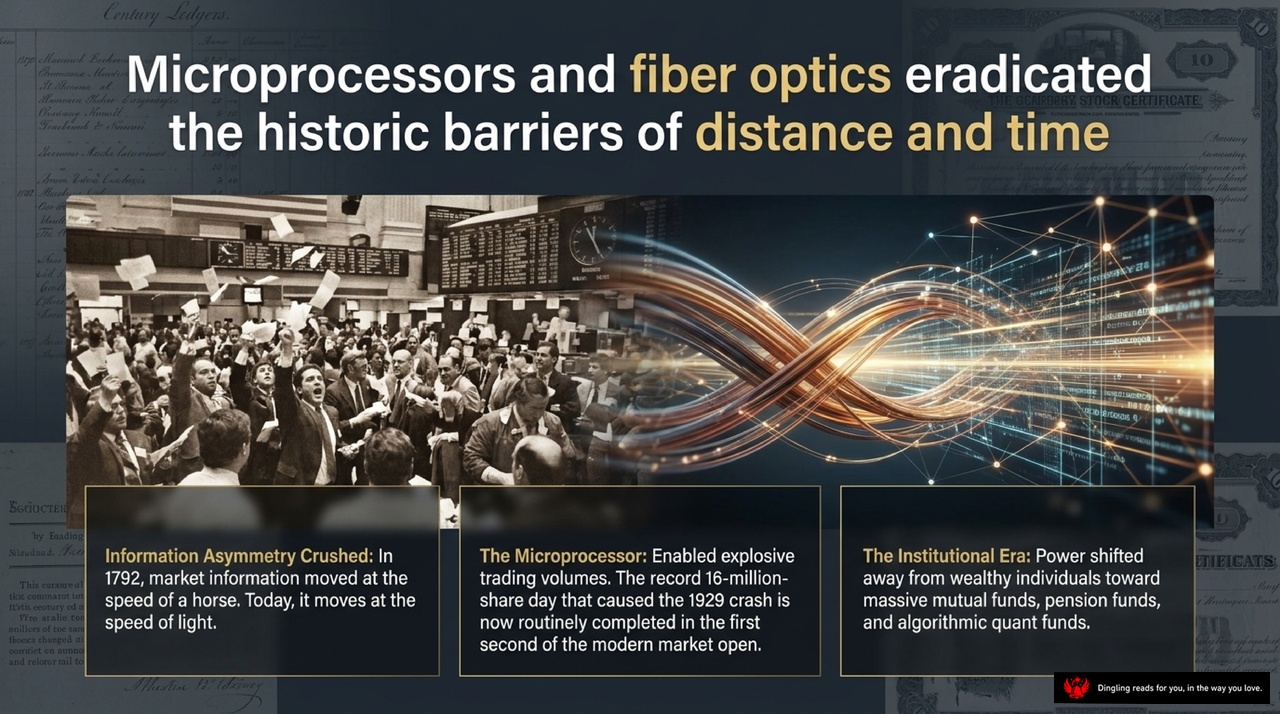
Microprocessors and fiber optics eradicated the historic barriers of distance and time, fundamentally reshaping how we trade and live. Look at the transformation: in 1792, market information moved at the speed of a horse, confined by geography and physical travel. Today, it moves at the speed of light, instantly connecting global markets. This shift crushed information asymmetry, allowing opportunities to be seized in real-time rather than days later.
The microprocessor enabled explosive trading volumes that were previously unimaginable. Consider this: the record 16-million-share day that caused the 1929 crash is now routinely completed in the first second of the modern market open. What took days now happens in milliseconds, compressing time itself into a negligible factor.
This technological leap also ushered in The Institutional Era. Power shifted away from wealthy individuals who once dominated the streets toward massive mutual funds, pension funds, and algorithmic quant funds. The human chaos of the past gave way to sophisticated, data-driven systems. We moved from a world of horse-drawn brokers to one where algorithms execute billions in trades, proving that the barriers of distance and time are no longer just memories—they are history.

Three foundational pillars separate sustainable economic superpowers from fleeting financial manias. Think of these not as abstract theories, but as the very architecture that holds a true financial giant together.
First, you must anchor your wealth in the real economy. This means virtual wealth must serve real-world production. If you disconnect finance from tangible economic value, you guarantee a crisis. History has shown us time and again that when money floats too far away from actual goods and services, the whole system becomes fragile.
Second, you need a transparent rule of law. A free market is not a lawless market. It requires strict, unbiased referees to prevent insider monopolies and fraud. Without these clear boundaries and honest enforcement, the game turns from commerce into chaos, where only the most ruthless survive.
Finally, you must ensure broad social participation. Markets are most stable when ownership is democratized. By aligning the wealth of the working class with corporate growth, you mitigate societal friction. When more people own a piece of the prosperity, the entire system becomes more resilient and inclusive.
These three pillars—real economy roots, fair legal rules, and shared ownership—are the difference between building a lasting legacy and just chasing a bubble.
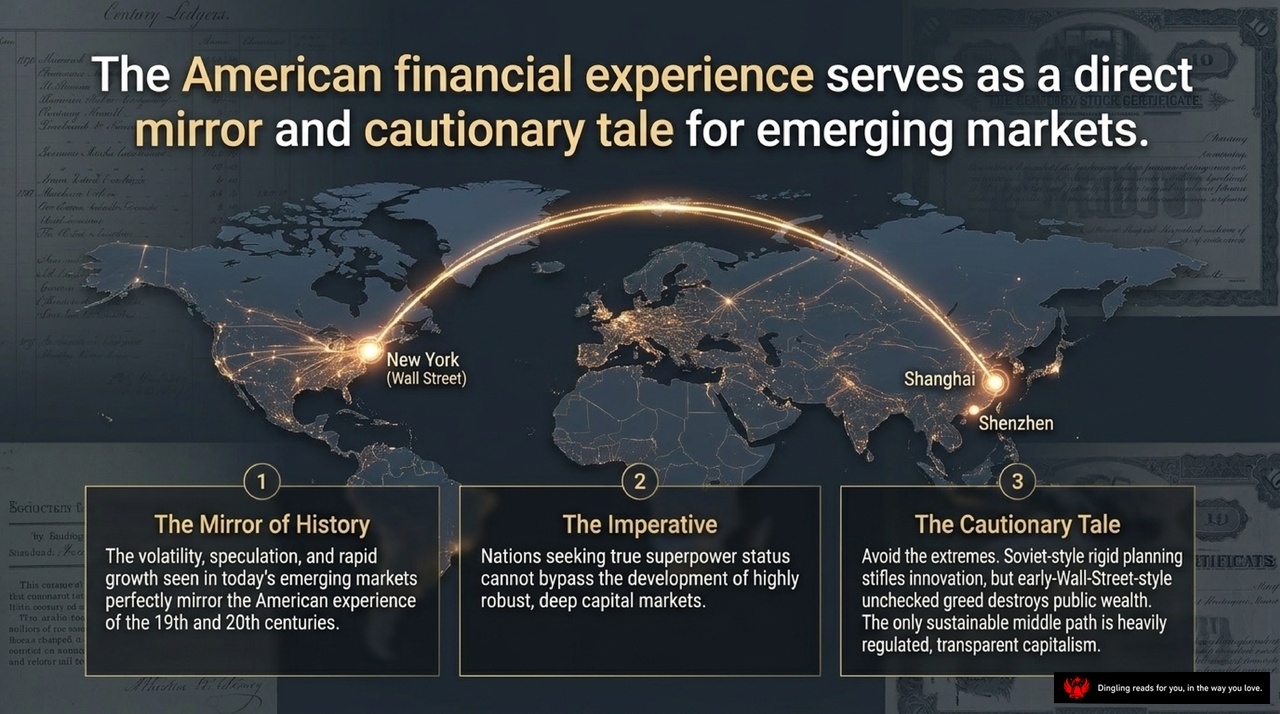
Look at this map connecting New York and Shanghai. It illustrates a powerful truth: the American financial experience serves as a direct mirror and a cautionary tale for emerging markets today.
Let's break down the three key lessons shown here. First, it's the Mirror of History. The volatility, speculation, and rapid growth we see in emerging markets today perfectly mirror the chaotic American experience of the 19th and 20th centuries. Just as early America faced fires, panics, and bubbles, modern markets are walking a similar path.
Second, we face an Imperative. Nations seeking true superpower status cannot bypass the development of highly robust, deep capital markets. You can't skip the hard lessons of building a financial system that can handle massive scale and complexity.
Finally, we have the Cautionary Tale. We must avoid the extremes. On one side, rigid, Soviet-style planning stifles innovation and kills progress. On the other, unchecked, early Wall Street-style greed destroys public wealth and creates instability. The only sustainable middle path, as history proves, is heavily regulated, transparent capitalism.
So, while we look to the East for growth, we must look to our own history for the rules of the road.
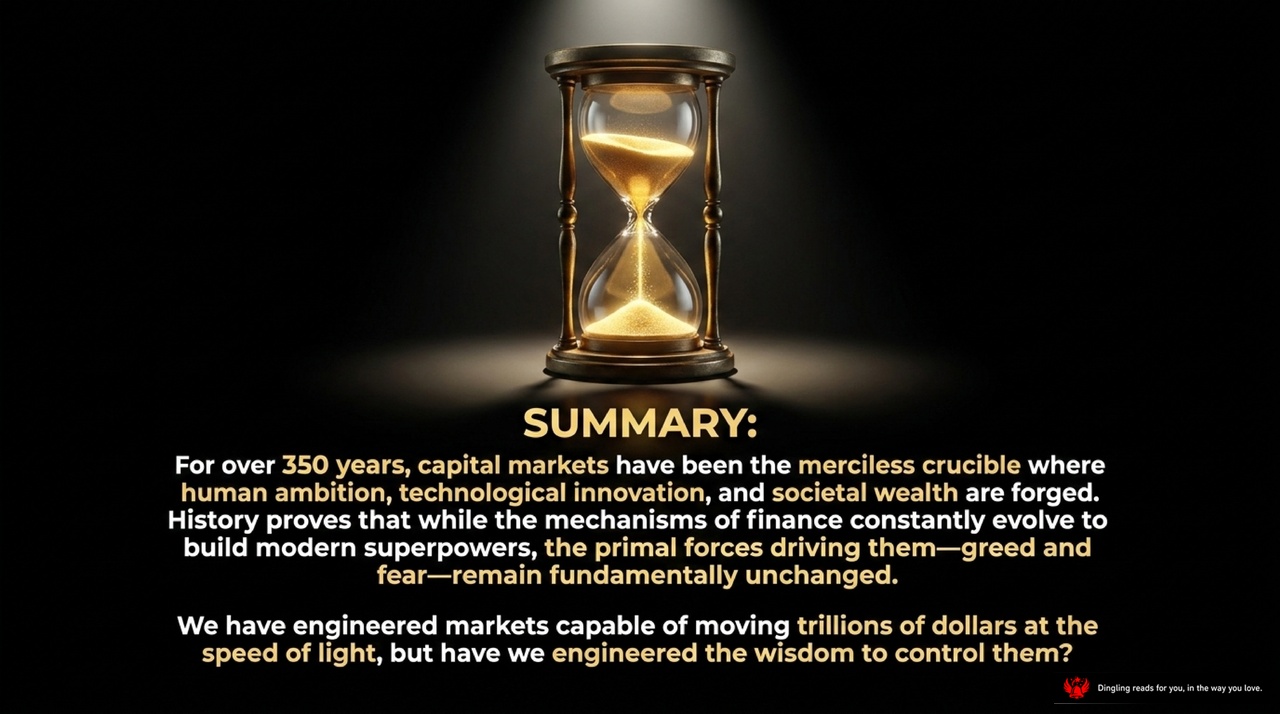
For over 350 years, capital markets have served as the merciless crucible where human ambition, technological innovation, and societal wealth are forged. As our slide illustrates, while the mechanisms of finance constantly evolve to build modern superpowers, the primal forces driving them—greed and fear—remain fundamentally unchanged. We have engineered markets capable of moving trillions of dollars at the speed of light, but have we engineered the wisdom to control them? History shows us that from the tulip mania of the 17th century to the digital frenzies of today, the tools change, but the human nature behind the trades does not. The real question isn't just about how fast we can move money, but whether we have developed the discipline to ensure that this incredible power serves the greater good rather than just fueling endless speculation.