
The Great Mental Models, Volume 1: General Thinking Concepts: Complete Chapter-by-Chapter Summary

Welcome to the world of mental models. Imagine your mind as a toolbox. For too long, many of us have been walking around with only a hammer, convinced that every problem is a nail. This is the trap of relying on a single perspective. But what if you had a comprehensive toolkit? That is exactly what *The Great Mental Models* by Shane Parrish offers: a collection of multidisciplinary frameworks designed to eliminate cognitive blind spots and optimize how you make decisions.
Think of these models not as abstract theories, but as practical tools to navigate a world full of uncertainty. Whether you are an investor analyzing risk, a leader managing a team, or simply trying to make sense of the news, these concepts help you see the world more clearly. By combining insights from physics, biology, psychology, and economics, you can build a robust network of thinking that reveals the full picture behind complex problems.
This book is your guide to moving beyond intuition and into a more reliable, evidence-based way of thinking. It teaches you how to avoid common traps like overconfidence and groupthink, and how to make decisions that stand the test of time. Whether you are building a business, raising a family, or planning your future, these mental models will help you find your way through the chaos and make choices that truly matter.

The Decision-Making Lifecycle isn't just a random collection of mental models; it's a chronological system designed to guide us from confusion to clarity. Think of it as a three-stage journey.
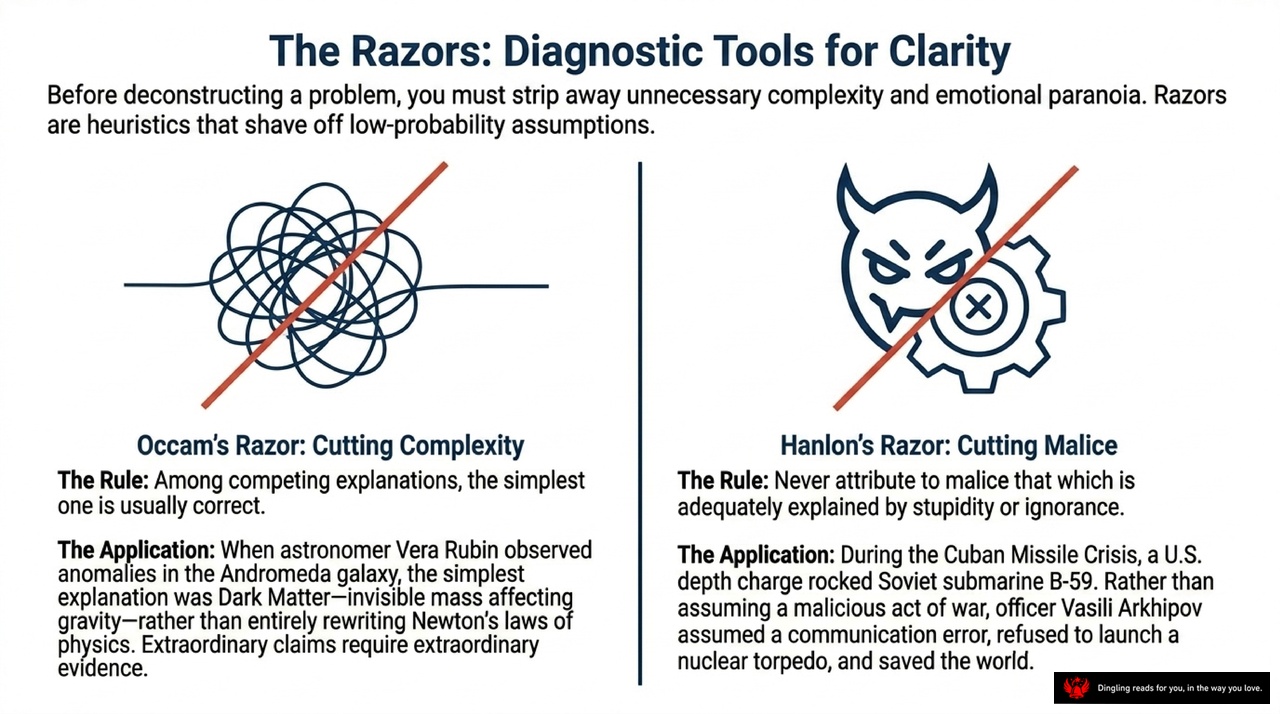
First, we must Perceive Reality. Before we can solve anything, we have to see the board clearly. This means remembering that "The Map is Not the Territory"—our models are just simplified guides, not the complex reality itself. We also need to define our "Circle of Competence," knowing exactly what we understand and, crucially, what we don't. By applying Occam's Razor and Hanlon's Razor, we cut through unnecessary complexity and avoid assuming malice where there is often just incompetence.
Once we've grounded ourselves in reality, Phase Two is about Deconstructing Problems. Here, we break down the challenge. We use First Principles Thinking to strip away assumptions and get to the core truth. We apply the Logic Filter to check necessity and causation, and we use Inversion to look at problems backward. Instead of asking how to succeed, we ask how to avoid failure, which often reveals the most critical obstacles.
Finally, we move to Phase Three: Predicting Outcomes. This is where we anticipate the future. We run Thought Experiments to simulate different scenarios, use Probabilistic Thinking to navigate uncertainty, and engage in Second-Order Thinking to see the ripple effects of our decisions. By weaving these tools together, we transform a chaotic situation into a series of manageable choices, making decisions that are not just reactive, but truly strategic.

The Map is Not the Territory. This phrase reminds us that our models are never the reality itself. As the slide illustrates, a grid of data points can only approximate the messy, flowing terrain underneath. If a map perfectly captured every detail of the territory, it would be just as large and useless as the territory itself. The real danger lies when we forget that vast, unmapped nuances still exist beyond our abstraction.
Consider the "Tragedy of the Commons." This model suggests that shared resources will inevitably be destroyed because individuals act in their own self-interest. It's a powerful lens, but if we treat it as an immutable law, we miss the reality of human cooperation. In places like the Swiss Alps, local herders developed their own rules to manage the pasture sustainably, proving that the model wasn't the whole story.
Similarly, Newton's physics was once our ultimate map for predicting motion. It worked brilliantly for centuries. But when we ventured into the cosmos or the quantum realm, that map became incomplete. Einstein's relativity provided a new, more accurate map for those specific territories. The lesson is clear: maps are just snapshots in time. When the territory changes, our models must be updated through direct exploration. We must respect the reality on the ground, not just the lines on our paper.
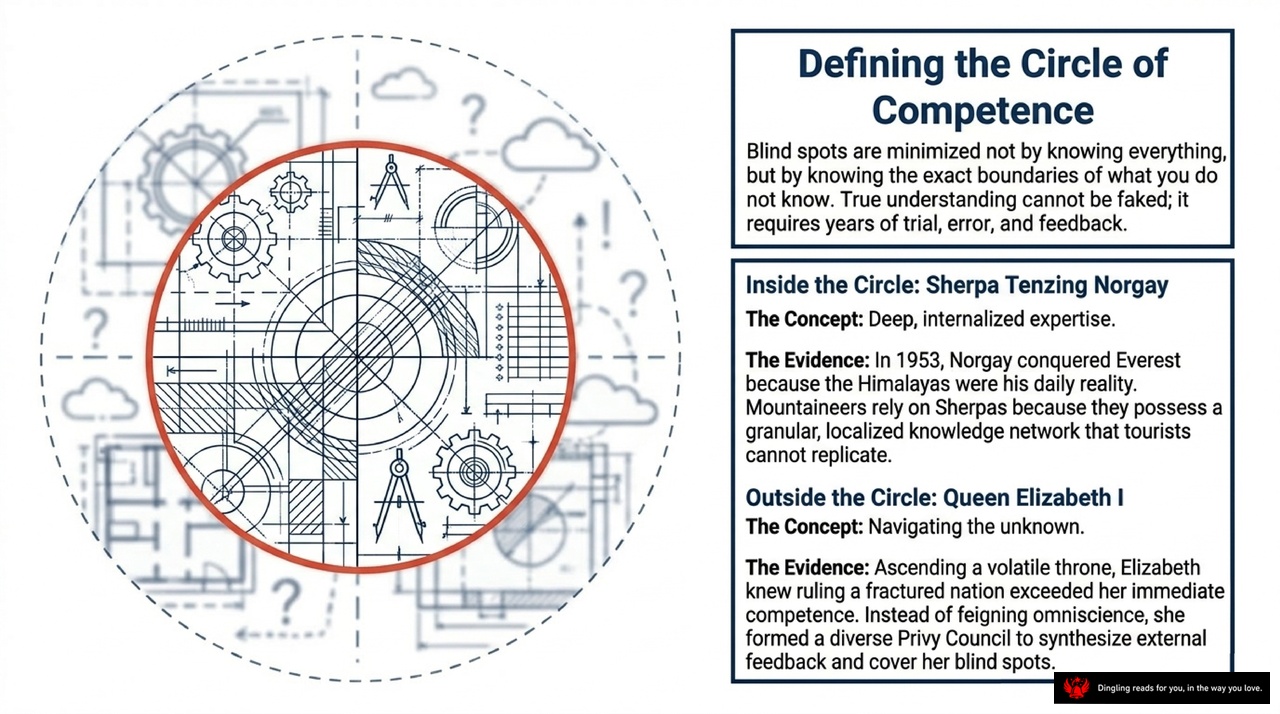
Defining the Circle of Competence is all about knowing exactly what you do not know. True understanding isn't something you can fake; it's built through years of trial, error, and feedback.
Take Sherpa Tenzing Norgay as the ultimate example of deep, internalized expertise. In 1953, he conquered Everest not just because he was fit, but because the Himalayas were his daily reality. He possessed a granular, localized knowledge network that tourists simply cannot replicate. He lives inside the circle.
Contrast that with Queen Elizabeth I, who had to navigate the unknown. Ascending a volatile throne, she knew that ruling a fractured nation exceeded her immediate competence. Instead of feigning omniscience, she formed a diverse Privy Council to synthesize external feedback and cover her blind spots. She knew where her circle ended and how to reach beyond it.
The core lesson here is simple: minimizing blind spots isn't about knowing everything. It's about knowing the exact boundaries of what you don't know. When you respect the limits of your expertise, you stop trying to fake it and start making decisions that are grounded in reality. That is the only way to build true, unshakeable competence.
Think about your decision-making process like you're a spy in a high-stakes game. You don't just hope for the best; you calculate the odds. That's the power of probabilistic thinking. Imagine you're a WWII spy, like Vera Atkins, recruiting agents behind enemy lines. You can't just pick the person who *looks* brave. You have to weigh variables: their fluency in French, their psychological resilience, even their family background. Every factor shifts the probability of survival. It's not about being right 100% of the time; it's about finding the option with the highest chance of success when you don't have all the answers.
But here's the catch: the world isn't a neat bell curve. We often live in a "fat-tail" world where extreme events happen more often than our math models predict. Think about wealth distribution or the risk of a terrorist attack. The odds of a massive event seem low, but when it happens, the impact is catastrophic. If you only plan for average outcomes, you're blind to the real danger. This is where the concept of "antifragility" comes in. Instead of trying to predict the future, build systems that get stronger from chaos. Look for opportunities where your downside is limited, but your upside is unlimited. Take a small risk, learn from the failure, and evolve. Don't fear the uncertainty; use it as fuel to upgrade your decision-making engine. By shifting from a black-and-white mindset to a gray, probabilistic one, you stop gambling on luck and start engineering your success.

Let's talk about how we can actually use these mental models to understand reality and make better decisions.
First, remember that a single model isn't enough. Think about gravity: it explains why a pen drops, how bridges hold weight, and even how to close a sales deal by leveraging the idea that "gravity weakens with distance." But just like gravity, every model has limits. If you try to use Newton's laws to explain the quantum world, you'll fail. The key is building a network of models from different disciplines.
Imagine trying to understand a forest. A botanist sees the ecosystem, an environmentalist looks at climate change, an engineer focuses on tree growth, and a businessman calculates land value. None of them sees the whole picture alone. You need to combine their perspectives.
So, how do you build this network? Start with the basics: probability from math, entropy from physics, evolution from biology, and cognitive biases from psychology. These are your foundational tools. Then, link them together. For example, when choosing a career, use the economic concept of opportunity cost alongside the psychological idea of loss aversion to understand why you might stay in a safe job instead of taking a better long-term risk.
But be careful. Models are just simplified maps of reality, not the territory itself. They are abstract and can become outdated. We must constantly test them against reality. If your model doesn't match what's actually happening, you need to update or replace it.
Finally, keep your network fresh. New fields emerge all the time, like complex systems theory or neuroscience, offering new ways to think. Regularly check your mental toolkit, add what works, and discard what no longer fits. By weaving these diverse models into a cohesive network, you break through cognitive blind spots and get closer to the truth, making smarter, more robust decisions in a complex world.

Inversion is the art of solving problems by working backward. Instead of obsessing over how to achieve success, we flip the script and ask: "What would guarantee failure?" Then, we systematically avoid those things. As the slide illustrates, moving forward often leads us straight into a roadblock, but moving backward allows us to clear the path by removing every obstacle we encounter.
History offers powerful proof of this approach. Consider Florence Nightingale during the Crimean War. Rather than asking, "How do we cure these soldiers?" she inverted the question to, "What is killing them unnecessarily?" By analyzing the data, she discovered that poor sanitation, not just battlefield wounds, was the primary culprit. She didn't just treat the symptoms; she prevented the problem at the source, drastically reducing mortality rates.
Similarly, in the 1960s, Marie Van Brittan Brown felt unsafe in her Queens home. Instead of asking, "How do I fight an intruder?" she asked, "What conditions make me vulnerable?" Realizing her front door was a blind spot, she invented the first closed-circuit television security system. She solved the problem by eliminating the vulnerability rather than fighting the threat.
The core message is clear: avoiding stupidity is often easier than seeking brilliance. By identifying the failure state and systematically removing the conditions that lead to it, we create a path to success that is far more reliable than chasing a perfect solution.

Before we make any big predictions about the future, we need a strict reality check. Your deconstructed ideas must pass three rigorous tests to ensure you aren't just fooling yourself with random data or false connections.
First, is your idea **falsifiable**? This concept comes from Karl Popper. The trap here is confirmation bias—like Bertrand Russell's turkey that believed it was loved every day until Thanksgiving. The filter? A real theory must be able to be proven wrong. You need to be able to say, "If this happens, my theory is dead."
Second, distinguish between **necessity and sufficiency**. The trap is thinking that having the basics guarantees success. For example, capital and hard work are *necessary* to build a Fortune 500 company, but they are not *sufficient*. You also need luck and timing. Don't mistake a baseline requirement for a guarantee of victory.
Third, separate **causation from correlation**. Just because B follows A doesn't mean A caused B. The trap is assuming a direct link where none exists. The filter requires you to account for "reversion to the mean." Extreme outliers naturally drift back to the average over time. If you see a stock surge and attribute it to a specific news event, remember that it might just be a natural statistical correction, not the result of your intervention.
By applying these three filters—falsifiability, necessity versus sufficiency, and causation versus correlation—you stop being fooled by randomness and start seeing reality clearly.

Thought experiments are powerful mental tools that let us manipulate variables that are physically impossible to change in the real world, helping us map the boundaries of our knowledge. Imagine you could instantly simulate a scenario to see the outcome before taking any action.
Consider the first filter: physical disparities. In a thought experiment pitting LeBron James against Woody Allen, the simulation instantly yields a definitive winner—a diamond outcome—because the physical gap is too obvious to ignore. However, if you simulate LeBron against Kevin Durant, the result becomes inconclusive, like a hexagon. The variables are too close to call without actual physical execution, proving that some outcomes simply cannot be resolved by mental simulation alone.
But what if we remove the variables of self-interest entirely? This leads us to the second filter: the Veil of Ignorance. Inspired by John Rawls, this experiment asks you to design a truly fair society without knowing your own gender, wealth, or race. By removing the variable of self-interest, you isolate the pure definition of fairness. Instead of getting stuck in the messy details of reality, you arrive at a star-shaped outcome of pure fairness.
In short, thought experiments allow us to test hypotheses by simulating different filters. Whether it's revealing physical limits or stripping away bias to find justice, these mental simulations help us navigate uncertainty and make better decisions without needing to pay the real-world price.
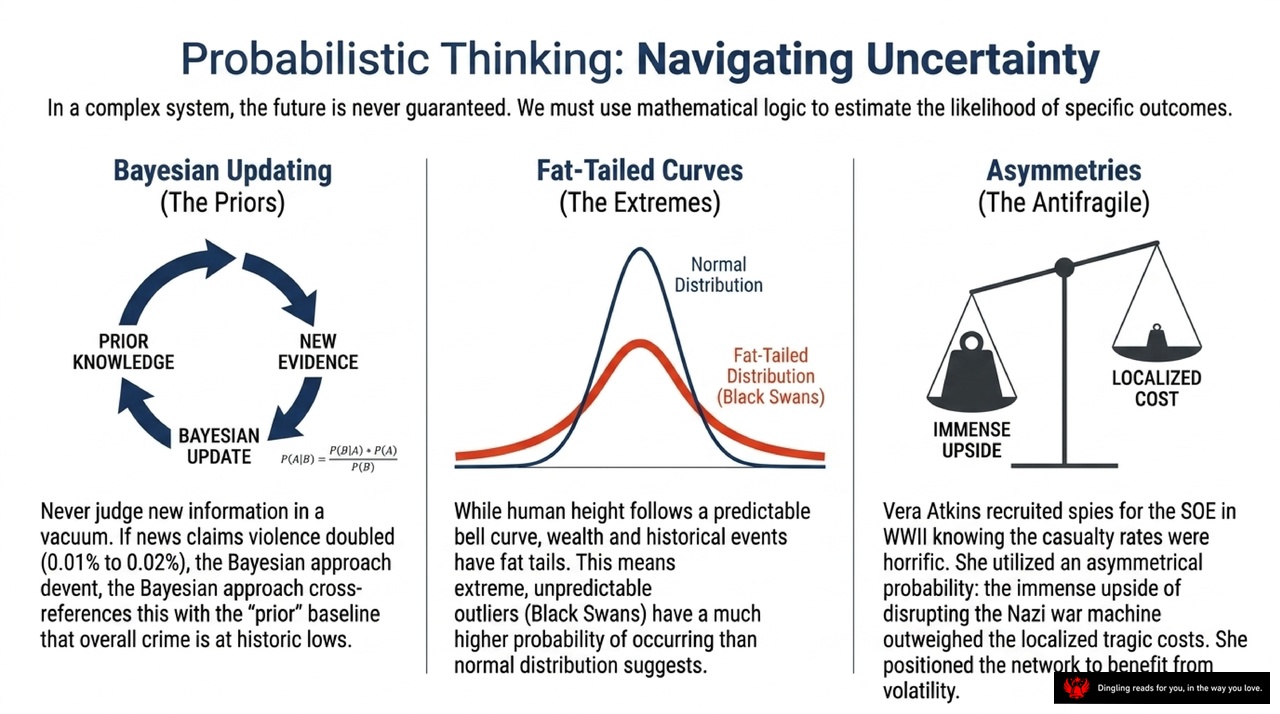
In a complex system, the future is never guaranteed. We must use mathematical logic to estimate the likelihood of specific outcomes. Today, we are diving into three powerful pillars of probabilistic thinking: Bayesian Updating, Fat-Tailed Curves, and Asymmetries.
First, let's look at Bayesian Updating, or "The Priors." Never judge new information in a vacuum. Imagine a news report claims violence has doubled from 0.01% to 0.02%. Our instinct might scream "danger," but the Bayesian approach forces us to cross-reference this with our "prior" baseline. If we know that overall crime is at historic lows, that new data point suddenly looks much less alarming. It's about how new evidence updates our existing knowledge, not just reacting to the headline.
Next, we move to Fat-Tailed Curves, representing "The Extremes." While human height follows a predictable bell curve, wealth and historical events have fat tails. This means extreme, unpredictable outliers—what we call Black Swans—have a much higher probability of occurring than a normal distribution suggests. While human height follows a predictable bell curve, wealth and historical events have fat tails. This means extreme, unpredictable outliers (Black Swans) have a much higher probability of occurring than normal distribution suggests. In a fat-tailed world, a rare event isn't just a statistical anomaly; it can be a game-changer.
Finally, we explore Asymmetries, or "The Antifragile." Not all risks are created equal. Consider Vera Atkins, who recruited spies for the SOE in WWII. She knew the casualty rates were horrific, representing a localized cost. However, she positioned the network to benefit from volatility, creating an immense upside of disrupting the Nazi war machine. She utilized an asymmetrical probability: the immense upside of disrupting the Nazi war machine outweighed the localized tragic costs. She positioned the network to benefit from volatility.
By mastering these three concepts—updating our priors, respecting the fat tails of reality, and seeking asymmetrical opportunities—we stop guessing and start navigating uncertainty with mathematical logic.

So, let's talk about thinking in second order. Most of us are stuck in first-order thinking, where we only look at the immediate result of an action. It's like solving a problem, fixing a symptom, and assuming the job is done. But as this slide shows, that approach often creates a worse future. Second-order thinking demands we ask the crucial question: "And then what?"
Imagine throwing a stone into a calm lake. The first ripple is the direct impact, but the second, third, and subsequent ripples spread outward, affecting everything around it. That's the Law of Unintended Consequences. We see it clearly in the Cobra Effect, where a British bounty for dead cobras in India backfired because locals started breeding them for profit, ultimately increasing the snake population. Or consider agricultural antibiotics; while they boost growth in the short term, the long-term ripple is the creation of superbugs that threaten global health.
Sometimes, second-order thinking is the key to strategic delay of gratification. Think of Cleopatra and Caesar. Her first-order move was to ally with him, which risked civil war and angering her subjects. But the second-order effect was securing powerful Roman backing, ensuring her long-term survival and rule. By looking past the immediate chaos, she secured a stable future.
So, don't just solve the problem at hand. Dig deeper. Ask "and then what?" to see the full chain of consequences, because the real cost or the real reward is often hidden in those second-order effects.
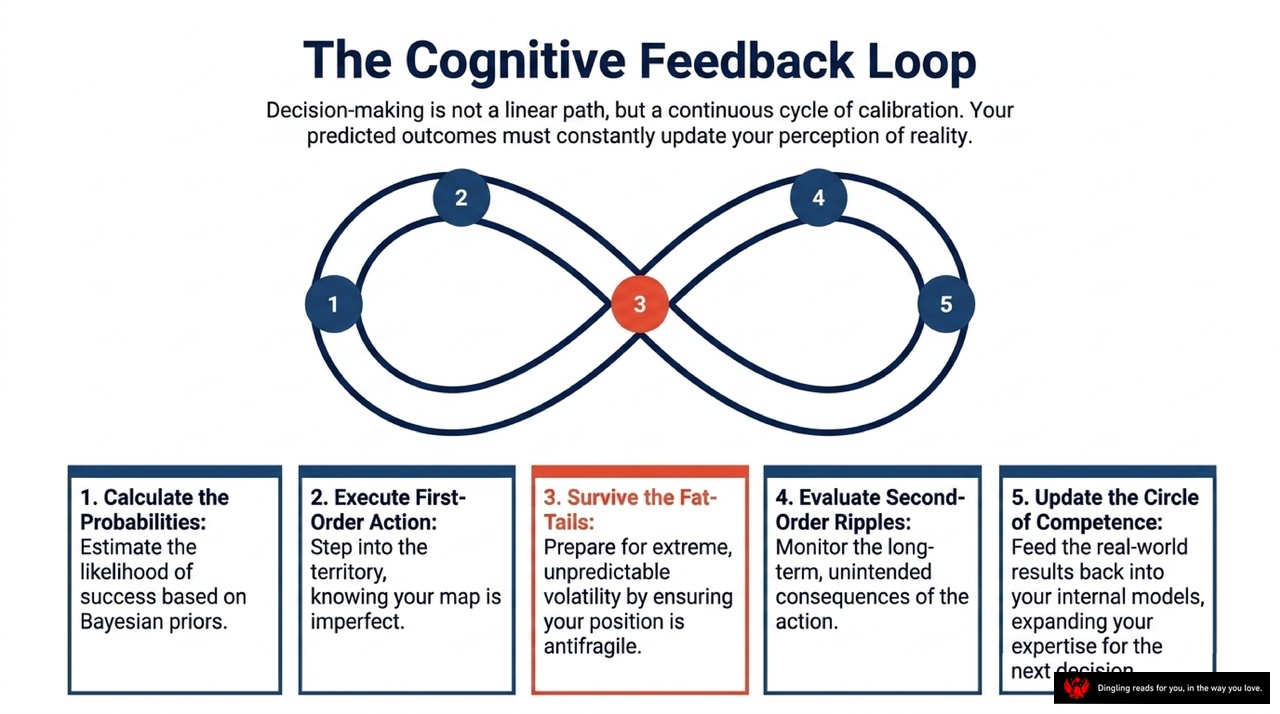
The Cognitive Feedback Loop isn't just a diagram; it's the operating system for making sense of a chaotic world. As the slide illustrates, decision-making isn't a straight line from A to B. It's a continuous cycle of calibration where your predicted outcomes constantly update your perception of reality.
Let's break down this infinite loop. It starts with **calculating probabilities**. You estimate the likelihood of success based on what you know now—your Bayesian priors. But you must remember, your map is never perfect. So, you move to **executing first-order action**. You step into the territory, knowing your initial model has gaps.
Here is the critical pivot point: **surviving the fat tails**. This is where most people fail. You must prepare for extreme, unpredictable volatility. You ensure your position is antifragile, meaning you don't just survive the shock, but you gain from it. Once you've weathered the storm, you **evaluate second-order ripples**. You stop looking at the immediate result and monitor the long-term, unintended consequences of your action.
Finally, you **update the circle of competence**. You feed those real-world results back into your internal models. You expand your expertise for the next decision, and the cycle begins again. This loop prevents you from getting stuck in a rigid worldview, ensuring you stay grounded in reality rather than trapped in your own assumptions.

So, let's be honest: being smart isn't enough to see the truth. You can have a high IQ, but if your mental map is outdated or too narrow, you're still navigating blind. The slide makes a crucial point here: cognitive blind spots don't vanish because you're intelligent; they disappear only when you deliberately build a multi-disciplinary network of mental models. This is the only way to cut through the noise, deconstruct problems logically, and predict outcomes with real confidence.
Now, look at that bold red question: "If your current worldview is merely a reductive map, what critical territories are you navigating blindly today?" This hits home because we all love our maps. We treat our simplified models of reality—the news cycles, our industry jargon, our personal biases—as if they are the territory itself. But a map is never the land. It's just a sketch. And when the world changes faster than our map updates, we crash.
Think about it: are you stuck in a single lane of thinking? Are you ignoring data that contradicts your beliefs just to protect your ego? If your current framework is too simple, you're missing the critical territories where the real opportunities and dangers lie. The goal isn't to eliminate blind spots entirely—that's impossible—but to expand your map enough to see them coming. So, I challenge you: take a hard look at your own worldview. What parts of reality are you ignoring right now? Because until you do, you're just driving with your eyes closed.