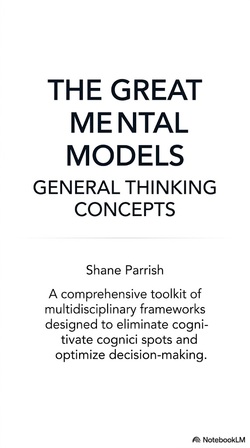


The Great Mental Models, Volume 1: General Thinking Concepts: Reader Reviews & Ratings

The Great Mental Models, Volume 1: General Thinking Concepts
Loading…

The Great Mental Models, Volume 1: General Thinking Concepts

Shane Parrish;Rhiannon Beaubien

Write a Review

Your Review

0/500

Other reviews

21 total
Zane95

The distinction between Map and Territory completely changed how I view news and data, stopping me from treating simplified headlines as absolute truth and forcing me to check the messy reality behind them instead, which feels like a necessary anchor against the chaos of modern information overload and my own tendency to oversimplify complex situations without ever questioning the validity of my mental shortcuts.


Don

The section on Second-Order Thinking changed how I look at career pivots. Instead of just chasing trends, I now ask what happens next after the next step. This simple shift helps me avoid short-term gains that could hurt my long-term stability in an unpredictable market.

Caroline

Reading this made me realize I was confusing maps with territory, so I now question my assumptions before making big decisions.

Gregory02

Good advice on knowing limits.

Marcus

Parrish explains complex models simply, but I still struggle applying them daily.

Jasmine

I appreciate the mental models for decision making but I worry they might become rigid rules that stop me from being creative when solving unique problems that don't fit any existing framework.

Gail27

Too much theory.

Tad99

The Circle of Competence model stopped me from blindly jumping into AI engineering when I was still a marketing manager, reminding me to build on my existing strengths instead of chasing every trend. Instead of quitting my job to learn machine learning algorithms from scratch, I chose to take courses on AI marketing tools and partner with data scientists for predictive models. This approach lets me tap into the growing AI field without abandoning my core expertise in customer behavior and campaign metrics, significantly reducing the risk of failure while expanding my skill set strategically rather than recklessly.

Autumn18

Using First Principles helped me cut through the noise of societal expectations when budgeting. I stopped buying things just because everyone else did and instead focused on what truly mattered to me like saving for travel or paying off debt, which feels much more empowering than following trends blindly.

Guillermo

I struggled with the idea of second-order thinking at first because it feels too abstract, but the Cleopatra example made it click for me. She took a huge risk to meet Caesar knowing the immediate chaos would happen, but she calculated that the long-term gain of securing her throne was worth it. This model forces me to ask then what repeatedly so I don't make short-sighted decisions that hurt my future goals later on.

Harvey

The explanation of Map vs Territory clarified why my news headlines always feel wrong. I finally see that simplified models are just guides, not reality itself. This shift in thinking feels essential for navigating daily chaos without getting trapped by false certainty or outdated information that no longer matches the world around me.

Zachary

This book is okay for the basic ideas but feels a bit dry in places. The explanation of Map versus Territory makes sense, yet the examples often feel too academic and don't connect well with my daily life, so I struggled to see how these models would actually help me make better decisions quickly.

Les01

Finally a guide that cuts through the noise.

Cordelia

Slightly repetitive in places, still solid overall.

Crystal

Parrish explains how Map versus Territory stops me from treating news headlines as absolute truth instead of simplified guides to reality.

Jeffery

Finally a practical book that explains how to think clearly instead of just giving vague advice about trusting your gut.

Caiden

The distinction between normal distributions and fat tails changed how I view investing risks completely. I used to think rare crashes were impossible based on average data, but realizing markets can have extreme outliers makes me feel much more prepared to keep calm during volatility instead of panicking and selling everything.

Edwin88

The story about the Soviet submarine during the Cuban Missile Crisis showed me how powerful Hanlon's Razor is in preventing catastrophic mistakes by assuming ignorance instead of malice when things go wrong.

Piper23

The section on Circle of Competence really helped me stop chasing trends I didn't understand. I realized I was investing in tech startups without knowing the fundamentals, just because friends were making money. Now I know to either learn deeply or partner with experts instead of blindly jumping into unfamiliar territory where I have no real insight.

Alexander

I found the advice about avoiding career pivots into fields I don't understand frustrating because it sounds like staying stuck, but it makes sense when you think about the real cost of failing in something you have no expertise in.