
The Greenhouse at the End of the Earth: Complete Chapter-by-Chapter Summary

Welcome to the world of *The Greenhouse at the End of the Earth* by Kim Cho-yeop. Imagine a planet where the sky is choked with dust, and heroes don't save the day with weapons or superpowers. Instead, survival hangs on the fragile, resilient glow of a single, forgotten plant. This is a quiet apocalypse, where the only hope lies in the stubborn life of a vine that refuses to die. Join us as we dive into this haunting tale of love, loss, and the incredible power of nature to heal a broken world.
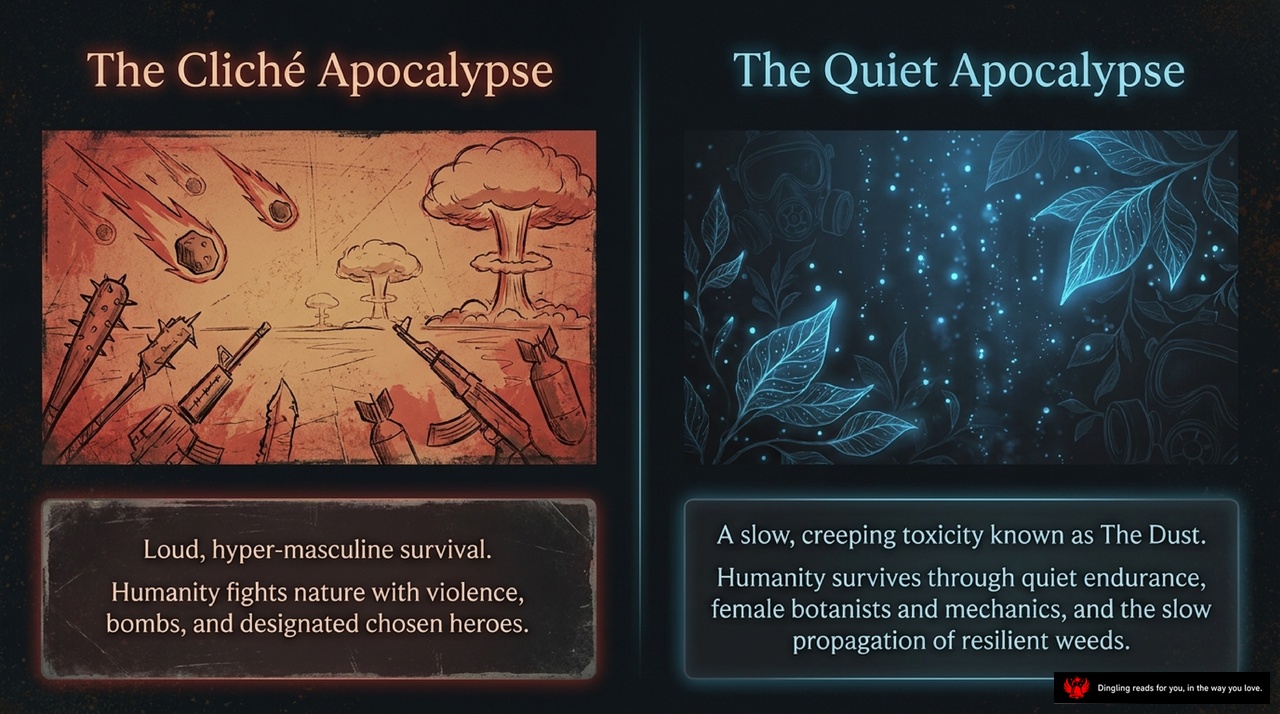
Look at this split-screen comparison. On the left, we have "The Cliché Apocalypse"—the loud, hyper-masculine version everyone expects. Think explosions, meteors, and chosen heroes fighting nature with bombs and violence. It's all about brute force and designated saviors. But on the right, we see the reality of our story: "The Quiet Apocalypse." Here, there are no grand battles or chosen ones. Instead, humanity survives through quiet endurance, facing a slow, creeping toxicity known as "The Dust." Survival isn't about dominating nature; it's about adapting to it. It's about female botanists and mechanics, and the slow, stubborn propagation of resilient weeds that find a way to grow even in the deadest soil. This isn't a war; it's a long, silent struggle where the smallest, quietest life forms become the true heroes of the world.
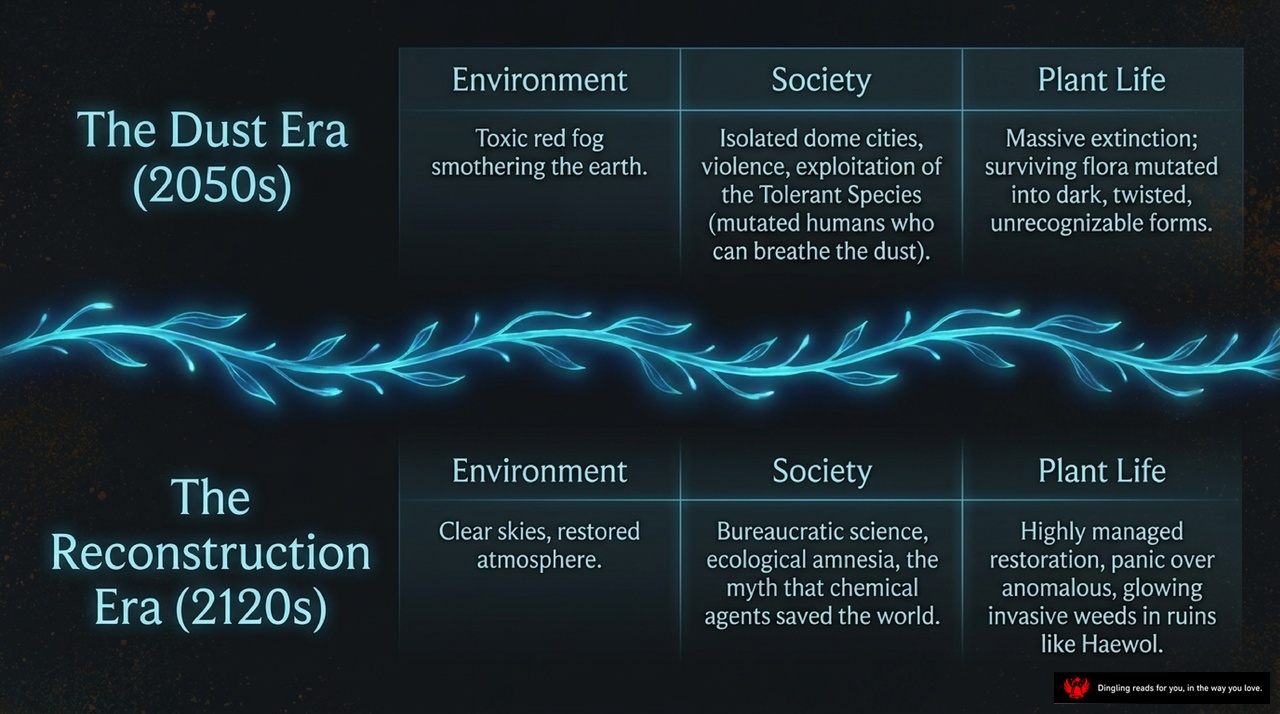
The Dust Era of the 2050s was a nightmare defined by suffocation. The sky wasn't blue; it was choked by a toxic red fog that smothered the Earth, making survival a constant battle against the dust. Society fractured into isolated dome cities, breeding violence and exploitation, where only the "Tolerant Species"—humans mutated to breathe the poison—could thrive at the expense of everyone else. Nature itself had twisted into something unrecognizable; massive extinction wiped out most life, leaving behind dark, mutated flora that looked like nightmares come to life.
Fast forward to the Reconstruction Era of the 2120s, and the surface looks healed. The skies are clear, and the atmosphere is restored, but this peace feels fragile and manufactured. Society is now run by bureaucratic science, driven by a collective "ecological amnesia" where people blindly believe chemical agents saved them, forgetting the true cost of survival. The environment is highly managed, yet panic lingers over glowing, invasive weeds like Haewol appearing in ruins. Nature isn't free here; it's a controlled variable, and the myth of a perfect recovery hides a deeper, unsettling truth about what actually rebuilt the world.
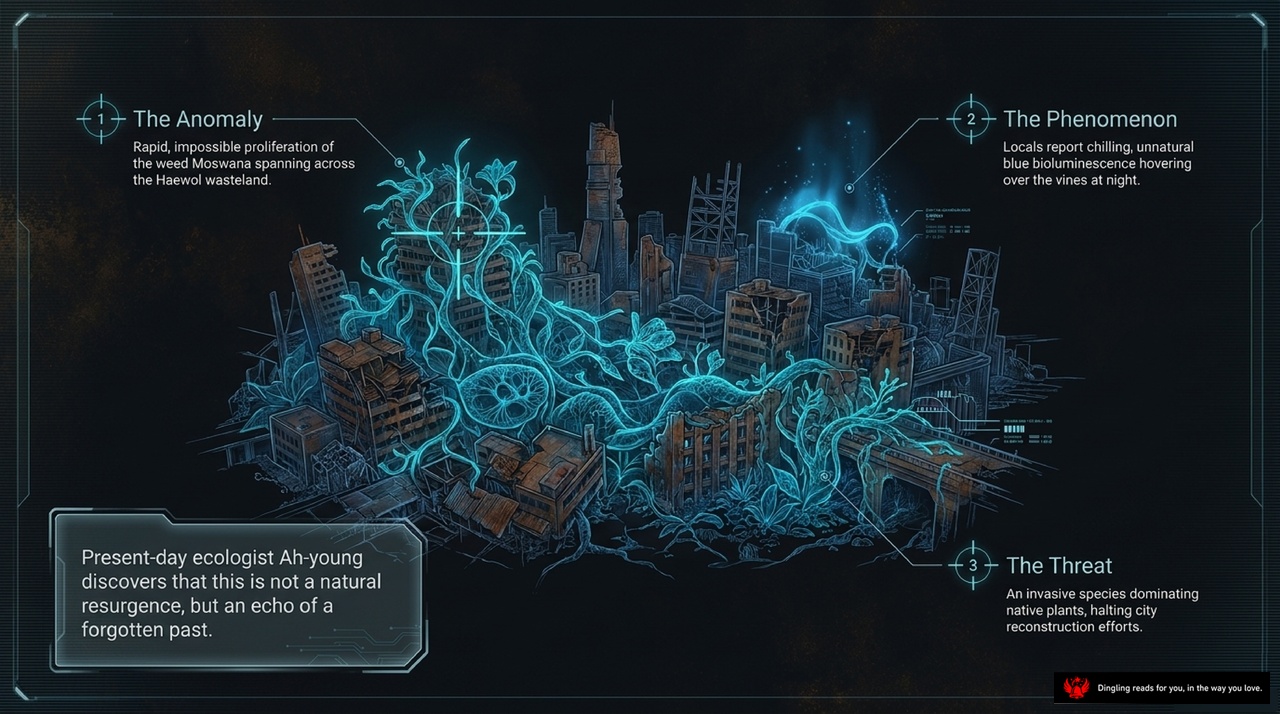
The image on your screen sets a tense scene for us: the Haewol wasteland, where a strange, impossible anomaly is taking hold. Look at those glowing blue vines labeled "The Anomaly"—they are the Moswana, spreading rapidly across the ruins. Locals report chilling, unnatural blue bioluminescence hovering over them at night, creating an eerie, otherworldly glow. This isn't just random growth; it's a threat. An invasive species is dominating native plants, halting the city's reconstruction efforts and choking out the life trying to return.
But here's the twist that changes everything. Ecologist Ah-young discovers this isn't a natural resurgence. It's an echo of a forgotten past. The blue light, the rapid proliferation, the specific way these vines strangle the ruins—it all points to something deliberate, something from a time before the dust settled. This isn't just an ecological crisis; it's a ghost story written in DNA, a secret from a lost sanctuary that has finally resurfaced to reclaim the world.

Look at this glowing blueprint. We're seeing *Hedera trifidus*, or Moswana, not as a simple vine, but as a digital masterpiece. The image breaks down its genome into three distinct strands: Malaysian wild woolly hook vines, Smilax and common ivy, and even Humulus with artificial gene modifications. It's a chimeric organism, a living patchwork created by human hands.
But here's the chilling part at the bottom. The text reveals that the Haewol genome is "too clean." It lacks the messy clutter of natural evolution. This isn't a wild plant that survived the apocalypse by chance; it's an engineered survival tool, perfectly designed by an unknown architect. It proves that Moswana isn't just a weed—it's a weapon of mass planting, a genetically edited chimera designed to thrive where nothing else could. This isn't nature taking over; it's a blueprint for domination, written in DNA.
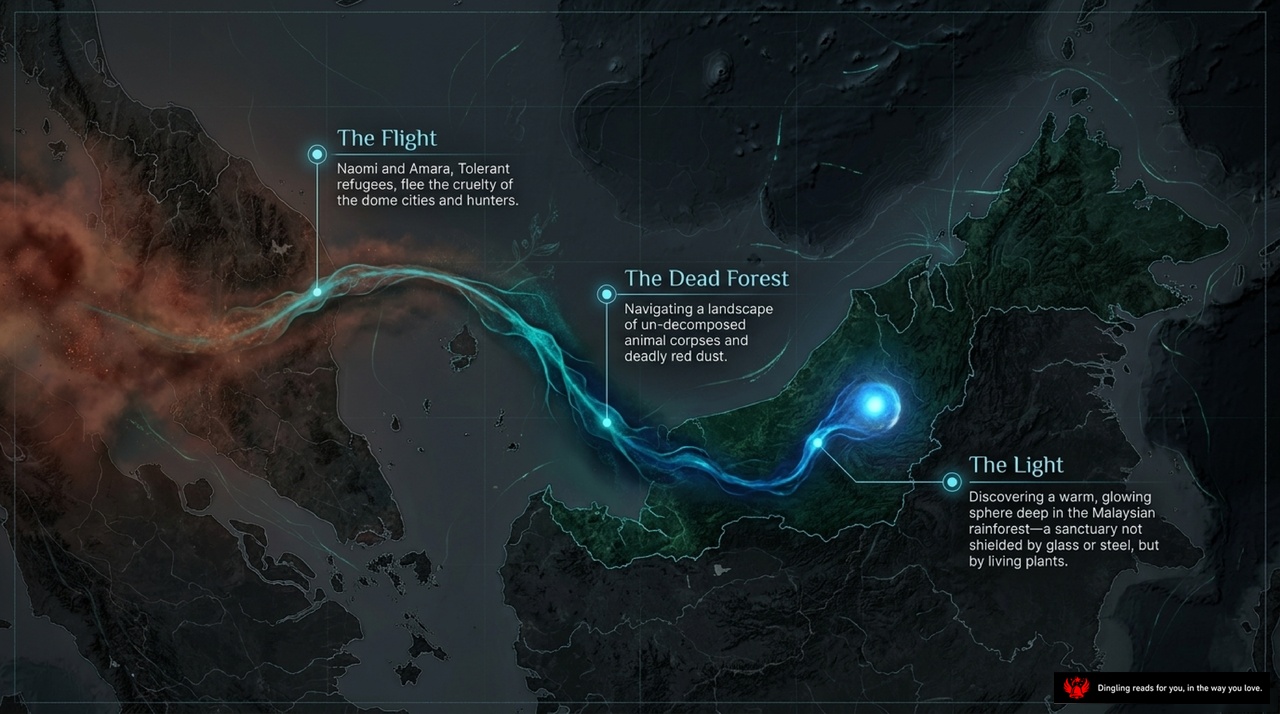
The map before us isn't just a route; it's a timeline of survival, tracing the desperate journey from the dome cities into the heart of the unknown. We start with "The Flight," where Naomi and Amara, branded as "tolerant refugees," are forced to flee the cruelty of their hunters. They leave behind their luxury hover-car, the Dolphin, trading it for a single coordinate that might mean life or death.
Their path leads them through "The Dead Forest," a landscape defined by un-decomposed animal corpses and the suffocating red dust that chokes the world outside. It's a place where nature has seemingly collapsed, yet it's here, deep within the Malaysian rainforest, that they find "The Light." This glowing sphere is not a technological sanctuary shielded by glass or steel, but a living, breathing refuge hidden by the very plants that once seemed like a curse.
This map captures the core tension of their story: the transition from a world of death and dust to a hidden haven where life, in the form of the mysterious Moswana vines, is fighting to survive against all odds. It's a reminder that even in the darkest ruins, a sanctuary can exist if you know where to look.

Welcome to the final chapter of our journey. Look at this breathtaking illustration. We see a sanctuary carved into the earth, protected by a glowing, living perimeter. This is the legacy of the people who refused to let the apocalypse win.
The outer ring, labeled "The Perimeter," represents engineered plants consuming dead matter to create a micro-climate free of the deadly red dust. Inside lies "The Settlement," a fragile utopian community built by marginalized refugees living openly in the apocalypse. At the very heart of it all is "The Core," an eternally lit greenhouse that functions as the village's mechanical and botanical heart.
This image captures the ultimate truth we've uncovered: hope isn't a myth. It's a garden you tend, a system you build, and a promise you keep. From the tragic fires of the past to this thriving green refuge, the story of Mooswana proves that even in the deepest darkness, life finds a way to grow. Thank you for joining us.

Look at this intricate network of relationships. At the top, we have Rachel, the cyborg botanist, and below her, Ji-soo, the mechanic and village leader. Their bond isn't just about survival; it's a silent, profound love built on transactional utility that grew into something much deeper. Ji-soo maintains Rachel's mechanical body, while Rachel grows the protective plants that keep them alive.
But the story doesn't stop there. Ji-soo also connects to Naomi and Amara, the refugee observers. Here, the dynamic shifts from mutual survival to fierce protection and the passing of the torch. Ji-soo trusts these two sisters with the village's legacy, ensuring that even if she can't stay, the hope she built will live on.
The key insight here is powerful: no one here set out to save humanity. They survived through mutual utility that blossomed into fierce devotion. In a world of ruins, these connections became the very thing that kept them human, turning simple acts of help into an unbreakable bond.
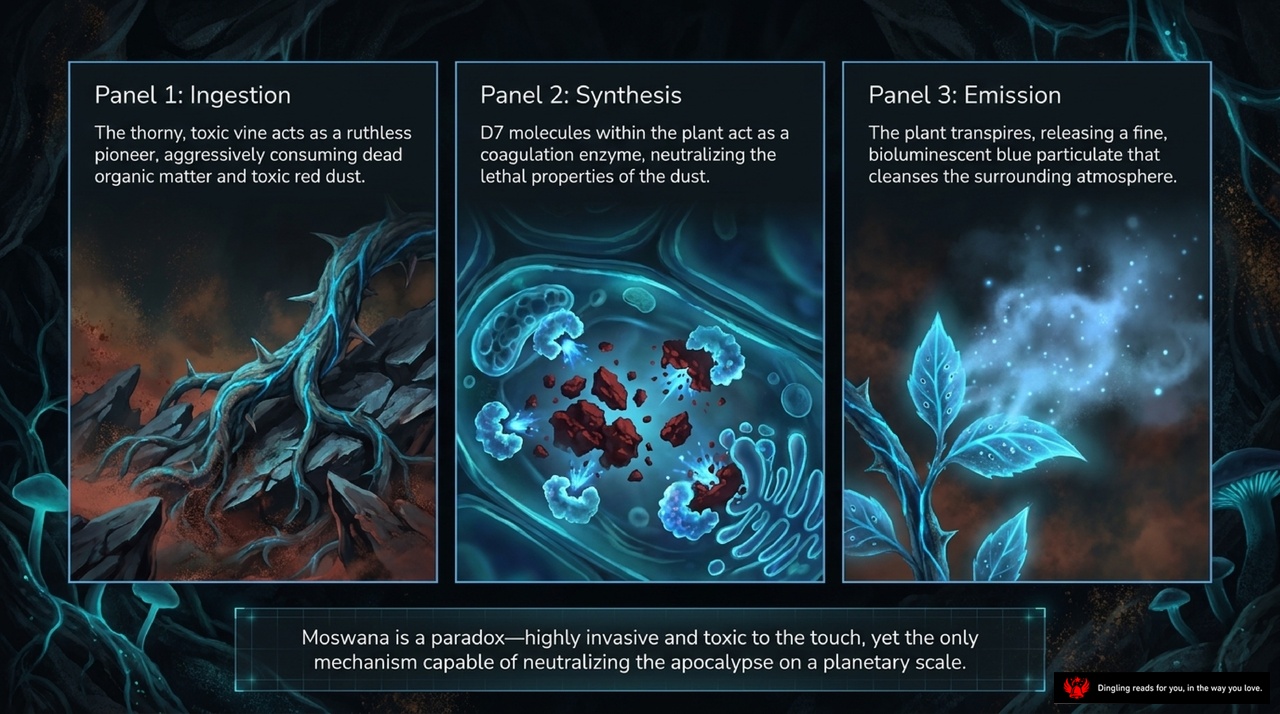
Look at this triptych. It tells the story of Moswana, the paradoxical vine that defines our world's survival.
Panel one shows Ingestion. This thorny, toxic vine acts as a ruthless pioneer. It aggressively consumes dead organic matter and that toxic red dust that choked the planet. It doesn't just survive the apocalypse; it eats it.
Move to Panel two: Synthesis. Inside the plant, D7 molecules act as a coagulation enzyme. They neutralize the lethal properties of the dust, turning a poison into something manageable. It's a biological alchemy happening right now in the cell.
Finally, Panel three: Emission. The plant transpires, releasing fine, bioluminescent blue particulate into the air. This isn't just decoration; it cleanses the surrounding atmosphere, scrubbing the toxicity from the sky itself.
This is the ultimate contradiction. Moswana is highly invasive and toxic to the touch, yet it is the only mechanism capable of neutralizing the apocalypse on a planetary scale. It is a dangerous savior, a living machine that turned the end of the world into a new beginning.
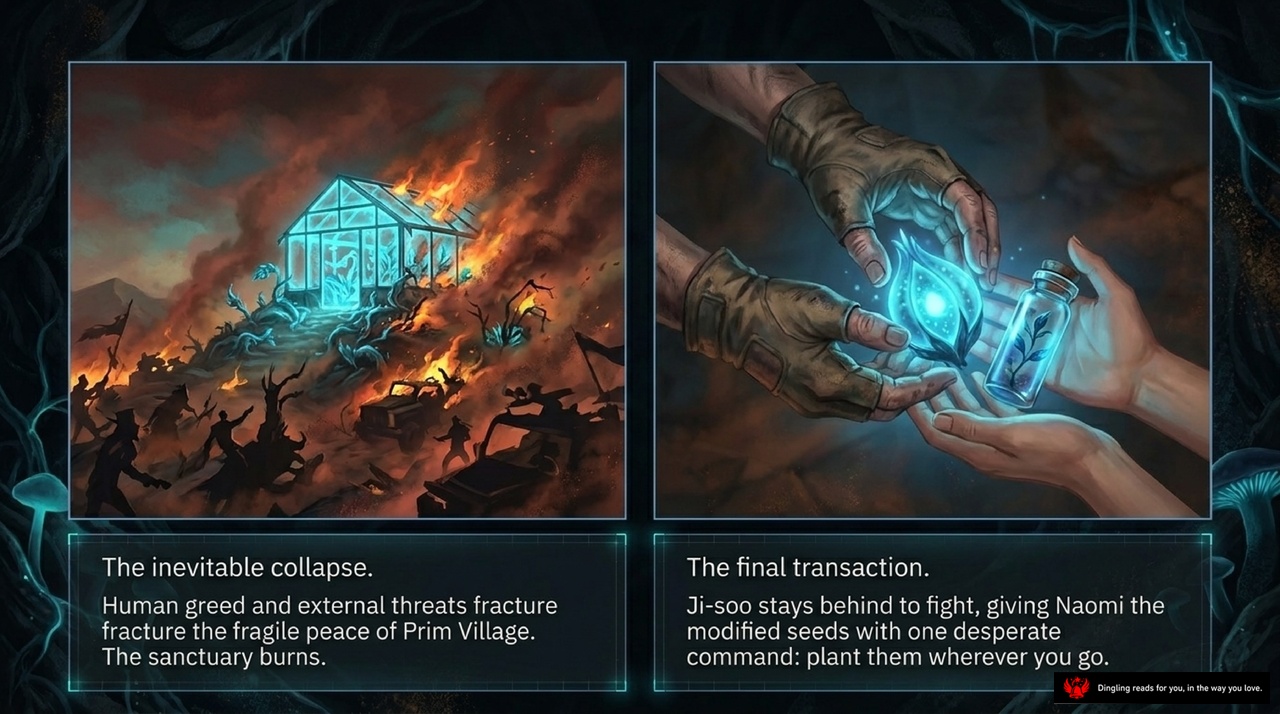
Look at the screen. On the left, we see the inevitable collapse. Human greed and external threats fracture the fragile peace of Prim Village. The sanctuary burns. On the right, we see the final transaction. Ji-soo stays behind to fight, giving Naomi the modified seeds with one desperate command: plant them wherever you go.
This moment captures the entire arc of their story. While the village they built together is consumed by fire, Ji-soo makes the ultimate sacrifice. She realizes that the physical sanctuary cannot save them forever, but the seeds she has nurtured can. By handing them to Naomi and ordering her to spread them globally, she transforms their struggle from a local tragedy into a global hope.
This act isn't just about survival; it's about legacy. It shifts the narrative from defending a single place to planting hope in every corner of the world. Even as the past burns away, the future is carried forward in those tiny, glowing seeds. It's a powerful reminder that sometimes, the bravest thing you can do is let go of what you've built, so you can help build something new for everyone.
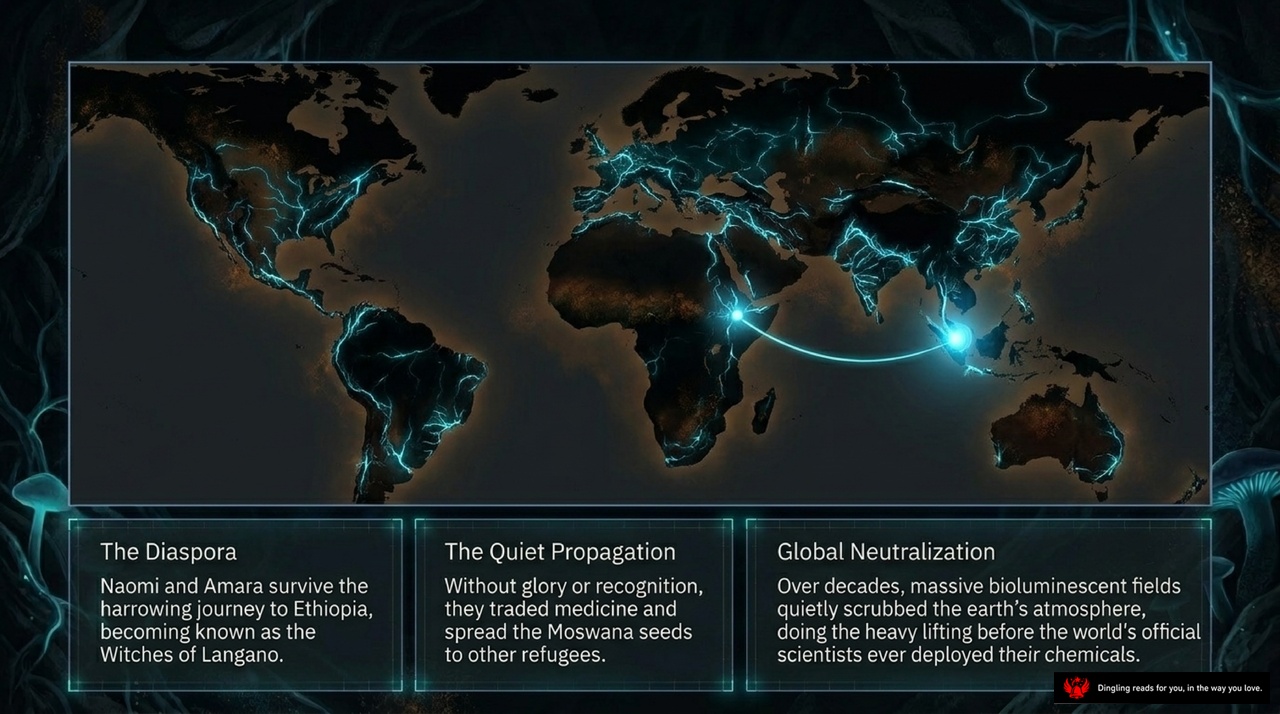
Look at this map. It traces a harrowing journey from Southeast Asia to Ethiopia, marking the path of Naomi and Amara. This is "The Diaspora." After surviving the ashes of the old world, they traded their last vehicle for coordinates, risking everything to reach a rumored sanctuary.
But their story wasn't just about fleeing; it was about "The Quiet Propagation." Without glory or recognition, they became the "Witches of Langano." They traded medicine and spread the Moswana seeds to other refugees, silently rebuilding life where others saw only ruin.
And then, there was "Global Neutralization." Over decades, massive bioluminescent fields quietly scrubbed the earth's atmosphere. These fields did the heavy lifting, cleansing the air long before the world's official scientists even deployed their chemicals. Naomi and Amara didn't just survive; they became the unsung architects of a new world, proving that hope could grow even in the darkest soil.
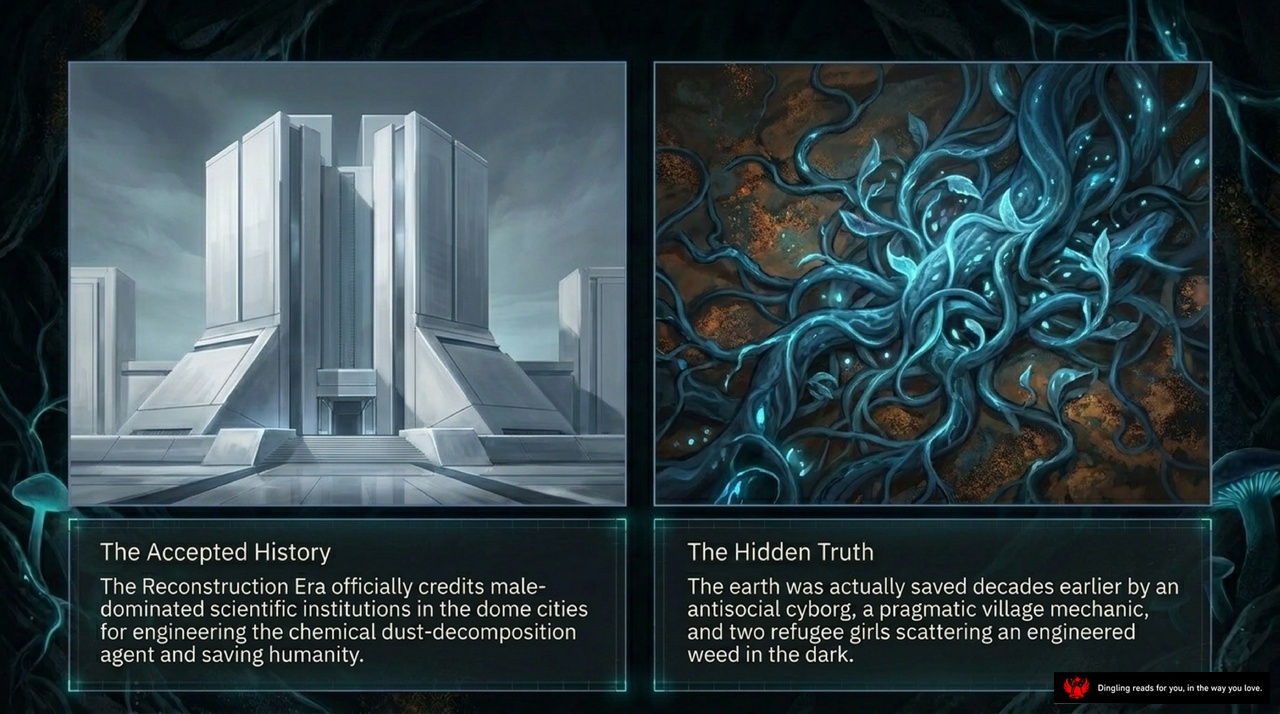
Look at this split screen. On the left, we see the gleaming, sterile architecture of the dome cities—the official story of our survival. History books tell us that male-dominated scientific institutions engineered a chemical dust-decomposition agent, saving humanity from the fall. That is "The Accepted History." It's a clean, logical narrative where heroes in white coats win the day.
But look at the right side. That's "The Hidden Truth." The reality was far darker and far more grassroots. Decades before the official reconstruction, the earth was actually saved by an antisocial cyborg, a pragmatic village mechanic, and two refugee girls scattering an engineered weed in the dark. They weren't celebrated scientists; they were outcasts working in the shadows. While the world built its domes, these three were fighting a war against the dust in a forest, planting seeds that would eventually cleanse the air. The truth isn't in the grand laboratories; it's in the dirt, in the roots, and in the quiet, desperate hope of people who refused to give up.

Plants are not passive background scenery; they are ruthless, resilient pioneers. True survival does not come from the loud, destructive traits of traditional heroes attempting to dominate nature. It comes from embracing the quiet, enduring, and creeping resilience of the natural world.
Look at this glowing sprout breaking through the cracked earth. It represents a profound truth often overlooked in our frantic race for control. In a world obsessed with force and domination, the real heroes are those who simply endure. They don't conquer; they adapt. They don't shout; they grow.
This image captures the essence of that hidden strength. Whether it's the vines of Moswana surviving in the toxic ash, or the quiet determination of a community rebuilding after disaster, life finds a way through the cracks. It's not about being the loudest voice in the room; it's about having the patience to wait for the sun, and the resilience to keep growing even when everything around you is falling apart. That is the true power of the overlooked.
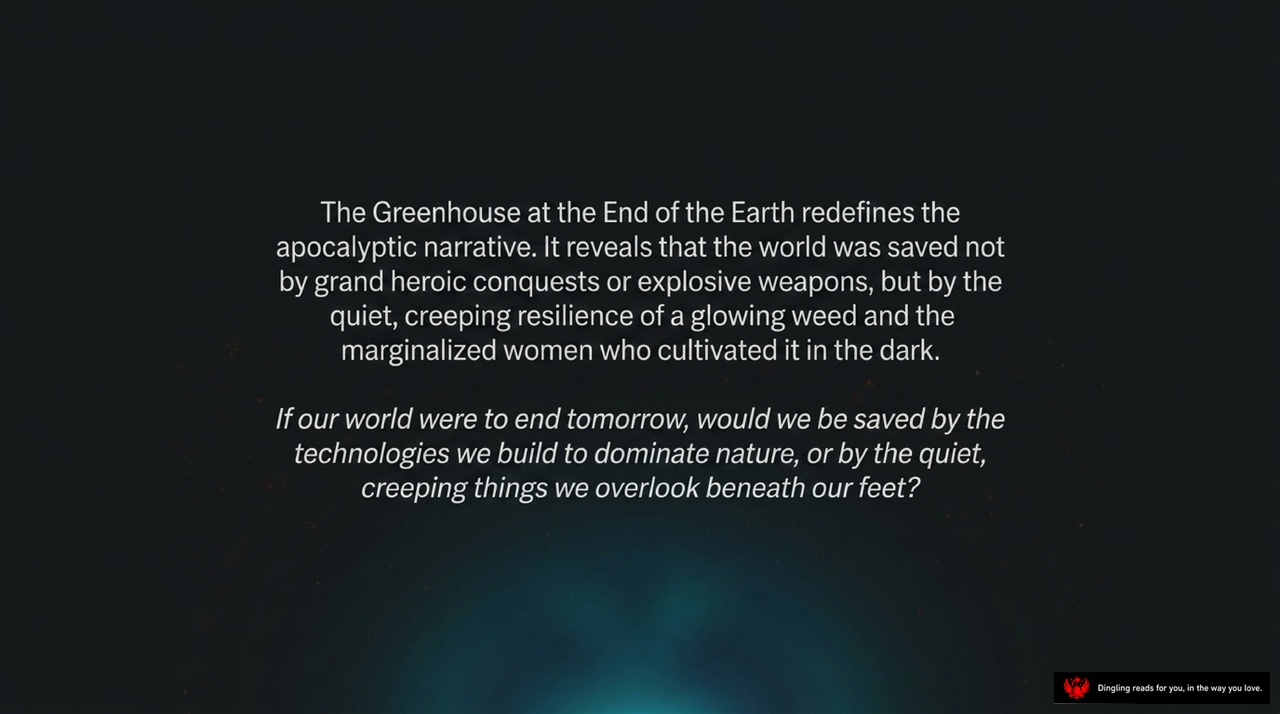
Imagine a world where the end isn't saved by a superhero with a laser beam, but by something far quieter: a creeping vine and the women who grew it in the dark. This slide captures the heart of that story. It challenges our usual apocalyptic narratives, suggesting that true resilience comes not from grand conquests, but from the stubborn, glowing life of a weed and the marginalized hands that cultivated it.
If our world were to end tomorrow, the question remains: would we be saved by the high-tech weapons we build to dominate nature, or by the quiet, creeping things we overlook beneath our feet? The answer lies in the choice between domination and the fragile, persistent hope of life finding a way to grow against all odds.