
The Guns of August: Complete Chapter-by-Chapter Summary
Welcome to our deep dive into Barbara W. Tuchman's masterpiece, *The Guns of August*. This book isn't just a history lesson; it's a chilling look at how the modern world was born out of a catastrophic mistake.
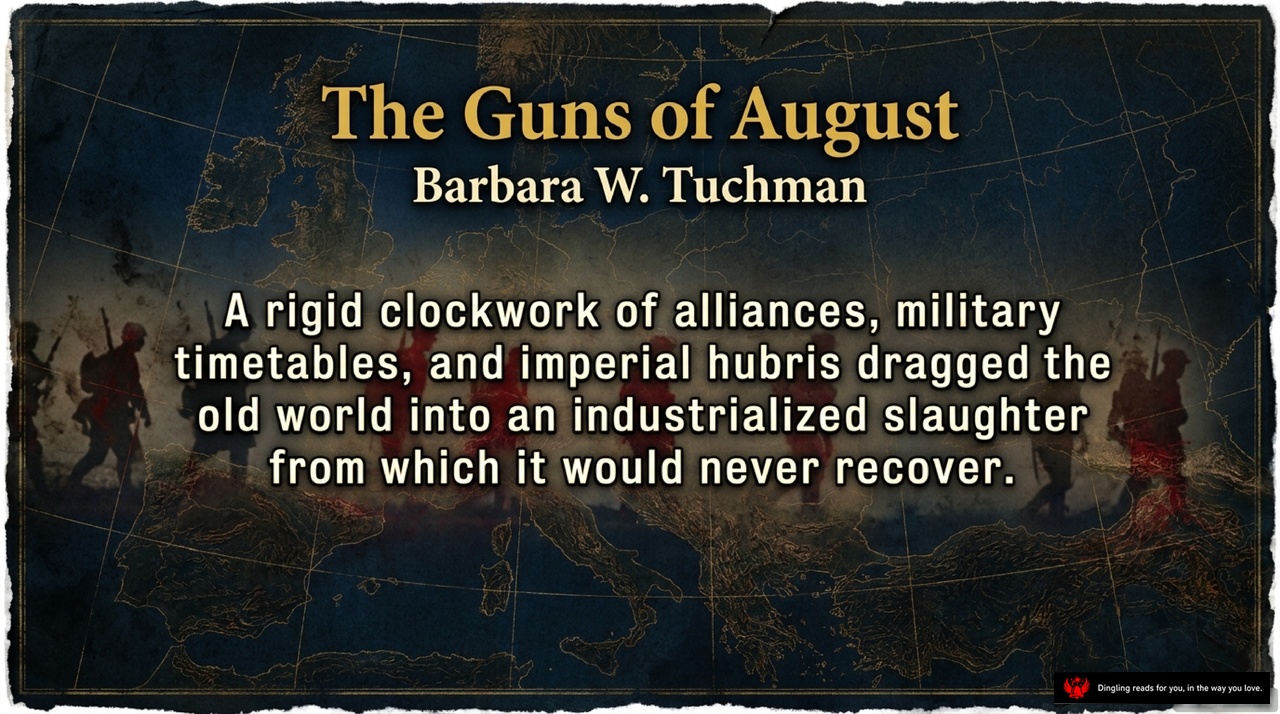
The cover image captures the essence of the entire story: a rigid clockwork of alliances, military timetables, and imperial hubris dragging the old world into an industrialized slaughter from which it would never recover. It's a perfect metaphor for the events of 1914.
Think about the funeral of King Edward VII in May 1910. It was the last great gathering of the European monarchs, a final sunset for the old order. Yet, behind the public mourning, the gears of war were already turning. Emperor Wilhelm II of Germany saw his uncle's death not as a tragedy, but as an opportunity to remove a political obstacle. While the world celebrated peace, German generals were already drafting plans for a war that they believed was inevitable and necessary for survival.
Tuchman shows us how a series of miscalculations and rigid plans led to disaster. France was obsessed with revenge for past defeats, while Germany believed in a quick victory through a massive encirclement of their enemies. Both sides ignored the reality of their enemies' strengths and weaknesses. When the spark finally lit in June 1914 with the assassination in Sarajevo, the entire continent exploded.
What makes this book so powerful is its focus on the human element. We see the arrogance of leaders who thought they could control history, the fear of soldiers who were just following orders, and the sudden shift from peace to horror. It reminds us that war often starts not with a grand strategy, but with a series of small, preventable choices made by people who thought they were in control.
As we move forward, we'll explore exactly how that "clockwork" broke down and how a few days in August changed the course of human history forever.

The old world's sun was setting in a blaze of splendor, but by 1910, the cracks were already showing. European diplomacy was still a family affair, but the stage was set for a tragedy. On this slide, we see the key players in this final act of the monarchy.
On the left, riding a gray horse in the crimson uniform of a British Field Marshal, is Kaiser Wilhelm II. He was harboring deep envy and ambition, convinced his time for supremacy had finally arrived. He hated the idea of a united France and Britain, seeing the late King Edward VII as the architect of his downfall.
On the right, stands Archduke Franz Ferdinand. He was tall and heavy, wearing a helmet with distinctive green feathers. This man's impending assassination would serve as the spark for global ruin, igniting the powder keg that Europe had spent decades loading.
And in the center, seemingly out of place in the pomp, is King Albert of Belgium. While he looked like just another participant in the royal procession, he would soon become the tragic symbol of resistance against an unstoppable machine. His kingdom's neutrality was about to be shattered, forcing him into the heart of the coming conflict.
These figures, bound by old alliances and personal grudges, stood on the precipice of a war that would change everything.
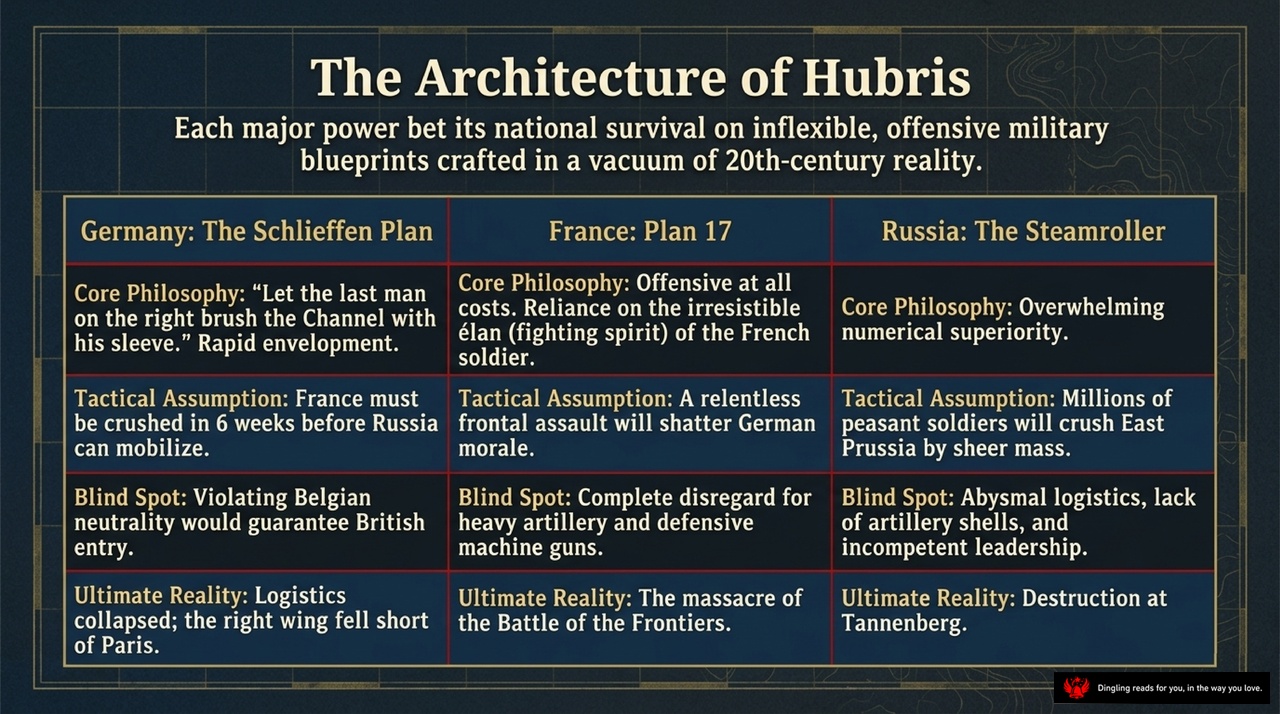
Look at this slide, "The Architecture of Hubris." It lays out the fatal blueprint for World War I. Every major power bet its national survival on rigid, offensive military plans crafted in a vacuum of 20th-century reality.
Germany relied on the Schlieffen Plan. Their core philosophy was aggressive: "Let the last man on the right brush the Channel with his sleeve." They assumed they could crush France in six weeks before Russia mobilized, completely blind to the fact that violating Belgian neutrality would guarantee British entry. Their ultimate reality? Logistics collapsed, and their right wing fell short of Paris.
France, on the other hand, bet everything on Plan 17. Their philosophy was offensive at all costs, relying on the irresistible *élan* of the French soldier. They assumed a relentless frontal assault would shatter German morale, ignoring the need for heavy artillery and machine guns. Their blind spot was a complete disregard for defensive preparations. The result? The massacre at the Battle of the Frontiers.
Finally, Russia's strategy was The Steamroller. They believed in overwhelming numerical superiority, assuming millions of peasant soldiers would crush East Prussia by sheer mass. But their blind spot was an abysmal logistics system, a lack of artillery shells, and incompetent leadership. Their ultimate reality was the catastrophic destruction at Tannenberg.
These plans were built on arrogance and ignored the complex reality of modern warfare. Each nation thought they could win by force of will and rigid doctrine, not realizing that their own blind spots would be the very things that brought them down. This architecture of hubris set the stage for a four-year nightmare.
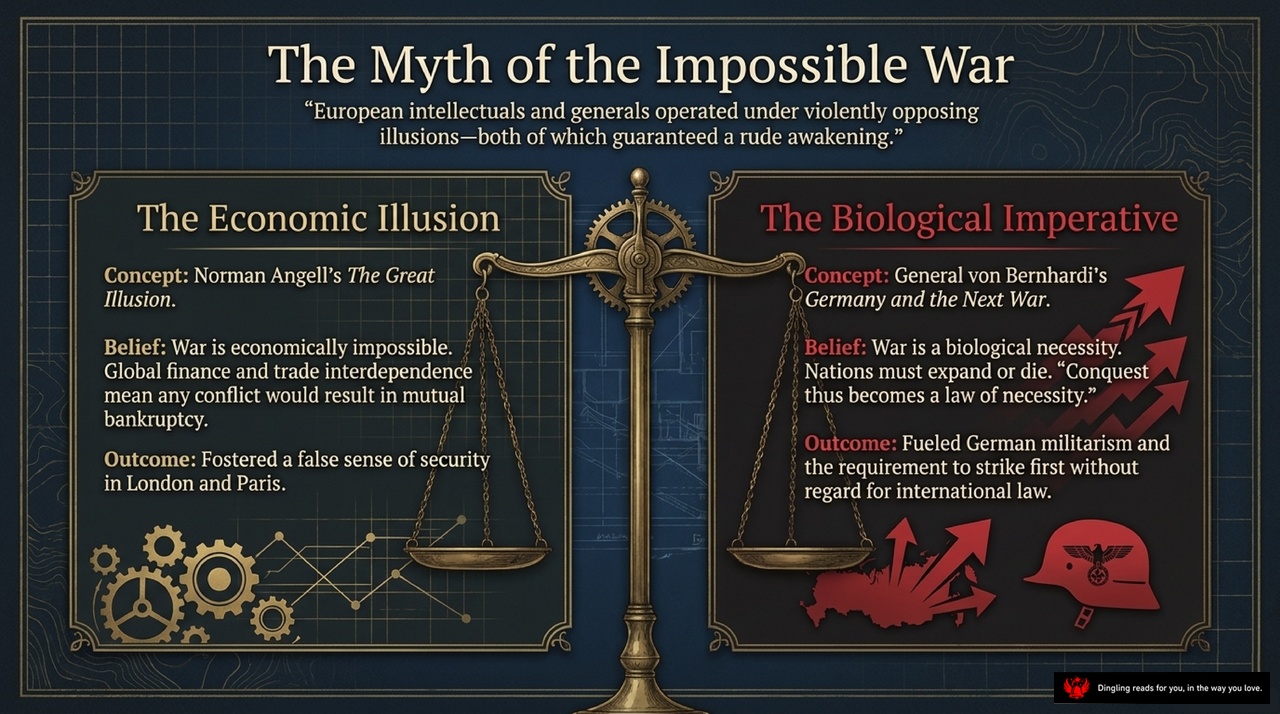
The Myth of the Impossible War wasn't just a title; it was a fatal trap that swallowed Europe whole. As the slide illustrates, the path to 1914 was paved by two violently opposing illusions. On one side, we have "The Economic Illusion," championed by Norman Angell's *The Great Illusion*. It was the comforting lie that told London and Paris that war was impossible because global finance and trade interdependence meant any conflict would result in mutual bankruptcy. This fostered a false sense of security, convincing everyone that peace was inevitable.
But on the other side of that scale sat "The Biological Imperative," driven by General von Bernhardi's *Germany and the Next War*. This was the brutal reality ignored by the elites: war was seen as a biological necessity. Nations had to expand or die. Conquest became a law of nature. This ideology fueled German militarism and the dangerous requirement to strike first, regardless of international law.
The tragedy was that while London and Paris were busy building castles in the sky based on economic interdependence, Berlin was preparing for a fight to the death based on survival instincts. The world wasn't ready for the clash between these two realities. The economic dream of perpetual peace collided head-on with the biological drive for conquest, and the result was the most violent awakening in human history. The "impossible" war wasn't a myth; it was the logical outcome of these two incompatible truths finally meeting.
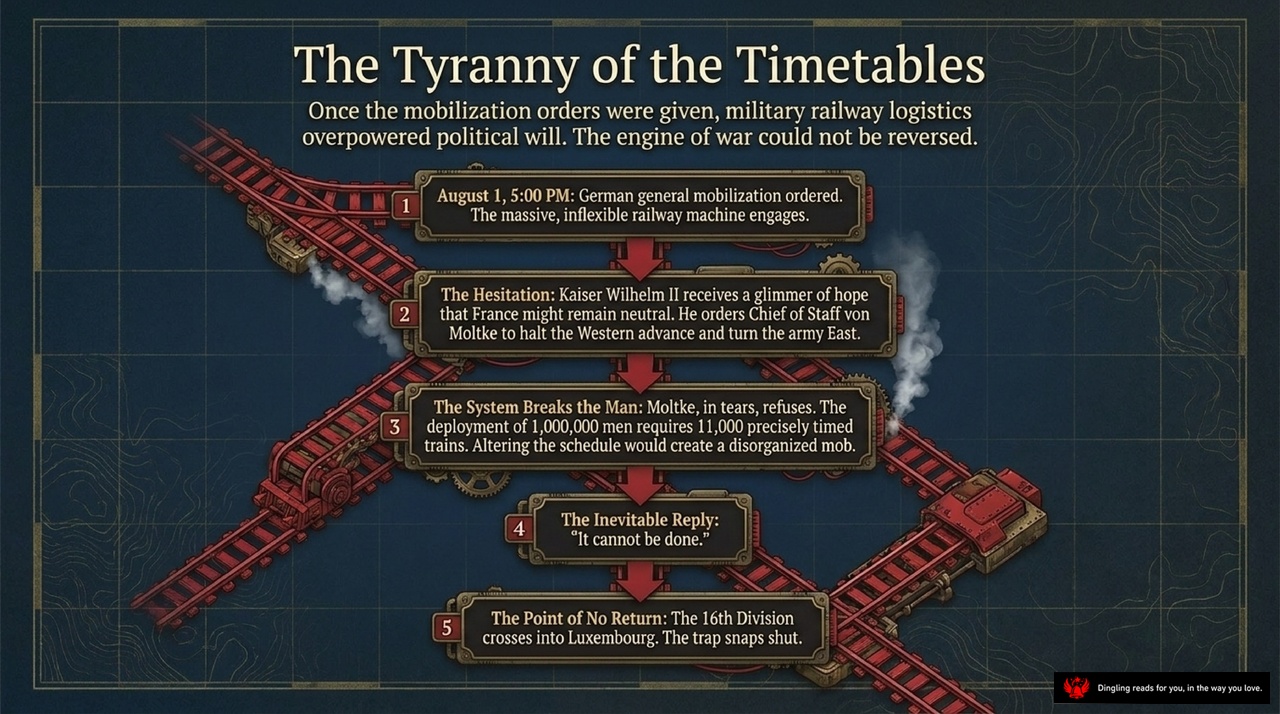
Once the mobilization orders were given, military railway logistics overpowered political will. The engine of war could not be reversed.
On August 1st at 5:00 PM, the German general mobilization was ordered, and the massive, inflexible railway machine engaged. Just hours later, Kaiser Wilhelm II received a glimmer of hope that France might remain neutral. He immediately ordered his Chief of Staff, Moltke, to halt the Western advance and turn the army East to focus on Russia.
But here lies the tragedy: the system broke the man. Moltke, in tears, refused. The deployment of 1,000,000 men required 11,000 precisely timed trains. Altering the schedule would create a disorganized mob, and the inevitable reply from the logistics department was simply, "It cannot be done."
With no time to reconsider, the point of no return was reached. On the same day, the 16th Division crossed into Luxembourg. The trap snapped shut. By the time the Kaiser realized he had been tricked by his own rigid timetable, the wheels were already rolling toward the very conflict he hoped to avoid.
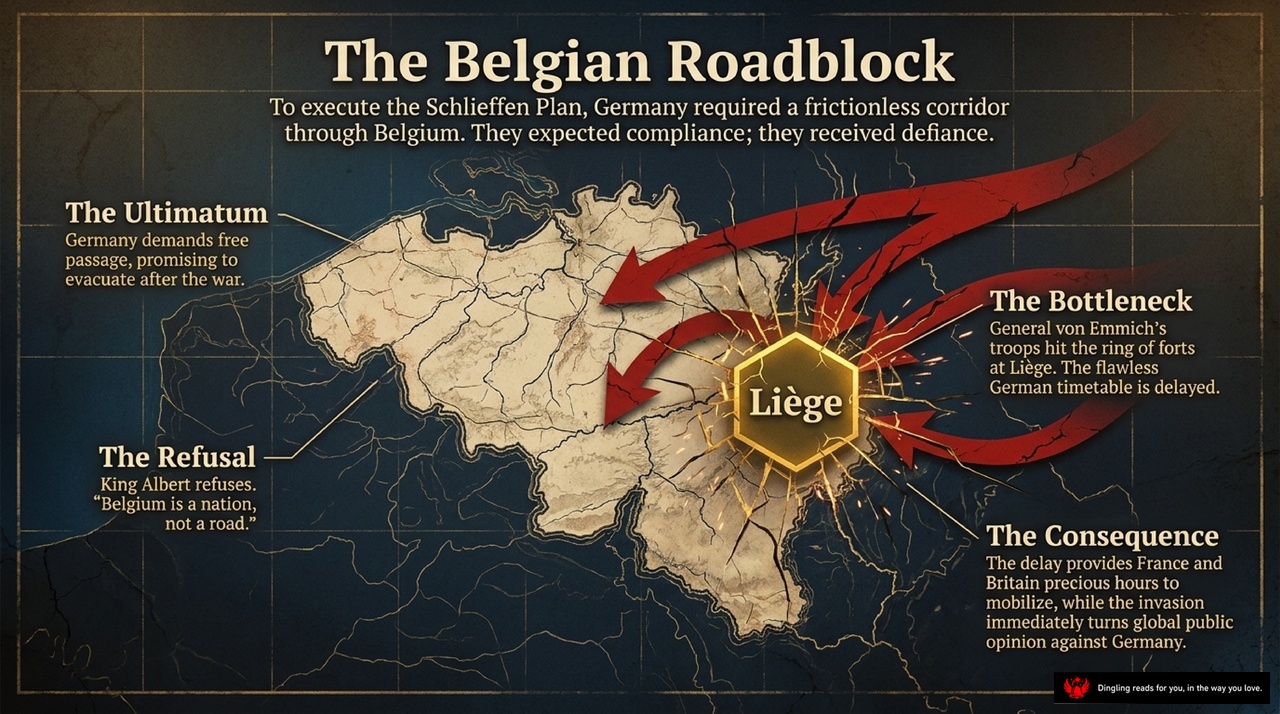
The German advance in late August was nothing short of a juggernaut. Following the fall of Liège and Brussels, the right wing of the German army, led by General von Kluck, swept southward through Belgium, aiming to encircle the French forces and crush them before they could retreat. The German high command, convinced that victory was within reach, believed the French army was collapsing and that Paris would fall in no time.
However, a critical error in German planning would soon change everything. As von Kluck's First Army pushed relentlessly toward the French Fifth Army, he made a fateful decision: instead of continuing the arc to surround Paris, he turned his army eastward, directly toward the French retreat. This move was driven by a desperate need to cut off the fleeing French forces, but it came at a catastrophic cost. By swinging east, von Kluck exposed the right flank of the German army to the French forces defending the capital.
This gap in the German lines created a life-saving opportunity for the Allies. The French Sixth Army, commanded by General Foch, and the British Expeditionary Force, now arriving in France, found themselves with a clear path to attack the exposed German flank. What had been a seemingly unstoppable German advance suddenly turned into a vulnerable salient, setting the stage for the decisive Battle of the Marne. The German dream of a quick victory over France was about to be shattered.
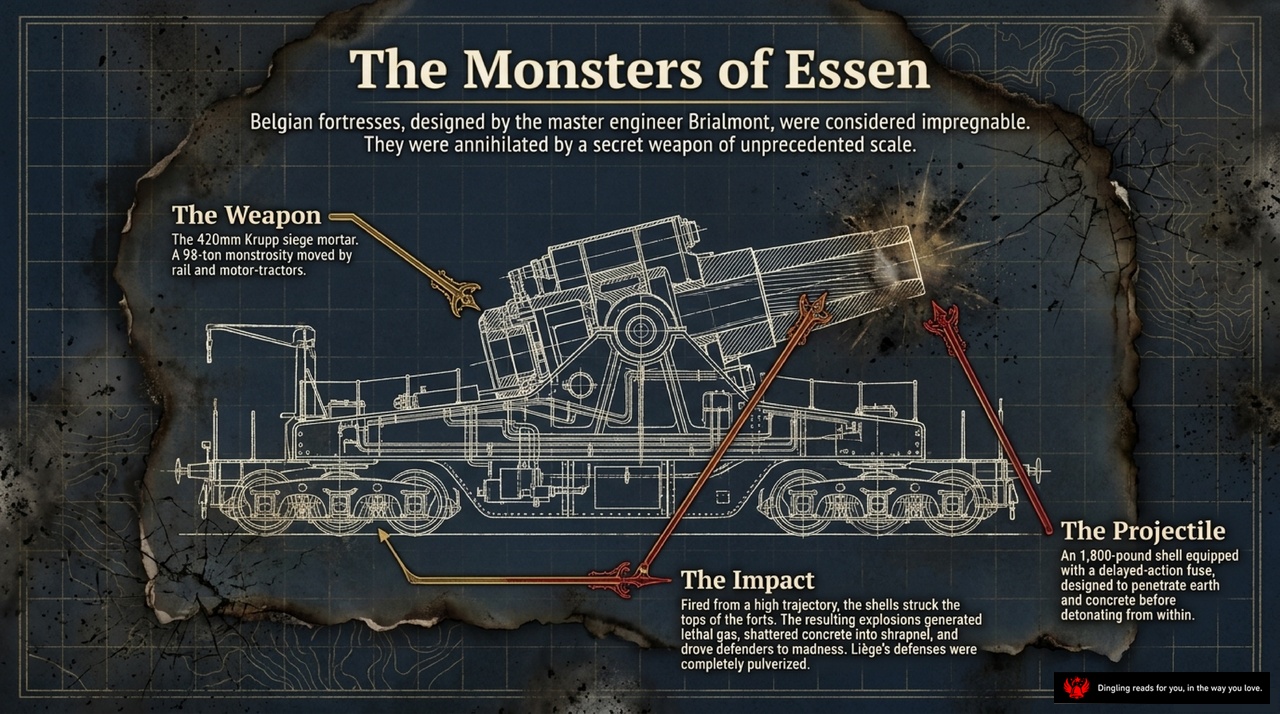
The Monsters of Essen. Imagine a machine so massive, it feels less like a weapon and more like a piece of industrial architecture that has come to life. This is the Krupp 420mm siege mortar, a 98-ton beast that rolled across the landscape on rails and motor-tractors, designed to do one thing: annihilate the seemingly impregnable Belgian fortresses.
Look at the sheer scale of this operation. The weapon fired a single 1,800-pound shell equipped with a delayed-action fuse. Its mission was brutal and precise: penetrate the thick earth and concrete of the forts, detonate from within, and turn the entire structure into a crater of lethal gas and shrapnel. The impact was catastrophic. Fired from a high trajectory, these shells struck the tops of the forts, shattering concrete and driving defenders to madness. By the time these monsters arrived, the defenses of Liège were completely pulverized.
This was the moment the "Monsters of Essen" changed the face of war forever. What was once considered an impenetrable shield was now just a target for unprecedented scale. The secret weapon had arrived, and the game was no longer about who had the strongest walls, but who could destroy them first.

The French Infantryman (The Illusion) versus The German Defensive Position (The Reality)
Here we see the brutal truth behind the "Anatomy of a Massacre." On the left, we have the French soldier, the embodiment of what the French called "The Illusion." Dressed in bright red trousers and blue coats, he was a highly visible target against the green landscape, essentially walking into a kill zone. His weaponry was outdated—relying on bayonets and light 75mm field guns—and his tactics were based on a dangerous delusion: the charge. Officers stood tall in white gloves, shouting "Forward!" believing that sheer spiritual supremacy and the will to win could overcome any physical disadvantage. They ignored the grim reality of industrial warfare.
On the right, we see the German position, representing "The Reality." Hidden in muted, earth-toned gray uniforms that blended perfectly into the terrain, German soldiers waited in pre-sighted kill zones. They didn't rely on heroics; they relied on heavy artillery and the devastating, rapid-fire Maxim machine gun. The math was terrifyingly simple: a machine gun could wipe out a charging line in only eight seconds. The French belief in spiritual supremacy collided fatally with German industrial defensive power. It wasn't a battle of wills; it was a slaughterhouse where the illusion of the charge met the cold, mechanical efficiency of the trench, turning the Ardennes and Lorraine into a place of horror rather than glory.
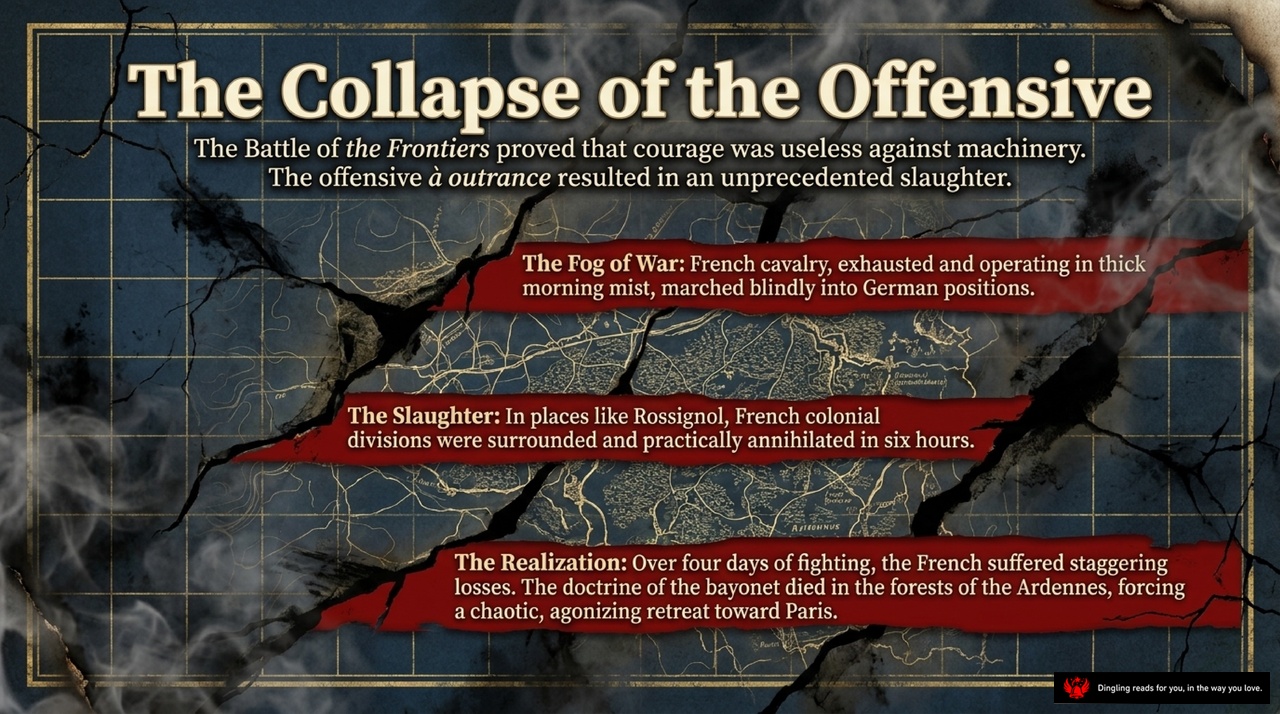
The Collapse of the Offensive: When Courage Met Machinery
The Battle of the Frontiers proved that courage was useless against machinery. The offensive à outrance resulted in an unprecedented slaughter.
Look at this map of the Ardennes. The Fog of War blinded the French cavalry, exhausted and operating in thick morning mist, marching blindly into German positions. They had no idea they were walking into a trap.
Then came The Slaughter. In places like Rossignol, French colonial divisions were surrounded and practically annihilated in six hours. It was a massacre.
Over four days of fighting, the French suffered staggering losses. The doctrine of the bayonet died in the forests of the Ardennes, forcing a chaotic, agonizing retreat toward Paris. This wasn't just a tactical failure; it was the death of an entire strategy. The French believed in the "will to win," but they forgot that in the modern era, will could not stop steel and artillery. The offensive that was supposed to be glorious turned into a disaster, leaving the path to Paris wide open for the enemy.

The "Russian Steamroller" was a powerful illusion. Western allies, terrified of a two-front war, bet everything on Russia's sheer manpower. They believed the Slavic horde was an unstoppable force that would inevitably crush Germany in the East, allowing the West to focus on France. But the reality was far more tragic. The Russian army wasn't a juggernaut; it was a machine suffocated by its own incompetence.
Look at the logistics. Minister Sukhomlinov despised modern warfare, refusing to stockpile artillery shells. While the West had over 2,000 rounds per gun, Russia had a pathetic 850. This meant their soldiers would run out of ammunition before they could even break the enemy's lines.
Then, look at the communications. There were no secure codes, no reliable wire networks. Russian generals broadcast their daily marching orders "in the clear" over the radio, right in front of German spies. They were essentially handing the enemy a map of their own movements.
This wasn't just a failure of equipment; it was a failure of leadership. From the Tsar to the generals, the entire system was rotten. The fear of a "Slavic horde" had prematurely diverted German troops from the Western front, but when that horde finally arrived, it was too weak, too disorganized, and too blind to make a difference. The myth of the steamroller collapsed under the weight of reality, leaving Russia to bleed itself dry in a war it was never prepared to win.
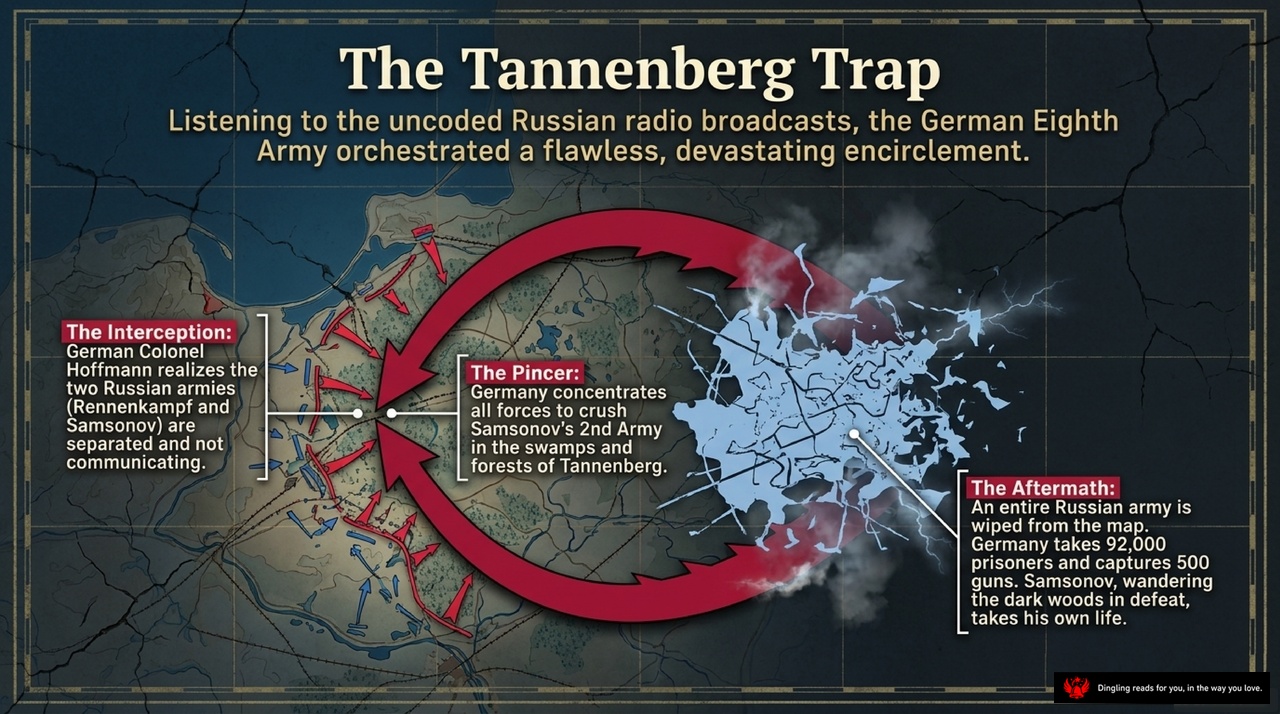
The Tannenberg Trap wasn't just a battle; it was a masterclass in intelligence warfare that turned the tide of the Eastern Front. As the graphic illustrates, the German Eighth Army didn't just fight; they listened. By intercepting unencrypted Russian radio broadcasts, German Colonel Hoffmann realized a fatal flaw in the Russian strategy: the two armies, Rennenkampf and Samsonov, were separated and not communicating. This disconnect became the golden opportunity.
Enter "The Pincer." Germany concentrated all its forces to crush Samsonov's Second Army in the swamps and forests of Tannenberg, effectively isolating him. While the Russians were confused and out of sync, the Germans executed a flawless encirclement. The result, shown in "The Aftermath," was devastating. An entire Russian army was wiped from the map. Germany took 92,000 prisoners and captured 500 guns. The tragedy for the Russian commander Samsonov was personal as well as military; wandering the dark woods in total defeat, he took his own life. This victory proved that in modern warfare, information is just as deadly as firepower, and the Germans had struck first.
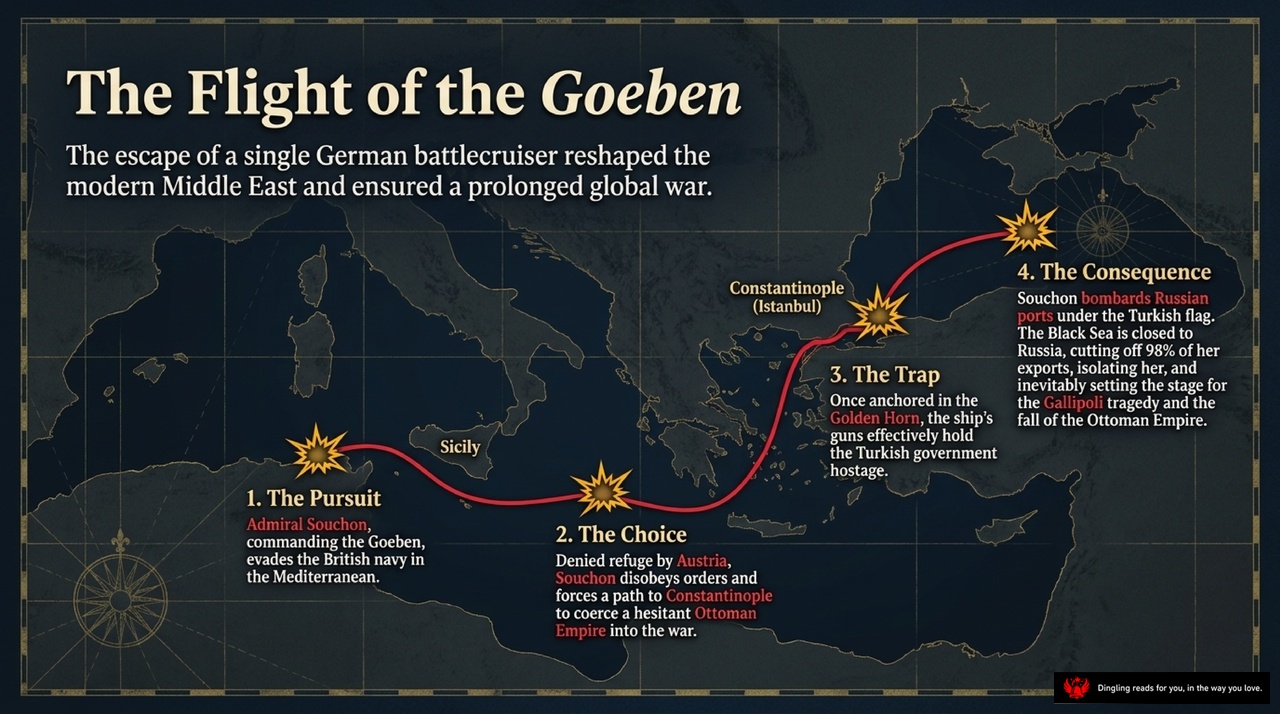
The escape of a single German battleship, the *Goeben*, didn't just change a naval map; it fundamentally reshaped the modern Middle East and ensured a prolonged global war. As shown on this timeline, the story begins with **The Pursuit**, where Admiral Souchon, commanding the *Goeben*, skillfully evades the British navy in the Mediterranean. This chase is crucial because it sets the stage for **The Choice**: denied refuge by Austria, Souchon disobeys orders and forces a path to Constantinople to coerce a hesitant Ottoman Empire into the war. Once anchored in the **Golden Horn**, the ship's guns effectively hold the Turkish government hostage, turning the Ottomans from a neutral party into a key ally for Germany. Finally, we reach **The Consequence**: Souchon bombards Russian ports under the Turkish flag. The Black Sea is closed to Russia, cutting off 98% of her exports and isolating her, inevitably setting the stage for the Gallipoli tragedy and the fall of the Ottoman Empire. This single ship's flight turned the Ottoman Empire into a major belligerent, dragging a reluctant nation into the heart of the conflict and altering the geopolitical landscape forever.
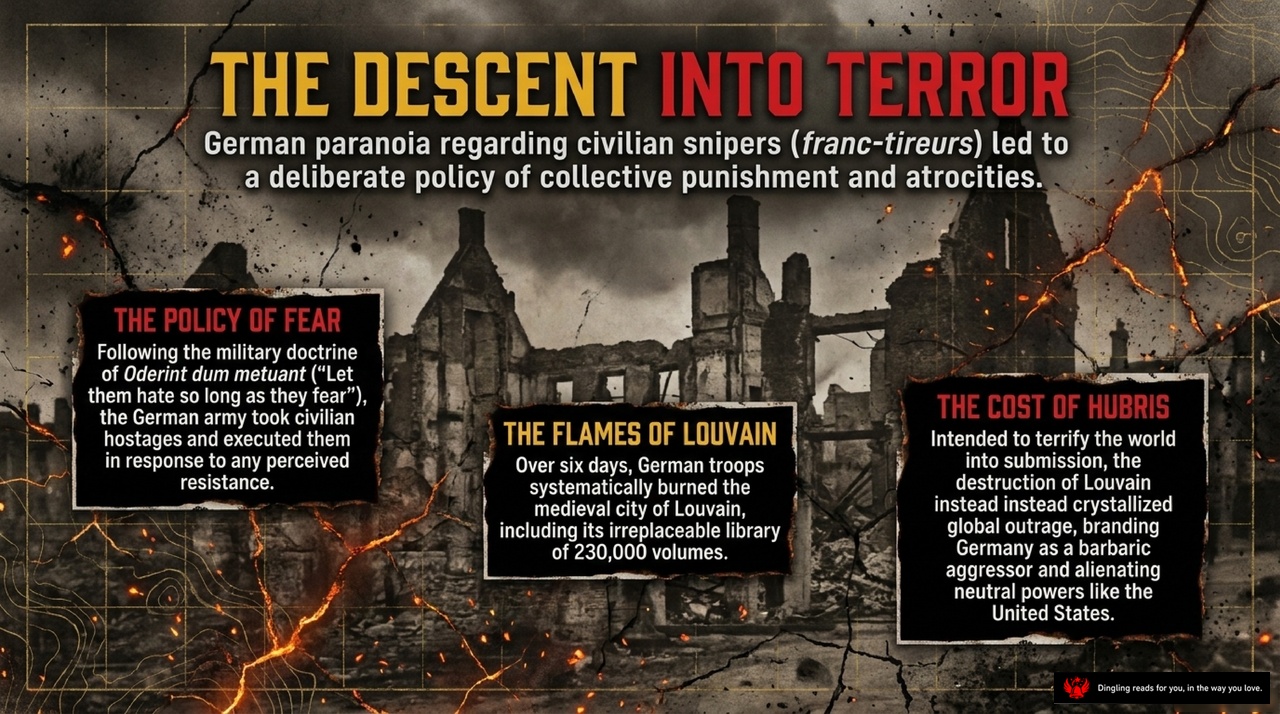
The descent into terror. It wasn't a sudden explosion, but a slow, deliberate burn that consumed everything in its path. As German troops swept through Belgium, their paranoia about civilian snipers—what they called *franc-tireurs*—triggered a policy of collective punishment that turned the war into a nightmare for everyone.
Under the doctrine of *Oderint dum metuant*—"Let them hate so long as they fear"—the German army didn't just fight soldiers; they targeted civilians. Hostages were executed, villages were burned, and fear was weaponized to crush resistance before it could even form. But this terror had a devastating cost. The destruction of Louvain, a medieval city with an irreplaceable library of 230,000 volumes, was intended to terrify the world into submission. Instead, it backfired spectacularly.
Over six days, German troops systematically razed the city, leaving nothing but ash and rubble. Far from forcing submission, this brutality crystallized global outrage. It branded Germany as a barbaric aggressor, alienating even neutral powers like the United States and pushing the world closer to total war. The flames of Louvain didn't just destroy books and buildings; they burned away any illusion that this conflict could be controlled, marking the moment Europe fully descended into the abyss.

By the end of August, the grand blueprints for Europe's future were nothing more than ash. The war of movement, once the promise of glory, violently slammed into an unbreakable deadlock. Look at the map: on the left, Schlieffen's plan has failed. The German right wing, exhausted and bled dry, could not encircle Paris, culminating in the desperate Battle of the Marne. On the right, Plan 17's failure is equally stark; the French élan was buried under relentless artillery fire, and the army survived only through agonizing retreat.
This is the death of the blueprint. Unable to advance and unwilling to retreat, armies dug into the earth, turning the battlefield into a killing zone. The illusion of a short, glorious war evaporated instantly, replaced by the grim reality of indefinite attrition. What began as a clash of strategies has now become a war of survival, where no side can claim victory, and the only path forward is a slow, grinding march toward exhaustion.

Imagine a pocket watch, beautiful but broken, its gears exposed and shattering. This isn't just a clock; it's the perfect metaphor for the trap Europe walked straight into. As we look at this slide, the text reveals a chilling truth: the nations of Europe didn't just stumble into war; they built a machine designed for mutual destruction. They crafted alliances, offensive doctrines, and even railway timetables that were perfectly engineered to tear the continent apart.
Once the levers were pulled, this system bypassed human agency entirely. It dragged millions into a four-year slaughter that erased an entire generation. The tragedy here is that when systems of our own design grow too fast, too rigid, and too complex to halt, we lose command. We aren't the pilots anymore; we are just passengers in a runaway train.
This slide captures the essence of that moment where ambition outpaced wisdom, and a grand, intricate plan turned into an unstoppable engine of chaos. It asks us a haunting question: Who is truly in command when the machine we built decides to run over us?