
The Hard Thing About Hard Things: Complete Chapter-by-Chapter Summary

Welcome to today's session on *The Hard Thing About Hard Things* by Ben Horowitz. This book isn't just a business manual; it's a tactical survival dossier for navigating the agonizing, unscripted challenges of building a business when there are no easy answers.
Horowitz shares that true leadership isn't about avoiding fear, but about acting despite it. He learned this early on when he chose to connect with a stranger instead of following a friend's bad advice, realizing that fear doesn't mean you lack courage. Whether it's leading a football team or launching a tech company, the reality is the same: you must face the unknown.
This book dives deep into the brutal reality of entrepreneurship. It covers the highs of creating a billion-dollar company and the devastating lows of near-bankruptcy. Horowitz argues that the hardest part of being a CEO isn't the strategy or the product—it's managing your own emotions when everything feels like it's falling apart. He teaches us that honesty, even when it's painful, is the only way to build trust and keep your team together during the storm.
If you are ever facing a crisis where the path forward isn't clear, this book will be your guide. It reminds us that while the struggle is real, finding the courage to keep moving forward is what separates good leaders from great ones.

Look at this map. It's called "The Anatomy of the Struggle," and honestly, it looks a lot like the journey of building a company from scratch.
At the very top, you start with "The Dream." That's the exciting beginning, the vision you have. But look at that big yellow arrow pointing down—it represents the inevitable descent into "The Struggle." This isn't a failure; it's the reality.
On the left, we have "Layer 1: The Descent." This is where things get messy. The dream turns into a nightmare. You feel surrounded by people, yet entirely alone. You might not even know why you started, or how to quit. It's that feeling of being stuck in a maze with no clear exit.
But here's the good news. On the right, we have "Layer 2: Survival Tactics." This is your toolkit for escaping the maze. First, don't shoulder it all. Distribute the burden. You can't do it alone. Second, play chess, not checkers. There is always a move, even when the board looks impossible. Finally, survive until tomorrow. The landscape shifts daily, so don't panic about the long term; just focus on getting through today.
This slide captures the essence of entrepreneurship: it's not about avoiding the struggle, but learning how to navigate it.
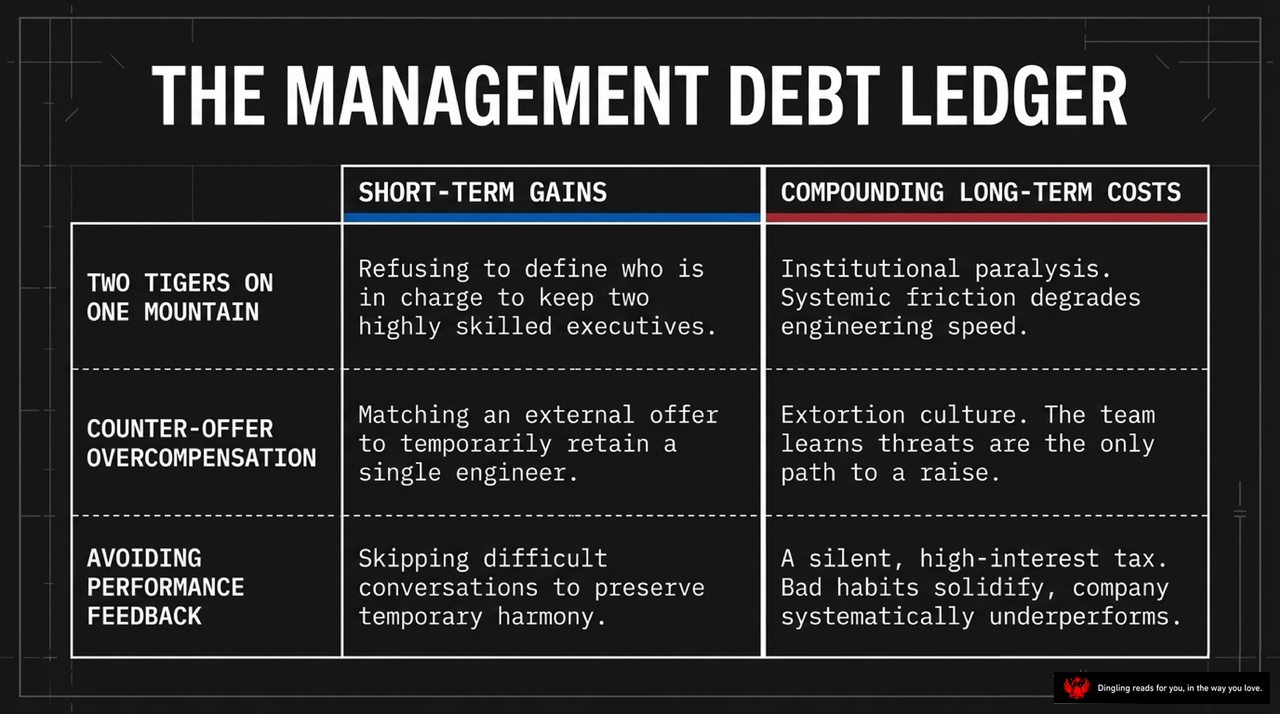
Look at this "Management Debt Ledger." It's a stark reminder of the hidden tax we pay for short-term comfort. The chart breaks down three common traps: "Two Tigers on One Mountain," "Counter-Offer Overcompensation," and "Avoiding Performance Feedback."
On the left, you see the tempting short-term gains. For instance, keeping two talented executives on the same team just to avoid making a hard choice about who leads. Or matching a competitor's offer just to keep one key engineer from leaving. These moves feel like victories in the moment—they preserve harmony and keep talent on the payroll.
But look at the right side. That's where the real cost compounds over time. When you let two bosses share one role, you create institutional paralysis. The team gets stuck in friction, and engineering speed grinds to a halt. When you pay someone an outlier salary to stop them from leaving, you accidentally build an extortion culture where the rest of the team learns that threats are the only way to get raises. And when you skip tough feedback conversations to keep things pleasant, you're essentially paying a high-interest tax on your future performance. Bad habits solidify, and the whole company systematically underperforms.
The lesson here is clear: avoiding the hard management decision today creates a debt that costs you far more tomorrow. As a leader, your job isn't just to keep the peace; it's to make the tough calls that prevent these long-term costs from destroying your company's potential.

Let's dive into the communication framework analysis. On the left, you see the "Sandwich Method"—the classic Compliment-Criticize-Compliment loop. I call this a failure loop because it's essentially manipulation disguised as diplomacy. Here's the reality: when employees know praise is just a setup for criticism, they stop listening to the good stuff entirely. The anticipation of the middle blow makes the initial praise feel fake, which erodes trust.
But on the right, there's the Authentic Pathway. This isn't about corporate scripts; it's about matching your style to your true personality. It stems from a genuine desire for the employee's success, not a tactic to soften a blow. Crucially, you must address the behavior and the outcome, never the character. When you give feedback, you're talking about what was done, not who they are. By ditching the manipulative sandwich and embracing authentic, un-personalized feedback, you build a culture where trust actually grows, and people feel safe enough to improve without fear.

Look at this diagram. It perfectly captures the brutal reality of scaling a company: the "Paradox of Growth." When you start getting big, what used to be easy suddenly becomes incredibly difficult. The slide breaks this down into a football play. In the center is the "Core Mission," your Quarterback. On the outside, you have the "Defenders"—the market, competitors, and chaos pushing against you.
The slide highlights "The Instinct." As a leader, your natural instinct is to push forward and try to handle everything personally. You want to be the hero who solves every problem. But here lies the trap. If you try to hold the line yourself, you get overwhelmed.
The graphic introduces a crucial concept: "Tactical Retreat." It argues that if the lineman—the outer layer of your organization—holds the ground, the defender blows past. But if the lineman gives up, the defender must retreat to protect the core. This sounds counterintuitive. It feels like losing ground, but it's actually the only way to prevent total collapse.
Instead of trying to control everything directly, you must sacrifice direct control and build layers of process. You have to step back, let your team take the hit, and let the system absorb the pressure. This isn't about giving up; it's about strategic positioning. By building a strong outer ring of processes and people, you protect your core mission. You stop being the one holding the bag and become the one directing the play. True leadership isn't about being the strongest player on the field; it's about designing the formation so everyone has a role, and you stay safe in the pocket to make the next big move.

So, we've talked a lot about hiring the right people and setting up structures, but let's be honest: having a great team doesn't automatically mean you have a great culture. In fact, a lot of people get this wrong. They think culture is about letting dogs in the office or holding yoga sessions. While those things might feel nice, they are just perks, not the core values that actually drive a company forward. A true culture is about the specific behaviors that help you achieve your goals. Think about Amazon using pallets as desks to enforce frugality, or Andreessen Horowitz charging a $10 fine for being one minute late to a meeting. Those aren't just rules; they are deliberate choices that shape how everyone acts every day.
But here's the tricky part: you can't just have a culture; you have to manage the people within it. And that means dealing with office politics, which are often created by the boss, not the employees. If you reward someone just for asking for a raise, you teach everyone to play games instead of doing the work. To stop this, you need to hire people with the right ambition—people who care about the company's success, not just their own title. You also need strict, transparent processes for promotions and performance reviews so no one feels they can game the system.
Then there's the issue of the "super jerk." You might have a genius employee who is two days ahead of everyone else, but once they get promoted, they start being arrogant, missing deadlines, or even abusing drugs. Or you have a manager who is technically brilliant but verbally attacks anyone who questions them. These people are toxic. No matter how smart they are, if they destroy the team's trust and communication, they have to go. You have to protect your team from these outliers, even if it's hard.
Finally, remember that culture isn't a magic shield. If you don't have a great product and market share, no amount of yoga or cool perks will save you. But if you get the culture right, you build a team that is willing to go the extra mile for you. It's about the details, the choices you make, and the environment you create.

When the company grows, the temptation to let ambition run wild is real. But true alignment requires a strict blueprint. First, you must manage the ambition vector. A manager's personal drive must strictly align with company goals; otherwise, even a tiny misalignment, like a "1% of zero," is still zero. Next, you have to ruthlessly handle the genius jerk. These are brilliant employees who highlight flaws without fixing them, often inflating their status by degrading the company. The only solution? Isolate or remove them immediately. Then, look at your titles. Ambiguous, vanity titles trigger political warfare and internal territory disputes. You need clear, honest definitions to stop the chaos. Finally, build a solid defense. Promotions must follow a transparent, merit-based architecture, and you must measure managers solely by team victory, not by fluff. This blueprint ensures that the individual and the company move as one, not against each other.

Look at this slide. It's a stark reality check for every leader: the "Peacetime CEO" versus the "Wartime CEO."
On the left, the Peacetime CEO is focused on expansion. They want to dominate new markets and foster a culture where creativity runs wild, even if it means tolerating minor deviations. Their communication is polite, diplomatic, and driven by consensus. They train employees for long-term career growth, assuming the company is a stable ship sailing on calm waters.
But look at the right side. The Wartime CEO operates under a completely different set of rules. Their focus shifts from expansion to desperate survival. They aren't trying to hit every target; they are focused on hitting one critical target to avoid death. The culture changes instantly: strict discipline becomes the norm, and any deviation is now fatal. Communication stops being polite; it becomes direct, urgent, and yes, frequently profane. Why? Because there's no time for diplomacy when the company is bleeding out.
Most importantly, the training goal flips entirely. A Peacetime CEO trains people for long-term career development. A Wartime CEO trains employees with a single, brutal objective: so they don't get the company killed today.
This distinction isn't just theoretical. I lived this exact shift when my cloud business collapsed and I had to spin up Opsware. One moment, I was trying to be a Peacetime CEO, negotiating deals and building a brand. The next, the funding dried up, and I was forced into Wartime mode. I stopped sugarcoating things. I stopped caring about consensus. I made hard calls, I fired people, and I spoke directly to the truth of our situation. That shift from "how do we grow?" to "how do we survive?" is the defining moment that separates a good CEO from a great one.

When we finally sold Opsware to Hewlett-Packard for 16.5 billion dollars, it felt like the end of my business life. I was physically and emotionally exhausted, battling insomnia and grief. But once the dust settled, I realized something profound: that sale was actually the most intelligent decision I ever made. We had started from zero and built a company worth over 10 billion dollars.
This moment of clarity led me to a new question: if my business life had ended, what was next? The answer was venture capital. I wanted to help other founders avoid the mistakes I made, specifically the trap of trying to prove themselves against investor expectations.
This brings us to the critical decision every founder must face: when to sell the company. As our slide outlines, the logic is ruthless but necessary. First, ask yourself: are we early in a truly massive market? If the answer is no, the ceiling is too low, and the action is to sell. Second, do we have a realistic chance of becoming number one? If we cannot win the top spot against the leader, we will eventually be crushed, so selling is the only viable path.
The slide highlights a dangerous pitfall called "The Pointcast Trap." Pointcast rejected a one-billion-dollar offer because they believed they were a massive portal, failing to understand their actual market size and execution capabilities. They prioritized their ego over reality, rationalized the market, and were ultimately destroyed.
In contrast, when I faced the same dilemma with Opsware, I looked at the data honestly. The rise of virtualization and strong competitors meant we could no longer be the clear leader. Recognizing that the current acquisition price was the local maximum for the next few years, I chose to sell. This wasn't about giving up; it was about making a rational choice to preserve value and avoid the risk of being left behind. Sometimes, the bravest thing a leader can do is admit when the game is over and exit on their own terms.

Look at this slide. We've just distilled the entire CEO experience into two hexagons: Intelligence and Courage. On the left, Intelligence builds the machine. It's about designing the structural blueprint, analyzing data, measuring metrics, and drawing up those org charts. It's the stuff that's easy to learn in business school. But look at the center. That's the core truth: Intelligence builds the machine, but Courage is the only variable that allows a CEO to make the agonizing, lonely decisions required to keep the machine alive when the blueprint fails.
Now, shift your focus to the right side. This is where real leadership happens. Courage isn't about feeling brave; it's about action when the data is divided. It's making the 46/54 decision when the board and staff are split. It's the guts to demote a loyal friend who simply cannot scale. It's the ability to ignore consensus and bet your last dollars on a single pivot. In my own journey, from the terrifying moment I walked up to a stranger's car to the crisis where I had to sell our cloud business to save Opsware, I learned that while intelligence sets the stage, courage is the only thing that lets you perform when the lights go out. Without that courage, even the best blueprint collapses.

Let's bring it home. The reality of building a business isn't the graceful execution of a perfect plan. It is a brutal, chaotic battle defined not by the absence of fear, but by the swift, terrifying actions taken despite it. When the blueprint fails, the capital dries up, and the odds are impossible, that is exactly where you have to be. The summary of our journey—from the chaos of Loudcloud to the turnaround at Opsware—teaches us one thing: fear is irrelevant. What matters is your next move. So, look at the path we walked through the fire, and ask yourself the most important question of all: what will your next move be?